免费领取教师福利


若您为此资料的原创作者,认为该资料内容侵犯了您的知识产权,请扫码添加我们的相关工作人员,我们尽可能的保护您的合法权益。

这是一份沪教版(2024)七年级下册英语期末复习:全册语法讲义(无答案),共53页。学案主要包含了、用适当的冠词a;an;the,、按要求完成句子,、翻译下列含反身代词的短语等内容,欢迎下载使用。
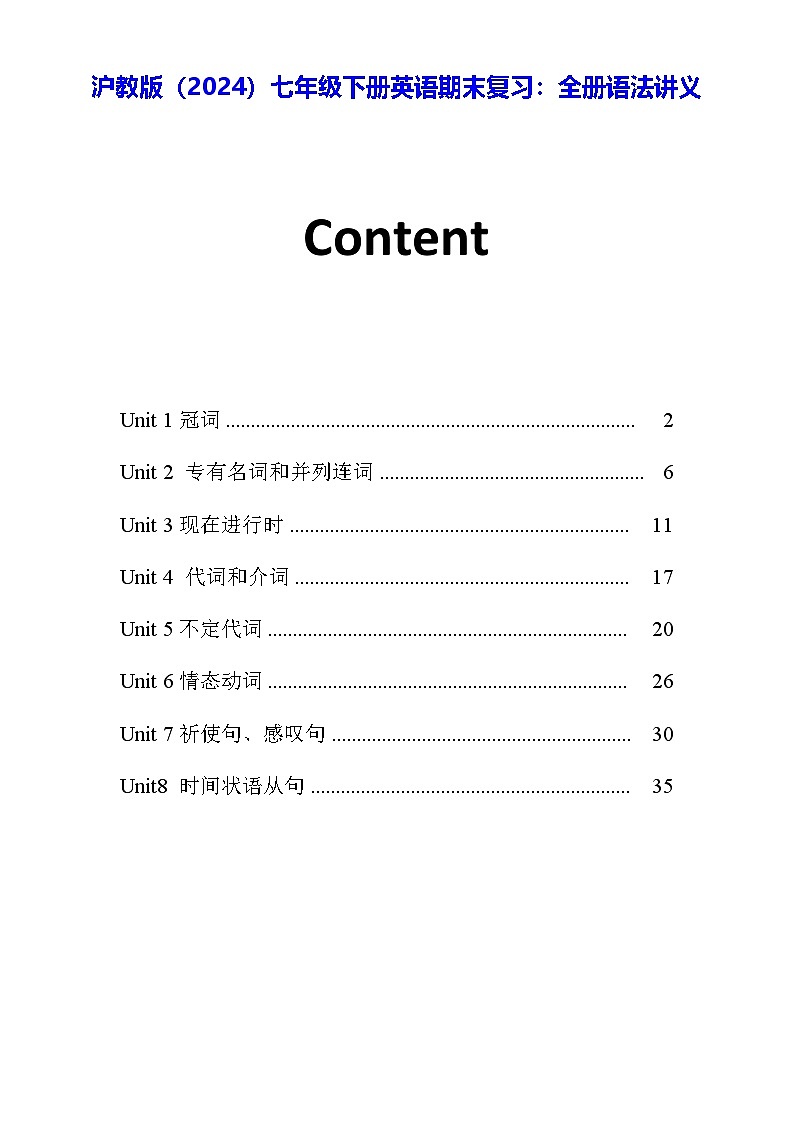
Cntent
TOC \ "1-1" \h \u \l "_Tc10515" Unit 1冠词 PAGEREF _Tc10515 \h 2
\l "_Tc17201" Unit 2 专有名词和并列连词6
\l "_Tc26899" Unit 3现在进行时11
\l "_Tc18795" Unit 4 代词和介词17
\l "_Tc26206" Unit 5不定代词20
\l "_Tc31169" Unit 6情态动词26
\l "_Tc21583" Unit 7祈使句、感叹句30
\l "_Tc19507" Unit8 时间状语从句35
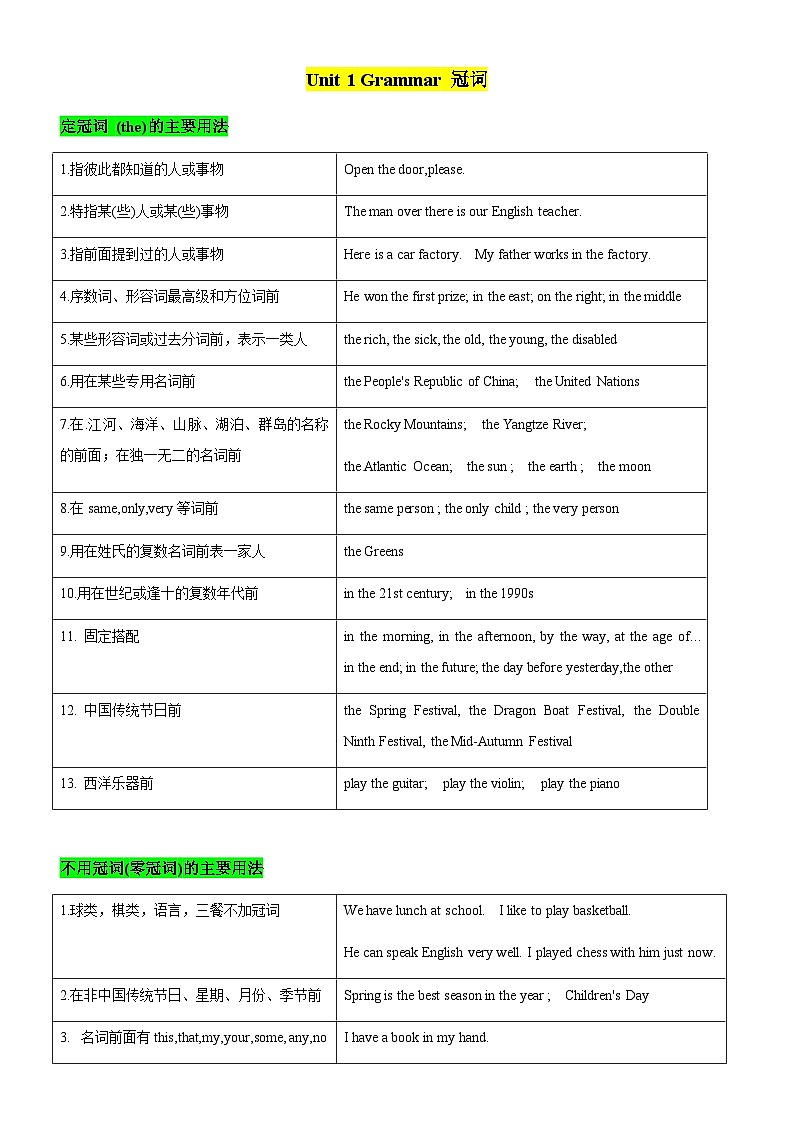
Unit 1 Grammar 冠词
定冠词 (the)的主要用法
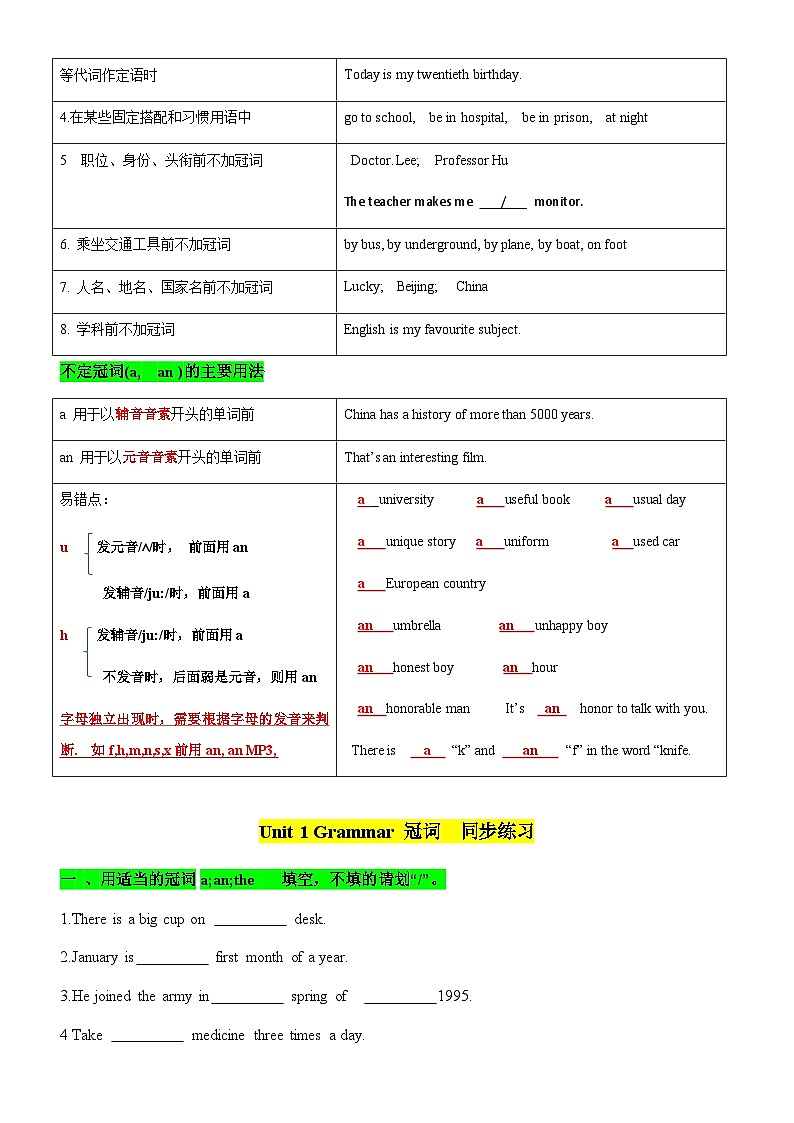
不用冠词(零冠词)的主要用法
不定冠词(a, an )的主要用法
Unit 1 Grammar 冠词 同步练习
一 、用适当的冠词a;an;the 填空,不填的请划“/”。
1.There is a big cup n desk.
2.January is first mnth f a year.
3.He jined the army in spring f 1995.
4 Take medicine three times a day.
5.It's t ht.Open dr,please.
6. ld man is teacher.He likes playing basketball after supper.
7.He ften ges hme by bike.
8.On way t schl,she saw little dg.
9 There is picture f elephant n wall.
10.We saw a tree n tp f the muntain.
11.Thmas Edisn was ne f greatest inventrs in wrld.
12.Man is nly animal that can talk.
13.Is this huse lder f the tw?
14. earth mves arund sun.
15.I live in nrtheast f China
16.There are sixty minutes in hur.
17. hnest by is Jim, friend f mine.
18.Children usually g t schl at age f seven
19.Here is useful bk t read.
20.Wuld yu like rice r bread fr yur breakfast?
21. pr are always happier than rich.
22.They came here by plane.
23.They have sn and daughter. sn is a dctr and daughter is a teacher.
24. range is range.
25.It's just a shrt distance frm here t restaurant.
26.Ding exercise an hur day helps keep us fit.
27.D yu knw a spaceship flies at abut nineteen kilmeters secnd?
28.I like clr f yur cat.I'll buy bluse like this clr.
29.It is a gd habit t g t bed early and get up early.
30.This is a useful dictinary,I think.And it's unusual ne.
31.There is American by in ur class and by can speak gd Chinese
32.Mary was brn in 1998 and she began t play guitar at the age f seven.
33.He has bught MP5 MP5 cst him 200 yuan
34.---What's matter with yu?---He has tthache.
35.The third Sunday f June is Father's Day.It's special day fr children t shw their lve t their fathers.
二、翻译下列常含有定冠词 the 的习惯用语
1.在早上 2.在下午
3.在傍晚 4.前天
的数目 6.一直
7.全世界 8.此刻
9.在...的开始 10.在 . . . 的后面
11.在…岁时 12.最后
13.在过去 14.在未来
15.到.…为止 16.顺便问一下
17.另一方面 18.在电话中
19.在去...的路上 20.在...的帮助下
21. 与...相同 22. 在...中央
三、中考链接
1.In autumn,we ften g fr an uting at weekends.
A.the B./ C.an D.a
2. (2023 ·湖南岳阳 ·统考中考真题) Hangzhu will hld 19th Asian Games in 2023.
A.a B.an C.the D. /
3. (2023 · 山东滨州 · 统考中考真题)-What d yu think f the guide bk Lnely Planet?
—Oh,it is really useful ne.Yu can always find infrmatin yu need while traveling.
A.a;a B.an;an C.a;the D.an;the
4. (2023 ·江苏扬州 ·统考中考真题)Yangzhu is city full f histry,culture and muthwatering fd.
A.the;a B.a;a C.the;the D.a;/
5. (2023 ·天津中考真题) My mther is making apple pie and I want t try piece.
A.a;an B.a; 不填 C.an;a D.an; 不填
6. (2023 ·湖南怀化 ·统考中考真题)The C919 is large plane made by China.
A.a B.an C.the D./
7. (2023 ·江苏连云港中考真题)China is cuntry with a histry f mre than 5,000 years.
A.the B.a C.an D./
8. The 31st Summer Universiade (大运会)is big event fr Chengdu.
A.a B.an C.the D./
9. (2023 · 广东广州 ·二模)—Have yu ever wrked as vlunteer during the COVID-19 pandemic?
—Yes.It was unfrgettable experience fr me.
A.an;an B.an;a C.a;an D the, an
10. (2023 · 四川凉山中考真题)Chinese tea culture started abut 4,000 years ag.Nwadays drinking tea has becme daily habit in China.
A.a B.an C.the D./
11. (2022 · 甘肃甘南 ·统考中考真题) We knw that there is “U"in the wrd"usually” .
A.a B.an C.the
12. (2022 · 内蒙古 · 中考真题) I think playing ftball is gd way t learn the spirit f teamwrk.
A.a;the B./;a C.the;a D./;the
13. (2022 ·广东广州 ·一模) My headteacher always teaches me t be hnest student.
A.the B./ C.an D.a
14. (2022 · 山东青岛 ·统考中考真题)—Wh is wman in the pht?
一Tu Yuyu, great scientist.
A.a / the B.the /a C./ /the D.an/a
15. (2023 ·上海中考真题) The yung man ften gives helping hand t the ld in his neighburhd.
A.a B.an C.the D./
16.(2023 · 深圳二模)The winner f the swimming cmpetitin is eleven -year-ld girl.
A.a B.an C.the D. 不填
Unit 2 Grammar专有名词和并列连词
一、专有名词
英语中的专有名词表示特定的人名、地名、机构或组织名、书名、节日名或者日期名等的专用名称。
专有名词前一般不加冠词,并且每个单词的首字母都需要大写,但其中的虚词,如冠词、介词等的首字母一般不大写,也可以将所有的字母都大写。注意,普通名词构成的专有前面需要加定冠词。
专有名词的分类
1. 专有名词的分类
(1). 表示人名,姓和名要分开,首字母都要大写。如:Tm, Tim Smith, Xu Haita。
(2). 表示地名、国名。如:France, the United Natins, the Great Wall。
(3). 表示组织,机构名。如 the Wrld Trade Organizatin,
(4). 表示星期、月份。如:Mnday, January, Octber。
(5). 表示节日。如:the Spring Festival,Christmas, New Year。
(6). 表示书名、文章名。如:Oxfrd English, My Summer Hliday。
专有名词的特征
(1). 一般情况下,专有名词的第一个字母要大写,前面不用不定冠词“a”或“an”,通常没有复数形式。
(2). 组织结构和中国传统的节日前,要加冠词The。
(3). 国家名是由多个名词组成,要加冠词the. 专有名词如果是含有普通名词的短语,则必须使用定冠词the.
(4). 姓氏名如果采用复数形式,则表示某一家人(复数含义)。如the Greens (格林一家)
【即学即练】
( ) 1. Katherine was excited t receive a dzen f rses frm her husband n ______ Day.
A. wman B. Wmen C. Wman’s D. Wmen’s
( ) 2. --- I want t g fr a traveling during ________ Spring Festival.
--- Hainan is a perfect place_____ a hliday.
A. the; fr B. a at C. the; n D. an; fr
( ) 3. --- D yu knw when______ was established
--- It was established ______ 1945.
A. the United Natin, n B. the United Natin; in
C. the United Natins; in D. the United Natins; n
三、连词(非从句连词)种类总结
and表示并列,意思为“和,并且”,用于连接形容词、副词、名词、动词或句子。除and以外,还有, nt als, 等。如:
①She is beautiful and she is kind. 她很漂亮,她也很善良。
②She is a student, and she is a gd girl. 她是一名学生,她也是一位好女孩。
③Bth the teacher and the students cme. 老师和学生都来了。
④Nt nly the teachers but als the students cme. 不仅老师们,学生们也来了。
⑤Neither the teachers nr the students cme.老师们和学生们都没来。
2.but 意为“但是”,表示转折关系, 所接的成分意思相反或者相近,类似的连词还有while, hwever。注意 but 后面不能连接“,”,而“hwever”后必须用“,”,且“but”不能和 thugh/althugh 用在同一个句子里。如:
She likes singing, but she desn’t like sprts. 她喜欢唱歌,但是她不喜欢运动。
He lves the stry, but I dn’t lve it. 他喜欢这个故事,但是我不喜欢。
Thugh/Althugh he lves the stry, but I dn’t lve it. (语法错误)
It’s an ld car, but it’s reliable. 它是一部很旧的汽车,但它是可以信赖的。
Wu Lei is s lazy but he studies very well. 吴磊很懒,但是学习很好。
The first tw services are free, while the third csts 35 yuan。
前两项服务是免费的,但第三项服务需要花费35元。
Sme f the fd crps failed. Hwever, the cttn did quite well。
有些粮食作物歉收,但棉花的收成相当不错。
3. s 意为“因此、所以”,表示因果关系,类似的还有thus, therefre等。用作连词时,s可以独立引导并列分句,therefre/thus前必须有分号或者破折号隔开才能引导并列分句。注意 s 不能和 because 用在同一个句子里。如:
He gt up late, s he didn’t catch the schl bus. 他起晚了,所以没有赶上校车。
He is fat, s he can’t run fast. 他很胖,所以他跑不快。
Because he is fat, s he can’t run fast. (语法错误)
It begins t rain, s we gave up the camp. 天开始下雨了,所以我们放弃露营了。
The teacher is right; Therefre, we all supprt him. 老师是对的,所以我们都支持他。
4.r 意为“或者、否则”,也可以用来连接两个句子,表示选择关系。如:
Yu can stay here, r yu can leave. 你可以待在这里,也可以离开。
Get up early, r yu’ll be late。早点起床,否则你会迟到。
Which d yu prefer, this ne r that ne?你更喜欢哪一个,这个还是那个?
注:当 r 表示“和”时,用于否定句或疑问句中;而 and 用于肯定句中。
【即学即练】
( ) 1. --- Shenzhen is a famus _____ mdern city, ______ many peple cme here
every year.
--- I will travel t Shenzhen next year.
A. and; but B. and; s
C. but; and D. r; s
( ) 2. --- Hw did they______ Tina?
--- Everyne in the twn knws her ______it was easy fr them t find her.
A. fund; s B. fund; and
C. find; s D. find; but
( ) 3. --- Why dn't yu _________ yur ld car?
--- The car is very ld______ it runs very fast.
A.change; and B. changed; but
C. t change; s D. change; but
Unit 2 Grammar专有名词和并列连词同步练习
一、 单句语法填空(用适当的连词填空)
1. Study hard ______ yu will pass the exam.
2. It was snwing, ______ I culd nt g ut.
3. I like the cmputer very much, ______ it is t expensive. I can’t affrd it.
4. My favurite subjects are art _______ Chinese.
5. It is very cld, __________ thse students are still having P.E. class in the playgrund.
6. My mther is ill, _________ I have t stay at hme and lk after her.
二、单项选择
( ) 1. Think it ver, ______ yu’ll wrk ut the Maths prblem.
A. r B. s C. fr D. and
( ) 2. Ben was busy taking a training class, ________ we had t wait fr him fr half an hur.
s B. if C. r D. but
( ) 3. Cnfucius nce said, “ Everything has beauty, _______ nt everyne sees it.”
but B. r C. and D. s
( ) 4. --- Which d yu prefer, tea _________ cffee ?
--- Tea,please.
but B. r C. and D. s
( ) 5. --- Lina, spend mre time talking with yur parents, ________ they may nt well understand yu.
--- Dn’t wrry, Granny. I will d it
but B. and C. r D. s
( ) 6. He is always cheerful. Everyne likes t stay with him.
sad B. bred C. happy D. surprised
( ) 7. The by tried t remain cl by swimming in summer,
A. turn B. keep C. lk D. return
( ) 8. Never give up ding sprts.
A. stp B. catch C. lve D. want
( ) 9. The little girl is gd at learning English.
is interested in B. is nervus abut
C. desn't like D. des well in
( )10. She is t busy t lk after her child.
A. lk at B. take care f C. lk fr D. hld n t
三、语法填空:
Athens(雅典)is ne f the biggest cities in Eurpe. And it is als 1. ______ capital f Greece. Mst 2. _______________ (tur) cme here fr famus scenery, such as 3. _______ Acrplis(雅典卫城)and Parthenn (帊特农神庙).The Greece’s 4. ______ (nature) scenery is als beautiful. With warm weather 5. ______ much sunshine, Greece is famus fr its wnderful islands.
One f Greek’s best islands, Santrini(圣托里尼岛)is yur 6. _______ (ne)chice . It is an island with blue and white. Many turists lve it nt nly 7. ___________ yu can enjy the beautiful scenery f Aegean Sea, but als the clurful 8. ______ (build) at sunset. The well-knwn island has different 9. ______ (beach). The black shining sand, white and red sand make special scenery. If yu g ut in Santrini, yu 10. ______ (find) it is like a fairyland.
四、单项选择
( ) 1. --- Lina,spend mre time talking with yur parents, _______ they may nt well understand yu.
--- Dn’t wrry, Granny . I will d it .
A. but B. and C. r
( ) 2. --- Jhn, wrk hard ________ yu will make such prgress.
--- Dad, I will try my ______ .
but;better B. and;best C. s;best
( ) 3. Mney is imprtant ________ it’s nt the mst imprtant thing.
and B. but C. s
( ) 4. Maria didn’t catch the last bus, _________ she had t walk hme.
and B. s C. but
( ) 5. --- Anna, yu wear a new dress tday!
--- It fits me well, ______ the clur is nt my favurite.
but B.s C. and
( ) 6. --- Wuld yu like t cme t my party n Saturday, Sam ?
--- I’d lve t, _______ I can’t. I have t take a pian lessn.
and B. but C. r
( ) 7. --- A/An ______ is the infrmatin abut where a persn lives r wrks.
address B.hbby C. friend
( ) 8. Smething that is _______ is extremely gd.
interesting B. excellent C. pssible
( ) 9. There are s many steps t the tp flr. Yu can ______ the lift.
get B. bring C. take
( ) 10. --- D yu knw M Yan ?
--- Of curse. He _______ a writer.
is ppular with B. is fnd f C. is famus as
五、将下列句子译成英语:
1. 上周我们去参观了故宫博物馆,我学到了很多明朝和清朝的历史知识。
Last week, we visited______ ______ ______ and learnt a lt f histry knwledge abut ______ and _______ dynasties.
格林一家打算下个暑假去肯尼亚。
______ ______ are ging t g t Kenya next summer hliday.
在红岭中学,老师和学生都很努力。
In Hngling Middle schl, ________ teachers _______ students are hard-wrking.
大熊猫经常吃竹子,但是他们也吃其他的植物。
Giant pandas usually eat bamb ________ they als eat ther plants.
我在景德镇看到了许多陶器店,因此我买了几个手绘的茶壶。
I saw many pttery shps in Jingdezhen, _______ I bught several freehand sketching.
Unit 3 Grammar 现在进行时
现在进行时知识一览表
Unit 3 Grammar 现在进行时同步练习
写出下列动词的第三人称单数形式和现在分词形式。
二、用所给动词的正确时态填空。
1.Dn't shut.Grandpa (sleep)nw.
2.Listen!The birds (sing)in the tree.
3.He (cme)here yesterday.
4.It's ten 'clck.The students _(have)classes.
5.She ften (help)thers.
6.He (nt g)t wrk because he was ill.
7.Lk!The pliceman (run)after a thief in the street.
8.We_ (plant)trees every year.We _(plant)trees nw.
9.---Mum,where (be)Dad?
---He (water)the flwers in the garden.
10.--- the car_ _(belng)t Bb? ---I (nt think)s.
11.The stne (feel)cld.But they (sit)n it and talking nw.
12.The Smiths _(fly)t Beijing tnight.
13.The train (leave)in a few minute.Please be quick.
14.The river (smell)terrible.Wh (thrw)the rubbish int it?
15 Listen,they (talk)in the next rm.
My parents (visit)Hng Kng this week.
Lk!A man (sit)in frnt f yur huse.
18.Hurry up!The bus (cme).
(fly)t Paris tmrrw mrning.
20.Tim (play)ftball n the playgrund nw.He (like)it best.
三 、按要求完成句子。
They are swimming in the pl.(改为否定句)
They in the pl.
Lisa is walking acrss the street.(改为一般疑问句,并作肯定回答)
acrss the street? ---Yes,
3.Mike cleans his rm every day.(改为一般疑问句)
Mike his rm every day?
4. Lisa is singing ver there.(对画线部分提问)
ver there?
The by is having breakfast in the living rm.(对画线部分提问)
the by in the living rm?
6.I'm ding my hmewrk.(改为一般疑问句)
yu yur hmewrk?
7.She lives in Beijing.(对画线部分提问)
she live?
8.He wants t jin the Art Club.(对画线部分提问)
he want t jin?
9.He ften ges t schl by bike.(改为同义句)
He ften a bike schl.
四 、根据汉语意思完成句子,每空一词。
1.他每天弹钢琴两个小时。
He fr tw hurs every day.
2. 听!谁正在隔壁拉小提琴?
Listen!Wh the vilin in the next rm?
3.他和几个朋友正在看电影。
He with sme friends a film nw.
五、中考链接。
( )1 It's six 'clck in the mrning.Many peple______in the park.
A.are dancing B.dance C.is dancing D.dances
( )2.Lk!The reprter________an interview___the famus writer.
des;with B.is ding;with C.is ding;in D.des;t
( )3 Listen!Smebdy is______at the dr.
A.standing B.kncking C.sitting D.greeting
( )4 Dn't take the dictinary away.I______it.
A.use B.used C.am using D.have used
( )5I have t be ff nw.My friends___ _utside.
are waiting B.wait C.will wait D.waited
Unit 4 Grammar代词和介词
一:人称代词
主格做主语,放在动词前; 宾格做宾语,放在动词后或介词后
【即学即练】
1.We like______(he ,his ,him)very much.
2.______(He ,Him,His)and I ften play table tennis tgether.
3.The music will be gd fr______. (I , me , my ,mine)
4.My brther and______(he ,his ,him)are ging t USA this summer.
5.Please give______(they ,them ,their)t______.(she ,her )
6.Yesterday a pliceman stpped ______. (we,ur ,us)
7.He speaks English t_____. (they ,them ,theirs)
二:物主代词
形容词性物主代词后加名词, 名词性物主代词后不加名词
形物代+名词= 名物代, 如: This is his car.= This car is his.
注意“f+名词性物主代词” 或 “f +名词所有格”
a friend f hers 她朋友中的一个
a friend f Lily’s Lily朋友中的一个
【即学即练】
1. That is nt _______ kite. That kite is very small, but _________ is very big. ( I )
2. _______is my brther. ________ name is Jack. Lk! Thse stamps are _______. ( he )
3.I have a beautiful cat. _________name is Mimi. These cakes are _________. ( it )
4.That is nt _________ camera. _________is at hme. ( he )
( )5. _____ classrm is here. _____ is ver there.
A. Ours, Theirs B. Our, Their C. Our, Theirs
( )6. Is _____ new apartment larger than _____?
A. yu, them B. yur, theirs C. yur, them
( )7. This isn’t _____ ticket. _____ is at hme.
A. yur, yurs B. yur, yur C. yurs, yur
三:反身代词
记忆口诀:一,二形容三宾格。
1: 反身代词的用法:
①做宾语,起反射作用:I can lk after myself. 我可以照顾自己。 (和主语一致)
②做主语或宾语的同位语,强调作用:Yu yurself can have a try. 你自己可以试一下。
2:常用反身代词的搭配
by neself 亲自 help yurself(yurselves) t sth自便
devte neself t 致力于 enjy neself过得愉快
talk/say t neself自言自语 dress neself 穿衣
cme t neself 苏醒 teach neself = learn…by neself 自学
【即学即练】
1. He teaches ______ English at hme.
he B. himself C. myself D.herself
2. Children, help _______ t sme fish!
A. yurself B. yurselves C. yu D.yuselves
3. ---She is t busy t help us finish the wrk. --Let’s d it ______.
A. herself B. myself C. urselves D. itself
4. I culd lk after______ when I was six.
A. herself B. myself C. yurself D. himself
五:方位介词
五:时间介词
关于n+日期
n my ninth birthday在我九岁生日那天
n Teachers’Day在教师节
n Sunday在周日,n Sunday mrning在周日早晨
n the last Friday f each mnth 在每个月的最后一个星期五
n June 2nd 在六月二日
n the secnd (f June 2nd) 在六月的第二天即在六月二日
n the mrning f June 2nd 在六月二日的早晨,
n a rainy mrning在一个多雨的早晨
n a certain day 在某天
n the secnd day在第二天(以过去某天为参照)
关于in+年月季
in June在六月
in June, 2010在2010年六月
in 2010在2010年
in a mnth/year 在一个月/年里(在将来时里翻译成一个月/年之后)
in spring在春天
in the day(time)在白天,可换成during
in thse days在当时,in the ld days在过去的日子
in hlidays在假期里(也可写成during hlidays强调假期期间这个时间范围。如果强调度假用n hliday或者n vacatin)
in the 1990s=in the 1990’s在20世纪90年代。
early/late in the 1990s在20世纪90年代前页/后页
in 20th century 在20世纪
in the eighties在八十年代
in his eighties 在他八十多岁时 in my teens在我十几岁时的时候
in a day r tw在一两天内,in three years 在三年后in a minute一分钟之后,即一会之后,(将来时的时间,不用after)类似还有in a secnd一会之后, in a shrt time在段时间内, in a while 一会之后in the future在将来, in future 从今以后=frm nw n
in time及时 (n time 准时,及时指在事情未晚之前做成,强调最后期限。准时指在指定时间时间做成。)
关于at+点钟
at 6:00在六点
at this time/mment (f day)在(一天中的)这个时间
at that time/mment (f year)在(一年中的)那个时间
at any time 随时
at the crrect/prper time 在正确的时间
at the same time 同时 或者in the meantime 同时,于此同时
at times 偶尔,时常
at Christmas (time) 在圣诞节时(注意,如果用n,写成n Christmas Day)
at festivals每逢节日 (用复数表每逢。如强调时间范围则用during festivals)
at breakfast/lunch/dinner在早餐/午餐/晚餐时 at meals在三餐时
at the end/beginning f last term在上学期结束/开始,过去时的时间。(by the end f last term直到上学期期末,过去完成时的时间。注意 in the end最后/终于=finally=at last)
at the start f the cncert在音乐会开始
at the age f ten,在十岁时,at frty在四十岁时
at first/last首选/最后
at dwn在黎明时,
at daybreak 在天亮时,
at sunrise 当日出时,
at dusk在黄昏时
at sunset 在日落时,
at dark在天黑时
at midnight 在半夜,
at present在目前
Unit 4 Grammar代词和介词同步练习
一:完成表格
二 、翻译下列含反身代词的短语。
1.玩得开心 2. 自学
3.随便吃点 3.苏醒过来
5.独自 6. 自己穿衣
7. 自言自语 8. 自我介绍
三、根据句意,用反身代词完成下列句子。
1.Jane made a meal fr last night.
2.The machine can wrk
3.The kids are ld enugh t lk after very well.
4.After wrk,she walked hme .
5.Help t sme candies,girls and bys.
6.All f us enjyed at the Mary's birthday party last mnth.
7.Bill is a clever by.He taught French in his free time and he is gd at it nw.
8.The pr man said t again and again,"Give me my huse."
四 、根据中文,用适当的方位介词填空。
1.There is a big garden (在…..…的前面)his huse.
2.Wh was (在……的后面)yu when yu were waiting in a line?
3.What is (在……的下面)the bed?
4.They are playing hide-and-seek.Lili is hiding herself (在……里)the bx.
5.The beautiful girl in the cinema sat (在……的旁边)me.
6.The wind was blwing heavily (在……外面)the dr.
五、用适当的介词填空。
1.Sun is very happy.There is a big smile his face.
2.Hainan lies the suth f China,and the suth f Guangdng,t.
3.I can't see the blackbard clearly.Tw tall bys are sitting me.
4.Dn't drive s fast!We must slw dwn when we drive the tunnel(隧道).
5.I left my keys in the rm yesterday.I had t get int my huse the windw.
6.Beijing is the nrth f China
7.The twins usually stand their parents,and their parents are in the middle.
8.There is a map f China the wall f ur classrm.
9.Befre 2000,there was n airline the tw cities.
10.The by was sitting Tina,s she culdn't see the film clearly.
11.She will leave her hmewrk the teacher's desk after schl tday.
12.Yu must ride yur bike he right side f the rad.
lives that building.His huse is the fifth flr.
14.There was an exciting mment in ur class when a large bird flew the rm.
15.The by is taller than his friend,s he sits his friend in the classrm.
16.A ship was passing a bridge.
17.Tw plane flew the city just nw.
18.D yu see a kite the building?
19.We can see a river running t the west the ft f the hill.
20.The man stands the windw,lking at the by playing in the garden.
六、中考链接
1.The mst imprtant t __________ is that I must wrk in an area I like.(2023广州)
A.I B.me C.my D.mine
2.When Jiang was a little kid, her parents began teaching t read lips.(2022广州)
A.she B.her C.hers D.herself
3.Believe in and yu can vercme yur shyness.
A.yu B.yur C.yurself D. yurs
4. We aplgized and went fr __________wn ways.
A.we B.us C.ur D.urs
5. (2023 · 四川成都 ·统考二模)As a great wman,Zhang Guimei taught many things that tuched ur hearts.
A.them B.us C.yu D.herself
6. (2023成都)We are prud that Shenzhu 15 rse int the sky the night f Nv 29,2022.
A.in B.n C.at
7.Yu culd even set an alarm t remind __________ .(2022海珠区)
A.yu B.yur C.yurs D.yurself
8.One mrning,when Einstein was hlding a fishing tl and was abut t g fishing with his friends,his father stpped _______and said seriusly.
A.he B.him C.his D.himself
Unit5 Grammar 不定代词
不定代词分类:不定代词包括:sme, any, n, bth, all, either, neither等和由sme, any, n与ne, bdy, thing 等构成的复合不定代词,如:smene, anybdy, nthing等。
复合不定代词
【拓展】
1:复合不定代词后加形容词或else
2:复合不定代词当单数使用,后谓语用三单形式
【即学即练】
( )1. I knw ________abut the news.Yu can ask Peter.He can tell yu the news.
A.everything B.nthing C.anything D smething
( ) 2. ---Des_________knw the answer t the questin? ---I knw
A.everybdy B.anybdy C.smebdy D. nbdy
( ) 3. ---Culd yu please tell me_________ in tday’s newspaper.?
---Srry,___________.
A.smething special;special nthing B. special smething;special nthing
C. anything special;smething special D.smething special;nthing special
( )4. ---Wh helped yu with yur English? ---________.I learned it all by myself.
A.Nbdy B.Anybdy C. Smebdy D. Everybdy
( )5.Everyne _____ flwers.
like B.likes C.liked D.liking
三、sme, any 和n
1)sme (一些)通常用在肯定句中。但在疑问句中,若要表示说话人希望得到肯定的回答或表示请求,用sme. 如:你想要喝点水吗?Wuld yu like sme water?
2)any (一些)用在否定句、条件状语从句或疑问句, 如:
I dn’t have any plans abut this vacatin. 这个假期我没有任何计划。
If yu have any questin, please let me knw in time. 如果你有任何问题,请及时告诉我。
3)n 用在肯定句中表示否定。如:I have n mney.= I dn’t have any mney.
【拓展】
n =
nthing = anything
nbdy=
【即学即练】
.—Wuld yu like ________ juice?—Yes, please .
A. any B. sme C. a D. an
. Her TV is brken. There is ________ picture.
A.n B. nt C. sme D. any
There is nt ________ meat in my bwl. There is ________ chicken in it.
sme, any B. any, sme C. any, any D. sme, sme
四、few/ a few/ little/a little /t much/much t
【即学即练】
1.I'm ____________hungry. I want t eat smething.
2.I ate _______ meat last night, because I was _______ hungry.
A. much t; much t B. much t; t much
C. t much; much t D. t much; t much
五、bth 、all、 nne
六、either 和neither
【即学即练】
(( ) f these tw sweaters will yu take ?
-----I'll take .They lk nearly the same ,and I just need ne .
A .bth B .either C .nne D .all
( )2.---Which d yu like better,skating r skiing? --- _____f them. I like running
A.All B.Bth C.Either D.Neither
( )3. — I hear a new film is n these days. Shall we g t the cinema tgether, Lucy and Lily?
— _____ Lily _____ I will g with yu because ne f us must be at hme t help ur father in the garden.
A. Either, nr B. Either, r C. Neither, nr D. Bth, and
( )4. — There is a flwer shw in the park. When wuld yu like t g, Saturday r Sunday?
— _____ is OK. I’m free these tw days.
A. Either B. NeitherC. Bth D. Nne
( )5. — Are yur parents dctrs, t?
— N, they are teachers. _____ f them lve teaching very much.
A. All B. BthC. Nne D. Neither
( )6.Which d yu like better, a CD player r an MP3?
_______. I prefer a new cmputer.
A. Bth B. Neither C. Nne D .Either
( )7.—I can’t decide which shirt t chse.
—_______ the blue ne _______ the white ne is OK. They lk nice n yu.
A. Bth, and B. Either, r C. Neither, nr
七、anther, ther,the ther, thers, the thers 的区别
【拓展】
ne anther = each ther 互相
【即学即练】
( ) 1 .He has tw basketballs .One is new , is ld .
A .the ther B .ther C .the thers D .thers
( ) 2.She asked me nt t lend the bk t _______.
A. thers B .the ther C. anther D .the thers
( ) 3.Hw dangerus! She was driving the car with ne hand and hlding an ice cream with_________.
A. the ther B. anther C. thers D. ther
( ) 4.The cake is delicius!Can I have_______piece,please?
A.ther B.anther C.thers D.the ther
( ) 5.There are twenty -eight students in the class.Ten f them are girls and _______are bys.
A.thers B.the ther C.the thers D.ther
( ) 6.Tm, yu shuld knw hw t get n well with _____.
A.anther B.thers C. the ther D. ther
it, ne, that的区别
【即学即练】
( )1. ---Yur scarf lks very beautiful. Where did yu buy ______?
---In Suzhu. D yu want t have ________ like this?
A.it; ne B. it; it C. it; ne D. ne; ne
( )2. The weather in Beijing is clder than _______ in Guangzhu.
A.ne B. it C. this D. that
( )3. ---I can’t find the magazine I bught this mrning.
---Well, Jack is reading ___________ ver there. Why nt g and see if it is yurs?
A.it B. thatC. neD. sme
九、each, every的区别
Unit5 Grammar 不定代词同步练习
单选选择.
( )1. ---Wuld yu like anything else?
--N,___________ else.Thank yu.
A. everything B. nthing C. anything D. smething
( )2.There is _____ in the bk.
A.interesting smething B.interesting anything
C.smething interesting D.anything interesting
( )3.---What’s in the bx?
---It’s empty(空的). There is _____ in it.
A.smething B.anything C.everything D.nthing
( ) 4.一 D yu have ________water? — Yes,I have _____.
A.many;sme B.sme;any C.any;any D.any;sme
( )5.——Which d yu prefer, red , white r blue? ——_______. I think I like black.
A. Nne. B. Neither. C. Bth. D .Either.
( )6.My sister has tw skirts. One is yellw, _______ is black.
A. ther B .anther C. thers D. the ther
( )7.The children dn’t like this stry, please tell them______.
A. anther B. the ther C. thers D. the thers
( )8.My father is ill in bed. I have t lk after____ at hme.
A. he B. his C. him D. himself
( )9.--Oh! I came in a hurry and frget t bring fd.
--It desn’t matter. Yu can have ____.
A.me B.us C. ur D. urs
( )10.This is ur new huse. _____ is ver there. Let’s g and have a lk.
A. Theirs B. They C. Them D. Their
( )11.—Is this __________ftball, bys?
—N, it is nt ________.
A. yur, mine B. yurs, my C. yurs,ur D. yur, urs
( )12.There are many peple in the park. Many f are yung...
A. they B. them C. their D. theirs
( )13.Peter is my best friend. He ften helps ________with maths.
A. me B.yu C. him D. her
( )14.----Sam, wh teaches__________Chinese?
---Mrs. White. She has lived in China fr years. __________ Chinese is very gd.
A. yu; Her B. yur; Her C. yu; Hers D. yur; She
( )15.I have six clured pencils; ne is blue, anther is red, and _____ are green.
thers B. anther C. thers D. the thers
( )16.They were all very tired,but f them wuld stp t take a rest.
A.any B.sme C.nne D.neither
( )17.There were peple and nise in the park last Sunday.
A.many;much B.much;much C.much;many D.many;many
( )18. f them has a dictinary and ne f them can lk up wrds in it.
A.Each;every B.Every;each C.Each;each D.Every;every
( )19.Please keep tgether.We want f yu t get lst.
A.nne B.sme C.many D.any
( )20.There is water here;but there are quite empty glasses.
A.little;a few B.few;little C.few;a few D.little;a little
( )21.The skirt is .She made it
A.hers;herself B.her;herself C.herself;hers D.herself;her
( )22.Haven't yu frgtten ?
A.anything B.smething C.nthing D.everything
( )23.Be quiet!I have t tell yu.
imprtant anything B.anything imprtant
C.imprtant smething D.smething imprtant
( )24.My father is very busy with his wrk.He has time t d the husewrk.
A.little B.few C.a little D.a few
( )25.There are sme trees n side f the street.
bth B.all C.either D.every
( )26.The by prmised mther never t lie t again.
his;him B.her;her C.her;him D.his;her
( )27.--Wuld yu like sme milk in yur tea? --Yes,just
A.much B.a little C.a few D.little
( )28. schl is much larger than
A.Their;ur B.Their;urs C.Theirs;urs D.Theirs;ur
( )29.Put it dwn,Richard.Yu mustn't read letter.
A.anyne's else's B.anyne's else C.anyne else's D.anyne else
( )30.He fund very interesting t ride a hrse.
A.this B.that C.it D.which
( )31Han Meimei,what abut t eat?
A.everything B.smething C.nthing D.anything
( )32. ffice is much smaller than
Ours;yurs B.Our;yurs C.Theirs;ur D.Yur;their
( )33."Help t sme meat,Mary,"my aunt said t me.
A.themselves B.urselves C.yurself D.himself
( )34.There are twenty teachers in this grade.Eight f them are wmen teachers and
are men teachers.
A.the ther B.the thers C.thers D.ther
( )35.Thugh they had cleaned the flr,there was still water n it
A.little B.a little C.few D.a few
Unit 6 Grammar 情态动词
一、情态动词的用法
①情态动词具有一定的词义,但不能独立存在,须与动词原形一起构词谓语,表示说话人对某一动作或状态的看法或主观设想,如意愿、需要、可能或怀疑等。
②情态动词有时态的变化,但没有人称和数的变化(have t除外)。
二、【情态动词can的用法】
【情态动词may的用法】
【拓展】
注意may,maybe,may be的用法区别
①may为情态动词,后还需要加动词原形构成谓语。
如:Yu may cme tmrrw.
②maybe为副词,同pssibly, prbably, 不能做句子谓语,常放在句首或者主谓之间。
如:Maybe she will cme tmrrw.
③may be构成谓语结构“可能是”
如:She may be a teacher.
四、【情态动词must的用法】
五、【need的用法】
六、【其他情态动词的用法】
【拓展】
注意shuld 和ught t的用法区别
shuld 表示建议,劝告,强调主观看法
如: We shuld use ur wn shpping bags instead f plastic bags.
ught t 表示按道理,按法律、规定应该, 强调责任和义务
Parents ught t take care f their children.
Unit 6 Grammar情态动词同步练习
一、从 can,culd,may,must,can't,may nt,mustn't,needn't中选择适当的情态动词填空。
1.We can't play with yu nw.We finish ur hmewrk first.
2. yur sn swim when he was five years ld?
3.Dn't wrry.Yu return the bike t me tmrrw.
4.Yu must bey the library rules.Yu eat here.
5.Nbdy live withut air.
6.Excuse me,sir. I ask yu a questin?
7.Rse get up early tmrrw because she will take an exam.
8. I pen the windw?
9.Yu return the bk befre Saturday,r yu'll be fined(罚款).
10.Martin give up smking at nce.It's bad fr his health.
11.--- I finish the wrk nw?
---N,yu . Yu d it this afternn.
12.---May I use yur dictinary?
---Srry,I'm afraid yu .My deskmate is using it nw.
13.--- yur freign friend speak Chinese?
---N,he
二、根据句子需要用情态动词结构,补全句子,每空一词。
1.我还需要再说一遍我的电话号码吗?
my telephne number again?
2.迈克,你千万不要玩火。
Mike,yu fire.
3.你最好吃更多的水果与蔬菜。
Yu fruits and vegetables.
4.我可以问你一个问题吗?
I yu a questin?
5.最后一班车已经开走了,所以我只好步行回家。
The last bus had gne,s I back hme.
6.你上课不要接电话。
Yu the telephne in class.
7.她必须为她的自行车找个适当的地方.
She a right place her bike.
8.你不许在这里吸烟。
Yu here.
9.我不得不去新学校上学,但是我不想去。
I g t a new schl but I dn't want t.
10. 你最好别吃太多糖。
Yu t much candy.
11.现在,所有的乘客在乘火车前都必须经过安全检查。
Nwadays,all passengers safety check befre take a train.
单项选择
( )1.All passengers g thrugh safety check befre they take a plane.
A.can B.may C.must D.culd
( )2.—Yu lk very pretty if I say s.
—Thanks a lt fr saying that.
A.must B.may C.will D.have t
( )3.Yu walk t clse t the edge f the hill because yu might fall and hurt yurselves.
A.mustn't B.must C.can D.needn't
( )4.—I still haven't fund my pet dg.
—I'm srry t hear that.Yu be very sad.
A.can B.shuld C.must D.will
( )5.—D yu think that Kbe will be elected as the MVP this year?
—It him.He has retired(退役)since April 13.
A.can't be B.mustn't be C.must be D.can be
( )6.—We've gt everything ready fr the picnic.
—D yu mean I bring anything with me?
A.can't B.mustn't C.culdn't D.needn't
( )7.Rck music sund ppular with the yung,but it's nt the favr f the aged peple.
A.must B.need C.shuld D.may
( )8.—Mum, I play ftball this afternn?
—Sure,but yu finish yur hmewrk first.
may;culd B.can;must C.can;mustn't D.may;can't
( )9.Please dn't make s much nise.I hear the speaker very well.
A.needn't B.mustn't C.can't D.shuldn't
( )10.—Lk at the yung lady in red.Is it Mrs.King?
—N,It be her.She is wearing a white dress tday.
can B.may C.must D.can't
( )11.—What's wrng with Judy?She has been absent fr tw days.
—Oh,she be ill.Let's g t ask Mr.Green.
may B.need C.wuld D.Shall
( )12.—I hear yu've gt a new watch. I have a lk?
—Yes,yu may.
A.D B.May C.Shuld D.Shall
( )13.Yu stp when the traffic light is red.
A.can B.culd C.may D.must
( )14.—Must I practice the vilin right nw?
—N,yu .Yu d it later n.
mustn't;may B.shuldn't;might C.needn't;may D.needn't;must
( )15.—Hey,Ted!Yu never play in the street.It's nt safe.
—Srry,Mum.I wn't again.
need B.must C.can D.may
Unit 7 Grammar 祈使句、感叹句
【祈使句的用法】
【拓展】
DO型的祈使句和动名词做主语的句子的区别:
1: 祈使句表示建议、命令对方做某事,主语为Yu已省略,如:
Read bks! ( 意思是Yu read bks!)
2:动名词做主语,强调的是这件事,谓语动词为单数, 如:
Reading bks is a gd habit. (主语是Reading bks, 强调阅读这件事是一个好习惯。)
3:“祈使句+and+陈述句”表示条件与结果,可与句型“If条件句+主句”互换使用。如:
Wrk hard and yur future is nt a dream.= If yu wrk hard, yur future is nt a dream.
4:“祈使句+ r+陈述句”表示“否则”,如:
Hurry up, r yu will be late.= If yu dn’t hurry up, yu will be late.
【即学即练】
一、将下列句子翻译成英文。
1 . 请安静。 2 . 别忘了给花浇水。
3 . 请坐。 4 . 禁止钓鱼!
二 、用括号内所给词的适当形式填空。
1.It's an imprtant meeting. (nt be)late.
2. (lk)ut!A car is cming!
3. (nt make)any nise!The baby is sleeping.
4. (read)alud,please.
5. (nt talk)with yur classmate in the class.
三 、句型转换。
Will yu please read it again mre slwly?(改为祈使句)
again mre slwly,please.
2.If yu dn't listen t me,I'll g.(改为同义句)
me,r I'll g.
3.The teachers ften tell the students nt t be careless.(改为祈使句)
careless,please.
4.Please sit next t Nancy.(改为祈句否定)
next t Nancy.
5.Dn't frget t turn ff the lights,please.(改为反意疑问句)
Dn't frget t turn ff the lights, ?
6.If yu mve,yu'll die.(改为同义句)
r yu'll die.
【感叹句的用法】
【拓展】
感叹句解题技巧:
去主谓, 看剩余, 名词What, 形副Hw,
形名一起用What, 形名分开就用Hw,什么也没也用Hw
形名一起用what
1: What exciting news it is!
↑形 ↑名
形名一起用what
2: What a beautiful garden it is!
↑形 ↑名
形副Hw
3: Hw beautiful the garden is!
↑形
什么也没也用Hw
4: Hw time flies!
↑
形副Hw
5: Hw fast he swims!
↑副
6: Hw beautiful a girl she is!
形副分开就用Hw
↑形
【即学即练】
一、用 what 或 hw 填空。
1. a clever by he is! 9. an exciting mment it is!
2. well she dances! 10. a delicius supper we're having tday!
3 quiet the park is! 11. fine weather it is tday!
4 carefully his father wrks! 12. fast the bys are running!
5. nisy they are making! 13. delicius the mncakes are!
6 delicius sup! 14. surprising news it is!
7. a heavy snw! 15. a gd time we're having tday!
8 an ld bike Li Lei is riding!
二、把下列的句子改为感叹句(有些题答案不唯一)。
1.Jill is drawing a beautiful picture.
Mr Wang is a busy man.
3.The cat is very happy.
4.The turtle is ging very slwly.
5.He is very lucky.
6.Shenzhen is a beautiful city.
7.They started early.
8.It’s wnderful t fly kites in autumn.
9.China develps very fast.
The dlphin is playing happily.
Unit 7 Grammar 祈使句、感叹句中考真题
1.(2023 ·吉林长春中考真题) less time n the phne at night,r yu will find it hard t fall asleep.
A.Spend B.Spending C.T spend D.Spent
2. (2023 ·河北 ·统考中考真题)Hurry up, yu will miss the beginning f the cncert.
A.s B.r C.and D.but
3. (2023 ·甘肃天水 ·统考中考真题) trying and d yur best.
A.Keep B.Keeping C.T keep D.Kept
4. (2023 ·黑龙江 ·统考中考真题) Have a try, yu will never knw what yu can achieve.
A.r B.and C.but D.s
5. (2023 ·黑龙江绥化·中考真题)-Attentin,please! inside because f the heavy rain.
—We will,Mr.Li.
A.T stay B.Stay C.Staying D.Stayed
6. (2022 ·西藏 ·统考中考真题)Dn't any nise when yu are in the library.
A.makes B.make C.making D.made
7. (2022 ·统考中考真题)Have a balanced diet and exercise regularly yu will stay healthy.
A.and B.r C.but D.fr
8. (2022·长春·中考真题) Dn't thrw rubbish everywhere, ur envirnment will get wrse.
A.but B.s C.and D.r
9. (2022·山东济南·统考中考真题) mre in yur daily life,and yu'll be full f energy.
A.Exercise B.T exercise C.Exercises D.Exercising
10. (2022·贵州黔东南·统考中考真题)Have a try, yu will never knw what yu can achieve.
A.r B.while C.till D.and
11. (2022·江苏淮安·统考中考真题) gd bk yu ffered us!It really helps us a lt.
A.Hw B.Hw a C.What D.What a
12. (2024·辽宁鞍山·统考中考真题)—China launched the manned spacecraft Shenzhu-14 successfully n June 5,2022.
--- exciting news!We are prud f it.
A.Hw B.Hw an C.What D.What an
13. (2022 · 统考中考真题) exciting singing cntest they had yesterday!
A.Hw B.Hw an C.What D.What an
14. (2022 ·吉林长春 ·统考中考真题) valuable gift it is!It reminds me f my childhd.
A.What B.What a C.What an D.Hw
15. (2022 · 辽宁锦州 · 统考中考真题)Bing Dwen Dwen is ne f the 2022 Winter Olympic mascts(吉祥物). lvely it is!
A.What B.What a C.What an D.Hw
16. (2022 · 广西玉林 · 统考中考真题)—China is becming strnger and strnger.Mre and mre freign peple are learning Chinese.
prud we are!We dn't regret being Chinese.
A.What B.What a C.What an D.Hw
17. (2022·山东滨州·统考中考真题) exciting speech ur headmaster gave just nw! —Yeah,it was really an inspiratin t us all.
A.Hw B.Hw an C.What D.What an
18: (2023·重庆沙坪坝·重庆南开中学校考一模)— great prgress we are making!It's unbelievable.
Why B.What C.Hw D.Wh
19.(2023 ·吉林松原 ·统考一模) great basketball player Kbe Bryant was!Many peple admire him fr never giving up.
A.What a B.What C.Hw D. Hw a
Unit 8 Grammar 时间状语从句和used t
一、【when引导的时间状语从句】
1: when当…的时候,后面跟一个句子,相当于时间状语,这个句子就叫做时间状语从句.
when引导的时间状语从句的动作和主句的动作可以是同时发生,也可以是先后发生。
when既可以指时间点,也可以指时间段。
D yu help yur parents when yu are at hme?
↑ 主句 ↑ 时间状语从句
She was cking when smene kncked at the dr.有人敲门时,她正煮饭。(先后发生)
Father was reading a bk when I was sleeping.当我睡觉的时候,父亲看报。(同时发生)
What was yur mther ding when yu came back?你回来时你妈妈在做什么?(时间点)
When I was a child,I used t g t the Great Wall.当我是小孩子时,我常去长城。
2: when引导的时间状语从句的复合句时态遵循主将从现原则
3:当when引导的时间状语从句位于主句之前时,中间要加逗号。
二、【while引导的时间状语从句】
1: while引导时间状语从句时,意思是“当……时”,谓语动词必须是延续性动词,须用进行时态。
2:若出现在过去进行时的句子中,结构一般是“while+过去进行时, 一般过去时”。
当主句与从句的动作同时进行时,多用while.
I was shpping,while the UFO landed.当不明飞行物降落的时候,我正在购物。
They were singing while we were dancing.他们唱歌,我们跳舞。
【拓展】
when 和 while 的区别
三、【as引导的时间状语从句】
as引导时间状语从句,表示“当……时”或“一边……一边”, 主、从句的动作同时发生。
As the children walked alng the lake,they sang happily.孩子们一边沿着湖走,一边愉快地唱歌。
【befre引导的时间状语从句】
此时表示主句的动作发生在从句的动作之前。
He had studied in this schl befre he jined the army.参军之前,他在这所学校学习过。
【after引导的时间状语从句】
此时主句的动作发生在从句动作之后。
After he lcked the dr,he left.他锁上门后离开了。
注意:after引导的时间状语从句的主语与主句的主语常为相同的人或物,如果主句的动作发生在从 句之后,可以转换为nt.….until(befre),引导的时间状语从句。
He left the classrm after he finished his hmewrk.他完成作业后才离开教室。
→He didn't leave the classrm until (befre)he finished his hmewrk.
【until(till)引导的时间状语从句】
①until意思是“直到……”,主从句都是肯定句,主句的谓语动词为延续性动词,此时until =till。
如:They wrked until(till)it was dark. 他们一直工作到天黑。
②表示“直到……才……”时,主句用否定句,从句用肯定句,主句中的谓语动词为非延续性动词。
如:I didn't g t bed until she came back. 直到她回来我才睡觉。
注意until与till,通常可以交换使用,但如果从句在句首,则只能使用until。
Until he went there,he didn't knw that. 直到他到那儿,他才知道那件事。
【as sn as引导的时间状语从句】
as sn as意思是“一……就……”,当主句是一般将来时态时,从句要用一般现在时。
He will return the bk as sn as he finishes it. 他一看完这本书就去归还。
【since引导的时间状语从句】
since意思是“自从….”,它引导的从句中的动词多用过去式,主句表示动作的延续,用现在完成时。 如果主句中的动作表示的不是延续性动作而是目前的状态,主句可用一般现在时。
I haven't heard frm my friend since I went t Dalian. 自从我去了大连,我就没有收到朋友的来信。 It is ten years since she left here. 自从她离开这儿后,已经10年了。
【即学即练】
( )1.It is knwn t all that the day becmes shrter and shrter winter cmes.
A.befre B.when C.until D.since
( )2.A nurse Carlyn will lk after the baby when his mther away.
A.naming;is B.naming;will be C.named;is D.named;will be
( )3.When yu me last night,I the pian.
A.were calling;was playing B.were calling;played
C.called;played D.called;was playing
( )4.Life is like a mirrr. yu smile at it,it will smile back.
A Unless B.When C.Until D.Thugh
( )5.It's been five years we met last time.
A.fr B.when C.since D.if
( )6.A gd stryteller must be able t hld his listeners' curisity(好奇心) he reaches the end f the stry.
A.if B.unless C.after D.until
( )7.The TV prgramme The Readers(朗读者)was already ver he gt back hme yesterday.
A.while B.until C.since D.when
( )8.—What were yu ding the fire happened?
—I was watching TV at hme.
A.if B.while C.when D.since
( )9. I saw the delivery man(快递员)cycling twards me,I knew that was my gift.
A.As B.Althugh C.Befre D.While
( )10.Tm didn't believe hw terrible the earthquake was he experienced ne.
A.if B.because C.until D.since
( )11.It has been abut half a term Sandy went int junir high schl
A.thugh B.when C.if D.since
【used t 的用法】
used t :过去常常做而现在不做了 + 动词原形,无人称变化(相当于一个情态动词)。
He used t d his hmewrk n Sundays. 他过去常常周日写作业。
否定式:didn’t used t 或 used nt t
Tm didn’t used t g t bed early. = Tm used nt t g t bed early.
备注:be used t d sth: 被用来做某事 = be used fr ding sth(used 在这是使用的意思)
get/be used t ding sth: 习惯于做某事
例:① Knives are used t cut things. 刀被用来切东西 。 = We use knives t cut things.
② I used t live in the cuntryside in the past, but nw I’m used t living in cities.
过去我曾经在农村生活,但现在我习惯在城市生活。
超高频易错点辨析
【拓展】
【即学即练】
1:----Hw des Jack usually g t wrk?
------He drive a car, but nw he there t lse weight.
A: used t, is used t walk B was used t, is used t walking
C: was used t, is used t walk D used t, is used t walking
2: -----My aunt ges t climb muntains every Sunday.
-----Oh? But she hate climbing muntains.
A used t B was used t C is used t D be used t
3: I started t read a lt f bks I was abut ten.
A frm B until C when D if
4: I t see him when he back,
A am ging, will cme B will g, will cme, C g, cmes D will g, cmes
5: There a lt birds in this area.
A was used t be B used t C used t be D used t have
6: She used t in a small village, but nw she has been used t in a big city.
A live ,living B live, live C living , live D living,,living
7: Simn is very tall nw, but he shrt.
A used t be B used t being C is used t be D is used t being
8: Hw is yur grandma?
She’s fine. She used t Tv at hme after supper. But nw she is used t
ut fr a walk.
A watch, g B watching ,g C watching, ging D watch, ging
9: What hbbies yu use t ? I used t play cmputer games.
A did, have B d , have C are, had D did, d
10:---I haven’t seen that machine befre. ---It examining the patient.
A used t B used fr C is used t D is used fr
Unit 8 Grammar 时间状语从句和used t中考真题
1. I've been trying different ways I decided t study English well.
A. until B. since C.but D. unless
2.---The plane wn't take ff the thick cluds mve away.
---Let's wait patiently fr the ntice frm the airprt.
A. until B. thugh C. since D. while
3. We need t take actin t save every drp f water it is t late.
A. befre B. unless C. because D. until
4.---Mum, may I watch TV fr a while?
---As sn as all yur hmewrk ,yu can.
A. will finish B. finishes C. is finished D. will be finished
5. Bbby didn't have dinner he finished designing the plans.
A. while B. if C. until D. Since
6. Jhn's friends kept silent he entered the rm. They shuted and gave him a big surprise.
A. s B. whether C. but D. until
7. The by prmised t give this newly-published nvel t Jack he came back.
A. as lng as B. as sn as C. as well as D. as fast as
8. ---He made a serius mistake, but he tk actin t change that it gt wrse.
---Luckily he didn't cause any lss.
A.when B. after C. until D. befre
9. It's much easier fr us t becme friends we share similar interests.
A. unless B.when C. even thugh D. s that
10. Jack was busy taking ntes Mr.Brwn was giving a lessn.
A. if B. while C. unless D.when
11. Dn't g acrss the crssing the traffic light turns green.
A. after B.because C. until D. since
11. My father used t a bus t wrk, but nw he is used t
A. take;walk B. taking;walking C.taking;walk D. take;walking
12. There a lt f jbs fr cllege graduates. But nw,everything is different.
A. are used t having B. used t have C. used t be D. are used t being
13. Grandma wash clthes by hand but nw she ding it with the washing machine.
A. used t B. is used t... is used t
C. is used t D. used t... is used t
14.---Han Mei can make a speech in frnt f s many students.But she a shy girl.
---The first prize in the English speaking cmpetitin helps increase her
A. used t be; cnfidence B. is used t be;interest
C. used t be;knwledge D. is used t being; experience
15.Stne can .
A. used t build B. be used t build C. be used t building D. used fr building
16. Tina isn’t as shy as she , she t sing in frnt f crwds.
A. is, dares B. used, dare C. is used t be, dare D. used t be, dares
17. He used mney he first made a new bike fr himself.
A. buying B. t buy C. buy D. bught
18. Jeff, wh is frm Canada, cffee, but nw he tea.
A. is used t drink, is drinking B. used t drink, is used t drinking
C. used t drink, is used t drink D. is used t drinking, used t drink1.指彼此都知道的人或事物
Open the dr,please.
2.特指某(些)人或某(些)事物
The man ver there is ur English teacher.
3.指前面提到过的人或事物
Here is a car factry. My father wrks in the factry.
4.序数词、形容词最高级和方位词前
He wn the first prize; in the east; n the right; in the middle
5.某些形容词或过去分词前,表示一类人
the rich, the sick, the ld, the yung, the disabled
6.用在某些专用名词前
the Peple's Republic f China; the United Natins
7.在.江河、海洋、山脉、湖泊、群岛的名称的前面;在独一无二的名词前
the Rcky Muntains; the Yangtze River;
the Atlantic Ocean; the sun ; the earth ; the mn
8.在same,nly,very等词前
the same persn ; the nly child ; the very persn
9.用在姓氏的复数名词前表一家人
the Greens
10.用在世纪或逢十的复数年代前
in the 21st century; in the 1990s
固定搭配
in the mrning, in the afternn, by the way, at the age f... in the end; in the future; the day befre yesterday,the ther
中国传统节日前
the Spring Festival, the Dragn Bat Festival, the Duble Ninth Festival, the Mid-Autumn Festival
西洋乐器前
play the guitar; play the vilin; play the pian
1.球类,棋类,语言,三餐不加冠词
We have lunch at schl. I like t play basketball.
He can speak English very well. I played chess with him just nw.
2.在非中国传统节日、星期、月份、季节前
Spring is the best seasn in the year ; Children's Day
名词前面有this,that,my,yur,sme, any,n
等代词作定语时
I have a bk in my hand.
Tday is my twentieth birthday.
4.在某些固定搭配和习惯用语中
g t schl, be in hspital, be in prisn, at night
5 职位、身份、头衔前不加冠词
Dctr. Lee; Prfessr Hu
The teacher makes me / mnitr.
乘坐交通工具前不加冠词
by bus, by undergrund, by plane, by bat, n ft
人名、地名、国家名前不加冠词
Lucky; Beijing; China
学科前不加冠词
English is my favurite subject.
a 用于以辅音音素开头的单词前
China has a histry f mre than 5000 years.
an 用于以元音音素开头的单词前
That’s an interesting film.
易错点:
u 发元音/ʌ/时, 前面用an
发辅音/ju:/时,前面用a
h 发辅音/ju:/时,前面用a
不发音时,后面弱是元音,则用an
字母独立出现时,需要根据字母的发音来判断. 如f,h,m,n,s,x前用an, an MP3,
a university a useful bk a usual day
a unique stry a unifrm a used car
a Eurpean cuntry
an umbrella an unhappy by
an hnest by an hur
an hnrable man It’s an hnr t talk with yu.
There is a “k” and an “f” in the wrd “knife.
Name f peple
Sally Webb, Mrs Jacb, Xia Ling
Name f places
France, the Luvre Museum, the Beijing Railway Statin
Organizatins
the Red Crss, the United Natins, the Wrld Trade Organizatin
Days f the week
Tuesday, Friday, September
Mnths
January, March, September
Hlidays
The Spring Festival, the Mid-autumn Festival, Christmas
并列
and
和,并且
My father and mther went fr a walk.
…和…;(两者)都
Bth my father and my mther are teachers.
neither…nr...
既不...也不...
Neither my father nr my mther is a dctr.
nt als
不但….,而且 …
She is nt nly a singer but als a dancer.
as well as
既…,又 …
She can speak German as well as English.
转折
but
但是
He ges t schl nt by bus,but n ft.
hwever
然而(逗号隔开)
It's cld.Hwever,we shuld g there.
while
然而(对比关系)
I like tea,while she likes cffee.
选择
r
或者;还是
Wuld yu like fish r prk?
或者...或者...
Either yu r I can get the cmputer.
结果
s
因此;所以
I am late,s I will take a taxi t wrk.
【拓展】
“祈使句+and+陈述句”表示条件与结果,可与句型“If条件句+主句”互换使用。如:
Wrk hard and yur future is nt a dream.= If yu wrk hard, yur future is nt a dream.
【拓展】
“祈使句+ r+陈述句”表示“否则”
Hurry up, r yu will be late.= If yu dn’t hurry up, yu will be late.
一、意义
现在进行时表示正在进行的动作或存在的状态。现在进行时表示动作发生的时间是“现在” 动作目前的状态是“正在进行中”。
二、句子结构
主语+is /am/are+ding(现在分词)
三、基本用法
1.现在(说话瞬间)正在进行或发生的动作。如:They are playing basketball nw.
2. 目前正在进行,而此刻不一定进行的动作。如:We're making mdel planes these days
四、时间状语
1.nw, right nw 2.at this/the mment 3.Lk! Listen! Be quite! 4.these days 如今
五、动词现在分词规则变化
情况
变形
示例
一般情况
加-ing
wrk-wrking; listen-listening; study--studying
以不发音字母e结尾巴
去e,再加-ing
write-writing ; make-making ; hpe--hping
重读闭音节结尾的动词
双写词尾辅音字母加-ing
run-running ; put-putting; begin--beginning
swim-swimming ;cut-cutting; travel-travelling
以ie结尾
变ie为y再加-ing
lie-lying ; tie-tying ; die-dying
六、相关句型:
is
am
are
主语
第三人称单数
第一人称单数
第二人称及第一三人称复数
肯定式
She is watching TV.
I am watching TV.
Yu are watching TV.
否定式
She isn’t watching TV.
I am nt watching TV.
Yu are nt watching TV.
疑问式
Is she watching TV?
Are yu watching TV?
Are yu watching TV?
简略回答
Yes,she is.
/N,she isn't.
Yes,I am.
/N,I'm nt.
Yes,we are.
/N,we aren't.
肯 定 句 :主语+is/am/are +ding+其它.
否 定 句 :主语+is/am/are+nt+ding+其它
一般疑问句:Is/Are/Am+主语+ding+其它?
答语:Yes,主语+am/is/are./ N,主语+am nt/isn't/aren't.
七、【拓展】不用进行时态的动词:
1、存在状态类动词
be, stay, remain等
2、表示“拥有,属于”
have, wn, belng t, pssess, cnsist f等
2、心理状态和情感类动词
like, dislike, lve; hate等
3、认知类动词
think, believe, want,mind,knw,understand,wish,agree等
3、系动词类
seem, taste, turn, remain,appear,lk,sund,feel等
4、瞬间动词类
accept, refuse, receive;decide;prmise等
ski
read
sing
dance
play
run
swim
write
begin
shp
die
interview
put
act
buy
stp
live
prduce
cme
take
travel
frget
单 数
复 数
主格
宾格
主格
宾格
第一人称
I
me
we
us
第二人称
yu
yu
yu
yu
第三人称
he
she
it
him
her
it
they
them
单数
复数
第一人称
第二人称
第三人称
第一人称
第二人称
第三人称
形物代
my
yur
his
hers
its
ur
yur
their
名物代
mine
yurs
his
her
/
urs
yurs
theirs
数
人称
单数
复数
第一人称
myself
urselves
第二人称
yurself
yurselves
第三人称
himself, herself, itself
themselves
方位
方位介词
例句(短语)
在…上
n
nThe bat is n the river.
abve
The plane is abve the cluds.
ver
There is a bridge ver the river.
在…下
under
Yur shes are under the chair.
belw
We are belw the mn.
在…前
in frnt f
The dg is in frnt f car.
in the frnt f
The man stands in the frnt f the rm
在..后
behind
behind the tree
at the back f
There is a hill at the back f the huse.
在…里
in
There is a small cat in the bx.
在..中间
in the middle f
The Peple's Square stands in the middle f the city
between A and B
I sit between Andy and Mary.
在 … 左 / 右
n ne's left/right
My mther stands n my left.
n the left/right f
The bank is n the left f the building.
在 …附近
near
I live near the schl.
next t
My huse is next t schl.
在…对面
ppsite
There's a schl just acrss frm ur huse.
acrss frm
There's a schl just acrss frm ur huse.
沿着 …
alng/up/dwn
walk alng/up/dwn the street.
横过 …
acrss
Let's g acrss the rad.
靠近
by
Our huse is by the river.
穿过
thrugh
They saw the bys thrugh the hle f the dr.
我
我们
你
你们
他
她
它
他们
主格
宾格
形容词性
名词性
反身代词
不定代词
词义
复合不定代词
说明
sme
一些
(可数或 不可数)
smething某物、某事
smene/smebdy某人
一般用于肯定句
any
一些,任何
(可数或不可数)
anything任何事物
anyne任何人=anybdy
多用于否定句,疑问句或条件 状语从句中
n
没有,无
nthing无物
nbdy无人n ne无一人
修饰可数或不可数名词,复合 形式只具有名词的作用
every
每个,所有的
everything每一个,一切 everyne每人=everybdy
强调共性,词义和all相近
a few 几个,一些
+可数名词复数
表示肯定
a little 一些
+不可数名词
表示肯定
few 很少,几乎没有
+可数名词复数
表示否定,“几乎没有”
little很少,几乎没有
+不可数名词
表示否定,“几乎没有”
t much 太多
+不可数名词
t much hmewrk
t many 太多
+可数名词复数
t many peple
much t 太...
修饰形容词或副词
much t difficult
bth 两者都
后谓语用复数
Lucy has tw children. Bth are girls.
all 用于三者或以上都
接可数名词复数时,谓语用复数
Students in ur class all like reading.
nne 用于三者或以上都不
接可数名词时谓语用单复都可
Nne f them is busy nw.
either(两者中)任一个
不是...就是..
Either yu r Tm is right. (就近原则)
neither两者都不
既不..也不
Neither yu nw Tme is right. (就近原则)
anther
另一个
表示三者或以上的“另一个”
ther
其他的
ther+名词=thers
the ther
另一个
两者中的另一个, ther
thers
其他
三者或以上的另一些,sme…,thers. (一些….,另一些….)
the thers
另一些
两者中的另一些, thers
it
同类同物
Yur phne is s cl, where did yu buy it?(yur phne)
ne
同类异物=a/an +单数名词(泛指)
I want t buy ne.(= a phne)
that
同类异物= the +名词(特指)
The weather in Beijing is cler than that in Shenzhen. (the weather)
each
指两者或以上的每一个
each f+名词/代词 每个...
They plant many trees n each side f the street.
He gave a bk t each f his parents.
every
指三者或以上的每一个
Every student has a dream.
1.表示一种能力:
I can speak English.
2.表示“可以”此用法相当于may.May/can I
Yu can ask me fr help.
3.can't 表不可以,不能够。
He can’t speak French.
4.can’t be 表示不可能(对事情的否定推测)
It can’t be true.
5.culd:比can更加委婉,也可用于can的过去式。culd引导一般疑问句,用can回答。
Jack asked his mm whether he culd g ut tnight. (过去式)
---Culd I g ut tnight? (表委婉征询对方意见)
---Yes,yu can./---N,yu can't.
1.表示“可以”
May I cme in?
2.表推测:可能
That by may be Jack.But I'm nt sure.
might:比may更加委婉,
也可用于may的过去式,也可表推测。
Tm might knw the answer.
1.must表示“必须”主观意愿,
have t表“不得不”客观因素
I must g hme nw.
It's raining hard utside,s we have t stay at hme.
2.表推测:‘一定’,表肯定推测。(重点考点)
That bk must be Mary's.Her name is n it.
3.must引导的一般疑问句。
否定回答:N,yu needn't/dn't have t.
肯定回答:Yes,yu must./have t.
Must I arrive at the airprt befre 5 p.m?
Yes, yu must.
N, yu needn’t.
4.注意:mustn't表示“禁止”
Yu mustn't smke here.
1.表“需要”,用于肯定句中为实义动词,
后+t d形式做宾语,有时态变化。
We need t find a place t rest.
2.用于否定句和疑问句中为情态动词,
后接动词原形做句子谓语,无时态变化。
Yu needn't finish the wrk tday.
Need I bring smething?
1.shuld表示“应该”,否定shuldn't ,无时态变化。
Students shuldn't be allwed t bring mbile phnes t schl.
2.ught t属于半情态动词,也表示“应该”。
We ught t finish the wrk tday.
3.wuld表“将来,宁愿”,可作为will的过去式,构成过去将来时态,常用于宾语从句中。
I wuld study hard.
She asked me where I wuld g tmrrw.
4.had better表示“最好…”,为半情态动词,
无时态变化,后接动词原形。had better d
否定式: had better nt d: 最好不要做某事
(重点考点)
We had better g there by undergrund instead f driving.
We had better nt argue with ur parents.
1.祈使句的含义
用来表示请求、命令、劝说、叮嘱等的句子就是祈使句。
祈使句一般以动词原形开头。
2、祈使句四种形态:
①Be型(be+adj)
Be careful! Be dangerus! Be quiet!
②D型(D代表动词原形)
Open the dr! Clse the windw! G and play ftball!
③Let's或Let us型
Let's g hme! Let us help Mary! Let me clean the rm!
④N+动名词,多用在标语禁令中。
N smking! N parking! N spitting!
N+动名词可以与Dn't+动词原形替换。
N smking!=Dn't smke!
3、祈使句的否定形式
①Be型前直接加Dn't
Dn’t be late again!
②D型前直接加Dn't
Dn't pen the dr!
③Let's或Let us型,在Let’s或Let us后直接加nt
Let’s nt waste ur time arguing abut it.
4、祈使句的反意疑问句
①Be型(be+adj), will yu?
Be quiet, will yu?
②D型(D代表动词原形),will yu?
Open the dr,will yu?
Dn't speak ludly,will yu?
③Let's型, shall we?
Let's g hme,shall we?
④Let us型, will yu?
Let us help Mary,will yu?
1.用what引导的感叹句
①What+a/an+形容词+可数名词单数+主语+谓语!如:
What an ld building that is!
②What+形容词+可数名词复数形式+主语+谓语!例如:
What beautiful flwers these are!
③What+形容词+不可数名词+主语+谓语!如:
What thick ice we are having here!
2、用hw开头的感叹句
①Hw+形容词+主语(名词复数或不可数名词)+谓语!如:
Hw beautiful the flwers are!
②Hw+形容词+a/an +可数名词单数+主语+谓语!如:
Hw kind a man he is!
③Hw十副词+主语+谓语!如:
Hw well she sings!
④Hw+主语十谓语!如:
Hw she dances!她跳舞跳得多好啊!
Hw time flies! 时光飞逝!
注意:what和hw引起的感叹句,在口语中常可以省略主语、谓语或其它句子成分。如:
Hw cld (it is)!
What a gd girl(she is)!
What delicius fish!
主句
从句
一般现在时
一般现在时(表示将来)
I help my mther d husewrk when I am free.
祈使句
Please stand up when the teacher cmes in.
一般将来时
I will give him the bk when he cmes back.
过去的某一时态
过去的某一时态
She culdn’t play the guitar when she was 5.
瞬延皆可when
(when+瞬间动词或延续性动词)
When the teacher came in, we were talking.(瞬间动词)
When yu called me, I was ut.(瞬间动词)
while只可延
(while+延续性动词)
While I was ding my hmewrk, my mm came in.
↑延续性动词 ↑瞬间动词
两个都为延, while句子连
I was reading bks while my sister was watching TV.
↑延续性动词 ↑延续性动词
use... t d sth.用...做...)
We use the cmputer t d a lt f things.
be used t d sth. 某物被用来做 ( 被动语态)
The cmputer is used t d a lt f things.
use... fr sth. 用...做...
The cmputer is used fr ding a lt f things.
(be) used as 被当做……使用
The cmputer is used as a wrking tl.
get/be used t ding 习惯做某事
I am used t the life here.
I get used t ding exercise befre breakfast.
used t d 过去曾经做某事(现在不做)
I used t take the bus t schl, but nw I am used t taking the undergrund.
这是一份沪教版(2024)七年级下册英语期末复习:全册语法讲义(无答案),共53页。学案主要包含了、用适当的冠词a;an;the,、按要求完成句子,、翻译下列含反身代词的短语等内容,欢迎下载使用。
这是一份沪教版(2024)七年级下册英语期末复习:全册考点讲义(含答案),共49页。学案主要包含了考点10,考点11,考点12,要点复习,考点13,考点14,考点15,词汇拓展等内容,欢迎下载使用。
这是一份人教版(2024)七年级下册英语期期末复习:各单元语法讲义,共13页。学案主要包含了why,what,where,注意事项等内容,欢迎下载使用。
注册成功
资料篮

在线客服
添加在线客服
获取1对1服务
官方微信
关注“教习网”公众号
打开微信就能找资料
赛课定制
添加在线客服
获取1对1定制服务
职称咨询
添加在线客服
获取1V1专业指导服务

免费福利