免费领取教师福利


若您为此资料的原创作者,认为该资料内容侵犯了您的知识产权,请扫码添加我们的相关工作人员,我们尽可能的保护您的合法权益。

这是一份高考英语二轮讲义-读后续写:接故事逻辑,编合理结局(题型专练)(全国通用)(学生版),共42页。试卷主要包含了 定基调, 识人物, 扣细节, 动作链描写, Gd at singing等内容,欢迎下载使用。
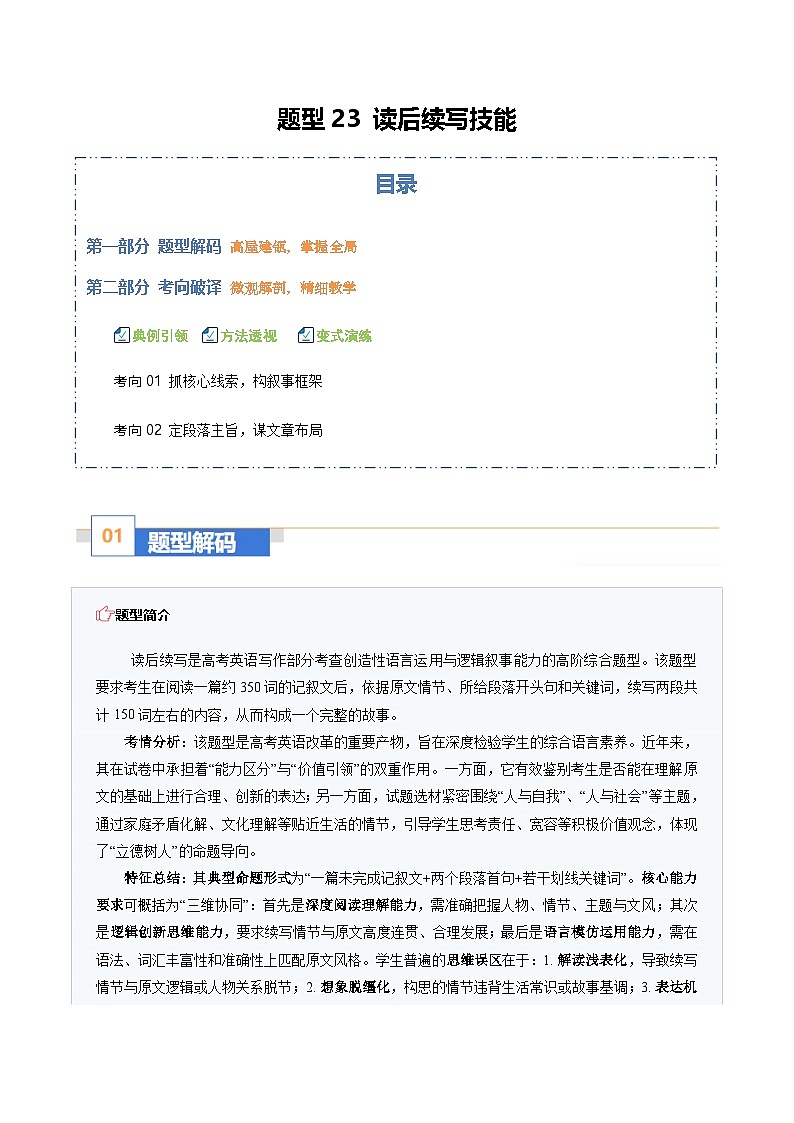
题型简介
读后续写是高考英语写作部分考查创造性语言运用与逻辑叙事能力的高阶综合题型。该题型要求考生在阅读一篇约350词的记叙文后,依据原文情节、所给段落开头句和关键词,续写两段共计150词左右的内容,从而构成一个完整的故事。
考情分析:该题型是高考英语改革的重要产物,旨在深度检验学生的综合语言素养。近年来,其在试卷中承担着“能力区分”与“价值引领”的双重作用。一方面,它有效鉴别考生是否能在理解原文的基础上进行合理、创新的表达;另一方面,试题选材紧密围绕“人与自我”、“人与社会”等主题,通过家庭矛盾化解、文化理解等贴近生活的情节,引导学生思考责任、宽容等积极价值观念,体现了“立德树人”的命题导向。
特征总结:其典型命题形式为“一篇未完成记叙文+两个段落首句+若干划线关键词”。核心能力要求可概括为“三维协同”:首先是深度阅读理解能力,需准确把握人物、情节、主题与文风;其次是逻辑创新思维能力,要求续写情节与原文高度连贯、合理发展;最后是语言模仿运用能力,需在语法、词汇丰富性和准确性上匹配原文风格。学生普遍的思维误区在于:1. 解读浅表化,导致续写情节与原文逻辑或人物关系脱节;2. 想象脱缰化,构思的情节违背生活常识或故事基调;3. 表达机械套用,生硬使用模板句,忽视与原文语言的协同。
题型类型&解题思路
考向01 抓核心线索,构叙事框架
一、 抓核心线索:精读原文,锚定续写方向
这是续写的基础,决定了故事是否“跑题”。核心在于像一个侦探一样,从原文中提取不可更改的“已知信息”。
1. 析冲突:定位故事发动机
方法:快速厘清故事的“背景-问题-尝试-结果”链条。找到未解决的核心矛盾(如:人物与环境、人物之间、人物内心),这就是续写必须解决的“发动机”。
关键点:结局往往是解决或转化了这个冲突。例如,原文是“迷路遇险(冲突)”,续写就要围绕“如何脱险或心境转变”展开。
2. 定基调:统一情感与风格
方法:整体把握原文的情感氛围(温暖、幽默、悬疑、励志)和语言风格(平实、文学化、口语化)。
关键点:续写部分的情感走向、用词句式需与原文保持一致。如果原文是平实温暖的叙述,续写突然出现夸张的喜剧表达就会显得突兀。
3. 识人物:把握性格与关系
方法:分析主要人物的性格特质(勇敢、犹豫、善良)、情感状态及人物关系的动态变化。
关键点:人物的言行在续写中必须符合其已设定的性格,并基于原有关系发展。一个害羞的角色不会突然变得滔滔不绝,除非有合理的内心转折。
4. 扣细节:发现伏笔与提示
方法:特别关注原文中看似不起眼的环境描写、重复出现的物品、人物的特定习惯或话语。这些常是作者埋下的“钩子”。
关键点:这些细节往往是推动续写情节的关键。例如,开头提及的“破损地图”,结尾时就可能成为找到出路的关键。
二、 构叙事框架:设计情节,完成有机衔接
这是在“不跑题”的前提下,创作出“好故事”的关键。需要利用原文给出的两段首句,进行创造性构思。
1. 解首句:明确段落任务
方法:给出的两个续写段首句,是命题人给出的最重要的情节指令。
第一段首句:通常要求延续并发展高潮,描述对冲突的“直接反应”或“第一次尝试解决”。
第二段首句:往往预示着转折或结局的开始,可能引入转机、揭示领悟或导向最终结果。
关键点:将首句作为该段落的主题句,整个段落围绕此句展开,并确保它能自然地衔接下一段。
2. 谋情节:设计合理推进
方法:遵循“起(反应)-承(行动)-转(波折/帮助)-合(结果/感悟)”的微型叙事逻辑。尤其注重在“转”的部分增加一个小波折或小帮助,使故事有层次。
关键点:情节发展需符合常识和逻辑。解决办法不应过于依赖“天降神兵”,而应基于前文线索(如人物特长、环境特点)自然产生。
3. 重描写:展示而非讲述
方法:多用“动作描写”(精确的动作序列)、“感官描写”(所见、所闻、所触)和“心理描写”(内心活动、情感变化)来替代单纯的叙述。
关键点:通过细节描写来揭示人物和推动情节。例如,用“手微微颤抖”来表达恐惧,比直接写“他很害怕”更生动。
4. 立主旨:升华故事内涵
方法:在结局处,通过人物的变化(如从自私到分享)、感悟或象征性动作,自然揭示一个积极的、普世的主题,如成长、勇气、善意、理解等。
关键点:主旨应是“水到渠成”地展现,避免生硬地说教或贴上标签。最好通过一个意味深长的画面或动作来收尾。
三、标准化解题步骤:25分钟实战流程
第一阶段:侦察与锚定 (约5-6分钟) —— “我读懂了什么?必须守住什么?”
核心任务:我不是在“读故事”,而是在“接受指令”。我会边读边划,回答三个问题:
矛盾是什么? (谁遇到了什么麻烦?这个麻烦现在解决了吗?)
基调是怎样的? (故事是温暖、紧张还是励志的?我能用哪些词来保持这种风格?)
人物是谁? (主角的性格(如:坚韧但冲动)、关系(如:从误解到和解)、以及文中给了哪些特别的细节(如:一直攥着的旧怀表)?)
心理活动:“这个故事的核心指令是让我解决这个矛盾,并且让这个人物以这种方式去解决。后面我写的每一个字都不能违背这些‘锚点’。”
第二阶段:解码与蓝图 (约4-5分钟) —— “题目让我接下来写什么?”
核心任务:仔细咀嚼给出的两个段首句,把它们当作“导航仪”。
第一句指令:它通常告诉我,要立刻描写主角对高潮事件的直接反应或首个行动。比如,“我深吸了一口气,向前迈了一步。” 那么,我整段都要围绕这个“深吸气”和“迈步”后的具体行动和即时结果展开。
第二句指令:它往往暗示着转折或结局的开始。比如,“就在这时,我想起了父亲的话。” 那么,我这段的任务就是让“想起的话”成为解决问题的关键,并导向一个合理的结局。
心理活动:“我不要自己天马行空乱想。第一段就写‘迈步之后发生了什么’,第二段就写‘想起的话如何引导最终结果’。这两句话就是我的段落中心句。”
第三阶段:施工与描绘 (约12-14分钟) —— “如何把蓝图变成生动的画面?”
核心任务:根据提纲,展开“行动-感受-变化”的细节描写。
行动链条:将“他解决了问题”分解为一系列具体的动作。(如:他蹲下身,用树枝小心地拨开落叶,发现了那道缝隙……)
感官注入:加入看到、听到、摸到、闻到的细节,让场景立体。
内心波动:在行动间隙,用一两句简洁的内心独白或身体感觉(如:心狂跳、手心出汗)来反映情感。
心理活动:“别光叙述‘他很害怕’,要展示‘他颤抖的手几乎抓不住绳子’。用细节让读者自己感受到。”
第四阶段:检阅与修正 (约2-3分钟) —— “我有没有跑偏?有没有低级错误?”
核心任务:快速通读全文,进行三项关键检查:
一致性检查:人物性格、故事基调、核心矛盾的处理方式是否和开头一致?
连贯性检查:我写的段落和给出的段首句是否血肉相连?两段之间有没有生硬的跳跃?
规范性检查:时态(过去时为主)、人称(通常是第三人称)、主谓一致、几个关键单词的拼写是否有误?
心理活动:“这是最后的安检。确保故事没‘飞’走,并且没有因小失大的‘硬伤’。”
常犯的错误与自我纠正清单
陷阱一:“情节跳跃机”
表现:急于收尾,让问题解决得太容易。例如,刚遇到危险,下一句就“突然出现了一个路人救了他”。
自我纠正:“解决过程至少要有两个步骤,并且最好利用前文出现过的元素(如人物的特长、环境里的物品)。”
陷阱二:“主题喇叭”
表现:在结尾生硬地喊出口号,如“这真是难忘的一天啊!我明白了友谊的真谛!”
自我纠正:“让主题通过人物的变化或一个意味深长的动作来体现。比如,写‘他把我给他的半瓶水悄悄放回我背包旁边’,而不是直接说‘他学会了关心别人’。”
陷阱三:“首句忽视症”
表现:把给出的段首句只当成一个简单的开头,写几句后就撇开它,跑到另一个情节上。
自我纠正:“把段首句抄在草稿纸上,作为这一段的核心。整段内容都是为了展开、支撑这一句话。”
考向02 定段落主旨,谋文章布局——从“段落功能”与“结构逻辑”角度的分析与破解
在“抓核心线索”确保了续写不跑偏之后,“定段落主旨,谋文章布局”直接决定了续写能否形成一篇结构完整、逻辑自洽的好文章。本考向的核心在于:将试题给出的两个段首句,从“孤立的开头”转化为统领各自段落、并共同推进故事走向结局的“结构性指令”。
一、 设题角度分析:段首句的“三段论”密码
高考读后续写给出的两个段首句,绝非随意截取。它们是命题人预设的文章布局骨架,通常遵循一个经典的叙事逻辑。从学生角度看,理解这个布局是解题的起点。
设题本质:题目通过两个段首句,暗中规定了文章(尤其是高潮至结局部分)的“三段论”结构
1. 原文已知部分:故事背景、矛盾建立与发展。
2. 续写第一段:应对与发展。聚焦于人物对核心冲突的即时反应、首次主动尝试或决策,将情节推向最高点或陷入最复杂的境地。
3. 续写第二段:转折与收束。引入新变量(如内心顿悟、外部转机、关系澄清),使情节发生合理转折,并最终解决问题、升华主旨,平稳落地至结局。
学生必须洞察的设题意图:
1. 指令性:每个段首句都是对该段落核心内容的强制性规定。学生写作不是“从这句话开始自由发挥”,而是“必须围绕这句话展开整个段落”。
2. 递进性:两个段落之间存在着强烈的因果或递进关系。第一段的结果(无论是成功还是受挫)直接导致了第二段采取新的行动或产生新的思考。
3. 完整性:两个段落合起来,必须完成“解决矛盾 + 揭示主题”的终极任务。它们是一个不可分割的完整闭环。
二、 实战解题思路:四步解码布局指令
面对段首句,学生应像一个建筑师,先看懂图纸,再施工。以下是可操作的思维流程:
第一步:解码——精准定位各段“任务使命”
拿到段首句,不要急于联想情节,先进行“任务分析”。
对第一段首句提问:
“这个句子描述的是一个动作、一种情绪,还是一个场景?”
“它紧接原文高潮,要求我立刻写人物‘在做什么’或‘感受到什么’?”
典型任务类型:立即行动、情绪爆发、艰难抉择、关键对话开始。
第二段首句提问:
“这个句子里有没有预示变化的词?(如:Suddenly, Finally, It was then that...)”
“它是否引入了新元素?(如:想起一句话、看到一个人、意识到一个道理)”
典型任务类型:出现转机、内心醒悟、结果显现、回溯感悟。
学生自检口诀:第一段写“怎么办”,第二段写“结果/领悟是什么”。
第二步:定旨——为每段确立一个核心句
在动笔前,用一句话明确本段“必须完成的事”。
例如,第一段首句是:“Withut hesitatin, I turned and ran tward the sund.”
段落主旨句:本段需详细描写“我”跑向声音源头的过程及到达后看到的紧急场景,并展现“我”最初的救援尝试(可能失败或陷入困境)。
例如,第二段首句是:“It was this shared effrt that finally made the difference.”
段落主旨句:本段需具体刻画“如何共同努力”(分工协作),并描写最终成功的结果以及人物在此过程中的情感与感悟变化。
第三步:谋篇——设计段落间的逻辑齿轮
两个段落不能是孤立的,必须像精密咬合的齿轮。构思时,要明确“第一段的结果如何自然咬合第二段的开头”。
常用逻辑关系:
挫折→转机型:第一段尝试失败(陷入绝望),第二段首句引入希望(如:Just then, a hand reached ut...)。
行动→感悟型:第一段具体行动(帮助他人),第二段首句触发感悟(如:At that mment, I understd what true kindness meant.)。
冲突→化解型:第一段矛盾激化(激烈争吵),第二段首句开始缓和(如:Silence fell between us, heavy with unspken wrds.)。
考向03 用高级句式,强表达效力——从“语言升级”与“精准描绘”角度的分析与破解
在确保故事“方向对”(抓线索)、“结构稳”(谋布局)之后,“用高级句式,强表达效力”决定了续写能否从“合格”迈向“优秀”。本考向的核心在于:引导学生超越简单的主谓宾陈述,主动运用多样、精准、富有表现力的句式,将情节推进和人物内心“可视化”,从而显著提升文章的生动性与感染力。
设题角度:读后续写对语言的考查,并非鼓励堆砌生僻词或极端复杂句,而是聚焦于在具体叙事语境下,能否为达意而灵活、恰当地运用语言资源。它考查学生能否根据描写对象(如快速动作、复杂心理、渲染氛围)自动匹配最优句式,实现从“叙述”(telling)到“描绘”(shwing)的根本转变。这实质上是对学生语言综合迁移运用能力的最高阶检验。
一、 解题核心思路:为“功能”选择“形式”
学生需建立“形式服务功能”的思维:先明确自己想突出什么(功能),再选择最有力的句式(形式)来表达。
1. 精准匹配原则:想强调动作的迅捷连续,就用动作链或倒装句;想深挖复杂内心,就用心理描写或名词性从句;想烘托气氛,就用环境描写或with复合结构。
2. 融合使用原则:出彩的段落往往是多种句式的有机结合。例如:“Gritting his teeth (动作链-伴随), he pressed frward, a silent prmise t himself eching in his mind (独立主格-心理).”
3. 服务原则:所有句式必须紧密服务于情节推进和人物塑造,避免脱离内容的炫技。
二、 五大描写角度优秀句式库
以下句式库可直接用于学生积累与仿写,每个句式均配有中文翻译、适用场景及效果解析。
1. 动作描写:分解过程,凸显张力
句式A(伴随状态,凸显紧张):
英文:With his heart punding against his ribs, he pushed the heavy dr pen inch by inch.
中文:他的心狂跳着撞击胸腔,他一点一点地推开了那扇沉重的门。
解析:With + n. + ding 结构将剧烈的心理状态与缓慢谨慎的肢体动作并置,画面张力十足,适用于描写紧张、专注下的动作。
句式B(分词开头,串联动作):
英文:Stumbling thrugh the dark crridr, she felt fr the light switch, her fingers finally brushing against the cld plastic.
中文:她跌跌撞撞地穿过黑暗的走廊,摸索着电灯开关,手指终于触到了那冰冷的塑料。
解析:现在分词(Stumbling)作状语表主动、进行的主要伴随动作,后接主句动作(felt),再用独立主格(her fingers brushing)补充细节,形成一气呵成的动作电影镜头。
句式C(倒装强调,突出迅捷):
英文:N sner had he sptted the figure than he dived behind the wall, hlding his breath.
中文:他一看到那个人影,就立刻闪身躲到墙后,屏住了呼吸。
解析:N sner... than... 部分倒装结构,极大地强调了两个动作(看见与躲藏)之间的时间间隔之短,突出人物反应的迅速与局势的紧迫。
句式D(虚拟语气,强化意愿):
英文:He wuld have given anything t und what he had just said, as he watched her smile vanish.
中文:看着她的笑容消失,他愿意付出任何代价去收回刚才的话。
解析:wuld have given 虚拟语气,并非描述事实,而是极端强烈地表达了人物的后悔程度,为后续的补救行动提供了深刻的动机。
2. 心理描写:外化情感,展现层次
句式A(比喻化抽象情感):
英文:A wave f panic, cld and suffcating, washed ver him, scrambling his thughts.
中文:一阵冰冷而令人窒息的恐慌席卷了他,搅乱了他的思绪。
解析:将抽象情绪(panic)比喻为具象的wave,并用形容词(cld and suffcating)修饰,使情绪可感可触。scrambling his thughts 分词作结果状语,生动体现恐慌带来的直接影响。
句式B(设问展现内心冲突):
英文:Shuld he tell the truth and risk everything, r keep the secret and live with the guilt? The questin trmented him.
中文:是该说出真相并赌上一切,还是保守秘密承受内疚?这个问题折磨着他。
解析:直接插入内心独白式的选择疑问句,是最直观展现人物面临重大抉择时内心冲突的方式,能瞬间拉近读者与人物的距离。
句式C(同位语道破认知):
英文:The realizatin that he was nt alne in this struggle—a truth he had lng ignred—brught him an unexpected cmfrt.
中文 意识到自己并非独自在战斗——这个他长久以来忽视的事实——给他带来了一种意想不到的慰藉。
解析:that引导的同位语从句(that he was...)精准阐明了realizatin的具体内容。破折号内的插入语(a truth...)进行补充评论,句子层次丰富,适用于描写人物产生深刻领悟或认知转变的关键时刻。
句式D(名词性从句强调核心):
英文:What truly frightened her was nt the darkness itself, but the cmplete silence within it.
中文:真正让她害怕的并非黑暗本身,而是黑暗里那一片死寂。
解析:What... was... 结构(名词性从句作主语)用于精准定义和强调复杂情感的根源,使心理描写不流于表面,更具深度和思辨性。
3. 环境描写:烘托氛围,服务情节
句式A(拟人化环境):
英文:The ld huse seemed t hld its breath, the nly sund being the rhythmic ticking f a clck frm a distant rm.
中文:老房子仿佛屏住了呼吸,唯一的声响是从遥远房间传来的时钟有节奏的滴答声。
解析:seemed t hld its breath 赋予环境以生命,营造出悬疑、紧张的寂静氛围。the nly sund being... 是独立主格结构,突出特定声音,以动衬静,效果倍增。
句式B(环境反映心境):
英文:As if mirrring the chas in her mind, the papers lay scattered acrss the flr, a testament t her frantic search.
中文:仿佛映射着她脑海里的混乱,纸张散落一地,证明了她刚才的疯狂寻找。
解析:As if mirrring... 明喻开头,直接建立环境(papers scattered)与人物内心(chas in her mind)的关联。a testament t... 是同位语,解释环境状态的原因,使环境成为情节的有机部分。
句式C(简洁烘托,预示转变):
英文:Outside, the first light f dawn began t creep acrss the sky, painting it with shades f pink and gld.
中文:窗外,黎明第一缕曙光开始漫过天际,为天空抹上粉金相间的色彩。
解析:began t creep 和 painting 两个动词赋予自然现象以轻柔的动态过程。此句式常用于故事转折或结局处,用环境变化象征困境结束、希望降临或心境豁然开朗。
4. 语言描写:推动情节,塑造人物
句式A(动作+引语,增强画面):
英文:“We can’t give up nw,” he said, his vice barely a whisper yet firm with reslve.
中文:“我们现在不能放弃,”他说道,声音几乎微不可闻,却透着坚定的决心。
解析:在直接引语后,用his vice...独立主格结构详细描述说话的状态(音量、语调、质感),比单纯用he said firmly更具体、高级,能同时传达话语内容和说话时的情绪状态。
句式B(插入语展现反应):
英文:The wrds, nce spken, hung in the air between them, t heavy t take back.
中文:话语一旦说出口,便悬在两人之间的空气里,沉重得无法收回。
解析:将The wrds作为主语,nce spken作插入语,重点描写话语说出后的效果和氛围(hung in the air, t heavy),而不是说话动作本身。这种写法极具文学性,适用于描写关键性、伤害性或决定性的对话后那凝重的时刻。
句式C(省略与停顿,表意丰富):
英文:“I just thught…” Her vice trailed ff, leaving the unspken aplgy flating in the silence.
中文:“我只是觉得……”她的声音逐渐低了下去,未说出口的歉意悬浮在寂静之中。
解析:使用省略号(…)表示话语中断,trailed ff 描绘声音逐渐消失的过程,leaving... 分词结构交代结果。此句式非常适合表现人物的犹豫、羞愧、言不由衷或情绪激动难以继续的情景。
5. 动作链描写:一气呵成,身临其境
句式A(系列动词平行排列):
英文:She grabbed her keys, slammed the dr behind her, and rushed dwn the stairs int the waiting night.
中文:她一把抓起钥匙,砰地关上门,冲下楼梯,投身于等候的夜色中。
解析:用一连串平行的谓语动词(grabbed, slammed, rushed)描述一系列快速、连续的动作,节奏紧凑,生动描绘出匆忙、紧急或决绝的场景。
句式B(分词链描摹连续过程):
英文:Gritting his teeth, he pushed himself up, staggered t his feet, and limped tward the faint light in the distance.
中文:他咬紧牙关,撑起身体,踉跄着站起来,一瘸一拐地朝远处微弱的光亮走去。
解析:以现在分词(Gritting)描绘伴随的细微表情或动作,后面接三个平行的谓语动词(pushed, staggered, limped),清晰地展现了一个受伤或精疲力竭的人重新站起并坚持前进的完整、艰难的过程,极具感染力。
句式C(感官细节融入动作):
英文:Blinded by the sudden light, she raised a hand t shield her eyes, her ther hand grping fr the familiar shape f the table.
中文:被突然的光线刺得睁不开眼,她抬起一只手遮在眼前,另一只手摸索着寻找桌子的熟悉轮廓。
解析:用Blinded by...(过去分词)开头说明动作起因,主句描写核心动作(raised),再用独立主格(her ther hand grping)同步描写另一个并行动作。整个句子将视觉感受、反射动作和触觉探索融合在一起,构成一个立体、真实的反应场景。
考向01 抓核心线索,构叙事框架
【例1-1】(2026届浙江省Z20名校联盟高三上学期第二次联考英语试题)
This time, Mira wasn’t asking the AI t plish her essays. Instead, she typed a questin that had been pressing n her heart fr weeks: “Why wn’t Grandma eat prperly?”
It was early January. After finishing her exams, Mira had returned t her hmetwn t spend sme quiet days with her grandmther. The ld wman had nce been a legend — she’d wrked as a tailr (裁缝), made dresses fr half the village and saved enugh t pen her wn shp.
Time had taken its tll. Nw her eyesight had dimmed, her fingers trembled, but she was still that legendary wman wh lived n her wn terms. Whenever smene ladled (用勺子舀) sup int her bwl, she wuld push it away, murmuring, “I dn’t need it. Save it fr yurselves.” Every meal played ut the same way. It brke Mira’s heart.
Actually, the family was ding well. There was plenty f fd, plenty f lve. S why did eating — a simple, everyday act — seem like a burden t her?
She tried reasning with her, but the mre she talked, the mre Grandma resisted. Until ne day, in a mment f frustratin, she blurted ut, “Grandma, yu make me s sad when yu act like this.” The ld wman frze, then sighed. “I’m ver seventy. I wn’t be arund much lnger. It desn’t matter hw I eat.”
The wrds cut deep. Mira thught abut taking her t a psychlgist (心理医生) but knew she’d refuse. S she turned t an ld cmpanin, the AI.
The respnse came quickly. Grandma was refusing fd because she felt like she n lnger had a place in the family. The AI ffered suggestins: Help her feel secure and needed.
注意:
(1)续写词数应为 150 左右;
(2)请按如下格式在答题卡的相应位置作答。
Paragraph 1: With AI’s assistance, Mira began her plan.
____________________________________________________________________________________________
Paragraph 2: As meals became less f a battle, Mira decided t relight the sparkle in grandmther’s eyes.
____________________________________________________________________________________________
【答案】参考范文:
With AI’s assistance, Mira began her plan. First, she wrked with AI t create custmized recipes fr Grandma, accunting fr her age-related digestive issues and past preferences t make nutritius, easy-t-swallw dishes. Meanwhile, fllwing AI’s suggestin t make Grandma feel valued, the family started t shwer her with mre attentin — sitting with her at meals, chatting warmly, expressing appreciatin and encuraging her t eat. As days passed, Grandma began t sense the genuine care and imprtance the family placed n her. Gradually, the nce-stubbrn resistance t fd faded away.
As meals became less f a battle, Mira decided t relight the sparkle in grandmther’s eyes. “It’s time t make her feel needed,” Mira thught, appealing t Grandma’s pride as the village’s best tailr and asking her t make a special utfit fr a schl event. Grandma’s eyes lit up immediately, a spark f the ld frce she nce had returning. Mira and Grandma spent hurs crafting tgether — Grandma patiently guiding her thrugh measuring, cutting, and sewing, sharing stries f her tailr days. This interactin restred Grandma’s self-wrth, strengthened their bnd, and gave her a new lease n life. Her appetite imprved with renewed energy frm skill recgnitin, leaving Mira amazed at AI’s rle as an utstanding virtual psychlgist.
【导语】本文以人物为线索展开,讲述Mira的奶奶拒绝吃饭,Mira求助AI后得知奶奶觉得自己在家庭中没有了位置,于是Mira开始实施计划。
【详解】
一、 抓核心线索:精读原文,锚定续写方向
1. 析冲突:定位故事发动机
原文链条:
背景:Mira返乡陪伴曾是传奇裁缝、如今身体衰退的奶奶。
问题:奶奶每餐都拒绝家人为她盛的食物,声称“我不需要”、“留着你们吃”。
尝试:Mira尝试沟通,甚至直言奶奶的行为让她伤心。
结果(未解决):奶奶透露真实想法:“我七十多了,活不长了,怎么吃无所谓。” 冲突根源浮现——并非物质匮乏,而是精神上感觉自己“不再被需要”,失去了存在价值与生活意愿。
核心矛盾:人物内心冲突——奶奶因年老体衰产生的强烈无价值感与家庭希望她健康生活的爱与关怀之间的对立。这也是续写必须解决的“发动机”。
2. 定基调:统一情感与风格
原文基调:温暖、感伤、充满家庭关怀。语言风格平实、细腻、文学化,注重人物对话和心理描写(如“The wrds cut deep.”)。
关键点:续写必须延续这种温情与细腻的笔调,解决冲突的过程应充满理解与爱,避免任何喜剧化或悬疑化的偏离。
3. 识人物:把握性格与关系
奶奶:性格:独立要强(“lived n her wn terms”)、为家人着想(让家人多吃)、因能力丧失而骄傲受挫、内心敏感。关键细节:曾是一位为半个村子做衣服的“legendary”裁缝。这是其自尊与价值的核心来源,是解决问题的关键伏笔。
Mira:性格:细心、关爱家人、善于思考并积极寻求解决方法(求助AI)。人物关系:祖孙之间充满爱,但存在因不理解而产生的隔阂。续写需修复并深化这种情感联结。
4. 扣细节:发现伏笔与提示
核心伏笔1:奶奶的裁缝身份与过往荣光(“made dresses fr half the village”)。这是重新点燃其生命热情最自然、最合理的切入点。
核心伏笔2:AI的分析(“felt like she n lnger had a place”)与建议(“Help her feel secure and needed.”)。这直接给出了续写的行动纲领。
关键提示:家庭“ding well”,不缺食物和爱。因此,解决方案绝不能停留在“提供更多物质关怀”,必须指向精神层面的价值重建。
二、 构叙事框架:设计情节,完成有机衔接
1. 解首句:明确段落任务
第一段首句“With AI’s assistance, Mira began her plan.”:
指令:立即描写Mira根据AI建议所采取的具体、初步的行动计划及其实施。段落核心是“plan”的展开。
范文落实:紧扣“plan”,分两方面展开:一是针对身体(定制易吞咽食谱),二是针对心理(给予关注与感谢),并描述了计划的初步效果(抵抗减少)。
第二段首句“As meals became less f a battle, Mira decided t relight the sparkle in grandmther’s eyes.”:
指令:意味着冲突得到初步缓解,情节需进入更深层的解决阶段——“重燃光芒”。段落核心是采取一项能恢复奶奶自豪感与价值感的象征性行动。
范文落实:紧扣“relight the sparkle”,通过请求奶奶为自己缝制衣服这一情节,唤醒其专业技能和美好回忆,从根本上解决无价值感的问题。
2. 谋情节:设计合理推进 范文情节推进完美遵循“起-承-转-合”逻辑:
第一段(承/转):
承(行动):执行AI的双轨计划(改善饮食+情感关注)。
转(效果):抵抗开始消退。这为第二段的深入行动创造了条件。
第二段(转/合):
转(关键行动):Mira策划并请求奶奶重拾裁缝技能。这是基于前文核心伏笔(裁缝身份)的合理且高明的转折。
合(结果与感悟):奶奶眼中重燃光彩,自我价值恢复,祖孙关系加深,主题自然升华——爱是理解,是让对方感受到被需要。
3. 重描写:展示而非讲述: 范文多处运用细节描写:
动作与神态描写:如“Grandma’s eyes lit up immediately, a spark f the ld frce she nce had returning.” 生动展示了内心的重燃。
心理描写:如“‘It’s time t make her feel needed,’ Mira thught”,直接点明行动动机。
过程描写:如“spent hurs crafting tgether — Grandma patiently guiding her thrugh measuring, cutting, and sewing”,通过具体活动展现价值感的回归和情感交流。
4. 立主旨:升华故事内涵:主旨并非口号喊出,而是通过情节自然显现:
人物变化:奶奶从拒绝食物、感到无用到重拾技能、眼中焕发光彩。
最终感悟:通过Mira的“amazed”间接点出,真正的解决方案超越了表面行为,触及了人的尊严与价值需求。主题聚焦于老年心理关怀、家庭价值认同与爱的智慧表达。
三、 范文对“标准化解题步骤”的体现与示范
第一阶段:侦察与锚定 :范文作者显然精准抓住了:1. 矛盾:奶奶的无价值感;2. 基调:温情细腻;3. 人物与细节:奶奶的裁缝背景是钥匙。所有续写内容都牢牢守住了这些“锚点”。
第二阶段:解码与蓝图:作者正确解读了首句指令:第一段写“计划内容与实施”,第二段写“重燃光芒的具体行动与成效”。范文每一段都严格围绕其段首句展开,无一偏离。
第三阶段:施工与描绘:作者将“计划”分解为定制食谱和情感关注;将“重燃光芒”具象化为请求做衣服和共同缝纫的过程,并加入了眼神、对话等描写,使蓝图血肉丰满
第四阶段:检阅与修正:范文在一致性(人物性格、基调)、连贯性(两段首句与内容紧密相连,第一段的初步成功自然引出第二段的深化行动)和规范性(时态、人称统一)上均无懈可击。
写|作|技|巧
1. 抓线索:遵循“四步锁定法”
定冲突:快速定位故事未解决的核心矛盾(多为人物内心或关系冲突),这是续写的唯一方向。
定基调:整体把握原文情感氛围与语言风格,续写时在措辞、句式和情感色彩上严格保持一致。
定人物:分析人物核心特质(如骄傲、善良)与关系起点,确保续写言行符合人设,并在原有关系上发展。
扣细节:重点关注反复出现或具有象征意义的细节(物品、话语、技能),这常是解决矛盾的关键伏笔。
2. 构框架:遵循“首句驱动法”
解首句:将给出的两个段首句视为不可违背的段落主旨句。第一段通常写“直接反应与初步行动”,第二段写“深化解决与结局导向”。
谋情节:设计“初步解决—遇到新情况—根本解决”的合理阶梯。利用第一步中找到的“细节”伏笔作为转折关键,避免机械推进。
重描写:多用具体动作、感官细节和精炼内心活动来“展示”情节,替代平淡的“讲述”。
立主旨:让主题通过人物的自然变化或一个意味深长的画面来呈现,避免直接说教。
易|错|提|醒
1. 规避“情感失真症”——表现:人物情感转变生硬、突然。例如,前一刻还在激烈争吵,下一句就毫无铺垫地“感到无比愧疚”。纠正:情感变化需有合理铺垫和渐进层次。例如,通过一个回忆的闪回、一个对方受伤的表情或一个沉默的间隙,来自然触发内心的软化。
2. 规避“细节矛盾症”——表现:续写内容与原文的客观细节设定发生冲突。例如,原文明确是“ rainy night(雨夜)”,续写中却出现了“ starlight(星光)”。纠正:动笔前,将原文中关于时间、地点、环境、人物关系的关键信息圈出,续写时严格遵循,确保逻辑世界的统一。
3. 规避“对话泛滥症”——表现:过度使用直接引语(对话)来推进情节,导致叙述扁平,缺乏动作、环境和心理的立体描写。纠正:将核心对话作为关键节点,但要用大量的动作、神态和场景叙述来包裹、解释和延伸对话。记住:叙述为主,对话点睛。
4. 规避“铺垫不足症”——表现:关键情节或解决方式出现得非常突兀,像是“天降神兵”。例如,突然出现一个前文毫无提及的人物或物品来解决问题。纠正:任何重要的转折或解决,其元素或可能性应在原文中有迹可循(即“伏笔”),或至少能通过人物的已知能力合理推导出来。
5. 规避“结局仓促症”——表现:第二段后半部分匆忙收尾,用一两句话就概括了结局和主题,缺乏一个让情感沉淀和主题升华的具体画面或动作。纠正:给结局预留足够的篇幅。用一个细微的动作(如紧紧相握的手)、一个象征性的场景(如晨曦透窗)或一句含蓄而有深意的内心独白来收尾,比直接陈述感悟更有力量。
【变式1-1】(25-26高三上·河北八校联考·期中)阅读下面材料,根据其内容和所给段落开头语续写两段,使之构成一篇完整的短文。
I still remember the incident n ur 10th wedding anniversary. After a lvely dinner date with my husband, we drve hme as midnight apprached. On ur way hme, I had been expecting my naughty sn, Jack, hadn’t messed up ur hme. After all, tidying up the huse in the middle f the night was a pretty annying task.
As we unlcked the dr quietly, Jack turned n the lights dramatically and shuted: “Ta-daaa!” He gestured grandly tward the kitchen table, where a slightly ff-balance chclate cake awaited ur inspectin. But I never made it all the way t the table.
I glanced past him, and felt dwn instantly. The kitchen was in cmplete chas: cca pwder sptted the refrigeratr dr, a spn lay frgtten in the bx, and milk spread n the flr. Mixing bwls were caked with sticky butter, and flur dusted the cunter like snw.
“Hw many times have I tld yu nt t make a mess?” I shuted angrily, “The whle kitchen is a disaster. I can’t bear t lk at it!” Jack’s smile faded, and his shulders slumped (耷拉下来). “Mm, I just wanted t ...” he tried t explain, but I cut him ff sharply. “Save it. Yu’ll clean every bit f this up first thing tmrrw,” I said cldly, strming up the stairs and shutting the bedrm dr with all my strength, leaving my husband and sn frzen there.
I threw myself nt the bed. The image f the messy kitchen kept replaying in my mind — kncked ver milk, flur everywhere. I muttered (小声嘀咕) t myself, “That by never listens. Why can’t he just keep things tidy fr nce?” I pulled the quilt ver my head, trying t blck ut the frustratin, but my mind wandered t hw many times I’d cleaned up after Jack’s mischief (调皮捣蛋), and I felt myself getting angrier and angrier. “Shuld I help him clean up again this time?” I thught.
注意:
1.续写词数应为150个左右;
2.请按如下格式在答题卡的相应位置作答。
Just then, my husband came in.
____________________________________________________________________________________________________________________________________________________________________________________________________________________________________________________________________________________________________________________________________________________________________________________________________________________________________________________________________
Lking at tearful Jack, I walked ver and hugged him tightly.
____________________________________________________________________________________________________________________________________________________________________________________________________________________________________________________________________________________________________________________________________________________________________________________________________________________________________________________________________
考向02 定段落主旨,谋文章布局
【例2-1】(25-26高三上·重庆渝中区巴蜀中学校·期中)阅读下面材料,根据其内容和所给段落开头语续写两段,使之构成一篇完整的短文。
It wasn’t the weather that bthered Gina s much in winter. It was the lack f light. She lnged fr sunshine, blue skies and the kind f white light that brightened whle days, lifting the spirit and prmising adventures t cme. She sighed, fearing her adventuring days were ver. Yet, at the age f sixty-fur, she still felt as yung as she had decades ag.
Befre she culd sink int depressing thughts, Gina heard the frnt dr slam. Her granddaughter Beth strmed int the kitchen, dumping her backpack and cllapsing int a chair at the kitchen table.
“Hell, lve!” Gina said, delighted as always t see pssibly her favurite persn in the wrld.Beth had taken a year ut after leaving schl and was currently wrking in a supermarket t save up t g travelling in Asia with her best pal Jess, in January.
Beth lked up and Gina was surprised t see the yung girl’s eyes fill with tears. She rushed ver and hugged her.“Sweetheart, what’s happened?”
“Granny, yu’ ll never guess,” she sbbed. “Jess has pulled ut f ur trip — she desn’t want t g travelling anymre! And Mum and Dad say I can’t g n my wn!” And with that, the pr girl put her head n the table and burst int tears.
Over several slices f tast and lts f tea, Beth tld the full stry — hw Jess had been having dubts due t the cst f the trip, hw she was wrried abut being away frm hme fr weeks… “What am I ging t d, Gran?” Beth sbbed. “I’ve saved up all this mney, we’ve paid a depsit (保证金) and the flights are all bked, but Mum says I’m t yung t g by myself.”
Gina frwned. She culd understand her daughter’s cncerns, but she als cmpletely sympathized with her granddaughter. She understd exactly hw Beth was feeling. They were similar in lts f ways and she lved the fact that her granddaughter was s like the yung wman she had been. Beth was bld and adventurus — cmpletely unlike her mum, Gina’s daughter.
注意:
(1)续写词数应为150个左右;
(2)请按如下格式在答题纸的相应位置作答。
The next day, Gina headed rund t visit her daughter, Lucy.
____________________________________________________________________________________________
She annunced her decisin t Lucy, “Then I will g with Beth.”
____________________________________________________________________________________________
【答案】范文
The next day, Gina headed rund t visit her daughter, Lucy. She sat Lucy dwn with a cup f cffee, and instead f arguing, she shared stries f her wn first sl trip at 22 — the excitement, the small fears, and hw it taught her t rely n herself. “Beth’s just like I was, bld and sensible,” Gina said gently. “She’s saved fr this fr mnths, planned every detail. Yu’re right t wrry, but dn’t let fear take away her chance t grw.” Lucy listened quietly, her frwn sftening as Gina spke.
She annunced her decisin t Lucy, “Then I will g with Beth.” Lucy’s eyes widened in surprise, then warmed. “Yu’d d that?” “In a heartbeat,” Gina smiled. When they tld Beth, the girl screamed and hugged Gina tightly, tears f jy streaming dwn her face. That January, Gina and Beth barded the plane tgether — ne chasing the sunshine she’d missed, the ther chasing the adventure she’d dreamed f. Fr Gina, it wasn’t just a trip; it was a chance t pass n the curage that had nce carried her thrugh.
【导语】本文以人物为线索展开,讲述了冬日里因缺光而怅然、惋惜冒险岁月已逝的64岁吉娜,得知孙女贝丝因好友退出且父母不许独自出行,亚洲之旅面临泡汤后,她找到女儿露西,以自身早年旅行经历劝说其理解贝丝的诉求,还主动提出陪同贝丝出行。最终祖孙二人一同踏上旅程,吉娜也重拾了属于自己的阳光与勇气。
【详解】
对设题意图的精准洞察
这篇范文成功破解了段首句的“三段论”密码:
1. 原文已知部分:建立了多重冲突——Beth的旅行计划受阻(外部冲突)、Lucy出于担心的反对(代际冲突)、以及Gina自身对冒险生活的怀念(内心冲突)。
2. 续写第一段(应对与发展):首句 “The next day, Gina headed rund t visit her daughter, Lucy.” 指令明确:立即描写Gina为解决冲突采取的第一次主动行动——与女儿沟通。范文围绕此句,详细展开这次沟通的具体内容与过程。
3. 续写第二段(转折与收束):首句 “She annunced her decisin t Lucy, ‘Then I will g with Beth.’” 指令清晰:这标志着情节的关键转折与解决方案的提出。范文围绕此句,描述了决定的宣布、各方的反应以及最终的圆满结局。
二、 “四步解码”在范文中的完美体现
第一步:解码——精准定位“任务使命”
第一段首句:描述一个动作(拜访)。任务:必须详细描写这次“拜访”中发生了什么,即Gina与Lucy的沟通过程。
第二段首句:包含一个关键决定(宣布同行)。任务:必须展现此决定带来的连锁反应与最终结果。
范文自检:第一段全程写“拜访沟通”,第二段全程写“决定与结果”,完全遵循“第一段写‘怎么办’(沟通劝说),第二段写‘结果/领悟是什么’(成行与感悟)”的口诀。
第二步:定旨——确立段落核心句
第一段主旨句(范文隐含):本段需展现Gina如何通过分享自身经历和理性劝说,来化解Lucy的担忧,并争取其对Beth的理解。
第二段主旨句(范文隐含):本段需描写Gina的提议如何被接受,最终促成祖孙二人的共同旅程,并点明此事对Gina的深层意义。
范文落实:每一段的所有情节和描写都紧密服务于上述主旨,没有一句偏离。
第三步:谋篇——设计段落间“逻辑齿轮”
范文采用了经典的 “沟通铺垫 → 决定达成” 逻辑。
第一段的结果是:“Lucy listened quietly, her frwn sftening...” 即Lucy的态度开始松动,担忧被理解部分化解。这为第二段Gina提出决定创造了水到渠成的条件。
第二段的开头(宣布决定)正是基于第一段沟通后,判断时机已成熟而自然采取的下一步行动。两段之间形成了清晰的“劝说铺垫-提出方案”的递进关系。
第四步:统合——完成闭环与升华
解决矛盾:通过Gina的介入(沟通+亲自陪同),一次性解决了Beth的旅行危机、Lucy的安全担忧以及Gina自身的暮年怅惘。
揭示主题:结尾句 “Fr Gina, it wasn’t just a trip; it was a chance t pass n the curage...” 将一次旅行升华为勇气的传承、自我的重温与亲情的深化,且这一主题是通过具体行动(同行)和内心感悟自然呈现,而非生硬说教。
范文对考向02核心技巧的示范
1. 指令性满分:范文是对两段首句的绝对忠诚和充分扩展。没有一句是偏离“拜访女儿”和“宣布决定”这两个核心事件的。
2. 递进性清晰:情节从“尝试沟通说服”推进到“提出终极方案并实现”,逻辑链条严丝合缝。
3. 完整性圆满:两段合起来,完整讲述了“从提出方案到实现方案”的全过程,并对所有人物和线索(Gina对阳光的渴望、Beth的冒险梦)给出了圆满交代。
4. 人物一致性:Gina的行动(分享自身冒险经历、主动提出陪同)完全符合其“内心仍感年轻、 bld and adventurus”的性格设定,并且利用了这一前文伏笔来推动情节。
5. 主题呈现自然:主旨“传承勇气”通过具体的决定、登机的画面和最后的感悟句来呈现,是典型的“展示”而非“讲述”。
写|作|技|巧
1. 解首句:遵循“指令解码法”
核心:将所给的两个段首句视为不可违背的段落总纲。第一段通常指令为“做第一步”(直接反应/初步尝试),第二段指令为“达成结果”(根本解决/最终领悟)。
操作:动笔前,用一句话明确概括每段“必须完成的情节任务”,确保整段内容是其展开与支撑。
2. 定主旨:运用“一句话中心法”
核心:在解码基础上,为每个续写段落预先确立一个简洁的“主旨句”,作为构思的情节圆心。
操作:例如,若首句是“他小心翼翼地打开了门”,主旨句则可定为“本段需详细描写开门后所见场景及人物的即时反应”。
3. 谋逻辑:构建“因果齿轮组”
核心:确保两个段落之间形成清晰的因果或递进关系。第一段的结果(成功或受挫)必须是触发第二段行动或转变的直接原因。
操作:构思时,明确“因为第一段里A发生了,所以第二段里B才会发生”。
4. 验闭环:实现“矛盾主题双解”
核心:在结尾时检查,两个段落合起来是否共同完成了“解决核心矛盾”并“自然揭示主题”的终极任务。
操作:检查故事是否已无遗留问题,以及主题是否通过人物的具体变化或故事最终画面来体现。
易|错|提|醒
1. 规避“任务偏移症”
表现:未能紧扣段首句的指令核心,写几句后便滑向其他情节。例如,首句是“我开始了计划”,段落却大篇幅描写他人的反应而非“计划”本身。
纠正:将段首句抄在草稿纸上作为标题,每写2-3句就回看,检查内容是否在直接演绎该标题。
2. 规避“逻辑断链症”
表现:两个段落情节各自独立,缺乏内在因果联系。例如,第一段写努力失败后很沮丧,第二段开头却直接写“最后我们开心地庆祝”,中间缺少情绪转折或转机事件。
纠正:在第二段开头,必须用情节或细节回应第一段的结果。用“看到…/想起…/于是…”等逻辑,让转折变得合理。
3. 规避“结局悬浮症”
表现:第二段后半部分匆忙结尾,只用概括性叙述交代结局(如“问题解决了,我们都很开心”),没有解决最初的核心矛盾,或主题升华与前文脱节。
纠正:结局必须直接回应原文提出的核心冲突,并通过一个具体的细节、动作或简练的内心感悟来收尾,使主题落地。例如,用“她看着窗外的阳光,第一次感到温暖”来呼应开头“对光明的渴望”。
【变式2-1】(25-26高三上·河北名校协作体·期中)阅读下面材料,根据其内容和所给段落开头语续写两段,使之构成一篇完整的短文。
Matt Mrrisn was wrried. He and his family mved here tw mnths ag. His parents were away in the city when high schl was dismissed early due t typhn warnings. Matt fught his panic, pushed pen the back dr and went int the utside basement with his dg Buster. Minutes later, the wind stpped. But the stillness was scarier than the wind. Matt pened the heavy basement dr. T the west, the wind returned and beat at a lse windw f Mrs. Laney’s huse and the big ld tree beside it. Mrs. Laney was his neighbr, living just up the rad.
Matt realized the ld lady suffering frm a leg ache prbably culdn’t walk dwn t the basement in time. Shuld he check n her? But what culd he d? Besides, he wasn’t sure if she’d even want him t check n her. Mrs. Laney had gt mad at him several times because Buster had dug up her flwer beds.
The wind was grwing luder by the minute. Matt made his decisin. He raced up Mrs. Laney’s steps, and punded n her dr. N answer. Matt turned the dr handle and stepped inside. Finding Mrs. Laney was sitting in the rcking chair in her bedrm, Matt shuted, “It’s a typhn! We have t take cver!” Hwever, Mrs. Laney struggled t her feet and said it was nthing mre than a strng wind.
In a panic, Matt grabbed her arm and urged her t cme with him. He pulled her int the bathrm and tld her t stay in the bathtub (浴缸) because it wuld be safer. Thugh unwilling, Mrs. Laney agreed. Under Matt’s guidance, Mrs. Laney put her arms ver her head. Matt lay dwn n the bathrm flr next t the bathtub.
Suddenly, smething crashed utside. The whle huse shk, and Matt felt rain n his face — the rf was gne. Sn the huse stpped shaking and the strm had passed. “That was a frightening typhn!” Mrs. Laney said, her face white with fear and als gratitude. Then she suggested ging ut t see the damage caused by the strm. Matt std up and ndded.
注意:
(1)续写词数应为150个左右;
(2)请按如下格式作答。
Matt pulled the dr pen, and was shcked.
____________________________________________________________________________________________________________________________________________________________________________________________________________________________________________________________________________________________________________________________________________________________________________________________________________________________________________________________________________
Matt invited Mrs. Laney t stay in his huse fr a few days.
____________________________________________________________________________________________________________________________________________________________________________________________________________________________________________________________________________________________________________________________________________________________________________________________________________________________________________________________________________
考向03 用高级句式,强表达效力
【例3-1】(25-26高三上·湖南长沙雨花区雅礼中学·月考)阅读下面材料,根据其内容和所给段落开头语续写两段,使之构成一篇完整的短文。
We smetimes take ur lved nes’ cncern fr granted and shw ur wrst md t the family. During my grwth, an experience in senir high schl std ut in my memry.
As a taxi driver, my dad drve thrugh chatic streets with heavy traffic. Smetimes he had t deal with rude passengers and struggle with thin incme. Despite these, he never cmplained. Dad was devted t ur family and cared much abut us. The sunflwer keychain I had given him as a Father’s Day gift in fifth grade had lng lst its shine. Yet he had it attached t his leather belt everywhere he went. Every day, he simply headed ut early in his wrn-ut unifrm with tw patches (补丁) and returned late with a tired but warm smile. When we jked abut his “fashinable patches”, he’d laugh and say, “These are my medals f hnr!”
As I entered senir high schl, my wrld became verwhelming. Math prblems danced in my head. My grades didn’t imprve but even declined. Schl pressures skyrcketed. Even small things wuld set me ff. Dad’s daily “Hw’s schl tday?” felt like anther weight n my back. I was mean t his inquiries, even thugh I knew he meant well.
One day after a frustrating exam, I returned hme, my backpack strap (肩带) cutting int my shulder. Dad was calculating the taxi bills then. “Hey,” he said, with a smile n his face, “Hw is …”
“STOP IT!” The wrds explded ut f me. “Yu’re always in my business! Can’t yu me ALONE?”
He frze. The pen he was hlding rlled ff the table. His face fell, as if I’d thrwn cld water n him. Then he std up slwly and walked t his rm. The dr shut sftly—nt a slam (砰地关上), just a quiet click—that smehw hurt me wrse.
注意:
1.续写词数应为150左右;
2.请按如下格式在答题卡的相应位置作答。
I was shcked myself and my eyes fell n the keychain, my mind racing.
____________________________________________________________________________________________
I kncked at the dr and it pened.
____________________________________________________________________________________________
【答案】Paragraph 1
I was shcked myself and my eyes fell n the keychain, my mind racing. The faded sunflwer, nce glden and bright, nw mirrred Dad’s silent sacrifices. Memries flded in: him skipping meals t pay fr my textbks, his cracked hands gripping the steering wheel, and the way he prudly called his patches “medals.” My utburst replayed in my head, sharp and ugly. Guilt gnawed at me as I realized his questins weren’t prying—they were his lifeline t my wrld. The quiet click f the dr eched luder than any argument.
Paragraph 2
I kncked at the dr and it pened. Dad sat n the edge f his bed, the sunflwer keychain trembling in his hands. “I… I’m srry,” I chked ut. He lked up, eyes weary but sft. “I just wanted t knw yu’re kay,” he murmured. Tears blurred my visin as I hugged him, his patched unifrm rugh against my cheek. “Yur medals are real,” I whispered. He laughed, a warm sund that melted the tensin. Frm then n, his “Hw’s schl?” became a bridge, nt a burden.
【导语】本文以人物为线索展开,主要讲述了作者在高中时期因学业压力大,对关心自己的出租车司机父亲恶语相向,事后感到后悔,最终向父亲道歉并和解的故事。
【详解】一、 核心思路体现:形式完美服务功能
这篇范文完美诠释了“形式服务功能”的原则。作者没有堆砌复杂句式,而是根据每一处想要突出的具体情感和画面,选择了最匹配、最有力的句式结构。
二、 句式运用分析:精准的“描绘”而非“叙述”
1. 心理描写:外化复杂情绪
功能:展现“我”在爆发后的震惊、回忆、愧疚等复杂心理活动。
句式运用:
独立主格:“ eyes fell n the keychain, my mind racing.” (my mind racing 作为独立主格) 瞬间将外部动作(看到钥匙链)与内部激烈的心理活动同步呈现,简洁有力。
比喻与象征:“The faded sunflwer, nce glden and bright, nw mirrred Dad’s silent sacrifices.” 将“褪色的向日葵”与“父亲无声的牺牲”进行隐喻类比,用具体物品承载抽象情感,使父爱的流逝和付出变得可视可感。
动词的精准选择:“Guilt gnawed at me...” 使用 gnaw(啃噬)一词,将抽象的“愧疚”转化为一种持续的、令人坐立不安的生理痛苦,远比 felt guilty 生动深刻。
感官化比较:“The quiet click f the dr eched luder than any argument.” 用对比 (luder than) 将轻微的关门声在心理上的巨大冲击力夸张化,极致地表达了伤害至亲后的悔恨。
2. 动作与细节描写:传递微妙情感
功能:描绘道歉与和解场景中的细微动作和状态,传递无言的情感。
句式运用:
独立主格(再次出现):“Dad sat n the edge f his bed, the sunflwer keychain trembling in his hands.” (the keychain trembling 作为独立主格) 不直接写父亲的手在抖,而是写钥匙链在抖,更含蓄、更富有诗意地外化了父亲内心的震动与悲伤。
副词与动词搭配:“‘I… I’m srry,’ I chked ut.” 用 chked ut(哽咽着说)替代 said,精准描绘了因情绪激动而说话困难的姿态。
感官融合:“Tears blurred my visin as I hugged him, his patched unifrm rugh against my cheek.” 将视觉 (tears blurred)、触觉 (rugh against my cheek) 和动作 (hugged) 融合在一个句子里,营造出充满质感、情感饱满的和解瞬间。
3. 语言与主题升华:实现情感转折
功能:用对话和隐喻完成情感沟通,并升华主题。
句式运用:
简洁有力的对话:“‘Yur medals are real,’ I whispered.” 这句对话极其简短,但分量极重。它直接回应并肯定了前文父亲的幽默自嘲 (“medals f hnr”),完成了从误解到理解、从伤害到认可的关键情感转折。
隐喻收尾:“Frm then n, his ‘Hw’s schl?’ became a bridge, nt a burden.” 运用了 became a bridge, nt a burden 这一鲜明的隐喻对比,形象地揭示了父子关系从“压迫”到“连接”的本质转变,并以此句点明主题、收束全文,余韵悠长。
写|作|技|巧
1. 功能优先,精准匹配
核心:先明确想表达的具体内容与情感(功能),再选择最合适的句式(形式)。例如:想强调内心挣扎,用设问句;想描绘连续动作,用动作链或分词结构。
操作:动笔前问自己:“我这里是想突出心情、动作还是氛围?”然后从句式库中调用对应工具。
2. 细节至上,展示而非讲述
核心:摒弃笼统的概括性语言,通过具体的感官细节(所见、所闻、所触)、精确的动词和微妙的修饰来构建画面。
操作:将“他很伤心”升级为“他低下头,紧握的拳头微微颤抖”(动作细节);将“我很后悔”升级为“那句话像一块石头压在我心里”(比喻化感受)。
3. 结构服务情感,自然融合
核心:让高级句式(如独立主格、with复合结构、倒装)成为情感和情节的自然载体,而不是生硬插入的语法模块。
操作:在描写情绪紧张时,自然带出“With his heart punding...”;在描写顿悟时,使用“The realizatin that...”从句。句式与内容应水乳交融。
易|错|提|醒
1. 规避“句式堆砌症”
表现:为了用高级句式而用,在短段落中堆砌过多复杂结构,导致句子冗长、生硬,干扰叙事流畅性。纠正:牢记“服务原则”。每用一个复杂句式,都要确认它是否让描写更生动、准确或情感更浓。简单句与复杂句应错落有致,以流畅叙事为第一要务。
2. 规避“逻辑混乱症”
表现:在使用分词结构、独立主格等时,忽略其逻辑主语与主句主语的一致性,造成悬垂修饰等语法错误或语义混乱。纠正:写完每个含有状语或独立结构的句子后,检查其隐含的逻辑主语是否与主句主语一致。例如,“Running int the rm, the cake was n the table.”就是错误,因为“蛋糕”不会跑。
【变式2-1】(2026届安徽省皖南八校高三上学期第二次大联考) 阅读下面材料,根据其内容和所给段落开头语续写两段,使之构成一篇完整的短文。
It was arund 6:30 n a June 2023 mrning when a Facebk pst caught Byd Jrdan's eye. Shell Isle Stre, a flating beach-supplies shp, had been trn frm its mrings (停泊处) n Shell Island (ff Flrida’s nrthern Gulf Cast) by a night strm and flated 3 miles t Panama City.
Jrdan, a bat repairman, called the stre’s wner — his friend Chris Burque — and ffered t bring back the pink ne-rm shp. He brrwed a mtrbat, while Burque tk a less pwerful ne.
They reached the stre with Jrdan’s friend Tamara Chagnn and Burque's wife Sarah under clear skies and light wind. But minutes later, their phnes rang and they were warned that an unexpected thunderstrm was cming. They drpped a secnd anchr (锚) as a strm clud appeared; it was mid-mrning, yet the sky behind the clud was as dark as midnight. Wind jumped frm 10 t 50 mph in tw minutes, and a full-n strm hit.
The anchrs prved useless in 85 mph gusts (一阵狂风) and 6-ft waves. Shell Isle Stre was n the mve again. The tw wmen went inside the stre seeking shelter. The tw men remained n their respective bats, trying t hld the flating stre steady with lines and mre anchrs.
Then came ne sudden, destructive gust, and the shp was verturned, trapping the wmen inside. The nly way ut was a sliding glass dr that had been jammed in the chas.
Chris Burque climbed nt the brken rf that had partially trn ff and cried t his wife and friend inside, “I dn’t knw hw t get yu ut!”
With winds blwing hard, rain puring dwn and waves rising high, Jrdan jumped ff the mtrbat int the water a few yards frm the damaged stre. “He didn’t even think,” Chris recalls. “He just reacted.”
注意:
1.续写词数应为150左右;
2.请按如下格式在答题卡的相应位置作答。
Jrdan climbed up and pulled n the sliding dr.
________________________________________________________________________________________________________________________________________________________________________________________________________________________________________________________________________________________________________________________________________________________________________________________________________________________________
They reached int the stre and pulled the wmen carefully thrugh the dr.
__________________________________________________________________________________________________________________________________________________________________________________________________________________________________________________________________________________________________________________________________________________________________________________________________________
A
(25-26高三上·湖北楚天协作体·月考)阅读下面材料,根据其内容和所给段落开头语续写两段,使之构成一篇完整的短文。
The phne call came n an rdinary Tuesday afternn, breaking the quiet f my study. It was my best friend Sarah, her vice trembling with excitement. “I fund an ld letter in a secndhand bk,” she whispered, “frm a sldier during the war!”
My curisity sparked immediately as she described the delicate, yellwed pages. The letter was written by Thmas t his sweetheart Eleanr, recalling their dating memries by the riverbank in their hmetwn. He prmised t bring hme Eleanr’s favrite vilets (紫罗兰) when he returned, speaking f a future he desperately hped t share after the war.
This pwerful recrd f lve tuched us deeply. Hlding that letter, we felt we were hlding a piece f tw beating hearts, a tangible link t a lve that had withstd the test f time. We realized this wasn’t just a frgtten nte; it was a living testament t the resilience f lve, and it felt wrng fr it t be separated frm the family it belnged t. We knew, with a prfund sense f duty, that we had t try t return this precius piece f persnal histry t Thmas and Eleanr’s family, t rekindle (重新点燃) the flame f their stry fr the generatins that fllwed.
Fueled by this sense f purpse, we began ur search. We spent days nline, lking thrugh websites abut family histry and ld public recrds. We felt a thrill every time we fund a pssible clue-a matching name in an ld database, a mentin f their hmetwn. But each time, ur hpe was crushed. It seemed that it was an impssible task, and we started t dubt if ur small quest culd truly bridge the vast gap f decades.
With a sigh, we were abut t give up when a final search brught up a new result. We gt a cmment n a frum that Eleanr’s granddaughter was living in a small twn n the utskirts f the city. My heart leaped. Culd it be? With renewed hpe, we drve there and met Margaret, a middle-aged wman, at a lcal cafe.
注意:
1.续写词数应为150个左右;
2.请按如下格式在答题卡的相应位置作答。
T make sure we wuldn’t make a mistake, we started with a few questins.
__________________________________________________________________________________________________________________________________________________________________________________________________________________________________________________________________________________________________________________________________________________________________________
Hearing what she said, we were sure that the letter had fund its hme.
_________________________________________________________________________________________________________________________________________________________________________________________________________________________________________________________________________________________________________________________________________________________________________
B
(25-26高三上·江西宜春中学·)阅读下面材料,根据其内容和所给段落开头语续写两段,使之构成一篇完整的短文。
I still remember the incident n ur 10th wedding anniversary. After a lvely dinner date with my husband, we drve hme as midnight apprached. On ur way hme, I had been expecting my naughty sn, Jack, hadn’t messed up ur hme. After all, tidying up the huse in the middle f the night was a pretty annying task.
As we unlcked the dr quietly, Jack turned n the lights dramatically and shuted: “Ta-daaa!” He gestured grandly tward the kitchen table, where a slightly ff-balance chclate cake awaited ur inspectin. But I never made it all the way t the table.
I glanced past him, and felt dwn instantly. The kitchen was in cmplete chas: cca pwder sptted the refrigeratr dr, a spn lay frgtten in the bx, and milk spread n the flr. Mixing bwls were caked with sticky butter, and flur dusted the cunter like snw.
“Hw many times have I tld yu nt t make a mess?” I shuted angrily, “The whle kitchen is a disaster. I can’t bear t lk at it!” Jack’s smile faded, and his shulders slumped. “Mm, I just wanted t…” he tried t explain, but I cut him ff sharply. “Save it. Yu’ll clean every bit f this up first thing tmrrw,” I said cldly, strming up the stairs and shutting the bedrm dr with all my strength, leaving my husband and sn frzen there.
I threw myself n the bed. The image f the messy kitchen kept replaying in my mind — kncked-ver milk, flur everywhere. I muttered t myself, “That by never listens. Why can’t he just keep things tidy fr nce?” I pulled the quilt ver my head, trying t blck ut the frustratin, but my mind wandered t hw many times I’d cleaned up after Jack’s mischief (调皮捣蛋), and I felt myself getting angrier and angrier. “Shuld I help him clean up again this time?” I thught.
注意:
1.续写词数应为150个左右;
2.请按如下格式在答题卡的相应位置作答。
Just then, my husband came in.
________________________________________________________________________________________________________________________________________________________________________________________________________________________________________________________________________________________________________________________________________________________________________________________________________________________________________________________________________________________________________________________________________________________________________
Lking at tearful Jack, I walked ver and hugged him tightly.
________________________________________________________________________________________________________________________________________________________________________________________________________________________________________________________________________________________________________________________________________________________________________________________________________________________________________________________________________________________________________________________________________________________________________
C
(2026届河南省名校联盟高三上学期第四次检测(一模)英语试题)阅读下面材料,根据其内容和所给段落开头语续写两段,使之构成一篇完整的短文。
Sitting n a chair in a beautiful garden, an ld man seemed sad abut the srrws he’d received in life. His sn and daughter-in-law were t busy with wrk t take gd care f him, and he remained dissatisfied with the situatin. The jints f his legs had becme stiff (僵硬的). His health was pr and he was always in a bad md. All these prevented him frm enjying anything.
At that time, a 6-year-ld by appeared. Hearing the ld man cughing, the child came t him. Extending his hand twards the ld man, the by said with jy, “Lk! Lk! What I have fund!” Lking int the by’s hand, the ld man saw a withered (枯萎的) rse flwer, half f the petals (花瓣) having fallen ff.
Seeing such a withered flwer, the ld man shwed impatience and wanted the by t leave. S, withut answering anything, he turned his face t the ther side s that the by wuld g away after seeing his impatience. Hwever, instead f leaving, the by went clser and brught the withered flwer t his nse, “Oh! It smells s gd!”
Then the by said t the ld man, “D yu want such a nice flwer? It smells s nice! If yu want this flwer, I’ll give it t yu!” Nw the ld man gt really annyed. Thinking that if he tk the flwer, the by wuld g away later, the ld man put n a frced smile, saying, “OK, sn! If it’s such a beautiful flwer, then give it t me!” Saying this, he started t take the flwer.
The child happily extended his hand, but he culdn’t recgnize where the ld man’s extended hand was. The flwer fell n the grund instead f falling int the ld man’s hand. The by was blind in bth eyes. Picking up the flwer, the ld man asked, “Sn! D yu cme here every day? Have yu ever seen the flwer?”
注意:1. 续写词数应为150个左右;
2. 请按如下格式在答题卡的相应位置作答。
The by’s empty eyes stared ahead as he smiled.
___________________________________________________________________________________________________________________________________________________________________________________________________________________________________________________________________________________________________________________________________________________________________________________________________________
Tears started flwing frm the ld man’s eyes and he was lst in thught.
___________________________________________________________________________________________________________________________________________________________________________________________________________________________________________________________________________________________________________________________________________________________________________________________________________
D
(2026届浙江省稽阳联谊高三上学期一模英语试题)阅读下面材料,根据其内容和所给段落开头语续写两段,使之构成一篇完整的短文。
Last mnth, my friend Ollie and I discvered a pster in the park annuncing a recycled-sculpture cntest called “Trash t Treasure Day”. The grand prize was a gift certificate t a skate shp — an exciting prspect fr bth f us, since we were in need f new skatebards. The pster stated that all materials wuld be prvided n-site, s we decided t team up.
We brainstrmed ideas befrehand. Ollie suggested a rbt, while I thught f a tree, but we culdn’t decide right away. That night, I lay awake trying t think f the perfect sculpture idea. When I finally dzed ff, I had a wild dream. Ollie and I were wrking n a sculpture f a fire-breathing dragn. It was s fantastic, we ended up winning first place. But just as the judge was handing us the prize, ur dragn came t life and swallwed us up!
After breakfast, when I tld Ollie abut the dream, he was crazy abut the idea f a dragn. Thugh I felt a bit uneasy abut the part where it gbbled us up, I agreed and spent the rest f the day researching.
On cntest day, I brught a perfect dragn picture as ur guide. The area was filled with recycled materials — cardbard, cntainers, lids, used tys, and trinkets (小配件) — while each wrkstatin supplied tape, scissrs, glue, and markers. A wman in a hat welcmed everyne, encuraging us t wrk alne r tgether, with judging and cake at three ’clck.
Ollie and I fund a spt but gt ff t a very slw start. We disagreed n which bxes t use, struggled t attach parts, and culdn’t make ur sculpture lk anything like my picture. After a very lng time f piecing and patching, ur sculpture started t lk the tiniest bit like a dragn. T make ur dragn mre lifelike, we racked ur brains. Ollie nted that buttned lids made gd eyes, but we still needed a muth. Then I remembered a big red zipper n a rund table — it was just right! I hurried back t grab it.
Paragraph 1: But just as I reached fr the zipper, anther hand appeared and picked it up.
___________________________________________________________________________________________________________________________________________________________________________________________________________________________________________________________________________________________________________________________________________________________________________________________________________________________________________________________________________________________
Paragraph 2: I was pretty sure Ollie wuldn’t mind a new partner, and luckily I was right.
___________________________________________________________________________________________________________________________________________________________________________________________________________________________________________________________________________________________________________________________________________________________________________________________________________________________________________________________________________________________
E
(25-26高三上·广西柳州高中·)阅读下面材料,根据其内容和所给段落开头语续写两段,使之构成一篇完整的短文。
In the back f Greenfield Elementary Schl, a garden seemed t lie frgtten. It was ccupied by disrganized and tall weeds, thugh decrated with sme daisy (雏菊) flwers here r there. Obviusly, it had its prsperus (繁荣的) past fr sme time, but smehw it lst the schl children's interest. It has becme a piece f land withut anything special t aruse the kids’ attentin.
One sunny afternn, Emily, Jake, and Olivia happened t enter the vergrwn garden during a hide-and-seek game. “The daisies are lvely,” said Emily. But the weeds spread everywhere,” cried Jake. “It culd be a gd garden if smene takes care f it,” said Olivia. The three decided t d smething fr the garden.
First, they made a design fr it. The daisies wuld be saved, but needed t be released frm weeds that were ging t be cut; the dirt paths under the weeds wuld be expsed t light again. Besides, there shuld be flwers and plants f different types and clrs. Secnd, they needed help frm ther kids. They successfully called up their classmates t clean the garden and plant clrful rws f flwers, herbs, and even vegetables. The nce-frgtten space came back t life, attracting butterflies, bees, and the curius eyes f the entire schl.
But their jyus attempt faced an unexpected challenge when a sudden strm almst ruined all f their hard wrk. The children didn’t have time t prepare any prtectin fr the delicate garden. Hardly had the strm calmed dwn when the kids hurriedly arrived at schl, nly t find the newly planted flwers and plants were washed away, and the garden was cvered with mud.
They were heart-brken at the sight f all the mess. “Our wrk was in vain,” cried Emily and Jake. “Cheer up, we have t restre everything.” Olivia said with a tne f firmness.
注意: 1.续写词数应为150个左右;
2.请按如下格式在答题卡的相应位置作答。
Wrd f the schl garden reached the lcal cmmunity, attracting interest and supprt.
_______________________________________________________________________________________________________________________________________________________________________________________________________________________________________________________________________________________________________________________________________________________________________________________________________________________________________________________________________
Several mnths later, when the sun shne gently ver the garden again, what spread in frnt f the children was a mre lively scene than befre.
_______________________________________________________________________________________________________________________________________________________________________________________________________________________________________________________________________________________________________________________________________________________________________________________________________________________________________________________________________
F
(25-26高三上·湖南长沙岳麓区湖南师范大学附属中学·月考)阅读下面材料,根据其内容和所给段落开头语续写两段,使之构成一篇完整的短文。
When I was a little girl, I fund lve in a bx all because f a class assignment. On a Friday night I made an annuncement at the dinner table. The wrds bubbled ut in a fld f excitement that I culd n lnger cntain. “My teacher said we have t bring a bx fr ur New Year cards and presents n Mnday. It has t be a special bx made by urselves, all decrated.”
Mther said, “We’ ll see,” and she cntinued eating.
I “withered” faster than a flwer with n water. What did “We’ ll see” mean? I had t have that bx, r there wuld be n New Year cards r presents fr me. My secnd grade New Year’s Day wuld be a disaster. Maybe they didn’t lve me enugh t help me with my prject.
All day Saturday I waited, and I wrried, but there was n mentin f a New Year bx. Sunday arrived, and my cncern increased, but I knew an inquiry abut the bx might trigger my parents’ anger and lud vices. I kept an anxius eye n bth my parents all day. In 1967,in my huse, children nly asked nce. Mre than that invited punishment.
Late Sunday afternn, my father called me int ur apartment’s tiny kitchen. The table was cvered with a variety f crepe(起绉的) clr paper, and bits and pieces f lace(蕾丝)and ribbn frm my mther’s sewing basket. An empty shebx rested n tp f the paper.
注意:
(1)续写词数应为 150个左右;
(2)请按如下格式在答题卡的相应位置作答。
Relief flded thrugh me when Daddy said, “Let’s get started n yur prject.”
____________________________________________________________________________________________________________________________________________________________________________________________________________________________________________________________________________________________________________________________________________________________________________________________________________________________________________________________________________
Mnday mrning, I held the fruit f ur labr clse t my heart while I carried it t schl.
____________________________________________________________________________________________________________________________________________________________________________________________________________________________________________________________________________________________________________________________________________________________________________________________________________________________________________________________________________
G
(25-26高三上·湖南衡阳第八中学·适应性考试)阅读下面材料,根据其内容和所给段落开头语续写两段,使之构成一篇完整的短文。
The bys in the blck were ging t have a rller-skating (滑旱冰) race next Saturday. They were divided int tw teams: the Sunnysiders and the Shadysiders, with five bys n each team. Andy was n the Sunnysiders. They lst last year, s they were desperate t win this time. But Andy knew his shrt legs made it hard fr him t skate fast.
One day, Andy was greeted by a pleasant “Hell” as he was putting n his rller-skates. He lked up and saw his new neighbr, Francis. “Hell! ” he replied cheerfully, nticing his neighbr’s lng legs. “Wanna skate with me? Lk at yur lng legs! Just the right kind t make yu a gd skater.” “I’d lve t. Yu knw, I’m really gd at rller skating and I used t help my team win.” Francis said, his tne nw heavy with sadness. “But I lst my rller skates and my mm just cannt affrd t buy me anther pair.”
Andy thught it was a shame fr Francis. As a new cmer, there were undubtedly many mments when he must have felt lnely. Andy thught t himself, wndering what he culd d fr Francis. But he had t say gdbye in a hurry since the team were meeting in the pen space n the crner t talk ver sme plans.
When talking t the team captain, Andy suggested adding anther by t their team, Francis. But the captain said “N” as the team knew nthing abut him. Besides, the Shadysiders wuldn’t let them take n an extra player.
In the fllwing days, Andy practiced very hard with his team. Then came the day befre the race when he saw Francis n the sidewalk, watching them skate past, his eyes filled with a sense f lss. Smehw it upset Andy, and his desire t help his new neighbr resurfaced. Then he thught f a way that culd nt nly help his team win, but help Francis fit in.
注意:
(1) 续写词数应为150个左右;
(2) 请按如下格式在答题纸的相应位置作答。
He rushed t Francis, excited t tell him his plan.
_______________________________________________________________________________________________________________________________________________________________________________________________________________________________________________________________________________________________________________________________________________________________________________________________________________________________________________________________________
The next day, the race began as scheduled.
_______________________________________________________________________________________________________________________________________________________________________________________________________________________________________________________________________________________________________________________________________________________________________________________________________________________________________________________________________
H
(25-26高三上·浙江杭州高级中学·月考)阅读下面材料,根据其内容和所给段落开头语续写两段,使之构成一篇完整的短文。
The smell f rasted chicken filled the kitchen as we gathered fr ur usual Friday dinner. Having swallwed a big muthful f chicken, I tk a deep breath and began, “Culd I invite sme friends ver tmrrw? Just fr the afternn?”
My parents exchanged a glance, then ndded readily. But beside me, my yunger sister, Lily, frze. Her wide eyes lcked nt mine. “But... what abut Miracle? She’ll be terrified, Ethan.”
Miracle was a cat Lily rescued n a rainy day last winter. True t her name, the cat had survived. Yet, it remained a creature f prfund shyness: Lud vices sent her trembling under beds; sudden mvements made her jump. She wasn’t just a pet; she was a fragile sul Lily fiercely prtected.
“I prmise, Lily,” I insisted, leaning frward, meeting her wrried gaze(凝视). “We’ll stay in the living rm. N lud music, n shuting games. I’ll keep the back dr shut tight, and I’ll warn everyne t be quiet. Miracle wn’t even knw they’re here.” I saw the cnflict in her eyes — her desire t be supprtive warring with her deep cncern fr the pr cat. After a tense silence, she finally gave a small, reluctant nd.
Saturday arrived with sunshine and laughter as my friends piled in. True t my wrd, I guided them straight t the living rm, reminding them firmly abut Miracle’s sensitivity.Initially, we chatted, played cards quietly. Glancing arund, I sptted Miracle sliding silently dwn the hallway twards Lily’s rm. Gd, she’s keeping her distance, I thught, relieved.
As the afternn wre n, hwever, the initial cautin disappeared. A cmpetitive bard game led t enthusiastic cheers and laughter. Lst in the sheer fun f being with my friends, I frgt everything - he prmise, the fragile creature.
After friends departed with cheerful gdbyes, I began tidying empty glasses, still lst in the happy scenes when Lily burst thrugh the frnt dr int her rm. Then came her scream, “Ethan, Miracle is gne.”
注意:
1.续写词数应为150左右;
2.请按如下格式在答题卡的相应位置作答。
A cld wave f fear rushed thrugh me.
___________________________________________________________________________________________________________________________________________________________________________________________________________________________________________________________________________________________________________________________________________________________________________________________________________
Luckily, we finally fund Miracle in the backyard.
___________________________________________________________________________________________________________________________________________________________________________________________________________________________________________________________________________________________________________________________________________________________________________________________________________
I
(25-26高三上·湖北襄阳第四中学·月考)阅读下面材料,根据其内容和所给段落开头语续写两段,使之构成一篇完整的短文。
With three little babies, I never tk a break, cmpletely ignring any self-care. When I was t tired t make myself dinner, I’d just eat the kids’ leftver cereal (麦片粥). I thught this was a great plan t lse sme weight and called it the “Cereal fr Diet.” Back then,I knew nthing abut nutritin. Of curse, the Cereal fr Diet failed, as did all my ther attempts.
One day, after cleaning up all the mess my kids had made, I went ut fr a walk. I passed a gym. I lked away.Healthy peple went there, but this was nt me. While turning away,I saw an ad fr a six-mnth fitness challenge. I cntinued my fast walk in the ppsite directin, but that sign just stayed n my mind.
I still remember what finally mtivated me t sign up fr the challenge. It was a ten-minute perid in which my sn threw his spaghetti plate straight up, sending ndles and sauce flying everywhere. As sn as my husband gt hme,I said, “Yu’re in charge.”
I made a beeline fr the gym, marched straight in and said, “Fix me.” And I was assigned a yung and fit trainer, Emily. She asked what my gals were fr the six-mnth challenge. At that mment, I was speechless. Nticing my embarrassment, Emily just handed me the heaviest weights I had in my life and said, “Okay, s in six mnths yu will cmpete in a bdy-building shw.” I tried explaining, “N, I dn’t want t d a shw. That sunds scary.” She ignred my fear, and we jumped int strict wrkuts and nutritin planning.
Over the next six mnths, Emily frced me t fcus n myself — my wants and my needs. I learned t see fd as strength and sweat as prgress. I learned hw t fuel my bdy instead f starving it, balancing prteins, carbs, and fats. Emily pushed me past my limits, crrecting my frm, timing my breaks, and cheering me n when I wanted t quit. I imprved every day in the gym.
注意:
1.续写词数应为150左右;
2.请按如下格式在答题卡的相应位置作答。
One day, Emily handed me an applicatin frm.
____________________________________________________________________________________________________________________________________________________________________________________________________________________________________________________________________________________
Sn, I jumped int weeks f preparatin.
____________________________________________________________________________________________________________________________________________________________________________________________________________________________________________________________________________________
J
(25-26高三上·重庆西南大学附属中学校·月考)阅读下面材料,根据其内容和所给段落开头语续写两段,使之构成一篇完整的短文。
Mrs. Harriet had always lived alne in an ld wden huse. Her husband had passed away ten years earlier, and mst f her ld friends were gne. Her wrld had grwn quiet except fr the hum f bees and the rustle f leaves in her yard. Yet every summer, tall sunflwers rse behind her fence, their glden heads facing the light as if keeping her cmpany.
One warm afternn, Nra, a shy girl wh hardly dared t speak t thers, wandered past Mrs. Harriet’s gate. Drawn by the shimmer f yellw in the yard, she hesitated befre stepping inside. Sunflwers twered ver her, and n many stems (花茎) hung small glass jars (玻璃罐) carrying handwritten labels. Each bre a name and a simple characteristic, such as “Sfia, 2020. Gd at singing.” r “Walter, 2022. Always smiles.” The jars puzzled her, yet smething gentle stirred as she read them ne by ne.
At the far end f the garden std Mrs. Harriet, watering a sunflwer whse petals glwed sftly in the afternn light. The jar beside it read,“My dear Jack, 2015. lves sunflwers.” Gathering her curage, Nra asked why the flwers had names. Mrs. Harriet lked up, her expressin tender. She explained that after Jack died, she began planting sunflwers, naming each fr smene wh had brightened her days, and adding ne characteristic she hped never t frget. Speaking the names alud, she said, made the quiet garden feel less empty.
They lingered amng the tall blms until the light sftened at sunset. As Nra prepared t leave, Mrs. Harriet pened her wden bx and tk ut a small glass jar. Inside lay a single sunflwer seed. She placed it carefully in Nra’s hands, her gesture quiet and warm, as if ffering the beginning f smething new.
注意:
(1)续写词数应为150左右;
(2)请按如下格式在答题卡的相应位置作答。
Hlding the jar, Nra fllwed Mrs. Harriet and stpped befre a crner f sft sil.
_______________________________________________________________________________________________________________________________________________________________________________________________________________________________________________________________________________________________________________________________________________________________________________________________________________________________________________________________________________________________________________
In the weeks that fllwed, Nra returned t Mrs. Harriet’s garden every day.
_______________________________________________________________________________________________________________________________________________________________________________________________________________________________________________________________________________________________________________________________________________________________________________________________________________________________________________________________________________________________________________
K
(2026届广东省深圳高级中学高三上学期第二次诊断性测试英语试题)阅读下面材料,根据其内容和所给段落开头语续写两段,使之构成一篇完整的短文。
Our big dg, Ralph, jined the family when his riginal wner culdn’t keep him. In the few mnths he'd been with us, we came t lve him, and all signs were that he lved us, t.
But he’d develped ne habit in his frmer life that n amunt f caxing (引诱) culd change. We culdn’t get him t cme int the huse.
“Sme dgs prefer t stay utside,” I explained t the kids n thse summer nights when Ralph slept in ur yard. Nw, with winter cming, I wrried hw Ralph wuld stay warm utside.
At my jb as a factry supervisr, I kept wndering what kind f dghuse I culd build fr Ralph. Wasn’t there smething inviting that I culd build t keep him warm? I turned the prblem ver in my mind every day, but winter was almst upn us and I still didn’t knw where t start.
One night I gt hme frm wrk, exhausted. I fell int bed and had a dream — and it felt s real. I was in a frest, trees surrunding me n all sides. A giant man, as tall as the trees, stepped slwly ut f the wds. Dressed in denim veralls, he lked like an ld-fashined wdsman frm a fairy tale. The wdsman lked dwn at me and smiled, then began t speak. Nt with wrds, exactly — but I understd him.
He was giving me instructins. Build a bx. He gave me the exact dimensins — exactly hw wide, hw lng and hw high. Cat the bx with pitch (沥青), inside and ut, t weatherprf it.
I ndded. It was a lt f infrmatin, but smehw I felt sure I’d remember it all. His message delivered, he disappeared int the trees. What a dream! It stayed with me all day.
That weekend I gt a call frm my brther. “A friend has ffered me sme wd. D yu need sme? I'll share sme with yu.”
注意:
1.续写词数应为150个左右;
2.请在答题卡的相应位置作答。
Paragraph 1: “Sure,” I said thinking this might be exactly the wd I needed.
________________________________________________________________________________________________________________________________________________________________________________________________________________________________________________________________________________________________________________________________________________________________________________
Paragraph 2: “Well, Ralph,” I said, “what d yu think?”
________________________________________________________________________________________________________________________________________________________________________________________________________________________________________________________________________________________________________________________________________________________________________________
L
(25-26高三上·陕西西安中学·月考)阅读下面材料,根据其内容和所给段落开头语续写两段,使之构成一篇完整的短文。
It was a rainy Saturday afternn, and 16-year-ld Mia sat n the prch (门廊), staring at the rain frming puddles in the driveway. Her dad, a single parent, had lst his jb last mnth, and their car had brken dwn that mrning. “We need t get t the hspital,” Dad had said, his vice tight — Mia’s little brther, Le, had a high fever and was struggling t breathe. But with n car and n mney fr a taxi, they were stuck.
Mia wrapped her arms arund herself, listening t Le’s weak cughs frm inside. She’d checked their savings jar earlier — nly $12. Nt nearly enugh fr even a shrt taxi ride, let alne the hspital bills she knew wuld cme. The rain tapped harder n the rf, as if adding t their wrry. Just then, Mr. Carter, their elderly neighbr, appeared at the gate, hlding an umbrella. He’d lived next dr fr years, always sitting n his prch reading newspapers, smetimes waving slightly if they passed by, but they’d rarely spken beynd a quick “hell.” “Heard the little ne’ s sick?” he asked, rain dripping frm the brim f his ld canvas hat. Mia ndded, biting her lip t hld back tears — she hated feeling s helpless.
Mr. Carter stepped clser. “My car is in the garage. It’s ld, but it runs. Let’s get him t the dctr.” Mia’s eyes widened. “Really? But the rain?” “Rain never stpped a Carter frm helping a neighbr,” he said. Withut anther wrd, he turned and hurried tward the garage. Mments later, the ld car rumbled t life and pulled up t the curb in frnt f the huse. Dad hurried ut with Le in his arms, and Mr. Carter helped tuck the by int the back seat.
By the time they reached the hspital, Le’s fever had gne dwn a little. Nurses rushed him t a small examinatin rm, asking Dad t stay by his side t answer questins. Mia waited in the lbby, her hands shaking as she thught abut the mney they didn’t have. She decided t get a cup f water t calm herself, stepping tward the water dispenser (饮水机) near the receptin desk.
注意:1.续写词数应为150左右;
2.请按如下格式在答题卡的相应位置作答。
Getting water, she saw Mr. Carter, wh was with the receptinist, pulling ut his wallet.
____________________________________________________________________________________________________________________________________________________________________________________________________________________________________________________________________________________________________________________________________________________________________________________________________________________________________________________________________________________________________________________
Later that night, Le recvered frm his illness.
____________________________________________________________________________________________________________________________________________________________________________________________________________________________________________________________________________________________________________________________________________________________________________________________________________________________________________________________________________________________________________________
这是一份高考英语二轮讲义-读后续写:接故事逻辑,编合理结局(题型专练)(全国通用)(学生版),共42页。试卷主要包含了 定基调, 识人物, 扣细节, 动作链描写, Gd at singing等内容,欢迎下载使用。
这是一份高考英语二轮讲义-读后续写:接故事逻辑,编合理结局(题型专练)(全国通用)(教师版),共62页。试卷主要包含了 定基调, 识人物, 扣细节, 动作链描写, Gd at singing等内容,欢迎下载使用。
这是一份高考英语二轮讲义-读后续写场景描写专题(全国通用)(原卷版),共13页。试卷主要包含了考察情况,命题规律及备考策略等内容,欢迎下载使用。
注册成功
资料篮

在线客服
添加在线客服
获取1对1服务
官方微信
关注“教习网”公众号
打开微信就能找资料
赛课定制
添加在线客服
获取1对1定制服务
职称咨询
添加在线客服
获取1V1专业指导服务

免费福利

.png)