 免费领取教师福利


若您为此资料的原创作者,认为该资料内容侵犯了您的知识产权,请扫码添加我们的相关工作人员,我们尽可能的保护您的合法权益。

这是一份初中英语人教版(2024)八年级上册(2024)Unit 2 Home Sweet Home Section BVocabulary in Use同步练习题,文件包含Unit2重点语法精练题型突破解析版docx、Unit2重点语法精练题型突破原题版docx等2份试卷配套教学资源,其中试卷共27页, 欢迎下载使用。
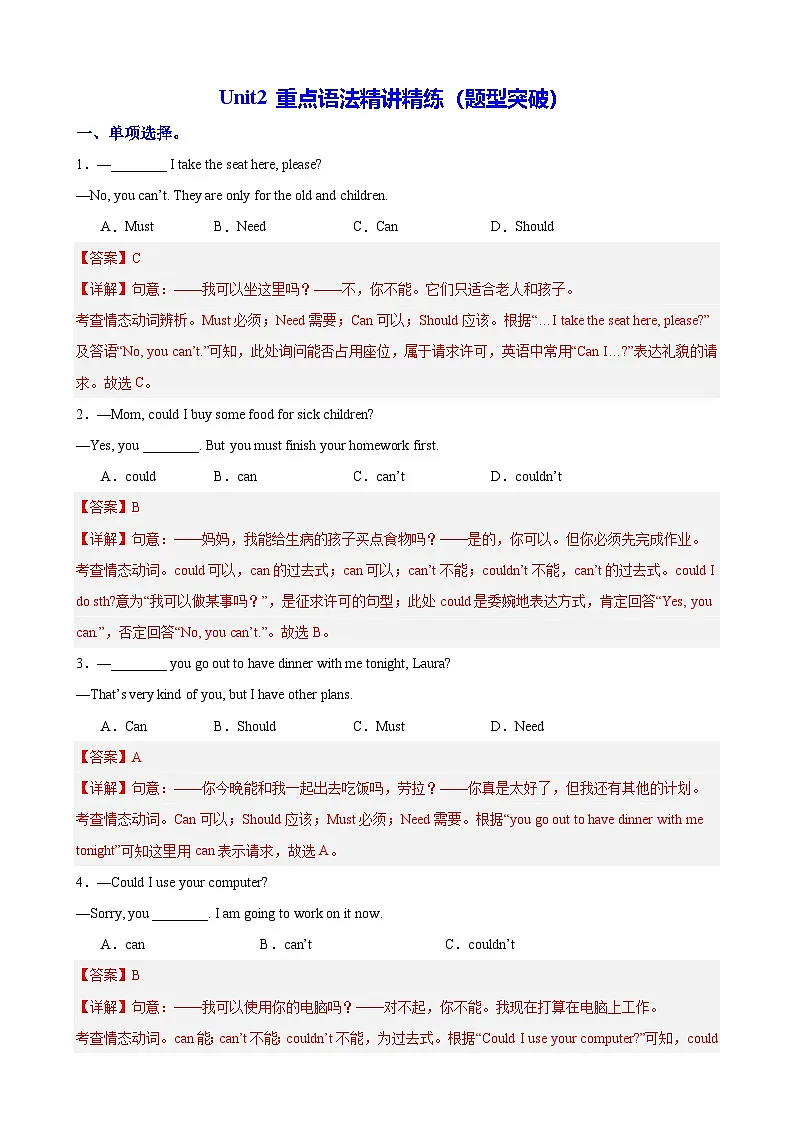
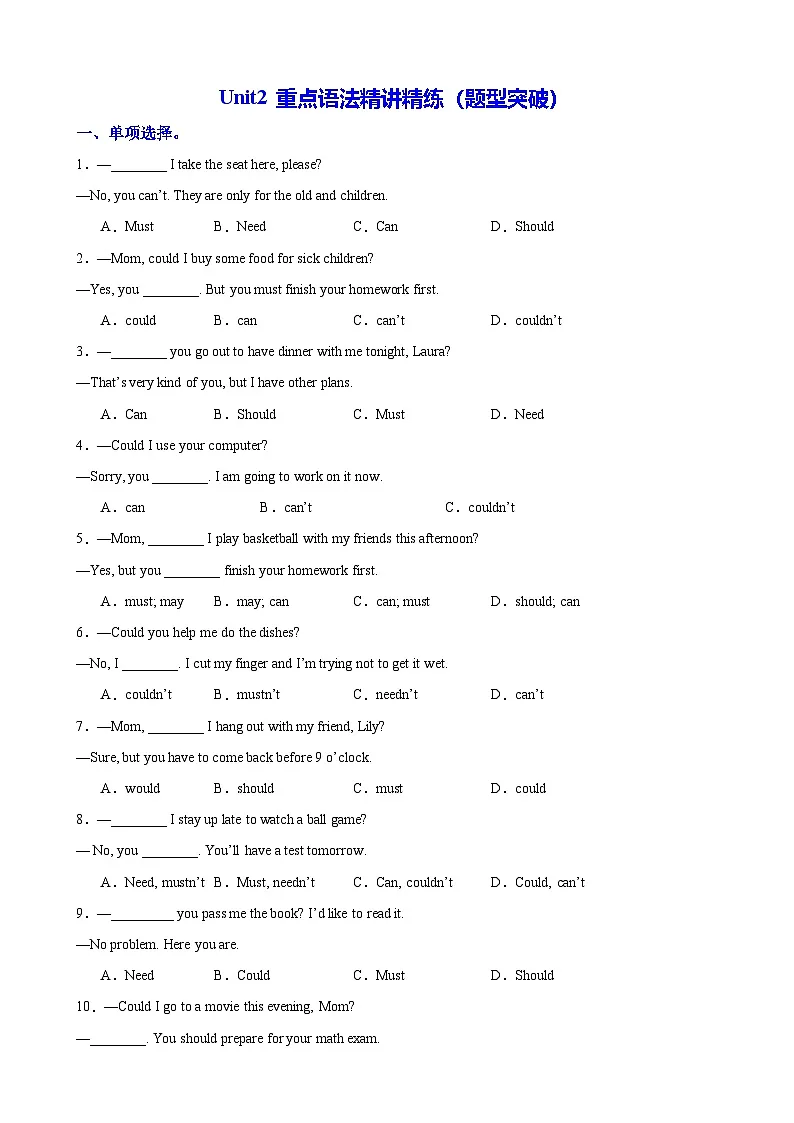
1.—________ I take the seat here, please?
—N, yu can’t. They are nly fr the ld and children.
A.MustB.NeedC.CanD.Shuld
【答案】C
【详解】句意:——我可以坐这里吗?——不,你不能。它们只适合老人和孩子。
考查情态动词辨析。Must必须;Need需要;Can可以;Shuld应该。根据“…I take the seat here, please?”及答语“N, yu can’t.”可知,此处询问能否占用座位,属于请求许可,英语中常用“Can I…?”表达礼貌的请求。故选C。
2.—Mm, culd I buy sme fd fr sick children?
—Yes, yu ________. But yu must finish yur hmewrk first.
A.culdB.canC.can’tD.culdn’t
【答案】B
【详解】句意:——妈妈,我能给生病的孩子买点食物吗?——是的,你可以。但你必须先完成作业。
考查情态动词。culd可以,can的过去式;can可以;can’t不能;culdn’t不能,can’t的过去式。culd I d sth?意为“我可以做某事吗?”,是征求许可的句型;此处culd是委婉地表达方式,肯定回答“Yes, yu can.”,否定回答“N, yu can’t.”。故选B。
3.—________ yu g ut t have dinner with me tnight, Laura?
—That’s very kind f yu, but I have ther plans.
A.CanB.ShuldC.MustD.Need
【答案】A
【详解】句意:——你今晚能和我一起出去吃饭吗,劳拉?——你真是太好了,但我还有其他的计划。
考查情态动词。Can可以;Shuld应该;Must必须;Need需要。根据“yu g ut t have dinner with me tnight”可知这里用can表示请求,故选A。
4.—Culd I use yur cmputer?
—Srry, yu ________. I am ging t wrk n it nw.
A.canB.can’tC.culdn’t
【答案】B
【详解】句意:——我可以使用你的电脑吗?——对不起,你不能。我现在打算在电脑上工作。
考查情态动词。can能;can’t不能;culdn’t不能,为过去式。根据“Culd I use yur cmputer?”可知,culd表示委婉语气,回答时肯定用can,否定用can’t,根据“srry”可知,是否定回答,因此空处用can’t。故选B。
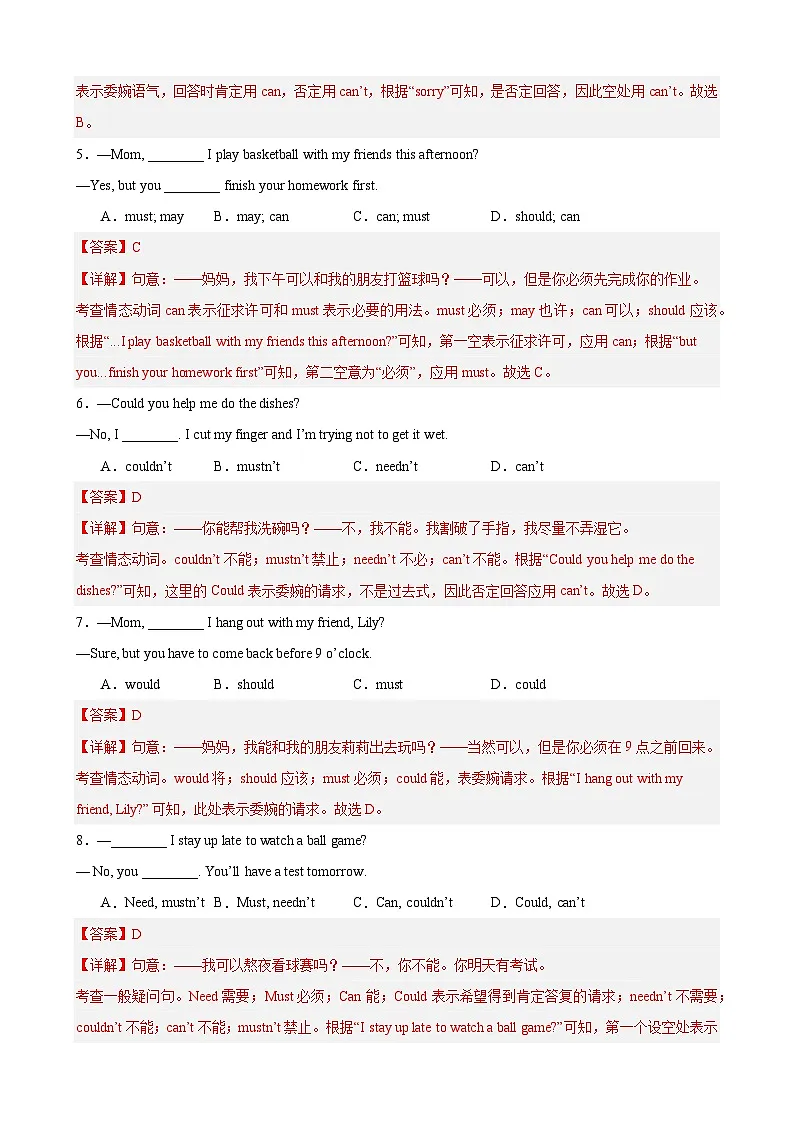
5.—Mm, ________ I play basketball with my friends this afternn?
—Yes, but yu ________ finish yur hmewrk first.
A.must; mayB.may; canC.can; mustD.shuld; can
【答案】C
【详解】句意:——妈妈,我下午可以和我的朋友打篮球吗?——可以,但是你必须先完成你的作业。
考查情态动词can表示征求许可和must表示必要的用法。must必须;may也许;can可以;shuld应该。根据“ play basketball with my friends this afternn?”可知,第一空表示征求许可,应用can;根据“but yur hmewrk first”可知,第二空意为“必须”,应用must。故选C。
6.—Culd yu help me d the dishes?
—N, I ________. I cut my finger and I’m trying nt t get it wet.
A.culdn’tB.mustn’tC.needn’tD.can’t
【答案】D
【详解】句意:——你能帮我洗碗吗?——不,我不能。我割破了手指,我尽量不弄湿它。
考查情态动词。culdn’t不能;mustn’t禁止;needn’t不必;can’t不能。根据“Culd yu help me d the dishes?”可知,这里的Culd表示委婉的请求,不是过去式,因此否定回答应用can’t。故选D。
7.—Mm, ________ I hang ut with my friend, Lily?
—Sure, but yu have t cme back befre 9 ’clck.
A.wuldB.shuldC.mustD.culd
【答案】D
【详解】句意:——妈妈,我能和我的朋友莉莉出去玩吗?——当然可以,但是你必须在9点之前回来。
考查情态动词。wuld将;shuld应该;must必须;culd能,表委婉请求。根据“I hang ut with my friend, Lily?”可知,此处表示委婉的请求。故选D。
8.—________ I stay up late t watch a ball game?
— N, yu ________. Yu’ll have a test tmrrw.
A.Need, mustn’tB.Must, needn’tC.Can, culdn’tD.Culd, can’t
【答案】D
【详解】句意:——我可以熬夜看球赛吗?——不,你不能。你明天有考试。
考查一般疑问句。Need需要;Must必须;Can能;Culd表示希望得到肯定答复的请求;needn’t不需要;culdn’t不能;can’t不能;mustn’t禁止。根据“I stay up late t watch a ball game?”可知,第一个设空处表示请求,排除A、B两个选项。第二个空结合“N, yu”可知,应说你不能,且该句是一般现在时,排除C。故选D。
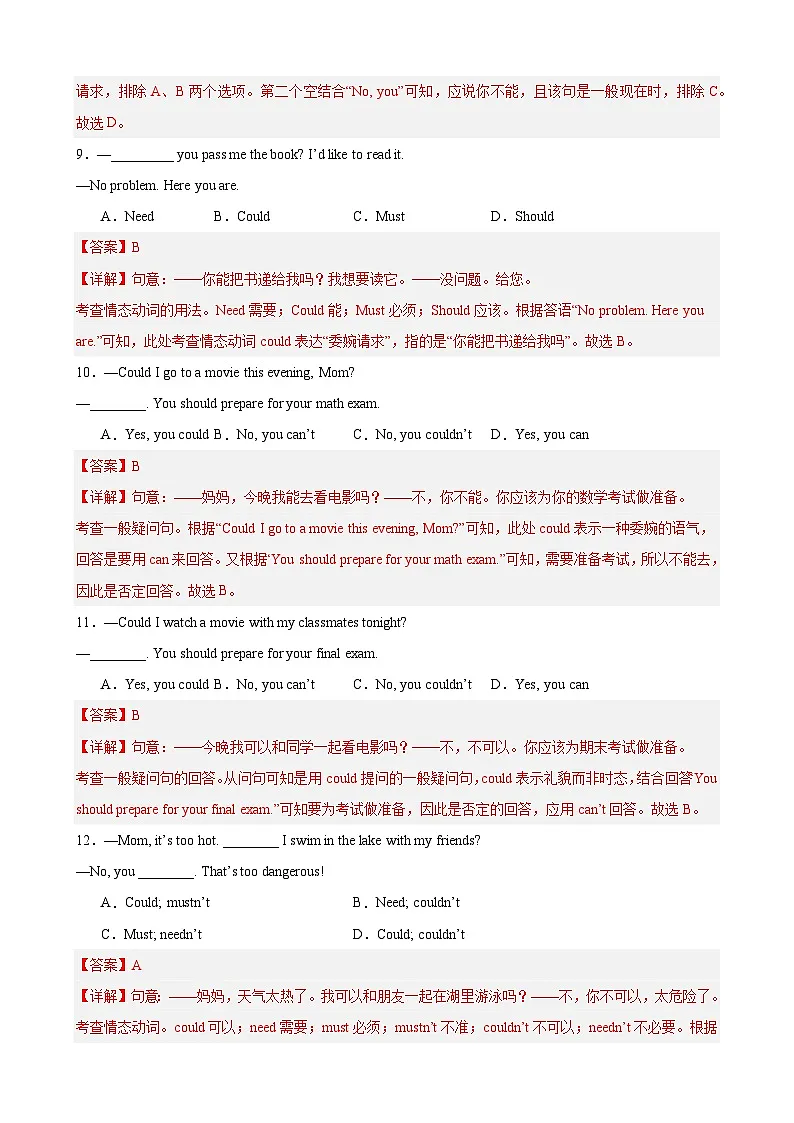
9.—_________ yu pass me the bk? I’d like t read it.
—N prblem. Here yu are.
A.NeedB.CuldC.MustD.Shuld
【答案】B
【详解】句意:——你能把书递给我吗?我想要读它。——没问题。给您。
考查情态动词的用法。Need需要;Culd能;Must必须;Shuld应该。根据答语“N prblem. Here yu are.”可知,此处考查情态动词culd表达“委婉请求”,指的是“你能把书递给我吗”。故选B。
10.—Culd I g t a mvie this evening, Mm?
—________. Yu shuld prepare fr yur math exam.
A.Yes, yu culdB.N, yu can’tC.N, yu culdn’tD.Yes, yu can
【答案】B
【详解】句意:——妈妈,今晚我能去看电影吗?——不,你不能。你应该为你的数学考试做准备。
考查一般疑问句。根据“Culd I g t a mvie this evening, Mm?”可知,此处culd表示一种委婉的语气,回答是要用can来回答。又根据“Yu shuld prepare fr yur math exam.”可知,需要准备考试,所以不能去,因此是否定回答。故选B。
11.—Culd I watch a mvie with my classmates tnight?
—________. Yu shuld prepare fr yur final exam.
A.Yes, yu culdB.N, yu can’tC.N, yu culdn’tD.Yes, yu can
【答案】B
【详解】句意:——今晚我可以和同学一起看电影吗?——不,不可以。你应该为期末考试做准备。
考查一般疑问句的回答。从问句可知是用culd提问的一般疑问句,culd表示礼貌而非时态,结合回答“Yu shuld prepare fr yur final exam.”可知要为考试做准备,因此是否定的回答,应用can’t回答。故选B。
12.—Mm, it’s t ht. ________ I swim in the lake with my friends?
—N, yu ________. That’s t dangerus!
A.Culd; mustn’tB.Need; culdn’t
C.Must; needn’tD.Culd; culdn’t
【答案】A
【详解】句意:——妈妈,天气太热了。我可以和朋友一起在湖里游泳吗?——不,你不可以,太危险了。
考查情态动词。culd可以;need需要;must必须;mustn’t不准;culdn’t不可以;needn’t不必要。根据“…I swim in the lake with my friends?”结合语境可知,此处表示请求许可,用culd;否定回答用can’t或mustn’t表示不允许,不用culdn’t。故选A。
13. ________ yu please clean yur rm?
A.Culd B.ShuldC.MustD.Wn’t
【答案】A
【详解】句意:请你打扫一下你的房间好吗?
考查情态动词辨析。Culd能否;Shuld应该;Must必须;Wn’t不愿意。根据“…yu please clean yur rm?”可知,此处表达委婉的请求,常用固定句式Culd yu please…“你能……吗”。故选A。
14.—________ I brrw yur knives?
—Srry, yu ________. I lent them t Sandy.
A.May; canB.Can; culdC.Culd; can’tD.Culd; culdn’t
【答案】C
【详解】句意:——我可以跟你借刀子吗?——抱歉,你借不了。我把它们借给桑迪了。
考查动词辨析。May可以;Can可以;Culd可以;can’t不可以;culdn’t不可以。根据“…I brrw yur knives?”可知此处表示请求许可,可用may或culd比can更加委婉客气,其肯定回答用may或can,否定回答用can’t;根据“Srry”可知此处应为否定回答,用can’t。故选C。
15.—Dad, ________ I g t the mvies with Amy tnight?
—Sure, but yu shuld be back befre 9: 30 p. m.
A.mightB.shuldC.culdD.must
【答案】C
【详解】——爸爸,今晚我能和艾米去看电影吗?——当然可以,但是你必须在晚上9点半之前回来。
考查情态动词。might可能;shuld应该;culd能;must必须。根据“Sure, but yu shuld be back befre 9: 30 p. m.”可知,应该问“今晚我能和艾米一起去看电影吗? ”表示委婉的请求,“Culd ” 意为“我能……吗?”,用于请求对方允许自己做某事。故选: C。
二、完成句子。
1.我们一次可以从图书馆借三本书。
frm the library.
【答案】We can brrw three bks at a time
【详解】根据汉语提示可知,空格处缺少“我们一次可以”和“借三本书”的英文表达。We“我们”作主语;情态动词can“能”后接动词原形brrw“借”;three bks“三本书”作宾语;at a time“一次”。故填We can brrw three bks at a time。
2.你能带有感情地读这篇课文吗?
yu read the text ?
【答案】 Can with feeling
【详解】根据中英文对照可知,空处缺“能”和“带有感情”的英文。情态动词“can”询问能力,放句首,首字母大写;with feeling“带感情”,介词短语。故填Can;with;feeling。
3.你能去遛狗吗?
take the dg fr a walk?
【答案】 Culd yu please
【详解】根据中英文对照可知,缺少“你能”,culd能,表示请求,语气更加委婉,一般疑问句中,将情态动词放于句首,开头字母要大写;yu你,人称代词主格,作主语;please请,礼貌用语。故填Culd;yu;please。
4.Culd I bring sme fd and drinks? (写出肯定答语)
【答案】Yes, yu can./Of curse./Sure
【详解】句意:我能带些食物和饮料吗?分析原句可知,culd yu please d sth?“请你做某事好吗?”句中的culd不是表示的过去时,而是表示的一种委婉的语气,答语中不能出现culd,肯定回答可以为Yes, yu can./Of curse./Sure。故填Yes, yu can./Of curse./Sure。
5.你可以帮助我打扫起居室吗?
help me the living rm?
【答案】 Culd yu t clean
【详解】根据情境可知,本句为一般疑问句;根据中文提示“你可以……吗?”可知,应该使用can yu或culd yu,根据情境表示委婉语气,应该使用culd yu更好,且置于句首,故culd首字母应该大写;根据help sb. t d sth.和中文提示“打扫”可知,应该填t clean。故答案为Culd yu;t clean。
6.我能为您捎个信吗?
fr yu?
【答案】Can I take a message/Culd I take a message
【详解】此处表示请求许可,可用情态动词can/culd引导此疑问句;I“我”,此处作主语,所以用主格;take a message“捎个信”,情态动词后接动词原形。故填Can/Culd I take a message。
7.请给我买张票好吗?
yu get me a ticket?
【答案】 Culd please
【详解】根据中文意思可知,句子为提建议句型。Culd yu please d sth? “你能做某事吗?”。Culd表达委婉语气,please“请”,礼貌用语。故填Culd;please。
8. ——你能告诉我 WiFi 密码吗? ——当然, WiFi 密码是 88888888。
— _______ _______ _______ _______ the WiFi passwrd?
— Sure, the WiFi passwrd is 88888888.
【答案】Can yu tell me
9. 我可以用你的笔记本电脑几个小时来完成我的项目吗?
_______ _______ _______ yur laptp fr a few hurs t finish my prject?
【答案】Culd I use
10. ——明天请你来参加我的聚会,好吗? ——可以,我很乐意。
—_______ _______ _______ _______ t my party tmrrw?
— Yes, I’d lve t.
【答案】Culd yu please cme
11.——苏西,你能教我怎么拉小提琴吗 ? ——没问题。
—_______ yu shw me hw t play the vilin, Suzy?
— _______ _______ .
【答案】Can; N prblem
12. ——杨小姐,我可以从图书馆借书吗? ——对不起,你不能。
— _______ _______ _______ the bks frm the library, Miss Yang?
— Srry, _______ _______ .
【答案】Culd I brrw;yu can’t
五、完形填空。
A
Hme is nt just a huse where we live. It is special and magical.
At hme, we build ur dreams. We can think abut what we are ging t be. Maybe we want t be a teacher 1 a dctr. We can study and learn at hme. We can read bks and draw pictures. We can talk t ur family abut ur dreams. Hme is where ur dreams 2 .
We feel cmfrtable at hme. We can feel lve and warmth. We can be urselves and say everything 3 . We feel accepted and helped there.
At hme, we learn t listen, care and share. When we have a bx f delicius ckies, we share them with ur family members. We give sme t ur brther r sister and see the 4 n their faces. When smene in the family desn’t feel well, we learn t 5 them. We bring 6 a glass f water. When ur parents talk abut their day, we learn t listen 7 .
Hme is als a place f grwing. It’s where we take ur first steps and say ur first wrds. It’s where we have ur first experiences and make ur first 8 . Hme is where we find ur interest. We are nt afraid t try anything in this place.
As we grw lder, hme becmes a safe place away frm the stress f the wrld. We always 9 peace there. Hme is nt just a place; it is a feeling that 10 us tgether.
1.A.rB.andC.butD.s
2.A.breakB.endC.stpD.start
3.A.quicklyB.slwlyC.badlyD.freely
4.A.tearsB.smilesC.angerD.sadness
5.A.lk afterB.lk frC.lk atD.lk up
6.A.himB.herC.themD.us
7.A.easilyB.carefullyC.ludlyD.carelessly
8.A.plansB.prblemsC.ideasD.memries
9.A.frgetB.lseC.findD.avid
10.A.pushesB.takesC.sendsD.brings
【答案】【导语】本文主要介绍了家不仅是居住的场所,更是滋养梦想、温暖心灵、孕育成长与联结情感的地方。
1.句意:也许我们想成为一名老师或者一名医生。
r或者;and和;but但是;s所以。此处指“一名老师”或者“一名医生”,表示选择,用r。故选A。
2.句意:家是我们梦想开始的地方。
break打破;end结束;stp停止;start开始。根据“Hme is where ur dreams ”并结合前文可知在家构建梦想,家是梦想开启之处,故选D。
3.句意:在家里,我们可以做自己,畅所欲言。
quickly快速地;slwly缓慢地;badly糟糕地;freely自由地。根据“We can be urselves and say everything”可知在家里可以自由地表达一切,freely符合语境,故选D。
4.句意:我们给兄弟姐妹一些饼干,然后看到他们脸上的笑容。
tears眼泪;smiles笑容;anger愤怒;sadness悲伤。根据“We give sme t ur brther r sister and see their faces.”可知当把美味的饼干分享给家人时,他们脸上应该是露出笑容,故选B。
5.句意:当家里有人身体不舒服时,我们学会照顾他们。
lk after照顾;lk fr寻找;lk at看;lk up查阅。根据“When smene in the family desn’t feel well,”可知,应该照顾不舒服的家人,故选A。
6.句意:我们给他们端一杯水。
him他;her她;them他们;us我们。这里指代前面身体不舒服的家人,用them指代,故选C。
7.句意:当父母谈论他们的一天时,我们学会认真倾听。
easily容易地;carefully认真地;ludly大声地;carelessly粗心地。根据“When ur parents talk abut their day, we learn t listen”可知倾听父母说话时,应该是认真倾听,carefully符合语境,故选B。
8.句意:家是我们有第一次经历、留下第一次回忆的地方。
plans计划;prblems问题;ideas想法;memries回忆。根据“we have ur first experiences and make ur first”可知在家有第一次的种种经历,会留下回忆,故选D。
9.句意:我们总能在那里找到安宁。
frget忘记;lse失去;find找到;avid避免。根据“peace there”可知家是能让我们找到安宁的地方,故选C。
10.句意:家不仅仅是一个地方,它是一种将我们凝聚在一起的情感。
pushes推;takes带走;sends发送;brings带来。根据“us tgether.”可知家将我们凝聚在一起,表示“使……聚集在一起”,故选D。
B
阅读下面短文,按照句子结构的语法性和上下文连贯的要求,从1~15各题所给的A、B、C和D项中选出最佳选项,并在答题卡上将该项涂黑。
Karl was a cheerful farm by except fr ne prblem. He had a great lve 1 cheese. Whenever he saw cheese r fd with cheese, he 2 stp eating it. His mther ften warned him, “Cheese is delicius, but t 3 f it may get yu a stmachache.” Hwever, Karl just laughed it ff and didn’t care abut 4 his mther tld him.
One night, while Karl 5 in bed, he thught abut having cheese again. Suddenly he heard a sft vice saying, “Just 6 with me and yu’ll find a cheese muntain!”
Quickly, he rse up and fllwed 7 vice t a frest. When he stepped deeper int the frest, he 8 t a party where a large cheese muntain was in the middle. Hundreds f tree elves were dancing 9 arund it. “Wnderful cheese fr wnderful dancers!” All the elves welcmed him. “CHEESE!” With jy in his heart, Karl jined them and didn’t stp dancing 10 the sun rse. The mment he stpped, pieces f cheese came twards him. Karl became even 11 when he started t enjy the tasty cheese. As sn as he finished ne piece, 12 came t him. Very sn, he was 13 full and tired t eat any mre. But the cheese kept cming — rlling clser, pushing him dwn… He gt scared, shuting fr help but all the elves weren’t arund!
“Karl, Karl! It’s time t get up…” Finding that it was just a dream, Karl felt relaxed. Frm then n, he decided 14 cheese right because Karl had learned 15 lessn: lve shuldn’t g t far!
1.A.inB.frC.nD.with
2.A.shuldn’tB.needn’tC.mustn’tD.culdn’t
3.A.fewB.muchC.manyD.little
4.A.whyB.hwC.thatD.what
5.A.was lyingB.am lyingC.liesD.had lied
6.A.cmeB.t cmeC.cameD.cming
7.A.aB.anC.theD./
8.A.invitesB.invitedC.is invitingD.was invited
9.A.exciteB.excitedC.excitedlyD.excitement
10.A.ifB.unlessC.whenD.until
11.A.happyB.happilyC.happierD.mre happily
12.A.antherB.the therC.the thersD.thers
13.A.tB.stillC.veryD.s
14.A.t eatB.eatC.ateD.eating
15.A.heB.himC.hisD.himself
【答案】
1.B 2.D 3.B 4.D 5.A 6.A 7.C 8.D 9.C 10.D 11.C 12.A 13.A 14.A 15.C
【导语】本文讲述了一个叫Karl的农场男孩,他非常喜欢奶酪,但遇到了问题的故事。
1.句意:他对奶酪有着深厚的喜爱。
in在……里;fr为了;n在……上;with和。根据“He had a great lve…cheese.”可知,have a lve fr表示“对……的热爱”,动词短语。故选B。
2.句意:每当看到奶酪或含奶酪的食物,他就无法停止食用。
shuldn’t不应该;needn’t不必;mustn’t禁止;culdn’t不能。根据“Whenever he saw cheese r fd with cheese, he…stp eating it.”可知,此处强调他无法自控。故选D。
3.句意:奶酪虽美味,但过量食用可能引发胃痛。
few很少,修饰可数名词;much许多,修饰不可数名词;many许多,可数;little很少,不可数。根据“Cheese is delicius, but t…f it may get yu a stmachache.”可知,此处修饰不可数名词cheese,t much表示“过多”。故选B。
4.句意:Karl不在意母亲告诉他的话。
why为什么;hw如何;that引导陈述句;what什么。根据“Karl didn’t care abut…his mther tld him.”可知,从句中“his mther tld him”缺少宾语,需用what指代内容。故选D。
5.句意:一天晚上,Karl正躺在床上时,又想吃奶酪。
was lying正躺着,过去进行时;am lying正躺着,现在进行时;lies躺,一般现在时;had lied撒谎,过去完成时。根据“One night, while Karl…in bed, he thught abut having cheese again.”可知,while"引导的时间状语从句需用过去进行时,描述过去某一时刻正在发生的动作。故选A。
6.句意:跟我来,你会找到一座奶酪山!
cme来,原形;t cme来,不定式;came来,过去式;cming来,现在分词。根据“Just…with me and yu’ll find a cheese muntain!”可知,祈使句需用动词原形。故选A。
7.句意:他跟随那个声音进入森林。
a一个,用于辅音音素开头的单词前;an一个,用于元音音素开头的单词前;the这,特指;/不填。根据“he fllwed…vice t a frest.”可知,特指前文提到的“a sft vice”,需用定冠词the。故选C。
8.句意:当他走进森林深处时,他被邀请参加一个聚会,在聚会的中央有一座巨大的奶酪山。
invites邀请,一般现在时;invited邀请,过去式;is inviting正在邀请,现在进行时;was invited被邀请,被动语态。根据“When he stepped deeper int the frest, he…t a party...”可知,应用被动语态表示“被邀请”。故选D。
9.句意:树精灵们兴奋地围着奶酪山跳舞。
excite使兴奋,动词;excited兴奋的,形容词;excitedly兴奋地,副词;excitement兴奋,名词。根据“Hundreds f tree elves were dancing…arund it.”可知,此处应用副词修饰动词dancing,excitedly表示“兴奋地”。故选C。
10.句意:他不停地跳舞,直到太阳升起。
if如果;unless除非;when当……时;until直到。根据“Karl jined them and didn’t stp dancing…the sun rse.”可知,表示“直到……才停止”。故选D。
11.句意:享用奶酪时,Karl变得更加开心。
happy开心的,原级;happily开心地,副词;happier更开心,比较级;mre happily更开心地,副词比较级。根据“Karl became even…when he started t enjy the tasty cheese.”可知,even修饰比较级happier,表示“更加快乐”。故选C。
12.句意:吃完一块,另一块又来了。
anther另一块,泛指;the ther另一块,两者中的另一个;the thers其他剩余全部;thers其他,泛指复数。根据“As sn as he finished ne piece…came t him.”可知,吃完一块,另一块又来了,anther泛指“另一块奶酪”。故选A。
13.句意:他吃得太饱太累,无法继续。
t太;still仍然;very非常;s如此。根据“he was…full and tired t eat any mre.”可知,表示“太……而不能”。故选A。
14.句意:从那以后,他决定正确地吃奶酪,因为卡尔得到了教训:爱不能走得太远!
t eat吃,不定式;eat吃,原形;ate吃,过去式;eating吃,动名词。根据“he decided…cheese right.”可知,decide后接不定式t eat,表示“决定做某事”。故选A。
15.句意:从那以后,他决定正确地吃奶酪,因为卡尔得到了教训:爱不能走得太远!
he他,主格;him他,宾格;his他的,物主代词;himself他自己,反身代词。根据“Karl had learned…lessn: lve shuldn’t g t far!”可知,此处应用物主代词修饰名词lessn,表示“他的教训”。故选C。
六、语法填空。
阅读下面短文,根据上下文在空格中填入适当的内容(或使用括号中的词语的适当形式填空)。
Like mst Chinese, Mr. Zhang has a traditinal family. 1 he and his wife are middle schl teachers and their 6-year-ld sn is 2 pupil. Mr. Zhang’s mther lives with them and helps lk 3 the kid. They lve each ther and live a much 4 (happy) life than mst families.
Yesterday was Mr. Zhang’s mther’s birthday. The cuple wanted t d smething 5 (shw) their lve fr her. After a big dinner, Mr. Zhang brught a basin (盆) f warm water and asked his mther t sit in frnt f the basin. He tk ff her shes and put her 6 (ft) int the water. After that he began t wash them carefully. His wife helped t cmb his mther’s hair 7 (slw). Seeing this, the by 8 (fllw) his mther’s example. He tried t cmb his mther’s hair, t. But he was nt tall enugh t d that. S he brught a chair and std n it. Everyne culd feel the warmth and lve in the family.
As we all knw, 9 (care) fr the ld and the yung is a gd Chinese traditin. We shuld try ur best t care fr ur family. We must visit ur parents as ften as pssible and spend mre time with 10 (they). Indeed, hme is the sweetest and the warmest place in the wrld.
【答案】
1.Bth 2.a 3.after 4.happier 5.t shw 6.feet 7.slwly 8.fllwed 9.caring 10.them
【导语】本文讲述了张先生一家人彼此相爱的温馨的画面,从而告诉我们:要延续中华民族尊老爱幼的优良传统,多抽出时间陪陪父母。
1.句意:他和妻子都是中学教师,他们6岁的儿子是一名小学生。根据“he and his wife are middle schl teachers”可知,此处是指“两者都”,应用的结构,故填Bth。
2.句意:他和妻子都是中学教师,他们6岁的儿子是一名小学生。此处泛指“一名小学生”,pupil以辅音音素开头,用不定冠词a。故填a。
3.句意:张先生的母亲和他们住在一起,并帮助照看孩子。根据“helps kid”可知,此处指的是“照看孩子”,lk after“照顾”,故填after。
4.句意:他们彼此相爱,生活得比大多数家庭幸福得多。根据“than”可知,此处形容词用比较级形式,故填happier。
5.句意:这对夫妇想做一些事情来表达他们对她的爱。空处表示目的,应用不定式作目的状语,故填t shw。
6.句意:他脱下她的鞋,并把她的脚放到水里。根据“her shes”及常识可知,此处指的是“两只脚”,应用复数形式,故填feet。
7.句意:他的妻子帮他母亲慢慢地梳理头发。空处修饰动词,应用副词形式,故填slwly。
8.句意:看到这一点,男孩效仿了他母亲的样子。此处描述过去发生的事情,时态为一般过去时,动词用过去式,故填fllwed。
9.句意:众所周知,照顾老人和年轻人是中国的一项优良传统。此处应用动名词作主语,故填caring。
10.句意:我们必须尽可能多地去看望父母,花更多的时间和他们在一起。with是介词,后接人称代词宾格作宾语,故填them。
七、阅读理解。
A
Martina’s Grandpa Peter lived with the family after Grandma’s death.
One day, Mm Susan decided t d the spring cleaning. They cleared ut lts f things. Then Mm pinted t Grandpa’s sfa and said, “That s fa is ld. We’ll buy Grandpa a new ne.”
But as they mved the sfa, Grandpa stpped them and shuted, “Yu can’t take my sfa! I dn’t want a new ne.” Mm had t stp, “We will talk abut it tnight when Jhn gets hme.” Jhn, Martina’s dad, was still at wrk.
“Grandpa, Is that sfa unusual?” Martina asked at supper. Grandpa shk his head, “I sat in this sfa, with yur grandma, when I asked her t marry me. It was s lng ag, but whenever I sit in this sfa and clse my eyes, she seems t be near.”
“It’s unbelievable!” Martina thught, “Hw Grandpa can remember things frm the past? These days he frgets almst everything.”
Grandpa smiled t Martina, “The night yur father was brn, I sat in this sfa. I was nervus when they placed the little baby int my arms.”
“Many years later,” Grandpa cntinued, “I sat in this sfa when the dctr tld me yur grandma was ill. I was lst withut her, but the sfa gave me the cmfrt.”
“I d see nw!” Martina lked at Grandpa. “This is nt just an ld sfa. It is mre like a friend.” “Yes.” Grandpa added, “It left me sweet memries. We’ve gt thrugh a lt tgether.”
The whle family agreed that the huse wuld be bring withut the ld sfa. They all cnsidered the sfa as a clse friend.
1.What was Grandpa like these days?
A.Frgetful.B.Unhappy.C.Angry.D.Careless.
2.Wh des the underlined phrase “the little baby” in Paragraph 6 refer t?
A.Martina.B.Jhn.C.Susan.D.Peter.
3.Accrding t the passage, what imprtant things did Grandpa experience sitting in the ld sfa?
①Grandma’s death ②hlding the little baby fr the first time
③asking Grandma t marry him ④hearing the news that Grandma was ill
A.①②③B.①②④C.②③④D.①③④
4.We can infer (推断) that the family were prbably ________ at the end f the stry.
A.surprisedB.bredC.mvedD.nervus
5.What’s the best title fr this text?
A.Martina’s WishB.A Spring CleaningC.A Happy FamilyD.Grandpa’s Old Sfa
【答案】1.A 2.B 3.C 4.C 5.D
【解析】本文讲述了Martina的爷爷与沙发的情感。
1.细节理解题。根据“These days he frgets almst everything.”可知,爷爷最近很健忘。故选A。
2.词句猜测题。根据“Jhn, Martina’s dad, was still at wrk…the night yur father was brn, I sat in this sfa. I was nervus when they placed the little baby int my arms.”可知,“the little baby”指的是Martina的父亲Jhn。故选B。
3.细节理解题。根据“I sat in this sfa, with yur grandma, when I asked her t marry me…The night yur father was brn, I sat in this sfa. I was nervus when they placed the little baby int my arms…I sat in this sfa when the dctr tld me yur grandma was ill.”可知爷爷在旧沙发上经历了以下重要事件:向奶奶求婚(③)第一次抱着刚出生的Jhn(②)得知奶奶生病的消息(④)。故选C。
4.推理判断题。根据“The whle family agreed that the huse wuld be bring withut the ld sfa. They all cnsidered the sfa as a clse friend.”可推断,全家人最后被爷爷的故事感动了。故选C。
5.最佳标题题。全文围绕爷爷的旧沙发展开,讲述了它承载的珍贵回忆。标题应突出核心元素“旧沙发”。故选D。
B
“See yu at Open Huse tnight, Amy,” Evelyn shuted frm the schl bus windw. “Dn’t frget t ask yur mm if I can cme tmrrw!”
“OK!” I called back. I wished I culd feel excited abut my first Open Huse at my new schl, but I was wrried. What wuld ther kids say when they fund ut my parents can’t hear?
And I wanted Evelyn t visit but then she’d see hw different my huse was. My parents use a vide phne s they can use sign language (手语) t cmmunicate with callers. We als have a light n the wall that flashes when the phne r drbell rings. Wuld Evelyn think my huse was strange?
That night, Dad drve us t the schl. As we walked dwn the hallway t my classrm, we stpped in frnt f the ntice bard in the hall. “Lk at Amy’s picture!” Mm said excitedly, t lud, because she can’t hear herself. Sme lder kids turned t stare at us and I wanted t hide.
I led my family int my classrm and lked arund. Other kids and parents were there, but I didn’t see Evelyn. Ms. Jennings walked ver t us. I intrduced my teacher t my family and let her knw abut my parents’ deafness.
“Oh,” she said. “Well, hw d yu say ‘Welcme!’ in sign language?”
“Like this.” I swept my pen right hand in tward my bdy, palm (手掌) up.
She did the gesture again.
“Thank yu,” Mm said, smiling. “It’s nice t meet yu.”
Ms. Jennings lked surprised. “Yu speak very well,” she said. Mm ndded. “I lst my hearing as a child, after I’d learned t talk. Amy’s father was brn deaf. He can talk, t, but he’s shy abut his vice.” Dad smiled in agreement.
Sme f my classmates watched us and whispered (小声说). Then I nticed Evelyn and her mm standing by the dr.
“I sit ver there,” I tld my family and quickly walked tward my desk.
“Hi, Amy,” Evelyn said suddenly. “I didn’t knw yur parents are deaf.”
“Yeah.” I culdn’t think f anything else t say.
“And yu can talk t them with yur hands? That’s s cl.”
“Yu think s?” I said with relief (释怀).
Evelyn ndded. “Wuld yu teach me sme sign language?”
I smiled. “Of curse. If yu cme tmrrw, we can d that.”
1.Hw is Amy’s huse different?
A.It is friendly t the deaf peple.B.It is painted in bright clurs.
C.It lks interesting.D.It has strange furniture.
2.At the Open Huse, Amy wanted t hide because ________.
A.she culdn’t find EvelynB.sme lder kids were unkind
C.her picture was n the bard fr all t seeD.her mm’s lud vice attracted unwanted attentin
3.Hw is “Welcme!” said in sign language?
A.B.C.D.
4.What made Amy feel relieved?
A.Evelyn finally prmised t visit her huse.
B.Her teacher learned sign language successfully.
C.Evelyn didn’t mind she was frm a special family.
D.Her classmates changed their attitude tward her mm.
【答案】1.A 2.D 3.B 4.C
【解析】本文讲述了Amy在新学校的第一次开放日活动中,因父母是聋人而感到担忧,但最终通过老师和朋友的理解与支持,逐渐释怀并接受自己家庭的故事。
1.细节理解题。根据“My parents use a vide phne s they can use sign language (手语) t cmmunicate with callers. We als have a light n the wall that flashes when the phne r drbell rings.”可知,Amy的家为聋人提供了便利的设备,如视频电话和闪光灯,这与选项A“It is friendly t the deaf peple.”相符。故选A。
2.细节理解题。根据“Mm said excitedly, t lud, because she can’t hear herself. Sme lder kids turned t stare at us and I wanted t hide.”可知,Amy想躲起来是因为她妈妈的声音太大,吸引了不必要的注意。故选D。
3.细节理解题。根据“Like this.” I swept my pen right hand in tward my bdy, palm (手掌) up.”可知,“Welcme!”在手语中的表达方式是手掌向上并向身体方向扫动。根据描述,选项B的图片符合这一手势。故选B。
4.推理判断题。根据“And yu can talk t them with yur hands? That’s s cl.”和“I said with relief (释怀).”可知,Amy感到释怀是因为Evelyn并不介意她来自一个特殊的家庭。故选C。
八、任务型阅读。
A
根据短文内容,从短文后的选项中选出能填入空白处的最佳选项。选项中有两项为多余选项。
Everybdy knws that healthy eating habits are very imprtant. 1 I’m sure yu will live a healthy and happy life if yu fllw them.
2
Drink abut 8 cups f water every day. Yu may need even mre water when yu d exercise.
Dn’t frget breakfast.
Breakfast is the mst imprtant meal f the day. 3
Try t eat light (清淡的) lunch.
Dn’t eat junk fd r fd that has t much fat fr lunch. They are bad fr yur health. If yu dn’t have enugh time t have a healthy lunch, yu can bring sme bread with yu fr a quick lunch.
4
Fruit and vegetables shuld be a necessary part f yur fd. Yu can have a vegetable salad fr yur lunch. If yu dn’t like eating vegetables, yu can eat sme fruit.
Dn’t have dinner t late.
5 Yur bdy needs time t digest (消化) mst f the fd.
A. Drink enugh water.
B. The results are as fllws.
C. Eat fruit and vegetables every day.
D. Here are five gd eating habits.
E. S we’d better exercise mre in ur free time.
F. Try t have dinner at least 3 hurs ag befre yu g t bed.
G. Yu will have mre energy (精力) after yu eat breakfast.
答案:
[语篇解读] 本文主要介绍了健康的饮食习惯。
1. D 根据后句“I’m sure yu will live a healthy and happy life if yu fllw them.”及下文介绍的饮食习惯可知此处应引出下文的好的饮食习惯,因此选项D符合语境。
2. A 根据下文中的“Drink abut 8 cups f water every day.”可知此处内容应和喝水有关,因此选项A符合语境。
3. G 根据前句“Breakfast is the mst imprtant meal f the day.”可知此处内容应和吃早餐有关,因此选项G符合语境。
4. C 根据下面的“Fruit and vegetables shuld be a necessary part f yur fd.”可知此处内容应和蔬菜水果有关,因此选项C符合语境。
5. F 根据标题“Dn’t have dinner t late.”及后句“Yur bdy needs time t digest mst f the fd.”可知此处内容应和吃晚餐的时间有关,因此选项F符合语境。
B
My family has always had family dinners, as far as I can remember. Since I was a little by, my mther has insisted (坚持) that we attend family dinners at least nce a week. Every Sunday, my mther wuld prepare a lt f fd and bring it t my grandma’s huse. We wuld wait fr mre family members t cme befre eating tgether at the table, my grandma’s dinner table.
I used t feel that was a silly little traditin. But nw I find it’s fantastic t get tgether as a family t talk abut anything and everything after a lng week f schl and wrk. Every time I sit at the dinner table, my grandma’s dinner table, I lk arund and find s many peple wh truly lve me. It’s a lve that feels s gd. Fr me, dinner is nt just a meal, but a chance t recnnect with each ther.
I finally realize the true meaning f this traditin. It’s nt abut the dinners r activities. It’s abut family, a grup f peple wh care abut each ther. All the memries (记忆) arund my grandma’s dinner table will last frever.
Nw, I’m always expecting Sunday t arrive.
1.Hw ften d the writer’s family members get tgether fr dinner?(不超过5个词)
2.What des dinner mean t the writer?(不超过10个词)
3.Why is “my grandma’s dinner table” mentined several times in the text?(不超过10个词)
【答案】
1.At least nce a week./Every Sunday.
2.It is a chance t recnnect with each ther.
3.Because it is the place full f family lve.
【导语】本文是一篇记叙文,讲述了作者一家的家庭聚餐传统。每周至少一次的家庭聚餐代表了家人之间的关爱。
1.根据“Since I was a little by, my mther has insisted (坚持) that we attend family dinners at least nce a week. Every Sunday, my mther wuld prepare a lt f fd and bring it t my grandma’s huse.”可知,作者一家每周至少一次/每个星期天家庭聚餐。故填At least nce a week./Every Sunday.
2.根据“Fr me, dinner is nt just a meal, but a chance t recnnect with each ther.”可知,对作者来说,家庭聚餐是一个与家人互相重新建立联系的机会。故填It is a chance t recnnect with each ther.
3.通读全文可知,文章多次提到“祖母的餐桌”,是因为家人们每周至少一次的家庭聚餐就是在祖母家,在祖母家的餐桌上,这是一个承载着家人们关爱的地方。故填Because it is the place full f family lve.
这是一份初中英语人教版(2024)八年级上册(2024)Unit 2 Home Sweet Home Section BVocabulary in Use同步练习题,文件包含Unit2重点语法精练题型突破解析版docx、Unit2重点语法精练题型突破原题版docx等2份试卷配套教学资源,其中试卷共27页, 欢迎下载使用。
这是一份人教版(2024)八年级上册(2024)Unit 2 Home Sweet Home Section BVocabulary in Use当堂检测题,文件包含Unit2重点语法精讲精练讲义解析版docx、Unit2重点语法精讲精练讲义原题版docx等2份试卷配套教学资源,其中试卷共30页, 欢迎下载使用。
这是一份初中英语人教版(2024)八年级上册Unit 1 Where did you go on vacation? Section B巩固练习,文件包含Unit1重点语法精讲精练讲义解析版docx、Unit1重点语法精讲精练讲义原题版docx等2份试卷配套教学资源,其中试卷共32页, 欢迎下载使用。
注册成功
资料篮

在线客服
添加在线客服
获取1对1服务
官方微信
关注“教习网”公众号
打开微信就能找资料
赛课定制
添加在线客服
获取1对1定制服务
职称咨询
添加在线客服
获取1V1专业指导服务

免费福利

.png)
.png)
.png)
