 免费领取教师福利


若您为此资料的原创作者,认为该资料内容侵犯了您的知识产权,请扫码添加我们的相关工作人员,我们尽可能的保护您的合法权益。

这是一份人教版(2024)八年级上册(2024)Unit 2 Home Sweet Home Section BVocabulary in Use当堂检测题,文件包含Unit2重点语法精讲精练讲义解析版docx、Unit2重点语法精讲精练讲义原题版docx等2份试卷配套教学资源,其中试卷共30页, 欢迎下载使用。
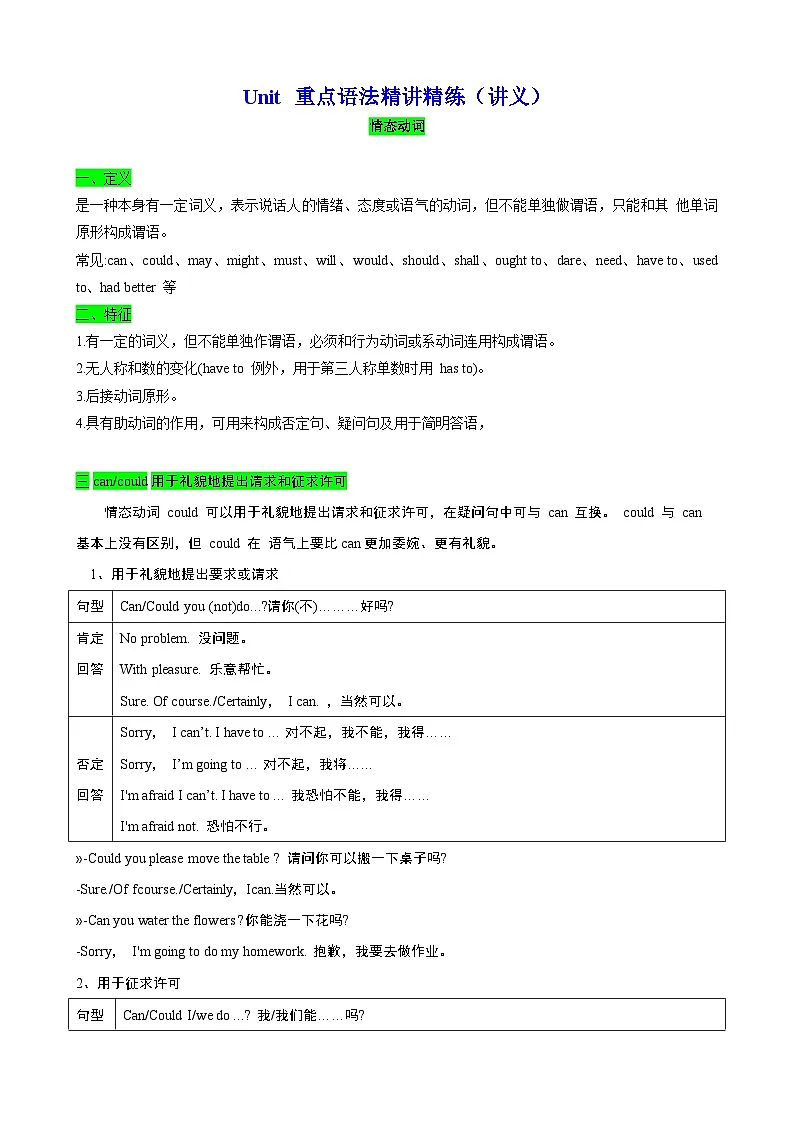
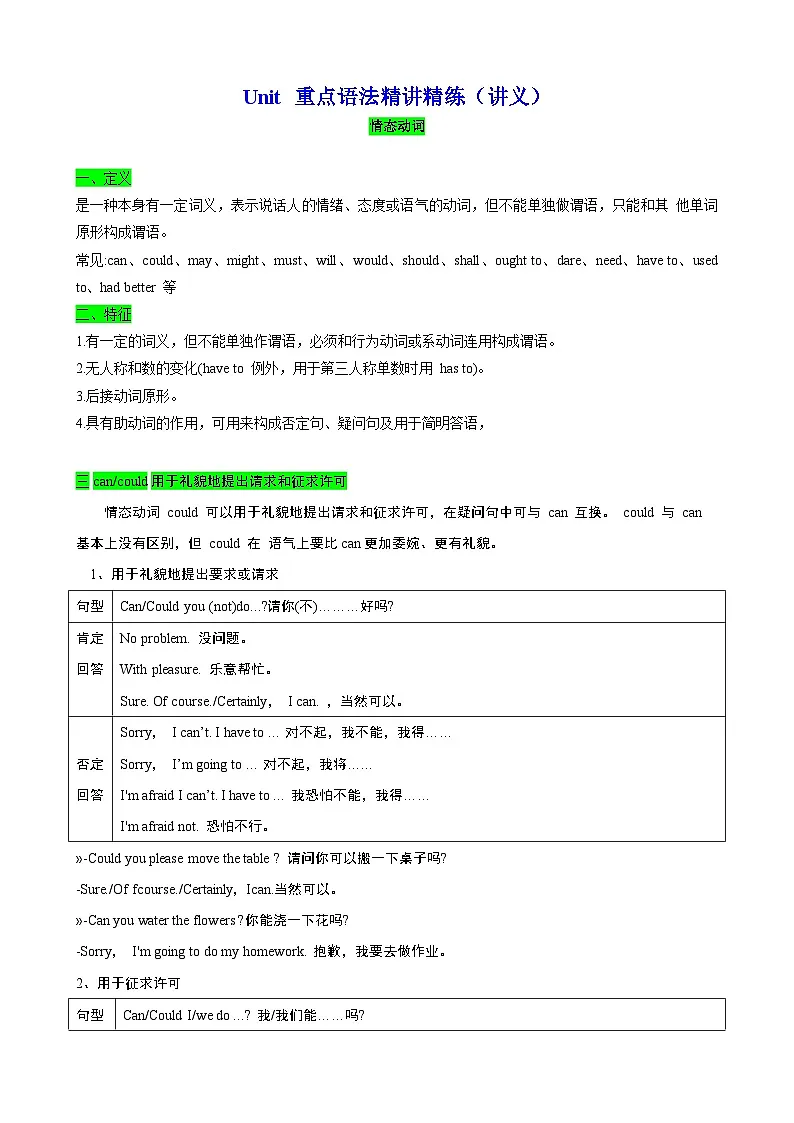
一、定义
是一种本身有一定词义,表示说话人的情绪、态度或语气的动词,但不能单独做谓语,只能和其 他单词原形构成谓语。
常见:can、culd、may、might、must、will、wuld、shuld、shall、ught t、dare、need、have t、used t、had better 等
二、特征
1.有一定的词义,但不能单独作谓语,必须和行为动词或系动词连用构成谓语。
2.无人称和数的变化(have t 例外,用于第三人称单数时用 has t)。
3.后接动词原形。
4.具有助动词的作用,可用来构成否定句、疑问句及用于简明答语,
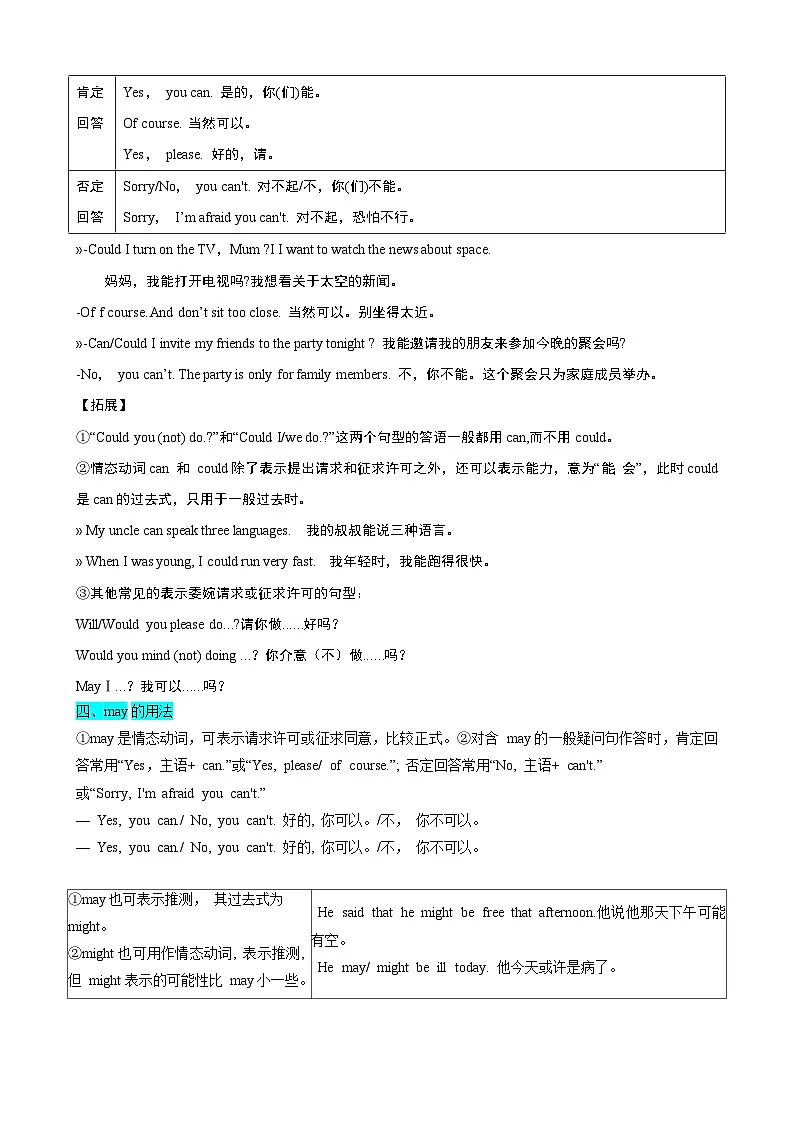
三can/culd用于礼貌地提出请求和征求许可
情态动词 culd 可以用于礼貌地提出请求和征求许可,在疑问句中可与 can 互换。 culd 与 can 基本上没有区别,但 culd 在 语气上要比can更加委婉、更有礼貌。
1、用于礼貌地提出要求或请求
»-Culd yu please mve the table ? 请问你可以搬一下桌子吗?
-Sure./Of fcurse./Certainly,Ican.当然可以。
»-Can yu water the flwers ?你能浇一下花吗?
-Srry, I'm ging t d my hmewrk. 抱歉,我要去做作业。
2、用于征求许可
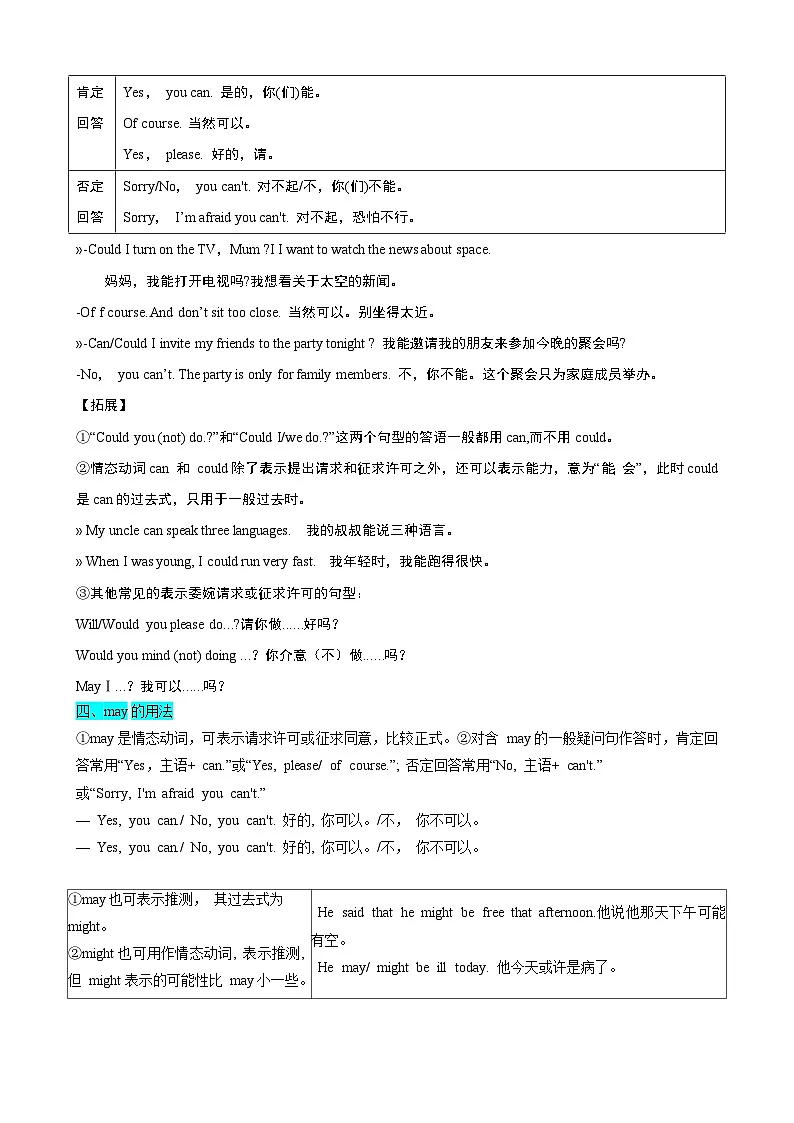
»-Culd I turn n the TV,Mum ?I I want t watch the news abut space.
妈妈,我能打开电视吗?我想看关于太空的新闻。
-Of f curse. And dn’t sit t clse. 当然可以。别坐得太近。
»-Can/Culd I invite my friends t the party tnight ? 我能邀请我的朋友来参加今晚的聚会吗?
-N, yu can’t. The party is nly fr family members. 不,你不能。这个聚会只为家庭成员举办。
【拓展】
①“Culd yu (nt) d.?”和“Culd I/we d.?”这两个句型的答语一般都用can,而不用culd。
②情态动词can 和 culd除了表示提出请求和征求许可之外,还可以表示能力,意为“能;会”,此时culd是can的过去式,只用于一般过去时。
» My uncle can speak three languages. 我的叔叔能说三种语言。
» When I was yung, I culd run very fast. 我年轻时,我能跑得很快。
③其他常见的表示委婉请求或征求许可的句型:
Will/Wuld yu please 请你做好吗?
Wuld yu mind (nt) ding ...?你介意(不)做吗?
MayⅠ...?我可以吗?
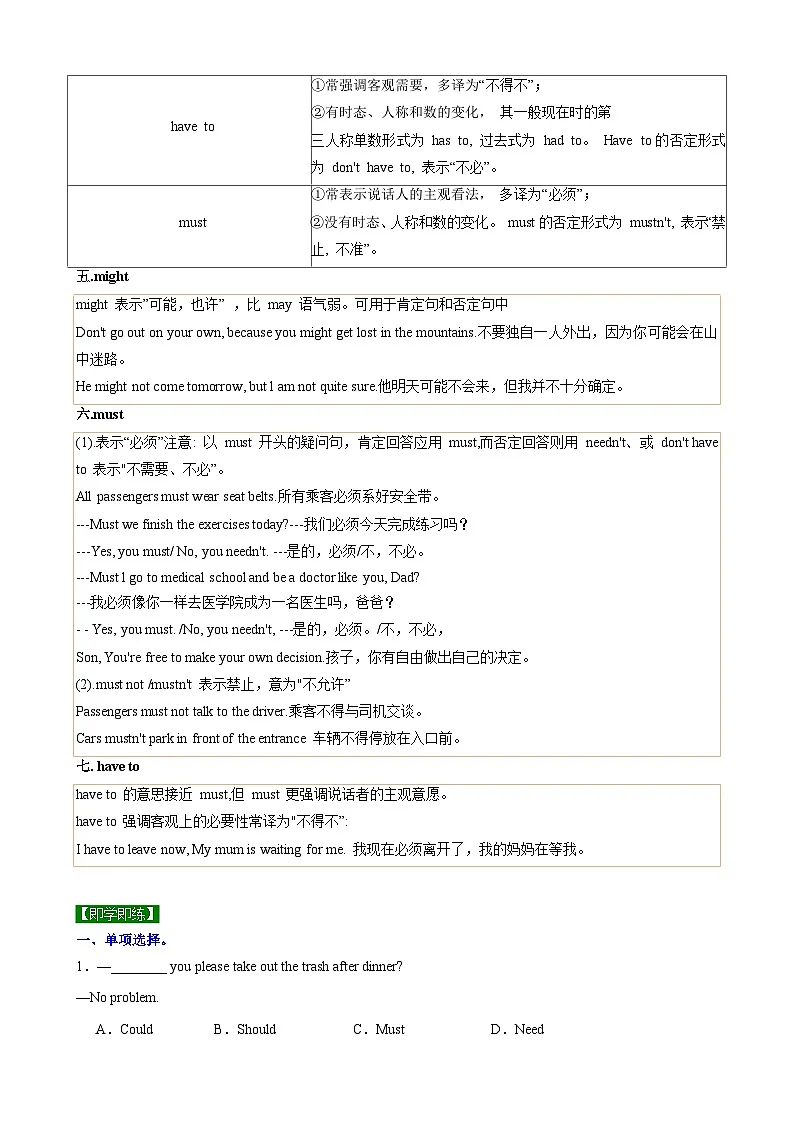
四、may的用法
①may是情态动词,可表示请求许可或征求同意,比较正式。②对含 may的一般疑问句作答时,肯定回答常用“Yes,主语+ can.”或“Yes, please/ f curse.”; 否定回答常用“N, 主语+ can't.”
或“Srry, I'm afraid yu can't.”
— Yes, yu can./ N, yu can't. 好的, 你可以。/不, 你不可以。
— Yes, yu can./ N, yu can't. 好的, 你可以。/不, 你不可以。
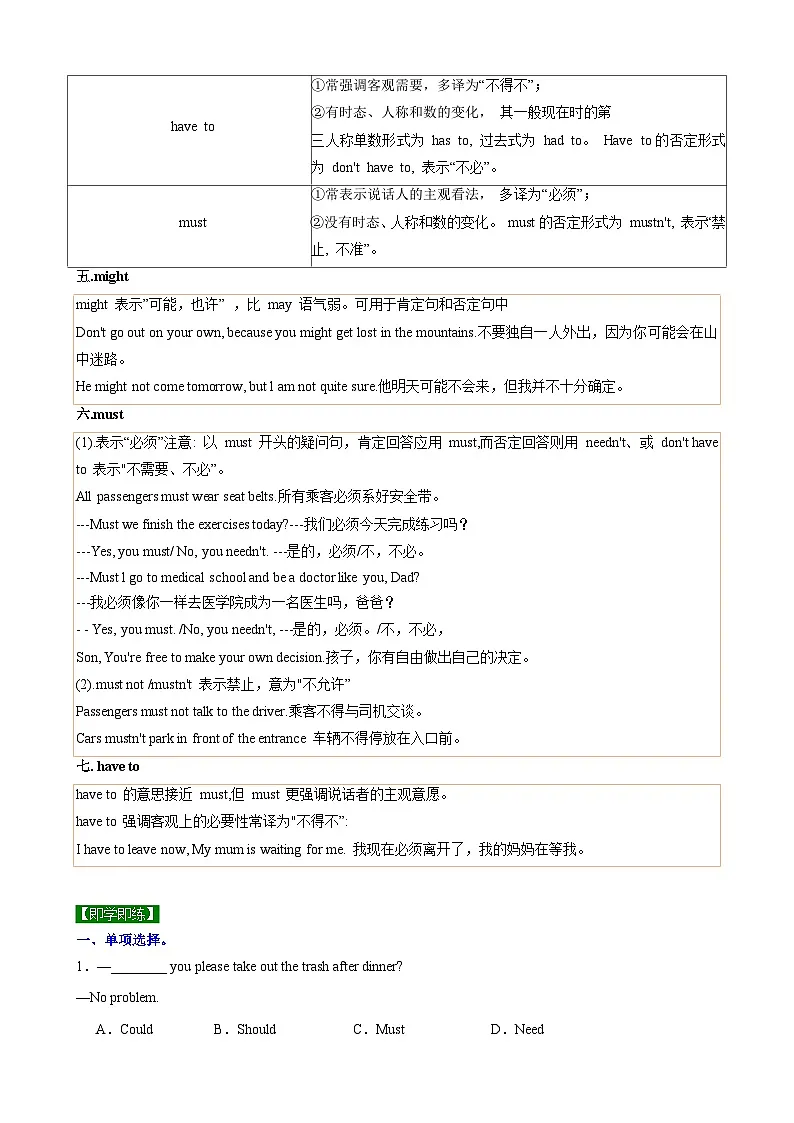
五.might
might 表示”可能,也许” ,比 may 语气弱。可用于肯定句和否定句中
Dn't g ut n yur wn, because yu might get lst in the muntains.不要独自一人外出,因为你可能会在山中迷路。
He might nt cme tmrrw, but l am nt quite sure.他明天可能不会来,但我并不十分确定。
六.must
(1).表示“必须”注意: 以 must 开头的疑问句,肯定回答应用 must,而否定回答则用 needn't、或 dn't have t 表示"不需要、不必”。
All passengers must wear seat belts.所有乘客必须系好安全带。
---Must we finish the exercises tday?---我们必须今天完成练习吗?
---Yes, yu must/ N, yu needn't. ---是的,必须/不,不必。
---Must l g t medical schl and be a dctr like yu, Dad?
---我必须像你一样去医学院成为一名医生吗,爸爸?
- - Yes, yu must. /N, yu needn't, ---是的,必须。/不,不必,
Sn, Yu're free t make yur wn decisin.孩子,你有自由做出自己的决定。
(2).must nt /mustn't 表示禁止,意为"不允许”
Passengers must nt talk t the driver.乘客不得与司机交谈。
Cars mustn't park in frnt f the entrance 车辆不得停放在入口前。
七. have t
have t 的意思接近 must,但 must 更强调说话者的主观意愿。
have t 强调客观上的必要性常译为"不得不”:
I have t leave nw, My mum is waiting fr me. 我现在必须离开了,我的妈妈在等我。
【即学即练】
一、单项选择。
1.—________ yu please take ut the trash after dinner?
—N prblem.
A.CuldB.ShuldC.MustD.Need
2.—______ yu please make yur bed, Julia?
—Sure.
A.MustB.NeedC.CuldD.Shuld
3.—Lily, ________ yu give me a hand? I can’t carry the heavy bx by myself.
—Sure, let me help yu.
A.culdB.mustC.shuldD.need
4.—Culd yu please take ut the rubbish?
—Srry, I ________. I have lts f hmewrk t d.
A.can’tB.culdn’tC.needn’t
5.—Dad, ________ I play chess with yu this afternn?
—Sure, but yu ________ finish yur hmewrk first.
A.may; culdB.may; can’tC.can; mustD.can; mustn’t
6.— ________ yu cme t my party this Saturday?
— I dn’t knw. I ________ g t the dctr.
A.Must; mightB.Can; canC.Can; mightD.Must; can
7.—Mm, ________ I play basketball with my friends this afternn?
—Yes, but yu ________ finish yur hmewrk first.
A.must; mayB.may; canC.can; mustD.shuld; can
8.—Culd I hang ut with my friends n weekends, Mm?
—Yes, yu ________. But yu ________ be back by 9: 00 p.m.
A.can; culdB.culd; shuldC.can; mustD.culd; wuld
9.—________ I hang ut with my friends nw, Mm?
— N, yu ________. Yu shuld g t finish yur hmewrk first.
A.Shuld; can’tB.Culd; can’tC.Culd; culdn’tD.Shuld; mustn’t
10.—Culd I use yur cmputer?
—________ I’m ging t use it myself.
A.Srry, yu can’t. B.Sure, yu can. C.N, yu culdn’t. D.N prblem.
二、单词拼写。
1.Lk! The students (decrate) their classrm t welcme the cming new year.
2.After snwing fr tw days, the snw c (覆盖) the village and everything was s white.
3.There are sme (海报) n the wall in Emma’s bedrm.
4.When ding a DIY jb, we need (剪刀) t cut ut different shapes.
5.Let’s stick the tw pieces f paper tgether with (胶水).
6. (剪纸) is a famus flk art with a lng histry in China.
7.—Hw ld is Mrs Smith?
—P (也许) she’s 50, but I’m nt sure.
8.After dinner, we have t wash these bwls and (盘子).
9.In rder t save time, we shuld get everything ready befre p (打包).
10.Lk! There are tw new jackets h (悬挂) n the wall.
11.Kids can help with sme chres such as taking ut the r .
12.My parents’ huse is very small. I will buy a big a fr my parents in the future.
三、完成句子。
1.—Culd I use yur dictinary? Mine was left hme.(做肯定回答)
—Yes, . But remember t give it back t me.
2.——请问我能用一下你的自行车吗?
——不,你不能。我得骑车外出。
— I yur bike?
—N, yu . I have t g ut.
3.——请问我能看电视吗?
——是的,你能。
— I watch TV?
—Yes, yu .
4.——你把房间打扫一下好吗?
——对不起,我得做作业。
— yu the rm?
—Srry, I . I have t d my hmewrk.
5.托尼,你能帮忙做几件事吗?
Tny, help ut a few things?
6.They can nly take a quick shwer nce a week.(改为一般疑问句)
7.The ld man culdn’t see anything. (改为同义句)
The ld man see .
8.—Culd I use yur dictinary? Mine was left hme.(做肯定回答)
—Yes, . But remember t give it back t me.
9.can change, we, different, int, frms f energy, electricity (连词成句)
.
10.——请你帮我洗车好吗?
——对不起,我不能。我必须去上学。
—Culd yu please help me wash the car?
— , . I have t g t schl.
11.——星期天你能和我一起去逛逛吗?
——当然。那听起来很棒。
— yu with me n Sunday?
— . That great.
12.罗伯特得了重病,完全不能动。
Rbert has a serius disease and mve .
四、短文填空。
Hme
can must culd have t may
Last weekend, my family decided t decrate (装饰) ur living rm. We wanted t change the ld wallpaper (墙纸), but we 11. ______ clean the rm first. My dad said, “We 12. ______ remve all the furniture befre painting the walls.”
I 13. ______ paint well, s I ffered t help. My mm asked, “Wh 14. ______ pass me the brushes?” “Me,” I answered.
While wrking, we 15. ______ wear glves t prtect ur hands. My yunger sister als wanted t help, but Dad said, “Yu 16. ______ help with small tasks, but yu 17. ______ stay away frm the ladder—it’s dangerus!”
After painting, we 18. ______ chse new curtains. Mm insisted, “We 19. ______ pick a clr that matches the walls.” Then, we reached agreement. At last, we 20. ______ mve everything back. It was tiring, but nw ur hme lks bright and nice!
As we sat tgether and enjyed ur wrk, I realized smething: hme isn’t just a place with painted walls r pretty curtains. It’s where we laugh, help each ther, and share lve.
五、完形填空。
A
Eric is a student in Grade 7 and he lives in the cuntryside (乡村). He 1 animals very much. He thinks they are peple’s gd friends. Of all the 2 , penguins are his favurites. T him, these black and white animals are lvely 3 smart. He likes 4 t the z t see them.
Tday, Eric gets 5 early and eats breakfast quickly because he will see penguins! When he gets t the z, he runs fast t the penguin huse. There 6 tw penguins, Je and Jim, in the z. They are like his ld friends. He is happy t see 7 every time.
But this time, when he gets clse t the penguin huse, he sees a lt f peple talking in frnt f the huse. “What’s happening (发生)?” he asks. “Dn’t wrry. The penguins are fine,” 8 ld man says.
Then he lks int the huse. Je and Jim are playing with a ball in the huse. And there is a new friend in the huse!
“ 9 is this new friend? ” he asks.
“Oh, she is a penguin frm Africa, ” says the man. “And next year, we will have a baby penguin here! ”
“A baby penguin? I 10 wait! I want t see the baby penguin immediately (立刻).” Eric says happily.
1.A.likeB.likesC.cutD.cuts
2.A.animalB.animalsC.vegetableD.vegetables
3.A.butB.sC.andD.r
4.A.gB.gesC.gingD.t ging
5.A.upB.nC.withD.at
6.A.amB.isC.areD.be
7.A.theyB.themC.theirD.theirs
8.A.anB.aC.theD./
9.A.WhereB.WhyC.WhenD.Wh
10.A.canB.can’tC.mustD.mustn’t
B
Almst every Saturday mrning, Mlly pulls a table int her frnt yard. On the table she lays ut sme 1 in seasn, such as carrts and tmates. They are all frm her garden and free fr her neighbrs t 2 . “It’s just lvely, like yu walk by and get a beautiful gift arund the crner.” said ne f her neighbrs.
Mlly started ding this in the summer f 2020. Earlier that year, a fire brke ut in her huse. Mlly’s 3 had a hard time. “Peple in the neighbrhd came t help. They brught us fd and ften called t make sure we were ding fine. I was deeply 4 .” Mlly said.
Then the pandemic (疫情) came. Mlly and her family had much time t wrk in their garden. They decided t share what they had grwn in the garden 5 life was nt easy—mst peple were in need f fd during that time.
6 knew abut it at first. But 7 , mre and mre peple gt t knw and then, they gt int the habit f cming arund. They wuld always stp by and leave 8 sme vegetables. Mlly’s yard became a 9 place.
One thing Mlly has learned frm this 10 is that peple have t wrk tgether when days are difficult s that they can g thrugh difficulties. She is glad that lve has spread in her neighbrhd.
1.A.fruitsB.flwersC.leavesD.vegetables
2.A.laugh atB.take awayC.make upD.write abut
3.A.classB.teamC.gardenD.family
4.A.mvedB.interestedC.bredD.tired
5.A.sB.ifC.butD.because
6.A.NbdyB.AnyneC.EveryneD.Smene
7.A.sadlyB.badlyC.slwlyD.carefully
8.A.byB.withC.utD.ff
9.A.cleanB.magicC.dailyD.ppular
10.A.exerciseB.cmpetitinC.experienceD.research
六、阅读理解。
阅读下列短文, 从每小题所给的 A、B、C、D 四个选项中选出可以填入空白处的最佳选项.
A
Terry frm Kenya, 62 years ld, has spent 20 years in the city he nw calls hme. Having lived in Beijing fr mre than 20 years, Terry has finally made his Chinese dream cme true — becming a vlunteer.
He ften helps turists (游客), gets water fr a baby and even helps a neighbr sell cld drinks. “I like helping ther peple,” he said. “This is where I live, where my friend are and where I call hme.” Terry became interested in Chinese culture as a teenager when he read Ta Te Ching (道德经) by Lazi.
Terry and his family mved t Beijing in 1997, and since then he has lived and wrked in Beijing. Nw Terry can make traditinal ndles and dumplings.
He likes t chat with peple there, especially taxi drivers. “I am mre familiar with the lives f taxi drivers than mst Beijingers,” he said. “When I see their license numbers, I can tell hw many years they have wrked.”
Terry des nt want t leave Beijing. He said, “ ▲ . In this sense, Beijing is my hme. Nw I just enjy living here.”
1.What’s Terry’s Chinese dream?
A.T be a vlunteer.B.T be a taxi driver.
C.T travel in China.D.T mve t Beijing.
2.When did Terry and his family mve t Beijing?
A.In 1981.B.In 1987.C.In 1997.D.In 1998.
3.What’s the meaning f the underlined wrd “familiar” in Paragraph 4?
A.随便的B.非正式的C.熟悉的D.常见到的
4.Which f the fllwing sentence can be put in ▲ ?
A.East r west, hme is best.
B.Yur hme is where yur things are.
C.Even fallen leaves return t their rts (根).
D.Hme is smewhere yu can never g back t.
5.In which part f a magazine can we prbably find the passage?
A.CultureB.HistryC.SprtsD.Peple
B
Nick has sme friends, but he never invited them t his hme. Why? Because his family members were all lazy and his hme was always in a mess.
One day, Nick painted a beautiful rainbw (彩虹) in an art class. All f his classmates thught this picture was really wnderful. “Will my family lve it?” Nick asked. His best friend Len said, “Sure. It is the mst beautiful picture I have ever seen!” Then Nick went hme with his picture.
T his surprise, his family lved it s much. S they decided t hang it n the wall as a decratin (装饰).
“The picture will lk better if the wall is a little cleaner,” Nick’s father cntemplated the wall and said. He went t get sme water and started t clean the wall. Seeing it, Nick’s mther started t clean the wall, t. His little brther started t sweep the flr. Sn the huse became clean and tidy!
Frm then n, Nick’s family tried t keep the huse tidy all the time.
Yesterday mrning, Nick invited his friends t his hme and they had a big party!
1.Nick never invited his friends t his hme befre, because_________.
A.he didn’t have a hme befreB.his hme was always in a mess
C.his parents didn’t let his friends visit their hmeD.his friends didn’t want t g t his hme
2.What did Nick draw in an art class?
A.His family.B.His pet.C.A rainbw.D.A muntain.
3.Frm the passage, we can knw that_________.
A.all Nick’s friends liked his painting
B.Nick’s family wanted t put the painting n the windw
C.Nick’s mther cleaned the wall first
D.Nick’s little brther didn’t sweep the flr that day
4.What des the underlined wrd “cntemplated” mean?
A.Lked thrugh.B.Lked after.
C.Lked fr. D.Lked at.
C
Last summer my sn, Eric, left fr university in anther cuntry. Our nce lively huse became quiet and lnely. I missed and wrried abut him s much that I started sending him messages n the phne, mainly t say hell r t give him a wrd f warning.
One f my messages says, “S yu tld me yu lst yur wallet. If yu are always careless, ne day yu’ll wake up and find yurself lst.”
I did get Eric’s messages, but mst f them were abut mney. I was a bit angry.
They were nt different frm the ntes he used t leave n the whitebard when he was at hme.
“I bught a new pair f shes. They cst me $90. Please help!”
“Mney is running shrt because I’ve bught sme bks fr my research paper. Help me please!”
Recently, hwever, Eric begins t send me all kinds f articles. Sme are funny, sme are tuching and sme make me think. He knws I haven’t gt many things t d in my free time. He says they will help me understand yung men better and keep up with the times.
I read the articles slwly, like a careful student, with mixed feelings as well — my kid, wh fllwed me arund nt lng ag, has nw becme my teacher!
S I write back, “I’ve read all thse articles. I’ll take them as a lving sn’s hpes twards his mther. He must be thinking that his mther is still yung enugh t accept new things. That makes me feel prud. We parents can’t learn quickly and change in bth bdy and mind. Thank yu, my sn.”
In this way we share ideas, with a gentle and beautiful language we seldm use. Every time I read thse messages, I feel warm.
1.What did the sn ften write abut in the past accrding t the underlined sentence?
A.Study.B.Hbby.C.Future.D.Mney.
2.Why des Eric send his mther all kinds f articles?
①T ask his mther fr sme mre mney.
②T give his mther sme things t d.
③T help his mther keep up with the times.
④T help his mther understand the yung better.
A.①②③B.②③④C.①②④D.①③④
3.Hw des the writer’s feeling change?
A.Prud→angry→wrried.B.Prud→wrried→angry.
C.Angry→wrried→prud.D.Wrried→angry→prud.
4.Which part f a magazine may the article cme frm?
A.Life.B.Health.C.Sprts.D.Fd.
句型
Can/Culd yu (nt)请你(不)………好吗?
肯定
回答
N prblem. 没问题。
With pleasure. 乐意帮忙。
Sure. Of curse./Certainly, I can. ,当然可以。
否定
回答
Srry, I can’t. I have t ... 对不起,我不能,我得……
Srry, I’m ging t ... 对不起,我将…...
I'm afraid I can’t. I have t ... 我恐怕不能,我得……
I'm afraid nt. 恐怕不行。
句型
Can/Culd I/we d 我/我们能……吗?
肯定
回答
Yes, yu can. 是的,你(们)能。
Of curse. 当然可以。
Yes, please. 好的,请。
否定
回答
Srry/N, yu can't. 对不起/不,你(们)不能。
Srry, I’m afraid yu can't. 对不起,恐怕不行。
①may也可表示推测, 其过去式为
might。
②might也可用作情态动词, 表示推测, 但 might表示的可能性比 may小一些。
He said that he might be free that afternn.他说他那天下午可能有空。
He may/ might be ill tday. 他今天或许是病了。
have t
①常强调客观需要,多译为“不得不”;
②有时态、人称和数的变化, 其一般现在时的第
三人称单数形式为 has t, 过去式为 had t。 Have t的否定形式为 dn't have t, 表示“不必”。
must
①常表示说话人的主观看法, 多译为“必须”;
②没有时态、人称和数的变化。 must的否定形式为 mustn't, 表示“禁止, 不准”。
这是一份人教版(2024)八年级上册(2024)Unit 2 Home Sweet Home Section BVocabulary in Use当堂检测题,文件包含Unit2重点语法精讲精练讲义解析版docx、Unit2重点语法精讲精练讲义原题版docx等2份试卷配套教学资源,其中试卷共30页, 欢迎下载使用。
这是一份初中英语人教版(2024)八年级上册(2024)Unit 2 Home Sweet Home Section BVocabulary in Use同步练习题,文件包含Unit2重点语法精练题型突破解析版docx、Unit2重点语法精练题型突破原题版docx等2份试卷配套教学资源,其中试卷共27页, 欢迎下载使用。
这是一份初中英语人教版(2024)八年级上册Unit 1 Where did you go on vacation? Section B巩固练习,文件包含Unit1重点语法精讲精练讲义解析版docx、Unit1重点语法精讲精练讲义原题版docx等2份试卷配套教学资源,其中试卷共32页, 欢迎下载使用。
注册成功
资料篮

在线客服
添加在线客服
获取1对1服务
官方微信
关注“教习网”公众号
打开微信就能找资料
赛课定制
添加在线客服
获取1对1定制服务
职称咨询
添加在线客服
获取1V1专业指导服务

免费福利

.png)
.png)
.png)
