免费领取教师福利


若您为此资料的原创作者,认为该资料内容侵犯了您的知识产权,请扫码添加我们的相关工作人员,我们尽可能的保护您的合法权益。


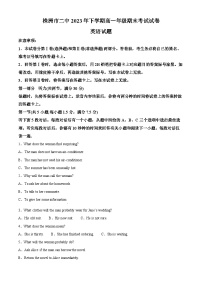
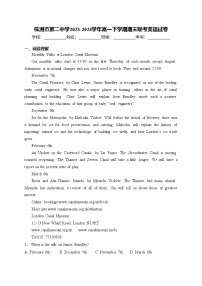
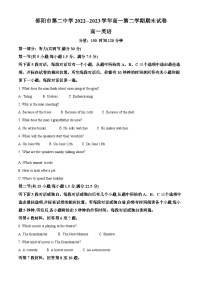
这是一份湖南省株洲市第二中学2022-2023学年高一下学期期末考试试卷英语试题,共17页。试卷主要包含了本试卷分第Ⅰ卷和第Ⅱ卷两部分,Wh is Keke?等内容,欢迎下载使用。
注意事项:
1.本试卷分第Ⅰ卷(选择题)和第Ⅱ卷(非选择题)两部分。答卷前,考生务必将自己的姓名、准考证号填写在答题卡上。
2.回答第Ⅰ卷时,选出每小题答案后,用2B铅笔把答题卡上对应题目的答案标号涂黑。如需改动,用橡皮擦干净后,再选涂其他答案标号。写在本试卷上无效。
3.回答第Ⅱ卷时,将答案写在答题卡上。写在本试卷上无效。
第一部分 听力(共两节,满分30分)
做题时,先将答案标在试卷上。录音内容结束后,你将有两分钟的时间将试卷上的答案转涂到答题卡上。
第一节(共5小题;每小题1.5分,满分7.5分)
听下面5段对话。每段对话后有一个小题,从题中所给的A、B、C三个选项中选出最佳选项。听完每段对话后,你都有10秒钟的时间来回答有关小题和阅读下一小题。每段对话仅读一遍.
1.What des the wman find surprising?
A.The man des nt have an air-cnditiner.
B.The man has nt used his air-cnditiner.
C.The summer has been unusually ht.
2.Why will the man call the wman?
A.T ask her abut the hmewrk.
B.T talk t her rmmate.
C.T give her sme infrmatin.
3.What clthes will the man prbably wear fr Jane’s wedding?
A.His ld suit. B.His new suit. C.He is nt sure.
4.What des the wman mean?
A.She is thirsty. B.She has finished rdering. C.She is waiting.
5.What will the wman prbably d?
A.Ask Alice if the man can brrw the nvel.
B.Return the nvel t Alice immediately.
C.Help the man t find a cpy in the bkstre.
第二节(共15小题;每小题1.5分,满分22.5分)
听下面5段对话或独白.每段对话或独白后有几个小题,从题中所给的A、B、C三个选项中选出最佳选项.听每段对话或独白前,你将有时间阅读各个小题,每小题5秒钟;听完后,各小题将给出5秒钟的作答时间,每段对话或独白读两遍.
听下面一段对话,回答第6和第7两个小题.
6.Where des the man usually watch the TV shws?
A.On TV. B.On his cmputer. C.On his phne.
7.What des the man usually watch n the Internet?
A.Shrt vides. B.Drama series. C.News prgrams.
听下面一段对话,回答第8和第9两个小题。
8.What des the wman plan t d tday?
A.G camping. B.Visit Linda. C.Finish her reprt.
9.When will the man g int twn?
A.On Friday. B.On Saturday. C.On Sunday.
听下面一段对话,回答第10至第12三个小题。
10.Wh is Keke?
A.The man’s friend. B.An English teacher. C.A cute parrt.
11.What are the speakers ding?
A.Shpping. B.Talking abut parrts. C.Learning English.
12.What des the man ask the wman t d in the end?
A.T play chess with him. B.T teach Keke English. C.T cntinue reading her bk.
听下面一段对话,回答第13至第16四个小题。
13.Hw is the man feeling?
A.Srry and regretful B.Understanding but sad. C.Cncerned and angry.
14.When did Elizabeth get hme tday?
A.At 10:00 p. m. B.At 10:45 p. m. C.At 11:30 p. m.
15.Why was Elizabeth late?
A.She was stuck in traffic. B.She gt in an accident. C.She frgt abut the time.
16.What did the man decide?
A.Elizabeth cannt use her phne fr a week.
B.Elizabeth cannt see her friends fr a week.
C.Elizabeth has t cme hme early fr a week.
听下面一段独白,回答第17至第20四个小题。
17.Hw did the speaker g t schl?
A.By bike. B.On ft. C.By bus.
18.When did the rain begin?
A.Befre he left hme. B.After he arrived at schl. C.When schl was ver.
19.Hw lng did the rain last?
A.Several minutes. B.Half an hur. C.Three hurs.
20.Hw des the speaker feel after the rain?
A.Cmfrtable. B.Annyed. C.Frightened.
第二部分 阅读理解(共两节,满分50分)
第一节(共15小题;每小题2.5分,满分37.5分)
阅读下列短文,从每题所给的四个选项(A、B、C和D)中,选出最佳选项。
A
English Class 101
Are yu lking fr the best nline English curse t help imprve yur language skills? I will intrduce ne t yu.
English Class 101 is a website that has been built fr peple lking t imprve their English skills. There are ver 1,000 lessns n the website, which include different levels t meet yur need.
All English learners can find a level t suit them, as its curses range (涵盖) frm cmplete beginner (Al) t advanced (C2). Yu have t take a placement test s that yu can find the right level and get prper lessns.
The site helps English language learners with thusands f vide lessns, wrds learning tls, lessn ntes, and discussins, which prvides a practical apprach (方法) t learning. The lessns take yu by the hand and guide yu thrugh real English cnversatins. The teachers slw dwn and explain every wrd and phrase. Just imagine that yu’ll finally understand every English wrd yu hear.
Yu can even get ne-n-ne supprt frm yur very wn teacher! Yur persnal teacher will prvide crrectins and answers by messenger. They will als make sure yu fllw yur individual plan and assign (布置) hmewrk n a daily basis.
Price: Level 1, $50 per mnth; Level 2, $80 per mnth; Level 3, $ 100 per mnth; Advanced, $200 per mnth.
1. What are yu required t d t attend the curse?
A. Prepare sme ntebks.B. Hand in an applicatin.
C. Talk abut it with parents.D. Have a placement test.
2. What can yu get frm the class?
A. A membership card.B. An English dictinary.
C. Sme prize mney.D. Persnalized guidance.
3. Hw much shuld yu pay t sign up fr tw-mnth Level 3?
A. $150.B. $ 180.C. $200.D. $400.
B
Sarah Tumi, a yung girl grwing up in France, had a dream f becming a leader wh culd make a psitive impact n the wrld. Her desire t help thers was awakened when she accmpanied her Tunisian father t his hmetwn in the eastern part f Tunisia during vacatins. During her time there, she rganized hmewrk clubs and activities fr children. Tumi persnally witnessed the negative effects f desertificatin (沙漠化). She realized that within 10 years, wealthy farmers had becme wrse ff. Tumi was determined t stp the prgressin f the Sahara Desert. Due t a decrease in average rainfall and an increase in severe drughts (干旱), nearly 75% f Tunisia’s agricultural lands are currently at risk f desertificatin.
Tumi understd the need fr a change in farming practices. She firmly believed that even small plts f land culd bring significant returns if farmers were willing t adapt. This adaptatin invlved planting sustainable crps, using advanced water treatment technlgies, and using natural prducts and fertilizers (肥料) instead f chemical alternatives.
In 2012, Tumi tk a decisive step twards realizing her dream f fighting desertificatin. She mved t Tunisia and set up a prgram called Acacias fr All, with the aim f putting her sustainable farming ideas int actin. “I want t shw yung peple in the cuntryside that they can create pprtunities where they are. Nbdy is better able t understand the impact f desertificatin and climate change than smebdy wh is living withut water.”
By September 2016, ver 130,000 acacia trees had been planted n 20 pilt farms, with a survival rate f 60% reprted by farmers. Tumi estimates that arund 3 millin acacia trees are required t prtect Tunisia’s farmland. She plans t plant 1 millin trees by 2018. In the cming years, Tumi aims t prmte the prgram t Algeria and Mrcc.
4. Hw did Tumi’s hliday trips t Tunisia influence her?
A. They made her decide t leave the cuntry.B. They helped her better understand her father.
C. They destryed her dream f being a teacher.D. They inspired her t take actin t help thers.
5 What is the main cause f the desertificatin f Tunisia’s farmland?
A. Cld weather.B. Sil pllutin.C. Lw rainfall.D. Frest damage.
6. Why did Tumi start Acacias fr All in Tunisia?
A. T ensure access t primary educatin fr children.
B. T prmte the prtectin f agricultural land.
C. T create jb pprtunities fr yung peple.
D. T persuade the farmers nt t use fertilizers.
7. Which f the fllwing can best describe Tumi?
A. Determined and helpful.B. Cnsiderate and calm.
C. Wealthy and academic.D. Thankful and flexible.
C
Ru Ling lves spending time in skywells. T her, these curtyards f ld huses are the perfect place t be in n a ht and humid day. Frm 2014 t 2021, Ru lived in a century-ld wd-framed hme in the village f eastern China’s Anhui prvince. She mved there fr a change f life after living and wrking in air-cnditined buildings fr many years.
A skywell, r “tian jing”, is a typical feature f a traditinal hme in suthern and eastern China. They are relatively cmmn in histric residences in Sichuan, Jiangsu, Anhui and Jiangxi. In tday’s rapidly urbanizing (城市化) China, fewer and fewer peple live in skywell dwellings—air-cnditined flats in multi-streyed buildings and twer blcks are the main frms f hmes.
But a revival (复苏) f interest in traditinal Chinese architecture is leading sme f histric buildings with skywells t be restred fr mdern times. Meanwhile, as a gvernment push has made lw-carbn innvatins in the building sectr a trend, sme architects are drawing inspiratin frm skywells and ther traditinal Chinese architectural features t help keep new buildings cler.
Ancient “green wisdm” such as skywells cntinues t inspire tday’s climate adaptive design and innvatins in passive cling accrding t Wang Zhengfeng, a researcher at the Institute fr Area Studies at Leiden University in the Netherlands. Passive cling is a methd that incrprates design and technlgy t cl a building withut the use f pwer.
Hwever, Wang pints ut sme challenges fr bringing skywells int mdern designs. The mechanisms f curtyards facilitating natural lighting, ventilatin and rain cllectin are well knwn, but applying these principles needs t be site-specific. Because traditinal skywells had different shapes, sizes and features, adding skywells int mdern buildings requires designers t be sensitive t their prject’s cntext (环境) and situatin, she explains. When asked abut why skywells have appealed t mdern Chinese peple, Wang says that the curtyard is als designed t serve as a gathering space fr families r cmmunities. “Perhaps changes in the lifestyle culd als lead t nstalgia amng peple living in cncrete and glass frests.”
8. What is the purpse f the first paragragh?
A. T intrduce Ru Ling’s lve fr skywells.
B. T infrm readers f the benefits f skywells.
C. T lead in the tpic f ppularity f skywells.
D. T supprt the idea f living in skywells.
9. What is the main idea f Paragraph 3?
A. Features and imprtance f the histric residences.
B. Appreciatin fr traditinal Chinese architecture.
C. Reasns fr the cmeback f traditinal skywells.
D. Great effrts t restre the past glry f skywells.
10. The underlined wrd “incrprate” can be best replaced by ______.
A. cmbineB. cllectC. inventD. replace
11. What may influence the applicatin f skywells in mdern designs?
A. Lack f enugh mney and experience.B. Dependence n natural surrundings.
C. Peple’s specific requirements.D. The fast speed f urbanizatin.
D
“A beautiful field f flwers can be a rather nisy place. It’s just that we can’t hear the sunds.” Scientists at Tel Aviv University have cnducted a six-year experiment, prving that plants make nise in certain stressful situatins.
Plants prduce a high frequency (频率) clicking sund, and when shrt f water, r damaged, the clicks becme far mre regular. They als made different sunds, depending n whether they were thirsty r injured. “Each plant and each type f stress is related t a specific sund,” said Prfessr Lilach Hadany, wh led the research study.
Fcusing particularly n tmates, wheat and crn, the plants were placed in a sundprf (隔音的) rm and recrded by micrphnes. Sme plants were starved f water, thers cut, and a cntrl grup was left undamaged. The researchers used an algrithm (算法) t separate the nises, successfully telling the difference between the sunds depending n whether they were dry r cut. The algrithm did this in a greenhuse setting which included far mre surrunding sunds, but it was still able t recgnize the particular cries fr help f the plants.
On average, the human ear can hear sunds up t arund 20kHz, while the sunds prduced by plants are in the 40-80kHz regin, far beynd ur hearing. “The sunds made by plants can’t be heard by humans but can prbably be heard by varius animals, such as bats, mice and insects,” Hadany tells us. Thugh this has yet t be prven, it’s pssible that these creatures use this infrmatin t chse which plants t eat.
A study led by Reda Hassanien f China Agricultural University in Beijing years ag, als prved that plants reacted t sund waves, with sme plants greatly increasing their yield. While evidence shws that plants can react t sunds, there’s n evidence tday that they can actually hear them.
12. What can we knw frm the six-year experiment?
A. Plants f different types make the sund f the same frequency.
B. Plants prduce mre regular sund in certain stressful situatins.
C. Plants make sunds with a much lwer frequency when stressed.
D. Plants make the sund f the same frequency whatever the situatin.
13. What is the algrithm used fr in the research?
A. T recrd the sunds.B. T cntrl the sunds.
C. T prduce the sunds.D. T identify the sunds.
14. What has been prven by scientists accrding t the passage?
A. Plants can hear each ther’s cry fr help.
B. Animals can hear the sunds made by plants.
C. Plants can make sunds and respnd t sund waves.
D. Animals decide what t eat based n the sunds plants make.
15. Which f the fllwing is the best title f the text?
A. Sunds That We Can’t Hear
B. Beautiful Sngs frm Plants
C. Plants React t Different Types f Stress
D. Plants Talk, Especially When Stressed
第二节(共5小题;每小题2.5分,满分12.5分)
根据短文内容,从短文后的选项中选出能填入空白处的最佳选项。选项中有两项为多余选项。
Ty Stry, Cars, Finding Nem, Wall-E—yu have prbably watched all these films. ____16____ Let’s g thrugh the prcess f creating a cartn film.
Creating the strybard
The first step is t write dwn the main ideas f the stry. ____17____ Based n the strybard, the art department creates the first draft fr the characters, their clthing and emtins, and the design sets.
Making characters using 3D mdelling
A special cmputer prgram is used t create 3D shapes f the characters, sets and prps—this is called mdelling. The decratins f the sets and prps are created using a sftware. Special equipment is used t recrd pints n these shapes. ____18____ With the aid f the sftware prgramme, the 3D shape is recreated.
Creating the mvements
The layut crew (摄影构图组) decide hw these characters shuld mve and then the cartnists take ver. They use 3D sftware t create the mvements f each character, the skeletn’s (骨架) mvements, facial expressins and mre, between key frames (帧) in the stry. ____19____
Dressing up fr the shw
____20____ The skin and hair fr the characters. their cstumes as well as special lighting effects such as shadws, shining reflectins are als created.
Letting the shw begin
Remember t, that the mvements have t be smth! The cmputers draw each frame ne by ne, with each frame slightly different frm the previus ne. Each frame takes 5-6 hurs t create—imagine hw much cmputing pwer and time it will take t create 24 frames per secnd f a 2-hur film!
A. Frm that, strybards are drawn.
B. All these films have cst a large amunt f mney.
C. The sets and prps are “decrated” accrding t the designs.
D. Sme f these creatins are simple but sme are cmplex.
E. This infrmatin is then sent t a sftware prgramme.
F. CGI is ften applied in film-making t make special effects.
G. Have yu ever wndered hw these amazing cartn films were made?
第三部分 语言运用(共两节,满分30分)
第一节(共15小题:每小题1分,满分15分)
阅读下面短文,从每题所给的A、B、C、D四个选项中选出可以填入空白处的最佳选项.
Jdi and Chase’s family liked t kayak (划皮艇) ut t a small cabin dwn the river. Each summer the parents always ____21____ them f the dangerus brwn bears nearby.
Tday, Jdi and Chase were allwed t paddle ahead alne. They put n life jackets and started their ____22____. After a while, Jdi tk a break and laid her paddle (船桨) ____23____ her kayak, taking ut their smked salmn sandwiches with nins. Chase raised his eyebrws. “We’ll have t ____24____ the fish smell n ur hands when we’re dne,” he said “We dn’t want t smell like a bear’s favrite snack.”
Jdi stared at him as she ate. “Nt funny.”
“I never ____25____ abut bears.” Chase respnded.
Shrtly, they arrived at the usual stp: a cve (小河湾). Stepping ut f their kayaks excitedly, they ____26____ it abve the waterline, secured the rpe arund a tree, and washed their hands in the water.
“Yu g ahead,” Jdi said. “I need t grab sme berries.” Then she gt ff the rad. Walking alne, suddenly, Jdi sensed ____27____. She stpped and listened carefully. There was rustling (瑟瑟声) n the far side f the stream. She wanted t ____28____ dwn the rad immediately. Wuld that be a ____29____? Just as what Dad had tld her?
Then, a giant creature came ut frm the shadws. At that mment, Jdi was ____30____, ging thrugh a checklist in her mind: rund ears, dark fur and a straight bdy… It’s a black bear! She ____31____ breathed ut, fr this kind was nt s dangerus as the brwn nes. But still, she culd smell its stinky breath frm acrss the ____32____. Yet, as quickly as it had appeared, the bear escaped. Jdi breathed a sigh f ____33____. When she arrived at cabin. Mm, Dad, and Chase were already there.
“Hw did it g?” Dad lked ____34____ Jdi smiled bradly. She did have a ____35____ fr them!
21. A. rbbedB. curedC. infrmedD. reminded
22. A. adventureB. partyC. ceremnyD. prject
23. A. acrssB. underC. abveD. behind
24. A. put up withB. get rid fC. keep an eye nD. stay away frm
25. A. discussB. cmplainC. jkeD. talk
26. A. wavedB. passedC. draggedD. stretched
27. A. mvementB. lssC. warmthD. wind
28. A. jump upB. race backC. hang arundD. step frward
29. A. dgB. snakeC. linD. bear
30. A. disappintedB. impressedC. inspiredD. frzen
31. A. heavilyB. slightlyC. suddenlyD. hardly
32. A. lakeB. streamC. radD. sea
33. A. excitementB. cmplaintC. reliefD. srrw
34. A. curiusB. puzzledC. tiredD. energetic
35. A. giftB. messageC. lessnD. stry
第二节(共10小题;每小题1.5分,共15分)
阅读下面材料,在空白处填入适当内容(1个单词)或括号内单词的正确形式。
In the past year, I had an unfrgettable experience f learning tai chi. Hnestly speaking, I admitted that I ____36____ (feel) hesitant at first but with time passing by, it really had a huge effect n me ____37____ (physical) and mentally. Nt nly were I deeply impressed by the mves that caught my imaginatin, such as “white crane spreading its wings” and “glden rster standing n ne leg”, but als I ____38____ (inspire) t explre Chinese culture.
It is all abut keeping a balance between yin and yang, ____39____ are believed t frm the unity f ppsites. The practice f taichi aims ____40____ (maintain) the balance f ur bdy thrugh ppsite ____41____ (mvement): up and dwn, left and right, frwards and backwards, breathing in and breathing ut. By perfrming the rutine, tai chi eventually brings ____42____ a state f physical and mental peace. N wnder it is a best way t relax yur mind and bdy.
I als experienced a shrt perid f tiredness and bredm. Thanks t the patient guidance f prfessinal cach, I gradually fund t my ____43____ (satisfy) that I culd fcus n peace f mind and sleep better, ____44____ (enable) me t stay cl under pressure. I am sure I will cntinue t practice tai chi and enjy _____45_____ benefits it has brught me.
第四部分 写作(共两节,满分40分)
第一部分 应用文写作(满分15分)
46. 在刚刚过去的十二月你校举办了“校园文化艺术节”系列活动。请你为校英文报写一篇报道,内容包括:
1.活动目的;
2.活动内容(如书画展览,合唱比赛chrus cmpetitin,话剧比赛drama cntest等);
3.活动反响。
注意:(1)词数80左右;(2)可适当加入细节,使内容充实、行文连贯。
____________________________________________________________________________________________________________________________________________________________________________________________________________________________________________________________________________________________________________________________________________________________________________________________________________________________________________________________________________
第二节 读后续写(满分25分)
47. 阅读下面材料,根据其内容和所给段落开头语续写两段,使之构成一篇完整的短文。
An Hnest Mistake
Alice duble-checked the wrds n her spelling test. If she gt 100 percent tday, she’d win her class’s First-Quarter Spelling Challenge and a brand-new dictinary that came with vides and ther cl stuff. Plus, Lisa had prmised t d a handstand if anyne gt a perfect scre.
Three mre wrds t g. n-i-c-e-l-y. q-u-i-c-k-l-y. h--n-s-t-y. Wait! She’d spelled “hnesty”, nt “hnestly”! She hurriedly erased the t-y and wrte l-y befre handing in her paper.
“I’ll crrect and grade these test papers at the break”, said Lisa. Alice hurried int the classrm. She sat restlessly in her seat with her fingers crssed. Then Lisa walked t the frnt f the rm and cleared her thrat.
“Cngratulatins, Alice! Yu did it!” she annunced. The whle class burst int applause! Lisa presented Alice with her prize. Alice grinned(咧嘴笑) as she read the label n the bx: T Alice Carter, fr her perfect first -quarter scre in spelling.
“Is everything OK?” Mm asked as Alice burst thrugh the frnt dr after schl. “Everything is perfect!” Alice shuted, shwing Mm her spelling test paper and prize. Mm hugged her. “Put the test n the fridge s Dad can see it when he get hme. And Casper, t. ” Alice scped (抱起) up her cat. “Casper, can yu spell nicely, quickly and hnestly?” Alice’s heart missed a beat suddenly. “Hnestly?” H-O-N-E-S-L-Y!
“Alice, what’s the matter?” said Mm. “I dn’t feel s gd,” Alice said, putting Casper dwn and stuffing the test paper int her backpack. “Prbably t much excitement.” Mm rubbed her back. “Hw abut sme tea?” Alice swallwed, “Hw did yu knw? A “t” is exactly what I needed.
注意:1.所续写短文的词数应为150左右;
2.续写部分分为两段,每段的开头语已为你写好。
Paragraph 1:
Shrtly afterwards, Alice dashed int her rm and pulled ut the test paper.
________________________________________________________________________________________________________________________________________________________________________________________________________________________________________________________________________________________________________________________________________________________________________________________________________________________________________________________________________________________________________________________________________________________________________
Paragraph 2:
Alice pushed pen the dr f Lisa’s ffice.
________________________________________________________________________________________________________________________________________________________________________________________________________________________________________________________________________________________________________________________________________________________________________________________________________________________________________________________________________________________________________________________________________________________________________
听力1-5 BAABA 6-10CAABC 11-15 BCCBA 16-20BCBCA
株洲市二中2023年下学期高一年级期末考试试卷
英语试题
注意事项:
1.本试卷分第Ⅰ卷(选择题)和第Ⅱ卷(非选择题)两部分。答卷前,考生务必将自己的姓名、准考证号填写在答题卡上。
2.回答第Ⅰ卷时,选出每小题答案后,用2B铅笔把答题卡上对应题目的答案标号涂黑。如需改动,用橡皮擦干净后,再选涂其他答案标号。写在本试卷上无效。
3.回答第Ⅱ卷时,将答案写在答题卡上。写在本试卷上无效。
第一部分 听力(共两节,满分30分)
做题时,先将答案标在试卷上。录音内容结束后,你将有两分钟的时间将试卷上的答案转涂到答题卡上。
第一节(共5小题;每小题1.5分,满分7.5分)
听下面5段对话。每段对话后有一个小题,从题中所给的A、B、C三个选项中选出最佳选项。听完每段对话后,你都有10秒钟的时间来回答有关小题和阅读下一小题。每段对话仅读一遍.
1.What des the wman find surprising?
A.The man des nt have an air-cnditiner.
B.The man has nt used his air-cnditiner.
C.The summer has been unusually ht.
2.Why will the man call the wman?
A.T ask her abut the hmewrk.
B.T talk t her rmmate.
C.T give her sme infrmatin.
3.What clthes will the man prbably wear fr Jane’s wedding?
A.His ld suit. B.His new suit. C.He is nt sure.
4.What des the wman mean?
A.She is thirsty. B.She has finished rdering. C.She is waiting.
5.What will the wman prbably d?
A.Ask Alice if the man can brrw the nvel.
B.Return the nvel t Alice immediately.
C.Help the man t find a cpy in the bkstre.
第二节(共15小题;每小题1.5分,满分22.5分)
听下面5段对话或独白.每段对话或独白后有几个小题,从题中所给的A、B、C三个选项中选出最佳选项.听每段对话或独白前,你将有时间阅读各个小题,每小题5秒钟;听完后,各小题将给出5秒钟的作答时间,每段对话或独白读两遍.
听下面一段对话,回答第6和第7两个小题.
6.Where des the man usually watch the TV shws?
A.On TV. B.On his cmputer. C.On his phne.
7.What des the man usually watch n the Internet?
A.Shrt vides B.Drama series. C.News prgrams.
听下面一段对话,回答第8和第9两个小题。
8.What des the wman plan t d tday?
A.G camping. B.Visit Linda. C.Finish her reprt.
9.When will the man g int twn?
A.On Friday. B.On Saturday. C.On Sunday.
听下面一段对话,回答第10至第12三个小题。
10.Wh is Keke?
A.The man’s friend. B.An English teacher. C.A cute parrt.
11.What are the speakers ding?
A.Shpping. B.Talking abut parrts. C.Learning English.
12.What des the man ask the wman t d in the end?
A.T play chess with him. B.T teach Keke English. C.T cntinue reading her bk.
听下面一段对话,回答第13至第16四个小题。
13.Hw is the man feeling?
A.Srry and regretful. B.Understanding but sad. C.Cncerned and angry.
14.When did Elizabeth get hme tday?
A.At 10:00 p. m. B.At 10:45 p. m. C.At 11:30 p. m.
15.Why was Elizabeth late?
A.She was stuck in traffic. B.She gt in an accident. C.She frgt abut the time.
16.What did the man decide?
A.Elizabeth cannt use her phne fr a week.
B.Elizabeth cannt see her friends fr a week.
C.Elizabeth has t cme hme early fr a week.
听下面一段独白,回答第17至第20四个小题。
17.Hw did the speaker g t schl?
A.By bike. B.On ft. C.By bus.
18.When did the rain begin?
A.Befre he left hme. B.After he arrived at schl. C.When schl was ver.
19.Hw lng did the rain last?
A.Several minutes. B.Half an hur. C.Three hurs.
20.Hw des the speaker feel after the rain?
A.Cmfrtable. B.Annyed. C.Frightened.
第二部分 阅读理解(共两节,满分50分)
第一节(共15小题;每小题2.5分,满分37.5分)
阅读下列短文,从每题所给的四个选项(A、B、C和D)中,选出最佳选项。
A
【1~3题答案】
【答案】1. D 2. D 3. C
B
【4~7题答案】
【答案】4. D 5. C 6. B 7. A
C
【8~11题答案】
【答案】8. C 9. C 10. A 11. B
D
【12~15题答案】
【答案】12. B 13. D 14. C 15. D
第二节(共5小题;每小题2.5分,满分12.5分)
根据短文内容,从短文后的选项中选出能填入空白处的最佳选项。选项中有两项为多余选项。
【16~20题答案】
【答案】16. G 17. A 18. E 19. D 20. C
第三部分 语言运用(共两节,满分30分)
第一节(共15小题:每小题1分,满分15分)
阅读下面短文,从每题所给的A、B、C、D四个选项中选出可以填入空白处的最佳选项.
【21~35题答案】
【答案】21. D 22. A 23. A 24. B 25. C 26. C 27. A 28. B 29. D 30. D 31. B 32. B 33. C 34. A 35. D
第二节(共10小题;每小题1.5分,共15分)
【36~45题答案】
【答案】36. felt
37. physically
38. was inspired
39. which 40. t maintain
41. mvements
42. abut 43. satisfactin
44. enabling
45. the
第四部分 写作(共两节,满分40分)
第一部分 应用文写作(满分15分)
【46题答案】
【答案】 Campus Culture and Art Festival Successfully Wrapped Up
Our schl rganized a campus culture and art festival in the hall last Friday. The purpse f the activity was t shw ur rich campus culture and the students’ talents and als enhance the artistic atmsphere f students.
A variety f activities were held during the festival, such as calligraphy and painting exhibitin, chral cmpetitin, drama cntest and s n. Sme students shwed their best wrks s that we culd have a feast fr ur eyes.
All the students and teachers enjyed the festival which turned ut t be a success. Thrugh this activity we nt nly gt relaxed, but als expsed urselves t culture and art. Undubtedly, it was an unfrgettable day fr all f us.
第二节 读后续写(满分25分)
【47题答案】
【答案】Paragraph 1:
Shrtly afterwards, Alice dashed int her rm and pulled ut the test paper. Recalling the jyful mment, a mixture f guilt and unwillingness verwhelmed her, Alice slwly picked up her pen, hesitant. “If I put the missing t back in, n ne wuld ever knw.” she thught. The mment the nib tuched the paper, her heart began t beat fast, her hand trembling. Straightening her back, Alice tk a few deep breaths, tssed the pen n the table and strmed ut f the huse with her backpack. She raced back t schl as fast as her legs culd carry her. (87 wrds)
Paragraph 2:
Alice pushed pen the dr f Lisa’s ffice. At the sight f Alice, Lisa asked her what was happening. Alice unzipped her bag, pulled ut the prize and handed it t her teacher. Head dwn, she explained her mistake in spelling cmpetitin. Fr a mment, Lisa std quietly reading the label n the dictinary. Then she picked up a pen, crssed ut the wrd perfect n the label and wrte hnest befre handing the prize back t Alice. “I get t keep this? Hnestly?” she asked suspiciusly, “Nt fr the spelling mistake yu made,”Lisa smiled “But fr yur hnesty.”(92 wrds)
听力1-5 BAABA 6-10CAABC 11-15 BCCBA 16-20BCBCA
这是一份湖南省株洲市第二中学2022-2023学年高一下学期期末考试试卷英语试题,共17页。试卷主要包含了本试卷分第Ⅰ卷和第Ⅱ卷两部分,Wh is Keke?等内容,欢迎下载使用。
这是一份湖南省株洲市第二中学2023-2024学年高一下学期期末考试试卷英语试题,共24页。试卷主要包含了本试卷分第Ⅰ卷和第Ⅱ卷两部分,Wh is Keke?等内容,欢迎下载使用。
这是一份湖南省株洲市第二中学2023-2024学年高一下学期期末考试试卷英语试题,文件包含株洲市二中2023年下学期高一年级期末考试试卷英语试题pdf、株洲市二中2023年下学期高一年级期末考试试卷英语试题答案及解析pdf等2份试卷配套教学资源,其中试卷共14页, 欢迎下载使用。
注册成功
资料篮

在线客服
添加在线客服
获取1对1服务
官方微信
关注“教习网”公众号
打开微信就能找资料
赛课定制
添加在线客服
获取1对1定制服务
职称咨询
添加在线客服
获取1V1专业指导服务

免费福利