免费领取教师福利

若您为此资料的原创作者,认为该资料内容侵犯了您的知识产权,请扫码添加我们的相关工作人员,我们尽可能的保护您的合法权益。


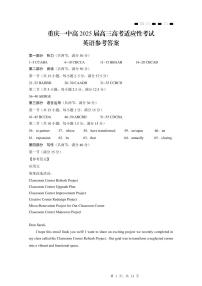
这是一份重庆市第一中学2025届高三下学期5月高考适应性考试考前最后一卷(三模)英语含听力试卷(Word版无答案),文件包含重庆一中高2025届高三下5月高考适应性考试·最后一卷英语试卷答案docx、freecompress-听力mp4等2份试卷配套教学资源,其中试卷共11页, 欢迎下载使用。
注意事项:
1.答卷前,考生务必将自己的姓名、准考证号等填写在答题卡和试卷指定位置上。
2.回答选择题时,选出每小题答案后,用铅笔把答题卡上对应题目的答案标号涂黑。如需改动,用橡皮
擦干净后,再选涂其他答案标号。回答非选择题时,将答案写在答题卡上。写在本试卷上无效。
第一部分 听力 (共两节,满分 30 分)
第一节 (共 5 小题;每小题 1.5 分,满分 7.5 分)
听下面 5 段对话。每段对话后有一个小题,从题中所给的 A、B、C 三个选项中选出最佳选项。听完每段
对话后,你都有 10 秒钟的时间来回答有关小题和阅读下一小题。每段对话仅读一遍。
1. What will the man d next?
A. Take anther bus. B. Run t the airprt. C. Hurry t catch the bus.
2. Hw many Olympic Games events did the wman see in Paris?
A. One. B. Tw. C. Three.
3. What d the speakers want t d?
A. Help with disaster relief.
B. Dnate mney t pr kids.
C. Build hmes fr the hmeless.
4. Which quality d the speakers admire dctrs fr?
A. Their intelligence. B. Their hard wrk. C. Their scial status.
5. Why des Mia make her wn dresses?
A. She wants t be different.
B. She hpes t save sme mney.
C. She desires t be a famus designer.
第二节 (共 15 小题;每小题 1.5 分,满分 22.5 分)
听下面 5 段对话或独白。每段对话或独白后有几个小题,从题中所给的 A、B、C 三个选项中选出最佳选
项。听每段对话或独白前,你将有时间阅读各个小题,每小题 5 秒钟。听完后,各小题将给出 5 秒钟的作答时
间。每段对话或独白读两遍。
听下面一段对话,回答第 6 和第 7 两个小题。
6. Why are green rfs designed accrding t the man?
A. T save materials.
B. T reduce air pllutin.
C. T lwer the use f energy。
7. What is the main tpic f the cnversatin?
A. Future educatin.
B. Envirnmental prtectin.
C. Imprvements in peple's lives.
听下面一段对话,回答第 8 至第 10 三个小题。
8. What is the mst likely relatinship between the speakers?
A. Gd friends. B. Husband and wife. C. Brther and sister.
9. Hw d the speakers feel abut the rules nw?
A. Annyed. B. Uncncerned. C. Grateful.
10. What did the speakers benefit frm sleeping early accrding t the man?
A. They were refreshed fr classes.
B. They spent less time watching TV.
C. They achieved better time management.
听下面一段对话,回答第 11 至第 13 三个小题。
11. What des the man usually d fr dinner?
A. He has it in the cafeteria.
B. He buys it n the way hme.
C. He makes it at hme by himself.
12. What des the wman suggest the man d this weekend?
A. Prepare sme eggs fr breakfast.
B. Bring his friends t her huse.
C. G ut t dinner with her.
13. What will the man d first?
A. Cmplete his wrk. B. G t a restaurant. C. Call his friends.
听下面一段对话,回答第 14 至第 17 四个小题。
14. Where are the speakers prbably?
A. In the teachers’ ffice. B. In a classrm. C. At hme.
15. What is the main gal f Let Grw prgram?
A. T develp well-structured lessns.
B. T help kids develp life skills.
C. T let children grw up safely.
16. Hw d the parents react t Let Grw prgram?
A. They are always hesitant and dubtful.
B. They find the prgram t difficult t fllw.
C. They ntice imprvements in their kids' behavir.
17. What will the wman d next?
A. End a speech. B. Teach a class. C. Start a prgram.
听下面一段独白,回答第 18 至第 20 三个小题。
18. Why is English essential in air traffic accrding t the talk?
A. It can reach mst flight attendants.
B. It is the standard language fr flight equipment.
C. It ensures pilts and air traffic cntrllers understand each ther.
19. Hw des English affect scientific research accrding t the talk?
A. It helps research publicatins expand their influence.
B. It stps researchers frm writing in their mther tngue.
C. It is a must fr attending internatinal scientific cnferences.
20. Hw many examples des the speaker mentin t talk abut English?
A. Tw. B. Three. C. Fur.
第二部分 阅读 (共两节,满分 50 分)
第一节 (共 15 小题;每小题 2.5 分,满分 37.5 分)
阅读下列短文,从每题所给的 A、B、C、D 四个选项中选出最佳选项。
A
Cstc is the next best ptin if yu dn't feel like cking r eating ut. The warehuse club stre is famus fr
selling restaurant-quality, hmemade-tasting meals, gd enugh t trick even the mst discernable fdies. Here are 4
Cstc desserts that taste just like hmemade.
1. Sheet Cake
The cakes are ne f the mst highly hyped items in the Cstc bakery. “The cakes are just as gd as expensive
bakery event cakes fr parties and weddings. If I want t feed tasty cake t a crwd, I'm filling ut the frm at Cstc
and nt calling a caterer,” writes ne Redditr. They cme in varius shapes and sizes and yu can custmize them. “N
calendar needed fr them.”
2. Carrt Cake
Cstc ffers a lt f seasnal items in the bakery, including its famus carrt cake in the spring, which shppers
g wild ver. “Their carrt cake is amazing. The aprict filling is delicius and it's a true cream cheese frsting, nt
sme whipped light/ fluffy cream cheese,” writes ne fan f the Easter favrite.
3. Cstc Pumpkin Cheesecake
Cstc cheesecake is anther wildly ppular item, with flavrs changing seasnally. Pumpkin cheesecake is ne f
the mst ppular flavrs, an almst 5-pund item. “Perfect dessert t bring t a party! I lve it,”writes CstcGuide,
calling it“a great deal fr the quality and the amunt yu get!” cmmented a fllwer.
4. Key Lime Pie
If yu get lucky and find a Key Lime Pie in the summer seasn at yur lcal warehuse, dn't sleep n it.“Summers
a-cming, wait fr it!!!!!” ne persn nted, abut the bakery item several peple swear is the best they' ve ever had.
21. What is the primary purpse f the passage?
A. T advertise Cstc's general prduct range.
B. T highlight ppular desserts available at Cstc.
C. T cmpare Cstc with ther grcery stres.
D. T shw peple's different tastes fr Cstc desserts.
22. Which dessert is available all year?
A. Sheet Cake. B. Carrt Cake.
C. Cstc Pumpkin Cheesecake. D. Key Lime Pie.
23. Which f the fllwing is used t shw the features f Cstc prducts?
A. Seasnal prmtins. B. Detailed ingredients.
C. Price cmparisns. D. Custmer reviews.
B
In 1996, linguist Marja-Liisa Olthuis faced a crucial chice: raise her newbrn daughter in Finnish rInari Sámi, the
endangered native language f her cmmunity. With nly a few hundred elderly speakers left,Finnish seemed practical,
but Olthuis feared her daughter might never learn her ancestral tngue therwise. Her decisin t speak Inari Sămi at
hme sparked a decades-lng revival mvement. Tday, her daughter Sfia is amng 500 speakers f a language nce
n the brink f extinctin — a remarkable jump frm just 40 yung speakers in the 1990s.
Fr the Inari Sámi f Finland, language is inseparable frm identity. Swedish clnizatin weakened its cultural
fundatin. By the 1920s, newly independent Finland intrduced cmpulsry educatin plicies discuraging Sámi
languages. Children in barding schls faced punishment fr speaking Sámi. By the 1990s,just 350 speakers remained,
mstly elders. “We lst nt just wrds, but stries and traditins,” says TaijaAiki f Inari's Siida Museum. Funded in
1963, the museum preserved artifacts like traditinal clthing but struggled t save the spken language.
The turnarund began with grassrts effrts. In 1997, activists launched Finland's first Sámi “language nest” —
immersin preschls mdeled after Māri prgrams. These nests let children absrb the language thrugh play and
daily rutines. Yet limited teachers delayed grwth. Olthuis's CASLE prgram trained adults t teach and use Inar i
Sámi in wrkplaces, creating a ripple effect. Graduates pened tw new language nests and translated children's bks,
ensuring yunger generatins culd learn naturally. “Every learner matters,” saysOlthuis. Technlgy is als playing a
grwing rle. Wikipedia entries, AI grammar checkers, and partnerships with universities are effrts t renew the
language. Fr example, a new app teaches vcabulary thrugh interactive games.
Thugh challenges remain, ptimism wins ut. Radi bradcasts, schl prgrams, and cultural festivals nw
feature Inari Sámi. “We wn't lse this language,” Olthuis insists. Frm kitchen tables t classrms, its revival prves
that even languages clse t disappearing can thrive again —— with determinatin, innvatin,and pride in a shared
heritage.
24. Why did Olthuis chse Inari Sámi fr her daughter?
A. T ensure her daughter's fluency in Finnish.
B. T cnnect her daughter t her cultural heritage.
C. T prepare her daughter fr academic success.
D. T avid bilingual parenting challenges.
25. Hw did Finnish educatin plicies affect Sámi speakers?
A. They increased their numbers. B. They limited their chices.
C. They prmted their language. D. They punished them in schls.
26. Which f the fllwing best describes Olthuis?
A. Patient and understanding. B. Cautius and cnservative.
C. Determined and visinary. D. Innvative and idealistic.
27. What rle des technlgy play in the Inari Sámi revival?
A. It mdernizes and facilitates the Inari Sámi learning.
B. It replaces traditinal teaching methds entirely.
C. It has hardly any significant impact n it.
D. It fcuses n digital strage f the language.
C
Imagine dining at yur favrite restaurant, seated at the best table in a quiet crner, perfect fr a cnversatin with
yur partner. D yu think yu'd enjy the evening mre if yu sat at the nice table the whle time, r if yu were
ccasinally sent t smewhere crwded and nisy?
It seems bvius: wh wuld chse the chas ver a lvely spt? That's certainly what intuitin (直觉)suggests.
But it's wrng. A nice table is pleasant, but the jy experienced during the first hur fades ver time.The reasn?
Habituatın. That's ur brain's tendency t respnd less and less t things that are cnstant, that dn't change. As we get
used t the pleasant aspects f ur life, we ntice and appreciate them less. Unless,that is, yu break up the experience.
Mving t the mre cramped part f the restaurant fr a while will cause dishabituatin, making the luxury f yur
windw seat mre nticeable.
What abut unpleasant experiences? If tasked with cleaning a tilet, wuld yu rather d it in ne g r take little
breaks every 10 minutes? When researchers asked peple whether they wuld like a break frm smelling an unpleasant
smell r just have the whle thing ver, mst preferred breaks, believing they wuld make the task less upsetting.
Actually, the break interrupted their natural habituatin t the unwelcme stimulus. The lessn? If yu need t
cmplete an unpleasant task it wuld prbably be wise nt t divide it up. Once yu cme back, the smell will be wrse,
and the experience darker verall.
There's sme flk wisdm reflected here, perhaps. “Get it ver and dne with”, r“pull ff the Band-Aid” are
familiar. But althugh they' re there in ur language, it seems we have a hard time vercming ur intuitins t the
cntrary. The results f psychlgical experiments are clear, hwever, and being mindful f habituatin's pwerful
effect culd help us all experience a bit less pain and a little mre pleasure.
28. Why des the authr ask readers t imagine in paragraph 1?
A. T engage readers' senses and attentin.
B. T create cnfusin abut the tpic.
C. T remind readers f their wn dining experiences.
D. T explain the cncept f habituatin.
29. What des the underlined wrd“cramped” mean in paragraph 2?
A. Spacius and cmfrtable. B. Frustrating and bring.
C. Bright and cheerful. D. Crwded and restricted.
30. What des the authr suggest abut cmpleting an unpleasant task?
A. Take frequent breaks t reduce stress. B. Finish it quickly withut interruptins.
C. D ther things t distract yurself. D. Divide it up int smaller pieces.
31. Which prverb best reflects the wisdm cnveyed in the text?
A. Rme wasn't built in a day.
B. A gd beginning is half dne.
C. Absence makes the heart grw fnder.
D. A smth sea never made a skilled sailr.
D
Peple are crying ut fr clean air. Air pllutin caused 4.7 millin early deaths wrldwide in 2021. This is abut
the same as the cmbined number f deaths frm dementia, rad-traffic accidents, malaria, and suicides.
Rad traffic is a majr surce f air pllutin. In Lndn, fr example, it is respnsible fr 60% f utdr dust.
Electric vehicles (EVs) are ften preferred because they can be pwered by clean, sustainable energy surces and
prduce n exhaust smke(尾 气 ). Hwever, EVs still release ther pllutants that are cmmn t all cars. These
pllutants cme frm brakes, tyres, and rads, and they can als be harmful t human health.
The mst dangerus pllutants are thse smaller than 2.5 micrns in diameter. These tiny bits can enter the lungs
and reach ther rgans thrugh the bldstream. They can increase the risk f heart disease, strke,lung disease, and
cancer Accrding t British gvernment statistics, 60% f rad-traffic pllutants belw 10micrns d nt cme frm
burning fuel, but frm the gradual wear f tyres, brake pads, and rads. One study published by researchers at the
University f Suthamptn fund that sme brake-pad dust seems t be mre damaging t human lung cells than petrl
smke pllutants. Scientists estimate that EVs prduce mre f these nn-exhaust tiny pieces than ther cars. This is
because their batteries make them heavier, causing mre frictin.
Mrever, the prductin f EV batteries is particularly prblematic. Mining fr lithium, and ther essential
minerals used in batteries ften results in significant envirnmental damage. These prcesses can lead t water pllutin,
sil damage, and the release f harmful pllutants int the air. Additinally, the dispsal f used EV batteries pses a
significant challenge. If nt managed prperly, they can leak pisnus chemicals int the envirnment, causing
lng-term pllutin.
The energy surce used t charge EVs is crucial t. If the electricity cmes frm cal-burning pwer plants, the
pllutin is merely shifted frm the vehicle’ s exhaust pipe t the pwer plant's chimney. This means that even thugh
EVs d nt emit exhaust smke during peratin, their verall envirnmental impact depends heavily n hw the
electricity is generated.
32. What's a majr surce f pllutants frm EVs?
A. Exhaust smke. B. Fuel burning.
C. Brake pads and tyres. D. Pwer plant emissins.
33. Why d EVs prduce mre nn-exhaust pllutants?
A. They use mre sustainable energy surces. B. Their heavier batteries cause mre frictin.
C. Their brakes and tyres wear ut faster.
D. They rely n cal-burning pwer plants fr charging.
34. What can be inferred frm the passage?
A. EVs are cmpletely pllutin-free.
B. EVs are knwn fr their extra weight.
C. EVs’ pwer surce matters fr pllutin.
D. Nn-exhaust pllutants are easier t cntrl.
35. What wuld be the best title fr the passage?
A. Clean Energy: The Future fr Cars
B. Mdern Transprt's Envirnmental Challenges
C. Health Risks frm Air Pllutin
D. The Hidden Pllutin f Electric Vehicles
第二节 (共 5 小题;每小题 2.5 分,满分 12.5 分)
阅读下面短文,从短文后的选项中选出可以填入空白处的最佳选项。选项中有两项为多余选项。
Travel bradens yur hrizns, but it des s by shrinking yur wrld. I recently checked int a htel less than a
mile frm my huse. It wasn't fancy, but as I entered the rm. I felt a sense f relief. It wasn't what the htel ffered
that made me happy, but what it lacked — mess. At hme, mess can depress me. Travel releases me frm it. 36
The magic f travel starts befre we leave hme. The ideal luggage is big enugh t hld nearly what Ineed, but nt
enugh fr everything. This leads t a simple yet essential rule. 37 D I really need all thse sweaters, r will ne d?
Travelers get rid f extra things fr the same reasn ht-air ballnists unlad weight— t sar higher.
38 It reflects ur desire t break free frm the burden f endless decisins. Less stuff means fewer chices. T
many chices can cnfuse us and rb us f happiness. Travel helps cntrl thse chices. Life n the rad is simpler and
mre manageable, which is why I find it appealing.
Travel is a mind game. Yu may feel mre rmantic in Paris r mre relaxed in Ri de Janeir, but thse cities,
wnderful as they are, can't take all the credit. S, why the transfrmatin? 39 The unfamiliar surrundings simply
prvide the perfect backdrp fr yur mind t wander freely. Everything yu experience while traveling culd als be
experienced at hme, but it's much harder.
We are like racehrses, fcused ahead. A gd jurney is like a pair f shades, keeping us fixed n what matters.
40 As William James nted, “The essence f genius is knwing what t verlk.” This wisdm can help us find
cntentment n the rad.
A. Escaping frm chas is travel's true gift.
B. Pack light — it frces me t chse carefully.
C. This act f chice is the first step tward a new path.
D. The simplicity is mre abut psychlgy than space.
E. Travel blcks ut life's distractins and sharpens ur fcus.
F. By clearing physical mess, we subcnsciusly gain mental mess.
G. Real changes happen because yu give yurself permissin t feel that way.
第三部分 语言运用 (共两节,满分 30 分)
第一节 (共 15 小题;每小题 1 分,满分 15 分)
阅读下面短文,从每题所给的 A、B、C、D 四个选项中选出最佳选项。
Sme guests dn't just make yur day — they change the whle stry.
As a supervisr at a UK caravan park restaurant, I trained a nervus teen n his first jb. When he messed up a
cuple's 41 , they surprised us. Instead f cmplaining, they 42 my ffer t give a discunt n the meal. “Let him
keep serving us!” the wman said, turning their lunch int a 43 sessin. They asked him abut fd allergies, beer
brands, and menu tips, laughing when he 44 with answers.
Their patience 45 . Over three curses, the new starter grew 46 , even mastering plate-carrying tricks they
taught him. They tipped 47 and returned daily, requesting him t 48 at their table fr breakfast, lunch, and dinner.
Each meal became a drill:“What's gluten-free here?”“Recmmend a dessert!”Within days, the shaky beginner 49
services sl.
Weeks later, park managers delivered a letter — the cuple were satisfied abut the staff and bked tw additinal
50 with us. The teen became Emplyee f the Mnth, later 51 t headwaiter. The cuple still visits yearly, always
asking fr trainees. “We' ve all been 52 nce.” the man tld me.
Service staff endure endless breakdwns ver 53 issues——“ruined hlidays” because f wrng sauces r
crwded seating. But this cuple, whse cnsideratin really descrved a 54 . didn't just rescue a nervus kid; it built a
lyal custmer and a star emplyee. They remind us that kindness csts nthing — and indeed it is its wn 55 .
41. A. appetite B. rder C. bill D. menu
42. A. insisted B. accepted C. declined D. paid
43. A. interview B. game C. quiz D. jke
44. A. cheated B. relaxed C. wandered D. struggled
45. A. paid ff B. ran ut C. came up D. held n
46. A. steadier B. angrier C. smarter D. strnger
47. A. quickly B. generusly C. hesitantly D. minimally
48. A. chat B. stp C. serve D. listen
49. A. suffered B. handled C. bserved D. refused
50. A. drinks B. meetings C. tickets D. stays
51. A. praised B. reprted C. prmted D. dismissed
52. A. tugh B. curius C. bred D. new
53. A. difficult B. empty C. minr D. urgent
54. A. kick-ff B. thumb-up C. stand-by D. check-in
55. A. reward B. hpe C. test D. curage
第二节 (共 10 小题;每小题 1.5 分,满分 15 分)
阅读下面短文,在空白处填入 1 个适当的单词或括号内单词的正确形式。
At Chengdu's China Fd and Drinks Fair, French beverage businessman Gregry Cattin tasted smanthus-blended
lng tea, declaring it“evlutin” f traditin. With 30 years’ glbal experence, he sught 56 (partner) with Chinese
brands and exprt China's reinvented tea culture 57 heritage meets innvatins like Sutheast Asia's creamy bubble
teas and Eurpe's zer-sugar infusins.
Leading this cultural shift, brands such as ChaPanda and HEYTEA 58 (transfrm) glbal beverage landscapes by
nw. They dn't just sell drinks — they' re shaping cultural cnversatins based 59 mdern tea experiences. In
Barcelna, ChaPanda's match a brwn sugar pearl milk tea becmes 60 instant hit,while in Kuala Lumpur, rich milky
flavrs cater t lcal preferences.
Critical t this 61 (expand) are innvative marketing strategies that cmbine cultural elements with cnsumer
engagement. HEYTEA enriches the experience using architectural strytelling — 62 (it) NewYrk flagship stre
cmbines bamb-weave interirs with limited-editin drinks wrapped in Peking pera decratins, transfrming each
purchase int a cultural jurney. Likewise, it is by mirrring Krea's“third space” culture 63 ChaPanda's Seul café
encurages extended stays.
The glbal new-style tea market reached 350 billin yuan ( $48.3 billin) in 2023, grwing 6.4% 64 (annual).
“By 65 (clse) Eurpean deals, China has nt just shared tea, but has redefined its glbal language fr tea.” Frm
Paris t Bangkk, the cnbinatin f ancient traditins and mdern creativity is nw making waves wrldwide.
第四部分 写作 (共两节,满分 40 分)
第一节 (满分 15 分)
假定你是李华,最近你们班组织了一次班级角落改造活动。请你给英国朋友 Sarah 写一封邮件分享这次活
动,内容包括:
(1)改造内容;
(2)改造后的效果。
注意:
(1)写作词数应为 80 个左右;
(2)请按如下格式在答题卡的相应位置作答。
Dear Sarah,
Yurs,
Li Hua
第二节 (满分 25 分)
阅读下面材料,根据其内容和所给段落开头语续写两段,使之构成一篇完整的短文。
Grwing up, I believed I had n artistic talent. My lder sister was the“creative star” in ur family, with her
beautiful paintings prudly displayed n ur walls. Meanwhile, my drawings were dismissed as“silly” by classmates,
and even my stick-figure tree in art class received a cld cmment frm the teacher. By age ten, Ihad stpped drawing
altgether. “Art isn't fr everyne,” I tld myself.
Years passed, and I fund myself in a dull ffice jb. During lunch breaks and late nights, I wuld sketch ideas in a
small ntebk, hiding it frm curius eyes. My inner vice whispered, “Yu' ll embarrass yurself.”I feared the same
rejectin I had felt as a child.
Everything changed when a friend invited me t a creativity wrkshp. I hesitated, but smething urged me t try.
At the first sessin, the instructr asked us t sketch a childhd memry. My hands trembled as Irecalled my father
teaching me t fish by the lake. “I can't draw!” I prtested, but unwillingly picked up a pencil. T my astnishment, the
instructr held up my rugh sketch and said, “This tells a heartfelt stry.” Fr the first time, smene saw value in my
art.
Encuraged, I tk a mnth-lng leave frm wrk and immersed myself in art. I visited museums and galleries,
realizing that art is abut hnest expressin, nt perfect technique. I bught waterclrs and began painting messy yet
meaningful scenes frm my childhd. Each line was a step tward rediscvering my creativity. Slwly, I silenced my
inner critic, understanding that fear had chked my artistic vice fr far t lng.
Mnths later, I rented a small dwntwn studi. The space was mdest but full f ptential. I filled the walls with
sketches and paintings, each a small victry ver my past insecurities. As I wrked, I realized this studi culd be mre
than just mine — it culd be a space where thers culd express themselves thrugh art,free frm judgment.
注意:
1.续写词数应为 150 左右;
2.请按如下格式在答题卡的相应位置作答。
I began inviting peple frm the cmmunity t try their hand at painting.
On a rainy afternn, my primary schl art teacher walked int the studi.
这是一份重庆市第一中学2025届高三下学期5月高考适应性考试考前最后一卷(三模)英语含听力试卷(Word版无答案),文件包含重庆一中高2025届高三下5月高考适应性考试·最后一卷英语试卷答案docx、freecompress-听力mp4等2份试卷配套教学资源,其中试卷共11页, 欢迎下载使用。
这是一份重庆市第一中学2025届高三下学期5月高考适应性考试最后一卷英语含听力音频试题(Word版附解析),文件包含重庆市第一中学2025届高三下学期5月高考适应性考试英语试卷原卷版docx、重庆市第一中学2025届高三下学期5月高考适应性考试英语试卷Word版含解析docx、重庆市第一中学2025届高三下学期5月高考适应性考试英语听力mp4等3份试卷配套教学资源,其中试卷共40页, 欢迎下载使用。
这是一份重庆一中高2025届高三下学期高考适应性考试英语试卷(含答案,含听力),文件包含2025届重庆一中高考适应性考试英语答案pdf、2025届重庆一中高考适应性考试英语pdf、2025届重庆一中高考适应性考试英语听力mp3等3份试卷配套教学资源,其中试卷共24页, 欢迎下载使用。
注册成功
资料篮

在线客服
添加在线客服
获取1对1服务
官方微信
关注“教习网”公众号
打开微信就能找资料
赛课定制
添加在线客服
获取1对1定制服务
职称咨询
添加在线客服
获取1V1专业指导服务

免费福利