免费领取教师福利

若您为此资料的原创作者,认为该资料内容侵犯了您的知识产权,请扫码添加我们的相关工作人员,我们尽可能的保护您的合法权益。


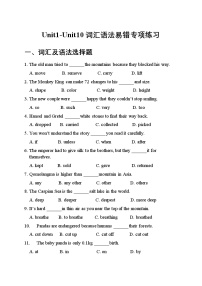
这是一份人教版八年级下册英语期中专题复习专题03 Unit1-5常考点和易错点 练习,共14页。试卷主要包含了have a cld 感冒,lie 的常用义项, 同意对方的建议时,一般用等内容,欢迎下载使用。
考点1.“What’s the matter?”表示“怎么了?/出什么事了?”
常用于询问某人有什么病或某人遇到什么麻烦、问题,其后跟询问对象时,与介词 with 连用。
重点:“What’ s the matter with sb? ”= What’s the truble with sb? =What’ s wrng with sb?
=What’s up? =What happens t sb.?
【注意】matter 和truble 为名词, 其前可加the 表示特指,wrng 是形容词,不能加the。
matter还可作动词v.,意为“要紧;关系重大”。
常用句型:It desn’t matter. “没关系”,用来回答对方的道歉。
Eg.—Srry, I’m late. I gt stuck in a traffic jam. 抱歉,我来晚了。路上堵车。
—It desn’t matter. 没关系。
考点2.have a cld 感冒
have 在此处作及物动词,意为“患病”,可与get或catch 互换。 cld 前可用bad、heavy等词修饰。
Because the temperature drpped sharply, many students had/gt/caught a bad cld.
【易错警示】have表示“患病”时, 不可用于进行时。
【拓展】“表示身体部位的名词+ ache”常表示“……痛”, 常见的还有:
tth (牙齿) + ache = tthache (牙痛)
head (头) + ache = headache (头痛)
back (背) + ache = backache (背痛)
ear (耳朵) + ache = earache (耳朵痛)
考点3患病的表达方式
have a/an +疾病名称
have a cld 感冒 have a fever 发烧
have a cugh 咳嗽
have a/an +身体部位-ache
have a headache 头痛 have a stmachache胃痛
have a tthache 牙痛
have a sre +身体部位
have a sre back 背疼 have a sre thrat 喉咙疼
主语+hurt (s) / cut (s) + 身体部位 / 反身代词
He hurts himself.
患病的表达方式
考点4.lie 的常用义项:
考点5 see sb. ding sth. 看到某人正在做某事
(1) see sb. ding sth. 强调看到某个动作正在进行。
(2) see sb. d sth. 强调看到某个动作经常发生或发生的全过程。
I saw Tm playing chess with the ld man.
I saw Jim g int the bank just nw.
考点6 expect sb. t d sth.预料某人会做某事;期望某人做某事
I didn’t expect him t stay s lng.
【拓展】expect的其他常见用法:
expect t d sth. 预计/期待做某事
expect + (that) 从句 预料……
I expect t be back within a week.
There’s the drbell—I expect that it will be my mther.
考点7 agree相关的短语:
考点8 truble的常用短语:
考点9 is used t
be used t 后常接名词、代词或动词-ing 形式作宾语。
I’m used t getting up early.
Yu will sn be/get used t the weather here.
考点10 because f 和because的区别:
考点11 be ready t d sth. 准备好做某事;愿意做某事
(1) be ready t d sth. 在此处意为“准备好做某事”,其同义短语为get ready t d sth.。be 强调状态,get 强调动作。
I’m ready t pick yu up.
(2) be ready t d sth. 还可意为“愿意做某事”。
I’m ready t answer yur questins.
【拓展】be/get ready fr 意为“为……做准备”。其中fr为介词,其后跟名词、代词或动词-ing形式。
We are getting ready fr the cmpetitin.
I’ve been ready fr making dinner.
考点12 mean /miːn/ v. 意思是;打算;意欲
(1) mean在此处作动词,意为“意思是”,其名词形式为meaning,意为“意思;含义”。What d/des…mean? =What’s the meaning f…? 意为“……是什么意思?”
What des this wrd mean? = What’s the meaning f this wrd?
(2) mean作动词,还可表示“打算;意欲”。mean t d sth. 表示“打算做某事”。
We mean t visit yu tmrrw.
s+ 形容词 / 副词 + that
such + a/an + 形容词 + 名词单数 + that
such + 形容词 + 名词复数 / 不可数名词 + that
如此……
以至于……
考点13 重点:与的用法
考点14 keep n ding sth. 继续做某事
keep的常见搭配:
keep sb. ding sth. 让某人一直做某事
keep sb. frm ding sth. 阻止某人做某事
keep sb. /sth. + adj. 使某人/某物保持……状态
Tm kept his friend waiting utside the gate.
The heavy rain kept us frm ging t schl.
We must keep ur classrm clean and tidy.
考点15 lnely /ˈləʊnli/ adj. 孤独的;寂寞的 alne /əˈləʊn/ adv. 独自;单独
The ld man lives alne, but he desn’t feel lnely.
At a dark night, a man came t a lnely(偏僻的) village.
The by was very shy, and he was alne all the time.
考点16 care fr
(1) care fr在此处意为“照顾”,相当于lk after 或take care f。
The mther cared fr the sick child day and night.
(2) care fr还可意为“非常喜欢”,常与nt连用。
He desn’t care fr classical music.
【归纳总结】与care相关的短语:
care fr照顾;非常喜欢
take care当心;小心
care abut 关心;在意
take care f 照顾
考点17 each与every,两者均可表示“每个”,但用法不同:
考点18 jurney, travel, trip与 tur
I tk a jurney frm Beijing t Shanghai last year.
Travel is much cheaper nw than it used t be.
They tk a bat trip t the island last mnth and had great fun there.
We tk a walking tur f the city.
考点19 disabled作形容词,the disabled意为“残疾人”,表示复 数概念。
He was brn disabled but he didn’t give up.
I wrked as a vlunteer t help the disabled.
【拓展】 一些词加否定前缀dis-可以构成它的反义词, 如:
agree (同意) — disagree (不同意)
appear (出现) — disappear (消失)
hnest (诚实的) — dishnest (不诚实的)
考点20 make it + adj. + (fr sb.) t d sth. 使做某事(对某人来说)……
该结构中it作形式宾语,真正的宾语是后面的动词不定式短语,形容词作宾语补足语。
His help makes it easy fr me t learn English.
【拓展】除make外,常用于这种结构的还有think、 find等。
I think it useful fr us t master a freign language.
We find it difficult fr us t finish this task by urselves.
考点21 carry, take, bring与get
He was carrying a big bag.
Mark ften takes his bks t Beth’s huse t study.
Dn’t frget t bring it here.
Can yu g and get sme water fr us?
考点22 a friend f mine
a friend f mine相当于ne f my friends,是双重所有格。如果被所有格修饰的名词前有冠词、数词、不定代词或指示代词等,常用双重所有格,即“f+ ’s所有格/名词性物主代词“的形式,来表示所属关系。
Jhn is a friend f my father’s = Jhn is ne f my father’s friends.
考点23 excited 与exciting
When we arrived in Beijing,we are all excited.
Exciting news made me nt sleep well.
考点24 interest在此处作名词,意为“兴趣;关注”。
have (an) interest in 对……感兴趣
have n interest in 对……不感兴趣
take an interest in 对……产生兴趣
lse interest in 对……失去兴趣
I have n interest in histry at all.
He lst interest in his wrk.
(2) interest还可作动词,意为“使感兴趣;使关注”。
Things f that nature d nt interest me.
考点25 The minute+时间状语从句+逗号+主句.
(1)The 是the minute引导的时间状语从句,the minute意为“一就”,可以与immediately/as sn as互换使用。它引导时间状语从句时主从句都用一般过去时或一般现在时,还可以遵循“主将从现”的原则。
The minute/As sn as/Immediately I finished ding the husewrk,Lucy came t visit me.我一做完家务露西就来拜访我。
I’ll visit yu the minute/immediately/as sn as I get back t Zhuzhu.我一回株洲就来拜访你。
考点26 neither did I是倒装结构。
neither在此作副词,意为“也不”,引导的倒装结构为“neither +be动词/助动词/情态动词+主语”,表示“也不这样”,neither可以与nr互换。该结构的前句为否定句,其主语与前句中的主语不同。be动词/助动词/情态动词要与前句谓语保持时态一致,也要和其后主语的单复数形式保持一致。
—He can’t speak Russian. 他不会讲俄语。
—Neither/Nr can I. 我也不会。
—I dn’t finish hmewrk. 我没有完成家庭作业。
—Neither/Nr des he. 他也没有完成。
特别关注:neither+主语+助动词/be动词/情态动词是错误结构。
知识拓展:
(1)s+be/助动词/情态动词+主语表示“也是如此”,是neither +be动词/助动词/情态动词+主语的反义结构。此时前句是肯定句,其主语与前句主语不同。be/助动词/情态动词要与前句谓语保持时态一致,也要和其后主语的单复数形式保持一致。
—Mary is a student.玛丽是学生
—S is Tm.汤姆也是学生。
(2)S+主语+be/助动词/情态动词表示“的确如此”。主语和前句主语相同,be/助动词/情态动词要与上句谓语保持时态一致,也要和其后主语的单复数形式保持一致。
—He wrks hard.他工作努力。
—S he des.他确实是这样。
考点27 prvide在此作及物动词,意为“提供”
prvide sth fr sb短语,表示“为某人提供某物”,可以与prvide sb with sth互换。
The Internet prvides peple with a new utlet t express their views.=The Internet prvides a new utlet fr peple t express their views.互联网为人们提供了一个表达自己观点的新渠道。
知识回顾:ffer作及物动词意为“提供”时,固定结构为ffer sb sth/ffer sth t sb,表示“为某人提供某物”。
She ffers me a cup f cffee.
=She ffers a cup f cffee t me. 她给我提供一杯咖啡。
考点28【句型】I think it is+形容词+fr sb t d sth.表示“我觉得做是。”
(1)it is 是省略连词that引导的宾语从句。此时最后带上连词that,因为在书面语中,如果that引导的宾语从句很长时,通常不省略连词that。
(2)从句用了“it is+形容词+fr sb+动词不定式.”结构。it是形式主语,真正的宾语是动词不定式部分。fr引导的介词短语说明该动词不定式是由children发出的动作。
It is imprtant fr me t d mre exercise.对我来说多做运动很重要。
特别关注:think接that引导的宾语从句时,如果从句用了“it is+形容词+(fr sb)+动词不定式.”句型,从句可以转换为it+(fr sb)+动词不定式(it为形式宾语)。
I think that it is necessary t learn Chinese well.
=I think it necessary t learn Chinese well.我觉得学好汉语是很有必要的
考点29 develp在此作及物动词,意为“培养”
I find it imprtant t develp a gd habit.我发现养成一个好习惯很重要。
知识拓展:develp作不及物动词时意为“发育”。作及物动词时意为“开发、发展、患病”。
The child is develping nrmally.这个孩子发育正常。
He intends t develp the new cmputer sftware.他打算开发一种新的计算机软件。
We have t develp ur ecnmy.我们必须发展经济。
It is said that he develps asthma.据说他患上了哮喘。
(2)independence在此作不可数名词,意为“(个人生活的)独立”。
Yu can maintain yur independence.你可以保持独立。
知识拓展:independence对应的形容词是independent,可以与介词f搭配,表示“不依赖”,反义短语是dependent n/upn。
Yu shuldn’t be dependent n yu.你不应该依赖我。
考点30 because、since、as、fr表示原因的区别
(1)because意为“因为”,引导原因状语从句时语气最强,指事情发生的直接原因。
Because he was ill, he was late fr schl.他生病了,所以迟到了。
(2)as的语气比since弱,意为“由于、鉴于”, 引导原因状语从句时表示附带说明的双方已知的原因。
As there was n answer, I wrte again.鉴于没回复,我又写了一封信。
(3)fr作并列连词,引导并列句,语气最弱。它表示推断的理由, 只放于主句之后。
He culd nt have seen me, fr I was nt there. 他不可能见过我, 因为我不在那里。
【注释2】主句they shuld knw tidy包含了一个that引导的宾语从句that everyne ... and tidy。该宾语从句中用了d ne’s part in ding sth短语,表示“尽某人的职责做某事”。由于in是介词,接动词时必须用动词的V-ing形式。
The President asked them t d their part in fighting inflatin.总统要求他们尽自己的本份对付通货膨胀。
【注释3】keeping it clean and tidy用的是“keep sth+形容词”短语。keep作使役动词,意为“使得”。it指上文中的huse。clean and tidy作宾语补足语,描述it的状态。
Dn’t clse the dr. Keep it pen.别关门。让它开着。
考点31 allw
(1) allw ding sth 允许做某事
We dn’t allw smking in ur huse. 我们不允许在家里抽烟。
(2)allw sb.(nt)t d sth. (不)允许某人做某事
We allw yu t have a break.我们允许你休息。
We dn’t allw eating in the classrms. 我们不允许在教室吃饭。
考点32 t many意为“太多”
(1)t many + 复数名词 许多 t many peple
(2)t much +不可数名词 许多 t much hmewrk
(3)much t +形容词 太… much t cld
There are t many peple here.这里有太多的人。
T many children like watching this mvie.太多小孩喜欢看这部电影。
考点33 until作介词时有如下两种用法。
(1)用在肯定句中,谓语要用延续性动词或 be动词,表示“直到……时为止”。
She was sick in bed until yesterday.她一直生病卧床休息到昨天为止。
He wrked until midnight.他一直工作到半夜。
用在否定句中,谓语多用短暂性动词,表示“直到……才……”。
She will nt cme until12 ’clck.她要到 12点才会来。
He didn’t g t bed until 11 ’clck last night.他昨晚直到11点钟才上床睡觉。
考点34 提建议的句型
(1) What abut ding sth. ?=Hw abut ding sth.? ….怎么样?
(2) Why dn’t yu d sth.?= Why nt d sth.? 为什么不呢?
(3) Let’s d sth. 让我们一起做某事吧。
(4) Shall we/I d sth.? 我们做…好吗?
(5) had better d/nt d sth. 最好做/不做某事
(6) Will/Wuld yu please d sth. 请你做…好吗?
(7) Wuld yu like t d sth.? 你想去做某事吗?
(8) Wuld yu mind ding sth.?你介意做某事吗?
【回答】
(1). 同意对方的建议时,一般用
Gd idea. / That’s gd idea. 好主意 OK/ All right. / Great. 好/ 行/太好了
Yes, please. / I’d lve t. 是的/ 我愿意 I agree with yu. 我同意你的看法
N prblem. 没问题 Sure./ Of curse./ Certainly. 当然可以
Yes, I think s. 对,我也这样想
(2).对对方的帮助或要求表示委婉谢绝时,一般用:
I dn’t think s. 我认为不是这样 Srry, I can’t. 对不起,我不能
I’d lve t, but…我愿意,但恐怕…… I’m afraid… 恐怕……
考点35 find sb.. ding sth. 发现某人正在做某事
I find(that)there is a by lying n the rad. =I find a by lying n the rad. 我发现路上躺着一个男孩。
lk thrugh是“不及物动词+介词”类型的短语,意为“翻阅、查看”,常接表示“物品”的词作宾语。
Lk thrugh yur ntes befre the examinatin.考试前翻阅你的笔记。
I usually lk thrugh newspapers after supper.我通常晚饭后翻阅一下报纸。
其他短语
lk fr 寻找 lk after=take care f照看 lk like看起来像 lk the same看起来一样
lk ver检查,复习 lk thrugh温习,检查 lk ut小心,从里向外看 lk up向上看,查单词
lk arund环视 lk frward t期望
考点36 whether和if引导宾语从句的异同点
相同点:它们都意为“是否”,引导宾语从句时从句都用陈述语序,通常可以互换使用。
He asked me whether/if I culd help him. 他问我我是否可以帮他。
不同点:
(1)whether可以直接接r nt,也可以把r nt放在句末。if不能和r nt直接连用。
I dn’t knw whether/if he will help me r nt. 我不知道他是否会帮我。
Please tell me whether r nt yu will cme.请告诉我你是否会来。
(2)在介词后面要用whether,不用if。
It depends upn whether yu can finish the task n time.这取决于你能否按时完成这个工作。
考点37 elder和lder的区别
elder 表示兄弟姐妹及子女之间的长幼关系, 表示“前辈的”、“年纪较长的”,仅用于同一家庭成员的比
较;
lder泛指新旧、老幼或年龄的大小关系,是ld的比较级形式。
My yunger sn is five and my elder sn is nine。我的小儿子5岁,大儿子9岁。
Tm is tw years lder than I.汤姆比我年长两岁。
(2)elder在句中只用作定语,不作表语;lder两者皆可。
My elder sister des her hmewrk all by herself. 我的姐姐独自做作业。
His elder sn gt married last week. 他的长子是上星期结婚的。
I think his mther is lder. 我认为他的母亲年龄大引起。
(3)elder只能用来指人;lder既可修饰人,也可修饰物。
My elder brther jined the army when he was nly fifteen.我哥年仅15就参了军。
This dg is lder than any ther dgs here.这条狗在这里是最老的一条。
I have a sister lder than myself.我有位比我大的姐姐。
考点38 instead
(1) instead adv 代替,句首或句尾, 表示前面的事情没做,而做了后面的事情。
Lee was ill s I went instead.李病了,所以我去了。
Instead he watches whatever he wants until late at night.
(2) instead f 代替 而不是,是介词短语 后接名词、代词、介词短语或动名词形式,放在句中
Instead f ging t Qingda I’m ging t Dalian this year. 今年我打算去大连,而不去青岛。
She wrte t him instead f calling him. =She didn’t call him. She wrte t him instead.
她没有给他打电话,而是给他写了封信。
考点39 .cmpete with
句中用了cmpete with sb短语,表示“与某人竞争”。
(1)cmpete with sb. 和某人竞争
(2)cmpete against/ with 与……竞争
(3)cmpete fr 为……参加比赛
Mre than 100 peple cmpeted fr the pst.有一百多人竞争这个职位。
Several cmpany are cmpeting fr the cntract.几家公司正在为争取这项合同而竞争。
拓展cmpetitin表示“竞争、竞争对手”时为不可数名词;表示“比赛、竞赛”时为可数名词。
Cmpetitin fr the jb is intense.该职位竞争很激烈。
考点40 cntinue作及物动词时意为“继续”
cntinue ding sth =g n ding sth 继续做某事(前后做同一件事)
cntinue t d sth = g n t d sth 继续做某事(前后不是同一件事)
After drinking sme water,he cntinued reading Lessn Ten.他喝了一些水后继续读第10课。
After finishing reading Lessn Nine,I cntinue t read Lessn Ten.读完第9课后,我继续读第10课。
考点41. cmparing
(1)cmpare…with… 把……与…..做比较 侧重指两者间的区别。
(2) cmpare…t… 把…..比做……着重注意两者间的相似点。
(3)cmpared with/t 状语,位于句首,句中
Cmpare this car with that ne, and yu will find the differences between them.
This sng cmpares ur cuntry t a big family.这首歌把我的国家比作一个大家庭。
考点41 truble的用法
“It's sad that many peple dn't want t help thers because they dn't want any truble,” says ne passenger. 一名乘客说:“令人伤心的是,许多人不想要帮助别人,因为他们不想要任何麻烦。”(P3)
拓展 辨析truble与prblem
1.truble(麻烦)指的是一种困扰、困难或不便,是由某种情况或行动而导致的麻烦。
2.prblem(问题)指的是一个具体的困难、难题或疑惑,需要解决或处理。
考点42 辨析raise与rise
Fr example, we can make plans t visit sick children in the hspital r raise mney fr hmeless peple. 例如,我们可以制订计划去医院看望生病的孩子或者为无家可归的人募捐。(P12)
考点43辨析brrw、lend、keep与return
Culd I brrw that bk?我能借那本书吗?(P20)
用brrw、lend、keep或return的适当形式填空。
1.T ________ a bk and take it hme tday, a persn just needs a library card.
[答案]brrw
2.Excuse me, can I ____ the nvel fr a week?
[答案]keep
3.[2024天津改编]We __________ the bks t the library after we read them last week.
[答案]returned
4.After I arrived hme frm schl, my mther asked me, “Has Jack __________ the bk yu ____ him last week?”
[答案]returned; lent
考点44 begin的用法
Ben was helping his mm make dinner when the rain began t beat heavily against the windws. 本正在帮妈妈做晚饭,这时雨开始猛烈地击打窗户。(P35)
拓展 beginner n.新手 beginning n.开端
begin with以……开始
at the beginning f在……的开端
考点45 辨析sleep、asleep、sleepy与sleeping
He finally fell asleep when the wind was dying dwn at arund 3:00 a.m. 凌晨三点左右,当风逐渐减弱,他终于睡着了。
考点46 辨析realize、achieve与cme true
Kate realized her bag was still at hme. 凯特意识到她的包还在家里。(P37)
动词
躺,存在
lie-lay-lain-lying
撒谎
lie-lied-lied-lying
下蛋,放置
lay-laid--laid-laying
可数名词
谎言,假话
lie-lies短语:tell a lie撒谎 lie t sb.对某人撒谎
agree t
主要表示一方提出一项建议、安排、计划等,另一方同意协作。
agree with
表示同意某人或某人的意见、想法、分析、解释等(即持同一观点)。
agree n/upn
指双方经过协商而取得对某事的一致意见或就某事达成协议。
get int truble
陷入麻烦、困境
be in truble
处于困境之中
have truble (in) ding sth.
做某事有困难
because f
短语介词
后可接名词、代词或动词-ing形式作宾语
Because f t much traffic, I was late fr the meeting.
because
连词
后接句子
He didn’t g t schl because he was ill.
each
强调个性,着眼于个体。
用于单数主语前,谓语动词用单数。
用于复数主语后,谓语动词用复数。
each f 后接复数名词或代词作主语时,谓语动词用单数。
every
强调共性,着眼于整体。
用于单数主语前,谓语动词用单数。
不能与f 连用。
jurney
travel
trip
tur
常指陆地上的远距离旅行,有时也可指“路程”。
常指长时间、远距离的“旅行”,尤指出国旅行。
常指近距离的为了办事或消遣的旅行,往往要回到出发点。
指成团的、以观光为目的的旅游,也可指明星的巡演。
carry
拿; 提; 扛
表示搬运、携带,具有负重的含义,没有方向性。
take
拿走; 带走
指把人或物从说话者所在的地方带到别处。有方向性。
bring
拿来; 带来
指把人或物从别的地方带到说话者所在的地方。有方向性。
get
去取; 去拿
指到某地去把某人或某物带来或拿来。表示来回。
excited
表示“感到兴奋的”,常用来修饰人。
exciting
表示“令人兴奋的”,常用来说明事物。
含义
常用短语或搭配
n.问题;忧虑;苦恼;困难;困境
be in truble 处于困境之中
be ut f truble 摆脱困境
get int truble 陷入困境
have truble ding sth. 做某事有困难
have truble with sth. 在某事上有麻烦或困难
v.麻烦;使烦恼
truble sb. with sth. 为某事麻烦某人
truble sb. t d sth. 麻烦某人做某事
词汇
含义
示例
raise(vt.)(raised; raised)
募集;征集
raise mney fr为……筹款
raise an army组建军队
举起;抬起
raise ne's hand 举手
增加;提高
raise salaries提高薪水
抚养;养育
raise pets养宠物
rise(vi.)(rse; risen)
(日、月、河水、温度等)上升
The river rse by ne meter.河水上涨了一米。
增长;上涨
The price rises.价格上涨了。
起来;起床
They rse frm the table.他们从餐桌旁站起身。
词汇
词性
含义及用法
sleep
动词/名词
“睡觉”
g t sleep去睡觉
I usually g t sleep at 21:00.
asleep
形容词
“睡着的”
fall asleep入睡
It is easy fr me t fall asleep with sft music.
sleepy
形容词
“瞌睡的,困倦的”
a sleepy child一个打瞌睡的孩子
G t bed if yu feel sleepy.
sleeping
形容词
“同住宿有关的,睡觉的”
a sleeping bag一个睡袋
This sleeping bag is very warm.
这是一份人教版八年级下册英语期中专题复习专题03 Unit1-5常考点和易错点 练习,共14页。试卷主要包含了have a cld 感冒,lie 的常用义项, 同意对方的建议时,一般用等内容,欢迎下载使用。
这是一份人教版八年级下册英语期中专题复习01 Unit1-5重点词汇,短语,句子归纳 练习,共24页。试卷主要包含了ft,rest剩余的,tth牙痛,press压力,sick疾病,breathe呼吸,we我们→我们的,climb攀登者等内容,欢迎下载使用。
这是一份人教版英语八年级下册 期中复习Unit1-unit5单词专练,共6页。试卷主要包含了用括号中所给单词的适当形式填空等内容,欢迎下载使用。
注册成功
资料篮

在线客服
添加在线客服
获取1对1服务
官方微信
关注“教习网”公众号
打开微信就能找资料
赛课定制
添加在线客服
获取1对1定制服务
职称咨询
添加在线客服
获取1V1专业指导服务

免费福利

(1).png)