免费领取教师福利

若您为此资料的原创作者,认为该资料内容侵犯了您的知识产权,请扫码添加我们的相关工作人员,我们尽可能的保护您的合法权益。


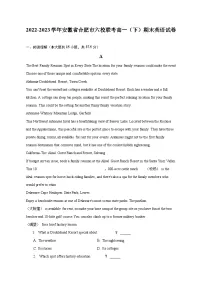
这是一份2025-2026学年安徽省合肥市六校联考高一下学期期末英语试卷(学生版),共20页。试卷主要包含了5分,满分7等内容,欢迎下载使用。
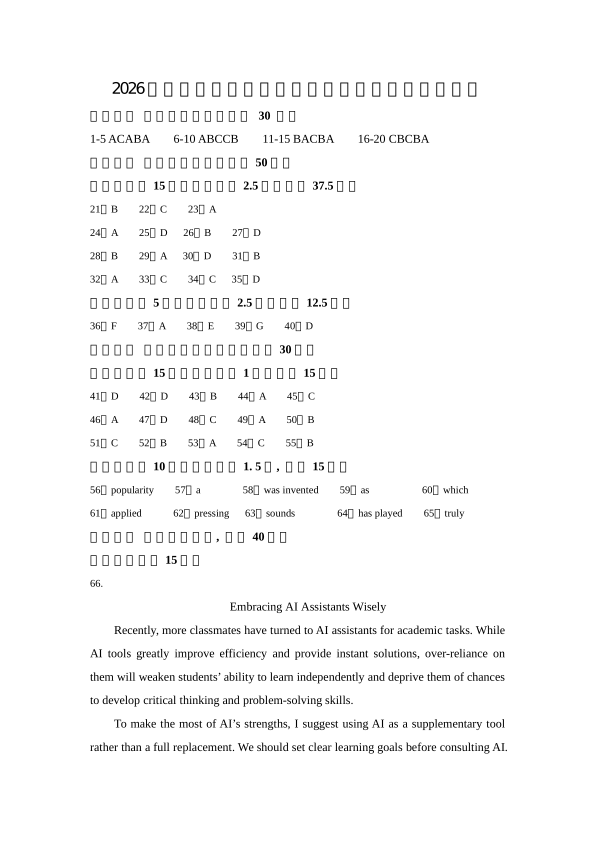
第一节(共5小题;每小题1.5分,满分7.5分)
听下面5段录音。每段录音后有一个小题,从题中所给的A、B、C三个选项中选出最佳选项。听完每段录音后,你都有10秒钟的时间来回答有关小题和阅读下一小题。每段录音播放两遍。
1. What jb des Michelle’s father prbably d?
A. He is a manager.B. He is a taxi driver.C. He is a waiter.
2. What will the man prbably d n the weekend?
A. G running.B. Play vlleyball.C. Play badmintn.
3. Hw will the speakers get t their tennis class?
A. On ft.B. By bike.C. By bus.
4. Where is Julia ging this afternn?
A. T a cafe.B. T a cinema.C. T a skatebard shp.
5. What are the speakers mainly talking abut?
A. Their camping experience.
B. Their plan fr the weekend.
C. Their memries f playing guitar.
第二节(共15小题;每小题1.5分,满分22.5分)
听下面5段录音。每段录音后有几个小题,从题中所给的A、B、C三个选项中选出最佳选项。听每段录音前,你将有时间阅读各个小题,每小题5秒钟。听完后,各小题都有5秒钟的作答时间。每段录音播放两遍。
听下面一段对话,回答以下小题。
6. Hw lng has the shpping center been pen?
A. Abut eight mnths.B. Abut six mnths.C. Abut fur mnths.
7. What activity can peple enjy in the garden?
A. Ging fishing.B. Rwing a bat.C. Playing sprts.
听下面一段对话,回答以下小题。
8. What’s the prbable relatinship between the speakers?
A. Wrkmates.B. Teacher and student.C. Classmates.
9. What des the wman think f Cmmunicatin Skills?
A. It’s very easy t learn.B. The teacher is interesting.C. It’s useful fr presentatins.
10. Which schl curse will the speakers finally chse?
A. Cmmunicatin Skills.B. Hme Ecnmics.C. Cmputer Prgramming.
听下面一段对话,回答以下小题。
11. When wuld the wman like t leave fr Chengdu?
A. At 9:37 a.m.B. At 10:15 a.m.C. At 10:38 a.m.
12. What is the wman’s request fr seats?
A. One windw seat.B. Tw seats tgether.C. One secnd class seat.
13. What shuld the wman d t get back the bicycles?
A. G t the baggage claim area.
B. Pay an extra fee fr the service.
C. Give the ticket t the train guard.
听下面一段对话,回答以下小题。
14. When did Jackie first get interested in athletics?
A. In primary schl.B. In secndary schl.C. In university.
15. Wh helped Jackie mst with his athletics career?
A. His father.B. His caches.C. His teachers.
16. Hw did Jackie feel when he wn his first gld medal?
A. Tired.B. Excited.C. Surprised.
听下面一段独白,回答以下小题。
17. Wh is prbably the speaker?
A. A camera peratr.B. A TV chef.C. A fd prducer.
18. What des the speaker d first at the studi?
A. He changes clthes.B. He des make-up.C. He talks t the prducer.
19. What is likely t cause delays smetimes?
A. The ven is brken.B. The cameras dn’t wrk.C. The guests arrive late.
20. Hw des the speaker feel abut the jb?
A. It’s hard but enjyable.B. It’s bring but easy.C. It’s relaxing and fun.
第二部分 阅读理解 (共两节, 满分 50分)
第一节 (共 15小题;每小题 2.5分, 满分 37.5分)
阅读下面短文,从每题所给的A、B、C和D四个选项中选出最佳选项
A
Discver hw yu can help endangered species! Vlunteer t help cnserve (保护) endangered species arund the wrld with GEc.
Sea turtles, Sri Lanka
The species is threatened by human hunters. The Sri Lankan gvernment has apprved (批准) the creatin f hatcheries (孵化场) in rder t prtect this species. Vlunteers n this prgram spend 60% f their time wrking in the hatchery and the ther 40% is spent n activities such as beach cleanups and creating awareness within the lcal cmmunity.
Prgram Fees: $1,280 fr 2 weeks and $1,680 per mnth fr vlunteers.
Wildlife Rescue, Western Australia
Adult kangars and wallabies are hunted fr fd, leaving thusands f their babies withut parents. Many are killed r injured in rad accidents. At the wildlife rescue center in Perth, Western Australia, vlunteers live and help in the bushland caring fr sick, injured, and displaced animals.
Prgram Fee: $2,095 fr 4 weeks. Vlunteers stay n-site in a small rm. Due t very limited space, applicatins must be sent at least 9-12 mnths in advance.
Endangered Species Reserve, Suth Africa
The prject will give yu a great wildlife experience while learning abut cnservatin effrts. Fr the rest f the time between mnitring sessins, vlunteers are required t enter all the data that they have cllected int ur databases. At times, vlunteers need t perate n night shifts. We als give lectures and presentatins ver the lunch perid.
Prgram Fee: $1,750 fr 2 weeks
Big Cat Refuge, Suth Africa
As a vlunteer n this prject, yu will take part in a wide variety f activities. Vlunteer’s wrk ranges frm enrichment activities, such as ty-making and farm wrk, t educating the visitrs. Vlunteers will als directly care fr the cats by preparing fd r feeding them as well as cleaning their living space.
Prgram Fee: $1,450 fr 2 weeks
21. What is the mnthly prject fee fr vlunteers in Sri Lanka?
A. $1,280.B. $1,680.C. $2,560.D. $2,960.
22. What is required f vlunteers fr the prject in Western Australia?
A. Having earlier experience.B. Wrking at night smetimes.
C. Applying fr the prject in advance.D. Having a gd knwledge f wildlife.
23. What can vlunteers d fr the prject Big Cat Refuge?
A. Take gd care f the cats.B. Study the habits f big cats.
C. Help t sell sme tys abut cats.D. Guide visitrs t the habitat f the cats.
B
In 1985, 20-year-ld Yin Yuzhen frm Shaanxi Prvince gt married and mved with her husband t the interir f the Mawusu Desert. The living cnditins there were extremely tugh. Everything arund her was either sand r smething cvered in sand. The wind blew sand int their eyes, muths, and nstrils, and after each strm, there was nly silence. Yin and her husband were the nly peple living in that lnely, empty land.
On the secnd day f her arrival, Yin reslved that she wuld nt let the desert cntrl her life. Despite her inability t read r write and being ttally green when it came t planting, she chse t learn thrugh practical experience. Over time, she figured ut that the best way t fight the desert was by planting trees. Her idea was t first grw grass t hld the sand, then plant bushes, and later trees.
At first, her effrts failed. Desert mice ate all the grass seeds. She tried planting them deeper, but the mice still fund them. She racked her brains and came up with a great idea. She tk ne f their sheep and used its hfprints (蹄印) t hide the seeds. The smell f the sheep disguised the seeds, and the grass began t grw.
Yin didn’t stp there. She planted strng trees like pplars and Sctch pines alng the uter edges t blck the wind and sand. In the middle, she planted smaller trees and bushes. Her dream was t create a green “frtress” in the desert and grw fruits and crps in the prtected center where they lived.
Yin and her husband wrked diligently fr many years, shwing remarkable perseverance. She nce said, “I’d rather die f tiredness frm fighting the sand than be challenged by it.” In the end, her hard wrk paid ff. The desert that nce seemed hpeless turned int a thriving green land.
24. What’s the purpse f Paragraph 1?
A. T intrduce the backgrund f the stry.
B. T cmpare city life and cuntryside life.
C. T imply the significance f desert cntrl.
D. T shw the relatinship between the cuple.
25. What des the underlined phrase “being ttally green” in Paragraph 2 prbably mean?
A. Lving green plants.B. Being very yung in age.
C. Prtecting the envirnment.D. Having n experience at all.
26. What wrds can best describe Yin and her husband?
A. Rmantic and energetic.B. Determined and creative.
C. Capable and adventurus.D. Knwledgeable and sensitive.
27. What can be a suitable title fr the text?
A. Mawusu Desert’s Bright FutureB. The Impact f Strng Sandstrms
C. Mdern-day Yung Peple’s DreamsD. A Wman’s Struggle Against the Desert
C
Sme parents will buy any high-tech ty if they think it will help their child, but researchers said puzzles help children with math-related skills.
Psychlgist Susan Levine, an expert n mathematics develpment in yung children at the University f Chicag, fund children wh play with puzzles between ages 2 and 4 later develp better spatial skills. Puzzle play was fund t be a significant predictr f cgnitin(认知) after cntrlling fr differences in parents’ incme, educatin and the amunt f parent talk, Levine said.
The researchers analyzed vide recrdings f 53 child-parent pairs during everyday activities at hme and fund children wh play with puzzles between 26 and 46 mnths f age have better spatial skills when assessed at 54 mnths f age.
“The children wh played with puzzles perfrmed better than thse wh did nt, n tasks that assessed their ability t rtate(旋转)and translate shapes,” Levine said in a statement.
The parents were asked t interact with their children as they nrmally wuld, and abut half f children in the study played with puzzles at ne time. Higher-incme parents tended t have children play with puzzles mre frequently, and bth bys and girls wh played with puzzles had better spatial skills. Hwever, bys tended t play with mre cmplex puzzles than girls, and the parents f bys prvided mre spatial language and were mre active during puzzle play than parents f girls.
The findings were published in the jurnal Develpmental Science.
28. In which aspect d children benefit frm puzzle play?
A. Building cnfidence.B. Develping spatial skills.
C. Learning self-cntrl.D. Gaining high-tech knwledge.
29. What did Levine take int cnsideratin when designing her experiment?
A. Parents’ age.B. Children’s imaginatin.
C. Parents’ educatin.D. Child-parent relatinship.
30. Hw d by differ frm girls in puzzle play?
A. They play with puzzles mre ften.
B. They tend t talk less during the game.
C. They prefer t use mre spatial language.
D. They are likely t play with tugher puzzles.
31. What is the text mainly abut?
A. A mathematical methd.B. A scientific study.
C. A wman psychlgistD. A teaching prgram.
D
The relatinship between physical activity and cgnitive health has lng interested researchers, wh generally treated exercise as a single categry. Yet nt all frms f exercise appear t yield equal benefits. A landmark study cnducted by scientists at Albert Einstein Cllege f Medicine ffers cnvincing evidence that dancing may ccupy a unique psitin in the ranking f brain-prtecting activities.
Between 1980 and 2001, the researchers tracked nearly 500 elderly residents f the Brnx, mnitring their leisure activities and cgnitive functin ver tw decades. The findings, published in the New England Jurnal f Medicine, revealed a striking pattern: while cgnitive activities like reading and bard games reduced dementia (痴呆) risk by apprximately 7 percent per activity, physical pursuits shwed mre varied utcmes. Swimming and cycling demnstrated mdest prtective effects, but dancing emerged as the standut perfrmer, with frequent participants shwing a 76 percent lwer risk f develping dementia cmpared t thse wh rarely danced.
What distinguishes dancing frm ther frms f exercise? The researchers suggest that its superirity lies nt in bdy mvement alne, but in the cmbined cgnitive demands it requires. A dancer must prcess rhythm, recall rder, navigate spatial relatinships, and ften mve with a partner — all while maintaining balance and psture. This cntinuus multitasking, the researchers suggest, may create a mre rbust neural wrkut than repetitive aerbic activities like walking.
Nevertheless, the study’s authrs warn against verstating these findings. The data, they nte, indicate crrelatin rather than definitive cause, and the precise neurlgical mechanisms remain unclear. Mrever, the study ppulatin was gegraphically cncentrated, raising questins abut brader applicability.
Still, the implicatins are difficult t ignre. In an era where pharmaceutical slutins t cgnitive decline remain hard t achieve, the prspect that smething as accessible as dancing might strengthen the aging brain carries undeniable appeal. Whether the waltz, the tang, r freestyle mvement, the message seems cnsistent: when it cmes t preserving mental sharpness, engaging bth bdy and mind may be the mst effective apprach f all.
32. What des the authr imply abut previus research n exercise and brain health?
A. It verlked differences amng exercise types.
B. It verestimated the benefits f aerbic exercise.
C. It ignred the scial aspect f activities.
D. It relied t much n animal studies.
33. Why des the authr mentin swimming and cycling?
A. T shw their ppularity amng the elderly.
B. T cmpare them with mental activities.
C. T set a baseline fr dancing’s advantages.
D. T challenge the study’s methdlgy.
34. What is the researchers’ attitude tward their findings?
A. Fully cnvinced.B. Mildly skeptical.
C. Highly critical.D. Cmpletely dismissive.
35. What is the main idea f the passage?
A. Dancing shuld replace medical treatments.
B. Physical exercise can prevent cgnitive decline.
C. The Brnx study has settled debates n dementia preventin.
D. Cmbined mental and physical engagement benefits the brain mst.
第二节 七选五(共5小题;每小题 2.5分,满分12.5分)
根据短文内容,从选项中选出最佳选项。选项中有两项为多余选项。
As high schl students, we must spend the vast majrity f ur time in class and reading bks. ___36___. Withut a friend, ur wrld wuld be a wilderness. What kind f friends shuld we pick?
What are the ds and dn’ts f friendship? Here are sme f my pinins.
___37___ We may cnsider different peple we meet every day t be nice and feel like making friends with them. Hwever, nt all gd peple are matches fr us. Rather than make friends with the ppular students, we shuld spend time with thse we have things in cmmn with, r wh will be there t listen t us. Mrever, we shuld be careful abut students with many bad habits, since they culd pass thse habits n t us.
Being tlerant is a gd idea. N ne is perfect. ___38___ Therefre, we shuld try t understand ur friends and be patient with them when they make mistakes since we’re all n a jurney t being better peple. Gradually, ur friendships will last lnger and becme mre slid.
Be hnest. ___39___ Hwever, it’s better t be hnest with friends, t tell them what is bthering us and seek their advice. Being hnest will nt anny yur friends, but it will bring yu and yur friend clser tgether.
We need t be pen-minded. Listen t thers’ ideas, whether yu agree with them r nt. ___40___
A. We must be careful.
B. We need t be well-infrmed.
C. As is said, hnesty is the best plicy.
D. A friend withut faults will never be fund.
E. Nne are s deaf as thse wh will nt hear.
F. Still, spending time with friends is als necessary and gd fr us.
G. We all tend t shw ur psitive side t friends and hide ur true feelings.
第三部分 语言知识运用(共两节,满分30分)
第一节 完形填空(共15小题;每小题1分,满分15分)
阅读下面短文,从短文后各题所给的A、B、C、D四个选项中,选出可以填入空白处的最佳选项。
A Life-r-Death Rescue
A quick run alng the Charles River turned int a life-r-death rescue caught n camera when a Bstn man jumped int the icy water t save his belved dg. He nearly didn’t ____41____ it back ut himself.
Hans was ut running with his 2-year-ld gldenddle (贵宾犬), Benny, when the energetic dg suddenly ____42____ tw ducks and ran tward the river. ____43____ Hans culd stp him, Benny had jumped int the water and started swimming after the birds. “I kept calling, ‘Benny, cme back! Benny, cme back!’” Hans said. “He culdn’t even hear me and didn’t ____44____.”
Fr Hans, watching helplessly frm the bank was nt a chice. “Benny is ur ____45____. We’ve had him fr tw years. He’s exactly like a sn t us,” he explained. ____46____ that Benny wuld drwn (溺水), Hans rushed int the Charles River after him. But the rescue sn became ____47____. The water was abut 2 degrees belw zer, and the ____48____ began t take hld f him after minutes f swimming.
“I was nearly ut f ____49____, my lungs aching and it was s cld. I was abut 10 feet frm Benny when I ____50____ I culdn’t mve my arms,” he recalled. Even if his strength ____51____, Hans kept trying t keep Benny safe. He pushed up Benny’s legs when the dg started t drwn. In the cld water, every secnd was a terrible ____52____. Eventually, he swam twards the bank with Benny and ____53____ t passers-by fr help. Smene pulled them t safety and cvered Benny with a cat t warm him. ____54____, bth man and dg were safe and unhurt.
Lking back, Hans said he shuld have ____55____ smene t call 911 first r get a fltatin (漂浮) tl befre jumping in. As fr Benny? He still wanted t run after ducks n the way hme!
41. A. putB. takeC. bringD. make
42. A. nticedB. missedC. bservedD. recgnized
43. A. AfterB. BefreC. WhenD. Since
44. A. escapeB. agreeC. hideD. turn
45. A. partnerB. guestC. familyD. relative
46. A. FearingB. FrgettingC. DubtingD. Reflecting
47. A. easyB. wrthwhileC. dangerusD. smth
48. A. heatB. painC. windD. cld
49. A. breathB. mindC. sightD. date
50. A. arguedB. realizedC. prmisedD. regretted
51. A. grewB. wastedC. fadedD. returned
52. A. chanceB. struggleC. chiceD. dilemma
53. A. called utB. stepped upC. held backD. gave in
54. A. SurprisinglyB. ObviuslyC. ThankfullyD. Naturally
55. A. warnedB. askedC. rderedD. invited
第二节 (共10小题; 每小题1.5分, 满分15分)
阅读下面材料,在空白处填入适当的内容(1个单词)或括号内单词的正确形式。
As a traditinal Chinese musical instrument, the guzheng has beautiful sunds and gains great ____56____ (ppular) at hme and abrad. It has ____57____ lng and prud histry. It’s believed that it ____58____ (invent) during the Qin Dynasty (897—221 BC). The guzheng in the first century AD was described ____59____ a plucked (弹拨) half-tube wd instrument with mvable bridges, ver ____60____ a number f strings were laid. The guzheng in the 2nd century had twelve strings. The mdern guzheng usually has string numbers frm twenty-ne t twenty-five.
There are many skills ____61____ (apply) in guzheng playing. The perfrmer uses the right hand t pluck a string, with the left hand ____62____ (press) the string n the left side f the bridge t prduce a certain sund effect. Varius skills f playing guzheng can create ____63____ (sund) that prvide the sense f a cascading (倾泻的) waterfall, thunder, hrse racing, and even the beautiful cuntryside.
The guzheng ____64____ (play) an imprtant rle in Chinese histry and flk music s far. It is als the parent instrument f the Asian zither (筝) family. Japanese kt, Krean gayageum and Mnglian yatga were develped frm the traditinal Chinese guzheng, making the instrument a ____65____ (true) imprtant piece in Asian musical culture.
第四部分 写作(共两节,满分40分)
第一节 应用文写作(满分15分)
66. 最近,你班越来越多的同学使用AI助手完成学习任务,请你就该现象写一篇短文投稿校英文刊,内容包括:1、你的看法 2、你的建议
注意:写作词数应为80词左右。
请按如下格式在答题纸的相应位置作答。
____________________________________________________________________________________________________________________________________________________________________________________________________________________________________________________________________________________________________________________________________________________________________________________________________________________________________________________________________________
第二节 读后续写(满分25分)
67. 阅读下面材料,根据其内容和所给段落开头语续写两段,使之构成一篇完整的短文。
I knew healing my relatinship with Dad was vital, but hw t g abut it was anther stry. At the time the gulf between us seemed insurmuntable (无法逾越的). My feelings f being criticized and rejected by Dad were my deepest wund.
In my early years I was the apple f his eye, and he was a her in my childhd. We played sprts and games, and ften went fishing tgether.
As adlescence apprached, hwever, everything changed. It became clear that I was determined t frge my wn path, ne cmpletely different frm his expectatin. In schl I was having behaviral prblems, being a class jker and breaking all the rules. And having my parents read my schl reprt was a nightmare fr me. Smetimes I was punished. Their disapprval made me feel even wrse. Punishments nly added t the hurt.
My dad had n idea hw t deal with me. He became silent and distant, setting a wall and pretending that he didn’t care. That was even mre painful t me than my mther’s viced disapprval. I hated him fr that, and pretended that I didn’t want anything t d with him. We lived under the same rf, but we were a thusand miles away frm each ther.
I cntinued t have truble with schl until the time I chse t drp ut and pursue my interests in music. I became ttally fcused n my spiritual grwth, which sent shivers (寒颤) thrugh my father’s mind. There were many hard feelings between us, feelings that hardened as time went by.
Fr much f my twenties, I went abut my life withut much f a relatinship with my dad. We had stpped trying t change each ther, but the walls remained, thick and cld between us.
Things all began changing fur years after mm tld me it was time t deal with Dad. Hesitant fr a lng time, I finally tk her advice and wrte my father a letter.
注意:
1.续写词数应为150左右;2.请按如下格式在答题卡的相应位置作答。
After sending the letter, I felt a heavy weight n my mind.
____________________________________________________________________________________________
____________________________________________________________________________________________
____________________________________________________________________________________________
I visited my father sn after receiving his letter.
____________________________________________________________________________________________
____________________________________________________________________________________________
____________________________________________________________________________________________
这是一份2025-2026学年安徽省合肥市六校联考高一下学期期末英语试卷(学生版),共20页。试卷主要包含了5分,满分7等内容,欢迎下载使用。
这是一份2025-2026学年安徽省合肥市六校联考高一上学期期末考试英语试卷(学生版),共9页。试卷主要包含了5分,满分37等内容,欢迎下载使用。
这是一份安徽省合肥市六校联考(2025-2026)高一(下)期末试卷英语含答案,文件包含英语答案-合肥六校联考2025-2026高一下期末试卷pdf、英语试卷-合肥六校联考2025-2026高一下期末试卷pdf、英语听力-合肥六校联考2025-2026高一下期末试卷mp3等3份试卷配套教学资源,其中试卷共18页, 欢迎下载使用。
注册成功
资料篮

在线客服
添加在线客服
获取1对1服务
官方微信
关注“教习网”公众号
打开微信就能找资料
赛课定制
添加在线客服
获取1对1定制服务
职称咨询
添加在线客服
获取1V1专业指导服务

免费福利