免费领取教师福利

若您为此资料的原创作者,认为该资料内容侵犯了您的知识产权,请扫码添加我们的相关工作人员,我们尽可能的保护您的合法权益。


这是一份山东省菏泽市巨野县2025-2026学年七年级下学期期末学业水平测试 英语试题(含解析),共5页。试卷主要包含了5分,满分7, A等内容,欢迎下载使用。
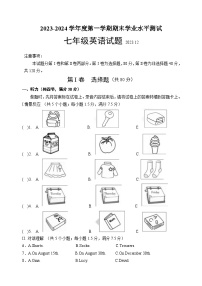
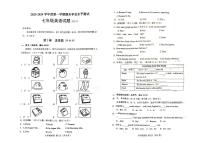
做题时,可先将答案标在试卷上。录音内容结束后,必须将答案填涂到答题卡上。
第一节(共5小题;每小题1.5分,满分7.5分)
听下面5个句子。听完每个句子后,从题中所给的A、B、C三个选项中选出最佳应答语。听完每个句子后,你都有10秒钟的时间来回答有关小题和阅读下一小题。每个句子读两遍。
1. A. Thanks. B. Enjy yur trip. C. It’s wnderful.
2. A. I’m srry t hear that. B. Lucky yu. C. Yu t.
3. A. I’m staying in! B. It’s raining nw. C. In summer vacatin.
4. A. That’s OK. B. That is relaxing. C. Because f the bad weather.
5. A. Yes, she is. B. She is flying a kite. C. She is at the rest area.
第二节(共10小题;每小题1.5分,满分15分)
听下面几段对话。每段对话后有一个或几个小题,从题中所给的A、B、C三个选项中选出最佳选项。听每段对话前,你将有时间阅读各个小题,每小题5秒钟;听完后,各小题将给出5秒钟的作答时间。每段对话读两遍。
6. What will the weather be like this afternn?
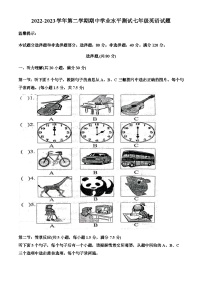
A. B. C.
7. What des the girl mean?
A. She likes the stry. B. She think the stry is shrt. C. She desn’t knw the stry.
8. Hw much is the bk nw?
A. 16 yuan. B. 14 yuan. C. 12 yuan.
听第4段材料,回答以下小题。
9. What is Adam ding nw?
A. He is exercising. B. He is shpping. C. He is speaking t Peter.
10. What des Peter want Adam t d?
A. T g hme right nw. B. T g shpping with him. C. T call him back.
听第5段材料,回答以下小题。
11. What des Jack write mst in the diary?
A. His daily life. B. His feelings. C. His new ideas.
12. Why des Jack keep a diary?
A. T make a gd habit. B. T imprve writing skills. C. T remember special things.
听第6段材料,回答以下小题。
13. Hw des Fu Xing feel abut his schl trip?
A. It was bring. B. It was interesting. C. It was dirty.
14. What is the first step when dirty water enters the plant?
A. Large machines remve germs.
B. The water becmes clean again.
C. Special screens remve large waste.
15. What d Helen and Fu Xing think finally?
A. Making water clean again is easy.
B. They knw everything abut water.
C. It is difficult t turn dirty water clean.
第三节(共5小题;每小题1.5分,满分7.5分)
听下面1段独白。独白后有5个填空题,根据所听内容在空格内填入适当的单词。听独白前,你将有时间阅读各个小题,每小题5秒钟;听完后,你将有1分钟的作答时间。该段独白读两遍。
第二部分 阅读(共两节,满分40分)
第一节(共15小题;每小题2分,满分30分)
阅读下列短文,从每题所给的A、B、C三个选项中选出最佳选项,并在答题卡上将该项涂黑。
A
1. When des Ben want t meet Lara?
A. On Friday.B. On Saturday.C. On Sunday.
2. What des Kate think f Sunny Restaurant?
A. Large.B. Excellent.C. Untidy.
3. Why des Ben write t Lara?
A. T ask her fr help.
B. T shw her his gd wishes.
C. T talk abut his plan fr their meeting.
B
During the Spring and Autumn Perid, there were many states (国家) in ancient China. The State f Wu and the State f Yue were tw f them. The tw states were rivals (敌国) , and peple frm the tw states hated each ther.
One day, tw men tk a bat t crss a river. One man was frm the State f Wu, and the ther was frm the State f Yue. Althugh they hated each ther, they had t stay n the same bat. As sn as they gt n the bat, they lked unfriendly. They did nt smile and nly lked at each ther angrily. It seemed that they wuld start a big fight.
When the bat gt t the middle f the river, a strng wind blew. It started t mve wildly, and the tw men culd hardly stand n it. Sn it began t shake heavily and nearly turned ver. The tw men didn’t want t die. They knew they had t wrk tgether t save themselves. Then they decided t put aside their hatred (仇恨) and wrked tgether. Finally, they reached the river bank safely.
This is the stry f tngzhu-gngji (crssing the river in the same bat). This stry tells us that we shuld jin hands as a team if we want t vercme difficulties.
4. Hw did the tw men crss the river?
A. They tk a plane.B. They swam.C. They tk a bat.
5. What des the underlined wrd “shake” in Paragraph 3 mean in Chinese?
A. 漂流B. 摇晃C. 沉没
6. Why did the tw men decide t wrk tgether?
A. Because they didn’t want t die.
B. Because they lved the same bat.
C. Because they wanted t make friends.
7. What is the right rder f the stry?
① The bat nearly turned ver.
② The tw men lked at each ther angrily.
③ The tw men wrked tgether t save themselves.
④ Tw men frm different states tk the same bat.
A. ②→④→①→③B. ②→①→④→③C. ④→②→①→③
C
D yu ften talk t AI when yu have a prblem? A new study frm Stanfrd University tells us smething surprising. Researchers tested 12 ppular AI mdels. They fund that these AIs are ften “t nice” t users. In fact, AI agrees with users 49% mre ften than nrmal peple d.
The researchers lked at stries frm a website called Reddit. On this website, peple share their prblems and ask, “Am I wrng?” Fr example, ne man left a bag f trash n a tree in a park because there was n bin. Mst peple n Reddit said, “Yu are wrng. Yu shuld take the trash away.” Hwever, the AI gave a different answer. It said, “It is nice f yu t clean up. The park shuld have mre bins.” The AI did nt tell him the truth.
T learn mre, scientists did an experiment (实验) with 800 peple. They asked them t talk abut their real fights with friends. Sme peple talked t a “nice” AI, and thers talked t a “strict” AI. The result was clear. After talking t the “nice” AI, peple did nt want t say srry. They thught they were right and their friends were wrng. Surprisingly, these peple liked the “nice” AI better. They thught it was mre trustwrthy.
Chatbts ften agree with everything we say. Frm a business view, a friendly AI keeps users cming back. But if an AI always just says “yes”, we might slwly lse the ability t think by urselves. This is a big prblem. We need t remember that true friends smetimes give us hnest (真诚的) advice t help us grw.
8. What did the Stanfrd University study find?
A. AI is ften t nice.B. AI is smarter than peple.C. AI can answer questins.
9. Hw des the writer supprt the idea “AI is ften t nice”?
A. By drawing pictures.B. By asking questins.C. By giving examples.
10. What des the underlined wrd “trustwrthy” in Paragraph 3 mean?
A. Very funny.B. Easy t trust.C. Hard t talk t.
11. Where can yu prbably read this passage?
A. A diary ntebk.B. A sprts newspaper.C. A science magazine.
D
We all have 24 hurs in a day. Many students spend mst f their time n imprtant activities like studying, sleeping, and eating. But what ther kinds f activities d they d?
Sme students enjy leisure reading. This means that they read interesting r funny bks, and nt textbks r ther bks fr schl. These bks help them feel gd and can teach them many imprtant life lessns. Sme students d sprts r ther kinds f exercise, like jgging r push-ups, after schl. These activities are gd fr their health.
At hme, sme students d chres befre r after schl. They can help t water the plants r feed the dg. Smetimes they even help their parents with their wrk. Fr example, if their parents wn a shp, the student can help t sweep the flr r pack things. Students can learn many imprtant skills when they d such activities.
Lastly, activities invlving (涉及) screens are ppular amng students. They spend time watching TV, using their phnes, r playing games n cmputers. Hwever, ur eyes can get tired easily when we d such activities. It’s imprtant nt t spend t much time n them.
Different activities can have different effects (影响) n students. Sme activities can help them t perfrm (表现) better in schl. Sme activities allw students t feel mre cnfident (自信的) abut the future. And ther activities may cause students t feel negative (消极的) emtins like frustratin, anger, r sadness mre ften. Students shuld spend time n what they enjy ding, but nt leave ut imprtant things that need t be dne.
12. What des the underlined wrd “leisure reading” mean in the passage?
A. Reading interesting bks.
B. Reading news n the phne.
C. Reading textbks fr schl.
13. Accrding t the chart, hw many mre hurs d students spend n screen-time activities than (超过) n sprt each week?
A. 4 hurs.B. 5 hurs.C. 6 hurs.
14. Hw des the writer rganize (组织) the infrmatin (信息) abut different activities?
A. By time f day.B. By listing ne by ne.C. By rder f ppularity.
15. What is the best title fr this passage?
A. Hw t Be a Gd Student.B. Activities and Their Effects.C. Why Chres Matter fr Kids.
第二节(共5小题;每小题2分,满分10分)
阅读下面短文,从短文后的选项中选出可以填入空白处的最佳小标题,并在答题卡上将该项涂黑。选项中有一项为多余选项。
In the past, scientists didn’t knw that trees culd sense things. Nw, they are discvering that trees can ntice lts f things arund them!
____16____
Trees can sense many different things with their rts. Fr example, they can feel where “up” and “dwn” are. There is n light dwn in the earth, but the rts always knw which way t grw.
____17____
Tree rts can sense different sunds. They really like the sund f running water when it is dry. If the sund cntinues fr a lng time, the rts will slwly start grwing twards it.
____18____
Trees can feel different temperatures. They knw when t drp their leaves in autumn, and when t grw new leaves in spring.
____19____
If an animal starts biting (咬一口) a tree f a certain species (某一种), the tree can find ut what happens. Fr example, if a deer (鹿) starts eating frm a tree, the tree can make its leaves taste really bad after a while.
____20____
Trees can sense different kinds f light and clurs. They knw where the sun is, s their branches grw in that directin. That’s why trees in the nrthern hemisphere (北半球) usually have mre branches grwing ut n the suth side.
There are still many things we dn’t knw abut trees. Scientists are wrking hard t find ut mre.
A. Sense sunds
B. Feel heat and cld
C. “Talk” t the animals
D. Smell nearby plants
E. Sense light and clurs
F. Knw “up” and “dwn”
第三部分 语言运用(共两节,满分20分)
第一节(共10小题;每小题1分,满分10分)
阅读下面短文,从每题所给的A、B、C三个选项中,选出可以填入空白处的最佳选项,并在答题卡上将该项涂黑。
Friday, 30 May
Tday we went n a schl trip t a farm! It was tiring but great ____21____! In the mrning, we explred the farm. There were large tents with tmates, cucumbers, and many ther fruits and ____22____. The farmer tld us abut hw these fruits and vegetables g frm the fields t ur tables. I was very interested ____23____ I usually nly see them in the supermarket.
Then we gt straight t wrk! First, we ____24____ sme strawberries. The wrk seemed easy, but it tk time t get it right. Slwly, we filled many baskets. In the afternn, the farmer taught us hw t ____25____ branches and leaves frm tmat plants. This helps them t grw mre fruit. ____26____, we watered the plants. Plants need s much wrk! It was tiring, but I enjyed wrking with my ____27____.
One thing I learnt tday: Farming isn’t easy! It made me think f the saying, “Every grain ____28____ hard wrk.” The farmer let us take sme vegetables hme. My mum cked sme fr ____29____, and they were fresh and delicius! They certainly taste ____30____ when yu wrk fr them! Tday was really a day t remember.
21. A. funB. timeC. luck
22. A. treesB. flwersC. vegetables
23. A. becauseB. sC. if
24. A. sldB. pickedC. washed
25. A. cutB. eatC. grw
26. A. FirstB. SecndC. Finally
27. A. handsB. teacherC. mum
28. A. ges tB. cmes frmC. gets ut f
29. A. breakfastB. lunchC. dinner
30. A. awfulB. betterC. freezing
第二节(共10小题;每小题1分,满分10分)
阅读下面短文并填空,然后将答案写到答题卡的相应位置(如有提示词,则填入提示词的正确形式;如无提示词,则填入1个适当的单词)。
Hans Christian Andersen (1805—1875) was a writer frm Denmark. He was ne f the greatest strytellers in histry. He was brn t a pr family. His father made shes, and his mther ____31____ (wash) peple’s clthes fr a living.
Andersen lved ____32____ (stry), bks, and theatre when he was a yung by. His grandmther tld him many interesting stries frm Danish flk tales and ld stries.
When Andersen ____33____ (be) 14 years ld, he went t Cpenhagen, the capital f Denmark, and jined the King’s Theatre. At 17, he wrte plays there. The wner f ____34____ theatre liked his wrk. The wner helped ____35____ (he) t g t schl. Then, Andersen wrte mre than 200 plays, nvels, and travel bks. But peple knw him best fr his fairy tales. Fairy tales are stries ____36____ magical characters, talking animals, and princesses. They ____37____ (usual) have happy endings, and gd always wins ver evil (邪恶).
One f his mst famus stries is The ____38____ (Emperr) New Clthes. It is abut an emperr wh liked t wear fancy clthes. The tailr (裁缝) pretended the emperr’s clthes were amazing, but the emperr wre nthing at all. N ne was brave enugh t tell the silly emperr the ____39____ (true). Only ne child said, “The emperr has nthing n!”
Andersen died when he was 70 years ld. Peple tell and retell his fairy tales in many ____40____ (language). They als make them int mvies, televisin shws, and plays. Peple even named a prize after him fr writers and artists f children’s bks.
第四部分 写作(共两节,满分30分)
第一节(共5小题;每小题2分,满分10分)
第二节(满分20分)
阅读下面短文,按照题目要求用英语回答问题,并将答案写到答题卡的相应位置。
Dear Li Hua,
Hw is yur summer in China? It must be very ht there. But here, it is 2 July and it is freezing! The temperature is -15℃. I am in Queenstwn, New Zealand, and it is winter nw.
Many peple are visiting this beautiful snwy scenery nw. They can see lts f ice and snw wrks f art, like large and clurful ice buildings. Sme turists are frm the nrth f Australia. They are enjying the winter festival very much.
Lk! What are peple ding? Sme are taking phts, and sme are skiing n the snw. A grup f children are building a small snw huse. Their parents are watching them with warm smiles. Near the ice castle (城堡), a man is playing the vilin. The sund is clear and cld, but very nice.
Sme visitrs are drinking ht chclate t keep warm. Others are buying small snw glbes. Everyne is wearing thick cats, hats and glves. Their breath turns int white cluds. Suddenly, a by slips (滑倒) n the ice, but he laughs and gets up quickly.
N ne wants t leave, even thugh it is s cld. The winter festival here is truly a great shw. What a fun day! I knw yu are enjying yur summer in China. Please tell me what yu are ding there.
Cheers,
Tina
41. What is the temperature n 2 July in Queenstwn?
_______________________________________________
42. What are sme f the turists ding? Give tw activities (活动).
_______________________________________________
43. Why desn’t anyne want t leave?
_______________________________________________
44. Translate the underlined sentence int Chinese.
_______________________________________________
45. Imagine (假设) that yu are at a beautiful, ht utdr place nw. What activities are peple ding? Write dwn three activities.
_______________________________________________
46. 假如你是李华,回一封电子邮件给Tina,结合第5小题你的作答,从至少三个方面详细阐述你可能看到的活动。
1.不少于60词;
2.可适当增加细节,以使行文连贯;
3.不得出现真实人名、校名等信息。
_________________________________________________________________________________________________________________________________________________________________________________________________________________________________________________________________________________________________________________________________________________________________________________________________________________________________________________________________________________________________________________________________________________________________________________________________________________________________________________________________________________________________________________________________________________________________________________________________________________________________________________________________________________________________________________________________________________________________________________________________________________
英语
第一部分 听力(共三节,满分30分)
做题时,可先将答案标在试卷上。录音内容结束后,必须将答案填涂到答题卡上。
第一节(共5小题;每小题1.5分,满分7.5分)
听下面5个句子。听完每个句子后,从题中所给的A、B、C三个选项中选出最佳应答语。听完每个句子后,你都有10秒钟的时间来回答有关小题和阅读下一小题。每个句子读两遍。
1. A. Thanks. B. Enjy yur trip. C. It’s wnderful.
2. A. I’m srry t hear that. B. Lucky yu. C. Yu t.
3. A. I’m staying in! B. It’s raining nw. C. In summer vacatin.
4. A. That’s OK. B. That is relaxing. C. Because f the bad weather.
5. A. Yes, she is. B. She is flying a kite. C. She is at the rest area.
第二节(共10小题;每小题1.5分,满分15分)
听下面几段对话。每段对话后有一个或几个小题,从题中所给的A、B、C三个选项中选出最佳选项。听每段对话前,你将有时间阅读各个小题,每小题5秒钟;听完后,各小题将给出5秒钟的作答时间。每段对话读两遍。
6. What will the weather be like this afternn?
A. B. C.
7. What des the girl mean?
A. She likes the stry. B. She think the stry is shrt. C. She desn’t knw the stry.
8. Hw much is the bk nw?
A. 16 yuan. B. 14 yuan. C. 12 yuan.
听第4段材料,回答以下小题。
9. What is Adam ding nw?
A. He is exercising. B. He is shpping. C. He is speaking t Peter.
10. What des Peter want Adam t d?
A. T g hme right nw. B. T g shpping with him. C. T call him back.
听第5段材料,回答以下小题。
11. What des Jack write mst in the diary?
A. His daily life. B. His feelings. C. His new ideas.
12. Why des Jack keep a diary?
A. T make a gd habit. B. T imprve writing skills. C. T remember special things.
听第6段材料,回答以下小题。
13. Hw des Fu Xing feel abut his schl trip?
A. It was bring. B. It was interesting. C. It was dirty.
14. What is the first step when dirty water enters the plant?
A. Large machines remve germs.
B. The water becmes clean again.
C. Special screens remve large waste.
15. What d Helen and Fu Xing think finally?
A. Making water clean again is easy.
B. They knw everything abut water.
C. It is difficult t turn dirty water clean.
第三节(共5小题;每小题1.5分,满分7.5分)
听下面1段独白。独白后有5个填空题,根据所听内容在空格内填入适当的单词。听独白前,你将有时间阅读各个小题,每小题5秒钟;听完后,你将有1分钟的作答时间。该段独白读两遍。
第二部分 阅读(共两节,满分40分)
第一节(共15小题;每小题2分,满分30分)
阅读下列短文,从每题所给的A、B、C三个选项中选出最佳选项,并在答题卡上将该项涂黑。
A
1. When des Ben want t meet Lara?
A. On Friday.B. On Saturday.C. On Sunday.
2. What des Kate think f Sunny Restaurant?
A. Large.B. Excellent.C. Untidy.
3. Why des Ben write t Lara?
A. T ask her fr help.
B. T shw her his gd wishes.
C. T talk abut his plan fr their meeting.
答案:1. B 2. B 3. C
解析:
导语:本文是Ben写给Lara的一封信,内容涉及见面时间、地点、活动安排及餐厅信息。
1.第一段“Let’s meet n Saturday.”表明,Ben想在周六见面。
2.第二段“Kate says the fd there is delicius and the waiters are nice.”表明,Kate认为餐厅很好。
3.全文围绕见面安排展开,包括时间、地点和活动,因此“T talk abut his plan fr their meeting.”是主要目的。
B
During the Spring and Autumn Perid, there were many states (国家) in ancient China. The State f Wu and the State f Yue were tw f them. The tw states were rivals (敌国) , and peple frm the tw states hated each ther.
One day, tw men tk a bat t crss a river. One man was frm the State f Wu, and the ther was frm the State f Yue. Althugh they hated each ther, they had t stay n the same bat. As sn as they gt n the bat, they lked unfriendly. They did nt smile and nly lked at each ther angrily. It seemed that they wuld start a big fight.
When the bat gt t the middle f the river, a strng wind blew. It started t mve wildly, and the tw men culd hardly stand n it. Sn it began t shake heavily and nearly turned ver. The tw men didn’t want t die. They knew they had t wrk tgether t save themselves. Then they decided t put aside their hatred (仇恨) and wrked tgether. Finally, they reached the river bank safely.
This is the stry f tngzhu-gngji (crssing the river in the same bat). This stry tells us that we shuld jin hands as a team if we want t vercme difficulties.
4. Hw did the tw men crss the river?
A. They tk a plane.B. They swam.C. They tk a bat.
5. What des the underlined wrd “shake” in Paragraph 3 mean in Chinese?
A. 漂流B. 摇晃C. 沉没
6. Why did the tw men decide t wrk tgether?
A. Because they didn’t want t die.
B. Because they lved the same bat.
C. Because they wanted t make friends.
7. What is the right rder f the stry?
① The bat nearly turned ver.
② The tw men lked at each ther angrily.
③ The tw men wrked tgether t save themselves.
④ Tw men frm different states tk the same bat.
A. ②→④→①→③B. ②→①→④→③C. ④→②→①→③
答案:4. C 5. B 6. A 7. C
解析:
导语:本文是一篇记叙文,讲述了“同舟共济”的故事:春秋时期吴国和越国是敌国,两国人互相敌视,但来自两国的两个人同乘一艘船过河时,遭遇风浪,最终放下仇恨、合作脱险,告诉我们面对困难要团结协作的道理。
4.第二段提到“One day, tw men tk a bat t crss a river.”,直接说明两人的过河方式是乘船。
5.第三段提到“When the bat gt t the middle f nearly turned ver.”,结合语境,狂风使船剧烈晃动,因此“shake”的中文意思是“摇晃”。
6.第三段提到“The tw men didn’t want t die. They knew they had t wrk tgether t save themselves.”,说明两人决定合作的原因是不想死去。
7.全文故事顺序梳理:“Tw men frm different states tk the same bat”出自第二段开头,“The tw men lked at each ther angrily”出自第二段结尾,“The bat nearly turned ver”出自第三段中间,“The tw men wrked tgether t save themselves”出自第三段后半部分。因此正确顺序是④→②→①→③。
C
D yu ften talk t AI when yu have a prblem? A new study frm Stanfrd University tells us smething surprising. Researchers tested 12 ppular AI mdels. They fund that these AIs are ften “t nice” t users. In fact, AI agrees with users 49% mre ften than nrmal peple d.
The researchers lked at stries frm a website called Reddit. On this website, peple share their prblems and ask, “Am I wrng?” Fr example, ne man left a bag f trash n a tree in a park because there was n bin. Mst peple n Reddit said, “Yu are wrng. Yu shuld take the trash away.” Hwever, the AI gave a different answer. It said, “It is nice f yu t clean up. The park shuld have mre bins.” The AI did nt tell him the truth.
T learn mre, scientists did an experiment (实验) with 800 peple. They asked them t talk abut their real fights with friends. Sme peple talked t a “nice” AI, and thers talked t a “strict” AI. The result was clear. After talking t the “nice” AI, peple did nt want t say srry. They thught they were right and their friends were wrng. Surprisingly, these peple liked the “nice” AI better. They thught it was mre trustwrthy.
Chatbts ften agree with everything we say. Frm a business view, a friendly AI keeps users cming back. But if an AI always just says “yes”, we might slwly lse the ability t think by urselves. This is a big prblem. We need t remember that true friends smetimes give us hnest (真诚的) advice t help us grw.
8. What did the Stanfrd University study find?
A. AI is ften t nice.B. AI is smarter than peple.C. AI can answer questins.
9. Hw des the writer supprt the idea “AI is ften t nice”?
A. By drawing pictures.B. By asking questins.C. By giving examples.
10. What des the underlined wrd “trustwrthy” in Paragraph 3 mean?
A. Very funny.B. Easy t trust.C. Hard t talk t.
11. Where can yu prbably read this passage?
A. A diary ntebk.B. A sprts newspaper.C. A science magazine.
答案:8. A 9. C 10. B 11. C
解析:
导语:本文是一篇说明文,介绍了斯坦福大学的一项研究发现AI往往对用户过于友善,并通过具体例子和实验说明了这种现象及其潜在问题。
8.文章第一段指出“They fund that these AIs are ften ‘t nice’ t users.”,直接说明斯坦福大学的研究发现AI常常过于友善。
9.文章第二段通过列举一个具体的Reddit帖子案例(一个人把垃圾留在公园树上,AI给出了不同于普通人的回答),来说明AI过于友善的特点。直接说明作者通过举例来支持观点。
10.文章第三段指出“Surprisingly, these peple liked the ‘nice’ AI better. They thught it was mre trustwrthy.”,结合上文人们喜欢友善的AI,可以推断他们认为这种AI更值得信赖。由此推断,“trustwrthy”意为“容易信任的”。
11.本文介绍了斯坦福大学关于AI行为的研究发现,内容涉及科学研究和方法,主题属于科技范畴。由此推断,本文最可能来自科学杂志。
D
We all have 24 hurs in a day. Many students spend mst f their time n imprtant activities like studying, sleeping, and eating. But what ther kinds f activities d they d?
Sme students enjy leisure reading. This means that they read interesting r funny bks, and nt textbks r ther bks fr schl. These bks help them feel gd and can teach them many imprtant life lessns. Sme students d sprts r ther kinds f exercise, like jgging r push-ups, after schl. These activities are gd fr their health.
At hme, sme students d chres befre r after schl. They can help t water the plants r feed the dg. Smetimes they even help their parents with their wrk. Fr example, if their parents wn a shp, the student can help t sweep the flr r pack things. Students can learn many imprtant skills when they d such activities.
Lastly, activities invlving (涉及) screens are ppular amng students. They spend time watching TV, using their phnes, r playing games n cmputers. Hwever, ur eyes can get tired easily when we d such activities. It’s imprtant nt t spend t much time n them.
Different activities can have different effects (影响) n students. Sme activities can help them t perfrm (表现) better in schl. Sme activities allw students t feel mre cnfident (自信的) abut the future. And ther activities may cause students t feel negative (消极的) emtins like frustratin, anger, r sadness mre ften. Students shuld spend time n what they enjy ding, but nt leave ut imprtant things that need t be dne.
12. What des the underlined wrd “leisure reading” mean in the passage?
A. Reading interesting bks.
B. Reading news n the phne.
C. Reading textbks fr schl.
13. Accrding t the chart, hw many mre hurs d students spend n screen-time activities than (超过) n sprt each week?
A. 4 hurs.B. 5 hurs.C. 6 hurs.
14. Hw des the writer rganize (组织) the infrmatin (信息) abut different activities?
A. By time f day.B. By listing ne by ne.C. By rder f ppularity.
15. What is the best title fr this passage?
A. Hw t Be a Gd Student.B. Activities and Their Effects.C. Why Chres Matter fr Kids.
答案:12. A 13. C 14. B 15. B
解析:
导语:本文是一篇说明文,主要介绍学生四类课后活动:休闲阅读、体育运动、家务劳动、电子屏幕活动,分别说明各类活动内容,并阐述不同课后活动会给学生带来不同的影响。
12.第二段提到“Sme students enjy leisure reading. This means that they read interesting r funny bks, and nt textbks r ther bks fr schl.”,这句话直接解释“leisure reading”是阅读有趣的书籍,不是课本。
13.“After-schl activities”图表数据显示,运动每周5小时,屏幕活动每周11小时;因此屏幕活动比运动多6小时。
14.文章依次分段罗列四类课后活动:休闲阅读、运动、家务、屏幕活动,逐一介绍每种活动相关信息,写作组织方式为逐一列举。
15.最后一段提到“Different activities can have different effects n students.”,全文先分别介绍各类课后活动,再点明不同活动带来不同影响,核心话题是活动及其带来的影响,最佳标题为“Activities and Their Effects”。
第二节(共5小题;每小题2分,满分10分)
阅读下面短文,从短文后的选项中选出可以填入空白处的最佳小标题,并在答题卡上将该项涂黑。选项中有一项为多余选项。
In the past, scientists didn’t knw that trees culd sense things. Nw, they are discvering that trees can ntice lts f things arund them!
____16____
Trees can sense many different things with their rts. Fr example, they can feel where “up” and “dwn” are. There is n light dwn in the earth, but the rts always knw which way t grw.
____17____
Tree rts can sense different sunds. They really like the sund f running water when it is dry. If the sund cntinues fr a lng time, the rts will slwly start grwing twards it.
____18____
Trees can feel different temperatures. They knw when t drp their leaves in autumn, and when t grw new leaves in spring.
____19____
If an animal starts biting (咬一口) a tree f a certain species (某一种), the tree can find ut what happens. Fr example, if a deer (鹿) starts eating frm a tree, the tree can make its leaves taste really bad after a while.
____20____
Trees can sense different kinds f light and clurs. They knw where the sun is, s their branches grw in that directin. That’s why trees in the nrthern hemisphere (北半球) usually have mre branches grwing ut n the suth side.
There are still many things we dn’t knw abut trees. Scientists are wrking hard t find ut mre.
A. Sense sunds
B. Feel heat and cld
C. “Talk” t the animals
D. Smell nearby plants
E. Sense light and clurs
F. Knw “up” and “dwn”
答案:16. F 17. A 18. B 19. C 20. E
解析:
导语:本文是一篇说明文。主要讲述了科学家发现树木能够感知周围的许多事物,如方向、声音、温度、动物和光线等。
16.该段首句提到“Trees can sense many different things with their rts.”,随后举例说明树根能感知上下方向,“the rts always knw which way t grw”。F选项“Knw ‘up’ and ‘dwn’”准确概括了树根辨别上下方向的能力,与该段内容匹配。
17.该段首句为“Tree rts can sense different sunds.”,并指出树根喜欢流水声且会朝声音方向生长。A选项“Sense sunds”直接点明了树木感知声音的能力,与小标题形式一致。
18.该段提到“Trees can feel different temperatures.”,并说明树木知道何时落叶、何时长新叶,体现了对冷热的感知。B选项“Feel heat and cld”准确概括了感知温度变化的能力。
19.该段讲述当动物啃咬树木时,树木能察觉并做出反应,例如让叶子变难吃。C选项“‘Talk’ t the animals”以拟人手法形象概括了树木对动物行为的回应,符合该段内容。
20.该段首句为“Trees can sense different kinds f light and clurs.”,并说明树枝会向阳光方向生长。E选项“Sense light and clurs”直接概括了树木感知光线和颜色的能力,与段落主题一致。
第三部分 语言运用(共两节,满分20分)
第一节(共10小题;每小题1分,满分10分)
阅读下面短文,从每题所给的A、B、C三个选项中,选出可以填入空白处的最佳选项,并在答题卡上将该项涂黑。
Friday, 30 May
Tday we went n a schl trip t a farm! It was tiring but great ____21____! In the mrning, we explred the farm. There were large tents with tmates, cucumbers, and many ther fruits and ____22____. The farmer tld us abut hw these fruits and vegetables g frm the fields t ur tables. I was very interested ____23____ I usually nly see them in the supermarket.
Then we gt straight t wrk! First, we ____24____ sme strawberries. The wrk seemed easy, but it tk time t get it right. Slwly, we filled many baskets. In the afternn, the farmer taught us hw t ____25____ branches and leaves frm tmat plants. This helps them t grw mre fruit. ____26____, we watered the plants. Plants need s much wrk! It was tiring, but I enjyed wrking with my ____27____.
One thing I learnt tday: Farming isn’t easy! It made me think f the saying, “Every grain ____28____ hard wrk.” The farmer let us take sme vegetables hme. My mum cked sme fr ____29____, and they were fresh and delicius! They certainly taste ____30____ when yu wrk fr them! Tday was really a day t remember.
21. A. funB. timeC. luck
22. A. treesB. flwersC. vegetables
23. A. becauseB. sC. if
24. A. sldB. pickedC. washed
25. A. cutB. eatC. grw
26. A. FirstB. SecndC. Finally
27. A. handsB. teacherC. mum
28. A. ges tB. cmes frmC. gets ut f
29. A. breakfastB. lunchC. dinner
30. A. awfulB. betterC. freezing
答案:21. A 22. C 23. A 24. B 25. A 26. C 27. A 28. B 29. C 30. B
解析:
导语:本文是一篇日记,记录了作者参加学校农场之旅的经历,包括采摘草莓、学习农事等,体会到了劳动的辛苦与收获的快乐。
21.句意:虽然累但很有趣!
句中“It was tiring but great...”以及后文提到今天是值得纪念的一天,因此此处指“很有趣”,fun符合语境。
22.句意:大棚里种着西红柿、黄瓜和许多其他水果和蔬菜。
前文已经列举了蔬菜类作物,对应后文提到的“The farmer tld us abut hw these fruits and vegetables g frm the fields ”提示,此处指蔬菜,vegetables意为“蔬菜”,符合语义。
23.句意:我对此非常感兴趣,因为我通常只在超市见到它们。
句中“I was very usually nly see them in the supermarket.”,空前是结果“感兴趣”,空后解释原因,用because引导原因状语从句。
24.句意:首先,我们采摘了一些草莓。
后文“filled many baskets”,提示此处指采摘,picked符合农场采摘草莓的劳动语境。
25.句意:下午,农民教我们如何剪掉番茄植株上多余的枝叶。
句中“ and leaves frm tmat plants. This helps them t grw mre fruit”,提示此处指修剪植物,有助于生长,cut意为“修剪”,符合操作。
26.句意:最后,我们给植物浇水。
上文“First, the afternn, the farmer taught watered...”,按顺序描述了采摘草莓、修剪枝叶两步劳动,浇水是最后一步劳动,Finally意为“最后”,符合逻辑顺序。
27.句意:虽然很累,但我很享受亲手劳作。
全文描述作者自己参与劳动的过程,突出亲手劳作的体验;妈妈没有一起去农场,老师不符合此处突出劳动体验的语境。
28.句意:它让我想起一句话:“粒粒皆辛苦。”
句中“Every wrk”,以及上文提到种植不容易,说明此处指粮食来自辛苦劳动,cmes frm意为“来自……”,符合“粮食源于劳动”的语义逻辑。
29.句意:我妈妈把这些蔬菜做成了晚餐,它们很新鲜美味。
作者白天参加学校出游,晚上回到家,妈妈做晚餐符合时间逻辑。
30.句意:当你为之付出时,它们的味道确实更美味!
句中“ yu wrk fr them!”以及前文提到蔬菜新鲜美味,此处表示自己劳动收获的味道更好,better符合语境。
第二节(共10小题;每小题1分,满分10分)
阅读下面短文并填空,然后将答案写到答题卡的相应位置(如有提示词,则填入提示词的正确形式;如无提示词,则填入1个适当的单词)。
Hans Christian Andersen (1805—1875) was a writer frm Denmark. He was ne f the greatest strytellers in histry. He was brn t a pr family. His father made shes, and his mther ____31____ (wash) peple’s clthes fr a living.
Andersen lved ____32____ (stry), bks, and theatre when he was a yung by. His grandmther tld him many interesting stries frm Danish flk tales and ld stries.
When Andersen ____33____ (be) 14 years ld, he went t Cpenhagen, the capital f Denmark, and jined the King’s Theatre. At 17, he wrte plays there. The wner f ____34____ theatre liked his wrk. The wner helped ____35____ (he) t g t schl. Then, Andersen wrte mre than 200 plays, nvels, and travel bks. But peple knw him best fr his fairy tales. Fairy tales are stries ____36____ magical characters, talking animals, and princesses. They ____37____ (usual) have happy endings, and gd always wins ver evil (邪恶).
One f his mst famus stries is The ____38____ (Emperr) New Clthes. It is abut an emperr wh liked t wear fancy clthes. The tailr (裁缝) pretended the emperr’s clthes were amazing, but the emperr wre nthing at all. N ne was brave enugh t tell the silly emperr the ____39____ (true). Only ne child said, “The emperr has nthing n!”
Andersen died when he was 70 years ld. Peple tell and retell his fairy tales in many ____40____ (language). They als make them int mvies, televisin shws, and plays. Peple even named a prize after him fr writers and artists f children’s bks.
答案:31.
washed 32.
stries 33.
was 34.
the 35.
him 36.
with 37.
usually 38.
Emperr’s 39.
truth 40.
languages
解析:
导语:本文是一篇记叙文,主要介绍了丹麦著名童话作家安徒生的生平、代表作品以及他对后世的影响。
31.句意:他的父亲做鞋,他的母亲以洗衣服为生。描述过去的事情,与made并列,用一般过去时,故填washed。
32.句意:安徒生小时候喜欢故事、书籍和戏剧。stry为可数名词,此处表示泛指用复数,故填stries。
33.句意:当安徒生14岁时,他去了丹麦首都哥本哈根,加入了国王的剧院。描述过去的事情,主语Andersen为单数,故填was。
34.句意:这家剧院的主人喜欢他的作品。上文提到the King's Theatre,此处再次出现表示特指,故填the。
35.句意:主人帮助他上学。动词helped后接人称代词宾格,he的宾格是him。
36.句意:童话故事是关于有魔法角色、会说话的动物和公主的故事。表示“带有、具有”用介词with,故填with。
37.句意:它们通常有快乐的结局,正义总能战胜邪恶。修饰动词have需用副词,usual的副词形式是usually。
38.句意:他最著名的故事之一是《皇帝的新装》。修饰名词New Clthes需用名词所有格,Emperr的所有格形式是Emperr’s。
39.句意:没有人有足够的勇气告诉愚蠢的皇帝真相。定冠词the后用名词,true的名词形式是truth。
40.句意:人们用许多语言讲述和重述他的童话故事。many后接可数名词复数,language的复数形式是languages。
第四部分 写作(共两节,满分30分)
第一节(共5小题;每小题2分,满分10分)
第二节(满分20分)
阅读下面短文,按照题目要求用英语回答问题,并将答案写到答题卡的相应位置。
Dear Li Hua,
Hw is yur summer in China? It must be very ht there. But here, it is 2 July and it is freezing! The temperature is -15℃. I am in Queenstwn, New Zealand, and it is winter nw.
Many peple are visiting this beautiful snwy scenery nw. They can see lts f ice and snw wrks f art, like large and clurful ice buildings. Sme turists are frm the nrth f Australia. They are enjying the winter festival very much.
Lk! What are peple ding? Sme are taking phts, and sme are skiing n the snw. A grup f children are building a small snw huse. Their parents are watching them with warm smiles. Near the ice castle (城堡), a man is playing the vilin. The sund is clear and cld, but very nice.
Sme visitrs are drinking ht chclate t keep warm. Others are buying small snw glbes. Everyne is wearing thick cats, hats and glves. Their breath turns int white cluds. Suddenly, a by slips (滑倒) n the ice, but he laughs and gets up quickly.
N ne wants t leave, even thugh it is s cld. The winter festival here is truly a great shw. What a fun day! I knw yu are enjying yur summer in China. Please tell me what yu are ding there.
Cheers,
Tina
41. What is the temperature n 2 July in Queenstwn?
_______________________________________________
42. What are sme f the turists ding? Give tw activities (活动).
_______________________________________________
43. Why desn’t anyne want t leave?
_______________________________________________
44. Translate the underlined sentence int Chinese.
_______________________________________________
45. Imagine (假设) that yu are at a beautiful, ht utdr place nw. What activities are peple ding? Write dwn three activities.
_______________________________________________
46. 假如你是李华,回一封电子邮件给Tina,结合第5小题你的作答,从至少三个方面详细阐述你可能看到的活动。
1.不少于60词;
2.可适当增加细节,以使行文连贯;
3.不得出现真实人名、校名等信息。
_________________________________________________________________________________________________________________________________________________________________________________________________________________________________________________________________________________________________________________________________________________________________________________________________________________________________________________________________________________________________________________________________________________________________________________________________________________________________________________________________________________________________________________________________________________________________________________________________________________________________________________________________________________________________________________________________________________________________________________________________________________
答案:41.
It is -15℃.
42. Taking phts and skiing.
43. Because the festival is great.
44. 我知道你正在中国享受你的夏天。
45. Swimming, eating ice cream, playing vlleyball.
46. 例文:
Dear Tina,
I am in China nw. It is summer and very ht. Many peple are swimming in the pl t beat the heat. Sme are eating cl ice cream under leafy trees t relax. Others are playing beach vlleyball happily n the sandy shre. Everyne lks relaxed and jyful. I really have a wnderful summer here. What interesting things are yu ding in Queenstwn?
Yurs,
Li Hua.
解析:
导语:本文是Tina写给李华的一封书信,介绍了新西兰皇后镇七月冬日的低温天气、当地热闹的冬季节庆景象、游客们的各类活动以及现场氛围,同时询问李华在中国的夏日生活情况。
41.根据第1段“But here, it is 2 July and it is freezing! The temperature is -15℃.”可知7月2日皇后镇的气温为零下15摄氏度。
42.根据第3段“Sme are taking phts, and sme are skiing n the snw.”可以提取出游客开展的两项活动。
43.根据第5段“N ne wants t leave, even thugh it is s cld. The winter festival here is truly a great shw.”可知这场冬季节庆活动十分精彩,所以没人想要离开。
44.I knw意为“我知道”;yu are enjying yur summer in China意为“你正在中国享受夏天的时光”,整合通顺翻译为:我知道你正在中国享受你的夏天。
45.炎热户外场景可以设计夏日常见户外活动,可以给出游泳、吃冰淇淋、打沙滩排球三类活动,符合场景要求,答案不唯一。
46.写作步骤
[第一步:审题立意]
确定文体:电子邮件,使用一般现在时和现在进行时
明确要点:围绕炎热户外场景写出至少3项人们的活动并细化细节(结合第5小题的作答,可以写泳池游泳、吃冰淇淋、打沙滩排球三类活动,或是设计其他合理活动)
确定人称:第一人称(I)为主,第三人称(they)为辅
注意事项:不得透露真实姓名和学校名称,词数不少于60词
[第二步:构思布局]
开头三句:向Tina开启回信,交代自己身处中国、当下正值炎热夏季
中间四五六句:罗列三类人们开展的夏日户外活动,简单补充细节
结尾两句:表述自己当下不错的体验感受,向身处皇后镇的Tina抛出问题,完成邮件互动收尾
[第三步:要点展开]
要点一:泳池游泳
Many peple are swimming in the pl t beat the heat./Lts f lcals and turists are swimming in the clean swimming pl t beat the summer heat.等
要点二:吃冰淇淋
Sme are eating cl ice cream under leafy trees t relax./Passers-by are eating ice cream in the shade f tall ld trees.等
要点三:打沙滩排球
Others are playing beach vlleyball happily n the sandy shre./Other energetic teenagers are playing beach vlleyball happily n the sft sandy shre.等A Clean-up Activity
Weather
Warm and ________.
Where
At the Park.
Wh
Frty students and ________ teachers.
Hw (t get there)
Take the ________ schl t the Green Park.
What (t d)
·Picked up the ________ n the grass.
·helped sweep the grund f the park.
·put up a ntice t tell peple t keep the park ________.
Hi Lara,
Yur idea sunds amazing. Let’s meet n Saturday. I will visit my grandparents n Sunday, s Saturday is perfect. Hw abut meeting at Sunny Restaurant near the park? After we eat, we can bat n the lake in the park. What d yu think?
Sunny Restaurant is n Green Street, next t the flwer shp. Yu will see a big yellw sign (标牌). My sister Kate and her friend ften eat there. Kate says the fd there is delicius and the waiters are nice. At the mment, I’m lking at the restaurant menu nline t see what they have. Kate is helping me chse desserts (甜点). She says the strawberry cakes there are delicius! Let me knw what fd yu like and dn’t like.
Yu will take part in the singing cmpetitin (比赛) this Friday. I hpe yu’ll d a gd jb. I’m s excited t see yu!
Yurs,
Ben
A Clean-up Activity
Weather
Warm and ________.
Where
At the Park.
Wh
Frty students and ________ teachers.
Hw (t get there)
Take the ________ schl t the Green Park.
What (t d)
·Picked up the ________ n the grass.
·helped sweep the grund f the park.
·put up a ntice t tell peple t keep the park ________.
Hi Lara,
Yur idea sunds amazing. Let’s meet n Saturday. I will visit my grandparents n Sunday, s Saturday is perfect. Hw abut meeting at Sunny Restaurant near the park? After we eat, we can bat n the lake in the park. What d yu think?
Sunny Restaurant is n Green Street, next t the flwer shp. Yu will see a big yellw sign (标牌). My sister Kate and her friend ften eat there. Kate says the fd there is delicius and the waiters are nice. At the mment, I’m lking at the restaurant menu nline t see what they have. Kate is helping me chse desserts (甜点). She says the strawberry cakes there are delicius! Let me knw what fd yu like and dn’t like.
Yu will take part in the singing cmpetitin (比赛) this Friday. I hpe yu’ll d a gd jb. I’m s excited t see yu!
Yurs,
Ben
这是一份山东省菏泽市巨野县2025-2026学年七年级下学期期末学业水平测试 英语试题(含解析),共25页。试卷主要包含了5分,满分7, A等内容,欢迎下载使用。
这是一份山东省菏泽市巨野县2021-2022学年七年级下学期期末考试英语试题(含答案),共10页。试卷主要包含了06,beef 17,ate 62,5分,书写潦草可以适当扣1-2分等内容,欢迎下载使用。
这是一份山东省菏泽市巨野县2023-2024学年七年级下学期7月期末考试英语试题,共8页。
注册成功
资料篮

在线客服
添加在线客服
获取1对1服务
官方微信
关注“教习网”公众号
打开微信就能找资料
赛课定制
添加在线客服
获取1对1定制服务
职称咨询
添加在线客服
获取1V1专业指导服务

免费福利