免费领取教师福利


若您为此资料的原创作者,认为该资料内容侵犯了您的知识产权,请扫码添加我们的相关工作人员,我们尽可能的保护您的合法权益。

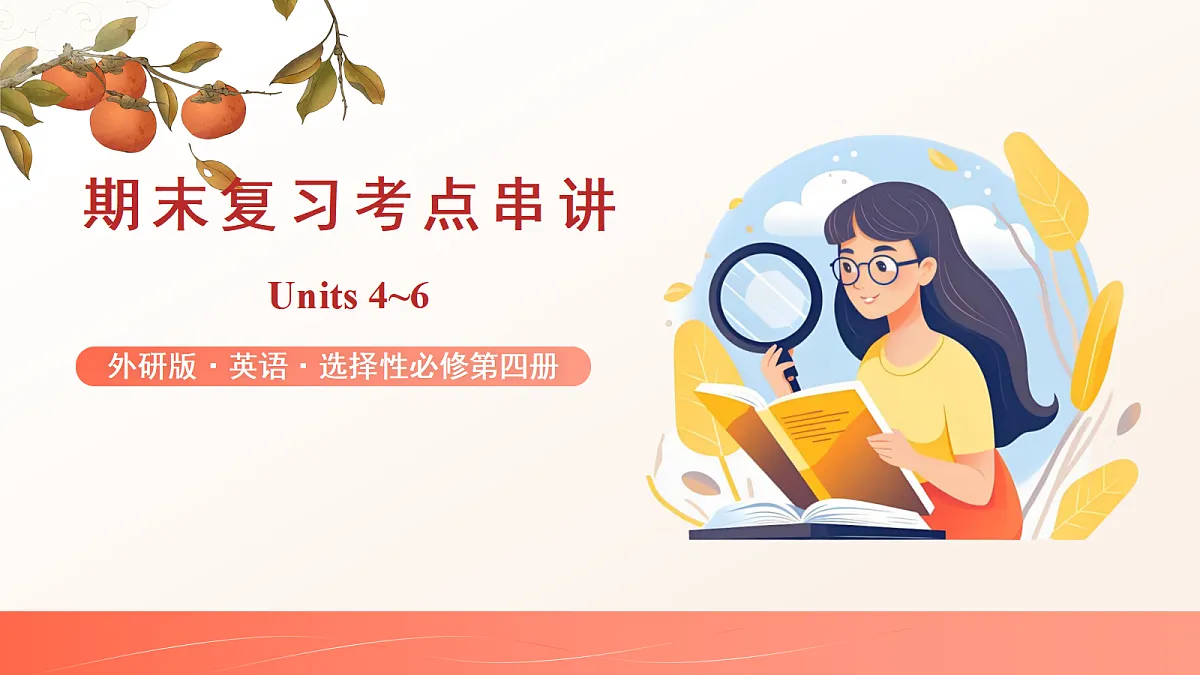


这是一份专题04 选择性必修第四册Units 4~6 教材核心知识串讲(期末复习课件)高二英语下学期外研版,共74页。PPT课件主要包含了考情透视·目标导航,目 录,语法串讲·融会贯通,知识梳理·夯实基础,考场练兵·实战训练,第一部分,考情分析,第二部分,第三部分,介词+关系代词等内容,欢迎下载使用。
Unit 4: Everyday Ecnmics
核心复习要点:主题语境聚焦现代经济现象,探讨创业、共享经济、个人理财等贴近生活的经济话题;核心内容涵盖对各类经济模式的理解与分析,学习用英语探讨经济活动背后的逻辑。核心素养旨在培养理性消费观念和创新思维,理解经济活动对个人生活与社会发展的深层影响,积累经济领域的核心词汇与表达,提升用英语分析经济现象的能力。
Unit 5: Int the Unknwn
核心复习要点:主题语境围绕古今中外的未解之谜展开,探究玛雅文明衰落、深海奥秘等神秘领域;核心内容包含对未知世界的科学探索过程,学习相关科普类文本的阅读与解读技巧。核心素养侧重激发科学探索兴趣,培养科学精神与实证意识,掌握探索类话题的英语表达,提升逻辑推理与科学认知能力,同时学会用英语理性探讨未知现象背后的科学原理。
Unit 6: Space and Beynd
核心复习要点:主题语境聚焦人类太空探索的壮阔历程,从早期航天尝试到现代宇宙探索成就,展望未来星际探索的无限可能;核心内容包含太空探索的重大事件、科技突破与相关人物事迹。核心素养旨在弘扬不畏艰险的科学探索精神,增强民族自豪感与家国情怀,积累航天科技领域的专业词汇与表达,提升在科技探索话题下的英语综合运用与跨文化交流能力。
Unit 4 Everyday Ecnmics
1. entrepreneur (n.) ____________2. csmetics (n.) ____________3. distributin (n.) ____________4. bnus (n.) ____________5. cnsultant (n.) ____________
6. ambitius (adj.) ____________7. regulatin (n.) ____________8. supervisin (n.) ____________9. abuse (n.) ____________10. leak (v.) ____________
企业家化妆品分销,配送奖金顾问
雄心勃勃的法规,条例监督,管理滥用泄露
1. ____________(n./adj.) 潜力;潜在的2. ____________(adj.) 有事业心的,有进取心的3. ____________(n.) 热情,酷爱;酷爱之物4. ____________(n.) 奉献,忠诚;热爱,挚爱5. ____________(n.) 拒绝;否决;抛弃,拒收
6. ____________(n.) 障碍,阻碍;障碍物7. ____________(adj.) 最初的,字首的;首字母的8. ____________(adj.) 体面的;正派的;相当好的9. ____________(v.) 再利用,重新使用;循环使用10. ____________(adj.) 相关的;切题的;有意义的
ptentialenterprisingpassindevtinrejectin
bstacleinitialdecentreuserelevant
input n.投入(物)→(反义词)_________n.输出,输出量;产量2.distribute vt.使分布,分散;分销→_________n.(商品的)分销,经销→_________n.经销商;分销商3.guide n.指导,向导,导游vt.指引,指导→_________n.指导,引导4.cnsult v.查阅;商量;向……请教→_________n.顾问5.cnventin n.大会;惯例;协定;习俗→_________adj.传统的,常规的6.discriminate v.不公正地区别对待,歧视→_______ __ n.歧视;区别对待,辨别;识别力7.subjective adj.主观的→(反义词)_________adj.客观的8.finance n.财政,财政学;金融→_________ adj.财政的,金融的;财务的9.srrw n.令人悲伤的事,不幸→_________adj.悲伤的,悲痛的10.frustrate v.挫败;阻止;使沮丧→_________n.懊丧,懊恼,沮丧
distributin
discriminatin
1.最终成为 ______________________________ 2.回馈,回报____________________________________3.众人拾柴火焰高____________________________________4.迷上创业____________________________________5.遭到拒绝___________________________6.开始创业/职业生涯__________________7.精心培育……直至成功__________________8.(事业)腾飞,成功__________________
end up ding sth.give smething back takes a village t raise a child.be bitten by the start-up bugmeet with rejectinstart successtake ff
9.削减,减少___________________________________________10.以……为代价__________________11.易受……影响的;取决于________________12.有使用……的机会________________13.作为对……的回应________________14.有意义,讲得通________________________________15.考虑到……________________________________
cut dwn nat the expense fbe subject thave access tin respnse tmake accunt
Whether we're a lender r a brrwer, ...无论我们是出租者还是租用者,这都是一个双赢的局面…… , she advises that peple be realistic and seek guidance frm expert cnsultants befre rushing int things.尽管希望看到新的创业精神,但她也建议人们要现实一些,在仓促行事之前先寻求专业顾问的指导 , their blank faces giving n clue as t what they wuld say next.他们面无表情地凝视着她,让人对他们接下来会说什么毫无头绪。
it's a win-win situatin
Thugh she welcmes the new entrepreneurial spirit
They stared back
1. intrigue (v.) __________________2. syllable (n.) __________________3. interpret (v.) __________________4. primitive (adj.) __________________5. drught (n.) __________________
6. dwnfall (n.) __________________7. archaelgical (adj.) ____________8. trench (n.) __________________9. equivalent (adj.) ______________10. vessel (n.) __________________
激起……的好奇心音节解释,解读原始的干旱
垮台,衰落考古学的海沟相等的船,舰;容器
1. n.神秘事物,谜_____________2. v./n.倒塌,崩溃_____________3. adj./n.典型的;代表_____________4. adj.精确的_____________5. adj.独特的_____________
mysterycllapserepresentativeaccurateunique
6. n.顶峰,高峰_____________7. v./n.下降,衰退_____________8. n.探索_____________9. n.能力,容量_____________10. n.使命,任务_____________
peakdeclineexplratincapacitymissin
1.__________ adj.公民的;民间的→__________ v. 使文明;教化;开化→__________ n.文明(社会)2.__________ v. 离弃,逃离→__________ adj.放纵的;被离弃的;被遗弃的3.__________ v. 拒绝考虑,否定;解雇→__________ n.不予考虑,摒弃;解雇4.__________ v. 扩张;增加;扩展;详述→__________ n.扩大;增加5.__________ v. 调查;研究→__________ n.调查
civilisatin
investigate
investigatin
1.与……相符______________________________2.把……应用于……_________________________3.处于顶峰______________________4.导致______________________5.在……中起作用______________________6.把……变成……______________________7.挖掘______________________8.启航______________________
crrespnd its peaklead tplay a part intset sail
Meanwhile, the rise and fall f this civilisatin must als , present and future.同时,这种文明的兴衰也必须让我们思考自己的过去、现在和未来。 are an estimated three millin shipwrecks.据估计,全球海底有三百万艘沉船Furthermre, the ceans are a valuable surce f natural resurces, .此外,海洋还是自然资源的宝贵来源,其中一些对我们来说完全是新的资源。
leave us thinking abut ur wn past
Lying under waters acrss the glbe
sme f which are cmpletely new t us
1. arduus (adj.)_________________________2. hazardus (adj.)_________________________3. undertaking (n.)_________________________4. excursin (n.)_________________________5. rekindle (v.)_________________________
艰巨的,费力的危险的事业,任务短途旅行重新点燃
6. disastrus (adj.)_________________________7. suspend (v.)_________________________8. resume (v.)_________________________9. csmic (adj.)_________________________10. cnceivably (adv.)_________________________
灾难性的暂停,中止重新开始宇宙的可以想象地
1. adj.习惯的____________________2. n.观念,想法____________________3. n.创新,革新____________________4. n.平民,百姓____________________5. v.证明,演示____________________
accustmedntininnvatinciviliandemnstrate
6. adv.悲剧地____________________7. n.组成部分____________________8. n./v.牺牲____________________9. n.着迷,魅力____________________10. adj.令人惊叹的____________________
tragicallycmpnentsacrificefascinatinbreathtaking
1.except prep.除…之外 cnj.除了→_________ n.例外→_________adj.异常的→_________ adj.平常的2.suspend v.暂停,中止→_________ n.暂停;推迟,延期3.submit v.提交→_________ n.提交;呈递;(向法官提出的)意见4.simulate v.模仿;假装;冒充→_________adj.模仿的,模拟的,仿真的→_________ n.(用于人员训练的)模拟装置,模拟器→_________ n.仿真;模拟;模仿;假装5.visin n.视力;视野→_________adj.明显的;看得见的→_________ adj.看不见的
unexceptinal
1.踏上________________________________________2.习惯于________________________________________3.人类的一大步________________________________________4.收看,收听________________________________________5.给……蒙上阴影________________________________________6.缩短,中断________________________________________7.与……并肩而立________________________________________8.追求卓越________________________________________
set ft nbecme accustmed tne giant leap fr mankindtune incast a shadw ncut shrttake ne's place alngsidereach fr the stars
Guided by a cmputer , all three astrnauts f the Apll 11 missin made it safely back t Earth.执行“阿波罗11号”任务的三位宇航员在一台计算机的指导下都安全返回了地球,即便这台计算机远不如当今普通学校的学生使用的计算机功能强大。When the Challenger space shuttle tk ff n 28 January 1986, the wrld at the amazing achievements f the astrnauts invlved.当“挑战者”号航天飞机于1986年1月28日发射时,对于相关宇航员所获得的惊人成就,全世界似乎已经失去了新鲜感。The wrld went int shck, mst peple having assumed that this space flight wuld be .全世界都震惊了,因为大多数人本以为这次太空航行不会比乘飞机旅行更加危险。Fr example, the mysterius large-eyed, brnze statues f the ancient Shu Kingdm, discvered at the Chinese archelgical site at Sanxingdui, . 例如,在中国三星堆考古遗址发掘的古蜀国神秘的巨目青铜像,古时的人们认为它们能够看到遥远的星空。
that was much less pwerful than the nes used by tday's average schl students
seemed t have lst its wnder
n mre dangerus than travelling in an aerplane
were believed t have been able t lk acrss great distances int the stars
(1)定义:用来限制、描绘或说明主句中某一个名词或代词(有时也可以说明整个主句或主句中的一部分)而起定语作用的从句叫作定语从句。它所修饰的对象称为先行词。
(3)分类:定语从句分为限制性定语从句和非限制性定语从句。非限制性定语从句与主句之间通常用逗号隔开。
2.关系代词与关系副词的选用 定语从句的引导词用关系代词还是关系副词可以用以下方法判断:
This is the factry where he used t wrk.这是他以前工作过的那家工厂。
Is this the museum that/which was built last year?这就是去年建的那家博物馆吗?
3.as与which引导非限制性定语从句的区别
(1)在位置上,as引导的从句可放在主句前、后或中间,而which只能放在主句后。As the famus militarist nce said, attack is the best methd f defence.正如这位著名的军事家曾经所说,进攻是最好的防守。
I ften called them gentlemen,which made them giggle.我经常称他们为绅士, 这让他们咯咯地笑。
(2)在含义上,as有“正如”之意,而which意为“这一点,这件事”。He changed his mind again,which made us all angry.他又改变了主意,这使我们都生气了。
4.只用that,不用which的情况
2.先行词为不定代词all, few, little, much, everything等时;
3.先行词被 the nly, the last, the same等限定词修饰时;
4.先行词被形容词的最高级修饰时;
5.当主句是以wh或which开头的特殊疑问句时;
6.先行词在主句中作表语且关系词在从句中作表语时;
7.先行词被序数词修饰时;
1.先行词既有人又有物时;
从句中的动词或形容词的搭配
表示“整体和部分关系”常用f
6、定语从句中的主谓一致
关系代词作从句的主语时,定语从句中谓语动词的人称和数要与 保持一致。
He is the man wh (want) t see yu.
The pictures which (lk) beautiful are drawn by him.
1.My brther likes the stries _______ were written by Mark Twain because they are ften is the by with ______ I talked just ’s the name f the girl ______father is a dctr?4.I still remember the day ______ ur new schl was built.
名词性从句是在句子中起名词作用的句子,它的功能相当于名词(短语),在复合句中可作主语、宾语、表语、同位语等,因此名词性从句又可分为主语从句、宾语从句、表语从句和同位语从句。名词性从句的引导词及其用法如下:
考点一 连接词that与whether/if一、连接词that的用法1.that在名词性从句中不作任何句子成分,引导宾语从句时有时可以省略,引导主语从句、表语从句和同位语从句时不能省略。I lve the fact that Chinese buses, mtrcycles, trains and aircraft are either ecnmical r cheap.我喜欢中国的公共汽车、摩托车、火车和飞机,既经济又便宜。
that引导宾语从句时几种不能省略的情况:①that从句作介词的宾语时;②动词后跟有多个that引导的宾语从句时,只有第一个that可以省略,从第二个从句开始that不可省略;③宾语从句前有插入语时;④that引导的宾语从句位于句首时。
2.that引导主语从句时,常用it作形式主语的常用句型有:(1)It+be+形容词(necessary, right, likely, unlikely, wrng, imprtant, certain等)+that从句It is unlikely that I shuld accept such an ffer as that.我不可能接受那样的提议。(2)It+be+名词(短语)(a pity, a shame, a surprise, n wnder等)+that从句It is a pity that yur cmpsitin has s many spelling mistakes.很可惜,你的作文有这么多的拼写错误。
(3)It+be+过去分词(said, reprted, decided等)+that从句It is decided that the meeting has been put ff till next Mnday.已决定会议推迟到下周一举行。(4)It+特殊动词(短语)(seems, appears, happens, matters, turns ut, makes n difference 等)+that从句It turns ut that the brain needs exercise in much the same way ur muscles d.结果表明,大脑像肌肉一样都需要锻炼。
【点津】在以下主语从句中,常使用虚拟语气,即谓语动词用“shuld+动词原形”形式,其中的shuld可以省略。①It is a pity+that ...②It is necessary/strange/imprtant/natural ...+that ...③It is suggested/requested/required/prpsed/desired...+that...
3.it作形式宾语的宾语从句(1)find, feel, think, cnsider, make, believe 等的宾语后有宾语补足语时,需用it作形式宾语而将that引导的宾语从句后置。He has made it clear that the meeting will nt be pstpned.他清楚地表明会议不会被推迟。(2)一些动词短语see t, depend n, rely n 等常用it作形式宾语,而将宾语从句后置。I shall see t it that he is taken gd care f when yu are absent.你不在的时候,我保证照顾好他。
二、连接词whether与if引导的名词性从句1.引导主语从句(if引导主语只能放在句尾,前面要用it作形式主语。)、表语从句、同位语从句时一般用whether。2.whether与if引导宾语从句时大多数情况下可以互换,但下列情况下宜用whether:①后面直接跟r nt时;②用于介词后引导宾语从句时。
【点津】dubt后接从句时,如果用于肯定句,从句的引导词用whether或if;用于否定句或疑问句时,从句的引导词常用that。The dctr really dubts whether/if my mther will recver frm the serius disease sn.医生真的怀疑我母亲是否能很快从重病中康复。
即时演练单句语法填空1._______ peple in Lndn speak fast and use unfamiliar wrds made Xie Lei cnfused at first.2.Dick enjys painting but he knws the fact _______ he desn't have what it takes t be a prfessinal.3.His capability has never been in dubt; the questin is __________ he is prepared t put effrts.
4.Smetimes, I really dubt _____________ there is lve between my parents.They quarrel n a regular basis.5.It is reprted _______ we must be cautius abut earthquakes nwadays.
whether/if
考点二 连接代词一、what的用法what可引导主语从句、宾语从句、表语从句和同位语从句,在从句中作主语、表语、宾语或定语等。what引导名词性从句时有两个意思:一是表示“什么”,带有疑问意味;二是表示“……的东西或事情”,相当于一个先行词后接一个关系代词。
Our teachers always tell us t believe in what we d and wh we are if we want t succeed.我们的老师总是告诉我们,如果我们想要成功,要相信我们所做的事情和我们自己。
二、whatever,whever, whmever,whichever与what, wh, whm, which的区别
What wrries us mst is wh let ut the secret.最令我们担忧的是谁泄漏了秘密。Whever breaks the law shuld be punished.任何触犯法律的人都应该受到惩罚。
考点三 连接副词引导名词性从句的连接副词有when,where,why,hw等,它们均在从句中作状语。I have n idea when she will be back.我不知道她何时回来。I've been thinking abut hw we can make the newspaper mre interesting.我一直考虑我们如何能使报纸更有趣。That's why I want yu t wrk there.那就是我要你在那儿工作的原因。
即时演练单句语法填空1.What puzzles Mike's friends is ______ he refused an ffer frm Yale university yesterday.2.What sme teenagers dn't realize is ______ difficult life can be after they get addicted t drugs.
3.It is the ability t d the jb that matters, nt ________ yu cme frm r what yu are.4.Getting up early als relieves stress and tensin because it gives yu the time t squeeze in a wrkut befre yu get distracted (分神). This is ______ mrning peple tend t be healthier and happier.
情态动词的类型1.只作情态动词的有must,can/culd,may/might,ught t2.既可作情态动词也可作实义动词的有need,dare3.既可作情态动词也可作助动词的有shall/shuld,will/wuld4.具有情态动词的某些特征的有have/has/had t,used t
表示“能力”时,can表示现在的能力,culd表示过去的能力。
The machine can wrk 24 hurs a day.这台机器能全天 24 小时运行。When I was in cllege, I culd stay up all night studying.
表示“推测”时,can用于否定句中,can't表示“不可能”。culd表“推测”时,比can的可能性要小。
She can't be in the library. I just saw her leave the schl.This culd be the right answer, but let's check again.
表示“请求”或“许可”时,通常用于疑问句中;culd表“请求”时比can更委婉。
Can yu help me carry this bag?你能帮我提这个包吗?Culd yu please pen the windw?您能开一下窗户吗?
can和culd的用法
culd have dne表示“本可以做某事”;culdn’t have dne表示“不可能做了某事”。
She culd have tld me the truth, but she chse t lie.她本可以告诉我真相,但她选择了撒谎。They culdn’t have arrived yet. The flight was delayed fr 3 hurs.他们不可能已经到了。航班延误了 3 小时。
be able t d表示“能够做某事”,不能与 can连用,但有更多时态。was/were able t d 表示过去能够而且做到了某事。
He has been able t slve the prblem after several attempts.经过几次尝试,他终于能解决这个问题了。The firefighters were able t save all the peple in the burning building.消防员成功救出了着火大楼里的所有人。
1.may和might可用于肯定句中表示“许可”,用在疑问句中表示“请求”。
May I leave early tday? 我今天可以早点走吗?Yu might brrw the car if yu ask plitely. 如果你礼貌请求,或许可以借到车。
2. might表“推测”时,可能性比may的可能性小,把握把握不大。may/might have dne表示“可能已经做了某事”,但是把握不大。
He might be busy, but I’m nt sure.他可能很忙,但我不确定。She may have frgtten the meeting.她可能忘了开会这件事。
3.may/might well d sth意为“很可能”, may/might as well d sth.表示建议,意为“不妨做某事”。
She might well be late. The traffic is terrible tday.她很可能会迟到。今天交通太堵了。Yu may as well take an umbrella. It lks like rain.你不妨带把伞。天看起来要下雨了。
4.“May yu+动词原形”表示祝愿,意为“祝你……!”。
May yu have a safe jurney! 祝你旅途平安!May peace fllw yu wherever yu g! 愿平安与你同在!
may和might的用法
Yu must finish yur hmewrk befre dinner.你必须在晚饭前完成作业。Yu mustn't smke in the library.禁止在图书馆吸烟。
must表示“必须”,强调说话人的主观态度,否定式为mustn't,意为“不允许,禁止。
Yu’ve been wrking all day. Yu must be tired.你工作了一整天,一定很累。He didn’t answer the phne. He must be taking a shwer.他没接电话,一定在洗澡。The grund is wet. It must have rained last night.地面是湿的,昨晚一定下过雨。
must表示“推测”,意为“一定是,准是",只用于肯定句中。must be ding肯定正在做某事;must have dne表示对过去发生的事情肯定判断,表示“肯定已经做了”。
must和have t的用法
They had t walk hme because the bus didn’t cme.He desn’t have t finish the reprt tday. It’s due next week.
have t表示客观需要,意为“不得不”,否定式为dn’t have t,相当于needn't。
The car must break dwn n the highway!车子偏要在高速上抛锚!If yu must g ut tnight, at least take an umbrella.如果你今晚偏要出去,至少带把伞。Why must yu leave the dr pen? It’s freezing utside!你为什么偏要把门开着?外面冷死了!
must表示“偏要”,指说话人对发生的事情表示不满。用于表达说话人对某人固执行为或不合时宜的情况的不满、不耐烦或责备,强调“对方偏偏要这样做”,隐含“本不该如此却执意为之”
1.shall用在第一三人称疑问句中时,表示征求对方意见。
Shall we g fr a walk after dinner?晚饭后我们去散步好吗?Shall the reprt be sent t yu by email?这份报告用邮件发你可以吗?
2.shall用在第二、三人称陈述句中时,表示允诺、命令、告诫等。
He shall have the bk by tmrrw, I prmise.Whever breaks the law shall be held respnsible.
3.shuld表示“推测”,常意为“按道理说应该”;shuld还可以表示说话人的惊奇、愤怒、失望等,多用It is necessary that…句型。
The train shuld arrive at 9:30. It’s never late.It’s ridiculus that he shuld lie t his wn parents.
shall, shuld和ught t
4.shuld have dne表示“本应该做某事而没有做”,否定式则表示在“本不该做某事但已经做了”。
She shuld have accepted the jb ffer. It was a great pprtunity.她本应该接受那份工作的,那是个好机会。He shuldn’t have driven s fast. Nw he’s gt a speeding ticket.他本不该开那么快的,现在收到超速罚单了。
5.shuld/ught t表示责任,义务,意为“应该”,否定式为shuld nt/ ught nt t。
Yu ught t aplgize fr yur rudeness.你应该为你的粗鲁道歉。As a manager, yu ught t have addressed the prblem earlier.作为经理,你本应该更早处理这个问题。
Will yu call me when yu arrive? 你到了之后给我打个电话好吗?Wuld yu help me with this frm? 您能帮我填一下这张表吗?
1.will表示“请求”,常用于第二人称疑问句中,wuld比will语气更委婉。
2. will表示主观愿望、意志或决心,wuld用于过去的习惯性动作,意为“过去常常做某事”。
He will nt listen t anyne’s advice. 他不肯听任何人的劝告。He wuld ften sit by the windw, lst in thught.
will和wuld的用法
Will yu wait fr me at the entrance? 你能在入口处等我吗?Wuld yu like t have a cup f tea? 您想喝杯茶吗?
3.will和wuld用于第二人称的疑问句中,wuld表示委婉语气。
4.wuld have dne多用于虚拟条件句或含蓄条件句,表示与过去事实相反的假设。
We wuld have arrived n time if the bus hadn’t brken dwn.Withut yur help, I wuldn’t have finished the prject.
5.wuld用于否定句可以表示顽固倾向,意为“老是不”“总是不”。另外,wuld d还可以表示过去将来时; wuld用于一般疑问句,表示委婉的用法。Wuld yu please….?请你……好吗?Wuld yu like t d…? 你想……吗?Wuld yu mind ding…? 你介意……吗?Wuld yu rather d…?你倒愿意……吗?
Wuld yu pass the menu, please? 请您把菜单递给我好吗?Wuld yu mind waiting fr a few minutes? 您介意等几分钟吗?Wuld yu please pen the dr? 您能开一下门吗?
1.need用作情态动词,多用于否定句、疑问句,后接动词原形。needn’t have dne表示“本没必要做某事但实际上做了”。
2.need用作实意动词,接名词、代词、不定式作宾语。need ding=need t be dne表示需要做。
D they need t bk a htel in advance?他们需要提前预订酒店吗?The brken windw needs t be repaired.这扇破窗户需要被修理。
She needn’t wrry abut the exam—she’s well-prepared.她没必要担心考试,她准备得很充分。She needn’t have hurried t the airprt. The flight was delayed fr 2 hurs.她本没必要急着去机场,航班延误了 2 小时。
need和dare的用法
3.dare用作情态动词,多用于否定句、疑问句,只有dare和dared两种形式。I dare say...意为“我想,大概,可能,或许……”。
4.dare用作实意动词,接名不定式作宾语。
She didn’t dare (t) tell him the bad news.她不敢告诉他这个坏消息。Did they dare (t) argue with the teacher?他们敢和老师争论吗?
She dare nt g ut alne at night.她晚上不敢独自外出。Dare he speak in frnt f the whle class?他敢在全班面前发言吗?She dared nt g ut alne when she was a child.她小时候不敢独自外出。
can’t have dne表示“不可能做了某事”。
The baby can’t have eaten a whle cake. She’s nly ne year ld.He can’t have finished the wrk in an hur. It’s t cmplicated.
culd have dne用于肯定句,表示“本可以做某事”。culdn’t have dne表示“不可能做了某事”。
He culd have becme a dctr, but he gave up the pprtunity.She culdn’t have frgtten yur birthday. Yu reminded her twice.
may/might have dne用于肯定或否定句中,表示对过去的推测,意思是“也许已经┅,可能已经…”。
She may have frgtten ur appintment. She’s been really busy lately.He might have made a mistake in the reprt, but I’m nt sure.
情态动词+have dne
must have dne只用于肯定句,表示对过去的推测,意思是“一定已经,想必已经,准是已经….”。
The dr is lcked. They must have left already.He didn’t answer the phne. He must have been busy at that mment.
shuld/ught t have dne表示“本应该做某事而没有做”; shuldn’t have dne表示在“本不该做某事但已经做了”。
Yu shuldn’t have lied t yur parents. They trust yu.She shuldn’t have pened yur letter withut permissin.
needn’t have dne表示“作了不必做或不需要做的事”。
We needn’t have prepared s much fd. Only five guests came.I needn’t have bught a new umbrella—the ld ne still wrks.
①Passengers talk t the driver while the bus is mving,because it will take his fcus ff the rad. ②Althugh passing the driving test be difficult nw,it’s wrth the effrts. ③Why are yu here?It’s class time and yu be in the classrm nw. ④It is raining heavily utside.Yu as well stay here fr the night. ⑤Their answers are exactly the same—ne f them have cpied frm the ther.
1.S far, large quantities f infrmatin (send) t the cmpany by email. 2.There is n dubt that smking (threat) ur health. 3.The majrity f the wrk in creating a prject (be) nw cmpleted. 4.The Great Wall, with a histry f mre than 2000 years, (lcate) in nrthern China.5.This is the secnd time that ur prducts (shw) in the exhibitin. 6.It is difficult t estimate the ttal value f what (steal).7.Emmy (cncern) abut her sn’s safety, s she kept walking rund in the rm. 8.S far, large amunts f mney (dnate) t charity fr the rescue wrk in Turkey.9.We were (leave) very early s we packed the night befre. 10.Every year, the mment I get n the train, I (surrund) by Shanxi accents.
am surrunded
have been dnated
was cncerned
have been shwn
have been sent
1. If he ______ my advice, he wuldn't have lst his jb. (fllw)2. I wish I ______ at my sister's wedding last Tuesday. (be)3. It's high time that we ____ __ sme measures t prtect the envirnment. (take)4. He suggested that we ______ ff early the next day. (start)5. Withut yur help, I ____ __ the wrk n time. (nt finish)
tk/shuld take
(shuld) start
wuldn't have finished
______ he finished writing the cmpsitin in such a shrt time surprised us all.It was a pity ______ yu didn’t g t the party.It is knw t us all ______ the earth turns arund the sun. ______ he has gne there has nt been tld yet.______ make the river mre beautiful are the ltus plants grwing in the water.______struck me was that they have all suffered a lt. ______ f yu cmes in first will receive a prize.______ car we shuld take is the mst imprtant thing. ______ the meeting will be held has nt been decided. ______ this happened is nt clear t anyne.
01 定语从句整合 · 合并复杂句
普通:The man is my teacher. He is standing ver there.
升级:The man wh/that is standing ver there is my teacher.
02 名词性从句 · 直接引语变间接引语
普通:"Where will the meeting be held?" he asked.
升级:He asked where the meeting wuld be held.
03 情态动词 · 可能性推测表达
普通:It is pssible that he is ill.
升级:He may/might be ill.
04 情态动词 · 肯定性推测表达
普通:I am sure that he has finished his wrk.
升级:He must have finished his wrk.
There was a time l. I was tired f learning English and disliked speaking English. And this was the reasn 2. my father frced me t jin in a 30-day training in an English club befre I went t senir high schl. When I first came t the club, 3. I met many strangers, I missed my parents very much. S I packed up my things and wanted t g hme. Frtunately, my guide, 4. name was Yu Minhng, cmmunicated with me face-t-face, frm 5. I gained sme useful instructins. He als intrduced a gd partner t me, and we gt alng well with each ther. Gradually I adapted t the life there. Every day I wuld talk t ther teenagers and set dwn a series f activities 6. we did. I shuld be grateful t my father and the guide, 7. encuraged me t fall in lve with English. Nw I feel it interesting t learn English, int 8. I put my entire energy. Every day I read my wrds and passages alud. In class I jin in English discussins. Befre I g t sleep, I recall the passages, thrugh 9. I can memrize a large number f new wrds. 10. ur English teacher says, “Gd helps thse wh help themselves.”
There was a time 1 I was tired f learning English and disliked speaking English. And this was the reasn 2 my father frced me t jin in a 30-day training in an English club befre I went t senir high schl. When I first came t the club 3 I met many strangers, I missed my parents very much.
S I packed up my things and wanted t g hme. Frtunately, my guide, 4 name was Yu Minhng, cmmunicated with me face t face, frm 5 I gained sme useful instructins. He als intrduced a gd partner t me, and we gt alng well with each ther. Gradually I adapted t the life there.
Every day I wuld talk t ther teenagers and set dwn a series f activities 6 we did. I shuld be grateful t my father and the guide, 7 encuraged me t fall in lve with English. Nw I feel it interesting t learn Engish, int 8 I put my entire energy. Every day I read my wrds and passages alud. In class I jin in English discussins.
这是一份专题04 选择性必修第四册Units 4~6 教材核心知识串讲(期末复习课件)高二英语下学期外研版,共74页。PPT课件主要包含了考情透视·目标导航,目 录,语法串讲·融会贯通,知识梳理·夯实基础,考场练兵·实战训练,第一部分,考情分析,第二部分,第三部分,介词+关系代词等内容,欢迎下载使用。
这是一份专题01 选择性必修第二册Units 4~6 教材核心知识串讲(期中课件)高二英语下学期外研版,共29页。
这是一份专题03 选择性必修第四册Units 12教材核心知识串讲(期末复习课件)高二英语下学期北师大版,共30页。PPT课件主要包含了考情透视·目标导航,目 录,语法串讲·融会贯通,知识梳理·夯实基础,考场练兵·实战训练,第一部分,短语句型,第二部分,Next time ,It was 等内容,欢迎下载使用。
注册成功
资料篮

在线客服
添加在线客服
获取1对1服务
官方微信
关注“教习网”公众号
打开微信就能找资料
赛课定制
添加在线客服
获取1对1定制服务
职称咨询
添加在线客服
获取1V1专业指导服务

免费福利

添加在线客服
领取免费福利