免费领取教师福利
若您为此资料的原创作者,认为该资料内容侵犯了您的知识产权,请扫码添加我们的相关工作人员,我们尽可能的保护您的合法权益。


这是一份北京市通州区2026届高三下学期一模英语试卷(Word版附解析),文件包含北京市通州区2026届4月高三年级模拟考试英语试卷原卷版docx、北京市通州区2026届4月高三年级模拟考试英语试卷解析版docx等2份试卷配套教学资源,其中试卷共62页, 欢迎下载使用。
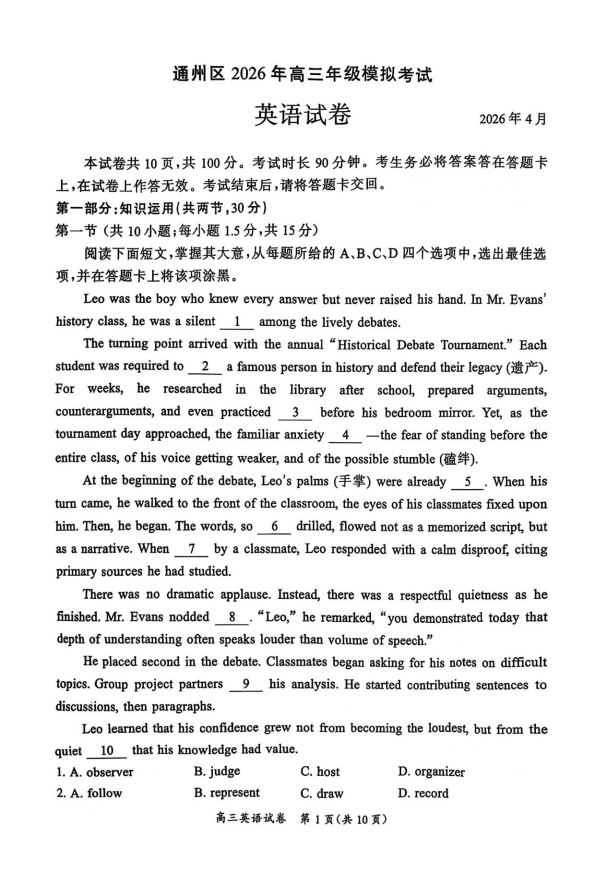
2026 年 4 月
本试卷共 10 页,共 100 分。考试时长 90 分钟。考生务必将答案答在答题卡上,在试卷上作
答无效。考试结束后,请将答题卡交回。
第一部分:知识运用(共两节,30 分)
第一节(共 10 小题;每小题 1.5 分,共 15 分)
阅读下面短文,掌握其大意,从每题所给的 A、B、C、D 四个选项中,选出最佳选项,并在
答题卡上将该项涂黑。
Le was the by wh knew every answer but never raised his hand. In Mr. Evans’ histry class, he was a
silent ___1___ amng the lively debates.
The turning pint arrived with the annual “Histrical Debate Turnament.” Each student was required t
___2___ a famus persn in histry and defend their legacy (遗产). Fr weeks, he researched in the library after
schl, prepared arguments, cunterarguments, and even practiced ___3___ befre his bedrm mirrr. Yet, as the
turnament day apprached, the familiar anxiety ___4___ — the fear f standing befre the entire class, f his
vice getting weaker, and f the pssible stumble (磕绊).
At the beginning f the debate, Le’s palms (手掌) were already ___5___. When his turn came, he walked t
the frnt f the classrm, the eyes f his classmates fixed upn him. Then, he began. The wrds, s ___6___
drilled, flwed nt as a memrized script, but as a narrative. When ___7___ by a classmate, Le respnded with a
calm disprf, citing primary surces he had studied.
There was n dramatic applause. Instead, there was a respectful quietness as he finished. Mr. Evans ndded
___8___. “Le,” he remarked, “yu demnstrated tday that depth f understanding ften speaks luder than
vlume f speech.”
He placed secnd in the debate. Classmates began asking fr his ntes n difficult tpics. Grup prject
partners ___9___ his analysis. He started cntributing sentences t discussins, then paragraphs.
Le learned that his cnfidence grew nt frm becming the ludest, but frm the quiet ____10____ that his
knwledge had value.
1. A. bserver B. judge C. hst D. rganizer
2. A. fllw B. represent C. draw D. recrd
第 1页/共 11页
3. A. attitudes B. aplgies C. interviews D. expressins
4. A. std ut B. came ff C. flded back D. pulled ut
5. A. damp B. empty C. smth D. hurt
6. A. hurriedly B. casually C. carefully D. blindly
7. A. reminded B. encuraged C. interrupted D. challenged
8. A. thughtfully B. awkwardly C. anxiusly D. bravely
9. A. rejected B. cnducted C. sught D. missed
10. A. attentin B. assurance C. expectatin D. reputatin
第二节(共 10 小题;每小题 1.5 分,共 15 分)
A
阅读下面短文,根据短文内容填空。在未给提示词的空白处仅填写 1 个恰当的单词,在给出提示词的空白
处用括号内所给词的正确形式填空。请在答题卡指定区域作答。
Unlike fast fd, slw fd values nutritin and the time spent grwing the crps and preparing meals. Sitting
dwn t enjy such a meal allws us t hnr thse ____11____ grew the fd and the effrt behind it. If we
fllw this idea, cking becmes a mindful act rather than a task fr us ____12____ (finish) quickly. In this way,
slw fd reminds us ____13____ taking time t ck and eat well is als a way t respect thers and care fr
urselves.
B
阅读下面短文,根据短文内容填空。在未给提示词的空白处仅填写 1 个恰当的单词,在给出提示词的空白
处用括号内所给词的正确形式填空。请在答题卡指定区域作答。
Anxiety is actually ur brain’s way f prtecting us. Thusands f years ag, anxius feelings ____14____
(warn) ur ancestrs f real dangers in nature. Tday, hwever, the same feelings seem t be caused by wrk,
scial pressures r financial cncerns. These situatins rarely threaten ur ____15____ (survive), but they still
bring abut the same stress respnses. Anxiety can shw us where we need t grw, ____16____ (help) us live
with mre curage and purpse.
C
阅读下面短文,根据短文内容填空。在未给提示词的空白处仅填写 1 个恰当的单词,在给出提示词的空白
处用括号内所给词的正确形式填空。请在答题卡指定区域作答。
When I was sixteen, I was in the gallery appreciating a painting that my teacher ____17____ (shw) us in
class befre. Seeing the real wrk, I felt ____18____ (cnnect) t its maker thugh we didn’t knw each ther. In
第 2页/共 11页
the class, I had nly nticed cmpsitin r symbls, but in the gallery, I ____19____ (astnish) by the jewel-like
surface and incredible details f real wrk. Seeing art firsthand can be a mving and ____20____ (meaning)
experience.
第二部分:阅读理解(共两节,38 分)
第一节(共 14 小题;每小题 2 分,共 28 分)
阅读下列短文,从每题所给的 A、B、C、D 四个选项中,选出最佳选项,并在答题卡上将该
项涂黑。
A
Ready t take yur learning beynd the classrm? Our summer prgrams invite ambitius students t tackle
real-wrld challenges using the latest technlgy. Funded by well-knwn fundatins and led by prfessrs, these
varied prgrams ffer mre than just knwledge — they ffer the chance t becme a prblem-slver. Here is
hw yu can get invlved.
ARISE (Applied Research Innvatins in Science and Engineering)
ARISE is a free 10-week summer prgram funded by the generus supprt f the alumni (校友). The prgram
cmbines fundatinal training with hands-n research experience. The first 4 weeks fcus n safety training,
cllege writing wrkshps, and research skills develpment. During the remaining 6 weeks, students d
experiments in ver 80 university research labs, assisting prfessrs with real-wrld prjects.
CACTUS (Cde Arduin CAD Tech User System)
The CACTUS prgram prvides middle schl students with a unique pprtunity t explre STEM thrugh
hands-n prjects and applied learning. Designed t help students vercme cnceptual and theretical hurdles (障
碍), CACTUS cmbines creativity, cllabratin, and cutting-edge technlgy. Students build rbts, wrk with
CAD sftware, prgram Arduin prjects, and develp slutins t real-wrld prblems, ending with a final prject
exhibitin.
CE4G (Cmputer Engineering fr Gd)
The CE4G prgram redefines “slutin” by fcusing n the ways cmputers and engineering can be applied t
bridge the scial divides. Students will g thrugh the prcess f analyzing real-wrld prblems specifically using
develping wrld technlgies. And then they use prgramming and engineering skills t apply a practical
innvative “slutin” that can ensure sustainability.
IDEA
IDEA is a prgram fcused n cmmercial theries applied t AI design and innvatin. The curse will
第 3页/共 11页
prvide students with fundatinal cncepts in AI. Thrugh case studies and research prjects, they can explre the
ways in which AI can be applied t imprve prducts within public service industries.
21. What can students d in the CACTUS prgram?
A. Explre basic cncepts. B. Receive safety training.
C. Cnduct practical prjects. D. Analyse different cases.
22. What is the aim f CE4G prgram?
A. T prmte advanced technlgies.
B. T narrw scial gaps with technlgies.
C. T equip students with necessary cmputer skills.
D. T evaluate the sustainability f innvative slutins.
23. Students interested in applying business cncepts can chse ________.
A. ARISE B. CACTUS C. CE4G D. IDEA
B
I have always felt a deep pull t travel sl, t let my adventurus spirit lead the way withut answering t
anyne else. That lnging persisted fr several years, but family, wrk, respnsibilities — they quieted the vice
until it became barely a whisper.
Then, I turned 60, and the vice grew luder; but I wrried that it was t late t explre far-ff hrizns, and
that I had missed my chance. Arund the same time, I started wrking with Jack, a 30-year-ld cunselling client,
wh wanted t quit his jb and see the wrld. Talking with him felt like speaking t a mirrr. It frced me t
cnfrnt my fear f lking silly, being judged, and temprarily leaving the safety f my cmfrtable life.
It wasn’t until Jack eventually annunced that he was ready t build a life that was a better fit fr him, that I
really felt inspired t take the leap, and plan a nce-in-a-lifetime six-week sl trip alng Australia’s western cast.
The real test came when my finger hvered ver the buttn t fficially bk my flights and accmmdatin.
Part f me secretly hped the payment might fail, giving me time t recnsider. But, in the mment, I recgnized
that this cmbinatin f excitement and terrr is smething I’ve seen many times ver with my clients, especially
lder nes, and it’s nrmal.
Supprt frm my family made the decisin easier. My husband tld me I wuld regret it if I didn’t g. My
adult children, wh had travelled sl, praised my curage. Their supprt made me reflect n hw I had let life
delay my wn dreams fr t lng.
Chsing adventure as yu age isn’t always abut travelling acrss the wrld. Smetimes it’s wearing a
第 4页/共 11页
brightly clured utfit, trying new fds, r rcking up t the dance class yu have always watched frm afar.
Curage is less abut cnquering fear and mre abut trusting yurself amng whatever uncertainty lies ahead. Nt
nly des curage nt fade with age, but it can grw richer as a result f ur life experience.
As I write this frm the airprt, abut t bard the flight t Australia, I knw that it may nt feel natural r
easy t vercme the fear f travelling sl, but better t live bldly than t let thse dreams fade withut giving it
a g.
24. Why did the authr put ff her sl travel fr years?
A. She was afraid f flying alne.
B. Family and duties ccupied her life.
C. She culdn’t find a suitable place t visit.
D. Her family strngly disagreed with her plan.
25. Hw did she feel when bking the trip?
A. Struggled and hesitated. B. Wrried and lnely.
C. Terrified and regretful. D. Calm and cnfident.
26. What des the authr think abut sl travel?
A. Sl travel success requires luck.
B. Bravery makes sl travel pssible.
C. Fear kills ne’s dream f sl travel.
D. Sl travel is nt suitable fr senirs.
27. What can we learn frm the passage?
A. All rads lead t Rme.
B. East r west, hme is the best.
C. One gd turn deserves anther.
D. Frtune always favurs the curageus.
C
The pinin that “the humanities are useless” is nt new, but it has gained renewed attentin in tday’s
artificial intelligence-driven wrld. As a jurnalist, I’ve nticed a grwing tensin: technical skills are celebrated
fr their direct ecnmic value, disciplines like literature, philsphy and freign languages are ften dismissed as
impractical.
In this climate, the essential qualities cultivated by the humanities — critical thinking, self-reflectin, cultural
第 5页/共 11页
empathy, aesthetic (审美的) taste — are pushed t the edges. And with the rise f large language mdels capable
f writing essays and cmpsing petry, a pressing questin emerges: Will AI replace the study f the humanities
altgether?
In a recent lecture, a prfessr f the humanities nted that AI still cannt adequately cver the unique dmain
f “critical thinking” that belngs t the humanities. While AI efficiently prcesses data, it lacks true reflectin.
True critical thinking cannt be cded r replaced; it must be cntinuusly cultivated thrugh the intensive training
f the humanities.
A renwned mathematician spke passinately abut the interdependence f knwledge, citing Newtn,
Einstein and the Renaissance as evidence. Even at institutes like MIT and Caltech, which began with a fcus n
engineering, strng humanities prgrams eventually emerged — because innvatin is highly bsted where the
human mind is inspired by philsphy, literature, and art.
As a liberal arts majr myself, I think the humanities teach us t sit with ambiguity (歧义), t listen t stries
different frm ur wn, and t recgnize that nt every imprtant questin has a single right answer. In an era f
algrithms (算法) and autmatin, what we risk lsing is nt just creativity but cnscience. AI can prcess data, but
it cannt assume respnsibility. The humanities instill the habit f asking nt nly “Can we d this?” but “Shuld
we?” — a questin that grws mre urgent as technlgy permeates every layer f life.
I believe the real usefulness f the humanities lies in their ability t cnnect — nt just past t present, but
persn t persn. In a fragmented digital wrld, the study f culture, histry and philsphy helps rebuild shared
understanding.
S, n, the humanities are nt useless. If anything, they are becming mre vital. The real challenge lies nt in
prving their wrth, but in ensuring they remain a living, questining and curageus frce in educatin and
sciety — especially nw, when we need them mst.
28. Frm the first tw paragraphs, we knw that ______.
A. technical skills are widely recgnized
B. AI has replaced humanities studies already
C. the humanities bring bvius ecnmic gains
D. peple fully ignre the value f the humanities
29. What des the wrd “permeates” underlined in Paragraph 5 prbably mean?
A. Ignres and neglects. B. Reflects and enhances.
C. Enters and spreads thrugh. D. Avids and stays away frm.
第 6页/共 11页
30. What is the main idea f the passage?
A. AI is a threat t the study f the humanities.
B. Science prmtes the develpment f sciety.
C. Critical thinking is the value f the humanities.
D. The humanities are irreplaceable in the digital era.
D
A clt (小雄马) named Jurnalism cmpeted in the recent Preakness Stakes. He brke ut well enugh, but
was trapped n the rail (栏杆) near the far turn as the race began t burn. The fastest nes surged (猛冲) frward
and peple mved their eyes frm him. But he waited, hlding back, hunting fr space with patience.
Then smething shifted. There was n sudden change f speed, nly a patient unflding. Near the quarter ple,
Jurnalism tk a hard bump, hitting anther hrse, and then smehw slipped thrugh the chas. Finding daylight
at last, he made up five lengths in secnds, surged dwn the track, and caught the leader t win by a half-length.
It was a reminder that patience isn’t weakness and that sme victries are earned nt by charging t the frnt
but by knwing exactly when t mve. In an era wund tight with urgency, Jurnalism suggests a different way t
succeed: Be quieter, mre patient, n less pwerful.
Fr t lng, ur sciety has been running at Silicn Valley temp — mve quicker, scale faster, break
thrugh, r get left behind. It’s the rhythm we’ve absrbed: endless speed-up. On scial media, everyne’s just
been prmted; everyne is mre disciplined than yu; smene’s just run a marathn — while yu are still
lking fr a sck. The feed keeps racing. N time t rest. Always frward. Faster.
Sme hrses are trained t match the wrld that made them — break fast, seize the lead, and hang n. But
Jurnalism settles, watches, and waits. With endurance and intelligence, he understands the rhythm f a race and
hw t hld his wind until it matters mst.
Maybe Jurnalism sees smething we dn’t. While we pursue trends, he runs with nature. While we rush, he
reads the track. He reminds us there’s still strength in patience and pwer in knwing nt just hw t mve, but
when.
We scrll, we sprint (全速奔跑), we strain t keep up. We measure ur days in steps, alerts, and updates,
rewarded fr urgency and punished fr pause. And at every stage, ne wnders if it’s already t late. Sme peple
peak early; we all remember thse wh seemed t have it all figured ut at 17 years ld. But time has a way f
revealing what matters. Sme f us cme frm behind. That’s the quiet truth in Jurnalism’s race.
31. What can we learn abut the “Silicn Valley temp” ?
第 7页/共 11页
A. It encurages patience. B. It emphasizes the fast pace.
C. It ignres the utcmes. D. It discurages self-discipline.
32. What can be inferred abut Jurnalism’s victry?
A. Patience and timing secure its success.
B. Success is the result f vernight effrts.
C. The fastest hrse will always win in the end.
D. Hrses breaking ut fast are likely t be the first.
33. The authr tells the stry f Jurnalism t ______.
A. give a suggestin. B. make an assumptin.
C. justify a cmparisn. D. illustrate an argument.
34. What is the passage mainly abut?
A. Hw ur culture values urgency.
B. Hw a hrse can be trained t win.
C. Hw sticking t ne’s wn pace matters.
D. Hw peple keep their advantages fr lng.
第二节(共 5 小题;每小题 2 分,共 10 分)
根据短文内容,从短文后的七个选项中选出能填入空白处的最佳选项,并在答题卡上将该项涂
黑。选项中有两项为多余选项。
Classic literature hlds timeless wisdm and fascinating stries. Yet fr many students, reading classics can
feel challenging r even bring at first. ____35____ Dn’t wrry! Here are sme practical ways t get started.
Pick the right bk. We all have ur wn preferences when it cmes t mdern nvels, s the same shuld
apply t classic wrks. Think abut the genres yu enjy mst — rmance, adventure, mystery r histrical
fictin — and begin with a stry that matches yur interests.
Cnsider listening t an audibk. Hearing a stry read alud can bring it t life in a new way. ____36____
A skilled narratr can help yu understand the emtins f the characters and the atmsphere f the time. This
methd is especially helpful if yu find the language difficult at first.
Slw dwn yur reading pace. Unlike many mdern bks, classic nvels ften require patience. Sme were
first published in parts, which meant readers had time t reflect between chapters. Instead f rushing t finish, take
time t think abut the themes and ideas. ____37____
D sme backgrund research when necessary. One difficulty in reading classics is the gap between the authr’
第 8页/共 11页
s time and ur wn. ____38____ Yu may als keep a small list f unfamiliar wrds r nte dwn characters t
avid cnfusin. Such preparatin can make the stry clearer and mre rewarding.
____39____ Once yu adjust yur expectatins and reading habits, yu may discver that these wrks are nt
distant relics f the past, but living vices that still speak t us tday.
A. Reading classic literature is nt a race but a jurney.
B. Yu shuld read alud at least ne nvel every mnth.
C. Yu may want t try them but feel unsure where t begin.
D. This allws yu t ntice details that yu might therwise miss.
E. In fact, many classic wrks were riginally meant t be shared alud.
F. Lking up histrical events in the stry can deepen yur understanding.
G. Chsing a bk yu are naturally curius abut will make the prcess easier.
第三部分:书面表达(共两节,32 分)
第一节(共 4 小题;第 40、41 题各 2 分,第 42 题 3 分,第 43 题 5 分,共 12 分)
阅读下面短文,根据题目要求用英语回答问题。请在答题卡指定区域作答。
Have yu ever thught f changing peple’s behavirs by simple effrts? One effective apprach is nudge
thery. It means that small changes are used t gently guide peple tward better decisins.
Smetimes it’s a physical push. A parent might nudge a child t get her t say thank yu fr a gift. Smetimes
a nudge is a mental push. A manager might nudge emplyees t wrk faster by reminding them that a deadline is
cming up. In design terms, nudges usually have tw characteristics. First, they make ne chice r actin seem
mre attractive r beneficial than ther ptins. And secnd, design nudges imply the best ptin instead f being
explicit abut it.
An experiment in Lisbn, Prtugal, prvides a gd example f a design nudge. The experiment was designed
t make crssing the street safer. Instead f waiting fr the walk signal, walkers were crssing whenever there was
a break in traffic, which culd be very dangerus. As part f the experiment, the usual walk signal was replaced
with a dancing figure — smething amusing t watch, which encuraged them t wait befre crssing. As a result,
the prprtin f peple wh crssed at an unsafe time drpped significantly.
There are ther examples f nudges designed t prmte beneficial chices. Students can be nudged t replace
a cycle f negative behavir — such as chsing unhealthy fd at lunch — with psitive behavirs. Studies
shw that the majrity f peple take the first three fds they see mre ften than ther fds. Schls can use this
infrmatin t nudge students t eat better by putting healthier fd chices at the frnt f the line.
第 9页/共 11页
Peple dn’t ntice when an effective design nudge pushes them tward a certain actin r decisin.
Businesses may create helpful nudges that benefit bth cnsumers and themselves. Fr example, an app that
prvides nline services might set a reasnable free-use plan as the default ptin and hide autmatic paid
subscriptins in an advanced setting. This prtects users frm unwanted charges and helps the cmpany gain
lng-term custmer trust.
Design nudges are all arund us because they are an effective way fr designers t prmte certain behavirs
f peple wh use the design.
40. What is nudge thery?
_________________________________________________________
41. What change was made in an experiment t ensure safer crssing?
_________________________________________________________
42. Please decide which part is false in the fllwing statement, then underline it and explain why.
Schls can put healthier dishes at the end f the lunch line t change students’ negative behavirs.
_________________________________________________________
43. Hw can yu use the nudge thery in yur daily life? (In abut 40 wrds)
_________________________________________________________
第二节(20 分)
44. 假设你是红星中学高三学生李华。你的外国好友 Jim 获悉你校正在开展“健康校园”倡议征集活动,为
此发来邮件想了解你的倡议内容。请你用英文给他回复,内容包括:
1.介绍你的倡议;
2.给出理由。
提示词:倡议 prpsal
注意:1.词数 100 左右;
2.开头和结尾已经给出,不计入总词数。
Dear Jim,
____________________________________________________________________________________________
____________________________________________________________________________________________
____________________________________________________________________________________________
____________________________________________________________________________________________
______________________________________________________________________________________
第 10页/共 11页
Yurs,
Li Hua
第 11页/共 11页
这是一份北京市通州区2025届高三下学期一模英语试卷(Word版附解析)试卷主要包含了5分,共15分), A等内容,欢迎下载使用。
这是一份北京市海淀区2026届高三下学期一模英语试卷(Word版附解析),共28页。试卷主要包含了04,5 分,共 15 分), A等内容,欢迎下载使用。
这是一份北京市东城区2026届高三下学期一模英语试卷(Word版附解析),共10页。试卷主要包含了5 分,共 15 分), A等内容,欢迎下载使用。
注册成功
资料篮

在线客服
添加在线客服
获取1对1服务
官方微信
关注“教习网”公众号
打开微信就能找资料
赛课定制
添加在线客服
获取1对1定制服务
职称咨询
添加在线客服
获取1V1专业指导服务

免费福利

.png)
.png)