 免费领取教师福利



若您为此资料的原创作者,认为该资料内容侵犯了您的知识产权,请扫码添加我们的相关工作人员,我们尽可能的保护您的合法权益。

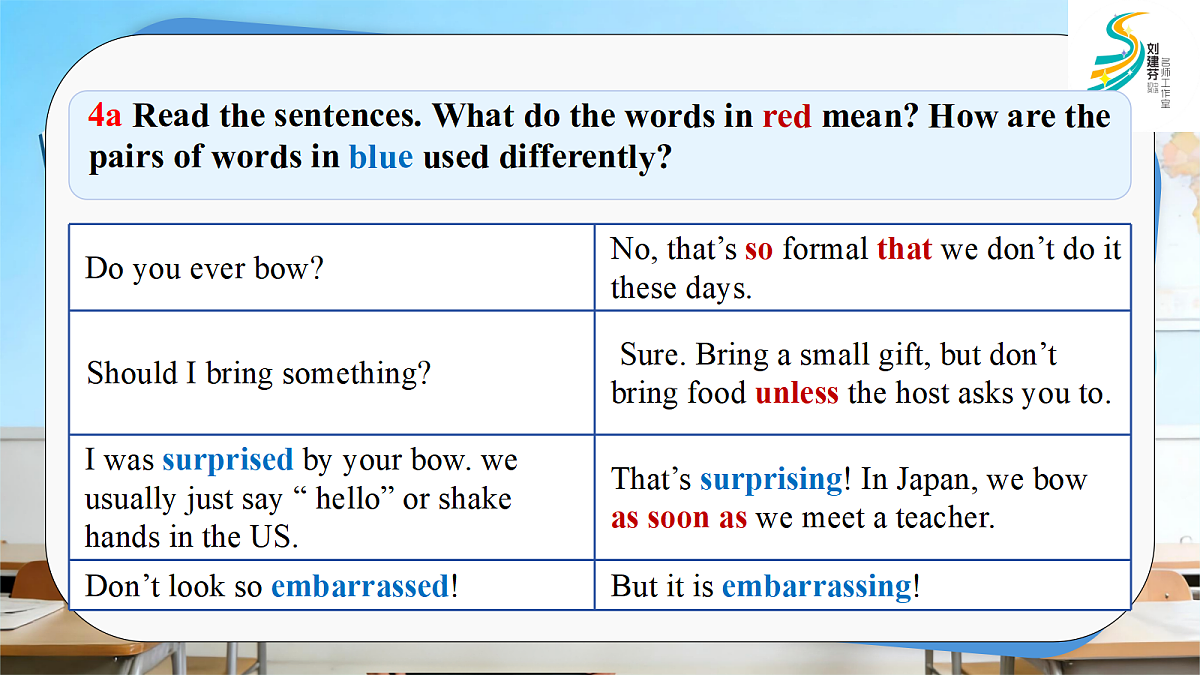
这是一份英语人教版(2024)Section A授课课件ppt,共20页。PPT课件主要包含了用法一主将从现,用法二主过从过,课后作业 · 练习一,begins,shook,boring,bored,课后作业 · 练习二,unless,hides等内容,欢迎下载使用。
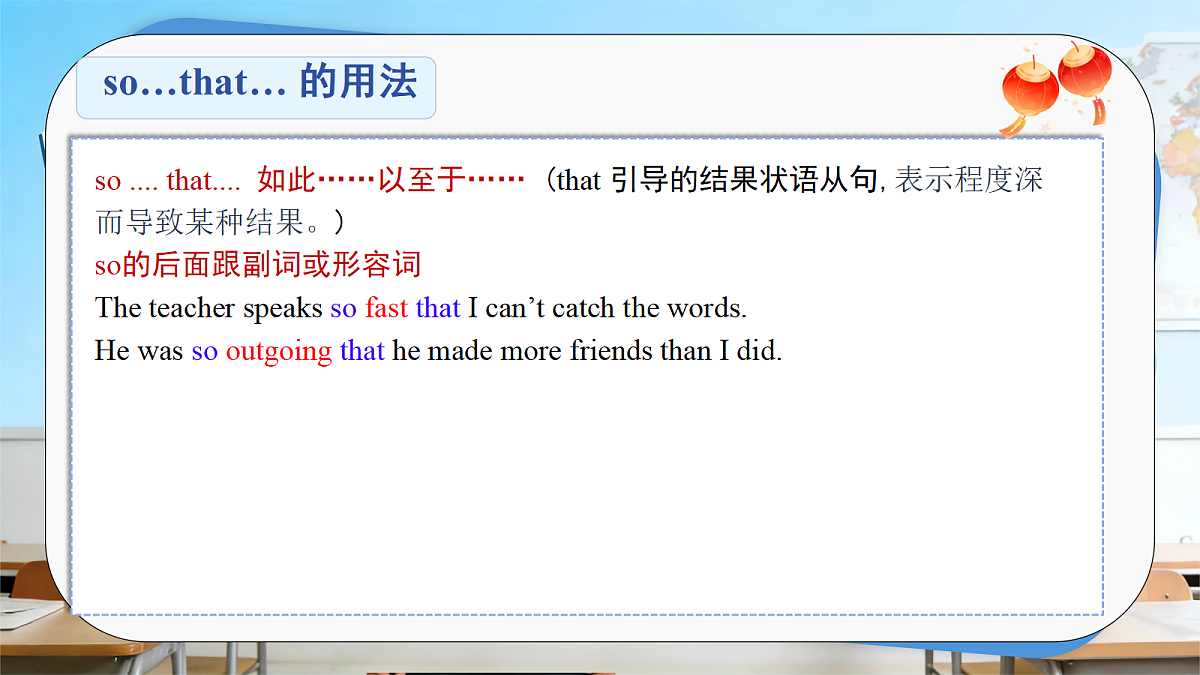
s 如此……以至于…… (that 引导的结果状语从句,表示程度深而导致某种结果。)s的后面跟副词或形容词The teacher speaks s fast that I can’t catch the wrds.He was s utging that he made mre friends than I did.
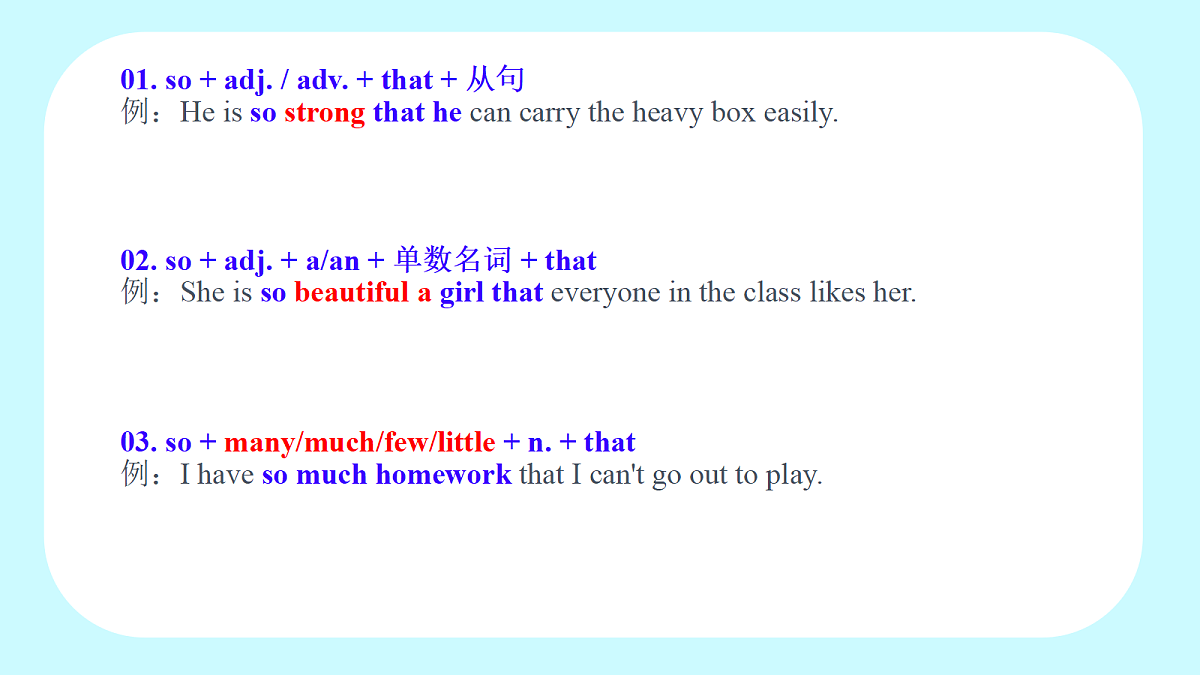
01. s + adj. / adv. + that + 从句例:He is s strng that he can carry the heavy bx easily.
02. s + adj. + a/an + 单数名词 + that例:She is s beautiful a girl that everyne in the class likes her.
03. s + many/much/few/little + n. + that例:I have s much hmewrk that I can't g ut t play.
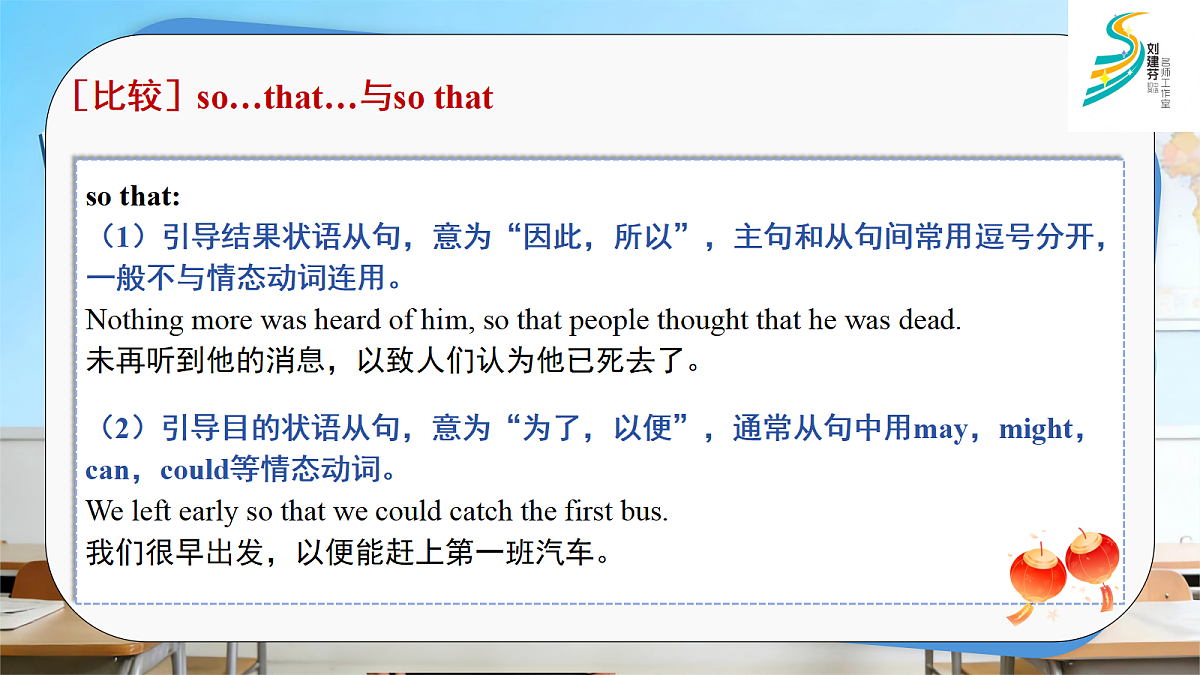
[比较]s…that…与s that
s that:(1)引导结果状语从句,意为“因此,所以”,主句和从句间常用逗号分开,一般不与情态动词连用。Nthing mre was heard f him, s that peple thught that he was dead.未再听到他的消息,以致人们认为他已死去了。
(2)引导目的状语从句,意为“为了,以便”,通常从句中用may,might,can,culd等情态动词。We left early s that we culd catch the first bus.我们很早出发,以便能赶上第一班汽车。
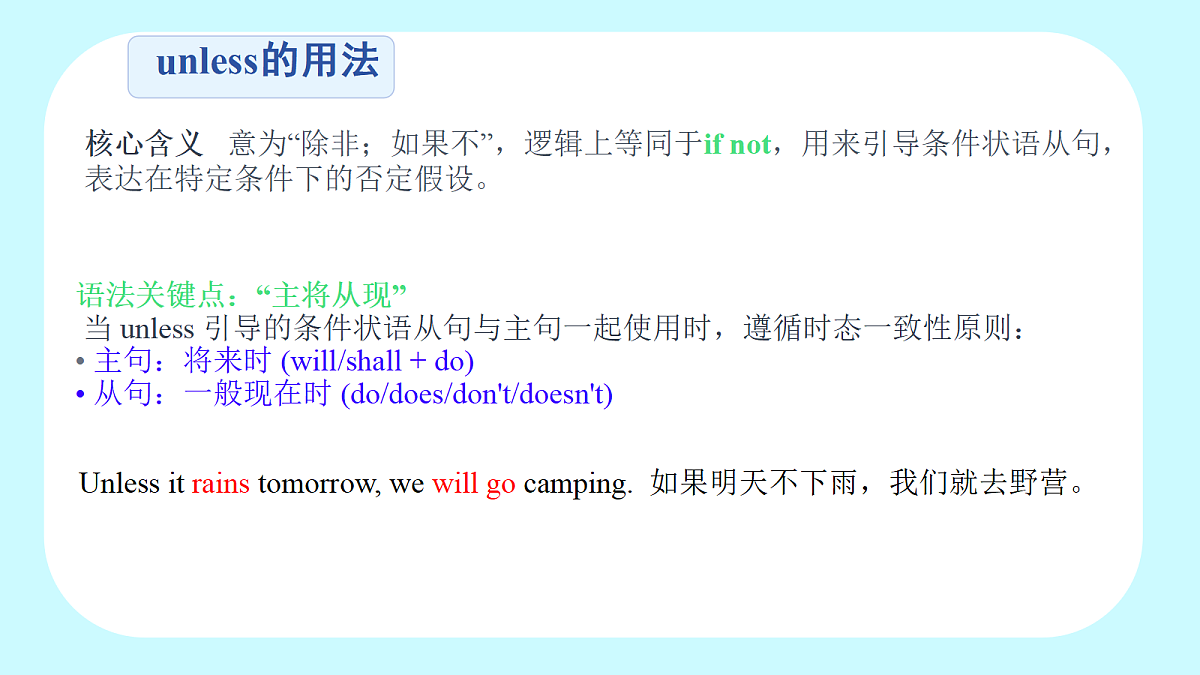
核心含义 意为“除非;如果不”,逻辑上等同于if nt,用来引导条件状语从句,表达在特定条件下的否定假设。
语法关键点:“主将从现” 当 unless 引导的条件状语从句与主句一起使用时,遵循时态一致性原则: • 主句:将来时 (will/shall + d) • 从句:一般现在时 (d/des/dn't/desn't)
Unless it rains tmrrw, we will g camping. 如果明天不下雨,我们就去野营。
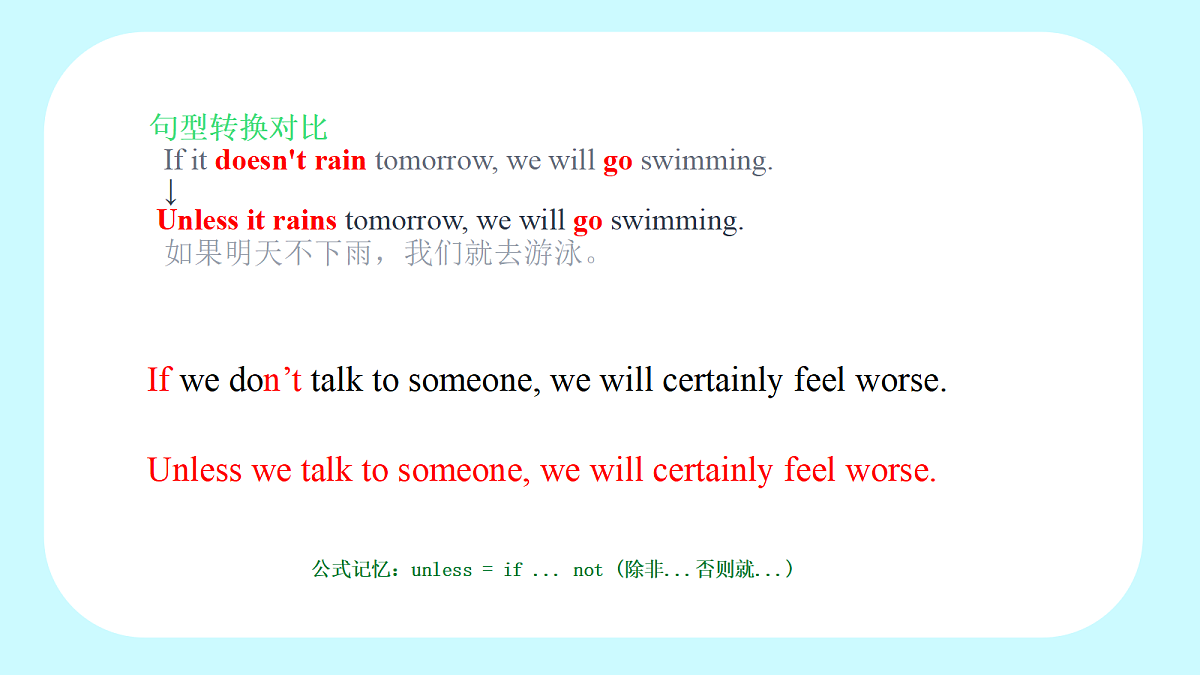
If we dn’t talk t smene, we will certainly feel wrse.
Unless we talk t smene, we will certainly feel wrse.
句型转换对比 If it desn't rain tmrrw, we will g swimming. ↓ Unless it rains tmrrw, we will g swimming. 如果明天不下雨,我们就去游泳。
公式记忆:unless = if ... nt (除非...否则就...)
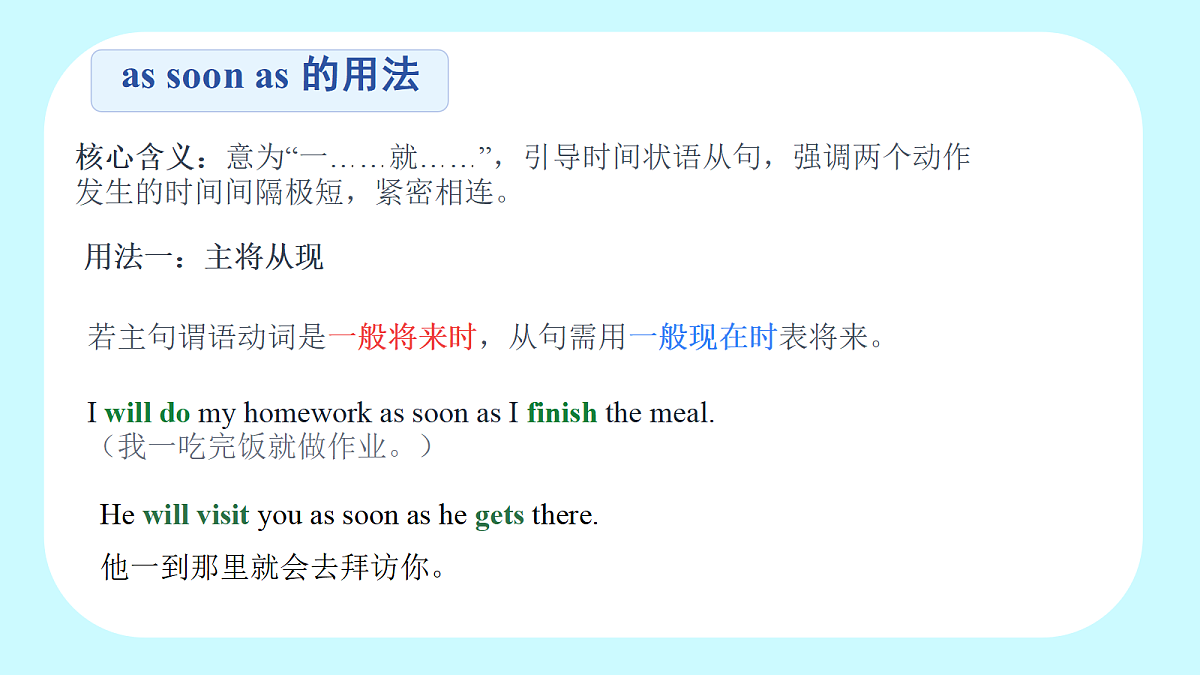
核心含义:意为“一……就……”,引导时间状语从句,强调两个动作发生的时间间隔极短,紧密相连。
若主句谓语动词是一般将来时,从句需用一般现在时表将来。
I will d my hmewrk as sn as I finish the meal.(我一吃完饭就做作业。)
He will visit yu as sn as he gets there.他一到那里就会去拜访你。
若主句谓语动词是一般过去时/过去将来时,从句需用一般过去时。
He called me as sn as he arrived hme.(他一到家就给我打了电话。)
句型转换: ↔ t / enugh
① (肯定) → enugh t dHe is s strng that he can carry the bx.→ He is strng enugh t carry the bx.
② (否定) → dJimmy is s yung that he can't g t schl.→ Jimmy is t yung t g t schl.
重点辨析:such ... that 的用法
such + a/an + 形容词 + 可数名词单数 + that + 从句(修饰名词短语,注意与s修饰形容词的区别)
They are such gd students that the teacher likes them.他们是如此好的学生,以至于老师喜欢他们。
用所给词的适当形式填空
01.The family will g t Yunnan as sn as the hliday __________ (begin).
02.As sn as he came int the ffice, he __________ (shake) hands with every ne f us.
03.That stry sunds s __________ that everyne here feels __________ (bre).br
04.He _______________ (learn) s quickly that his father was very happy.
05.My parents ______________ (nt allw) me t g ut t play unless I finish my hmewrk.
learnt/learned
将下列句子改为同义句 (使用 unless)
He can't turn himself int a man if he desn't hide his tail.Rewrite:He can't turn himself int a man __________ he __________his tail.
If yu dn't study hard, yu wn't pass the exam.Rewrite:Yu wn't pass the exam __________ yu study hard.
1. Türkiye: Peple dn’t kiss ne anther n the cheek. They can d s if they are gd friends. (unless)In Türkiye, peple dn’t kiss ne anther n the cheek unless they are gd friends.2. Japan: Take ff yur shes. Yu d this when yu enter smene’s hme. (as sn as)3. Kenya: Being late is very cmmn. Yu shuld be patient and nt expect peple t be n time. ()
In Japan, take ff yur shes as sn as yu enter smene’s hme.
In Kenya, being late is s cmmn that yu shuld be patient and nt expect peple tbe n time.
4. China: Sticking chpsticks int a bwl f rice is very rude. Yu shuld avid it.(s )5. Mexic: Dn’t use smene’s first name if yu dn’t knw him r her well. Yu can use it if the persn invites yu t d s.(unless)
In China, sticking chpsticks int a bwl f rice is s rude that yu shuld avid it.
In Mexic, dn’t use smene’s first name unless yu knw him r her well.Yu can use it if the persn invites yu t d s.
s. . . that
interesting
D yu knw what culture shck is? Yu may feel it when yu experience a new culture, because the new culture is _____ different frm yur wn____ yu feel_________. Fr example, I experienced this ________ I gt ff the plane in Peru last year. Peple were standing n my right and left, even thugh there was plenty f space n the bus! That was really ________ t me. In Germany, peple usually like mre persnal space, and we dn’t stand clse t smene ______we knw them very well. But nce I was used t it, I became mre curius and _________ in learning abut the culture there. It’s s ________ t discver cultural differences like this!
surprising
(1) But nce I was used t it, I became mre curius and interested in learning abut the culture there. 但一旦习惯了这种情况,我就变得更加好奇,并对学习那里的文化感兴趣。(教材 P55 4c)be/get used t 习惯于 t在此处为介词,其后常接名词、代词或动词-ing形式。Yu will sn be/get used t the weather here. 你很快就会适应这里的天气。The ld peple are used t buying daily things arund the neighbrhd. 老人们习惯在小区附近购买日常用品。
(2) It’s s interesting t discver cultural differences like this! 发现这样的文化差异真是太有趣了! (教材 P55 4c)cultural adj. 与文化有关的;文化的由“culture(n. 文化)去e +-al( 形容词后缀)”构成。They share the same cultural backgrund. 他们有着相同的文化背景。In ur culture, it is rude t ask smene hw much they earn. 在我们的文化里, 问别人收入多少是不礼貌的。
s+形容词/副词+that从句(重点)
这是一份初中Section A图片课件ppt,共22页。PPT课件主要包含了as soon as,unless,boring,interested,excited,satisfying,shocked,worried,surprised,surprising等内容,欢迎下载使用。
这是一份初中英语人教版(2024)八年级下册(2024)Section B课文配套ppt课件,共19页。PPT课件主要包含了Yaming,Tina,应用文电子邮件,以第二人称为主,一般现在时,审题立意,开篇点题,呼应前文进行总结等内容,欢迎下载使用。
这是一份初中英语Section B教案配套课件ppt,共12页。
注册成功
资料篮

在线客服
添加在线客服
获取1对1服务
官方微信
关注“教习网”公众号
打开微信就能找资料
赛课定制
添加在线客服
获取1对1定制服务
职称咨询
添加在线客服
获取1V1专业指导服务

免费福利

.png)
.png)
.png)
