 免费领取教师福利

若您为此资料的原创作者,认为该资料内容侵犯了您的知识产权,请扫码添加我们的相关工作人员,我们尽可能的保护您的合法权益。


这是一份2026年山东省临沂市兰山区中考一模考试英语试卷(学生版),共9页。试卷主要包含了 本试卷分试题卷和答题卡两部分, 答卷前考生务必用0等内容,欢迎下载使用。
1. 本试卷分试题卷和答题卡两部分。试题卷1至10页,答题卡1至3页。总分100分,考试时间120分钟。
2. 答卷前考生务必用0.5毫米黑色墨水签字笔将自己的姓名、准考证号、座号填写在试题卷和答题卡规定的位置。考生须在答题卡规定的区域内答题,在试题卷上答题不得分。选择题须用2B铅笔填涂,非选择题须用0.5毫米黑色墨水签字笔书写。
3. 考试结束后,将本试题卷和答题卡一并交回。
试题卷
第一部分 听力测试(共四节,满分20分)略
第二部分 阅读理解(共两节,满分30分)
第一节(共15小题;每小题1.5分,满分22.5分)
阅读下列短文,从每题所给的A、B、C三个选项中选出最佳选项。
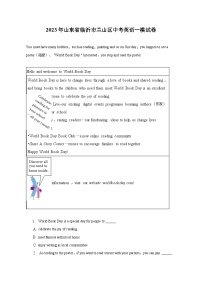
A
1. Wh is the writer f the article “Hw t take ntes”?
A. Paul Miller.B. Judy Dean.C. Alex Black.
2. Hw many famus nature parks are mentined in the article “Nature parks”?
A. Five.B. Seven.C. Nine.
3. On which page can yu find the article “Chinese gardening”?
A. Page 8.B. Page 15.C. Page 22.
B
Vicky’s mther pened the dr. She had a lk at Vicky’s bedrm.
“What a mess! It lks as if a hurricane (飓风) passed thrugh Vicky’s bedrm,” said Vicky’s mther. “I must ask her t clean it.”
Vicky was eating breakfast. Her father came int the kitchen and said, “Mm wants yu t clean yur rm. It lks as if a hurricane passed thrugh it.”
Je, Vicky’s little brther, asked, “A hurricane? Is that a bad thing?”
“Sure it is,” said his father.
“I’ll d it after schl, Dad,” said Vicky. “My first class is gegraphy and Mr. Miller hates peple t be late.” And she ran thrugh the frnt dr.
Twenty minutes later, Vicky ran int her classrm. “Tday,” said Mr. Miller, “we’re ging t learn abut hurricanes. Have any f yu seen a hurricane?” Vicky thught abut her bedrm, but she said nthing.
“I haven’t seen ne: Nt a real ne but I watched a prgram n TV and I knw they destry (破坏)things and leave a mess,” said James wh sat next t Vicky.
“Yes,” said Mr. Miller. “But tday I’m ging t surprise yu. Smetimes hurricanes d gd.”
“Hurricanes can be gd things?” Vicky asked.
“Oh, yes,” said Mr. Miller. “Hurricanes bring a lt f water t rivers and lakes that are becming dry. Animals and fish cme back t live in them. Hurricanes als pick up heat frm the very ht areas f the wrld and drp it in less warm places.”
“S, hurricanes can be gd things,” Vicky said t herself. “I’m ging t shw Mm the gd part.”
When Vicky gt hme in the afternn, she began t clean up her bedrm. She put all f her things in their prper places.
“Mm,” she called. “Can yu cme here fr a minute?”
Vicky’s mther put her head arund the dr. “Vicky!” she said. “That lks fantastic! I tld yur dad this mrning that it lked as if a hurricane had hit it!” “Are yu sure that’s a bad thing, Mm?” asked Vicky, smiling.
4. What surprised the students in Mr. Miller’s class?
A. Hurricanes can be stpped.
B. Hurricanes can be gd things.
C. Hurricanes can destry the envirnment.
5. Hw wuld Vicky’s mther feel at the end f the stry?
A. Wrried.B. Relaxed.C. Happy.
6. What can we learn frm the stry?
A. D what yur teachers tell yu.
B. Put what yu have learned int practice.
C. Ask yur parents befre making a decisin.
7. What is the best title fr the text?
A. Tiger Mther.
B. Hurricane Vicky.
C. Knwledgeable Teacher.
C
Human actins are affecting the envirnment. We will lse mre f the natural wrld if we dn’t try t change things. Thugh it is difficult, we can make a difference. Each small change is imprtant, and luckily mre individuals (个人) and rganizatins are wrking n cnservatin (保护) prjects.
Samsn, an African fisherman, has becme a vice f the cean. He and the ther fishermen realized they were catching fewer and fewer fish. They were verfishing. Wrking with the Wrld Wide Fund fr Nature (WWF), Samsn learned they had t fish with mre care. He realized they shuldn’t catch s many yung fish because if there are t few f them, there wn’t be enugh adult fish t reprduce. He believes prtecting the cean is everybdy’s jb. As he says, “Take yur respnsibilities and never think that yu are alne.”
In Flrida, the Sea Turtle Cnservancy (STC) nticed there were always plenty f single-use plastic items, like bttles and drinking straws (吸管), n the beaches. These items can hurt the cean wildlife terribly. Straws are especially dangerus fr turtles because they can get stuck in turtles’ nses and hurt them badly. S, STC started the prject “Where are the straws?” asking lcal restaurants t stp giving custmers straws with their drinks. Nw, many restaurants will nly give straws if custmers ask fr them, and they nly give ut paper straws.
Thse are just tw examples f the many cnservatin effrts arund the wrld tday. They bth shw us that change is pssible and that it can start with small actins. We are part f the prblem. It’s time t be part f the slutin.
8. What des the underlined wrd “them” in Paragraph 2 refer t?
A. Yung fish.B. Oceans.C. Fishermen.
9. What wuld happen thrugh STC’s effrts?
A. Mre and mre turists wuld relax n the beaches.
B. There wuld be fewer plastic straws n the beaches.
C. Custmers wuld buy mre drinks frm restaurants.
10. Which f the fllwing best shws the structure (结构) f the passage? (P = Paragraph)
A. B. C.
11. What is the writer’s purpse f writing the passage?
A. T call n peple t prtect the natural wrld.
B. T tell peple hw t use plastic safely.
C. T shw why we need t help fishermen.
D
Have yu ever wndered why yur vice sunds different n a recrding? This cmmn experience has a science fact behind it. It’s all abut hw sund mves t yur ears.
When yu speak, sund mves in tw ways. First, it mves thrugh the air t yur ears. This is hw ther peple hear yur vice. Secnd, it mves thrugh the bnes in yur head t yur inner ears. This is called bne cnductin (骨传导). The bnes in yur head shake as yu speak. This makes yur vice sund deeper and fuller t yurself.
But when yu hear yur vice n a recrding, yu’re nly hearing the sund that mved thrugh the air. The bne-cnducted sund is nt there. S yur recrded vice sunds higher and, t yu, a little strange.
This is why singers smetimes put ne hand n their ear when they sing. They are trying t hear bth the air sund and the bne sund. This helps them sing better.
This desn’t just happen with vices. Think abut when yu eat hard fds like apples. Yu hear the crunching (咬碎) sund thrugh yur bnes t. That’s why yur wn chewing (咀嚼) sunds much luder t yu than t peple sitting next t yu. They nly hear the sund thrugh the air, while yu get bth air and bne sunds.
Scientists find that peple usually dn’t like their recrded vices at first. Why? Because they’ re nt used t them. Yur brain likes familiar sunds. The vice yu hear thrugh yur bnes is what yu’ve heard yur whle life. But after listening a few times, mst peple get used t it.
S next time yu hear yur recrded vice and think “That desn’t sund like me!”, remember — it’s nt a prblem with yur phne. It’s just science explaining hw yur bdy wrks!
12. Hw des the writer lead int the tpic?
A. By asking a questin.
B. By telling a stry.
C. By giving an example.
13. What makes peple’s wn vice sund deeper and fuller?
A. The air arund their muth.
B. The bne cnductin in their head.
C. The help f high-technlgy machines.
14. Why d singers put ne hand n their ear while singing?
A. T make their vice much luder.
B. T hear their real vice mre crrectly.
C. T make thers hear them mre clearly.
15. What is the main idea f the passage?
A. T intrduce the ways t prtect ur ears.
B. T shw hw we can make ur vice sund better.
C. T explain why ur recrded vice sunds different.
第二节(共5小题;每小题1.5分,满分7.5分)
阅读下面短文,从短文后的选项中选出可以填入空白处的最佳选项。选项中有一项为多余选项。
Cking, the art and science f preparing fd, is far mre than daily husewrk. It’s like a fun classrm where yu can learn different subjects all at nce! ____16____
Science is everywhere in cking. When yu make bread, the yeast (酵母) eats sugar and makes bubbles f gas. ____17____ When yu ck meat and it turns brwn and smells gd, that’s cl chemistry. Als, think abut heating water, which shws hw heat mves. It is all abut physics.
____18____ Yu need t fllw the instructins when yu mix materials, like “adding 1/4 spn f salt”. Smetimes yu have t make sme changes t feed mre r fewer peple. That means ding math. Even buying the required materials with lw cst teaches yu math.
Fd has a lt f histry. ____19____ Spices (香料) were nce traded like gld, and this changed hw cuntries talked t each ther. Gegraphy als matters. In ht places, peple grw mre different fds than in cld places. Learning abut these things helps yu understand hw the wrld wrks.
Cking is like a secret key that pens the dr t learning many subjects. It’s nt just abut making yummy fd. ____20____ Schls shuld teach cking because it helps students see hw everything in learning is cnnected!
A. This is bilgy in actin.
B. Math helps a lt in the kitchen.
C. It’s als abut becming smarter in lts f ways.
D. Pasta didn’t start in Italy—it came frm Asia lng ag!
E. Sme students ften spend mney buying ready-made fd.
F. The fllwing will explain why cking shuld be taught at schl.
第三部分 语言运用(共三节,满分20分)
第一节(共6小题;每小题1分,满分6分)
阅读下面短文,从每题所给的A、B、C三个选项中,选出可以填入空白处的最佳选项。
Wen Yan is a dctr f China Medical Team t Africa. She ften thught f the fight t ____21____ Beauty, a baby wh was brn with nly 800 grams. She had weak lungs (肺) and culd hardly breathe. It was believed that she culdn’t live lng in a hspital shrt f necessary equipment (设备). “But even with the smallest chance, my team and I had t try ur best,” said Wen.
T keep the baby ____22____, Wen cated Beauty with a sft clth. The mst dangerus mment arrived when Beauty’s heart beat nly 30 times a minute. Wen stayed clse t Beauty t lk after her fr almst five hurs. ____23____, Beauty was able t breathe by herself.
By the time f her leaving hspital ver tw mnths later, Beauty weighed 2,050 grams. The medical team and her family celebrated the great mment with laughter and tears. Beauty’s mther held Wen’s hands and said, “I want my daughter t be a dctr like yu.”
During her stay in Africa, Wen helped thusands f ____24____. Wen traveled t faraway villages under a burning ht sun. ____25____ she ften felt tired after lng traveling, she had n time t take a rest, because the lcal peple were lining up fr help. They endlessly expressed their thanks fr her effrts.
Besides saving lives, Wen’s team als ____26____ lcal dctrs and nurses every week t better their skills.
21. A. wakeB. dressC. save
22. A. warmB. cleverC. strng
23. A. ClearlyB. FinallyC. Certainly
24. A. travelersB. patientsC. vlunteers
25. A. UnlessB. AsC. Thugh
26. A. calledB. trainedC. rdered
第二节(共6小题;每小题1分,满分6分)
阅读下面短文,从方框中的选项中选出可以填入空白处的最佳选项。选项中有一项为多余选项。
Our art teacher Gerge was leaving sn fr his cuntry. I was preparing a special gift fr him. It was a hand-drawn picture bk abut ur schl. I wrked a lng time, trying t make each picture ____27____.
One day, I was drawing while my little sister Becky was watching with great interest. Just then, my classmate Jeff drpped by.
“Hi! Peter, want t play basketball in the yard?” he asked.
“I’d like t, but it’s t cld utside!” I replied.
“Exactly!” he said. “It’s the perfect weather fr nt getting t ht.” That’s a cl thing abut Jeff. He always lks n the ____28____ side f almst everything.
“Let’s g!” We went ut, leaving the drawings n the table.
We laughed as we returned. When I pened the dr, my heart nearly ____29____. Right there, Becky was cluring my pictures.
“Stp, Becky!” I rushed t her, but it was t late. Almst every page was clred.
“What did yu d?” I shuted angrily.
“I just wanted t help.” She began t cry.
“My drawings are gne frever!” I felt frustrated (懊恼的) and turned t Jeff fr help.
“Unless…” said Jeff.
“Unless what?” I asked.
“Remember the jigsaw puzzle (拼图)? We can create ____30____ frm these messy pictures.” Jeff suggested.
“Can we make it?” I dubted.
“I’m nt sure, but we can have a try.” He encuraged.
First, we cut the drawings int shapes, ____31____ ur brwn teaching buildings, green playgrund and s n. Then, we put all these pieces tgether and made a jigsaw. At last, we even added mre paints. Days later, a beautiful “schl” appeared in frnt f us.
There was a happy ending.
“Thanks, guys,” Gerge smiled, “I lve it s much. It will give me ____32____ here.”
S, yu see, there lies a beam (束) f light behind every dark clud. Jeff’s way f managing things did help.
第三节(共8小题;每小题1分,满分8分)
阅读下面短文,在空白处填入一个适当的单词或括号内单词的正确形式。
The Great Wall, which is a symbl f ur histry, snakes acrss a muntain area f Tianzhu, Gansu prvince. Thirty-nine prtectrs wrk ____33____ (careful) in the area t prtect the great wnder.
With ____34____ histry f ver 2,000 years, the wall in Gansu wasn’t in gd cnditin. Nature did great harm t the wall. Sme parts f the wall ____35____ (wash) away by heavy rains and blwn away by strng winds. Peple in sme places als harmed it.
But things started t change. In 2006, Great Wall Prtectin Regulatins (条例) came int effect. After that, mre and mre peple started t take part in ____36____ (repair) the wall. In recent years, the gvernment f Tianzhu ____37____ (spend) mre and mre mney prtecting the wall. Mdern technlgy like self-driven sensing technlgy and drnes (无人机) has als been used t watch the wall.
With all these effrts, the prtectrs are still busy with the wrk. Every week they guard the wall, and any changes are well recrded and reprted t the gvernment. They als help peple realize it’s imprtant ____38____ (prtect) cultural heritage (遗产). Luckily, with ____39____ (they) hard wrk, much greater changes have taken place.
“As lng as we are here, we will prtect this wall. It is ur jb and ur ____40____ (prud),” said ne f the prtectrs.
第四部分 阅读表达(共5小题;每小题2分,满分10分)
阅读下面短文,按照题目要求用英语回答问题。
In 1876, Alexander Graham Bell made a great inventin—the telephne. Fr the first time in histry, peple culd talk t smene far away just like they were in the same rm. But tday, phnes can d much mre than just make calls!
The stry f mbile phnes began with tw-way radis. These early devices (设备) had a big prblem—they nly wrked when peple were clse t each ther. In the 1940s, smart scientists fund a way. They built tall radi twers acrss the cuntry t pass signals (信号) easily.
Everything changed in 1973 when Dr. Martin Cper made the first real mbile phne call. During the 1980s, mbile phnes became smaller but were still very expensive. Only rich business peple culd affrd them, and the phnes lked like big plastic bricks.
The 1990s brught anther big change. Phnes became cheaper and smaller, fitting easily in pckets. Sn, almst everyne had ne. Text messaging became ppular. Peple started writing shrt messages instead f making phne calls. Meeting time became mre flexible (灵活的) because yu culd just text “I’ll be 15 minutes late.”
Nw we have smartphnes—like pwerful mini-cmputers in ur pckets. We use them t take phts, watch vides, play games, and even help with husewrk! Messaging apps let us send vides and lng messages easily. While phnes help us stay cnnected, sme peple wrry that we spend t much time n them.
Lking back, it’s amazing hw phnes have changed. Frm Bell’s simple telephne t tday’s smartphnes, this has truly changed ur lives. What will phnes be able t d next? Only time will tell!
41. When did Alexander Graham Bell invent the telephne?
______________________________________________
42. Why did scientists build tall radi twers in the 1940s?
______________________________________________
43. What changes happened t mbile phnes in the 1980s and the 1990s?
______________________________________________
44. Hw can smartphnes help us in ur lives? (Please give tw examples.)
______________________________________________
45. What d yu think the future phnes might be like?
______________________________________________
第五部分 补全对话(共4小题;第(48)小题2分,其余每小题1分,满分5分)
阅读下面对话,在每个空白处填入一个适当的句子,使对话完整,合乎情境。
Mary: Hey, Jhn. Yu lk s busy.
Jhn: Hey, Mary. Nice t see yu.
Mary: What are yu busy ding these days?
Jhn: I’m busy preparing a class prject.
Mary: Sunds interesting. _____________46_____________ ?
Jhn: It’s abut my hmetwn Linyi. I want t intrduce it t mre peple.
Mary: Hw special and meaningful yur prject is!
Jhn: Thank yu. But I dn’t knw hw t make it mre creative. ______________47______________ ?
Mary: Of curse I can.
Jhn: It’s really kind f yu. Then what shuld I d t make it better?
Mary: ______________48______________
Jhn: Gd idea! That will make my prject much mre interesting. Thank yu s much!
Mary: ______________49______________.
第六部分 书面表达(满分15分)
50. 假如你是李明,请阅读下面的邮件,并根据邮件内容用英语回信。可以适当发挥。
要求:
1. 词数不少于80,开头和结尾已经写好,不计入总词数;
2. 语言通顺,条理清楚,书写规范;
3. 文中不要出现任何真实人名、校名及其它相关信息,否则不予评分。
A. bright B. many great memries C. fr example D. such as
E. stpped F. as perfect as pssible G. smething new
Dear Li Ming,
My name’s Harry and I’m ging t be at yur schl fr the exchange visit next mnth. I’m really excited abut it!
Well, why am I writing right nw? Fr ne thing, I really want t knw smething abut Chinese table manners. Als, fr the interesting activities at yur schl, culd yu intrduce ne f them? Besides, I am interested in Chinese culture. S what d yu suggest I d after schl?
Harry
Dear Harry,
Thanks fr yur e-mail.
____________________________________________________________________________________________________________________________________________________________________________________________________________________________________________________________________________________________________________________________________________________________________________________________
Best wishes!
Li Ming
这是一份2026年山东省临沂市兰山区中考一模考试英语试卷(学生版),共9页。试卷主要包含了 本试卷分试题卷和答题卡两部分, 答卷前考生务必用0等内容,欢迎下载使用。
这是一份2026年山东省临沂市兰山区中考一模考试英语试题(含解析),共9页。试卷主要包含了 本试卷分试题卷和答题卡两部分, 答卷前考生务必用0, B等内容,欢迎下载使用。
这是一份2024年山东省临沂市兰山区中考英语一模试卷,共14页。试卷主要包含了本试卷分试题卷和答题卡两部分,答卷前考生务必用0, Questin等内容,欢迎下载使用。
注册成功
资料篮

在线客服
添加在线客服
获取1对1服务
官方微信
关注“教习网”公众号
打开微信就能找资料
赛课定制
添加在线客服
获取1对1定制服务
职称咨询
添加在线客服
获取1V1专业指导服务

免费福利

.png)
.png)
