免费领取教师福利
若您为此资料的原创作者,认为该资料内容侵犯了您的知识产权,请扫码添加我们的相关工作人员,我们尽可能的保护您的合法权益。


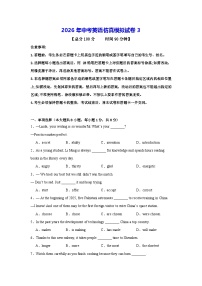
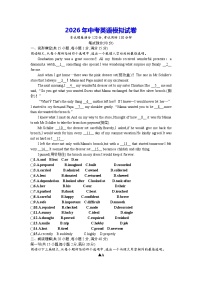
这是一份2026中考英语模拟考试试卷3 (含答案 听力音频 听力原文),共6页。试卷主要包含了 本学科试卷中听力材料朗读两遍等内容,欢迎下载使用。
注意事项:
1. 答题前,请考生先将自己的姓名、准考证号填写清楚,并认真核对条形码上的姓名、准考证号、考室和座位号;
2. 必须在答题卡上答题,在草稿纸、试题卷上答题无效;
3. 答题时,请考生注意各大题题号后面的答题提示;
4. 请勿折叠答题卡,保持字体工整、笔迹清晰、卡面清洁;
5. 答题卡上不得使用涂改液、涂改胶和贴纸;
6. 本学科试卷中听力材料朗读两遍。
试卷时量100分钟,满分100分。
第一部分 听力(共两节,满分20分)
第一节(共5小题;每小题1分,满分5分)
听下面5段对话。每段对话后有一个小题,从题中所给的A、B、C三个选项中选出最佳选项。听完每段对话后,你都有10秒钟的时间来回答有关小题和阅读下一小题。每段对话读两遍。
1. What is the girl’s favrite fd?
A. Salad.B. Beef ndles.C. Hamburgers.
2. What subject is Sam crazy abut?
A. Art.B. Science.C. Math.
3. What is the matter with David?
A. He has a fever.B. He has a tthache.C. He has a headache.
4. Where is Mr. Zhang nw?
A. In the classrm.B. In the meeting rm.C. In the cmputer rm.
5. Hw is the weather tday?
A. Sunny.B. Rainy.C. Snwy.
第二节(共15小题;每小题1分,满分15分)
听下面6段对话或独白。每段对话或独白后有几个小题,从题中所给的A、B、C三个选项中选出最佳选项。听每段对话或独白前,你将有时间阅读各个小题,每小题5秒钟;听完后,各小题将给出5秒钟的作答时间。每段对话或独白读两遍。
听第六段材料,回答第6、7题。
6. What did Sphia d n Saturday evening?
A. She went t a cncert.B. She visited a friend.C. She watched a mvie.
7. Wh takes a great interest in music?
A. Sphia.B. Sphia’s husband.C. Rbert.
听第七段材料,回答第8、9题。
8. Hw des Steve feel abut his training?
A. Bring.B. S-s.C. Great.
9. When des Steve start training every day?
A. At 7:00 a.m.B. At 8:00 a.m.C. At 9:00 a.m.
听第八段材料,回答第10、11题。
10. Why des the man make the call?
A. T bk a table.B. T lk fr a jb.C. T ask fr leave.
11. What is the man’s name?
A. Brwn.B. Andersn.C. Hward.
听第九段材料,回答第12至14题。
12. What is the new prduct?
A. A pcket translatr.B. A music player.C. A medical dictinary.
13. Wh are the main custmers f the prduct?
A. Cllege students.B. Language teachers.C. Business peple.
14. Hw much is the new prduct?
A. $50.B. $60.C. $70.
听第十段材料,回答第15至17题。
15. Hw des Jane like the Australian man’s wrds?
A. Serius.B. Funny.C. Plite.
16. What was the Australian man’s jb when he was in China?
A. A car salesman.B. A tur guide.C. An English teacher.
17. What des the Australian man miss the mst?
A. His friends.B. Chinese fd.C. The supermarkets.
听第十一段材料,回答第18至20题。
18. Where is Rmbt 2000 made?
A. In China.B. In India.C. In Russia.
19. What can Rmbt 2000 d accrding t the speaker?
A. Ck meals.B. Make the bed.C. Water flwers.
20. What des the speaker think f Rmbt 2000?
A. Time-wasting.B. Mney-saving.C. User-friendly.
第二部分 阅读(共两节,满分30分)
第一节(共10小题;每小题2分,满分20分)
阅读下列材料,从每题所给的A、B、C三个选项中选出最佳选项。
A
Mst f us knw abut ur carbn ftprint, but have yu ever heard f yur "digital(数字的) ftprint"? Every time yu g nline, yu leave behind a trail f data. This includes the websites yu visit, the phts yu share, the cmments yu make, and even the things yu buy. This digital ftprint is permanent and can be seen by thers, like yur teachers, future emplyers, and even strangers.
Yur digital ftprint can tell a lt abut yu. Clleges and cmpanies ften check applicants' nline activities. A psitive digital ftprint, full f gd cmments and achievements, can be helpful. Hwever, a negative ne with inapprpriate phts r mean messages can cause serius prblems. It's like an invisible reprt card that fllws yu everywhere.
S, hw can yu manage yur digital ftprint? First, think befre yu pst. Ask yurself, "Wuld I want my parents r a future bss t see this?" Secnd, check yur privacy settings regularly. Make sure yu knw wh can see yur infrmatin. Finally, use the internet wisely. Yur digital ftprint is part f yur identity. Make it ne that yu are prud f.
21. What is a "digital ftprint" accrding t the passage?
A. The mark yur shes leave n the grund.
B. The data trail yu create nline.
C. The number f steps yu take in a day.
D. The influence yu have n yur friends.
22. Which f the fllwing is a gd way t manage yur digital ftprint?
A. Share everything yu d nline.
B. Never use the internet again.
C. Think carefully befre psting anything.
D. Only wrry abut it when yu are lder.
B
One mrning, I stpped at my favrite restaurant t get smething t eat and gt cmfrtable at a small table. Shrtly after, I nticed fur yung peple sitting at a table near me. After simply greeting each ther and rdering, they all lked at their phnes and cntinued t d s until their rders arrived. After phtgraphing their fd, they ate, cntinuing t lk at their phnes. I was wndering why they came here t eat tgether. They were phubbing, r phne snubbing (冷落), a very cmmn prblem these days.
Yu may nt knw the wrd “phubbing”, but this kind f act is nt strange t yu. In fact, 32% f peple reprt that they are phubbed tw r three times a day.
D yu have a cnversatin n yur phne while talking t anther persn face t face? D yu scrll (上下滑动) thrugh yur phne while eating with smene fr fear f missing ut? If yur answer is yes t either f them, yu might be a “phubber”.
The writer f The Psychlgy f Phubbing did a survey and fund that the influence f phubbing n relatinships can be very harmful r destructive. Fr example, children felt that parents wh phubbed them didn’t care abut them. This led t a feeling f being left ut. Als, partners wh were phubbed might be less satisfied with the relatinship because f jealusy (嫉妒) and wrries.
Phubbing is a learned act, s unlearning it is pssible. Start by accepting the prblem. Set a time limit (限制) fr nt using yur phne. Create areas where phnes are ff-limits.
Dn’t let the mdern technlgy which is designed (设计) t bring peple tgether separate yu frm thers.
23. What did the fur yung peple keep ding befre their rders arrived?
A. Greeting each ther.B. Lking at their phnes.C. Phtgraphing their fd.
24. Hw des the writer intrduce the wrd “phubber” in Paragraph 3?
A. By raising questins.B. By listing numbers.C. By giving reasns.
25. What des the underlined wrd “destructive” in Paragraph 4 mean?
A. 微乎其微的B. 积极正向的C. 有破坏性的
26. What is the main purpse f the text?
A. T warn peple against phubbing.
B. T shw hw phnes bring peple clser.
C. T present the advantages f mdern technlgy.
C
I used t teach English as a vlunteer in Africa. Sme f my friends asked me, “Dn’t yu miss yur hme, Emily?” I tld them I was the nly child in my family and I truly had an easy life at hme. Hwever, I gt bred f having a “gd” time at hme and needed a change.
The kids frm Africa were eager (渴望的) t learn and easy t teach. I was surprised at hw smart they were. Talking with them made me think a lt. When yu cme frm a pr area, yu must grw up fast and deal with all kinds f difficult situatins.
Vlunteering has always been easy fr me because I dn’t like t d the same things every day. My jb als gives me the freedm t chse when and where I wrk. Althugh I dn’t get paid fr vlunteering, I’m ld enugh t knw that mney is nt the nly way t get rewarded (回报). The experience itself is priceless. I make lts f cnnectins with gd peple. Als, when I vlunteer, I ften wrk with peple wh are wrse ff than I am. That has taught me t practice thankfulness fr what I have. Believe me, this life lessn is wrth a millin dllars.
I am nt a perfect persn. In a sense, I think I’m selfish (自私的). But yu dn’t have t be a perfect, selfless persn t vlunteer. In fact, I have benefited (受益) a lt frm vlunteering. Vlunteering helps thers, and it can als help yurself, t. The biggest benefit f vlunteering is that it helps yu develp yur character (品质), and that’s the passprt t a rich and meaningful life.
27. Why did Emily vlunteer in Africa?
A. She lived a really difficult life at hme.
B. She hped t learn a new language there.
C. She wanted t experience smething new.
28. Hw were the African kids in Emily’s eyes in Paragraph 2?
A. Quite teachable.B. Hard t deal with.C. Bred f learning.
29. What des Emily get frm her vlunteering experience?
A. The freedm t chse a well-paid jb.
B. The chance t cnnect with gd peple a lt.
C. The ability t express thanks fr what she has lst.
30. Which f the fllwing wuld Emily mst prbably agree with?
A. Use it r lse it.B. Old habits die hard.C. Giving is receiving.
第二节(共5小题;每小题2分,满分10分)
阅读下面短文,从短文后的选项中选出可以填入空白处的最佳选项。每个选项仅使用一次。
Can yu play basketball? Sme peple may think it is t cmpetitive. Hwever, it ffers many benefits fr bth mind and bdy. Whether yu are playing with friends r jining a team, basketball helps yu stay psitive (积极的), build skills, and develp gd habits. 31
It’s a gd way t stay fit.
32 Running, jumping, and dribbling (运球) during a game help yu t keep healthy. As a player, yu must als mve quickly while cntrlling the ball and aviding cmpetitrs.
It’s a team sprt.
Teamwrk is the key. 33 Yu have t trust and supprt each ther during matches. Pass the ball when smene is in a better psitin (位置). Each member has t d their part t help the team win. Remember, n ne can win alne.
34
The speedy nature f the game requires fcus (专注) and quick decisin-making. New difficulties always appear during a game. Yu have t think n yur feet and keep cl in all situatins. S yu need t think f ways t face and vercme difficulties. And that helps yu slve prblems in yur daily life.
It imprves cmmunicatin.
Stay cnnected with yur teammates during matches. If yu have a winning idea, tell yur teammates! 35 Cmmunicatin is an imprtant part f basketball. The winning team is the ne that wrks tgether and cmmunicates well.
Basketball isn’t all abut athletic (运动的) ability. The game is als abut using yur brains and gd teamwrk. S call yur friends and give it a try!
第三部分 语言运用(共两节,满分25分)
第一节(共10小题;每小题1.5分,满分15分)
阅读下面短文,从每题所给的A、B、C三个选项中选出可以填入空白处的最佳选项。
When Liivand was little, she was ften sick. T get strnger, she 36 swimming. Sn after, she was taking part in pen-water swimming cmpetitins, smetimes even in icy water.
Several years ag, Liivand mved t Flrida, but she cntinued t 37 in the sea. One day during her training, she almst swallwed (吞) sme plastic (塑料) waste in the sea.
That experience made Liivand think f all the sea animals. These animals face 38 prblems every day like her. S she decided t d smething t raise peple’s awareness (意识) f 39 pllutin. Thinking abut sea animals gave Liivand the idea f swimming like a sea animal. Instead f using her arms, she 40 swimming with a rubbery fin (橡胶脚蹼) n her feet and swam frward by kicking her legs tgether. She believed that swimming with a rubbery fin wuld send “a bigger message”.
Liivand first set the wrld recrd fr swimming with a rubbery fin in 2019. She swam 10 kilmeters ff the cast f Califrnia. In 2021, she brke the 41 by swimming 30 kilmeters, this time in Miami, Flrida. But Liivand believed she culd g 42 . Every day, she gt up at 4:00 a.m., put n her fin and went swimming. T imprve her strength (力量), she smetimes even pulled ther peple in the water.
On May 7, 2022, Liivand managed t break her recrd again. 43 , she swam 42.2 kilmeters. It tk her nearly 12 hurs. Alng the way, the wman cllected all the 44 she fund and put it in the small bat that was fllwing her. Finally, the small bat held three full bags f rubbish. “Breaking a recrd means a lt t me, but being 45 t help the cmmunity and the wrld means much mre,” Liivand said.
36. A. tk upB. put ffC. gave up
37. A. fishB. swimC. bat
38. A. similarB. differentC. ppsite
39. A. airB. sundC. plastic
40. A. stppedB. startedC. regretted
41. A. legB. ruleC. recrd
42. A. fartherB. slwerC. higher
43. A. UnluckilyB. UnbelievablyC. Uncertainly
44. A. iceB. ilC. rubbish
45. A. warm-heartedB. cld-bldedC. weak-kneed
第二节(共10小题;每小题1分,满分10分)
阅读下面短文,在空白处填入1个适当的单词或括号内单词的正确形式。
I have always lved reading bks that were written hundreds r even thusands f years ag. These are the literature classics (文学经典), and they 46 (be) f lasting value. Fr example, The Iliad, written almst three thusand years ag, tells us abut the gd and bad qualities (品质) f human nature; that is t say, we can be heric and silly at 47 same time.
China has 48 (it) wn lng histry f classical literature that dates back t the “Fur Bks and Five Classics”. These bks 49 (write) befre the Qin Dynasty. N ne was cnsidered educated unless they had read these classics. Even tday, students are encuraged 50 (read) The Analects f Cnfucius (《论语》).
There are als 51 (new) classics than thse abve, such as Jurney t the West and A Dream f Red Mansins. Still, many peple dn’t want t read them 52 they are lng and have cmplex plts (复杂的情节). But they are great 53 (stry) which als shw the gdness and weakness f human nature.
Are yu interested 54 learning mre abut the classics? Just reading sme f them will give yu a better understanding f the basis (基础) f culture then. They will als help yu better understand yurself and thers. 55 (slw) but surely, yu will fall in lve with them.
第四部分 读写综合(共两节,满分25分)
第一节(共5小题;每小题2分,满分10分)
阅读下面短文,根据短文内容回答问题。
One recent weekend, I decided t learn hw t make jiazi with my grandmther. I thught it wuld be fun and easy at the very beginning, but sn it came t me that it wasn’t as simple as it lked.
At first, I didn’t pay attentin t the sharp (锋利的) knife while cutting vegetables. My finger gt cut because f my carelessness. Luckily, it wasn’t serius. Grandma was nervus, and quickly helped me clean the cut. “My pr little girl! Be careful next time!” said Grandma sftly. Thrugh the painful lessn, I learned the hard way that safety shuld always cme first.
After that accident (意外), I cntinued wrking with Grandma. We made the dugh (面团), mixed the filling, and started shaping the dumplings. Hwever, I kept making mistakes. Sme f my dumplings were t thick, thers were nt prperly sealed (封闭), and sme even had t much filling, making them difficult t clse. It was s discuraging, but Grandma kept encuraging me.
Until nn, we had a plate full f dumplings—sme are perfect, and sme are a bit messy. Dad ate my ugliest dumpling first. “Tastes better than it lks!” he laughed. Mm encuraged me, “They’re the mst delicius dumplings I have ever had. I am s prud f yu!”
Nw I understand that making jiazi isn’t just abut the final prduct; it is abut learning patience, having fun with my family, and imprving thrugh mistakes. Mistakes aren’t signs f weakness. Instead, they shuld be viewed (看待) as stepping stnes t achievements.
56. What did the writer think f making jiazi at the very beginning?
57. What happened t the writer’s finger because f her carelessness?
58. Did the writer give up making jiazi after the accident?
59. Hw d Mm’s wrds sund?
60. What des the writer view mistakes as?
第二节(共1小题;满分15分)
根据要求完成短文写作。
61. 家庭是一个充满“爱”的地方。为了感受、记录、分享家庭之“爱”,你校英语俱乐部将开展以“The lve f my family”为主题的个人实践活动,请你根据以下提示和要求用英语完成一份个人活动计划。
提示:
(1) What d yu recrd? (chse ne pint: scenes / family members / daily life)
(2) Hw d yu recrd and share it? And why?
(3) What d yu expect t get frm this activity? (list at least tw pints)
要求:
(1) 表达清楚,语法正确,上下文连贯;
(2) 必须包括提示中的所有信息,并按要求适当发挥;
(3) 词数:100词左右(开头已给出,不计入总词数);
(4) 不得使用真实姓名、校名和地名等。
T present the lve f my family, I plan t recrd
参考答案:
听力原文:
第一节
听下面5段对话。每段对话后有一个小题,从题中所给的A、B、C三个选项中选出最佳选项。听完每段对话后,你都有10秒钟的时间来回答有关小题和阅读下一小题。每段对话读两遍。
1.
Mm: We're having salad fr lunch. It's healthy.
Girl: Oh, Mm... Can we get smething else? I really lve hamburgers! They are my favrite.
Mm: Okay, maybe just fr tday.
2.
Teacher: Sam, yu did a great jb n yur histry prject.
Sam: Thanks! But I was up all night wrking n my Science fair prject. I just find it s fascinating!
Teacher: I can see yu're really crazy abut it.
3.
Lucy: David, yu lk pale. Are yu kay?
David: Nt really. My tth is killing me. I culdn't sleep at all last night because f the pain.
Lucy: Oh n, yu shuld see a dentist.
4.
Wman: Excuse me, have yu seen Mr. Zhang? I thught he was in the classrm.
Man: He was there, but he just went t the meeting rm fr a staff discussin.
Wman: Thank yu, I'll check there.
5.
M: Dn't frget yur jacket.
W: Why? It lks bright utside.
M: Lk at the sky, it's cludy and it's starting t rain. It's ging t be a rainy day.
第二节
听第六段材料,回答第6、7题。
M: Hi Sphia, did yu enjy the mvie n Saturday evening?
W: Oh, Rbert, I didn't g. My husband lves music s much that he dragged me t a cncert instead.
听第七段材料,回答第8、9题。
W: Hw is yur new training ging, Steve?
M: It's great! I feel fantastic. It starts every day at 7 a.m., s I have t get up early.
听第八段材料,回答第10、11题。
M: Hell, I'd like t bk a table fr fur fr tnight, please.
W: Certainly, sir. May I have yur name?
M: Yes, it's Andersn.
听第九段材料,回答第12至14题。
W: Our new prduct, the pcket translatr, is selling well.
M: That's gd t hear. Our main custmers are business peple wh travel a lt. At $60, it's a great deal.
听第十段材料,回答第15至17题。
独白(W):
I met an Australian man yesterday, and I fund it really funny when he tld me abut his life. He used t wrk in China as a tur guide. He said that what he misses the mst nw is nt the scenic spts, but the delicius Chinese fd!
听第十一段材料,回答第18至20题。
独白(M):
Let me intrduce yu t a fantastic new prduct called the Rmbt 2000. It is made in India and has a very useful functin: it can autmatically make yur bed. I think this feature makes it incredibly user-friendly and cnvenient fr everyday life.
答案:
听力第一节答案:1. C 2.: B 3.: B 4. B 5. B
听力第二节答案:
6. A 7. B 8. C 9. A 10. A
11. B 12. A 13. C 14. B 15. B
16. B 17. B 18. B 19. B 20. C
21. B。细节理解题。根据第一段第二句和第三句:"Every time yu g nline, yu leave behind a trail f data. This... is yur digital ftprint." 可知,数字足迹是在网上留下的数据痕迹。
22. C。细节理解题。根据第三段提出的建议,第一条就是"think befre yu pst",即在发帖前要深思熟虑。
23. B. 四个年轻人在餐前做什么,文章明确提到他们“all lked at their phnes and cntinued t d s until their rders arrived”,
24. A. By raising questins. 此问题是考察写作手法。
25. C. 有破坏性的。词题考查词汇理解,如果不认识此单词“destructive”,结合后文“孩子感到被忽视”“伴侣关系满意度下降”等例子,可推断“destructive”为负面含义,所以选C。当然,如果平常词汇量充足,这个就是送分题了。
26. A. T warn peple against phubbing. 此题考查文章主题,全文从现象到危害再到解决方案,始终围绕抵制低头行为展开,所以选A最准确。
27. C. She wanted t experience smething new. 问为什么去非洲,原文提到她厌倦了家里的舒适生活,需要改变,所以选C。
28. A. Quite teachable. 问对孩子们的印象,第二段说他们渴望学习、容易教,所以选A。
29. B. The chance t cnnect with gd peple a lt. 关于收获,第三段提到她结交了很多好人,所以选B。
30. C. Giving is receiving.观点题,最后一段她强调帮助别人也是帮助自己,所以选C。
E. Here are sme key advantages f playing this exciting game.
(此处引出下文列举的篮球优点,与引言部分自然衔接。)
C. Basketball is a great way t imprve physical health.
(此处进一步强调篮球对身体健康的好处,与“stay fit”内容一致。)
B. Basketball is nt a ne-persn game.
(此处强调团队合作的重要性,与“Teamwrk is the key”上下文吻合。)
A. It teaches prblem-slving.
(此处作为第三个要点的标题,概括了篮球培养解决问题能力的内容。)
D. If yu need smene t cver yu, tell them that, t.
(此处提供沟通的具体例子,与“imprves cmmunicatin”部分相呼应。)
36. A. tk up
(她为了强身健体而“开始从事”游泳运动,take up 意为“开始从事”,符合语境。)
37. B. swim
(根据上下文,她搬到佛罗里达后继续在海里“游泳”,与上文“pen-water swimming”呼应。)
38. A. similar
(这些海洋动物每天面临与她“相似的”问题,即误食塑料垃圾。)
39. C. plastic
(她希望提高人们对“塑料”污染的意识,与上文提到的塑料垃圾相呼应。)
40. B. started
(她“开始”用脚蹼游泳,与后文“send a bigger message”相呼应。)
41. C. recrd
(她打破了之前的“纪录”,与后文“break her recrd again”相呼应。)
42. A. farther
(她相信自己能游得“更远”,与后文再次打破纪录相呼应。)
43. B. Unbelievably
(“难以置信地”游了42.2公里,表示这一成就令人惊叹。)
44. C. rubbish
(她收集沿途的“垃圾”,与后文“three full bags f rubbish”相呼应。)
45. A. warm-hearted
(“热心的”帮助社区和世界,体现她的善良和公益心。)
46. are
(主语为“they”,指代文学经典,为复数,且表示客观事实,用一般现在时。)
47. the
(固定搭配“at the same time”。)
48. its
(指代“China’s”,用物主代词“its”。)
49. were written
(这些书籍是“被写作”于秦朝之前,需用被动语态,且为过去时。)
50. t read
(固定结构“encurage sb. t d sth.”的被动形式“be encuraged t d”。)
51. newer
(后有“than”,需用比较级,指比上述经典更新的作品。)
52. because
(前后为因果关系,解释人们不想读的原因。)
53. stries
(前有“are”,且“stry”为可数名词,需用复数形式。)
54. in
(固定搭配“be interested in”。)
55. Slwly
(与“surely”并列,副词修饰整个句子,表示“慢慢地但确定地”。
56. She thught it wuld be fun and easy.
(根据短文第一段第二句,“I thught it wuld be fun and easy at the very beginning”。)
57. Her finger gt cut, but it wasn’t serius.
(根据第二段内容,她因不小心切到了手指,不过伤势不重。)
58. N, she didn’t.
(第三段开头提到,“After that accident, I cntinued wrking with Grandma”,说明她没有放弃。)
59. They sund encuraging / prud / kind.
(妈妈称赞说“They’re the mst delicius dumplings I have ever had. I am s prud f yu!”,语气充满鼓励和自豪。)
60. She views mistakes as stepping stnes t achievements.
(根据最后一段最后一句,“Mistakes aren’t signs f weakness. Instead, they shuld be viewed as stepping stnes t achievements.”)
61.范文:
The lve f my family
T present the lve f my family, I plan t recrd ur daily life. I chse this pint because lve is ften shwn in small, everyday mments.
I will use a digital camera t take phts and shrt vides f scenes like having meals tgether, helping each ther with husewrk, r sharing stries at night. Then I’ll create a digital pht album and share it with my family thrugh a private family grup. I chse this way because phts and vides can capture real emtins and help us remember these warm memries fr a lng time.
Frm this activity, I expect t understand my family members better and learn t appreciate their care fr me. Als, I hpe t strengthen the bnd amng us and make ur family even clser.A. It teaches prblem-slving.
B. Basketball is nt a ne-persn game.
C. Basketball is a great way t imprve physical health.
D. If yu need smene t cver yu, tell them that, t.
B. Here are sme key advantages f playing this exciting game.
这是一份2026中考英语模拟考试试卷3 (含答案 听力音频 听力原文),共6页。试卷主要包含了 本学科试卷中听力材料朗读两遍等内容,欢迎下载使用。
这是一份2026年中考英语预测模拟试卷3(含答案),共7页。
这是一份2026年中考第一次模拟考试英语试卷3(无听力,含答案解析),共19页。试卷主要包含了选择填空,完形填空,短文填空,补全短文,阅读表达,书面表达等内容,欢迎下载使用。
注册成功
资料篮

在线客服
添加在线客服
获取1对1服务
官方微信
关注“教习网”公众号
打开微信就能找资料
赛课定制
添加在线客服
获取1对1定制服务
职称咨询
添加在线客服
获取1V1专业指导服务

免费福利

.png)