免费领取教师福利
若您为此资料的原创作者,认为该资料内容侵犯了您的知识产权,请扫码添加我们的相关工作人员,我们尽可能的保护您的合法权益。

这是一份高中英语基础语法汇编 chapter 9 介词 讲义-2026届高三英语上学期一轮复习专项(全国通用),共21页。学案主要包含了介词的定义,常见介词的用法等内容,欢迎下载使用。
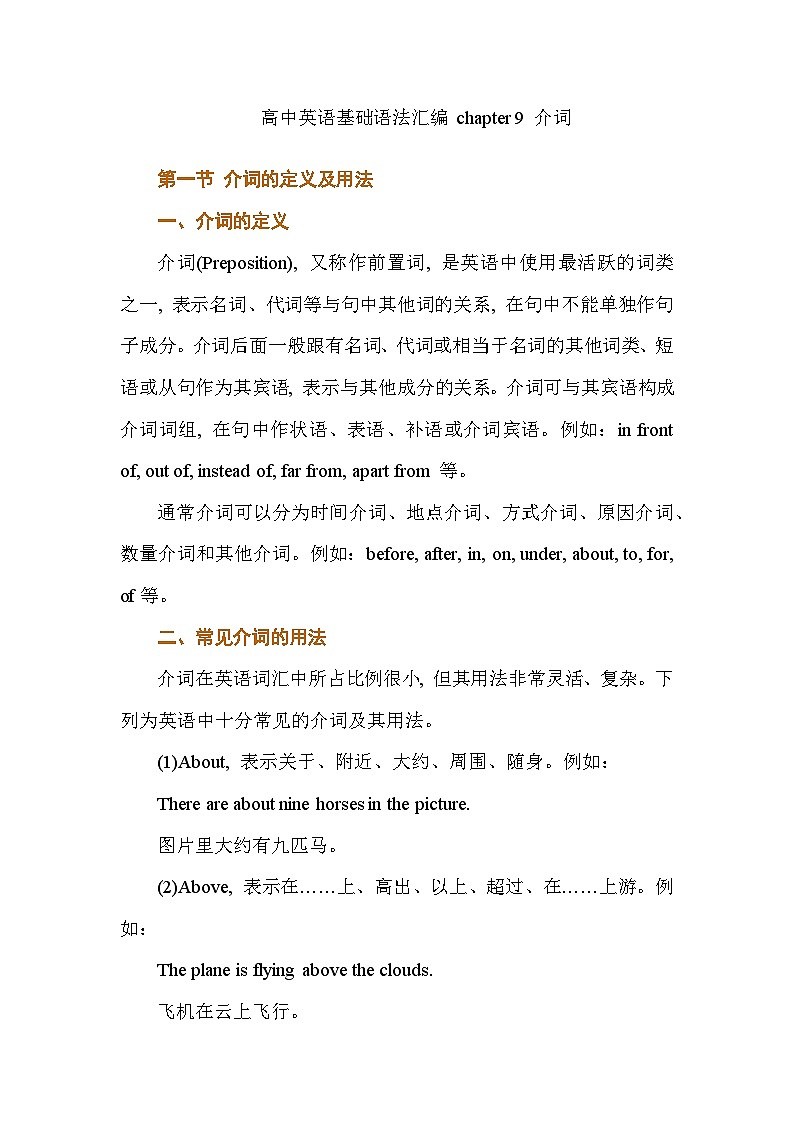
一、介词的定义
介词(Prepsitin), 又称作前置词, 是英语中使用最活跃的词类之一, 表示名词、代词等与句中其他词的关系, 在句中不能单独作句子成分。介词后面一般跟有名词、代词或相当于名词的其他词类、短语或从句作为其宾语, 表示与其他成分的关系。介词可与其宾语构成介词词组, 在句中作状语、表语、补语或介词宾语。例如:in frnt f, ut f, instead f, far frm, apart frm 等。
通常介词可以分为时间介词、地点介词、方式介词、原因介词、数量介词和其他介词。例如:befre, after, in, n, under, abut, t, fr, f等。
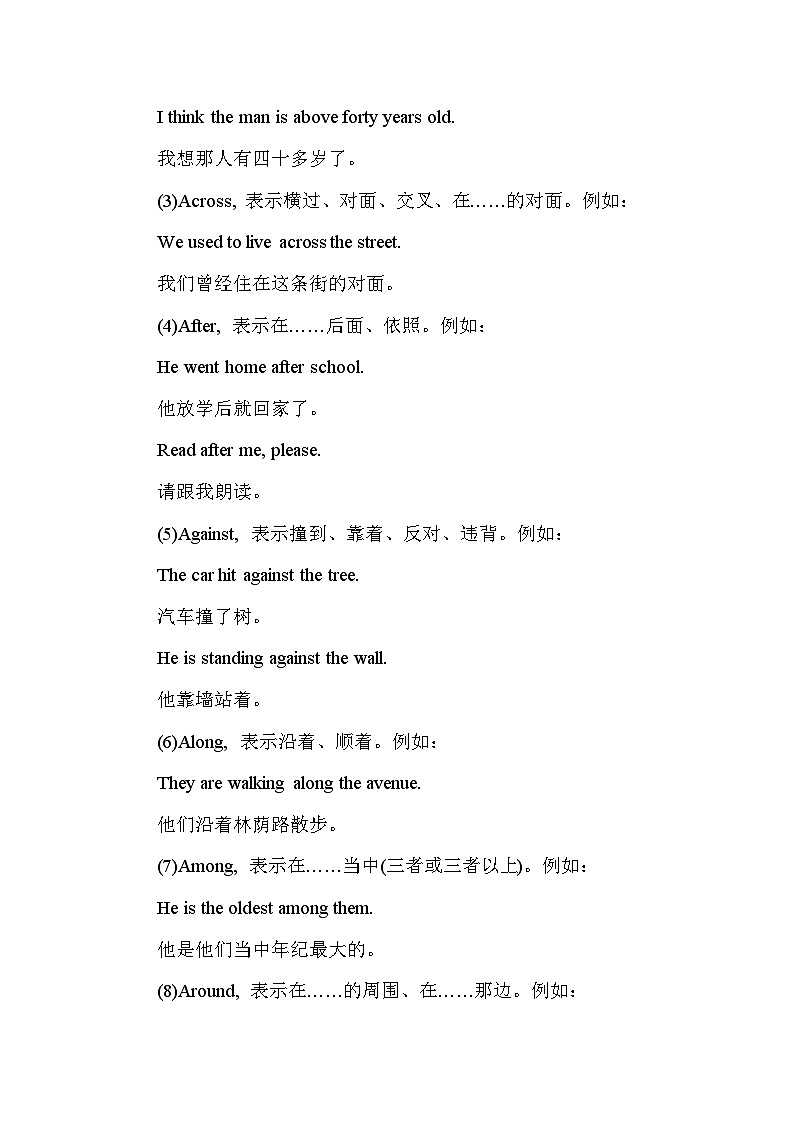
二、常见介词的用法
介词在英语词汇中所占比例很小, 但其用法非常灵活、复杂。下列为英语中十分常见的介词及其用法。
(1)Abut, 表示关于、附近、大约、周围、随身。例如:
There are abut nine hrses in the picture.
图片里大约有九匹马。
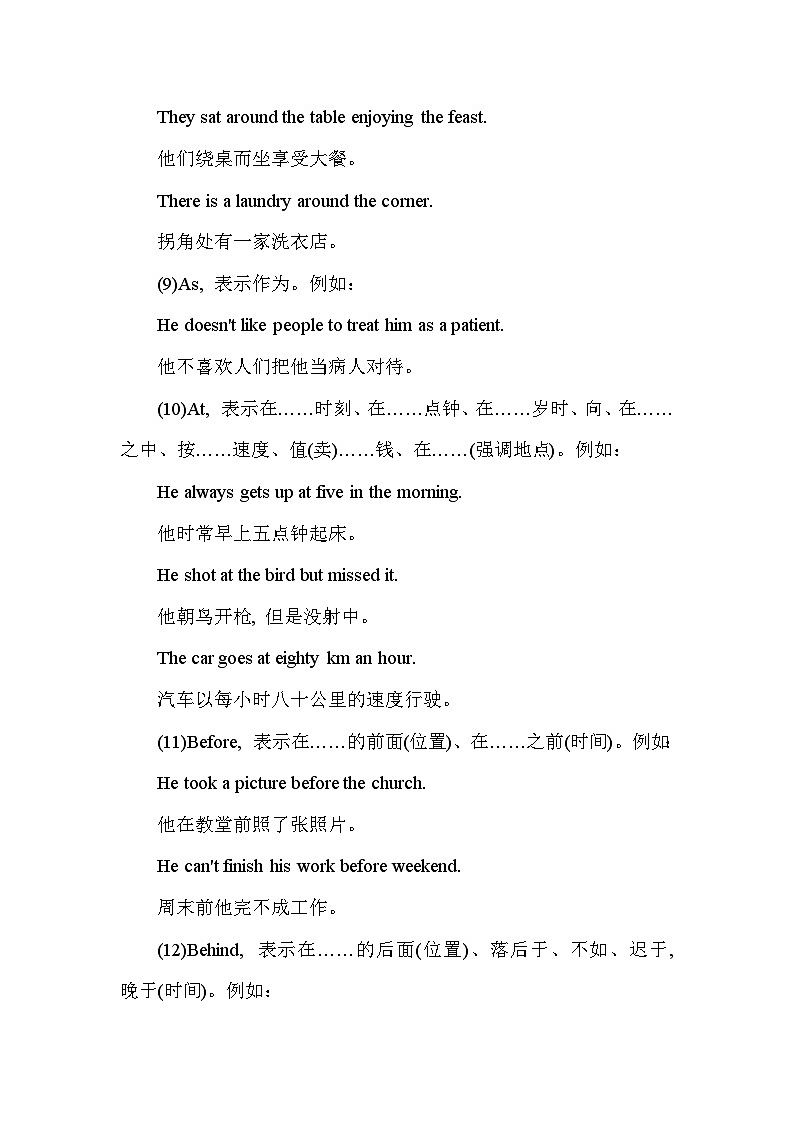
(2)Abve, 表示在……上、高出、以上、超过、在……上游。例如:
The plane is flying abve the cluds.
飞机在云上飞行。
I think the man is abve frty years ld.
我想那人有四十多岁了。
(3)Acrss, 表示横过、对面、交叉、在……的对面。例如:
We used t live acrss the street.
我们曾经住在这条街的对面。
(4)After, 表示在……后面、依照。例如:
He went hme after schl.
他放学后就回家了。
Read after me, please.
请跟我朗读。
(5)Against, 表示撞到、靠着、反对、违背。例如:
The car hit against the tree.
汽车撞了树。
He is standing against the wall.
他靠墙站着。
(6)Alng, 表示沿着、顺着。例如:
They are walking alng the avenue.
他们沿着林荫路散步。
(7)Amng, 表示在……当中(三者或三者以上)。例如:
He is the ldest amng them.
他是他们当中年纪最大的。
(8)Arund, 表示在……的周围、在……那边。例如:
They sat arund the table enjying the feast.
他们绕桌而坐享受大餐。
There is a laundry arund the crner.
拐角处有一家洗衣店。
(9)As, 表示作为。例如:
He desn't like peple t treat him as a patient.
他不喜欢人们把他当病人对待。
(10)At, 表示在……时刻、在……点钟、在……岁时、向、在……之中、按……速度、值(卖)……钱、在……(强调地点)。例如:
He always gets up at five in the mrning.
他时常早上五点钟起床。
He sht at the bird but missed it.
他朝鸟开枪, 但是没射中。
The car ges at eighty km an hur.
汽车以每小时八十公里的速度行驶。
(11)Befre, 表示在……的前面(位置)、在……之前(时间)。例如:
He tk a picture befre the church.
他在教堂前照了张照片。
He can't finish his wrk befre weekend.
周末前他完不成工作。
(12)Behind, 表示在……的后面(位置)、落后于、不如、迟于, 晚于(时间)。例如:
What is behind the dr?
门后有什么?
All f us are behind him in science subjects.
我们理科都不如他。
(13)Belw, 表示在……之下、低于。例如:
There are several lamps belw the ceiling.
天花板下面有几盏灯。
(14)Beside, 表示在……的旁边、在……之外、与……相比。例如:
He fund the ftprints beside the river.
他在河边发现了脚印。
Beside yurs, my cellphne is t ld.
与你的手机相比, 我的手机旧多了。
(15)Besides, 表示除……之外, 还有……。例如:
We are all here besides Lily.
除莉莉外, 我们也都来了。
(16)Between, 表示在……两者之间。例如:
The relatin between the tw cuntries has imprved as expected.
两国的关系正如预料的那样得到了改善。
(17)Beynd, 表示在……那边。例如:
The restaurant yu are lking fr is beynd the street, yu can't miss it.
你要找的餐馆在街的那边, 你不会找不到的。
(18)But, 表示除去。例如:
He left nthing but a letter.
他除了一封信, 什么也没留下。
(19)By, 表示被……、在……的近旁、在……之前、不迟于、以……为手段。例如:
The classrm was cleaned by the student n duty.
教室由值日生打扫干净了。
Linda came t China by air.
琳达是乘飞机来中国的。
(20)Dwn, 表示沿着……往下。例如:
She walked dwn the street.
她沿着街道走。
(21)Except, 表示除……之外。例如:
He remembered nthing except the accident.
他除了那场事故以外什么都记不起来了。
(22)Fr, 表示为……。例如:
He wrks fr his cuntry.
他为祖国工作。
(23)Frm, 表示从……、来自……、因为……。例如:
Where are yu frm?
你是哪里人?
He suffered frm a serius illness.
他因生大病而受苦。
(24)In, 表示在……、在……之内、从事于……、按照……、穿着……。例如:
I was brn in 1992.
我生于1992年。
I try t finish the prgram in tw weeks.
我尽量用两周时间完成这个项目。
He spent little time in reading.
他读书时间很少。
The man in black jacket is my uncle.
穿黑夹克的那个人是我的叔叔。
(25)Like, 表示像……、如同……。例如:
The twins are like each ther.
这对双胞胎长得很像。
(26)Near, 表示靠近……。例如:
There are sme trees near the huse.
房子附近有一些树。
(27)Of, 表示……的、属于……。例如:
This is a map f the wrld.
这是一张世界地图。
(28)Off, 表示离开……、在……之外。例如:
Remember t get ff the bus at the fifth stp.
记得在第五个站下车。
I lived in a village a little way ff the twn.
我以前住在离镇不远的一个村庄里。
(29)On, 表示在……之上、在……之时。例如:
My pen is n the table.
我的笔在桌子上。
(30)Out f, 表示从……出来、在……之外。例如:
The dg ran ut f the kitchen.
狗从厨房里跑出来。
(31)Outside, 表示在……外边。例如:
Please wait utside the gate.
请在门外等着。
(32)Over, 表示在……之上、遍于……之上、越过……。例如:
There is a light ver the desk.
桌子上方有盏灯。
He is ver fifty years ld.
他有五十多岁。
(33)Past, 表示越过……、过……、超越……。例如:
The students walked past the ffice building.
学生们走过了办公大楼。
It is ten past fur.
现在是四点十分。
(34)Rund, 表示围着……、绕过……、在……周围。例如:
The earth ges rund the sun.
地球绕着太阳转。
(35)Since, 表示自……以后、自……以来。例如:
I haven't written hme since Christmas.
自圣诞节以来, 我未曾写信回家。
(36)Thrugh, 表示经过……、穿过……(立体层面)。例如:
They went thrugh the frest.
他们穿过了森林。
(37)Thrughut, 表示遍及……、在各处。例如:
The news spread thrughut the cuntry.
这个消息在全国四处传播。
(38)Till, 表示直到……、在……以前。例如:
He wn't cme back till next week.
他直到下周才回来。
We'll be hme till six.
六点以前我们都会在家。
(39)T, 表示到……、向……、趋于。例如:
Hw lng is it frm birth t death?
生死之间的距离有多远?
(40)Under, 表示在……之下、低于。例如:
There are sme bxes under the bed.
床底下有一些箱子。
These students are under twenty years ld.
这些学生们不到二十岁。
(41)Until, 表示直到……、在……以前。例如:
It was nt until last week that I gt a reply.
直到上周, 我才得到回复。
(42)Up, 表示在……上面、在……上。例如:
He went up the stairs.
他上了楼。
(43)Upn, 表示在……之上、迫近……。例如:
It's nt plite t lk dwn upn thers.
蔑视别人是不礼貌的。
(44)Within, 表示在……之内。例如:
Yu must finish the wrk within tw weeks.
你必须两周内完成这项工作。
(45)Withut, 表示没有、不、在…之外。例如:
We can't manage it withut yur help.
没有你的帮助, 我们就做不成这事。
We culdn't live withut air and water.
没有空气和水, 我们就不可能生存。
第二节 介词的区分与辨别
(一)表示地点的介词
1.at, in, n, t
At, 表示:①在小地方;②在……附近、旁边。例如:
We had dinner at a restaurant in Attle Brugh.
我们在阿特尔·伯勒的一家餐厅里吃饭。
In, 表示:①在大地方;②在……范围之内。例如:
in the nrth f China 在中国的北部
On, 表示毗邻、接壤、在……上面。例如:
He was able t spend nly a few dags at a time n the island.
他每次去岛上都只能待几天。
T, 表示在……范围外、不接壤、到……。例如:
t the nrth f China 在中国以北
2.abve, ver, n
Abve, 表示一个物体高过另一个物体, 不强调是否垂直, 与belw相对。例如:
The butterfly is flying abve my head.
这只蝴蝶在我头顶上空飞舞着。
Over, 一个物体在另一个物体的垂直上方, 与under相对。另外, ver与物体有一定的空间, 不直接接触。例如:
The bridge is ver the river.
河上有一座桥。
On, 表示一个物体在另一个物体表面上, 并且两个物体互相接触, 与beneath相对。例如:
He puts his ntebk n the desk.
他把他的笔记本放在书桌上。
3.belw, under
Under, 表示在……正下方。例如:
There is a dg under the table.
桌子底下有一只狗。
Belw, 表示在……下, 不一定在正下方。例如:
Please sign yur name belw the line.
请在这条线下签上你的名字。
4.in frnt f, in the frnt f
In frnt f, 意思是“在……前面”, 指甲物在乙物之前, 两者互不包括。其反义词为behind(在……的后面)。例如:
There are sme trees in frnt f the huse.
房子前面有些树。
In the frnt f, 意思是“在……的前部”, 指甲物在乙物的内部的前部。其反义词为at/in the back f(在……范围内的后部)。例如:
There is a clck in the frnt f ur classrm.
我们的教室前边有一个钟(钟在教室里)。
Our headmaster stands in the frnt f the classrm.
我们的校长站在教室前(校长在教室里)。
5.beside, behind, between
Beside, 表示在……旁边。例如:
On the table beside an empty plate was a pile f bks.
桌上空盘子的旁边是一堆书。
Behind, 表示在……后面。例如:
Keith wandered alng behind him.
基思跟在他后面闲逛。
Between, 表示在两者之间。例如:
He had t decide between the tw.
他必须在两者之间作出抉择。
6.n the tree, in the tree
On the tree, 表示长在树上(如果实)
In the tree, 表示外来的落在树上(如小鸟)
(二)表示时间的介词
1.in, n, at
In, 表示较长时间, 如世纪、朝代、时代、年、季节、月及一般(非特指)的早、中、晚等。例如:
in the 21th century, in the 1950s, in 1989, in summer, in January;
in the mrning, in ne's life, in ne's thirties。
On, 表示具体某一天及其早、中、晚。例如:
n May 1st, n Mnday, n New Year's Day, n a cld night in January;
n a fine mrning, n Sunday afternn。
At, 表示某一时刻或较短暂的时间, 或泛指节日等。例如:
at 3:15, at this time f year, at the beginning f, at the end f...;
at the age f..., at Christmas, at night, at nn, at this mment。
注意:在last, next, this, that, sme, every 等词之前一律不用介词, 也不用冠词。例如:
What are yu ging t d this afternn?
今天下午你要做什么?
He visits his parents every weekend.
他每周末都去看望父母。
She is ging t Beijing next Mnday.
她下个星期一去北京。
2.in, after
“in+一段时间”, 表示将来的一段时间以后, 由“Hw sn”对其提问。(“fr+一段时间”, 表示某动作或情况持续的时间, 动词用延续性动词, 由“Hw lng”对其提问。)例如:
He'll finish the bat in ten days.
十天后他将造完船。
“after+一段时间”, 表示过去的一段时间以后。例如:
After a mnth, they went back hme t America.
一个月之后, 他们返回了美国。
“after+将来的时间点”, 表示将来的某一时刻以后。
The day after Christmas is generally a busy ne fr retailers.
圣诞节后的那一天零售商一般都比较忙。
3.frm, since, fr
Frm, 仅说明什么时候开始, 仅说明动作开始的时间, 不说明某动作或情况持续多久。句子的谓语可用过去、现在、将来的某种时态。例如:
frm nw n 从现在开始
Since, 表示从某时一直延续至说话时刻, 意思是“自(某具体时间)以来”。后接时间点, 常用作完成时态谓语的时间状语。例如:
since liberatin 自从解放以来
Fr, 指动作延续贯穿整个过程;后接时间段, 主句一般用完成时态。例如:
They have been clse friends fr years.
他们多年来一直是好朋友。
注意:
(1)since the war指“自从战争结束以来”;若指“自从战争开始以来”, 须用“since the beginning f the war”。
(2)不要将since与after混淆。
请比较下面两句话。
He has lived here since 1949.
自从1949年以来, 他一直住在这儿(指一段时间, 强调时间段)。
He began t live here after 1949.
从1949年以后, 他开始住在这儿(指一点时间, 强调时间点)。
4.after, behind
After, 主要用于表示时间。例如:after tmrrw(明天之后)。
Behind, 主要用于表示位置。例如:behind the dr(在门后)。
(三)表示运动的介词
1.acrss, thrugh, past
Acrss, 表示横穿, 即从物体表面通过(二维平面)。例如:
walk acrss the rad 过马路
Thrugh, 表示穿过, 即从物体内部穿过(三维立体)。例如:
walk thrugh the frest 穿过森林
Past, 表示从物体的旁边通过。例如:
Walk past the stre 从商店旁边经过
, 表示从……到……。例如:
frm my hme t my schl 从我家到学校
3.t, twards, nt, int, ut f
T, 表示到某处去。例如, g t schl(到学校去)。
Twards, 表示朝着某个方向去。例如, twards the dr(朝门口)。
Ont, 表示放到某物上面。例如, nt the field(入场)。
Int, 表示进入物体内部。例如, g int a rm(进入一个房间)。
Out f, 表示从物体内部出来。例如, get ut f the rm(从房间里出来)。
4.up, dwn
Up, 表示向上。例如, stand up(起立);turn up(将音量调高)。
Dwn, 表示向下。例如, sit dwn(坐下);turn dwn(将音量调低)。
5.ver, arund, alng
Over, 表示从上方跃过。例如, ver the suthern tip f Flrida(越过佛罗里达州南端)。
Arund, 表示环绕一圈。例如, arund the crner(绕过拐角)。
Alng, 表示沿着。例如, alng the river(沿着河流)。
(四)表示方位的介词
表示方位的介词有in frnt f, behind, n, in, near, under, up, between, amng等。其中, between指在两个人或两个事物之间;amng指在三个或三个以上的人或事物之间。例如:
between 1793 and 1797 amng yung peple
1793—1797年 在年轻人当中
(五)表示进行的介词
作表语时, 某些介词可以表示“正在进行”“正在发生”。例如:
He is at wrk.
他正在工作。
The huse is n fire!
房子着火了!
(六)表示其他意思的介词
1.n, abut
On表示书、文章或演说的内容较为严肃, 或为学术性的, 多用于正式行文;abut表示内容较为普通, 一般不用于正式行文中。例如:
n paper writing and editing abut the prblem
关于这个问题的论文撰写和编辑
2.by, with, in
By, 表示以……方法、手段或泛指某种交通工具。例如, by car(开车)。
With, 表示用……工具、手段, 一般接具体的工具和手段。例如, with the help f(在……的帮助下)。
In, 表示用……方式, 用……语言(语调、笔墨、颜色)等。例如, in English(用英语)。
3.except, besides
Except, 表示除……之外(不包括在内);besides表示除……之外(包括在内)。例如:
Except fr Dr.Sun, we went t see the film.(孙医生没去)
Besides Dr.Sun, we als went t see the film.(孙医生也去了)
第三节 常用介词短语
1.at的常用介词短语
at a stretch 一连, 连续地 at a time 一次, 每次
at ease 稍息, 安心 at first sight 一见(钟情)
at first 最初, 开始时 at heart 在内心
at hme 在家, 随便 at last 最后
at least 至少 at length 最后, 详细地
at mst 至多 at nce 立即, 同时
at peace(war)处于和平(战争)状态 at play(wrk)在玩耍(工作)
at present 现在, 目前 at randm随意地, 胡乱地
at the risk f 冒……的风险 at the same time(与此)同时
at the start 一开头 at the time此刻, 这时
at times有时候 at will 任意地
2.by的常用介词短语
by accident偶然 by air航空
by all means想一切办法 by bus(plane, etc)坐巴士(飞机等)
by chance 偶然 by cheque 用支票
by chice 出于自愿 by daylight 在大白天
by day(night)白天(夜间) by frce 靠武力
by mistake 错误地, 误把…… by turns 轮流
by surprise 突然, 出其不意 by the way 顺便说一句
3.in的常用介词短语
in a sense 从某种意义上说 in additin(t)此外(除……之外)
in advance 事前 in all总共
in any case(event)不管怎样, 反正 in brief 简而言之
in case 要是, 如果 in case f 在……情况下
in cmparisn 比较起来 in danger 处于危险中
in debt 负债 in demand有需求
in detail 详细地 in fact 实际上
in general 一般说来 in ne's pinin 在(某人)看来
in rder t(that)以便, 为了 in ther wrds 换句话说
in part(s)部分地 in persn 亲自
in practice 实际上 in public(private)公开(私下)地
in regard t 关于 in shrt 总之
in the end 最后 in the middle f 在……中间
in time 及时地 in vain 白白地, 没有结果
4.n的常用介词短语
n accunt f 由于 n behalf f 代表(某人)
n bard 在船(飞机)上 n cnditin 在……条件下
n duty 值班 n fire 着火
n ft 步行 n guard警惕地值班
n hand 在身边 n hliday 在休假
n purpse 故意地 n sale 在出售
n strike 罢工 n the cntrary 相反
n the way 在路上 n time 准时
n the tp f 在……上面 n the run 正在逃窜
5.ut f的常用介词短语
ut f actin 失灵 ut f breath 气喘吁吁
ut f cntrl 失去控制 ut f danger 脱离危险
ut f drs 在户外 ut f fashin过时
ut f hand 失去控制 ut f rder 坏了
ut f reach 无法得到(拿到) ut f sight 看不见
ut f temper 发脾气 ut f the questin 不可能
ut f tuch(with)和……失去联系 ut f tune 走调
ut f use 不再使用 ut f wrk 失业
第四节 省略介词的几种情况
(1)表示时间的短语中如果有next, last, ne, this, every, each, sme, any, all等单词, 则不用介词。例如:
Can yu cme t see me next weekend?
下周末你能来看我吗?
We gt married last mnth.
我们上个月结的婚。
Yu are welcmed any day.
你哪一天来都欢迎。
(2)在口语中, 星期名称前的n常被省略。例如:
Why dn't yu cme and play(n)Saturday mrning?
星期六早上来玩不好吗?
(3)在不定冠词a或an(a或an的意思是“每一……”)的短语中不用介词。例如:
three meals a day 一日三餐
100 km an hur 每小时100 公里
(4)what time前的at经常被省略, 尤其在口语中。例如:
(At)what time did she say she was arriving?
她说她几点钟到?
(5)含有height(高度), length(长度), size(尺码), shape(现状), age(年龄), clur(颜色), weight(重量)等的短语在句子中做表语时, 短语前不用介词。例如:
She is just the right height t be a mdel.
她的身高正合适当模特。
What size are yur shes?
你的鞋是多大号的?
Her bag is the same clr as mine.
她的包和我的包颜色一样。
(6)在in the same way, in this way, in anther way等短语中, in常常被省略。例如:
Please try it again(in)the same way.
请用同样的方法再试一次。
(7)在表示持续一段时间的短语中, fr常被省略。例如:
They stayed there(fr)six mnths.
他们在那里待了6个月。

注册成功
资料篮

在线客服
添加在线客服
获取1对1服务
官方微信
关注“教习网”公众号
打开微信就能找资料
赛课定制
添加在线客服
获取1对1定制服务
职称咨询
添加在线客服
获取1V1专业指导服务

免费福利


.png)