 免费领取教师福利
若您为此资料的原创作者,认为该资料内容侵犯了您的知识产权,请扫码添加我们的相关工作人员,我们尽可能的保护您的合法权益。

这是一份专题05 考点拓展5&肯定句、否定句、疑问句及转化方法&写作指导(动植物介绍)-2025春外研版七下预习,文件包含专题05考点拓展5肯定句否定句疑问句及转化方法写作指导动植物介绍原卷版docx、专题05考点拓展5肯定句否定句疑问句及转化方法写作指导动植物介绍解析版docx等2份学案配套教学资源,其中学案共36页, 欢迎下载使用。
目录
TOC \ "1-1" \h \u \l "_Tc18225" 一.词汇拓展 PAGEREF _Tc18225 \h 1
\l "_Tc26520" 二.考点拓展 PAGEREF _Tc26520 \h 2
\l "_Tc12793" 三.语法考点 PAGEREF _Tc12793 \h 7
\l "_Tc28058" 四.写作考点 PAGEREF _Tc28058 \h 12
\l "_Tc25323" 五.阅读拓展 PAGEREF _Tc25323 \h 17
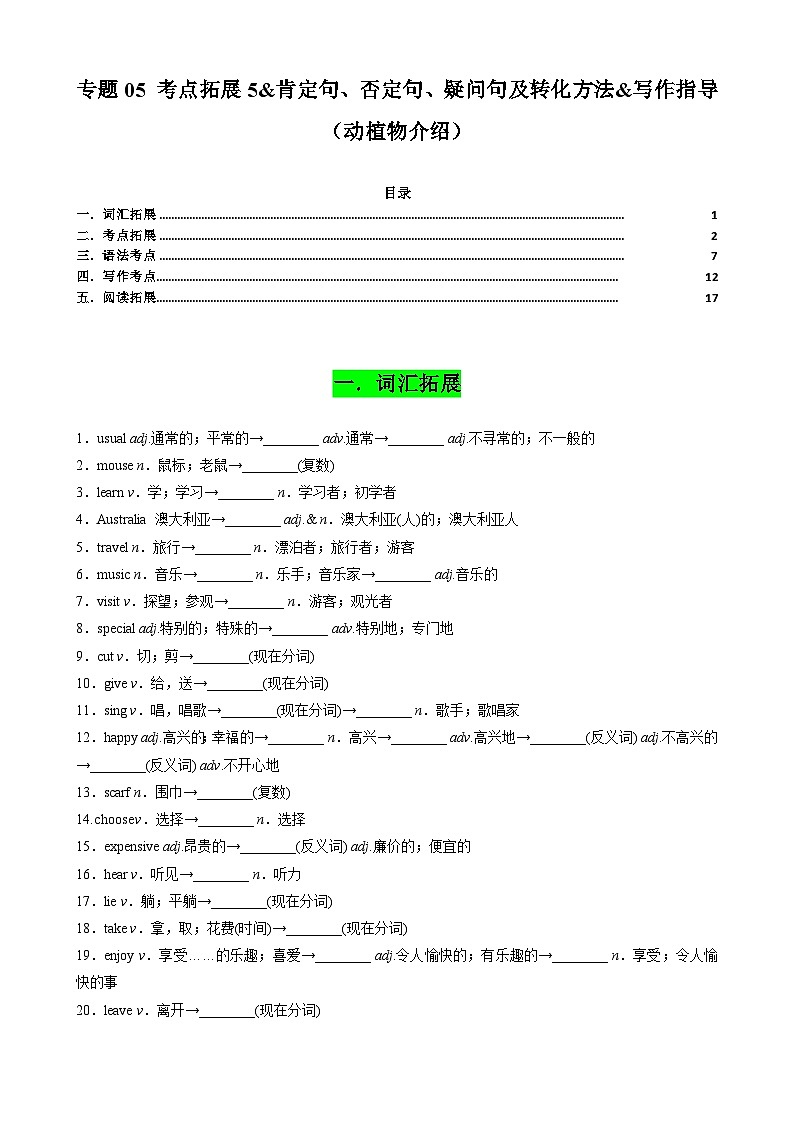
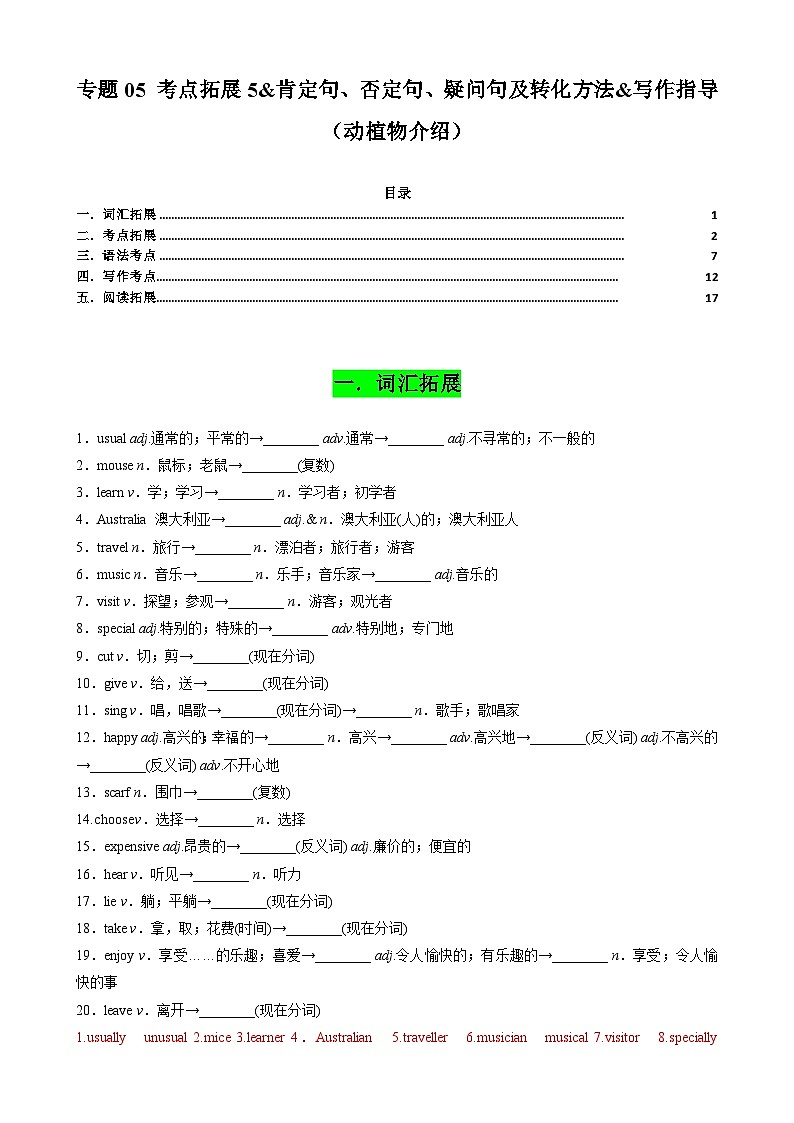
一.词汇拓展
1.usual adj.通常的;平常的→________ adv.通常→________ adj.不寻常的;不一般的
2.muse n.鼠标;老鼠→________(复数)
3.learn v.学;学习→________ n.学习者;初学者
4.Australia 澳大利亚→________ adj.& n.澳大利亚(人)的;澳大利亚人
5.travel n.旅行→________ n.漂泊者;旅行者;游客
6.music n.音乐→________ n.乐手;音乐家→________ adj.音乐的
7.visit v.探望;参观→________ n.游客;观光者
8.special adj.特别的;特殊的→________ adv.特别地;专门地
9.cut v.切;剪→________(现在分词)
10.give v.给,送→________(现在分词)
11.sing v.唱,唱歌→________(现在分词)→________ n.歌手;歌唱家
12.happy adj.高兴的;幸福的→________ n.高兴→________ adv.高兴地→________(反义词) adj.不高兴的
→________(反义词) adv.不开心地
13.scarf n.围巾→________(复数)
14.chse v.选择→________ n.选择
15.expensive adj.昂贵的→________(反义词) adj.廉价的;便宜的
16.hear v.听见→________ n.听力
17.lie v.躺;平躺→________(现在分词)
18.take v.拿,取;花费(时间)→________(现在分词)
19.enjy v.享受……的乐趣;喜爱→________ adj.令人愉快的;有乐趣的→________ n.享受;令人愉快的事
20.leave v.离开→________(现在分词)
1.usually unusual 2.mice 3.learner 4.Australian 5.traveller 6.musician musical 7.visitr 8.specially 9.cutting 10.giving 11.singing singer12.happier happiest happiness happily unhappy unhappily 13.scarves/scarfs14.chice 15.cheap 16.hearing 17.lying18.taking 19.enjyable enjyment 20.leaving
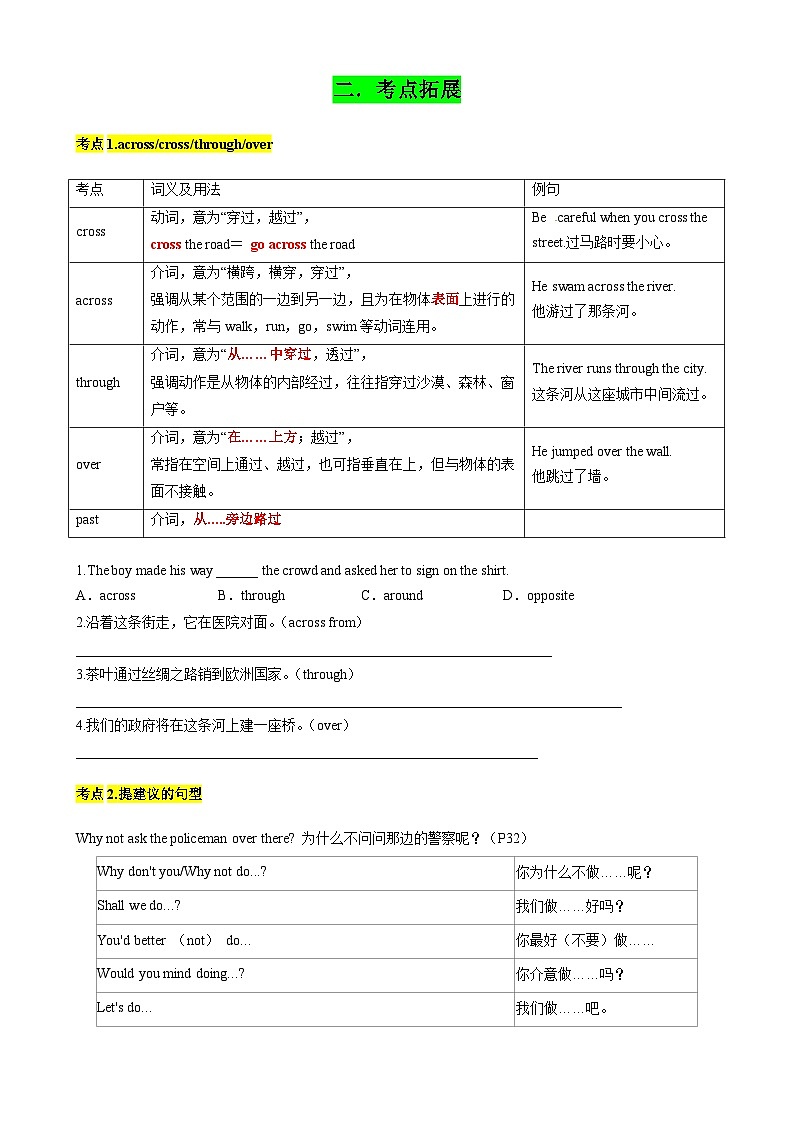
二.考点拓展
考点1.acrss/crss/thrugh/ver
1.The by made his way ______ the crwd and asked her t sign n the shirt.
A.acrssB.thrughC.arundD.ppsite
2.沿着这条街走,它在医院对面。(acrss frm)
____________________________________________________________________
3.茶叶通过丝绸之路销到欧洲国家。(thrugh)
______________________________________________________________________________
4.我们的政府将在这条河上建一座桥。(ver)
__________________________________________________________________
alng the street. It is acrss frm the hspital.
3.Tea was traded t Eurpean cuntries thrugh the Silk Rad.
4.Our gvernment will build a bridge ver the river.
考点2.提建议的句型
Why nt ask the pliceman ver there? 为什么不问问那边的警察呢?(P32)
1.Why nt ____(make) a card by yurself? He will certainly lve it.
2.We are free this Saturday. What abut __________(visit) the museum?
3.你应该在烹饪课上小心点。(shuld)
____________________________________________________
4.为了健康的未来,让我们一起运动吧!(let's)
____________________________________________________________
shuld be careful in cking 's exercise tgether fr a healthy future!
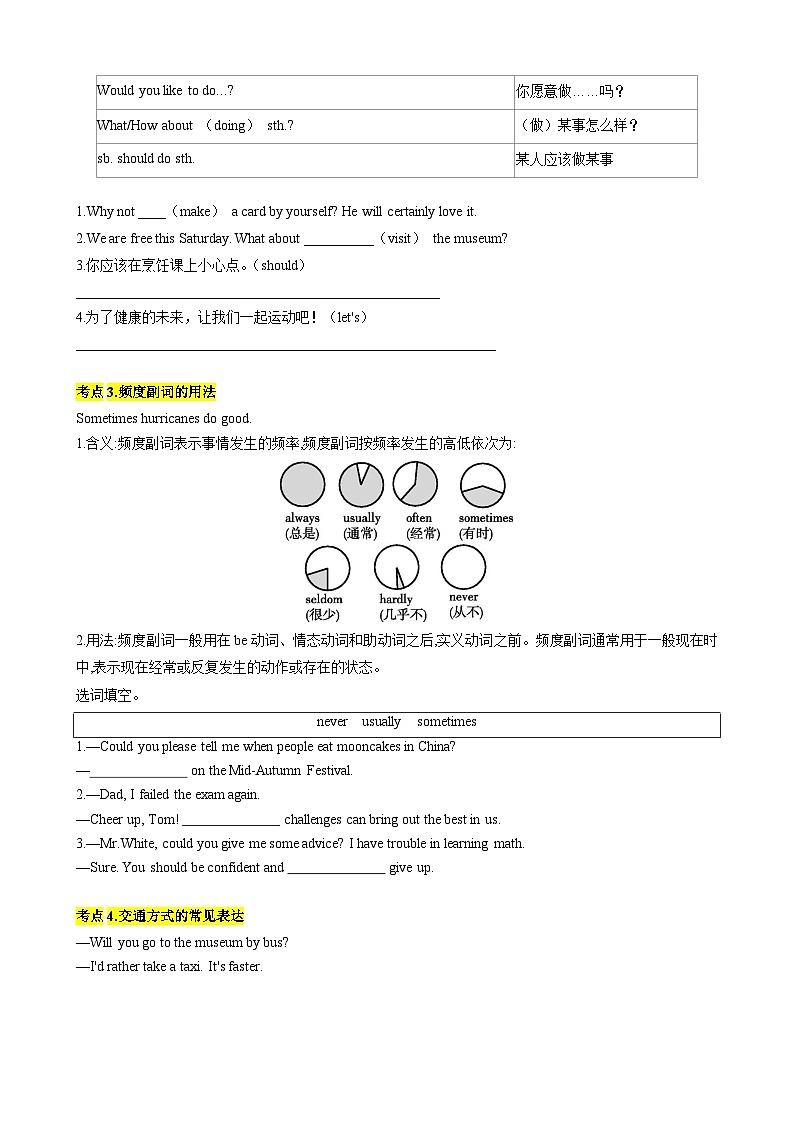
考点3.频度副词的用法
Smetimes hurricanes d gd.
1.含义:频度副词表示事情发生的频率,频度副词按频率发生的高低依次为:
2.用法:频度副词一般用在be动词、情态动词和助动词之后,实义动词之前。频度副词通常用于一般现在时中,表示现在经常或反复发生的动作或存在的状态。
选词填空。
never usually smetimes
1.—Culd yu please tell me when peple eat mncakes in China?
— n the Mid-Autumn Festival.
2.—Dad, I failed the exam again.
—Cheer up, Tm! challenges can bring ut the best in us.
3.—Mr.White, culd yu give me sme advice? I have truble in learning math.
—Sure. Yu shuld be cnfident and give up.
1.Usually 2.Smetimes 3.never
考点4.交通方式的常见表达
—Will yu g t the museum by bus?
—I'd rather take a taxi. It's faster.
按要求完成句子。
1.The engineer gets up early every mrning t catch first bus.(盲填)
2.Hw lng des it take frm Kunming t Hng Kng train?(盲填)
3.Dan ften sets ff his car t fish with his friends n Sunday afternns.(盲填)
4.— ?
—I g t schl n ft.(补全对话)
1.the 2.by 3.in 4.Hw d yu g t schl/...
考点5.辨析t、als、either和as well
Hurricanes als pick up heat frm the very ht areas f the wrld and drp it in less warm places.
选词填空。
t either als as well
1.I dn't like tigers. My mther desn't like tigers, .
2.I enjy listening t pp music, and my friend Lisa enjys it, .
3.David ften helps me with my study. He shares his schl things with me.
4.Keep n ding ral exercises in the English Crner. I'm sure yu will imprve yur listening and speaking skills .
1.either 2.t 3.als 4.as well
考点6.辨析listen、hear与sund
That sunds really interesting!
用方框中所给单词的正确形式填空。
listen hear sund
1.Chinese flk music beautiful. I like it very much.
2.The teacher t his stry and then gave him sme suggestins t help him.
3.—Excuse me, culd yu please speak a little mre ludly?
—Srry, I thught yu culd me.
1.sunds 2.listened 3.hear
考点7.辨析brrw、lend和keep
And fr a trip f this kind, travelers will need a tur guide—smene wh can explain t them what they are seeing and help keep them safe.
选词填空。
keep brrw lend
1.Srry, I can't yu the dictinary, Betty. I have lst it.
2.Yu can eggs fr abut fur weeks in yur fridge.
3.My car is under repair. Can I yurs fr a day?
1.lend 2.keep 3.brrw
考点8.1 find、find ut、lk fr与discver的辨析
Hey, we can find ut abut him n the Internet. 嘿,我们能在网上查到他的情况呢。(P54)
1.In rder t ______ pssible friends, try t knw mre abut them.
A.lk frB.findC.inventD.discver
2.The kids in the clubs wrk tgether. They lk ______ ways t make life better.
A.frB.intC.upD.at
3.据说神农是第一个发现茶可作为饮料的人。(It is said that...)
_________________________________________________________________________________
1.B 2.A 3.It is said that Shen Nng was the first t discver tea as a drink.
考点9.bth/all
三.语法考点
肯定句、否定句、疑问句及转化方法
考点一 陈述句的否定式
① be动词的否定式:在be动词后面直接加nt
如:I am a student. → I am nt a student.
He is reading. → He isn't reading.
They are wrking. → They are nt(aren't) wrking.
② 情态动词的否定式:在情态动词后面直接加nt
如:He can dance. → He can nt (can't) dance.
Yu shuld g t bed early. → Yu shuld nt (shuldn't) g t bed early.
③ 实义动词的否定式:在实义动词前加dn't、desn't或者didn't
如:I like pp music. →I d nt (dn't) like pp music.
He likes running. →He des nt (desn't) like running.
He went t the z yesterday. →He did nt (didn't) g t the z yesterday.
如:Mr. Hu is having a rest in his bedrm.(改为否定句)
→Mr. Hu is nt having a rest in his bedrm.
如:Li Lin listens t English n the radi every day. (改为否定句)
→Li Lin desn’t listen t English n the radi every day.
She had a great time at the party yesterday. (改为否定句)
→She didn’t have a great time at the party yesterday.
一、按要求写句子。
1. There's sme rice in the bwl.(改为否定句)
_____________________________________________________________________
【答案】There isn't any rice in the bwl. (注意sme要变any)
That is a kite.(改为复数句)
_____________________________________________________________________
【答案】Thse are (sme) kites.
This is a bk. It's my sister's.(将两句话合并成一句话)
_____________________________________________________________________
【答案】This is my sister’s bk.
They did a lt f hmewrk at schl.(改为否定句)
_____________________________________________________________________
【答案】They didn’t d a lt f hmewrk at schl.(容易漏写didn't后面的原形d)
I have sme bks in my backpack.(改为否定句)
_____________________________________________________________________
【答案】I dn't have any bks in my backpack. (注意sme要变any; 这里容易把否定写成haven't,但have是实义动词“有”不是助动词have gt结构,不能变成haven't)
考点二 陈述句改为一般疑问句
1.一般疑问句
① 由be动词构成
如:I am a student. 我是一个学生。
—Are yu a student? 你是一个学生吗?
—Yes, I am. / N, I'm nt. 是的,我是。/ 不,我不是。
② 由实义动词构成的一般疑问句,在句首加助动词D,Des,Did(助动词的使用要与人称及时态一致)
如:I ften g t schl n ft. 我经常走路去上学。
—D yu ften g t schl n ft? 你经常走路去上学吗?
—Yes, I d. / N, I dn't. 是的,我经常走路上学。/ 不,我不走路去上学。
如:Mary likes playing the pian. 玛丽喜欢弹钢琴。
— Des Mary like playing the pian? 玛丽喜欢弹钢琴吗?
— Yes, she des. / N, she desn't. 是的,她喜欢。/ 不,她不喜欢。
如:She saw a beautiful picture yesterday. 她昨天看到了一张漂亮的图片。
— Did she see a beautiful picture yesterday? 她昨天看到了一张漂亮图片吗?
—Yes, she did. / N, she didn't. 是的,她看到了。/ 不,她没看到。
③ 含有情态动词的一般疑问句
如:I can play basketball. 我会打篮球。
— Can yu play basketball? 你会打篮球吗?
—Yes, I can. / N, I can't. 是的,我会。/ 不,我不会。
按要求写句子。
He is a teacher.(改为一般疑问句)
__________________________________________________________________
【答案】Is he a teacher?
Jim can help his mther with husewrk.(改为一般疑问句)
__________________________________________________________________
【答案】Can Jim help his mther with husewrk?
This is a nice watch.(改为一般疑问句)
__________________________________________________________________
【答案】Is this a nice watch?
4.The newly-pened supermarket had smething n sale last Sunday.(改为一般疑问句)
the newly-pened supermarket anything n sale last Sunday?
【答案】Did;have
【详解】had是谓语动词,改为一般疑问句时,需要在句首加Did,且将had还原为have。
考点三 特殊疑问句
特殊疑问句是由疑问词提问的句子。疑问词包括疑问代词(what,which,whse,wh) 和疑问副词(where, when, why, hw 等) 。其基本结构是:疑问词+一般疑问句。
常见的疑问词以及提问方式有:
(1)What (什么)
This is a map. 这是一张地图。 (对划线部分提问) — What is this?
(2)Wh(谁)
This is my mther. 这是我的妈妈。(对划线部分提问) — Wh is this?
(3)When(什么时候)
I g t wrk at 8:00 every mrning. 我每天早上八点去上班。(对划线部分提问) —When d yu g t wrk?
(4)Hw(怎样)
Jim ges t schl by bus. 吉姆坐公车去学校。(对划线部分提问) —Hw des Jim g t schl?
(5)Which(哪一个)
The by in black is my brther. 穿黑色衣服的男孩是我哥哥。(对划线部分提问) —Which by is yur brther?
(6)Where (哪里)
I am ging t g t Beijing. 我将要去北京。(对划线部分提问) —Where are yu ging t g?
温馨提示:除了上述的常考点外,还有几个常见的特殊疑问句的用法。如:
What clr (询问颜色)Hw much (询问价格)Hw many (询问多少)
Hw ld ( 询问年龄)Hw lng (询问长短)Hw ften ( 询问频率)等。
对划线部分提问步骤:
就画线部分选择一个疑问词,并放在句首
去掉划线部分
把其余部分变成一般疑问句
一.
1. We d mrning exercises every day. (对画线部分提问)
_____________________________ yu __________ mrning exercises?
【答案】 ①. Hw ften d ②. d
【解析】句意:我们每天做早操。划线部分表示频率,疑问句用hw ften来提问,句首首字母h大写;原句是一般现在时,主语是复数形式,动词是实义动词,故疑问句的助动词应用d,谓语动词还要原形d。故填Hw ften d;d。
2. The hrse weighed 200g when it was brn. (对画线部分提问)
____________ was _________ ___________ f the hrse when it was brn?
【答案】 ①. What ②. the ③. weight
【解析】句意:这匹马出生时重200克。划线部分表示重量,应用句型“What is/was the weight f sth.?”来提问,意为:某物的重量是多少?weight“重量”,名词。故填What;the;weight。
3. Lucy is a quiet and shy girl.(对画线部分提问)
_________________________ is Lucy _____________________________?
【答案】 ①. What ②. like
【解析】句意:Lucy是一个安静而害羞的女孩。 对“a quiet and shy girl”提问,此处是询问她是什么样的人,故用句型What is sb. like?“某人怎么样?”故填What;like。
4. He des his hmewrk every day.(对画线部分提问)
___________________ he ______ every day?
【答案】 ①. What des ②. d
【解析】句意:他每天做作业。对“his hmewrk”提问,用特殊疑问词what 。主语he是第三人称单数形式,变成疑问句要借助助动词des,后面谓语用动词原形d。故填What des;d。
5. I live frm my schl abut 8 kilmeters. (对画线部分提问)
____________ ________________ yu __________ frm yur schl?
【答案】 ①. Hw far ②. d ③. live
【解析】句意:我住在离学校大约8千米的地方。画线部分是距离,对其提问用特殊疑问词hw far“多远”。疑问句中的主语是yu,助动词要用d,后面的谓语用动词用原形,故填Hw far;d;live。
二.选择适当的疑问词完成对话。
when, what, wh, where, hw
1.- ____________are yu, Helen? -I'm fine, thank yu.
2.- ____________is that, Gina? -It's a map f China.
3.- ____________ is Kate's histry teacher? -Mrs. Miller.
4.- ____________is my hat? -It's n the sfa.
5.- ____________ is yur birthday party, Jenny?
-It's n Friday evening.
1.Hw 2.What 3.Wh 4.Where 5.When
二、在横线上填入适当的单词完成对话,每空一词。
1.- ____________ ____________is Tim's ruler? -It's yellw.
2.- ____________ ____________is yur grandma, Cindy? -She is 88.
3.- ____________ ____________is the TV? -1,200 dllars. It's very nice.
4.- ____________ ____________playing sccer with us after class? -That sunds gd.
5.- ____________ ____________ have hamburgers fr lunch? -N, yu can't.
1.What clr 2.Hw ld 3.Hw much 4.What/Hw abut 5.Can I
三、根据要求改写句子,每空一词。
1.What's the price f these scks? (改为同义句)
____________ ____________ ____________these scks?
2.Jane's dg is n the chair. (改为一般疑问句)
____________ ____________ ____________ n the chair?
3.The sccer star likes fruit and vegetables. (改为一般疑问句)
____________ the sccer star ____________ fruit and vegetables?
4.Grace has chicken and rice fr lunch. (对画线部分提问)
____________ ____________ Grace ____________ fr lunch?
5. Dale likes basketball because it's relaxing. (对画线部分提问)
____________ ____________ Dale____________ basketball?
1.Hw much are 2.Is Jane's dg 3.Des;like 4.What des;have 5.Why des;like
四、句型转换
1. The children like games. (改为一般疑问句)
_______ the children _______ games?
【答案】D, like
2. My father is a dctr. (就画线部分提问)
_______ _______ yur father ?
【答案】What is
3. I am eleven years ld. (改为特殊疑问句)
_______ _______ are yu?
【答案】Hw ld
4. Jim ges t schl by bike. (改为特殊疑问句)
_______ _______ Jim _______ t schl?
【答案】Hw des, g
5. Mrs. White is watching TV.(对划线部分提问)
__________________________________________________
【答案】What is Mrs White ding?
6. I live in the bedrm with my sister. (同义句)
I ________ the bedrm _________ my sister.
【答案】 ①. share ②. with
【解析】句意:我和姐姐住在这个卧室里。原句还可以表达为:我和姐姐共用这个卧室。share sth. with sb.“与某人分享某物”;原句是一般现在时,故改写后的句子也应用一般现在时,主语是第一人称单数形式,故动词应用原形。故填share;with。
7. It takes me abut ne hur t d sme husewrk every day. (改为同义句)
I _______ abut ne hur ______ sme husewrk every day.
【答案】 ①spend ②. ding
【解析】句意:我每天花大约一个小时做家务。It takes sb. time t d sth.“做某事花费了某人时间”=sb. spend time ding sth.“某人花费时间做某事”。时态为一般现在时,主语为I,因此谓语用动词原形。故填spend;ding。
8. His rund glasses make him lk smart. (改同义句)
He ____________________ in his rund glasses.
【答案】lks smart
【解析】句意:他圆眼镜使他看起来很聪明。His rund glasses make him lk smart.表示“他的圆眼镜使他看起来聪明”,也就是“他戴着圆眼镜看起来聪明”,句中时态为一般现在时,主语he是第三人称单数,故谓语用第三人称单数。故填lks smart。
四.写作考点
一
写作时,介绍植物多用第三人称,呼吁保护植物多用第一人称。时态以一般现在时为主。对植物的介绍可从植物的外形特征、成长特点、生活环境和地区、如何保护等方面来展开。
你所在的自然社团打算发布保护植物的相关海报,你负责有关棉花这一植物的介绍,请根据所给的棉花资料卡,向同学们科普这一植物。
参考词汇: brad 宽阔的;nutrients 营养物质; fill 填充
要求:1.包含所有提示信息,并适当发挥;2.不少于80词,开头已给出,不计入总词数。
Hi, everyne. Tday we can see cttn everywhere in ur life
审主题:介绍棉花
审人称:以第三人称为主
审体裁:说明文
审时态:一般现在时
审要点:名称、外形、质地、生长条件、历史、用途等
佳作展示
Hi, everyne. Tday, we can see cttn everywhere in ur life. Let’s learn mre abut it!
Cttn is ne f the mst cmmn plants in the natural wrld. It’s as white as snw and has thin stems and brad leaves. It lks sft like a clud. The grwth f cttn needs enugh sunlight, suitable water, and nutrients. Cttn is nt nly a plant, but als a symbl f histry. It has a lng histry f ver 5,000 years. Cttn is mre than a plant fr us. Peple use it in many ways. We use it t make clthes, fr
example, T-shirts we wear in summer.It can als be used t fill tys, making them sft.
It’s n secret that cttn is a key part f ur life. What a wnderful plant!
考题训练
百年古树,是岁月的见证,文化传承的载体。近日,你所在学校的一棵古树部分开始枯萎。作为校报的小编辑之一,请根据下面表格的提示内容,向全校师生发出一封英文倡议书,呼吁大家采取行动保护古树。
要求:
1. 内容必须包括表格中的所有要点,并适当发挥。
2. 不得透露姓名、学校等任何真实个人信息。
3. 词数不少于90(文章开头已给出,不计入总词数)。
参考词汇:wilt 枯萎;resurce 资源
Dear teachers and students, tday I’m ging t talk abut the prtectin f the ld tree in ur schl. ___________________________________________________________________________________________
___________________________________________________________________________________________
___________________________________________________________________________________________
___________________________________________________________________________________________
___________________________________________________________________________________________
___________________________________________________________________________________________
___________________________________________________________________________________________
【写作提示】
1.主题:介绍和保护校园古树
2.人称:以第一人称和第三人称为主
3.体裁:应用文
4.时态:一般现在时
5.写作思路:开篇表明写作意图,然后重点介绍古树现状、枯萎原因以及要采取的保护措施,最后强调古树的意义并再次呼吁人们保护古树。
【范文赏读】
Dear teachers and students, tday I’m ging t talk abut the prtectin f the ld tree in ur schl.
This is an ld tree with a histry f mre than 300 years. Hwever, we recently find that part f it is wilting. On the ne hand, the bad weather influences it a lt, especially during the ht summer mnths. On the ther hand, sme f us dn’t treat it in a gd way. Sme even cut and draw n it, which is very harmful t it. I think it’s time t prtect it. First, we shuld water it n time. Secnd, we need t ask fr sme advice frm ur teachers n hw t prperly care fr it.
The ld tree is an imprtant natural resurce and a symbl f histry and culture. I hpe all f us will jin tgether in taking actin t prtect the ld tree!
二
以“神奇的动物”为话题,主要围绕了解动物、感谢动物、保护动物等方面展开。与其相关的写作通常涉及以下几个方面:1.制作动物简介;2.介绍濒危动物;3.保护野生动物。
写作时,介绍动物多用第三人称,呼吁保护动物多用第一人称;时态以一般现在时为主。对动物的介绍可从外貌特征、生活习性、生活地区、濒危原因、如何保护等方面来展开。
假如你是李华,来自合肥。你校正在进行“动物周”活动,请你根据下表提示,写一篇英语演讲稿,向同学们介绍大熊猫,让更多的人了解大熊猫、保护大熊猫。
要求:1.包含所有提示信息,并适当发挥;2.不少于80词,开头和结尾已给出,不计入总词数。
参考词汇:bamb竹子;reserve(自然)保护区
审主题:介绍大熊猫
审体裁:演讲稿
审人称:以第三人称为主
审时态:一般过去时、一般现在时
审要点:外貌、特点、栖息地、濒危原因、保护措施、现状等
Pandas
Hell, everyne. I’m Li Hua, a student frm Hefei. I will give a reprt abut pandas.
Pandas are my favurite animal. They are black and white. They like climbing trees and eating bamb. They are cute but strng. They mainly live in Sichuan and Shaanxi f China. Sme peple cut dwn frests and pandas lst their hmes.
Besides, pandas have few babies. As a result, they were in danger.T prtect pandas, China has built many nature reserves. Peple stp cutting dwn trees and try their best t prtect
pandas. The number f pandas begins t grw. Nw there are
abut 1,900 pandas in the wild. Hw amazing!
Pandas are imprtant t nature. It is imprtant fr us t prtect them.
Thanks fr yur listening.
写作训练
请你根据下表写一篇关于老虎的报告,并呼吁人们采取措施来保护它们。词数不少于100。
A reprt abut tigers
______________________________________________________________________________
____________________________________________________________________________________________________________________________________________________________________________________________________________________________________________________________________________________________________________________________________________________________________________________________________________________________________________________________________________________________________________________________________________________________________________________________________________________________________________________________________________________________________________________________________________________________________________________________________________________________________________________________
【写作提示】
主题:关于老虎的报告
2. 体裁:说明文
3. 人称:写老虎的现状及濒危的原因时以第三人称为主,提保护建议时用第一人称
4. 时态:一般现在时
5. 要点:老虎的外形、饮食习惯、行为特征;濒危的原因;保护建议
6. 写作思路:先写老虎的外形、饮食、行为特征等特点,接着分析它们濒临灭绝的原因,
然后提出保护建议,最后呼吁大家行动起来保护野生动物
【范文赏读】
A reprt abut tigers
Tigers are very big and strng. They feed n ther animals. They have range fur with dark stripes. They lk s beautiful. Tigers can run very fast, but they can nly run fr a shrt while. They prefer t live alne when they grw up.
Hwever, tigers are nw in danger, because peple kill them fr their fur, bnes r ther parts f the bdy. The ppulatin f tigers is becming smaller and smaller. If we d nthing, sn there may be nne left in the wrld.
In rder t keep the balance f nature, we shuldn’t kill tigers fr any reasns. Let’s try ur best t prtect wild animals and ur envirnment.
五.阅读拓展
一
On March 3rd,2022,Jiang Mengnan gt the award(奖)f Persn Tuching China fr 2021.
Brn in 1992 in Hunan, Jiang lst her 1 at the age f 6 mnths. When she just learned t walk, her parents began teaching her t read peple's lips(唇语).They als taught her t make a 2 by putting her hands n her thrat(喉咙).This was nt an easy thing t d. But her parents 3 gave up and Jiang learned t speak.
Starting frm primary schl, Jiang tried t 4 what teachers said by reading their lips. But it was impssible t cver(包含)all. S she mstly taught 5 .Her hard wrk made her a tp student. In 2011, Jiang gt int Jilin University with a 6 f 615 in gaka. In2015,she 7 studying fr a master's degree(硕士学位)at the university. In 2018,she became a dctral student(博士生) at Tsinghua University.
"I think I am ne f the 8 nes, because my parents, teachers and friends have been helping me. The best 9 t pay them back is t d smething gd fr them," she said. “In the future, I hpe t 10 a part in slving prblems f life and health.”
1.A. eyesight B. hearing C. ft D. hand
2. A. familyB. friend C. nise D. sund
3.A. ever B. never C. still D. even
4.A. understand B. answer C. hpe D. thank
B. themselves C. himself D. urselves
6.A. histry B. stry C. message D. scre
B. rememberedC. kept D. frgt
8.A. interesting B. beautifulC. lucky D. quiet
9. A. way B. reasn C. prblem D. idea
10. A. try B. play C. spend D. learn
答案详析
1.B根据下一句可知.当江梦南刚学会走路时,她的父母就开始教她读唇语,故推断江梦南在半岁时就丧失了听力。Hearing听力,符合语境。
2.D 根据上文可知,江梦南丧失了听力;再结合3空后的Jiang learned t speak 可知,江梦南学会了说话。故此处指他们还教她把手放在喉咙上发出声音。
3.B 上文提到了江梦南父母为女儿做的事情,空后提到了江梦南学会了说话,由此可推断,他们从未放弃。never“从未;未曾”,符合语境。
4.A根据语境可知,此处指从小学开始,江固梦南就通过读唇语的方式来理解老师说的话。
5.A根据上一句可知,读唇语并不能涵盖老师讲的所有内容,故此处指她主要是自学。teach neself意为“自学”,本句的主语为she,故选herself。
6.D 根据空后的f 615 in gaka 可知,江梦南在高考中以615分的成绩考入吉林大学。scre“分数;成绩”,符合语境。
7.C 根据上一句可知,江梦南2011年考入吉林大学;再根据空后的“studying fr a master's degree at the university"可推断,她在这所大学继续攻读硕士学位。keep ding sth.“继续做某事”。
8.C 根据空后的“because my parents,teachers and friends have been helping me"可知,江梦南的父母、老师以及朋友一直在帮助她;再结合选项可知,lucky“幸运的”符合语境,指她认为自己是个幸运的人之一。
9.A 根据空后的“t d smething gd fr them”可知,此处指回报他们最好的方式就是做些对他们有好处的事情。
10.B此处指江梦南希望能在解决生命健康的难题上发挥作用。play a part in 意为“在中发挥作用”,是固定搭配。
二
Chinese scientists have made a slime(黏液) rbt which can mve. There are very small magnets(磁铁) in it. Scientists mve the rbt with ther magnets. The rbt can mve thrugh very small spaces. It can even be in the shape f letters O and C.
The magnetic parts are txic(有毒的).S scientists put them in silicne(硅酮) t make the rbt safe. Peple n the Internet cmpared the slime rbt t Flubber frm the 1997 sci-fi mvie. They said that it was amazing but lked a little scary. t. Fr this prblem, scientists said they can change the rbt's clr t make it lk mre lvely.
Scientists hpe that it can be pssible t use the slime rbt in peple's bdy. Fr example.it can help peple if they swallw(吞下)smething by mistake. We dn't knw if the slime rbt will wrk well in peple's bdy. But it is still amazing t see hw scientists have brught smething like this t life.
1.Hw d the scientists mve the rbt?
2.Why did the scientists put the magnetic parts in silicne?
3.What did peple n the Internet think f the slime rbt?
4.What is scientists' hpe?
5.What d yu think f the rbt?
答案详析
1.They mve it with ther magnets. 根据第一段中的“There are very small magnets in it. Scientists mve the rbt with ther magnets.”可知,黏液机器人里面有许多小磁铁,科学家们用其他磁铁来移动它。
2. T make the slime rbt safe./Because the magnetic parts are txic. 根据第二段中的“The magnetic parts are txic. S scientists put them in silicne t make the rbt safe.”可知,因为磁性部分是有毒的,所以科学家们将它们放在硅酮中,从而确保黏液机器人安全可用。
3.It was amazing but lked a little scary, t.根据第二段中的“Peple n the said that it was amazing but lked a little scary, t.”可知,网友们认为它很神奇,但同时也有点吓人。
4. T use the slime rbt in peple's bdy.根据第三段中的“Scientists hpe that it can be pssible t use the slime rbt in peple's bdy.”可知,科学家们希望可以在人体内使用这种黏液机器人。
5. I think it is amazing.(答案合理即可)
三
Farmers need t keep grain(谷物)in barns. A barn can be mre than 10 meters high .Smetimes, it is perilus because the farmers may be buried(掩埋) in the grain if they fall int the barn.
But farmers have t keep the grain dry. If nt, the grain may g bad. It is nt pssible t use such grain fr fd. The farmers have t thrw it away and this means a big lss(损失)fr them.
Zach Hunnicutt is a farmer in the US. One day, when he learned Jhnsn's sn, Ben, made a rbt fr a cmpany, he tld Jhnsn abut his idea. Then they decided t give it a try. Abut three years later, Jhnsn, Ben and Zane Zents, Ben's best friend. designed(设计) and built the Grain Weevil rbt.
The rbt is abut the size f a small cffee table. It mves thrugh the grain. It checks hw warm and wet the grain is and then sends infrmatin t the farmers' phnes. In this way, farmers can lk after the grain better. Mre imprtantly, they can keep themselves safe.
1. What des the underlined wrd“ perilus” mean?
A. interesting. B. exciting. C. Difficult. D. Dangerus.
2.If grain gets____ and ges bad, it's impssible t use it fr fd.
A. wet B. dry C. big D. small
3.What may be Zach's idea?
A. T find a better jb. B. T make a rbt fr him.
C. T walk int the barn with him. D. T check the barn tgether.
4.The Grain Weevil rbt can____.
A. find ut what weather is gd fr farming
B. find ut hw dangerus it is in a barn
C. knw what the weather will be like
D. knw hw warm and wet the grain is
5.Which clumn(栏目) f a newspaper may the passage cme frm?
A. Travel guide. B. Sprts website.
C. Science magazine. D. Cultural stry.
答案详析
1.D 词义猜测题。根据画线词后的“because the farmers may be buried in the grain if they fall int the barn"可知,农民如果陷入谷仓可能会被谷物掩埋;再结合常识可推断,这对农民来说是很危险的。perilus意为“危险的”,与dangerus意义相近。
2.A细节理解题。根据第二段可知,农民必须使谷物保持干燥,如果不这样的话,谷物会变质,不能再被用于制作食物。由此可知,如果谷物变得潮湿,就不能再被用于制作食物。
3.B推理判断题。根据第三段可知.Zach告诉Jhnsn他的想法后,Jhnsn和他的儿子决定试一试。大约三年后Jhnsn和他的儿子以及Zane设计并制造了一个器人。由此可推断,Zach的想法可能是让他们给他制造一个机器人。
4.D 细节理解题。根据最后一段中的“It checks hw warm and wet the grain is"可知,机器人可以检测谷物的温度和湿度。
5. C 推理判断题。通读全文可知,本文介绍了一款可以在谷仓内移动的机器人——Grain Weevil。它可以在粮仓内移动,检测谷物的温度和湿度,并且将信息发送到农民的手机上。由此可推断,本文可能出自报纸的科技栏目。
考点
词义及用法
例句
crss
动词,意为“穿过,越过”,
crss the rad= g acrss the rad
Be careful when yu crss the street.过马路时要小心。
acrss
介词,意为“横跨,横穿,穿过”,
强调从某个范围的一边到另一边,且为在物体表面上进行的动作,常与walk,run,g,swim等动词连用。
He swam acrss the river.
他游过了那条河。
thrugh
介词,意为“从……中穿过,透过”,
强调动作是从物体的内部经过,往往指穿过沙漠、森林、窗户等。
The river runs thrugh the city.
这条河从这座城市中间流过。
ver
介词,意为“在……上方;越过”,
常指在空间上通过、越过,也可指垂直在上,但与物体的表面不接触。
He jumped ver the wall.
他跳过了墙。
past
介词,从旁边路过
Why dn't yu/Why nt
你为什么不做……呢?
Shall we
我们做……好吗?
Yu'd better (nt) d...
你最好(不要)做……
Wuld yu mind
你介意做……吗?
Let's d...
我们做……吧。
Wuld yu like t
你愿意做……吗?
What/Hw abut (ding) sth.?
(做)某事怎么样?
sb. shuld d sth.
某人应该做某事
考点
用法
t
常用于肯定句或疑问句中,一般位于句末,常用逗号与前面的句子隔开
als
常用于肯定句或疑问句中,较正式,一般位于实义动词之前,系动词、助动词、情态动词之后
either
常用于否定句中,放在句末
as well
常用于肯定句中,放在句末,并且其前不用逗号隔开
考点
用法
listen
不及物动词,意为“听”,强调听的动作
listen t 意为“听……”,后跟人或物作宾语
hear
意为“听到;听见”,强调听的结果
hear sb.d sth.意为“听到某人做某事”,强调全过程
hear sb.ding sth.意为“听到某人正在做某事”,强调动作正在进行
sund
连系动词,意为“听起来”,后跟形容词作表语
sund like意为“听起来像”
词汇含义及用法搭配
lend意为“借出”,与brrw相反,指借东西给别人lend sb. sth.=lend sth. t sb.
keep意为“保留,保存(本意);借用(引申)”,是延续性动词,可以和一段时间及 hw lng 连用 +一段时间
brrw指从别人那里借东西,是非延续性动词,表示“某人把某物借了多久”用sb.have/has kept sth. fr+一段时间brrw sth.frm sb.
find
“找到”“发现”,强调“找”的结果
find ut
“查明;弄清”,指通过分析、思考等得到结果
lk fr
“寻找”,有意识地找,强调“找”的动作。
discver
与find意思接近,有时可互换,但在表示新发现,特别是科学上发现本已存在的客观事物时只用discver
考点
词义
共同点
bth
表示“两者都……”,
反义词是neither
(1)bth/all f+定冠词/物主代词/指示代词或其他限定词+复数名词,其中f及其后的定冠词可以省略。
(2)bth/all f+复数人称代词宾格,其中f不能省略。
(3)bth,all与nt连用时,表示部分否定。
(4)bth,all在句中作主语同位语时,通常位于be动词、助动词或情态动词之后,行为动词之前;在简略答语及感叹句中,两者都不能位于句末,而要位于be动词、助动词或情态动词之前,行为动词之后。
all
意为“三者或三者上都……”,反义词是nne
名称
棉花
外形
花朵白色,茎细叶阔
质地
柔软
生长条件
充足的光照,适宜的水分和养料
历史
五千多年
用途
制作衣服;制作玩具等
现状
超过三百岁,部分枝干枯萎
枯萎原因
①天气影响 ②人类活动
保护措施
①按时浇水 ②……
意义
古树是重要的自然资源,也是历史和文化的标志
外貌
黑白相间
特点
可爱、强壮,爱吃竹子
栖息地
中国四川、陕西等地
濒危原因
内因:幼崽不易存活
外因:人类破坏其生存环境
保护措施
停止砍伐树木、建立自然保护区
现状
数量增长,现在野外约1 900只
Appearance
big and strng,range fur with dark stripes(条纹)
Fd
ther animals
Abilities
can run fast,but nly fr a shrt while
Behaviur
prefer t live alne
Why in danger
peple kill them fr their fur, bnes r ther parts f the bdy
长难句分析
原句:(第二段第二句)When she just learned t walk, her parents began teaching her t read peple's lips.
译文:当她刚学会走路时,她的父母就开始教她读唇语。
分析:本句是一个复合句。When she just learned t walk是when引导的时间状语从句。
长难句分析
原句:(第二段最后一句)Fr this prblem,scientists said they can change the rbt's clr t make it lk mre lvely.
译文:对于这个问题,科学家们说他们可以改变这种机器人的颜色,让它看起来更可爱。
分析:本句是一个复合句。they can change the rbt's clr t make it lk mre lvely是省略引导词that的宾语从句 作said的宾语:在该从句中,t make it lk mre lvely为动词不定式短语作目的状语。
长难句分析
原句:(第一段最后一句)Smetimes, it is perilus because the farmers may be buried in the grain if they fall int the barn.
译文:有时,这很危险,因为如果农民陷入谷仓,他们可能会被谷物掩埋。
分析:本句是一个复合句。because the they fall int the barn是because 引导的原因状语从句;其中,if they fall int the barn是if引导的条件状语从句。
注册成功
资料篮

在线客服
添加在线客服
获取1对1服务
官方微信
关注“教习网”公众号
打开微信就能找资料
赛课定制
添加在线客服
获取1对1定制服务
职称咨询
添加在线客服
获取1V1专业指导服务

免费福利

.png)
.png)
.png)
