 免费领取教师福利

若您为此资料的原创作者,认为该资料内容侵犯了您的知识产权,请扫码添加我们的相关工作人员,我们尽可能的保护您的合法权益。


这是一份福建省仙游经济开发区第一中学等校2025-2026学年九年级下学期考前英语适应性练习卷 (无音频)(含答案+解析),共7页。试卷主要包含了5分,满分30分), B等内容,欢迎下载使用。
Ⅰ.听力(共三节,20小题;每小题1.5分,满分30分)
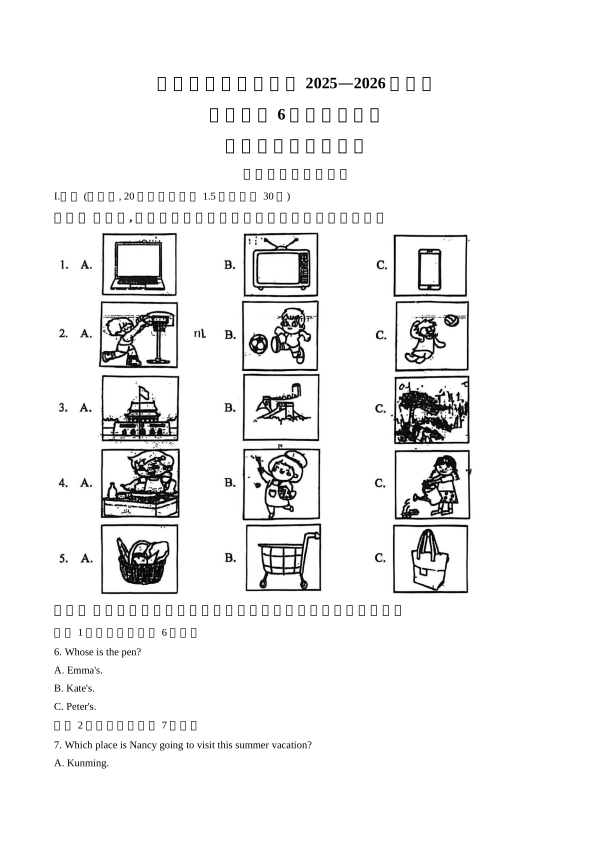
第一节 听下面五个句子,从每小题所给的A、B、C三幅图中选出与句子内容相符的选项。(每个句子读两遍)
1.
2.
3.
4.
5.
第二节 听下面七段对话,从每小题所给的A、B、C三个选项中选出正确答案。(每段对话读两遍)
听第1段对话,回答第6小题。
6. Wh is the wman in yellw in the pht?
A. Amy’s mther. B. Amy’s aunt. C. Amy’s grandma.
听第2段对话,回答第7小题。
7. What is the relatinship between the speakers?
A. Classmates. B. Mther and sn. C. Teacher and student.
听第3段对话,回答第8小题。
8. When will they leave fr the bk shw?
A. At 8:30. B. At 8:40. C. At 9:30.
听第4段对话,回答第9小题。
9. What’s the girl’s favrite subject?
A. Math. B. Histry. C. English.
听对话,回答小题。
10. Hw is the weather ging t be tmrrw?
A. Sunny. B. Cludy. C. Rainy.
11. What will they prbably d tmrrw?
A. Fly kites. B. G climbing. C. Play chess.
听对话,回答小题。
12. Which kind f dumplings des the man rder?
A. Prk dumplings. B. Beef dumplings. C. Vegetable dumplings.
13. Where are the speakers?
A. In a restaurant. B. At hme. C. In a street.
听对话,回答小题。
14. Hw ften des Lily take the waste paper t the recycling statin?
A. Every day. B. Once a week. C. Twice a week.
15. What are the speakers mainly talking abut?
A. When t g shpping.
B. Where t recycle paper.
C. Hw t prtect the envirnment.
第三节
听下面短文,根据你所听到的内容,完成下面表格,每空填一词。(短文读三遍)
Ⅱ.选择填空(共15小题;每小题1分,满分15分)
从每小题所给的A、B、C三个选项中,选出可以填入空白处的最佳答案。
1. — D yu fllw the news?
— Yes. Dnald Trump visited China ________ May 13th, 2026.
A. nB. inC. at
2. —Be careful with the knife, Tm. Yu might hurt ________.
—OK, Mm. I’ll be careful.
A. yuB. yurC. yurself
3. —China started the Natinal Reading Regulatin (条例) in 2025.
—Yes. We shuld never lse the chance t ________ a gd reading habit.
A. carryB. preventC. develp
4. China’s high-speed rail netwrk runs ________ than that f any ther cuntry in the wrld.
A. fastB. fasterC. fastest
5. — In China, respecting the elderly and caring fr the yung is a gd family ________.
— Yes. It has been passed dwn fr generatins.
A. signB. traditinC. cmmunicatin
6. Since last spring, ur cmmunity ________ free medical services fr the elderly.
A. prvidesB. has prvidedC. was prviding
7. —The 8th China Internatinal Imprt Exp was ________ held in Shanghai.
—Yes. It attracted many cmpanies frm arund the wrld.
A. quietlyB. nervuslyC. successfully
8. — I heard yu and yur brther jined the schl basketball team.
— That’s right. ________ f us practice hard every day.
A. AllB. BthC. Either
9. When the little by saw the giant panda, he shuted ________.
A. in surpriseB. in trubleC. in silence
10. —During Eln Musk’s visit t China with his sn, the traditinal Chinese Tang cstume his sn wre ________ warmly by Chinese peple.
—Yes, it shws the charm f Chinese culture.
A. praisedB. was praisedC. were praised
11. — Mum, I want t learn t ck.
— It’s a ________ skill fr yur future life.
A. sillyB. strangeC. valuable
12. —Why were yu late fr schl this mrning?
—My dad’s car ________ n the way, s we had t wait fr help.
A. turned dwnB. brke dwnC. slwed dwn
13. — What’s yur favrite way t relax after schl?
—________ t sft music makes me feel relaxed.
A. ListenB. T listenC. Listening
14. —I will attend the summer camp tmrrw mrning.
—Great. Send me a message ________ yu get t the camp.
A. s thatB. even ifC. as sn as
15. —“Tw muntains” Thery was put frward 20 years ag.
— Yes. It teaches us ________ fr a better future.
A. what we can d t prtect nature
B. when we shuld start planting trees
C. where we can find the mst beautiful muntains
Ⅲ.完形填空(共10小题;每小题1.5分,满分15分)
阅读下面短文,从每小题所给的A、B、C三个选项中,选出可以填入空白处的最佳答案。
Ning Zhngyan, a 26-year-ld skater frm China, realized his biggest dream at the 2026 Milan Winter Olympics. He wn the gld medal in the men’s 1500 m speed skating fr the first time, and even ____16____ the Olympic recrd! Hwever, the rad t the tp was nt easy.
Fur years ag at the Beijing Winter Olympics, Ning nly finished seventh. Fr a lng time, he culdn’t ____17____ that failure. “I had a big ‘muntain’ in frnt f me,” he said.
T get ver the difficult time, Ning decided t make a ____18____. He went t the Netherlands (荷兰) fr special training. There, he lived alne ____19____ learned t be mre independent. He had t understand why he needed t train every day. Training with the wrld’s best skaters, he learned a lt frm their hard wrk and strng minds.
Ning set a picture f a gld medal as his phne screen saver (屏保). It was his dream. Every time he lked at his phne, he tld ____20____, “I will make it!” This simple sentence encuraged him t keep ging.
At the Milan Olympics, Ning felt ready. Befre his race, a Dutch skater set a very fast time. But Ning stayed ____21____. He skated his race with a clear plan. He tried his best and gave it 120% in the last lap. When he crssed the line, he had dne it—he skated ____22____ than anyne ever had at the Olympics!
As the natinal flag was rising, he cried ____23____. All the hard wrk, tears and sweat had finally ____24____. He had climbed ver that big muntain in his heart. “Getting t the _____25_____ f the muntain is wnderful,” Ning said with a smile. His stry tells us that if we hld n t ur dreams and never give up, we can all succeed.
16. A. brkeB. fundC. kept
17. A. causeB. frgetC. repeat
18. A. mistakeB. changeC. wish
19. A. andB. butC. until
20. A. myselfB. yurselfC. himself
21. A. calmB. angryC. cnfused
22. A. harderB. fartherC. faster
23. A. patientlyB. sadlyC. prudly
24. A. put ffB. paid ffC. taken ff
25. A. tpB. ftC. middle
Ⅳ.阅读理解(共两节,满分45分)
第一节 阅读下列短文,根据短文内容,从题中所给的A、B、C、D四个选项中,选出最佳选项。(共20小题;每小题2分,满分40分)
A
26. Hw many kinds f skills in English study can Amy imprve this term?
A. Five.B. Six.C. Seven.D. Eight.
27. Wh has assessed Amy?
A. Amy herself.
B. Her teacher and her parents.
C. Her parents and grup members.
D. Amy, grup members and her teacher.
28. Which speaking skill is NOT included in Amy’s self-assessment?
A. Expressing herself in simple English.
B. Giving speeches in frnt f the class.
C. Answering questins ludly and clearly.
D. Discussing questins in simple English.
29. What cmment shuld be fr Amy?
A. Nt bad.B. Well dne!C. Try harder!D. Keep it up!
30. Where is the text mst prbably frm?
A. A diary.B. A pster.C. A textbk.D. A magazine.
B
When my grandma retired (退休) five years ag, she made a big decisin: she wuld learn t paint il paintings. All f her children and grandchildren felt surprised. “Yu are already 60. Why d yu learn painting nw?” my cusin asked. “It must be t hard fr yu.” But grandma just held her new brush and said, “Age is never a prblem as lng as I have a psitive attitude (态度).”
At the beginning, everything was difficult fr her. Her hands always shk when she held the brush, and she wasted mre than ten pieces f canvas in the first mnth. I went t her rm t see her practice ne day, and I fund all her fingers were cvered with paint. I asked her if she wanted t give up. She pinted t the half-finished painting f ur garden and said, “Every mistake teaches me hw t d better next time.”
Grandma kept practicing fr tw hurs every day. A year later, ur cmmunity held a painting cmpetitin fr peple ver 55. Grandma tk part with her garden painting and wn the third prize. When we cheered fr her, she tld me that nthing is impssible as lng as yu stick t it with the right attitude.
Nw grandma still paints every weekend. Her wrks are even hung in ur cmmunity’s hall. She ften tells me that yur attitude decides what yu can get, nt yur age r yur past experience.
31. What did the grandma decide t d after retiring?
A. T travel arund the wrld.B. T learn t paint il paintings.
C. T teach her grandchildren art.D. T hld a cmmunity cmpetitin.
32. What des the underlined wrd “canvas” in Paragraph 2 mst prbably mean?
A. BrushB. MdelC. PaintD. Painting clth
33. What can we infer frm Paragraph 3?
A. The cmmunity nly allwed yung peple t jin.
B. Grandma practiced painting fr tw hurs every week.
C. Grandma prved that effrt leads t success.
D. The writer helped grandma finish the garden painting.
34. Which wrds can best describe grandma?
①Clever. ②Hard-wrking. ③Warm-hearted. ④Strng-willed.
A. ①②B. ①③C. ②④D. ③④
35. Which sayings best matches the stry?
A. Practice makes perfect.B. It is never t ld t learn.
C. East r west, hme is best.D. A friend in need is a friend indeed.
C
Have yu ever thught that middle schl students culd influence natinal plicies? In China, mre and mre teenagers are making their vices heard thrugh “Mdel Chinese Peple’s Plitical Cnsultative Cnference” activities.
In 2026, tw prpsals (提案) written by students frm Xi’an Gaxin N.1 High Schl were brught t the Tw Sessins (两会) in Beijing by natinal plitical advisrs. One prpsal fcused n deep reading difficulties amng teenagers in the digital age. The ther explred ways t prtect lcal dialects as part f China’s cultural heritage (遗产).
Hw did these students develp such meaningful prpsals? First, they fund prblems in their daily lives. Then, they made surveys and interviews, cllected data (数据), and studied infrmatin. Fr the dialect prpsal, students interviewed lder peple in their cmmunities and studied hw dialects are disappearing. They even asked language experts fr advice.
“Mdel CPPCC activities allw students t step ut f schls and int sciety. They help us better understand ur cuntry,” said ne student. The tw prpsals were praised by natinal plitical advisrs fr their strng research and practical suggestins.
This activity cnnects Chinese language arts, scial studies, and even math—students used the numbers f their research t supprt their arguments. It als develps careful thinking and prblem-slving skills.
“Every year fr the past 11 years, ur schl has had student prpsals taken t the Tw Sessins,” a teacher frm Xi’an Gaxin N.1 High Schl shared prudly. With the supprt f their schls and sciety, mre teenagers are learning that they are nt t yung t make a difference.
36. Hw des the writer begin the passage?
A. By asking a questin.B. By telling a stry.
C. By giving an example.D. By listing numbers.
37. What were the tw student prpsals mentined in the passage abut?
A. Heavy hmewrk and student stress.
B. Deep reading difficulties and dialect prtectin.
C. Sprts develpment and arts educatin.
D. Envirnmental prtectin and space explratin.
38. What des the wrd “They” refer t in Paragraph 4?
A. The Tw Sessins.B. Natinal plitical advisrs.
C. Mdel CPPCC activities.D. The students’ prpsals.
39. Which subjects are mentined as being cnnected t this activity?
A. Math and science.B. Histry and art.
C. Chinese and math.D. Chinese and physics.
40. What is the main purpse f this passage?
A. T teach students hw t write prpsals fr the Tw Sessins.
B. T cmpare different schls’ perfrmance in the Tw Sessins.
C. T intrduce the histry f the Mdel CPPCC activities in China.
D. T encurage teenagers t take part in scial activities and make a difference.
D
Have yu ever imagined turning n rm lights r talking t thers just by thinking, withut mving yur bdy r pening yur muth? With the develpment f brain-cmputer interface (接口), r BCI, this amazing idea frm science fictin is slwly becming reality.
BCI is a new technlgy that directly cnnects ur brain with external (外部的) cmputers. It wrks by cllecting weak electrical signals that ur brain prduces when we think. Then it translates these signals int clear cmmands (指令) that machines can understand. In this way, ur thughts can cntrl devices r help us send messages t thers withut any mvement r speech.
The mst valuable use f BCI is t help peple with disabilities. Fr example, sme peple are paralyzed (瘫痪的) because f accidents r serius illnesses, and they cmpletely lse the ability t speak r mve. They used t have great difficulty cnnecting with the wrld arund them. BCI gives them a new way t realize cmmunicatin. They can share their ideas with family and even cntrl their wheelchairs t mve arund just by thinking. Recently, scientists helped a paralyzed man “speak” with BCI; it turned his brain signals int text n a screen in secnds. It was a big breakthrugh fr medical treatment f this grup f peple. ▲
Tday, BCI is still develping fast. Scientists believe that in the near future, this technlgy may enter ur daily life. Ordinary (普通的) peple may use it t cntrl smart hmes r play games mre easily. When we can d many things with ur thughts, “yur thughts cme true” will nt just be a warm wish anymre.
41. Hw des BCI wrk accrding t the text?
A. It reads peple’s emtins thrugh cameras.
B. It uses vice cmmands t cntrl machines.
C. It cnnects the bdy directly t the Internet
D. It cllects brain signals and turns them int machine cmmands.
42. Why des the writer mentin the paralyzed man in Paragraph 3?
A. T shw that BCI can help disabled peple cmmunicate.
B. T explain hw BCI can cure serius illnesses and accidents.
C. T prve that scientists are better at speaking than disabled peple.
D. T tell us that turning brain signals int text is an easy jb.
43. Which f the fllwing can be put in the “ ▲ ” in Paragraph 3?
A. This technlgy is already perfect fr everyne.
B. Hwever, BCI nly helps peple with serius injuries.
C. Dctrs are still unsure if BCI is safe fr lng-term use.
D. Beynd helping the disabled, BCI may als change everyday life fr rdinary peple.
44. Which f the fllwing pictures matches the descriptin in Paragraph 4?
A. B.
C. D.
45. Which is the best title fr the text?
A. The Develpment f External Cmputers
B. Mind-Cntrlled Technlgy Brings Challenges
C. Brain-Cmputer Interface: Making Thughts Cme True
D. External Cmputers: Cnnecting Humans with Machines
第二节 (共5小题;每小题1分,满分5分)
E
阅读下面短文,从短文后所给的五个选项中选出能填入短文空白处的最佳选项,使短文通顺、连贯,意思完整。
In China, children like t make prmises by hking pinkies (拉小拇指) with each ther and saying, “A pinkie prmise must be kept fr 100 years.” There is ne mre step. ____46____ It’s a fun way fr children t shw they’ll keep their wrd.
Hw did this pinkie prmise cme abut? N ne knws the exact answer. ____47____ These guesses have been passed dwn fr years. Sme say it came frm a sng fr kids. ____48____. It was brn ut f a western lve stry where a man and a wman hked pinkies.
____49____ The Chinese character fr “finger” is als prnunced as “aim”—meaning peple’s best wishes. S hking pinkies can be seen as the exchanging f best wishes. ____50____
Generally speaking, hking pinkies means making a serius prmise. Nw yu see hw imprtant “pinkie prmises” are!
A. Others say it was intrduced frm the West.
B. Sme think that it may have smething t d with the rle f fingers in Chinese culture.
C. Here are many guesses n hw the pinkie prmise came abut.
D. Therefre, the fingers play an imprtant rle in making a prmise.
E. Then, they may press their thumbs tgether t cmplete the prmise.
V.情景交际(共5小题;每小题2分,满分10分)
根据情景提示,用得体的英语完成下列对话。
51. A: Gd afternn.
B: ________
52. A: ____________________ tday?
B: It’s Mnday.
53. A: ________ help yu?
B: Yes, please. I want t buy a scarf fr my mther.
54. A: Can yu swim r dance?
B: ____________________
55. A: What are yu ging t be when yu grw up?
B: ________
Ⅵ.看图写话(共5小题;每小题2分,满分10分)
根据每小题所提供的图画情景和提示词,写出一个与图画情景相符的句子。
56. There be
_______________________________________________
57. nw
_______________________________________________
58. run, than
_______________________________________________
59. What, delicius
_______________________________________________
60. if, tmrrw
_______________________________________________
Ⅶ.短文填空(共10小题;每小题1分,满分10分)
阅读下面短文,根据语境或所给单词的提示,在每个空格内填入一个恰当的词,要求所填的词意义准确、形式正确,使短文意思完整、行文连贯。
The Sng Dynasty was a glden age fr Chinese petry. Fujian, ____61____ imprtant prvince at that time, attracted many famus pets. Its beautiful nature and rich culture inspired ____62____ (they) t create amazing pems. These pems serve as special windws int the past.
The green muntains and clear ____63____ (river) f Fujian were ppular in petry. Wuyi Muntain especially tuched the pets’ hearts. The great philspher Zhu Xi, fr example, set up his schl there. He ften wrte pems ____64____ he was walking alng Jiuqu Stream. His pems shwed deep thughts abut life, like a river that never stps ____65____ (mve) frward.
Fujian’s lively arts als influenced Sng petry. Back in the Sng Dynasty, puppet shws and musical dramas ____66____ (be) very ppular. Pets like Liu Kezhuang described actrs ending their perfrmances— “The red curtain (帘子) falls as actrs bw, leaving laughter lingering (萦绕) arund. ____67____ (lucky), we can als see this scene tday, as Fujian still keeps 23 traditinal pera types.
Sng pets were ____68____ (interest) in the tea traditin, t. Su Shi and Li Qingzha wrte abut the exciting tea cmpetitins. They described hw peple enjyed “drawing” n tea—an art ____69____ (call) “tea play”. Su Shi wrte prudly abut winning the cmpetitin. It shwed that peple tk the cmpetitins very seriusly.
Frm the evergreen Wuyi Muntain ____70____ the clrful peras and tea art, the pems shw us Fujian’s special beauty. Reading them tday allws us nt nly t learn histry but als t discver beauty with petic eyes.
Ⅷ.书面表达(满分15分)
71. 假定你是某校学生李华,为了纪念抗战胜利80周年(the 80th anniversary f the victry f the War f Resistance Against Japanese Aggressin),近日你校开展了以“诵读经典,凝聚中国力量”为主题的活动。请你结合以下提示,用英语给笔友Henry写一封电子邮件,分享活动内容及感受。词数80左右。
注意事项:
1.必须包含所有提示信息,可适当发挥,开头已给出,不计入总词数;
2.意思清楚,表达通顺,行文连贯,书写规范;
3.请勿在文中使用真实的姓名、校名和地名。
Dear Henry,
I’m glad t share with yu the activity “Read Classics, Unite Chinese Strength” in ur schl.
____________________________________________________________________________________________________________________________________________________________________________________________________________________________________________________________________________________________________________________________________________________________________________________________________________________________________________________________
Yurs,
Li HuaA Fun Rbt Shw Trip
Place
The Natinal Science Museum.
Time
At ________ a. m. next Saturday.
Activities
◇Watch ________ rbt shws.
◇Try ut the rbts and take ________ with them.
◇Listen t a talk n hw rbts help dctrs in hspitals.
Requirements
◇ ________ a bttle f water.
◇Wear yur schl unifrm.
◇Dn’t be ________.
Purpse
T learn mre abut science and technlgy.
English Study Assessment (评价)
Grade: 8 Name: Amy
Self-assessment
Listening skill:
☆I can understand the teacher’s instructins and finish the listening tasks in class.
Speaking skill:
☆I can answer the questins ludly and clearly.
☆I can discuss questins and express myself in simple English.
Reading skill:
☆I can find ut the main ideas f passages quickly.
☆I can read English newspapers and magazines which are fit fr teenagers.
Writing skill:
☆I can write smething in English crrectly.
☆I can imitate the examples t write articles.
Viewing (看) skill:
☆I can knw mre abut freign culture frm English vides r films.
Grup assessment
☆Amy can help the grup members a lt with English.
English teacher assessment
☆Amy can take an active part in the English class and get gd grades.
Ttal pints: ________
Cmments (评语):
30-40 Well dne! 21-29 Keep it up! Belw 20 Try harder!
这是一份福建省仙游经济开发区第一中学等校2025-2026学年九年级下学期考前英语适应性练习卷 (无音频)(含答案+解析),文件包含福建省仙游经济开发区第一中学等校2025-2026学年九年级下学期考前英语适应性练习卷原卷版docx、福建省仙游经济开发区第一中学等校2025-2026学年九年级下学期考前英语适应性练习卷解析版docx等2份试卷配套教学资源,其中试卷共41页, 欢迎下载使用。
这是一份福建省厦门第一中学2025-2026学年度 中考模拟适应性练习 九年级英语学科含答案,共36页。
这是一份福建福州第一中学2025_2026学年九年级下册开学巩固提能练习英语学科(文字版,含答案),共18页。试卷主要包含了5分,满分30分)等内容,欢迎下载使用。
注册成功
资料篮

在线客服
添加在线客服
获取1对1服务
官方微信
关注“教习网”公众号
打开微信就能找资料
赛课定制
添加在线客服
获取1对1定制服务
职称咨询
添加在线客服
获取1V1专业指导服务

免费福利

.png)
.png)
