 免费领取教师福利


若您为此资料的原创作者,认为该资料内容侵犯了您的知识产权,请扫码添加我们的相关工作人员,我们尽可能的保护您的合法权益。

这是一份福建福州第一中学2025_2026学年九年级下册开学巩固提能练习英语学科(文字版,含答案),共18页。试卷主要包含了5分,满分30分)等内容,欢迎下载使用。
I. 听力(共三节,20小题;每小题1.5分,满分30分)
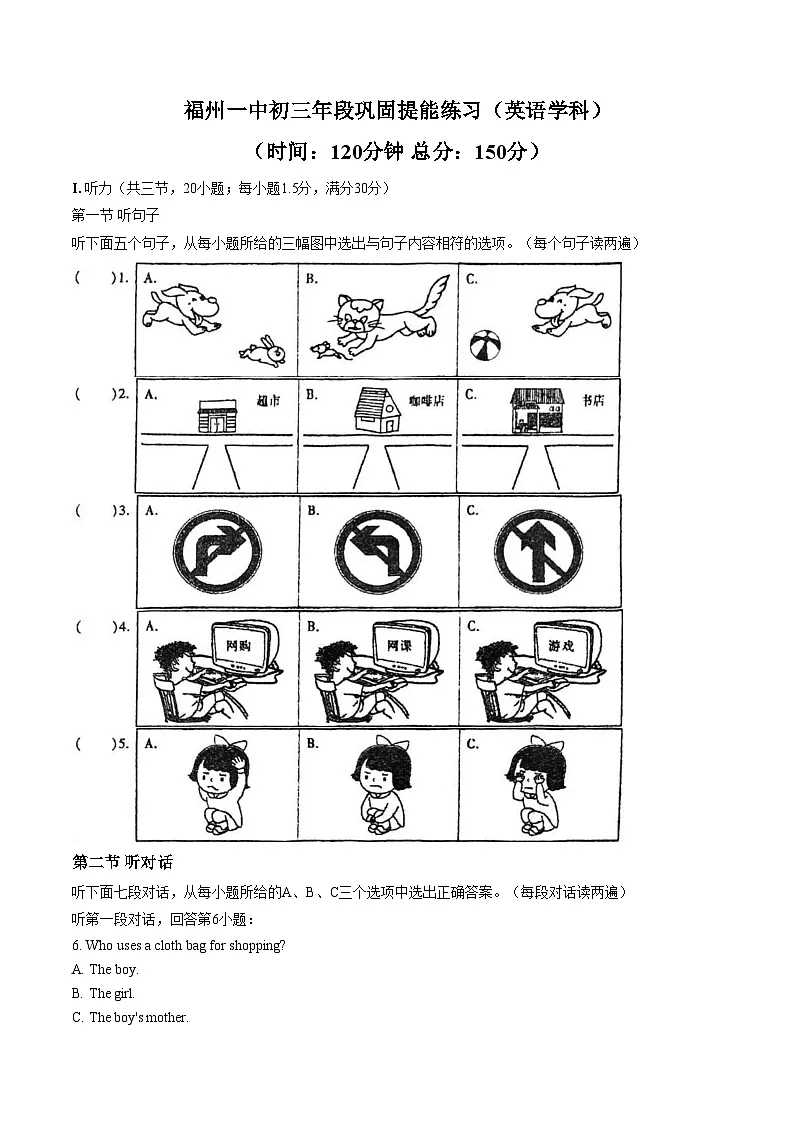
第一节 听句子
听下面五个句子,从每小题所给的三幅图中选出与句子内容相符的选项。(每个句子读两遍)
第二节 听对话
听下面七段对话,从每小题所给的A、B、C三个选项中选出正确答案。(每段对话读两遍)
听第一段对话,回答第6小题:
6. Wh uses a clth bag fr shpping?
A. The by.
B. The girl.
C. The by's mther.
听第二段对话,回答第7小题:
7. What's prbably the seasn nw?
A. Spring.B. Fall.C. Winter.
听第三段对话,回答第8小题:
8. Hw des the man feel nw?
A. Hungry.B. Full.C. Thirsty.
听第四段对话,回答第9小题:
9. Hw ften des the wman g ut fr dinner?
A. Never.B. Often.C. Always.
听第五段对话,回答第10、11小题:
10. Where des the wman prefer t live?
A. In the cuntry.B. In the city.C. Abrad.
11. Hw des the man like living in the cuntry?
A. It's mre exciting.
B. It's mre clrful.
C. It's healthier.
听第六段对话,回答第12、13小题:
12. What are the speakers talking abut?
A. Air pllutin.B. Water pllutin.C. Nise pllutin.
13. What shuld the gvernment d accrding t the girl?
A. Organize educatinal activities.
B. Prvide jb pprtunities.
C. Give speeches t the public.
听第七段对话,回答第14、15小题:
14. What is the by eating nw?
A. A hamburger.B. Vegetables.C. Fruits.
15. What is prbably Burger King?
A. A bkstre.B. A restaurant.C. A clthing stre.
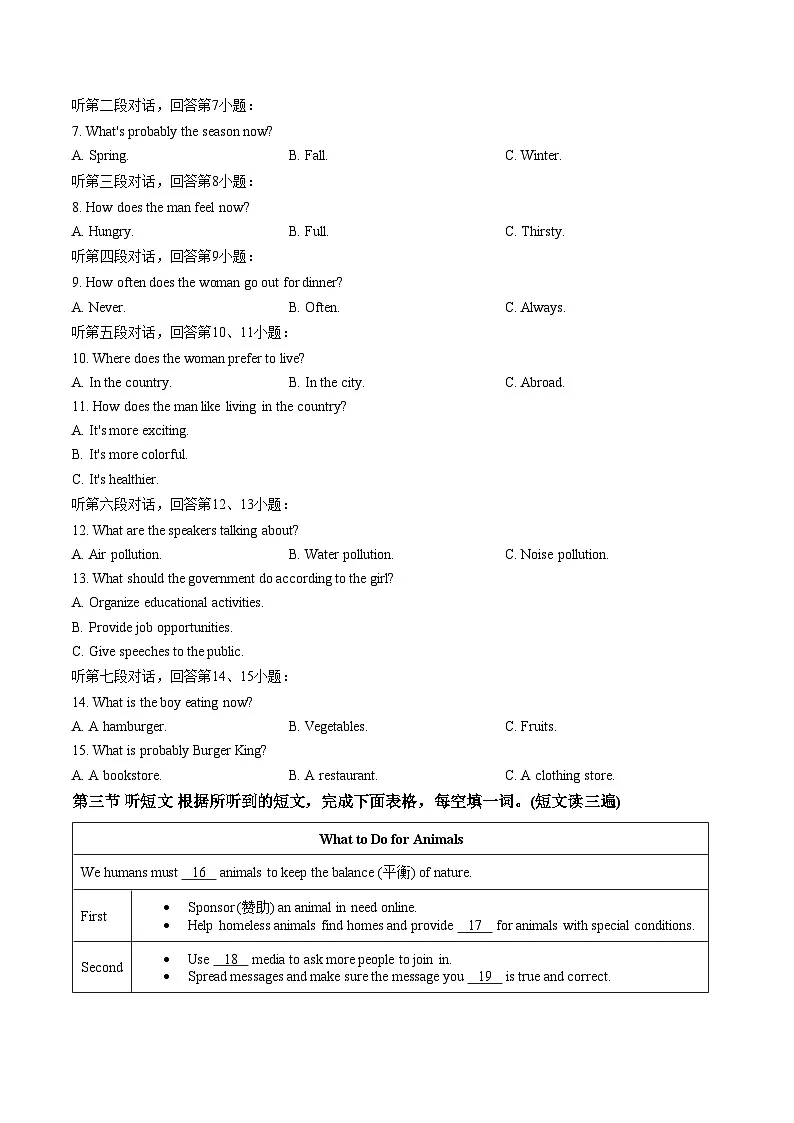
第三节 听短文 根据所听到的短文,完成下面表格,每空填一词。(短文读三遍)
II. 单项选择(共15小题,每小题1分,满分15分)
21. —D yu knw the ld man wh is playing ______ chess?
—He is my uncle. He is ______ university teacher.
A. the; a
B. /; an
C. /; a
22. —D yu like Beijing Opera r Kunqu Opera?
—______. I like Min Opera.
A. Either B. Neither C. Nne
23. The ______ f this activity is t raise mney fr the rganizatin.
A. plicy B. prcess C. purpse
24. —Why did the bss cnsider the plan s lng?
—He had t ______ the advantages and disadvantages befre making the decisin.
A. discver B. weigh C. divide
25. I can't remember ______ when Mr. Smith came t ur city. I nly remember it was a cld mrning.
A. prbably B. prperly C. exactly
26. — I usually have milk and bread fr breakfast.
— ______.
A. S have I B. S I have C. S d I
27. WeChat Pay makes ur life cnvenient. We can buy things ______ we dn't take any mney.
A. unless
B. even if
C. s that
28. Thugh the jb is ______ my ability, I want t have a try.
A. beside
B. beynd
C. behind
29. Dad prmised t buy me a new bike if I gt gd grades. And he ______ his wrds.
A. referred t
B. cnnected t
C. stuck t
30. —D yu knw the by wh helped the disabled man?
—He ______ be a student in ur schl. He wears the same unifrm as we d.
A. might
B. can't
C. must
31. The teacher warns us ______ in the exams. We shuld be hnest.
A. dn't cheat
B. nt t cheat
C. t nt cheat
32. —What d yu think f the mvie?
—______. I have never seen a better ne.
A. Bring
B. Excellent
C. Interested
33. The ntebk is the first gift ______ I received frm my father. It means a lt t me.
A. that
B. wh
C. which
34. —Why d yu want t be dctrs?
—Because a lt f tuching news abut them ______ these days.
A. have been reprted
B. has reprted
C. is reprted
35. —Culd yu tell me ______ fr the fruit?
—By paying ver the Internet.
A. hw much shuld I pay
B. hw much I shuld pay
C. hw I shuld pay
III. 完形填空 (共 10 小题,每小题 1.5 分,满分 15 分)
Eddie was filled with excitement. The muntain bike 36 was abut t start and he had been training hard. Perhaps, this year, he wuld finally win. The waiting crwd shuted encuragement, and Eddie's dad was amng them, smiling 37 .
The starter's gun 38 and Eddie gt away quickly. The rad was bumpy
(起伏不平) with lts f sudden turns, but Eddie was ready fr these challenges. As he went arund a crner, he 39 that his friend Riley was the nly rider in frnt f him.
Putting in mre effrt, Eddie reached Riley and then suddenly he was 40 . He was ging t win!
Eddie culd see the finish line at the tp f the next hill. The crwd began t 41 and Eddie heard his father's vice supprting him.
Mments later, Eddie heard a cry. He lked arund t see Riley 42 n the rad with his bike n tp f him. Any minute nw, the ther riders wuld rush tward him ver the hill.
Eddie jumped ff his bike and ran t Riley. His friend was unhurt and the bys quickly mved Riley's bike ff the rad.
The ther riders 43 past t the finish line, and Eddie heard a cheer g up fr the winner.
Slwly, Eddie 44 his bike t the finish line. Tears f disappintment filled his eyes.
Then, t his surprise, Eddie heard a sund and lked ver at the crwd t see them cheering fr 45 .
And there was his dad, with the prudest smile f all.
36.A. exerciseB. raceC. trip
37.A. prudlyB. graduallyC. plitely
38.A. brke upB. fell ffC. went ff
39.A. realizedB. decidedC. expected
40.A. side by sideB. n the tpC. in the lead
41.A. laughB. hideC. cheer
42.A. standingB. lyingC. riding
43.A. spedB. walkedC. ran
44.A. threwB. pushedC. sent
45.A. itB. themselvesC. him
IV. 阅读理解(共两节,25 小题;满分 45 分)
第一节 阅读下列短文,根据短文内容,从题中所给的 A、B、C、D 四个选项中,选出最佳答案。(共 20 小题;每小题 2 分,满分 40 分)
A
As a cuntry strng in math, China has many flk games filled with math wisdm. Yu may have played many f them befre. Let's take a lk at Three Chinese Classical Intelligence (智力) Games—Tangram, Nine Linked Rings (九连环) and Huarng Rad.
① First ppular in the Ming and Qing Dynasties, the Tangram is a game made up f seven pieces f different shapes, including five triangles, a square and a parallelgram. Players need t use these seven pieces t create new shapes. T d it, they must knw abut plane gemetry (平面几何). In the 18th century, the game spread t the West and sn became ppular there.
② Nine Linked Rings puzzle has a histry f ver 2,000 years. It is made up f nine rings cnnected t a handle (手柄). Players need t mve all the rings frm the handle t win the game. This is nt a simple game. Fr example, if yu want t mve the ninth ring, yu have t mve the third, fifth and seventh nes first, r yu will nt be able t d it.
③ Huarng Rad puzzle is a blck - mving game. It first appeared in the early 20th century. Each blck is named after a character in the nvel Rmance f the Three Kingdms, like Ca Ca, Guan Yu and Zha Yun. T win the game, players need t mve the blcks t get Ca Ca ut. It aims t test the players’ math knwledge, fr example, gemetric area.
46. Chse the right picture fr each blank: ______.
A. ① - a ② - b ③ - c
B. ① - b ② - a ③ - c
C. ① - b ② - c ③ - a
D. ① - c ② - a ③ - b
47. The writer starts the passage by ______.
A. expressing feelingsB. giving examplesC. asking a questinD. explaining reasns
48. Which f the fllwing shapes is made by Tangram?
49. What d all these games have in cmmn?
A. They are abut plane gemetry.B. They are digital games.
C. They are blck - mving games.D. They are abut math prblems.
50. Where is the passage prbably frm?
A. A mvie pster.B. A magazine.C. A stry bk.D. A nvel.
B
The Beijing Central Axis (中轴线) shws a grup f buildings and archaelgical (考古的) sites that fllw the traditinal Chinese way f planning a capital city. It has been added t the UNESCO (United Natins Educatinal, Scientific and Cultural Organizatin) Wrld Heritage List, becming China's 59th Wrld Heritage Site.
Stretching 7.8 kilmeters nrth t suth thrugh the heart f Beijing, the prperty includes 15 parts, with the Bell and Drum Twers at the nrthern end and Yngdingmen Gate at the suthern end. The cmplex includes imperial palaces and gardens, sacrificial (祭祀的) buildings, ancient city management facilities (设施), natinal ceremnial (仪式的) and public buildings, and central axis rad remains.
Accrding t Lyu Zhu frm Tsinghua University, there is a descriptin f this way f planning cities in the Kagngji 《考工记》(Bk f Diverse Crafts), written befre 221BC.
The bk mentins "curt in the frnt, market in the back," which matches the Frbidden City and the markets at the Bell and Drum Twers area. It als includes "an ancestral temple n the left, an altar f land and grain n the right," referring t the Imperial Ancestral Temple and the Altar f Land and Grain, lcated n the east and west sides f the Central Axis.
Cnstructin f the Beijing Central Axis began in the 13th century and tk shape in the 16th century. It has been refined ver the past seven centuries and cntinues t influence Beijing's develpment tday.
"The Beijing Central Axis is a symbl f traditinal Chinese ideas and beliefs, shwing natinal rder and the Chinese traditin f inclusin and diversity," Lyu
added.
51. What d we knw abut the Beijing Central Axis?
A. It is the ldest building in the capital city.
B. It is built with the traditinal Chinese way f planning.
C. It is the wrld's 59th Wrld Heritage Site.
D. It is the nly capital city added t the UNESCO Wrld Heritage List.
52. What can we infer frm the secnd paragraph?
A. The rad thrugh the heart f Beijing is 7.8 kilmeters lng.
B. There is little rm amng the 15 parts.
C. Peple can buy everything there.
D. It is an imprtant histrical and cultural site.
53. Hw many years did it take t build the Beijing Central Axis?
A. Abut 100 years.B. Abut 200 years.C. Abut 300 years.D. Mre than 400 years.
54. Which f the fllwing shws the layut f the Beijing Central Axis accrding t Kagngji?
55. What des the passage mainly talk abut?
A. The histry f the Frbidden City.
B. The significance f the Bell and Drum Twers.C. The cnstructin and cultural imprtance f the Beijing Central Axis.D. The rle f Tsinghua University in preserving heritage sites.
C
Lenses (镜片) are useful tls that help us see things mre clearly. They are widely used in ur daily lives. They can help us read small wrds in bks and take clear phts. They are als used t help peple wh have truble seeing things clearly, like thse wh can't see far away r thse wh can't see things up clse. There are many kinds f lenses, but tday we will talk abut cnvex and cncave lenses.
Imagine yu're using a magnifying glass (放大镜) t read small wrds in a bk. What happens when yu mve the glass clser t the wrds? The letters get bigger, right? That's the pwer f a cnvex lens. Cnvex lenses are thicker in the middle and thinner at the sides. When light passes thrugh a cnvex lens, it is brught tgether at a single pint called the fcus. This is why magnifying glasses, camera lenses, and even the lenses fr sme ld peple use cnvex lenses t see mre clearly.
Different frm cnvex lenses, cncave lenses are thinner in the middle and thicker at the sides. When light passes thrugh cncave lenses, it spreads ut. Yu can find cncave lenses in yur daily life. Fr example, if yu are nearsighted (近视的), yur glasses prbably have cncave lenses. Yu are nearsighted because the light entering yur eyes des nt fcus exactly n the retina (视网膜). When yu wear glasses with cncave lenses, the light spreads ut first and then enters the eyes, allwing it t fcus crrectly n the retina. In this way, yu can see things clearly.
56. What is the first paragraph mainly abut?
A. Hw lenses wrk.
B. What lenses lk like.
C. What lenses are used fr.
D. Hw many kinds f lenses there are.
57. Which f the fllwing have cnvex lenses accrding t the text?
a. Cameras. b. Mirrrs. c. Magnifying glasses. d. Nearsighted glasses.
A. a, cB. a, dC. b, cD. b, d
58. Hw des the cncave lens wrk?
59. Hw des the writer mainly rganize the text in the last paragraph?
A. Facts→Opinins.B. Descriptins→Examples.C. Causes→Effects.D. Prblems→Slutins.
60. What is the purpse f the text?
A. T express feelings f using different lenses.
B. T give advice n hw t learn physics well.
C. T ffer infrmatin abut science in daily life.
D. T encurage students t use mre mdern tls.
D
The Rise f Physical AI
At the 2026 CES (国际消费电子展), a human - like rbt uses tuch sensrs t make ice cream. This scene shws the rise f Physical AI — an imprtant new trend in artificial intelligence (AI).
Unlike traditinal AI, which deals with digital infrmatin, Physical AI lets machines understand and interact (互动) with the real wrld. It helps them learn ideas like gravity and hw ne thing causes anther. We can use it in many ways: warehuse (仓库) rbts mving thrugh messy places, self - driving cars dealing with sudden weather changes, and hme rbts hlding fragile things. This cnnects digital intelligence with real - wrld actins.
Technlgy leaders are pushing this change frward. NVIDIA makes AI mdels fr self - driving cars, while Qualcmm prduces prcessrs fr advanced rbts. Chinese cmpanies are als imprtant in this field. They have much experience in smart hme devices and human - like rbts. These technlgy slutins help machines learn faster in cmputer simulatins (模拟) and wrk mre n their wn in real life.
Physical AI is changing many fields. In healthcare, rbt dctrs can d careful peratins. In manufacturing (创造业), smart rbts make assembly lines (流水线) wrk better. Our daily life is als changing with self - driving taxis and smart hme helpers. They help peple get rid f bring and daily husewrk.
There are still sme prblems. Gd training data csts a lt, and skills learned in simulatins d nt always wrk in real life. Peple als wrry abut its influence
n jbs. Hwever, experts like NVIDIA's CEO Jensen Huang think rbts will create new jbs and help slve the glbal shrtage f wrkers.
As Physical AI develps, it is changing hw we live and wrk. It turns science fictin int real life and will surely change ur wrld.
61. We can learn frm the passage that traditinal AI ______.
A. can help machines make ice cream at the CES
B. mainly wrks with infrmatin in the digital wrld
C. is better than Physical AI in dealing with real - life prblems
D. is widely used in warehuse rbts and self - driving cars
62. What can we infer abut Chinese cmpanies in the field f Physical AI?
A. They fcus n making AI mdels fr self - driving cars nly.
B. They have rich experience in prducing advanced prcessrs.
C. They play an imprtant rle thanks t their experience in smart devices.
D. They are the leaders that push the develpment f Physical AI frward.
63. What des Jensen Huang prbably think abut Physical AI's influence n jbs?
A. It will take away mre jbs than it creates in the future.
B. It will nt cause any prblems fr the wrld's jb market.
C. It can help slve the prblem f nt having enugh wrkers.
D. It will make mst peple lse their jbs in healthcare and manufacturing.
64. Which f the fllwing sentences is right?
A. Physical AI will turn mre science fictin ideas int real - life prducts.
B. Skills learned by machines in simulatins always wrk well in real life.
C. Physical AI has n prblems and will develp smthly in the future.
D. Physical AI has taken the place f traditinal AI in daily life.
65. What is the main idea f the passage?
A. T intrduce the 2026 CES and the human - like rbts there.
B. T explain the differences between traditinal AI and Physical AI.
C. T discuss the prblems f Physical AI and hw t slve them.
D. T intrduce Physical AI, its develpment, uses and future.
第二节 阅读下面短文,从短文后所给的选项中选出能填入短文空白处的最佳选项,使短文通顺、连贯,意思完整。(共5小题;每小题1分,满分5分)
E
Strytelling has caught the human imaginatin fr thusands f years. Peple
everywhere have tld stries t amuse, t teach, t remember, and just t pass the time. Peple started telling stries lng befre writing was invented. 66 But peple all ver the wrld still tell ne anther stries ut lud. A persn wh can tell a gd stry nearly always finds listeners.
Befre peple develped writing, strytelling was the mst imprtant way t pass alng infrmatin. Anything a culture wanted t prtect — its beliefs, its histry, and its traditins —, had t be tld ut lud. Each generatin wuld tell the culture’s stries t the next. 67 Knwledge passed n in this methd is called the spken traditin. Even cultures that knw hw t write still pass alng sme infrmatin in this way.
68 In ther cultures nly special strytellers were trusted t d this imprtant jb. A culture’s best strytellers had gd memries. They culd als make the stries very interesting, s peple wuld listen and remember them. Smetimes peple wuld sing the stries r tell them in the frm f pems. 69
Hwever, stries tld alud change ver time as different peple tell them. A stryteller might change a stry in rder t make it better. Or a teller may simply nt remember all the details f a stry. Unlike written stries, the spken traditin is nt created by any ne persn. 70 Smetimes the stries are cllected and written dwn lng after they have been created.
In this way, the stries were passed alng.
In sme cultures everyne wuld pass alng the stries.
Sngs and pems can bth make stries easier t remember.
Instead, a whle culture helps shape the changing stries thrughut histry.
Tday stries are als written dwn in bks and acted ut in mvies, TV shws, and plays.
V. 情景交际(共5小题,每小题2分,满分10分)
根据情景提示,完成下列各题。(每小题2分,满分10分)
71. A: _______________________________f Fuzhu?
B: It has a ppulatin f abut 4.14 millin.
72. A: China is the third natin t send a persn int space.
B: _____________________________________!
73. A: Has she arrived yet?
B: ________________________________. She is n the way.
74. A: ____________________asking Jean t help us with the research?
B: That’s a gd idea.
75. A: Wish yu a pleasant jurney t China!
B: _______________________________.
VI. 看图写话。(共5小题;每小题2分,满分10分)
根据每小题所提供的图画情景和提示词,写出一个与图画情景相符的句子。
76. invent, by, Bell
VII. 短文填空(共10小题,每小题1分,满分10分)
阅读下面短文,根据语境、音标或所给单词的提示,在每个空格内填入一个恰当的词,要求所填的词意义准确,形式正确,使短文意思完整,行文连贯。
Schl bullying (欺凌) happens in schls wrldwide, frm calling students’ names t 81 (hit) smene. In fact, many students have been 82 (give) insulting (侮辱性的) names. It really hurts them, even causes lifelng pain.
83 d sme teenagers bully thers? Sme parents are busy 84 their wrk. They leave their children 85 [əˈləʊn] r with the grandparents. The children dn’t get lve r warmth frm their parents. Children wh are bullied are easier t bully thers. Sme teenagers bully thers t get respect frm thers. Teenage girls bully t win attentin r lve frm thers. Mvies and vide games als play 86 rle in a teenager’s bullying actin.
Bullying can cause physical hurt, stress r make yu feel terrible. 87 yu ever feel like being bullied, the 88 (ne) thing is t tell the bully t stp. Yu can als tell yur parents r teachers abut it.
89 (luck), laws have been passed t deal with it. T help teenagers t grw up 90 (health), cmmunity, schl and family must wrk tgether t stp bullying.
VIII. 书面表达(满分15分)
假如你是李华,你的美国笔友 Tm 对长城很感兴趣,并希望今年暑假来北
京旅游。请你根据下列提示写一份邮件,向 Tm 详细介绍长城,并邀请他来北京旅游。
要求:1.词数 80 左右 (开头部分已给出,不计入总词数) 。
2.文中不得出现真实的地名、校名、人名。
Dear Tm,
I'm s glad that yu want t visit Beijing this summer. I'd like t intrduce the Great Wall f China t yu since yu have shwn great interest in it.________________________________________________________________________
________________________________________________________________________
________________________________________________________________________
________________________________________________________________________
________________________________________________________________________
________________________________________________________________________
________________________________________________________________________
________________________________________________________________________
________________________________________________________________________
________________________________________________________________________
________________________________________________________________________
Yurs,
Li Hua
福州一中初三年段巩固提能练习(英语学科)
姓名:__________ 班级:__________
考场/座位号:__________
注意事项
1. 答题前,考生先将自己的姓名、班级、考场填写清楚,并认真核对条形码上的姓名和准考证号。
2. 选择题部分请按题号用2B铅笔填涂方框,修改时用橡皮擦干净,不留痕迹。
3. 非选择题部分请按题号用0.5毫米黑色墨水签字笔书写,否则作答无效。要求字体工整、笔迹清晰。作图时,必须用2B铅笔,并描浓。
4. 在草稿纸、试题卷上答题无效。
5. 请勿折叠答题卡,保持字体工整、笔迹清晰、卡面清洁。
单选题
第三节 听短文
16. ____________________ 17. ____________________ 18.____________________
19. ____________________ 20.____________________
V. 情景交际 + VI. 看图写话。(共20分)
71. ____________________________________________________f Fuzhu?
72. ____________________________________________________!
73.____________________________________________________
74. __________________________asking Jean t help us with the research?
75. ____________________________________________________.
76.____________________________________________________
79.____________________________________________________
80.____________________________________________________
VII. 短文填空(共10小题,每小题1分,满分10分)
81. _________________ 82. _________________ 83._________________
84. _________________ 85. _________________ 86._________________
87. _________________ 88. _________________ 89._________________
90._________________
VIII. 书面表达(满分15分)
Dear Tm,
I'm s glad that yu want t visit Beijing this summer. I'd like t intrduce the Great Wall f China t yu since yu have shwn great interest in it.
Yurs,
Li Hua
试卷答案
---------------------------------------------------
由于图片中未提供听力原文,无法准确回答听力部分题目。以下是其他部分答案:
Ⅱ. 单项选择(共15小题,每小题1分,满分15分)
21. C(“play
chess”下棋,棋类前不加冠词;“university”是以辅音音素开头,用“a”)
22.
B(“Neither”表示两者都不,根据回答喜欢闽剧可知对京剧和昆曲都不喜欢)
23. C(“purpse”目的,活动的目的是为组织筹款)
24. B(“weigh”权衡,老板在做决定前要权衡利弊)
25. C(“exactly”确切地,不记得史密斯先生确切什么时候来的)
26. C(“S d I”我也是,“have”是实义动词,用助动词“d”)
27. B(“even if”即使,即使不带钱也能买东西)
28. B(“beynd”超出,工作超出能力但想尝试)
29. C(“stuck t”坚持,爸爸信守诺言)
30. C(“must”一定,穿同样校服所以一定是学校学生)
31. B(“warn sb nt t d sth”警告某人不要做某事)
32. B(“Excellent”极好的,从“never seen a better ne”可知电影好)
33. A(先行词“gift”被序数词“first”修饰,用“that”)
34. A(“news”是不可数名词,但“a lt f”修饰时谓语动词用复数,“have
been reprted”现在完成时的被动语态)
35. C(宾语从句用陈述句语序,“hw”表示方式)
Ⅲ. 完形填空(共10小题,每小题1.5分,满分15分)
36. B(“race”比赛,山地自行车比赛)
37. A(“prudly”自豪地,爸爸自豪地笑)
38. C(“went ff”(枪)响,发令枪响)
39. A(“realized”意识到,意识到朋友在前面)
40. C(“in the lead”领先,突然领先)
41. C(“cheer”欢呼,人群欢呼)
42. B(“lying”躺,看到朋友躺在路上)
43. A(“sped”(speed的过去式)快速移动,其他骑手快速冲过终点)
44. B(“pushed”推,慢慢推自行车到终点)
45. C(“him”他,人群为他欢呼)
Ⅳ. 阅读理解(共两节,25小题;满分45分)
第一节(共20小题;每小题2分,满分40分)
46. D(根据描述,七巧板对应c,九连环对应a,华容道对应b)
47. B(开头通过举例引出中国民间数学游戏)
48. A(七巧板由七块不同形状组成,A选项符合)
49. D(这些游戏都与数学问题有关)
50. B(文章介绍中国民间数学游戏,可能来自杂志)
51. B(根据第一段“fllws the traditinal Chinese way f planning a capital city”可知)
52. D(第二段描述中轴线包含很多重要建筑和设施,是重要历史文化遗址)
53. C(13世纪开始建造,16世纪成形,大约300年)
54. A(根据“curt in the frnt, market in the back”“an ancestral temple n the left, an altar f land and grain n the right”可知A选项符合)
55. C(文章主要讲北京中轴线的建设和文化重要性)
56. C(第一段讲镜片的用途)
57. A(相机和放大镜用凸透镜)
58. D(凹透镜使光发散,D选项符合)
59. B(最后一段先描述凹透镜,再举例说明)
60. C(文章介绍生活中的科学知识——镜片)
61. B(根据第二段“Unlike traditinal AI, which deals with digital infrmatin”可知)
62. C(根据第三段“Chinese cmpanies are als imprtant in this field. They have much experience in smart hme devices”可知)
63. C(根据第五段“experts like NVIDIA's CEO Jensen Huang think rbts will create new jbs and help slve the glbal shrtage f wrkers”可知)
64. A(根据最后一段“It turns science fictin int real life”可知)
65. D(文章介绍物理AI的发展、用途和未来)
第二节(共5小题;每小题1分,满分5分)
66. E(与后文“but”转折,现在故事也写在书里等)
67. A(知识通过这种方式传递)
68. B(有些文化中每个人都传递故事)
69. C(唱歌或用诗的形式使故事易记)
70. D(口头故事是整个文化塑造的)
Ⅴ. 情景交际(共5小题,每小题2分,满分10分)
71. What's the ppulatin(询问人口)
72. That's great / Wnderful(对中国是第三个送人进入太空的国家表示赞叹)
73. N, she hasn't(根据“She is n the way”可知还没到)
74. What abut / Hw abut(提建议)
75. Thank yu(对祝福表示感谢)
Ⅵ. 看图写话(共5小题;每小题2分,满分10分)
76. The telephne was invented by Bell(电话被贝尔发明)
77. The train has already arrived(火车已经到达)
78. We ught t leave(我们应该离开)
79. Smking isn't allwed in public(公共场所不允许吸烟)
80. Cutting dwn trees is bad fr the envirnment(砍伐树木对环境有害)
VII. 短文填空(共10小题,每小题1分,满分10分)
81. hitting(“t”是介词,后接动名词)
82. given(“have been + 过去分词”被动语态)
83. Why(询问原因)
84. with(“be busy with”忙于)
85. alne(根据音标和句意“独自”)
86. a(“play a rle”起作用)
87. If(如果)
88. first(第一件事)
89. Luckily(幸运地,副词修饰整个句子)
90. healthily(“grw up”是动词短语,用副词修饰)
VIII. 书面表达(满分15分)
Dear Tm,
I'm s glad that yu want t visit Beijing this summer. I'd like t intrduce the Great Wall f China t yu since yu have shwn great interest in it. The Great Wall is ne f the greatest wnders in the wrld. It's abut 8,800 kilmeters lng and was first built abut 2,500 years ag. Mst f the walls were built in the Ming Dynasty and are made f stnes and bricks. It's a treasure f Chinese civilizatin. Yu can imagine hw great the ancient Chinese peple were. Welcme t Beijing and I'm sure yu'll have a great time visiting the Great Wall.
Yurs,
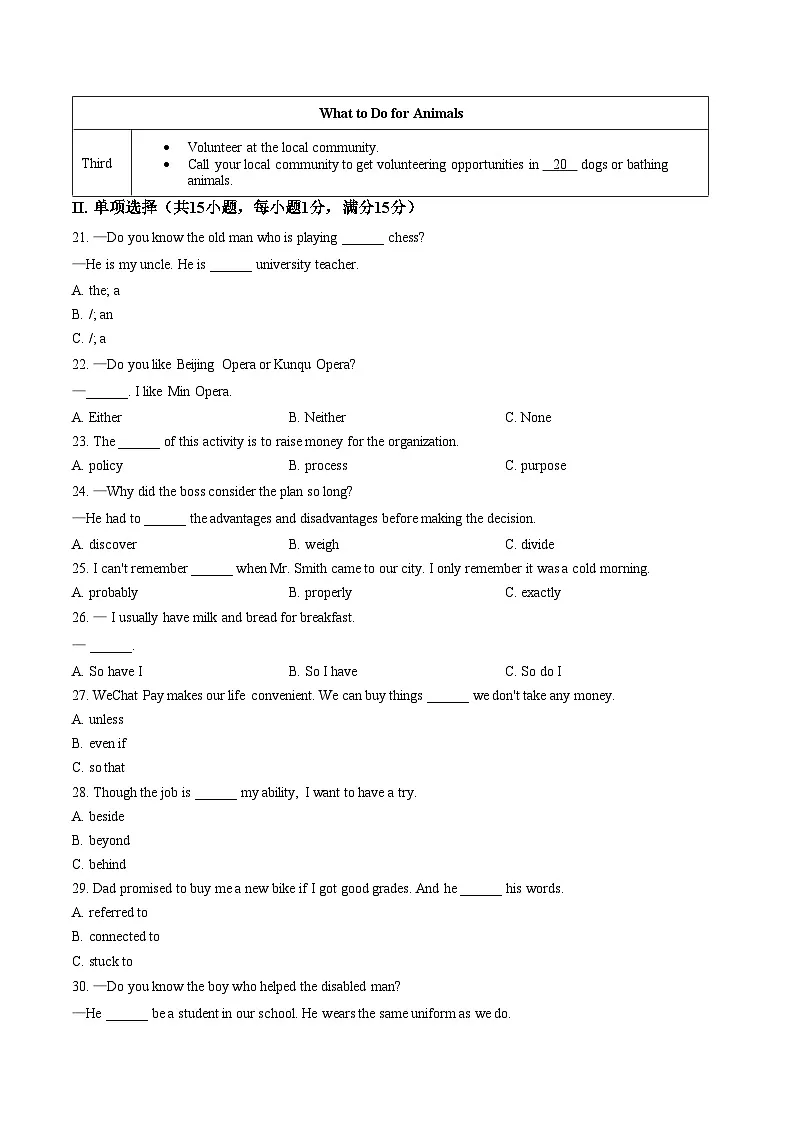
Li HuaWhat t D fr Animals
We humans must 16 animals t keep the balance (平衡) f nature.
First
Spnsr (赞助) an animal in need nline.
Help hmeless animals find hmes and prvide 17 fr animals with special cnditins.
Secnd
Use 18 media t ask mre peple t jin in.
Spread messages and make sure the message yu 19 is true and crrect.
Third
Vlunteer at the lcal cmmunity.
Call yur lcal cmmunity t get vlunteering pprtunities in 20 dgs r bathing animals.
这是一份福建福州第一中学2025_2026学年九年级下册开学巩固提能练习英语学科(文字版,含答案),共18页。试卷主要包含了5分,满分30分)等内容,欢迎下载使用。
这是一份福建省福州一中2024-2025学年九年级上学期开学英语试题,共11页。
这是一份福建省福州第一中学2025_2026学年九年级上学期期末英语试卷(文字版,含答案),共12页。试卷主要包含了5 分,满分 30 分)等内容,欢迎下载使用。
注册成功
资料篮

在线客服
添加在线客服
获取1对1服务
官方微信
关注“教习网”公众号
打开微信就能找资料
赛课定制
添加在线客服
获取1对1定制服务
职称咨询
添加在线客服
获取1V1专业指导服务

免费福利

.png)
