 免费领取教师福利


若您为此资料的原创作者,认为该资料内容侵犯了您的知识产权,请扫码添加我们的相关工作人员,我们尽可能的保护您的合法权益。


这是一份北京市西城区2026年下学期九年级中考二模 英语试题(含答案),共13页。
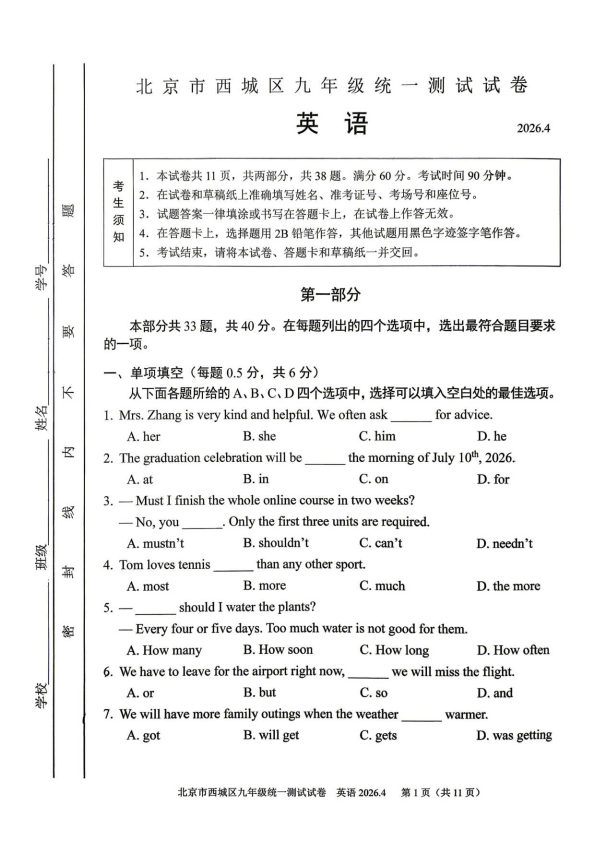
英 语2026.5
本试卷共 11 页,共两部分,共 38 题。满分 60 分。考试时间 90 分钟。
在试卷和草稿纸上准确填写姓名、准考证号、考场号和座位号。
试题答案一律填涂或书写在答题卡上,在试卷上作答无效。
在答题卡上,选择题用 2B 铅笔作答,其他试题用黑色字迹签字笔作答。
考试结束,请将本试卷、答题卡和草稿纸一并交回。
考生须知
第一部分
本部分共 33 题,共 40 分。在每题列出的四个选项中,选出最符合题目要求的一项。
一、单项填空(每题 0.5 分,共 6 分)
从下面各题所给的 A、B、C、D 四个选项中,选择可以填入空白处的最佳选项。
—Is this blue bttle yurs?
—N, is white.
A. myB. mineC. yurD. yurs
I bught a dress my mm n Mther’s Day.
A. nB. atC. frD. in
Yu speak ludly in the library. It’s against the rules.
A. mustB. needn’tC. culdD. shuldn’t
This is bk I’ve ever read. It intrduces Chinese histry in a fun way.
A. the mst amazing B. mre amazingC. mst amazingD. amazing
— d yu plan t travel this summer vacatin?
—I’m thinking abut smewhere cl.
A. WhyB. WhenC. WhD. Where
The basketball game was really difficult, ur team didn’t give up.
A. butB. sC. rD. fr
My grandmther takes a walk every day. She the habit twenty years ag.
A. was develpingB. develpedC. has develpedD. develps
—I’m nervus abut the speech.
—Take it easy. I’m sure yu a great jb tmrrw.
A. didB. have dneC. will dD. d
S far, Tm at the lcal nursing hme fr tw years, and he will cntinue t d s in the future.
A. will vlunteerB. vlunteeredC. has vlunteeredD. vlunteers
—Have yu seen Tny?
—Yes. He ftball when I passed by the playgrund just nw.
A. is playingB. was playingC. will playD. played
We will send yu an e-mail if yur article .
A. will acceptB. acceptsC. will be acceptedD. is accepted
—D yu knw n the far side f the mn?
—On January 3, 2019.
A. when Chang’e-4 landedB. when Chang’e-4 lands
C. when did Chang’e-4 landD. when des Chang’e-4 land
二、完形填空(每题 1 分,共 8 分)
阅读下面的短文,掌握其大意,然后从短文后各题所给的 A、B、C、D 四个选项中,选择最佳选项。
Maya was a perfectinist. Her wrld was beautifully 13 . Her ntebks were clearly rganized by clr, her desk was always clean, and her scks were always a perfect, matching pair. Hwever, her best friend, Chle, was her 14 . Chle’s backpack was a black hle f frgtten papers and unfinished art prjects. Yet, their friendship was perfect because they balanced each ther ut.
One Mnday mrning, Maya verslept. She raced thrugh her mrning activities. Withut checking carefully, she grabbed (抓起) tw dark scks, put them n and 15 ut f the dr. It wasn’t until she was sitting in her first-perid class, feeling prud f having made it n time, that she mindlessly lked under her desk. The scks n her feet were different! A wave f heat rushed t her face. She spent the whle lessn 16 her feet under her chair, believing that every wrd and laugh
was abut her mismatched feet.
At lunch, she sat next t Chle. “I might as well g hme nw,” she said, finally telling Chle abut her mismatched scks. Chle stared (凝视) fr a secnd and said, “That’s wnderful! I lve it! It’s like yur 17 are having an argument!”
“We shuld start a trend (潮流)! Let’s make tmrrw ‘Mismatched Sck Day’!
I’ll tell everyne! It must be fun!”
Maya thught her friend had lst her mind. “N ne will d it.”
But Chle was already n her phne, her fingers flying acrss the screen, 18 their whle grade and psting n the class scial page. The whle grade respnded (回应) quickly and psitively.
The next day, Maya 19 put n mismatched scks. She walked int schl with her head dwn, prepared t be laughed at. But t her surprise, there were flwers and animals, plka dts and stars, knee-highs and shrt scks—all prudly mismatched. Even her histry teacher had ne sck with cats and anther with
dgs. Peple were laughing, pinting at each ther’s feet, and high-fiving.
plka dt
Maya lked dwn at her wn crazy scks and felt a huge smile spread acrss her face. She realized she had been hiding behind the idea f “ 20 ” fr s lng. That day, she learned that true cnfidence is abut being brave enugh t be a little different, and smetimes, the best ideas are the imperfect nes that bring everyne tgether in laughter.
13. A. bright
B. timed
C. rdered
D. simple
14. A. ppsite
B. match
C. supprter
D. cmpetitr
15. A. lked
B. stle
C. reached
D. flew
16. A. feeling
B. shaking
C. hiding
D. cmparing
17. A. feet
B. shes
C. classmates
D. fingers
18. A. answering
B. messaging
C. pleasing
D. encuraging
19. A. prudly
B. unwillingly
C. independently
D. carelessly
20. A. psitivity
B. cnfidence
C. creativity
D. perfectin
三、阅读理解(每题 2 分,共 26 分)
(一)下图展示了学校为学生提供的四个职业体验工作坊。请根据三名学生的喜好及需求,匹配最适合他们的工作坊,并将其所对应的选项(A、B、C、 D)填在相应位置上。其中一个选项为多余选项。
A
David 21.
I lve t learn thrugh explratin. Visiting museums has always been ne f my hbbies. If I culd becme a museum guide ne day, I’m sure I wuld be able t give visitrs the best- ever experiences!
Actually, I haven’t decided what I want t d in the future. But I’m very interested in ding scientific research. I like finding truth thrugh experiments. I’m excited t have a chance t talk with a scientist.
Alice 22.
It’s cl t share infrmatin frm all ver the wrld with the public. That’s why I want t be a news reprter. I’m lking frward t learning abut the wrk f a news reprter in persn this time.
Mike 23.
(二)阅读下列短文,根据短文内容,从短文后各题所给的 A、B、C、D
四个选项中,选择最佳选项。
B
Mrs. Lee’s garden was the mst beautiful place n Parks Street. It was a living painting that changed with the seasns. T the neighbrhd, it was a symbl f peace and beauty, but t a grup f teenagers, led by a bred and restless by named Mark, it was a target (目标).
They picked flwers, kncked dwn the
fence
fence, and threw empty cans. The plice suggested that Mrs. Lee shuld build a taller fence, but she had a different idea, brn nt frm anger, but frm a deep understanding f lneliness.
One Saturday, she saw Mark and his friends n the playgrund. Taking a deep breath, she walked ver, a basket in her hand. “My rses are being attacked by insects,” she said calmly. “I need sme strng hands t help me put sapy (肥皂的) water n them. I just made sme apple pies. Wuld yu like t help me and have a snack?” Mark and his friends were surprised. Free pies? They were nt sure, but they fllwed her.
In the garden, she shwed them hw t make the sapy water. She tld them the names f the flwers and the bees that visited them. They wrked in silence at first, but Mrs. Lee’s calm presence slwly relaxed them. In her garden, they ate pies and drank tea. She asked them abut schl, abut their music, listening with real interest. A strange feeling grew inside them. They were treated as helpers.
Mark started cming by after schl, smetimes with friends, smetimes alne, t see if Mrs. Lee needed anything. One evening, Mark saw a yunger by frm the neighbrhd aiming a kick at the fence. “Hey!” Mark shuted, running ver. “Watch it! There are bees in there!” The yunger by ran ff. Mark std there fr a mment, realizing with shck that he was nw prtecting the garden.
Mark didn’t receive a lecture (训斥) abut right and wrng frm Mrs. Lee. Instead, he received respnsibility, trust, and the sweet taste f apple pies. He learned that anger builds walls, but kindness builds bridges. Mrs. Lee taught him that frgiveness (原谅) isn’t abut frgetting the harm; it’s abut planting smething new and beautiful in the messed-up sil.
What did the neighbrhd see Mrs. Lee’s garden as?
A place fr painting.B. A new playgrund.
C. A symbl f peace and beauty.D. A messed-up target.
Why did Mark feel shcked after the yunger by ran ff?
Because the bees were attacking the by.
Because Mrs. Lee had asked fr his help.
Because the fence had suddenly fallen dwn.
Because he realized he was prtecting the garden.
What did Mark learn abut frgiveness frm Mrs. Lee?
It cmes after smene says srry.
It gives smene a chance t grw.
It means letting g f the pain f the past.
It is abut telling thers right frm wrng.
C
In 2025, researchers frm the UK published a finding that humanity’s cnnectin t nature has drpped by ver 60% since 1800.
This has serius utcmes fr ur ability t slve envirnmental prblems. Our persnal ties with nature can shape hw we take care f ur lcal envirnments and hw we act n bigger prblems like climate change. Discnnectin frm nature als influences ur shared future in less nticeable ways. Our persnal relatinship with the natural wrld is necessary fr ur mental (心理的) health and even ur cnnectin t ne anther. In an age f rising distrust and lneliness, we need cnnectin t nature mre than ever.
What It Means t Belng in Nature
Belnging is nt nly abut scial cnnectin. It’s als abut hw we’re cnnected t the physical wrld.
As recent studies shw, spending time in green and blue spaces lwers stress, imprves sleep, and helps children with attentin and creativity. Time in natural settings is als necessary t ur ability t cnnect. When we’re cut ff frm natural settings, it’s hard t really listen, t care, r t put urselves in anther persn’s shes. What’s mre, nature can ffer us sensry richness and a sense f awe (敬畏), which als strengthens ur ability t cnnect.
Is It Pssible t Turn Things Arund?
We need t restre ur ties with nature, but we als need t d smething much mre fundamental (根本的). We need t fall back in lve with the natural wrld. It’s abut respnsible dependence. We depend n ur places, s we we (欠) them ur care. T belng in nature is t be in relatinship. That means receiving gifts frm the lands and waters where we live, while taking respnsibility fr their lng-term well- being. This is a relatinship that we call “reciprcal.” And that’s what belnging is all abut.
Then hw d we return t this relatinship with nature? I’ve seen many slutins. Fr example, there is a land-based prject in Canada that teaches fishing, natural medicine, and lcal histry alngside traditinal language, which rebuilds a lived relatinship t hme while passing respnsibility frm elders t their children.
There are many practical examples that are scalable (可扩展的) arund the wrld. Cities shuld spend mre n street trees, pcket parks, and safe wildlife passages. Schls and cmmunities shuld cnsider early-childhd prgrams: frest and gardening educatin, and ways fr parents t help their kids learn abut nature.
Of curse, the wrk f falling back in lve with nature is up t each ne f us. It’s valuable t have ur wn practices f paying attentin and finding cnnectin t the place we call hme. Belnging is abut feeling ur place in the greater whle.
What can we learn abut the human-nature cnnectin frm the passage?
Creative children usually cnnect with nature mre easily.
Discnnectin frm nature weakens ur ability t relate t thers.
T belng in nature requires us t build mre scial cnnectins.
Rising distrust and lneliness are caused by lsing tuch with nature.
What des the wrd “reciprcal” in Paragraph 5 mst prbably mean?
Benefiting each ther.B. Ging ne-way.
C. Wrking independently.D. Changing all the time.
Hw des the writer develp his ideas in this passage?
State an idea → Prve it with examples → End with an pinin
Intrduce tw cases → Explain differences → Give a final pint
Present a prblem → Explain why it matters → Offer ways t slve it
Shw a prblematic event → Describe causes → Make predictins
D
like buttn
Stella Smith
Yu’ve prbably pressed a like buttn many times tday, r kept checking what yu psted as the like cunt rises. But why d we like the like buttn s much?
In 2018, neurscientist Lauren Sherman and her team studied that questin. They asked 58 teens t chse sme phts they
had psted recently. Each teen then viewed the phts chsen by the whle grup n a specially-designed scial media that included a like buttn. They did s while lying in an fMRI (功能磁共振成像) machine, which allwed researchers t see if the brain lit up when they hit the like buttn—and if s, what parts f it.
Sure enugh, there was activity, and a lt f it. In the experiment, when teens saw their wn phts with many likes, their brains shwed activity in many different areas. Ntably, Sherman als fund that viewing phts with many (cmpared with few) likes was related t greater brain activity. That means we dn’t just like t receive likes; we als like things mre when ther peple have liked them.
Why d we like likes s much? Accrding t Nichlas Christakis, a scilgist at Yale University, it is because “the like buttn is built n the back f evlutinary (进化的) bilgy.” All animals learn and evlve as they interact with a challenging wrld, frm experience they get thrugh trying and making mistakes, but nly certain primates (灵长类动物) have the ability t learn frm thers’ experience. This scial learning allwed early humans t raise their chances f survival by aviding mistakes they saw thers making, and cpying the successful mves.
This helps explain why human beings have the preference fr “mild hierarchy” (轻微等级制度). In the animal wrld, animals becme leaders by frce. Humans, hwever, recgnize the ne frm whm they learn mst as the leader. Members fllw standut perfrmers cnsidering what they have dne and hw well they share the lessns t be taken frm their experience.
The evlved scial learning ability als helps develp ur habits f expressing thankfulness. Because we are willing t keep learning, we shw thankfulness in a way that encurages thers t keep sharing. Fr example, we give likes t their psts. In turn, they respnd t the likes they receive. It’s what keeps us sharing what we discver.
All this explains why we have evlved t enjy liking and being liked. What has been chsen in human evlutin is nt just physical characteristics, but als
urges (冲动) and feelings.
And this is the very deep psychlgical (心理的) area the like buttn was able t tap in t. Seeing likes cme in gives us pleasure. Giving a like, knwing it will make smene happy, als makes us feel gd. This is the key t the rise f the like buttn: Its ppularity has very much t d with smething fundamental in ur bilgy.
Why des the writer intrduce the experiment in Paragraph 2 and 3?
T explain why seeing likes causes brain activity.
T prve that liking behavir is supprted by bilgy.
T suggest a bilgical methd t study brain activity.
T stress the difference between giving and receiving likes.
Accrding t the passage, what might scial learning allw peple t d?
Respect thse wh rise t the tp by frce.
Make mre knwledgeable friends by giving likes.
Use likes t encurage sharing what can be learned.
Survive better by telling thers hw t crrect mistakes.
Which f the fllwing wuld the writer mst prbably agree with?
Liking behavir results frm the evlutin f scial media.
Human’s scial learning ability evlved first t chse leaders.
Seeing ur liked phts causes greater brain activity than seeing thers’.
The pleasure f liking and being liked has ppularized the like buttn.
Which f the fllwing is the best title fr this passage?
Humans Evlved t Like Likes
The Evlutin f Ways t Give Likes
The Like Buttn Evlved with the Times
Liked by Others: Human Evlutin’s Driving Frce
第二部分
本部分共 5 题,共 20 分。根据题目要求,完成相应任务。四、阅读表达(第 34-36 题每题 2 分,第 37 题 4 分,共 10 分)
阅读短文,根据短文内容回答问题。
The heart f learning is tranquility (宁静), nt excitement.
We ften cnnect the idea f learning with the mments f inspiratin and excitement. But these mments dn’t last. True learning happens in the quiet, daily steps we take. The key is t stay cnsistent (一贯的) withut being burned ut by the
pressure f achieving quick results. The mst meaningful learning takes place in the space between pushing t hard and ding nthing. It’s abut finding the balance.
Learning is nt a race but a jurney. It requires patience.
Set realistic gals and increase the difficulty f what yu learn ver time. This way, yu can make prgress withut frcing it.
Learning requires the curage t bear bredm, which is what leads t mastery. The repetitin f small tasks is the true training grund fr develping expertise (专长). Whether reading the same unit again r practicing the same skill, cnsistency is key. The true value f learning lies in making daily effrt and cntinuing withut expecting quick results. This is what results in mastery.
S hw t learn with tranquility? It’s imprtant t set a clear gal and break dwn the learning tasks int smaller, manageable nes which shuld be clear and achievable. Remember t fcus n prgress, nt perfectin, and allw yurself t make mistakes withut feeling ashamed.
As yu fllw the crrect methd, each step builds upn the last. There’s n need t rush—step by step, calmly, yu’ll make prgress. True grwth begins with acceptance— recgnizing where we are and where we need t g. By accepting where we are, we can plan ur next steps calmly and effectively, withut the need t frce change.
Learning is nt abut running away frm ur prblems but dealing with them. When we accept the challenges and discmfrts f ur learning jurney and take actin, we develp resilience (韧性).
Frm this fundatin (基础), we can shape the future, ne step at a time. When we understand that change takes time and requires patience, we’ll stp expecting quick results and fcus n ur prgress.
Accrding t the passage, what is the heart f learning?
What kind f curage des learning require?
When will we stp expecting quick results and fcus n ur prgress?
T learn with tranquility, what ways wuld yu like t try? Explain hw these ways benefit yu. (Please give tw ways.)
五、文段表达(10 分)
从下面两个题目中任选一题,根据所给的中文和英文提示,完成一篇不少于
50 词的英语文段写作。文中已给出内容不计入总词数。所给提示词语仅供选用。请不要写出真实的校名、姓名和地名。
题目①
某国际青少年健康组织将与你校联合举办“健康生活”主题活动,现面向学生征集方案。假设你是李华,你为此调查了学生最想了解的健康生活内容(下图是部分统计结果)。请你用英文给该组织写一封邮件,简要分析调查结果,并针对
同学们感兴趣的某. 一. 方. 面. 提出具体活动方案。
What d yu want t learn abut healthy living?
提示词语:balanced, invite, grup, share, practical
内容提示:•What have yu learned frm the results?
What activity d yu suggest based n the results?
Dear Sir/Madam,
I did a survey n what students in my schl want t learn abut healthy living.
I hpe my idea can be cnsidered. Thanks.
Yurs, Li Hua
题目②
初中三年匆匆而过。回首来路,你也许曾战胜过胆怯,也许曾为梦想努力拼搏……这一路,你应该感谢自己。某英文网站正在举办以“谢谢你,曾经的自己”
为主题的征文活动。假设你是李华,请用英文写一篇短文投稿,讲述一次你想感谢自己的经历,并说明为什么感谢当时的自己。
提示词语:encurage, cnfident, brave, success, imprve
内容提示:•Describe a time when yu wanted t thank yurself.
Why d yu want t thank yurself?
Lking back n the past three years, there’s a time when I truly wanted t
thank myself.
这是一份2022届北京市西城区九年级中考二模英语试题(含答案),共13页。试卷主要包含了单项填空,完形填空,阅读理解,阅读表达,文段表达等内容,欢迎下载使用。
这是一份2026年北京市西城区中考二模考试英语试题(无答案),共11页。
这是一份2022届北京市西城区九年级二模英语试题(含答案),共10页。试卷主要包含了单项填空,完形填空,阅读理解,阅读表达,文段表达等内容,欢迎下载使用。
注册成功
资料篮

在线客服
添加在线客服
获取1对1服务
官方微信
关注“教习网”公众号
打开微信就能找资料
赛课定制
添加在线客服
获取1对1定制服务
职称咨询
添加在线客服
获取1V1专业指导服务

免费福利

.png)
.png)
.png)
