 免费领取教师福利


若您为此资料的原创作者,认为该资料内容侵犯了您的知识产权,请扫码添加我们的相关工作人员,我们尽可能的保护您的合法权益。


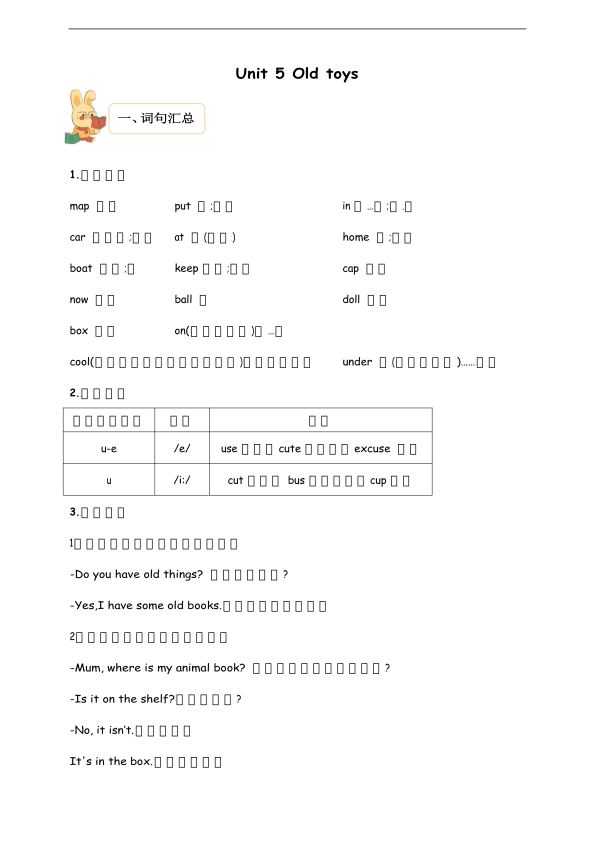
这是一份小学英语人教版PEP(2024)三年级下册(2024)Unit 5 Old things同步测试题,共7页。试卷主要包含了方位介词的归纳及具体用法2,have的用法4,综合训练等内容,欢迎下载使用。
· 内容导航 ·
1.方位介词的归纳及具体用法2.询问物品位置的特殊疑问句及其答句
3.have的用法4.确认某物是否在某处的句型
5.综合训练
高频易错点、易错点提示、小练笔、答题点拨
易错精讲
高频易错点01
方位介词的归纳及具体用法
方位介词在句子中用于表示名词或代词与其他词之间的关系,帮助明确物体或人的位置。以下是小学英语中常见方位介词的归纳和用法总结:
易错点提示
1.镶嵌在墙里的物品,如门、窗等用in。
2.挂在墙上的物品,如地图、字画等用n。
3.长在树上的东西用n,站在或落在树上的东西用in。
4.at用在比较小的地方,in用在比较大的地方。
小练笔 01
一、看图,选择正确的方位介词补全句子。
A.under B.n C.in D.near E.behind
1.Lk! The cmputer (电脑) is __________ the teacher's desk.
2.The windw is __________ the dr.
3.The desk is __________ the light(灯).
4.The schl bag is __________ the desk.
5.The chairs are __________ the desks.
二、根据所给图片,判断句子正(T)误(F)。
( ) 1.The bks are in the bag.
( ) 2.The picture is n the wall.
( ) 3.The bk is under the desk.
( ) 4.The chair is near the desk.
( ) 5.We can see tw black bards in the classrm.
高频易错点02
询问物品位置的特殊疑问句及其答句
where表示“在哪里”,常用来询问地点,构成特殊疑问句。
例如:—where is my animal bk?—我的动物书在哪儿?
—It's in the bx.—在盒子里。
·“Where’s ”句型用于询问单数的人或物品在什么地方,回答视所询问的内容而定。
如果是物品,就用 “It’s +地点.” 回答;如果是人,则用 “He/She is +地点.” 回答。
典例: —Where is yur cap? 你的帽子在哪里?
—It’s n the sfa. 它在沙发上。
—Where’s yur brther? 你弟弟在哪里?
—He’s in the bedrm. 他在卧室里。
·“Where are ” 句型也是用于询问物品或人在什么地方,但询问的物品或人是复数形式,其回答也用复数形式 “They’re + 地点.”。
典例: —Where are the bys? 男孩子们在哪里?
—They’re in the classrm. 他们在教室里。
注意:其中where’s = where is。
易错点提示
注意区分:
Where引导的特殊疑问句是对单数物品提问还是对复数物品提问
小练笔 02
一、单项选择。
( )1.—__________ are yu frm? —I'm frm China.
A. What B. Where C. Wh
( )2.—__________ Mr Lin? —He is in the classrm.
A. Wh's B. Where C. Where's
( )3.—Where are yur pens? —__________
A. It's in the bag. B. They're black. C. They're in my bag.
二、将下列句子排列成一段通顺的对话。
A. He's in the bedrm.
B. Is that yur ruler?
C. Lk! What's that ver there?
D. Where's Jim?
E. N, it isn't. It's Jim's.
F. It's a ruler.
G. Let's g and find(找到) him.
三、对画线部分提问。
1. The bk is under the bag.
the bk?
2. The students are in the z.
the students?
高频易错点03
have的用法
➊ have意为“有”,表达某人拥有某种物品,强调“所属关系”。
当 have 后面的可数名词是单数时,名词前要加 a/ an或 ne;
当have后跟不可数名词或可数名词复数时,名词前可用sme,也可用具体的数词tw, three等。
如: have a pear 有一个梨子have an egg 有一个鸡蛋
have sme tea有一些茶have sme grapes 有一些葡萄
❷ 句型“I have …”意为“我有……”。它的否定句为“I dn’t have...”,意为“我没有……”。如:
I have sme apples. 我有一些苹果。
I dn't have any apples. 我没有一些苹果。
❸ 句型“ D yu have ”意为“你有⋯⋯吗”。
该句型的肯定回答是“ Yes,I d.”,否定回答是“ N, I dn’t.”。
如: —D yu have a ruler?你有一把尺子吗? —Yes,I d. 是的,我有。
—D yu have any manges?你有一些芒果吗? —N, I dn't. 不,我没有。
易错点提示
注意have的三单形式has,两者用法不同:
have:用于第一人称(I/we)、第二人称(yu)和复数主语(they/parents/vegetables等),表 “吃、喝、拥有”。
has:用于第三人称单数主语(he/she/it/ 单个人名 / 单数名词),表 “吃、喝、拥有。
如: She has a strybk.她有一本故事书。
小练笔 03
一、用所给词的适当形式填空。
1. ________(d ) yu have a pen?
2. He ________( d nt ) have any bks.
3. Des Lisa ________(have) breakfast?
4. My sister ________( have) sme tys.
二、单项选择。
( )1. I ________ sme manges.
A. have B. like C. wuld
( )2.—D they have ________ rulers?
—Yes, they d.
A. any B. sme C. a
( )3. I ________ have any fruit.
A. isn't B. nt C. dn’t
高频易错点04
确认某物是否在某处的句型
—Is it n the shelf? —N, it isn't.—它在货架上吗?—不,不在那里。
—Is it in the bag? —Yes, it is.—在袋子里吗?—是的,在里面。
易错点提示
“ Are...+介词短语?”句型用于询问某(些)人或物是否在某处。这里的介词短语用来表达地点或位置,一般由“介词+名词”构成。
如果询问的主语是单数,用 “Is...+介词短语?”句型,其答句为 “Yes, he/ she/ it is./ N, he/ she/ it isn't.”;
如果询问的主语是复数,则用“Are…十介词短语?”句型,其答句为 “Yes, they are./ N, they aren't.”。
如:—Is yur bk in the desk?你的书在课桌里吗? —Yes, it is. 是的,它在。
—Is Su Hai in the bathrm?苏海在卫生间里吗?
—N, she isn't. She's in the kitchen.不,她不在。她在厨房里。
—Are they in yur bedrm?它们在你的卧室里吗?
—Yes, they are. 是的,它们在。
小练笔 04
一、看图,完成对话。
1.—________ the ________ n the ________? —Yes, it is.
2.—________ yur mther in the living rm?
—N, she ________. She’s ________ the ________.
3.—________ the cat ________ the ________?
—Yes,________ ________.
二、按要求完成句子。
1. The dgs are under the table.(改为一般疑问句,并作否定回答)
—________ the dgs under the table?
—________, they ________.
2. The bird is beside the windw.(改为一般疑问句,并作肯定回答)
—________ the bird beside the windw?
—Yes, ________ ________.
综合训练
选词填空。
1.— (Is / Are) yur map n the wall? —Yes, it is.
2.I have ten animal (bk / bks).
3.— (D / Are) yu have ld things at hme? —Yes.
4.—D yu have pencils in the bx?
—N, but I have pens. (any / sme)
5.Let’s (cut / cuts) the cake.
单项选择。
( )6.There are many ducks ______ the lake.
A.atB.nC.t
( )7.The ball is ________the chair.
A.nB.underC.in
( )8.—Is it n the bx? —________ It’s in the bx.
A.Yes, it is.B.Yes, he is.C.N, it isn’t.
( )9.—________ is the ball? —It’s n the map.
A.WhB.WhatC.Where
( )10.—D yu have ld things?
—_________ I have sme ld tys and bks.
A.N, I dn’t.B.Yes, it is.C.Yes, I d.
( )11.—Is it n the bx? —______
A.Yes, it is.B.N, it is.C.Yes, it isn’t.
( )12.—Where is my bk? —______
A.It’s n the shelf.B.It’s green.C.It’s an elephant.
( )13.—D yu have ld things? —______
A.OK. I dn’t.B.Yes, I dn’t.C.N, I dn’t.
( )14.—Is it n the shelf? —_________
A.N, it isn’t.B.N, I dn’t.C.N, I’m nt.
( )15.—Where is my pen? —_________
A.I have a pen.B.It’s five yuan.C.It’s under the bag.
Amy准备收拾自己的房间。根据图片,选择合适的单词补全句子。
16.The red car is the bed.
17.The bks are n the .
18.—Is the bat the shelf? —Yes, it is.
19.Amy’s is in the ty bx.
20.Amy has many ld things her rm.
A.OK.
B.N, it isn’t.
C.They’re bats.
D.Yes, I d.
E. Yes, they are.
Amy与 Sarah正在交谈。为下列句子选择合适的答句。
( )21.D yu have any ld things?
( )22.Is it n the chair?
( )23.Are the rulers n the bk?
( )24.Put yur ld things in a bx.
( )25.What are these?
一顶顶帐篷成了欢乐的驿站,朋友们穿梭于彼此的帐篷间,欢笑声此起彼伏!选择正确的选项补全对话。
A.Are they in yur ty bx?
B.Yes. I have sme dlls and balls.
C.Let’s bunce the balls.
D.They are n the shelf.
E.Thank yu. I like bananas.
A: Welcme t my tent(帐篷). Have sme bananas.
B: 26 D yu have any ld tys?
A: 27
B: Hw many balls d yu have?
A: Tw. 28
B: Great! Where are they? 29
A: N, they aren’t. 30
Huahua去找Lnglng玩,Lnglng在整理自己的旧物,他准备将这些旧物充分利用起来。选择合适的单词填空,补全短文。
Hi, I’m Lnglng. I find a ty car and a ty 31 under the desk. They are 32 gd. I can give them t my cusin Ne.
I find pencils and erasers in the 33 . The pencils are shrt. The erasers are small. I can make a picture 34 them.
I find sme ld bks n the shelf. They are still gd. I can 35 them in the bk crner.
连词成句。
36.grandfather’s, it, watch, is (.)
37.bat, is, ty, my, where, (?)
38.sme, I, tys, have, ld (.)
39.n, bk, shelf, the, is, the (.)
40.yu, things, hme, have, d, ld, at (?)
阅读短文,选择正确的答案。
Hi, I’m Lily. I have many ld things at hme. Tday I find my ld dll in the bx. But it has ne arm, ne leg and n clthes. I lve the dll s much. I need sme help. I need an arm and a leg fr my dll. Tim helps me. He has an ld rbt’s arm and leg. Mary helps me t. She has an ld ty bear. She gives me the clthes f the ty bear. It’s a blue dress(连衣裙). Nw my dll is cmplete.
( )41.Where is the ld dll?
A.It’s in the bag.B.It’s in the bx.C.It’s under the bx.
( )42.Lily’s dll has n _____.
A.legsB.clthesC.arms
( )43.The dll’s arm and leg are frm _____.
A.Tim’s ld rbtB.Mary’s dllC.Mary’s ld ty bear
( )44.The wrd “cmplete” means “_____” in Chinese.
A.完整的B.新的C.漂亮的
Huahua在图书馆发现一本名为《变废为宝》的绘本。根据绘本内容,完成下列任务。
45.给绘本选择合适的图片,并将序号填到(1)、(2)题的横线上。
A. B. C.
(1)
(2)
46.阅读绘本,判断句子正(T)误(F)。
( )(1) We can’t plant flwers in an ld bttle.
( )(2) If (如果) we have sme ld bttles, we can clean the windw with them.
( )(3) Old things are nt useful.
( )(4) We can use ld things in new ways.
47.阅读绘本,根据图片提示,补全句子。
We can use sme ld t make a .
参考答案
小练笔 01
一、1~5BDACE
二、1~5TTFTF
小练笔 02
一、1.B 2.C 3.C
二、F B E D A G
三、1.Where is 2.Where are
小练笔 03
一、1. D 2. desn't 3. have 4. has
二、1~3 A A C
小练笔 04
一、1. Is, cap, table 2. Is, isn't, in, kitchen 3. Is, n, sfa, it is
二、1. Are, N, aren't 2. Is, it is
解析:1.含 are的肯定句改一般疑问句时,应将 are提到句首,肯定回答应是: N,… aren't.
2.含is的肯定句改一般疑问句时,应将is提到句首,肯定回答应是: Yes,… is. the bird用it代替。
综合训练
1.Is 2.bks 3.D 4.any sme 5.cut
6~10 BBCCC 11~15 AACAC
16.under 17.shelf 18.n 19.dll 20.in
21.D 22.B 23.E 24.A 25.C
26.E 27.B 28.C 29.A 30.D
31.bat 32.still 33.bx 34.with 35.put
36.It is grandfather’s watch.
37.Where is my ty bat?
38.I have sme ld tys.
39.The bk is n the shelf.
40.D yu have ld things at hme?
41.B 42.B 43.A 44.A
【导语】本文讲了玩具。
41.句意:旧玩具娃娃在哪?A它在包里。B它在箱子里。C它在箱子下面。根据“Tday I find my ld dll in the bx.”,可知在箱子里,故选B。
42.句意:莉莉的玩具娃娃没有______。A腿,B衣服,C胳膊,根据“ But it has ne arm, ne leg and n clthes.”,可知有一只胳膊,一条腿和没有衣服,故选B。
43.句意:玩具娃娃的胳膊和腿来自______。A蒂姆的旧机器人,B玛丽的玩具娃娃,C玛丽的旧玩具熊,根据“He has an ld rbt’s arm and leg. ”,可知来自蒂姆的旧机器人,故选A。
44.句意:单词“cmplete”的中文意思是“_______”。根据短文语境可知意思是完整的,故选A。
45.C A 46.F F F T 47.paper kite
【导语】本文主要讲述的是《变废为宝》绘本内的把旧物变废为宝的方式。
45.(1)根据句子“We can use an ld shirt t make a bag.”,可知我们可以用旧衬衣做一个包,C图是包,与句子匹配,故选C。
(2)根据句子“We can use an ld bx t make a huse fr cats.”,可知我们可以用一个旧箱子给猫做一个房子,A图是一个房子,与句子匹配,故选A。
46.(1)句意:我们不能在旧瓶子里种花。根据句子“We can use an ld bttle t plant flwers.”,可知我们可以在旧瓶子里种花,题干与短文不符,故答案为F。
(2)句意:如果我们有一些旧瓶子,我们可以用它们来擦窗户。根据句子“We can use ld newspapers t clean the windw.”,可知我们可以用旧报纸擦窗户,题干与短文不符,故答案为F。
(3)句意:旧东西没用。根据句子“We can use an ld bttle t plant flwers.”、“We can use an ld shirt t make a bag.”、“We can use an ld bx t make a huse fr cats.”和“We can use ld newspapers t clean the windw.”,可知旧东西很有用,题干与短文不符,故答案为F。
(4)句意:我们可以用新方式利用旧物。根据短文大意,可知我们可以用新方式利用旧物,把旧物变废为宝,题干与短文相符,故答案为T。
47.句意:我们可以用一些旧的_____制作一个_______。根据句子图片可知我们可以用旧纸做一个风筝,纸paper,风筝kite,故答案为paper;kite。C
第1题图
第2题图
第3题图
dll shelf n in under
still bx bat put with
We all have ld things. Hw t make them useful again?
We can use an ld bttle (瓶子)t plant flwers.
We can use an ld shirt t make a bag.
We can use an ld bx t make a huse fr cats.
We can use ld newspapers t clean the windw.
We can use sme ld t make a
这是一份小学英语人教版PEP(2024)三年级下册(2024)Unit 5 Old things同步测试题,共7页。试卷主要包含了方位介词的归纳及具体用法2,have的用法4,综合训练等内容,欢迎下载使用。
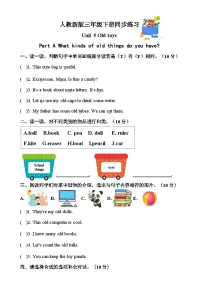
这是一份人教版PEP(2024)三年级下册(2024)Unit 5 Old things当堂达标检测题,共14页。试卷主要包含了many的用法2,字母组合 “u-e”的发音4,put的用法6,综合训练等内容,欢迎下载使用。
这是一份小学英语人教版PEP(2024)三年级下册(2024)Unit 5 Old toys课后作业题,共5页。试卷主要包含了辨音题,看图写单词,看图,选择正确的单词,补全对话,选择正确的答案,情景题,给下列图片选择相应的句子,从方框中选择正确的选项补全对话等内容,欢迎下载使用。
注册成功
资料篮

在线客服
添加在线客服
获取1对1服务
官方微信
关注“教习网”公众号
打开微信就能找资料
赛课定制
添加在线客服
获取1对1定制服务
职称咨询
添加在线客服
获取1V1专业指导服务

免费福利

.png)
.png)
