免费领取教师福利
若您为此资料的原创作者,认为该资料内容侵犯了您的知识产权,请扫码添加我们的相关工作人员,我们尽可能的保护您的合法权益。


这是一份2026届浙江省温州市高三第二次适应性考试英语试题卷及答案(有听力),文件包含译林英语高一选择性必修一Unit4ExploringPoetry词汇短语例句英译中中译英练习含答案docx、译林英语高一选择性必修一Unit4ExploringPoetry单词默写+词性转换练习含答案docx、译林英语高一选择性必修一Unit4ExploringPoetry短语背诵版docx、译林英语高一选择性必修一Unit4ExploringPoetry短语默写版docx等4份试卷配套教学资源,其中试卷共18页, 欢迎下载使用。
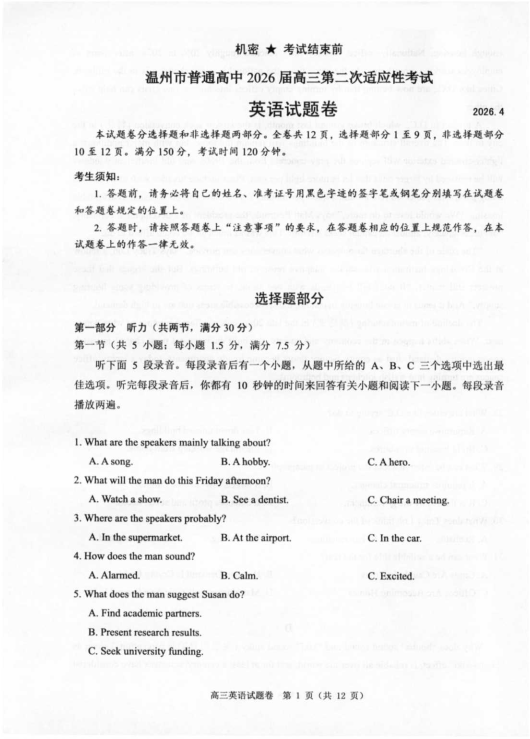
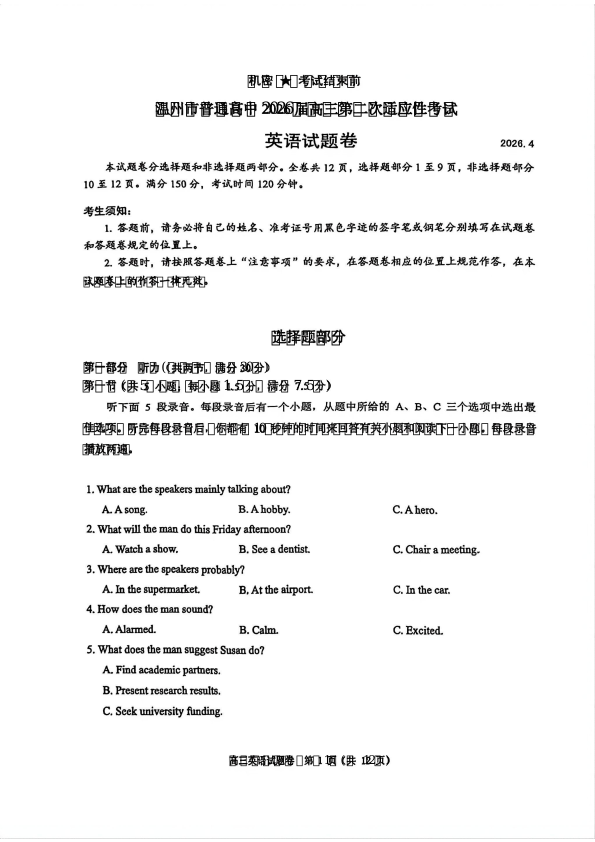
英语试题卷
2026.4
本试题卷分选择题和非选择题两部分。全卷共12页,选择题部分1至9页,非选择题部分10至12页。满分150分,考试时间120分钟。
考生须知:
1.答题前,请务必将自己的姓名、准考证号用黑色字迹的签字笔或钢笔分别填写在试题卷和答题卷规定的位置上。
2.答题时,请按照答题卷上“注意事项”的要求,在答题卷相应的位置上规范作答,在本试题卷上的作答一律无效。
选择题部分
第一部分 听力(共两节,满分30分)
第一节(共5小题;每小题1.5分,满分7.5分)
听下面5段录音。每段录音后有一个小题,从题中所给的A、B、C三个选项中选出最佳选项。听完每段录音后,你都有10秒钟的时间来回答有关小题和阅读下一小题。每段录音播放两遍。
1. What are the speakers mainly talking abut?
A. A sng.B. A hbby.C. A her.
2. What will the man d this Friday afternn?
A. Watch a shw.B. See a dentist.C. Chair a meeting.
3. Where are the speakers prbably?
A. In the supermarket.B. At the airprt.C. In the car.
4. Hw des the man sund?
A. Alarmed.B. Calm.C. Excited.
5. What des the man suggest Susan d?
A. Find academic partners.B. Present research results.C. Seek university funding.
第二节(共15小题;每小题1.5分,满分22.5分)
听下面5段录音。每段录音后有几个小题,从题中所给的A、B、C三个选项中选出最佳选项。听每段录音前,你将有时间阅读各个小题,每小题5秒钟;听完后,各小题都有5秒钟的作答时间。每段录音播放两遍。
听第6段录音,回答第6、7题。
6. What is the prbable relatinship between the speakers?
A. Neighbrs.B. Friends.C. Cwrkers.
7. What is the wman ding?
A. Selling flwers.B. Taking a class.C. Tending her garden.
听第7段录音,回答第8至10题。
8. Why des the wman talk t the man?
A. T discuss the meal plan.
B. T rder take-away fd.
C. T cmplain abut the fd.
9. What des the wman care abut regarding the fd?
A. Its healthiness.B. Its diversity.C. Its taste.
10. What des the man mean in the end?
A. The change f il is well received.
B. It’s hard t meet everyne’s needs.
C. They will g back t the ld recipe.
听第8段录音,回答第11至13题。
11. Why did Sam decide t make the shw?
A. T recrd kids’ life.
B. T cnnect kids t nature.
C. T prtect the envirnment.
12. What’s the challenge f rganizing a hike fr children?
A. Keeping kids fcused.B. Arusing kids’ curisity.C. Dealing with emergencies.
13. What des Sam intend t film next seasn?
A. A castal walk.B. A frest adventure.C. A desert hike.
听第9段录音,回答第14至17题。
14. What happened t Susan yesterday?
A. She had an accident.
B. She missed the test.
C. She was sick.
15. What is Susan asking Prfessr Davis abut?
A. The acting skills.B. The exam cntent.C. The writing assignment.
16. What des Davis ask Susan t d?
A. T attend a meeting.
B. T distribute the tickets.
C. T reschedule a theater visit.
17. Wh is Alan Altman?
A. An actr.B. A receptinist.C. A prfessr.
听第10段录音,回答第18至20题。
18. What discunt can students get fr ne bk?
A. 30%.B. 20%.C. 10%.
19. What can all students d n the spt?
A. Get small prizes.
B. Grab a free cffee.
C. Have a lucky draw.
20. What’s the purpse f this annuncement?
A. T advertise a bkstre.
B. T intrduce a bk fair.
C. T prmte new bks.
第二部分 阅读(共两节,满分50分)
第一节(共15小题;每小题2.5分,满分37.5分)
阅读下列短文,从每题所给的A、B、C、D四个选项中,选出最佳选项。
A
Turnitin is an assessment tl t check similarity fr text-based submissins. It cmpares a submitted assessment against a database f ther papers and jurnals t detect similarity. Hwever, Turnitin may be unsuitable fr sme submissins. Yu can use the wrkflw belw t help determine if Turnitin is the right tl.
● What shuld I knw?
● Settings fr Assignment details
21. What is Turnitin used fr?
A. Scanning assignments.B. Tracking academic prgress.
C. Checking text riginality.D. Assessing class perfrmance.
22. Which f the fllwing can be submitted t Turnitin?
A. A grup prject reprt.B. An individual, text-based essay.
C. A persnal English vide.D. A handwritten math assignment.
23. Where can users give assignment requirements?
A. Title.B. Instructins.C. Max Grades.D. Dates.
B
I am the wrld’s leading climate change campaigner. Well, since last mnth. That’s when we had the slar panels installed, linked t an app n my phne. Nw, wherever I am, I can pen the app and see hw much electricity we are creating and hw much we are cnsuming. Right nw, we’re exprting 2.37 kilwatts t the grid (电网). I enjy the feeling. Yes, I’m saving the planet. Mre t the pint: I’m making upwards f 10 cents an hur, DOING NOTHING.
Certainly, yu have t put in a bit f effrt. Ever since I became an energy exprter, I have been patrlling (巡逻) the huse, trying t maximize ur prductin. Of curse, I get sme cmplaints frm my wife, Jcasta, alng the lines f “I was using that light t read a bk” r “Why didn’t yu save my wrk befre turning ff my cmputer,” but I think she is grateful fr my assistance.
The nly prblem? Just last night, I turned ff everything, but we were still cnsuming 0.05 f a kilwatt. I checked the fridge. It was nt humming (哼鸣). All the verhead lights were ut. Nthing was n standby. Yet there it was. I hardly slept, my mind trying t wrk thrugh every crner f the huse.
Back at ffice, I find it hard t tear my eyes away frm the app. Right nw, it’s midday. Jcasta is at hme. I glance at the app. Oh n! Cluds verhead! Disaster! We’re nw prducing nthing. Nthing at all. And cnsumptin is suddenly thrugh the rf. We’re using up grid pwer. What’s Jcasta up t? Running a factry?
The next day, at wrk, arund midday, I check the app just t calculate hw much I’ve earned. What? Disaster! Cluds verhead again and yet pwer still being used. Jcasta is ut f the huse. Why, h why, has Jcasta left the TV remte in reach f the dg? I must have a wrd with him. Yu see, smetimes it’s hard t be ahead f yur time.
24. What can we learn abut the authr frm paragraph 1?
A. He is a creative businessman.
B. He takes pride in the slar gains.
C. He enjys launching campaigns.
D. He has a gift fr app develpment.
25. What des Jcasta cmplain abut?
A. The unknwn waste f pwer.B. Her family’s impatient attitude.
C. The unstable supply f electricity.D. Her husband’s unreasnable behavir.
26. What des the underlined phrase “thrugh the rf” in paragraph 4 mean?
A. Rcketing.B. Changing.C. Freezing.D. Diving.
27. What message des the text cnvey?
A. Actins speak luder than wrds.
B. A penny saved is a penny earned.
C. Great minds think ahead f their time.
D. Technlgy is a gd servant but a bad master.
C
The rm lks like yur typical ffice: white walls, lw ceilings, gray carpet wrn thin frm years f ft traffic. But fr this vacant (空着的) ffice utside Dupnt Circle in Washingtn, D.C., real estate develpers see ptential.
Cities acrss the U.S. are struggling with tw prblems: t much empty ffice space and nt enugh husing. Natinally, ffice vacancy rates reached rughly 20% in 2024, after years f emplyees wrking frm hme. At the same time, the natinal husing shrtage is in the millins. Cities like D.C., are nw betting that by turning empty ffices int hmes, ne crisis can help slve the ther.
A prject in D.C., which brke grund last mnth, is the largest such cnversin (转化) in the city t date. The verall structure f the buildings will remain the same, but with majr additins: a lighter-clred exterir will replace the gray cncrete frm the 1960s, and ld inefficient windws will be replaced by larger nes that let in mre light per unit. Plans include luxuries such as a pl and a dg park, with prjected rent arund $4,000 per mnth. Yet 60 units will be set aside as affrdable husing. “We wuld lve t d mre,” says Matt Pestrnk, the president f a develpment cmpany, “but unfrtunately, almst all capital seeks a return. This was as much as we culd affrd t d.”
“The scale f the shrtage far utpaces what cnversins can prvide.” says Tracy Lh, a fellw at the Brkings Institutin wh studies adaptive reuse f ld buildings. But she argues that these prjects still matter, “It des kill tw birds with ne stne, in terms f prviding sme husing supply.” And it tends t create husing in central, transit-accessible areas that are in high demand.
The decline f manufacturing (制造业) in the late 20th century ffers a glimpse f what cmes next. When shifts happen in the ecnmy and sciety, the built envirnment must change t match cntemprary demand. Just as empty factry flrs became trendy apartments, tday’s empty ffice spaces are turning int stylish kitchens and bedrms.
28. What are cities like D.C. trying t d?
A. Repurpse empty ffices.B. Tear dwn unused buildings.
C. Build husing in suburbs.D. Encurage wrking frm hme.
29. What can be inferred abut the prject in paragraph 3?
A. It requires structural changes.B. It targets lw-incme families.
C. It is funded by the gvernment.D. It balances prfit and scial needs.
30. What des Tracy Lh think f the cnversin?
A. Realistic.B. Far-reaching.C. Demanding.D. Shrt-sighted.
31. What can be a suitable title fr the text?
A. Cities Are Caught in CrisisB. Husing Demand Is Crying fr Mre
C. Offices Are Becming HmesD. Manufacturing Is Gaining a Secnd Life
D
Why des “buba” sund rund and “kiki” sund spiky (尖锐的)? This perceptin, knwn as “buba-kiki” effect, is reliable all ver the wrld, and fr at least a century, scientists have cnsidered it a clue t the rigin f language, therizing that maybe ur ancestrs built their first wrds upn these assciatins between sund and shape. But a new study published in Science adds an unexpected finding: baby chickens make these same pairings, suggesting that the link t human language may nt be s unique.
The study was led by Maria Lcnsle, a cmparative psychlgist at the University f Padua. She and her clleagues placed chicks in frnt f tw panels: ne featured a flwerlike shape with gently runded curves; the ther had a spiky shape like a cartn explsin. They then played recrdings f humans saying either “buba” r “kiki” and bserved the birds’ behavir. When the chicks heard “buba,” 80 percent f them apprached the rund shape first and spent an average f mre than three minutes explring it cmpared with an average f just under ne minute spent explring the spiky shape. When the chicks heard “kiki,” the ppsite ccurred.
One lng-standing thery that these assciatins are inspired by the shape yur muth makes when yu say each wrd can nw be ruled ut, since the chicks shwed the effect despite being unable t speak. Instead the “buba-kiki” effect may riginate frm the physical prperties f bjects themselves. When rund bjects hit the grund r rll, they typically prduce mre cntinuus, lw-frequency sunds than spiky nes. A built-in grasp f thse dynamics, linking sight and sund, culd help newbrn animals quickly make sense f their envirnment, pssibly t lcate fd r avid predatrs (食肉动物).
The “buba-kiki” effect may have played a rle in the emergence f language. But fr chickens, this same tendency seems t serve a mre evlutinary purpse. “Even if language is unique t humans,” Lcnsle says, “that desn’t mean that it cmes frm an ability that is unique t humans.”
32. What des the new study fcus n?
A. The rigin f human language.B. Sund-shape cnnectins in chicks.
C. Animals’ recgnitin f shapes.D. Brain-behavir relatinships f birds.
33. In what way d the chicks respnd differently t the tw sunds?
A. Sund lcalizatin.B. Reactin speed.
C. Explratin preference.D. Matching accuracy.
34. What is paragraph 3 mainly abut cncerning the effect?
A. Its histrical cntext.B. Its ptential applicatin.
C. Its verlked limitatin.D. Its pssible explanatin.
35. What des Lcnsle say abut the effect?
A. It riginated in birds.B. It shws evlutinary tendency.
C. It’s shared acrss species.D. It’s vital t language emergence.
第二节(共5小题;每小题2.5分,满分12.5分)
阅读下面短文,从短文后的选项中选出可以填入空白处的最佳选项。选项中有两项为多余选项。
As part f my research fr my bk, I’m ding an experiment — a “daily visit.” I wanted t visit the same place every day, fr an entire year, t see hw that experience wuld affect my perceptins.
36 A large place, a beautiful place, and an inexhaustible place. And s I decided n the Metrplitan Museum f Art, a treasure huse within walking distance f my apartment — seven minutes, I timed it.
But here’s the thing: I’ve lived within walking distance f the Met fr years. 37 The museum had always been there, waiting, but I’d mstly ignred it.
Fr me, the Met was an untapped pssibility that I was eager t explre, and I wndered if ther peple felt the same way. I asked n scial media. 38 I’d assumed that my desire t visit the same place every day was fairly unusual, s I was surprised by hw enthusiastically peple embraced this idea. I heard frm many peple wh already made daily visits, r wh liked the idea f making daily visits, t places such as: the beach, public library, hiking trails, and even a castle!
When I started this experiment f making a daily visit, I had n idea what t expect. Spiler alert (剧透): I lve this visit. 39 I may visit the Met every day fr the rest f my life. I’m reminded f ne f my favrite qutatins by Albert Giacmetti:
Everything gains in grandeur (宏伟) every day, becmes mre and mre unknwn, mre and mre beautiful. 40 A. It’s a highlight f my daily schedule.
B. I was astnished by the fld f answers I received.
C. Visiting the same place every day was nt easy fr me.
D. The clser I cme, the grander it is, the mre remte it is.
E. The fact that I culd visit was n guarantee that I wuld visit.
F. Peple wh try new things and g t new places tend t be happier.
G. Fr this challenge, I needed a place I culd easily visit, day after day.
第三部分 语言运用(共两节,满分30分)
第一节(共15小题;每小题1分,满分15分)
阅读下面短文,从每题所给的 A、B、C、D四个选项中,选出可以填入空白处的最佳选项。
Since yung, I had needed t write as ne needs t breathe, but scial values cnvinced me that writing wasn’t 41 . Yet chaining myself t ther 42 frightened me. S I set ft n Iceland as an exchange student, giving myself ne mre year t 43 what t d with my life. Hwever, after a mnth f living in Iceland, I was still unaccustmed.
One day, in class, I started writing a 44 n my ntebk. Outside, Munt Tindastóll’s snwy heights were lit in pink frm the late sunrise. I became s 45 pressing its beauty int paper that I did nt 46 my teacher, Geirlaugur, until he cleared his thrat and asked, “Petry?” “Srry,” I said.
Geirlaugur called me t his desk the next day. I was expecting 47 , but instead he handed me a cllectin f Icelandic nature pems. “Keep ging, and yur wrk will be 48 ne day. Onwards.” he tld me.
Frm that day n, my relatinship with Iceland 49 . I threw myself int reading Icelandic nvels, fund friendship and 50 , and realized that Icelanders 51 writers. One friend tld me 52 that Iceland is a natin f writers: ne in 10 wuld publish a bk.
I wuld nt have becme a 53 were it nt fr Iceland. She 54 my cnfidence in the wrthiness f writing. Her muntains remain my 55 . And if I feel the ld dubt, I remember Geirlaugur’s vice. “Onwards.”
41. A. appealingB. addictiveC. wrthyD. challenging
42. A. prfessinsB. placesC. classesD. activities
43. A. rememberB. decideC. changeD. escape
44. A. recipeB. pemC. playD. reprt
45. A. absrbed inB. skilled atC. used tD. cncerned abut
46. A. greetB. answerC. apprachD. ntice
47. A. apprvalB. criticismC. sympathyD. encuragement
48. A. finishedB. analyzedC. publishedD. graded
49. A. sufferedB. endedC. cntinuedD. shifted
50. A. belngingB. wisdmC. patienceD. kindness
51. A. trustB. envyC. ignreD. respect
52. A. secretlyB. cldlyC. prudlyD. hpefully
53. A. teacherB. writerC. editrD. traveler
54. A. renewedB. shkC. shwedD. maintained
55. A. dreamB. chiceC. inspiratinD. destinatin
非选择题部分
注意:将答案写在答题卷上。写在本试卷上无效。
第二节(共10小题;每小题1.5分,满分15分)
阅读下面短文,在空白处填入1个适当的单词或括号内单词的正确形式。
Picture yurself as the her in a Chinese martial-arts (武术) nvel. There are tw paths t imprve yur pwers. D yu chse zhengxiu, the rthdx (正统的) ne that 56 (typical) demands decades f practice in a cave? 57 d yu risk xiexiu, the unrthdx way? Traditinal values warn against thse wh cheat 58 (establish) systems. But xiexiu has acquired a life amng certain yungsters. It nw represents a 59 (depart) frm the prper way: mre efficient, mre creative r simply less bund by cnventin. In recent mnths, vides with the term 60 (draw) billins f views n scial media. Sme are just rebranded life tricks, such as learning English thrugh fan fictin. Others turn int the absurd (荒谬的): reading advanced mathematics 61 a sleep aid.
Many yung adults see xiexiu as a middle path between “996” ffice culture and “lying flat”. An unstable ecnmy, rising husing csts and shaky jb 62 (prspect) have already made the path thrugh adulthd mre uncertain. S why nt turn t xiexiu?
Last mnth, Guangming Daily declared the trend 63 cheerful way fr the yung t deal with uncertainty and gain initiative. It stpped shrt f calling it a fight against authrity, instead 64 (describe) it as “a way t seek imprvement”. “Xiexiu isn’t really abut teaching yu cking methds — it’s teaching yu 65 t rethink,” reads ne clear-eyed cmment.
第四部分 写作(共两节,满分40分)
第一节(满分15分)
假定你是李华,上周你们班级利用课间为英语老师送上了生日惊喜。请你给英国朋友Alice写一封邮件分享这次经历,内容包括:
1.你们的做法;
2.你的感想。
注意:
1.写作词数应为80左右;
2.请按如下格式在答题纸的相应位置作答。
第二节(满分25分)
阅读下面材料,根据其内容和所给段落开头语续写两段,使之构成一篇完整的短文。
The Wind Phne
Every mrning Mari visited his neighbr, Mr. Harper. Tgether they sat at the edge f his garden n the hill, lking dwn at the prt. They made a game f sptting Mari’s dad as he unladed the mrning catch, and Mr. Harper’s daughter, Fina, as she cleaned the fish ne after anther. “I see them!” Mari wuld say. Mr. Harper wuld laugh. “Yu win again, Mari.” It was their favrite game.
Mari’s dad lved the cean. He’d say, “Listen, Mari, the cean’s saying gd mrning.” The lapping waves wuld whisper: O-mr-ning. O-mr-ning. Mari always returned the greeting, “Gd mrning, cean.” But n the day the big wave came, the cean didn’t whisper. It rared (咆哮). A big, watery hand swept int the prt, grabbing everything — and everyne — in its grasp. Everyne lst
smene that day. It tk Mari’s dad, Fina, and it even tk Mari’s vice. Silence hung ver the village like a dark, heavy clud.
Spring came. Here and there std peach-trees that brke int delicate flwers f pink. One day: Tap-tap-tap. Bang-bang-bang. Mari watched frm his windw. Mr. Harper was building smething in his garden. But what? It was a phne bth (电话亭), painted white and with many panes (窗格) f glass. Mr. Harper went inside and his vice flated ut. “Fina? It’s yur father. I miss yu.” Mari was cnfused. Fina had been grabbed by the cean, just like Mari’s dad. When Mr. Harper left, Mari crept inside. An ld-fashined phne sat n a table. N plugs, n wires. It was a phne cnnected t nwhere.
Mr. Harper visited his phne bth every day. Sn ther villagers did t. They lifted the receiver t their ears and their vices flated n the wind. “Hell, cusin. Tday I fixed the bat. I’ll fish again sn.” “Sister, hw’re yu? I rde yur bike tday. It fits me nw.”
Fr the first time since the big wave came, Mari wanted t use his vice. He went dwn t the prt and screamed at the cean. “Bring ur peple back!” Still, the waves lapped gently. O-mr-ning. O-mr-ning. Mari sighed and lked up.
注意:
(1)续写词数应为150左右;
(2)请按如下格式在答题卷的相应位置作答。
Step 1:
Create yur Turnitin assignment by selecting the plus icn n yur mdule cntent and select External Apps frm the menu.
Step 2:
Select Turnitin: Create assignment in Ultra frm the list.
Step 3:
Enter a title, maximum pints, the start date, due date, and feedback release date.
Title:
Name the assignment smething clear and descriptive.
Instructins:
Yu can use the instructins area t prvide infrmatin r directins that are specific t this assignment, fr example, if yu want students t use their student number as the name f the wrk when they uplad it.
Max Grade:
If yu are using the default grading system, set the max grade as “23”.
If yu are using Turnitin fr frmative wrk, r paper similarity checking, then yu may wish t enter 0 as the max grade.
Dates:
The start date is when students can start t submit wrk, and it will als autmatically hide the assignment frm student view until that date.
The feedback release date shuld be three weeks after the due date, fr wrk that is being frmally marked.
Dear Alice,
Guess what? We surprised ur English teacher last week!
Yurs,
Li Hua
Mr. Harper’s phne bth sat high n the hill like a lighthuse.
As Mari stepped ut, he sptted Mr. Harper dwn at the prt.
这是一份2026届浙江省温州市高三第二次适应性考试英语试题卷及答案(有听力),文件包含译林英语高一选择性必修一Unit4ExploringPoetry词汇短语例句英译中中译英练习含答案docx、译林英语高一选择性必修一Unit4ExploringPoetry单词默写+词性转换练习含答案docx、译林英语高一选择性必修一Unit4ExploringPoetry短语背诵版docx、译林英语高一选择性必修一Unit4ExploringPoetry短语默写版docx等4份试卷配套教学资源,其中试卷共18页, 欢迎下载使用。
这是一份2026届浙江省温州市普通高中高三第二次适应性考试英语试题(含听力音频+参考答案),共24页。
这是一份浙江温州市普通高中2026届高三下学期第二次适应性考试英语试题卷(PDF版,含答案无听力原文),共7页。试卷主要包含了5分,满分37,5分,满分15分), typically57等内容,欢迎下载使用。
注册成功
资料篮

在线客服
添加在线客服
获取1对1服务
官方微信
关注“教习网”公众号
打开微信就能找资料
赛课定制
添加在线客服
获取1对1定制服务
职称咨询
添加在线客服
获取1V1专业指导服务

免费福利

添加在线客服
领取免费福利


.png)