免费领取教师福利


若您为此资料的原创作者,认为该资料内容侵犯了您的知识产权,请扫码添加我们的相关工作人员,我们尽可能的保护您的合法权益。


这是一份26年英语中考复习专题第9讲 动词概说(学生版不带答案)练习,共19页。试卷主要包含了The sun is red,情态动词等内容,欢迎下载使用。
第 份
第9章 动词概说
在英语中,每个句子都必须有一个动词来担当谓语,说明主语“是什么”或“做什么”。动词是一个句子的重心,因此从动词的变化可以看出该句是现在时、过去时还是将来时。所以,了解动词的时态,在英语学习中相当重要。另外,本章还将综述动词的种类、动词的基本形式、动词的时态,短语动词等内容,帮助同学们对动词有一个大致的了解。
典型例句:1.I am his elder sister.(我是他的姐姐。)
典型例句:2.Yu study English.(你学习英语。)
典型例句:3.The sun is red.(太阳是红的。)
说明:典型例句中的am,study,is是动词,study作句子的谓语;am,is和后面的表语一起担当谓语。
1.动词的种类
在英语中,动词可以分为以下几类:
1.行为动词
我们日常接触的大量动词都是行为动词,又可称为实义动词,如wrk,study,run,walk等。行为动词分为及物动词和不及物动词。
(1)及物动词
及物动词的后面要跟一个名词或代词等作它的宾语。
I want t see a film.(我想去看电影。)
(说明:see是一个及物动词,a film是动词see的宾语。)
Dick is watching TV.(迪克正在看电视。)
In fact,Scut desn’t like her.(实际上,斯考特并不喜欢她。)
(2)不及物动词
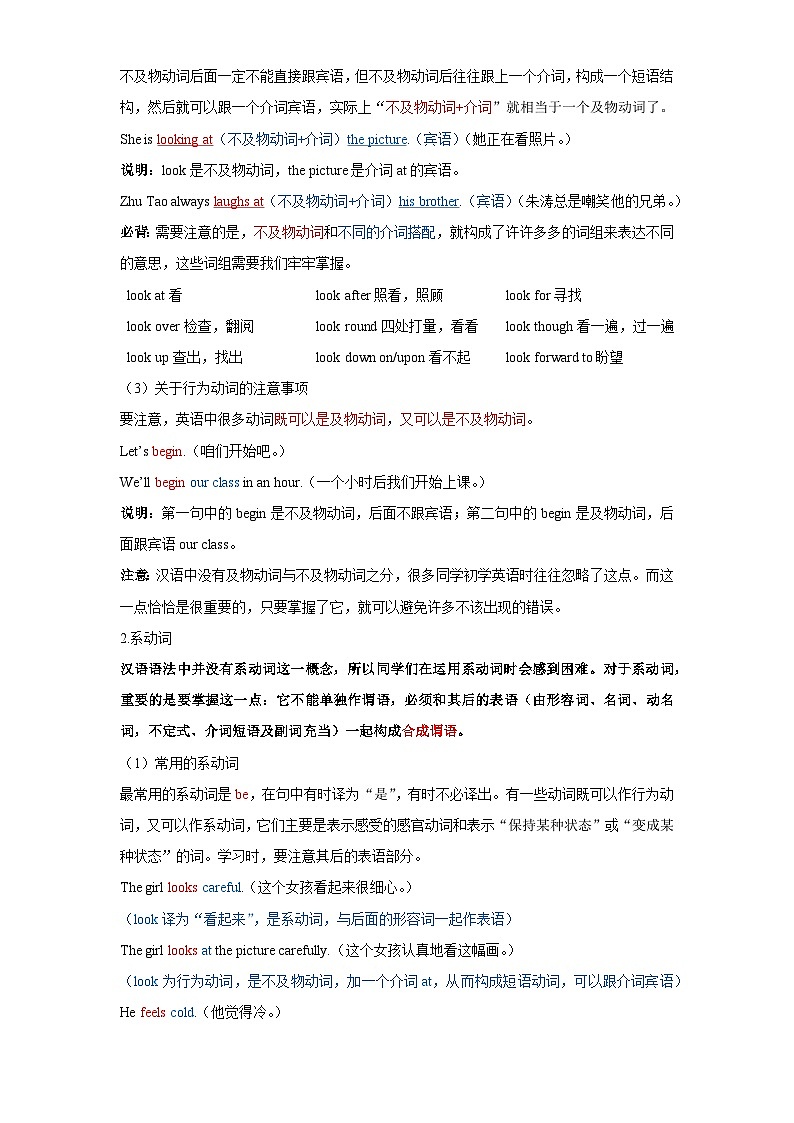
不及物动词后面一定不能直接跟宾语,但不及物动词后往往跟上一个介词,构成一个短语结构,然后就可以跟一个介词宾语,实际上“不及物动词+介词”就相当于一个及物动词了。
She is lking at(不及物动词+介词)the picture.(宾语)(她正在看照片。)
说明:lk是不及物动词,the picture是介词at的宾语。
Zhu Ta always laughs at(不及物动词+介词)his brther.(宾语)(朱涛总是嘲笑他的兄弟。)
必背:需要注意的是,不及物动词和不同的介词搭配,就构成了许许多多的词组来表达不同的意思,这些词组需要我们牢牢掌握。
(3)关于行为动词的注意事项
要注意,英语中很多动词既可以是及物动词,又可以是不及物动词。
Let’s begin.(咱们开始吧。)
We’ll begin ur class in an hur.(一个小时后我们开始上课。)
说明:第一句中的begin是不及物动词,后面不跟宾语;第二句中的begin是及物动词,后面跟宾语ur class。
注意:汉语中没有及物动词与不及物动词之分,很多同学初学英语时往往忽略了这点。而这一点恰恰是很重要的,只要掌握了它,就可以避免许多不该出现的错误。
2.系动词
汉语语法中并没有系动词这一概念,所以同学们在运用系动词时会感到困难。对于系动词,重要的是要掌握这一点:它不能单独作谓语,必须和其后的表语(由形容词、名词、动名词,不定式、介词短语及副词充当)一起构成合成谓语。
(1)常用的系动词
最常用的系动词是be,在句中有时译为“是”,有时不必译出。有一些动词既可以作行为动词,又可以作系动词,它们主要是表示感受的感官动词和表示“保持某种状态”或“变成某种状态”的词。学习时,要注意其后的表语部分。
The girl lks careful.(这个女孩看起来很细心。)
(lk译为“看起来”,是系动词,与后面的形容词一起作表语)
The girl lks at the picture carefully.(这个女孩认真地看这幅画。)
(lk为行为动词,是不及物动词,加一个介词at,从而构成短语动词,可以跟介词宾语)
He feels cld.(他觉得冷。)
Steel feels hard.(钢摸起来很硬。)
Silk feels sft and cmfrtable.(丝绸摸起来既柔软又舒服。)
(以上三句中的feel均是系动词,后面要跟形容词)
切记:
感官动词:lk看起来;taste尝起来;smell闻起来;sund听起来;feel摸起来
表示状态的词:becme变成;remain保持;keep保持;prve证明;get/turn/grw变得;appear/seem好像是
I feel the plane mve strngly.(我觉得飞机在剧烈地振动。)
(此句中的feel是一个行为动词/实义动词)
(关于系动词后跟形容词的用法可参见(第6章 副词)中的形容词和副词的比较部分)
重要:“feel+”意为“感觉到……正在/被”。
He felt his heart beating faster.(他感觉到他的心跳正在加快。)
(2)常用的系动词词组
词组:cme true实现
Our dream has cme true at last.(我们的梦想终于实现了。)
What Mary had hped all came true.(玛丽希望实现的都实现了。)
说明:cme在这里作系动词,有“达到/变成某种状态”的含义。
词组:get dressed穿衣服
He is ld enugh t get dressed himself.(他长大了,已经会自己穿衣服了。)
After Liu Gang gt dressed,he had breakfast.(刘刚穿好衣服后,就吃早餐了。)
词组:get/be married结婚
What did yu d befre yu gt married?(你结婚之前做什么工作?)
Mary has been married fr five years.(玛丽已经结婚5年了。)
词组:get/becme lst迷失,迷路
Srry.I’m late fr the meeting.I became/gt lst.(对不起,我开会迟到了,因为我迷路了。)
The little girl went fr a walk and gt lst.(小女孩出去散步,迷路了。)
词组:seem/appear t be似乎是……,好像……
The student seems t be a very kind and thughtful persn.
(这个学生似乎是个善良且体贴的人。)
It appears t be an excellent pprtunity fr Carline t get mre experience.
(对于卡罗琳来说,这似乎是一个获得更多经验的绝好的机会。)
说明:seem和appear的后面常常跟不定式t be。
(3)关于系动词后接表语的注意事项
绝大多数以a-开头的形容词常与系动词连用作表语,而不能作前置定语,但可以放在名词后面作后置定语。
He isn’t asleep.(他没睡着。)
The by asleep is my little brther.(那个睡着了的小男孩是我弟弟。)
(一定不能用the asleep by,但可以用the sleeping by)
切记:以a-开头的常见形容词
3.助动词
助动词本身并没有意义,它只是帮助主要动词构成谓语,表示疑问、否定、时态、语态等。英语中有些单词并不是固定的助动词,如动词be,have,d等在句子中与主要动词一起构成各种时态、语态、否定句、疑问句时,才担当起助动词的作用。
It is made in China.(它是中国制造的。)
(is是助动词,帮助主要动词made构成一般现在时的被动语态)
I haven’t had my breakfast yet.(我还没吃早饭呢。)
(have是助动词,帮助主要动词had构成现在完成时的否定句)
4.情态动词
情态动词表示说话人对某一动作或状态的态度,认为“可能”“应当”“必要”等。情态动词有词义,但词义不完整,其后一定要跟不带t的动词不定式(即动词原形,ught t除外)。另外,情态动词没有人称和数的变化。
He can speak English.(他会说英语。)(主语是第三人称单数,也不能在can后加s)
He speaks English well.(他英语说得很好。)
(时态是一般现在时,主语是第三人称单数,行为动词speak后要加s)
补充:常用的情态动词
2.动词的基本形式
动词有以下几种基本形式:动词原形(即前面不带t的动词不定式形式)、动词第三人称单数、过去式、过去分词和现在分词。
1.动词第三人称单数的构成
2.动词的过去式及过去分词的构成
(1)规则动词的变化
注意:词尾-ed在清辅音后读[t];在元音和浊辅音后读[d];在辅音t,d后读[id]。
(2)不规则动词的变化(参见本章不规则动词变化表)
3.动词的现在分词的构成
注意:以y结尾的动词变为现在分词时,y不变,直接加上-ing。如:
play→playing;study→studying
3.动词的时态
1.动词时态概述
时态是表示动作与时间相互关系的语法范畴。正确使用时态能反映一个人的英语基本功。对中国学生来说,英语的时态是相当困难的一个语法项目,原因之一是中文动词没有时态形式的变化。也就是说,中文动词不是用词形的变化,而是用特定的词语,如:“现在”“将来”“过去”“正在”“经常”“了”“过”“已经”等来说明一个动作发生的时间,而动词本身并无变化。在英语中,则用动词本身的词形变化或加助动词表示动作的时间。
She reads newspapers every day.(她每天看报纸。)
(句子中有every day,所以用现在时)
She read the newspaper yesterday.(她昨天看过了这张报纸。)
(句子中有yesterday,所以用过去时)
She will read the newspaper tmrrw.(她明天看这张报纸。)
(句子中有tmrrw,所以用将来时)
She is reading the newspaper nw.(她正在看报纸。)
(句子中有nw,所以用现在进行时)
She has read the newspaper.(她已经读过这张报纸了。)
(句子中没有标识性的时间状语,但因为表示的是“过去的动作对现在的影响”,所以要用现在完成时)
2.动词十二种时态的形式
英语动词共有十六种时态,一般语法书列出的英语动词的十二种时态为“现在”“过去”和“将来”三大类;每类中又分为“一般”“进行”“完成”“完成进行”四种,共十二种,下面以study为例,列表说明。
注意:初中阶段最常用的时态有5种,即一般现在时、一般过去时、现在进行时、一般将来时和现在完成时。在下面的文章中,将分别讲述各种时态的具体用法。
不规则动词变化表
4.短语动词
动词加一个(或两个)介词或副词构成词组后,在意义上和原来的动词不同,这种词组叫短语动词或成语动词。英语里这种词组很多,而且非常有用。
Can yu find ut what time the plane leaves?(你能弄清楚飞机几点起飞吗?)
Yu shuld listen t the teacher if yu want t learn well.
(如果你想学好的话,你必须注意听老师讲。)
Jane is lking after the baby.(简在照看这个宝宝。)
Be quiet!Try nt t wake the little baby up.(安静!别把这个小宝宝吵醒了。)
Cmmn Mistakes(注意!失分陷阱!)
陷阱例题①
Dn’t __________ the radi.The baby is sleeping.【北京中考】
句意提示:不要打开收音机,婴儿正在睡觉。
陷阱追击:本题考查根据上下文情景辨析动词词组,容易误选。
正确解析:turn ff意为“关掉,使(某人)不高兴”;turn n意为“打开,启动”;turn ver意为“打翻,移交给,变换电视频道”;turn dwn意为“拒绝,把……调低,关小”。根据题意可知,正确答案为B。
陷阱例题②
I’m interested in animals,s I __________ every Saturday wrking in an animal hspital.【北京中考】
句意提示:我对动物感兴趣,所以每个周六我都在一家动物医院工作。
陷阱追击:本题考查pay,get,take和spend这四个动词用法的区别,容易误选。
正确解析:在这四个动词中,只有spend常用于“ sth.”的句型中,意为“花费……做……”;pay常用于固定搭配“pay sb. fr sth.”,表示“付钱给某人”;take的主语一般为it或物。正确答案为D。
陷阱追击③
A:Hw lng have yu __________ the mtrbike? B:Fr abut tw weeks.【哈尔滨中考】
句意提示:A:你买摩托车多长时间了?B:大约两周了。
陷阱追击:本题结合上下文语境考查延续性动词和非延续性动词用法的区别,容易误选。
正确解析:延续性动词可以同一段时间连用,而非延续性动词则不可以。由题意可知是询问一段时间,在本题的四个选项中只有had是延续性动词。正确答案为B。
陷阱例题④
With the help f the Internet,news can __________ every crner f the wrld.【天津中考】
句意提示:有了互联网,新闻可以到达世界的各个角落。
陷阱追击:本题考查及物动词和不及物动词的用法区别,容易误选。
正确解析:arrive,g,get为不及物动词,需跟介词才能接地点名词,如arrive in/at,g t,get t。reach为及物动词,后面可直接连接地点,表示“到达……”。正确答案为B。
Final Check(实力测验)
1.选用下列动词的适当形式填空
1.The meat __________ terrible,s I think it has __________ bad.
2.Her face __________ red when she heard the news.
3.Yur grandmther __________ pale.What’s wrng with her?
4.Our English teacher’s vice __________ like my mther’s.
5.It ften rains in this seasn and the trees __________ fast.
6.The pizza yur mther makes __________ delicius.
7.Everyne __________ very excited at the evening party.
8.The flwers in yur garden __________ sweet.
9.Vegetables can __________ fresh in the fridge.
10.It is __________ late and dark.Let’s hurry.
11.In the ld days,sme pr peple ften __________ hungry.
12.Fr me ,English is __________ mre and mre interesting.
13.The sup that Mike made __________ terrible.
14.When little Tm lied t his teacher,she __________ extremely angry.
15.We all __________ tired after the picnic last night.
2.选择括号中的正确答案填空
1.I __________ (received;accepted) a present but I didn’t __________ (receive;accept) it.
2.Her mther __________ (allwed;agreed) her t g t the party.
3.I agree __________ (with;t) yu and I agree __________ (with;t) the plan.
4.__________ (Wrk;Wrking) hard and yu will succeed.
5.Great changes __________ (have taken;have been taken) place in ur cuntry in the past 30 years.
6.I have finished __________ (reading;t read) the nvel.
7.I didn’t g t yur party because he frgt __________ (t tell;telling) me.
8.I frgt __________ (psting;t pst) the letter and lked fr it everywhere.
9.The handsme yung man __________ (married;married with) the girl last year.
10.I missed __________ (attending;attended) his lecture because I had t take care f my mm.
3.选用每组中合适的动词并用其正确形式填空
A.match,fit,suit
1.This shirt can __________ this suit.
2.This dress __________ me fine.
3.The cat __________ me well.It’s neither t big nr t small.
B.pay,take,spend,cst
1.Traveling arund Paris by taxi can __________ a lt f mney.
2.It __________ me half an hur t reach schl every day.
3.I __________ tw hurs in drawing last night.
4.What a beautiful sweater!Hw much did yu __________ fr it?
5.It __________ me an hur t d my English hmewrk yesterday.
6.I __________ an hur (in) ding my English hmewrk yesterday.
7.It __________ arund 3 hurs (t get) frm Beijing t Shenzhen.
8.A small number f students __________ tw hurs surfing the Internet every day.
C.lie(躺,lay,lain,lying),lie(说谎,lied,lied,lying),lay(放,laid,laid,laying)
1.She was ill and __________ in bed.
2.He __________ that he did the wrk all by himself.
3.She __________ her hand n my shulder.
4.The man __________ n the grund and __________ that he had __________ the mney n the table.
D.raise,rise
1.If yu have any questins,please __________ yur hands.
2.Every Mnday mrning,we __________ ur natinal flag.
3.The sun __________ in the east and sets in the west.
4.She __________ frm the table t greet her father.
【课后作业】
1.Mary_______in the garden when it began t rain.
A.was walking B. walked
C.walking D.had walk
2.English___________in a new way at my cllege in the past few years.
A.has been teaching B. was being taught
C.has been taught D.had been taught
3.Smith is t study medicine as sn as he___________military service.
A.will finish B. has finished
C.finish D.wuld finish
4.Please be sure t telephne me the next time yu_______.
A.will cme B. wuld cme
C.shall cme D.cme
5.When I gt t the tp f the muntain,the sun _________.
A.shne B.shines
C.has shne D.was shining
6.There was s much nise that the speaker culdn’t make himself____________.
A.hearing B. being heard
C.t hear D.heard
7.Retum the bk immediately t the 1ibrary as sn as yu_______with it.
A.finish B. are finished
C.have finished D.are finishing
8.Yur experiment reprts must be checked with care befre________.
A.handed them in B. them handing in
C.being handed in D.handing them in
9.Let’s g t the cinema tnight.I________fr yu at the gate.
A. wait B. shall wait
C.am waiting D.shall have waited
10.The chemktry class______________fr five minutes when we hurried there.
A.had been n B. was n
C.has been n D.wuld be n
11.By the time Juan gets hme,her aunt_________.
A.will leave B. leaves
C.will have left D.is leaving
12. Yu’ve already missed t many classes this term.Yu_______tw classes just last week.
A.missed B. wuld miss
C.had missed D.have missed
13.One f the guards__________when the general came in,which made him very angry.
A.has slept B.were sleeping
C.slept D.was sleeping
14.“Car 17 wn the race”
“Yes, but its driver came clse t_______killed.”
A. being B. having been C.be D.have been
15.Abut the sixth century A D when few Eurpeans culd read,the Chinese_______ paper.
A.invented B. had invented
C.have invented D.had been invented
16.I __________n the dr fr ten minutes nw withut an answer.
A.was kncking B. an kncking
C.kncking D.have been kncking
17.Televisin makes us better___________than ever befre.
A.infrm B. infrming
C.infrmed D.t be infrmed
18.Dr.Rbert went t New Yrk,bught sme bks and________.
A.visiting his daughter B. t visit his daughter
C.visit his daughter D.visited his daughter
19.The famus nvel is said________int Chinese.
A.t have translated B.t be translate
C.t have been translated D.t translate
20.I___________writing the article by the time yu get back.
A.shall finish B. must have finished
C. have finished D.shall have finished
动词的时态语态专项练习
一、根据句意,用所给动词的适当形式填空。
1. It is a fine day. The sun __________(shine) brightly.
2. They ___________(visit) the Science Museum next Sunday.
3. Mr Brwn __________(live) in Beijing since he came t China.
4. Mr Wang ___________(teach) us English tw years ag.
5. The Smiths _______________( watch) TV at this time last night.
6. We __________(learn) abut ten English sngs by the end f last term.
7. Father said that he ____________(buy) a new bike fr me the next Friday.
8. Bill isn’t here. He ___________(chat) with his friends in the classrm.
9. The teacher said that the mn __________(g) rund the earth.
10. The Yung Pineers will g t the z if it ____________(nt rain) this Sunday.
11.It is said(据说) that the lng bridge______________(build)in tw mnths.
12. Jim asked us what ___________(happen) in China in 1976.
13. My mbile phne ___________(steal) n a bus last week.
14. The hst ____________(interview) the little by just nw.
15. The Greens __________(watch) TV nw.
16. He said that he _____________(ring) me up when he gt there.
17. We ____________(learn) English fr abut three years.
18. My brther_____________(jin) the League in 1997.
19. Where t have the meeting ______________ (discuss)nw.
20. The farmers __________(pick) apples when I saw them.
21. The film ____________(begin) when I gt t the cinema.
22. The girl tld me that she wanted t be an English teacher when she _____(grw) up.
23. My sister is a student and she _____________(study) at a middle schl nearby.
24. Mr Green __________(travel) t several places in Suth China since he came here.
25. Yu _________(catch) the early bus if yu get up early.
26. The lst by_____________(nt find)s far.
27. I’ll g hme as sn as I ___________(finish) my hmewrk.
28. Mst science bks _______________(write) in English.
29. Last year a large number f trees______________(cut)dwn.
30. The students _____ ften _____(tell) t take care f their desks and chairs.
31. The ld man is ill. He ______ (must send) t the hspital.
32. -What _______ knives ______ (make) f ?
-They_______________(make) f metal(金属) and wd.
二、下列各句均有一处错误,请找出并改正过来。
1. I was nly fur when my grandmther passes away.
2. Unfrtunately, by the time I gt back, they have finished the scene.
3. I have been practising fr three weeks nw, but I still culdn’t get used t it.
4. If yu like yur friends, yu will enjy every minute that yu spent with them.
5. One day he was having a yard sale and the ld man living next dr cme by t help.
6. This is the first time that I had been away frm my family fr such a lng time.
7. We’ve been friends ever since we are at schl tgether.
8. It will be a while befre we will knw the results.
9. Alice has returned t America and I dn’t knw when I see her again.
10. As was ften the case, whenever I called Sam, he is talking n the phne.
11. Lts f studies have been shwn that glbal warming has already becme a very serius prblem.
12. The teacher tld us that the sun rse in the east.
13. D yu want t knw why we mve last week?
14. A talk n American culture will be giving in the schl hall this weekend.
15.When yu get the paper back, pay special attentin t what have marked.
16. The sup was tasted s delicius that the whle family enjyed it.
三、将下列各主动句改为被动句。
1. They pay us very badly._________________________________________________________
2. They ffered me a pay rise._______________________________________________________
3. They are still discussing the same tpic._____________________________________________
4. Smene was fllwing us.______________________________________________________
5. They will lend us sme mney.____________________________________________________
6. They must have redecrated their huse.____________________________________________
7. Nbdy has seen her fr the last tw weeks._________________________________________
8. They advised us t buy a new car._________________________________________________
9. Peple say that he is a driver._____________________________________________________
10. They used t cut this material by hand, but nw they use a machine.
_______________________________________________________________________________
四、阅读下面材料,在空白处填入括号内单词的正确形式。
Dear J,
Well, I 1_______(arrive) back safely tw weeks ag. The flight was fine, but a bit lng.
Everything here is very different frm Lndn. I 2_______(write) this letter utside in the garden. It is very ht tday, s I’m sitting under a big umbrella. I knw we 3______(have) sme sunny days in Lndn but there was als sme rain. I remember we were caught in a heavy rain when we 4________(walk) in the park.
It 5_________(be) difficult fr me t start wrk after my wnderful hliday, but it’s OK nw. I 6_________(be) in a department since I came hme and it’s interesting. Nw I’m ding a new prject and it 7________(finish) by the end f this mnth.
By the way, have yu fund a black leather pht album? I think I 8_______(leave) it in the bedrm. Culd yu send it t me smetime? N hurry.
Please write sn, and thank yu again fr a wnderful time.
Yurs,
Chris
初中语法讲义
动词概说
年 月 日
类别(英文缩写)
特点
举例
行为
动词
及物动词(vt.)
跟宾语
We lve peace.
(我们热爱和平。)
不及物动词(vi.)
不能直接跟宾语
Classes begin.(开始上课。)
系动词(link.v.)
跟表语
I’m a student.(我是一个学生。)
助动词(aux.v.)
跟动词原形或过去分词
(无特殊意义)
I have had my breakfast.
(我已经吃过早饭了。)
情态动词(md.v.)
跟动词原形
(表示说话者的态度)
Yu must study hard.
(你必须用功学习。)
lk at看
lk after照看,照顾
lk fr寻找
lk ver检查,翻阅
lk rund四处打量,看看
lk thugh看一遍,过一遍
lk up查出,找出
lk dwn n/upn看不起
lk frward t盼望
afraid害怕,恐怕
asleep入睡,睡着了
alne独自
alive活(着)的
awake醒着的
can/culd
may/might
must
need
have t
ught t
构成法
例词
读法
词尾加-s
help→helps
knw→knws
get→gets
ride→rides
s在清辅音后读[s],在浊辅音或元音后读[z];
在t后读[ts],在d后读[dz]
词尾加-es
以字母s/x/ch/sh结尾的动词加-es
guess→guesses
fix→fixes
wash→washes
es读[iz]
以结尾的动词加-es
g→ges
d→des
es读[z]
以辅音字母加y结尾的动词,先变y为i,再加-es
fly→flies
study→studies
es读[z]
构成法
例词
一般加-ed
wrk→wrked,wrked
以e结尾的词加-d
live→lived,lived
以“辅音字母+y”结尾的词,改y为i,再加-ed
study→studied,studied
cry→cried,cried
以“元音字母+y”结尾的词,直接加-ed
play→played,played
以重读闭音节或r音节结尾,末尾只有一个辅音字母的词,要双写这个辅音字母,再加-ed
stp→stpped,stpped
prefer→preferred,preferred
构成法
例词
一般加-ing
wrk→wrking
study→studying
以e结尾的动词去e后加-ing
live→living
以重读闭音节或r音节结尾,末尾只有一个辅音字母的词,要双写这个辅音字母,再加-ing
stp→stpping
refer→referring
以ie结尾的重读开音节的词,改ie为y,再加-ing
die→dying
一般时
进行时
完成时
完成进行时
现在
I study.
Yu study.
he studies.
We study.
They study.
I am studying.
Yu are studying.
He is studying.
We are studying.
They are studying.
I have studied.
Yu have studied.
He has studied.
We have studied.
They have studied.
I have been studying.
Yu have been studying.
He has been studying.
We have been studying.
They have been studying.
过去
I studied.
Yu studied.
He studied.
We studied.
They studied.
I was studying.
Yu were studying.
He was studying.
We were studying.
They were studying.
I had studied.
Yu had studied.
He had studied.
We had studied.
They had studied.
I had been studying.
Yu had been studying.
He had been studying.
We had been studying.
They had been studying.
将来
I shall study.
Yu will study.
He will study.
We shall study.
They will study.
I shall be studying.
Yu will be studying.
He will be studying.
We shall be studying.
They will be studying.
I shall have studied.
Yu will have studied.
He will have studied.
We shall have studied.
They will have studied.
I shall have been studying.
Yu will have been studying.
He will have been studying.
We shall have been studying.
They will have been studying.
现在式
过去式
过去分词
现在式
过去式
过去分词
beat打,敲
beat
beaten
becme成为
became
becme
begin开始
began
begun
bite咬
bit
bitten/bit
blw吹
blew
blwn
break打破
brke
brken
bring携带
brught
brught
build建造
built
built
burn燃烧
burned/burnt
burned/burnt
buy买
bught
bught
catch捉
caught
caught
chse选择
chse
chsen
cme来
came
cme
drink喝
drank
drunk
drive驾驶
drve
driven
eat吃
ate
eaten
fall落下
fell
fallen
feed喂
fed
fed
feel觉得
felt
felt
fight打架
fught
fught
find找
fund
fund
fly飞
flew
flwn
frget忘记
frgt
frgtten/frgt
frgive原谅
frgave
frgiven
get获得
gt
gtten/gt
give给
gave
given
g去
went
gne
grw生长
grew
grwn
hang挂
hung
hung
hear听
heard
heard
hit击
hit
hit
hld持
held
held
hurt伤害
hurt
hurt
keep保持
kept
kept
knw知道
knew
knwn
lay放置
laid
laid
lead引导
led
led
learn学习
learned/learnt
learned/learnt
leave离开
left
left
lend借出
lent
lent
let让
let
let
lie躺
lay
lain
lse遗失
lst
lst
make做
made
made
meet遇见
met
met
pay支付
paid
paid
read读
read
read
rise上升
rse
risen
run跑
ran
run
say说
said
said
see看见
saw
seen
sell售
sld
sld
send送
sent
sent
shine照耀/擦去,磨光
shne/shined
shne/shined
sht发射
sht
sht
sing唱歌
sang
sung
sit坐下
sat
sat
sleep睡觉
slept
slept
smell嗅
smelt/smelled
smelt/smelled
speak说
spke
spken
spell拼写
spelt/spelled
spelt/spelled
spend花费
spent
spent
stand站立
std
std
steal偷窃
stle
stlen
sweep扫除
swept
swept
swim游泳
swam
swum
swing摇摆
swung
swung
take拿,握,抓
tk
taken
teach教
taught
taught
tear撕
tre
trn
tell告诉
tld
tld
think想
thught
thught
thrw投
threw
thrwn
understand了解
understd
understd
wear穿
wre
wrn
win赢
wn
wn
write写
wrte
written
begin with以……开始
catch up with赶上
climb up爬上去
cme back回来
cme frm来自……
cme n加油
cme ut开花
cme rund来,前来
crss ut画叉,删除
d with处理……
fall behind落后
fall ff掉下,减少
fight abut为……而斗争
find ut弄清楚
fly away飞走
fly up高飞
get back回来,回到……
get ff the (bus)下(公共汽车)
get n the (bus)上(公共汽车)
get ut f (the lift,car...)从(电梯、小汽车……)中走出来
g alng沿着……走
g n继续下去
g ut出去
g ver仔细检查
g thrugh经受,经历
grw up长大
hear f听说
hld n (fr a mment)
稍等一下(打电话用语)
jump int跳入
laugh at嘲笑
learn frm...向……学习
listen t听……,注意听……
lk after照顾,关照
lk arund参观
lk fr寻找
lk like看起来像
lk ver检查,浏览
make ut看出,辨认出
make up化妆
mve away移走
pass n sth. t sb.
传递某物给某人
pass n传递(某物)
pay fr为……付钱
pick up拾起来
pull up拉上来
put n (the suit,a cap)
穿(衣服),戴(帽子)
sell ut卖完,卖光
send fr派人去请……
send up射出,发送
take ff
脱掉(衣服);(飞机)起飞
take ut拿出
thanks t
多亏了;由于,因为
turn ff (the radi,gas...)
关上(收音机、煤气……)
turn n (the radi,gas...)
打开(收音机、煤气……)
turn rund转身
turn t翻到……页,转向……
wait fr等待
wake up醒来
wrry abut...为……而担心
write dwn写下来
A.turn ff
B.turn n
C.turn ver
D.turn dwn
A.pay
B.get
C.take
D.spend
A.bught
B.had
C.brrwed
D.lent
A.arrive
B.reach
C.g
D.get
smell
sund
taste
g
get
becme
grw
seem
lk
feel
turn
stay
keep
这是一份26年英语中考复习专题第9讲 动词概说(学生版不带答案)练习,共19页。试卷主要包含了The sun is red,情态动词等内容,欢迎下载使用。
这是一份26年英语中考复习专题第9讲 动词概说(教师版带答案)练习,共21页。试卷主要包含了The sun is red,情态动词等内容,欢迎下载使用。
这是一份26年英语中考复习专题第10讲 助动词和情态动词(学生版不带答案)练习,共26页。试卷主要包含了need的用法,/N,yu ught nt ,My mther is ill等内容,欢迎下载使用。
注册成功
资料篮

在线客服
添加在线客服
获取1对1服务
官方微信
关注“教习网”公众号
打开微信就能找资料
赛课定制
添加在线客服
获取1对1定制服务
职称咨询
添加在线客服
获取1V1专业指导服务

免费福利

.png)
.png)