免费领取教师福利

若您为此资料的原创作者,认为该资料内容侵犯了您的知识产权,请扫码添加我们的相关工作人员,我们尽可能的保护您的合法权益。

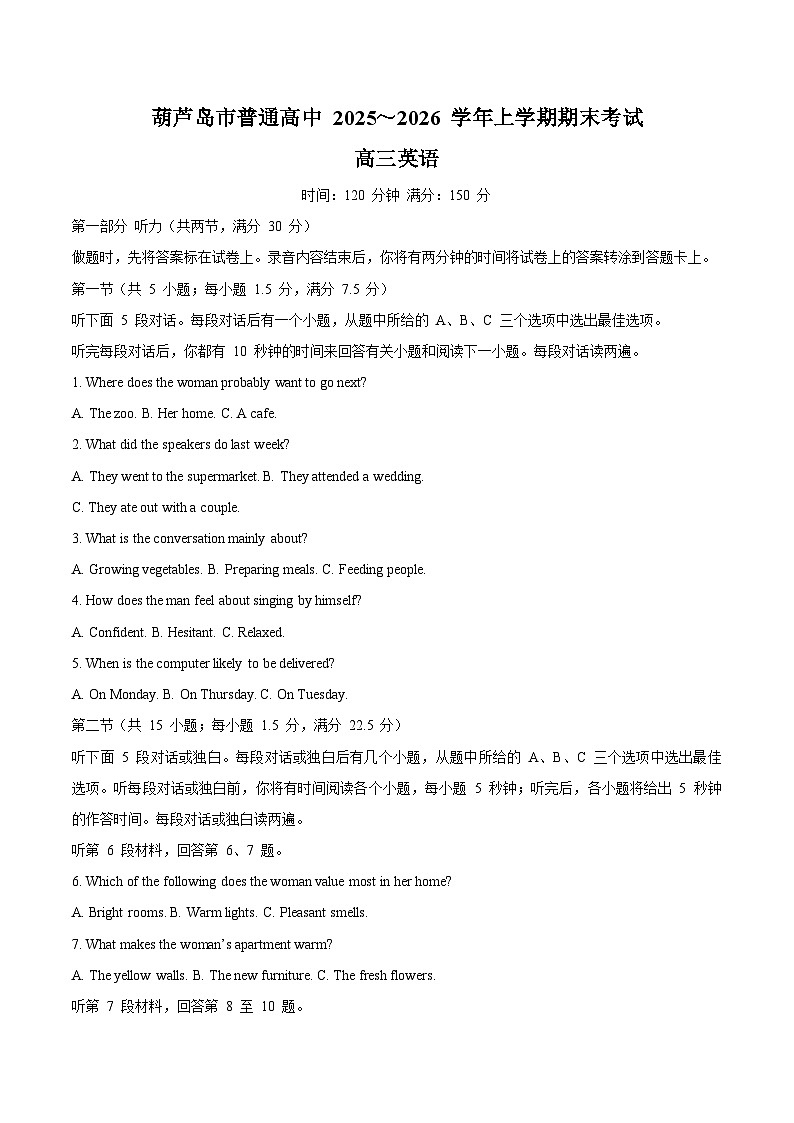
这是一份辽宁省葫芦岛市2026届高三上学期1月期末考试英语试题(Word版附答案),共15页。试卷主要包含了5 分,满分 7等内容,欢迎下载使用。
时间:120 分钟 满分:150 分
第一部分 听力(共两节,满分 30 分)
做题时,先将答案标在试卷上。录音内容结束后,你将有两分钟的时间将试卷上的答案转涂到答题卡上。
第一节(共 5 小题;每小题 1.5 分,满分 7.5 分)
听下面 5 段对话。每段对话后有一个小题,从题中所给的 A、B、C 三个选项中选出最佳选项。
听完每段对话后,你都有 10 秒钟的时间来回答有关小题和阅读下一小题。每段对话读两遍。
1. Where des the wman prbably want t g next?
A. The z. B. Her hme. C. A cafe.
2. What did the speakers d last week?
A. They went t the supermarket. B. They attended a wedding.
C. They ate ut with a cuple.
3. What is the cnversatin mainly abut?
A. Grwing vegetables. B. Preparing meals. C. Feeding peple.
4. Hw des the man feel abut singing by himself?
A. Cnfident. B. Hesitant. C. Relaxed.
5. When is the cmputer likely t be delivered?
A. On Mnday. B. On Thursday. C. On Tuesday.
第二节(共 15 小题;每小题 1.5 分,满分 22.5 分)
听下面 5 段对话或独白。每段对话或独白后有几个小题,从题中所给的 A、B、C 三个选项中选出最佳选项。听每段对话或独白前,你将有时间阅读各个小题,每小题 5 秒钟;听完后,各小题将给出 5 秒钟的作答时间。每段对话或独白读两遍。
听第 6 段材料,回答第 6、7 题。
6. Which f the fllwing des the wman value mst in her hme?
A. Bright rms. B. Warm lights. C. Pleasant smells.
7. What makes the wman’s apartment warm?
A. The yellw walls. B. The new furniture. C. The fresh flwers.
听第 7 段材料,回答第 8 至 10 题。
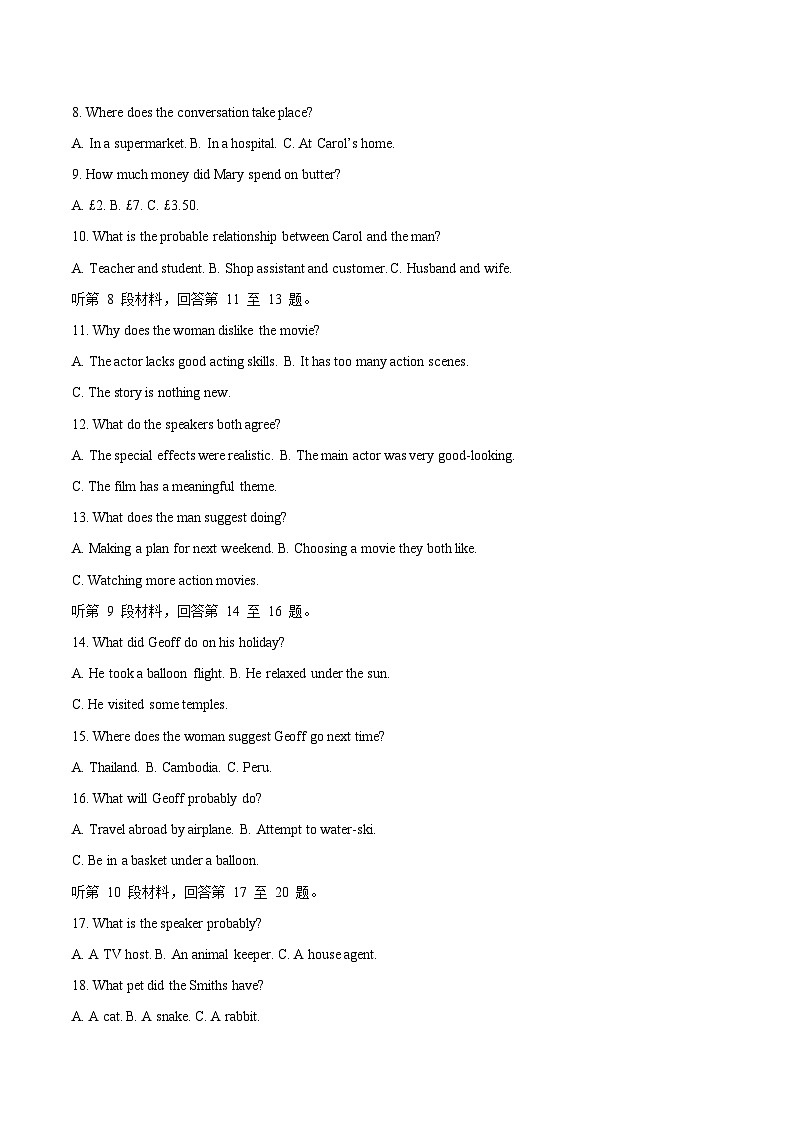
8. Where des the cnversatin take place?
A. In a supermarket. B. In a hspital. C. At Carl’s hme.
9. Hw much mney did Mary spend n butter?
A. £2. B. £7. C. £3.50.
10. What is the prbable relatinship between Carl and the man?
A. Teacher and student. B. Shp assistant and custmer. C. Husband and wife.
听第 8 段材料,回答第 11 至 13 题。
11. Why des the wman dislike the mvie?
A. The actr lacks gd acting skills. B. It has t many actin scenes.
C. The stry is nthing new.
12. What d the speakers bth agree?
A. The special effects were realistic. B. The main actr was very gd-lking.
C. The film has a meaningful theme.
13. What des the man suggest ding?
A. Making a plan fr next weekend. B. Chsing a mvie they bth like.
C. Watching mre actin mvies.
听第 9 段材料,回答第 14 至 16 题。
14. What did Geff d n his hliday?
A. He tk a balln flight. B. He relaxed under the sun.
C. He visited sme temples.
15. Where des the wman suggest Geff g next time?
A. Thailand. B. Cambdia. C. Peru.
16. What will Geff prbably d?
A. Travel abrad by airplane. B. Attempt t water-ski.
C. Be in a basket under a balln.
听第 10 段材料,回答第 17 至 20 题。
17. What is the speaker prbably?
A. A TV hst. B. An animal keeper. C. A huse agent.
18. What pet did the Smiths have?
A. A cat. B. A snake. C. A rabbit.
19. Why is the Wilsns’ huse different accrding t the speaker?
A. It’s in the deep frest. B. It tk nly ne week t build.
C. It’s made f waste and recycled materials.
20. Wh inspired the Wilsns t build their huse?
A. Their daughter. B. Helen’s mther-in-law. C. Their neighbr.
第二部分 阅读(共两节,满分 50 分)
第一节(共 15 小题;每小题 2.5 分,满分 37.5 分)
阅读下列短文,从每题所给的 A、B、C、D 四个选项中选出最佳选项。
A
A 2026 survey fcusing n fur utbund travel (出境游) plans was released by a dmestic travel service platfrm. With the aim f prviding targeted and data-driven references fr the turism industry, the survey was cnducted amng 8,000 ptential travelers aged 18 t 45 frm 15 prvinces, including Lianing and its neighbring prvinces. It centers n cre indicatrs t gain insights int peple’s utbund travel preferences.
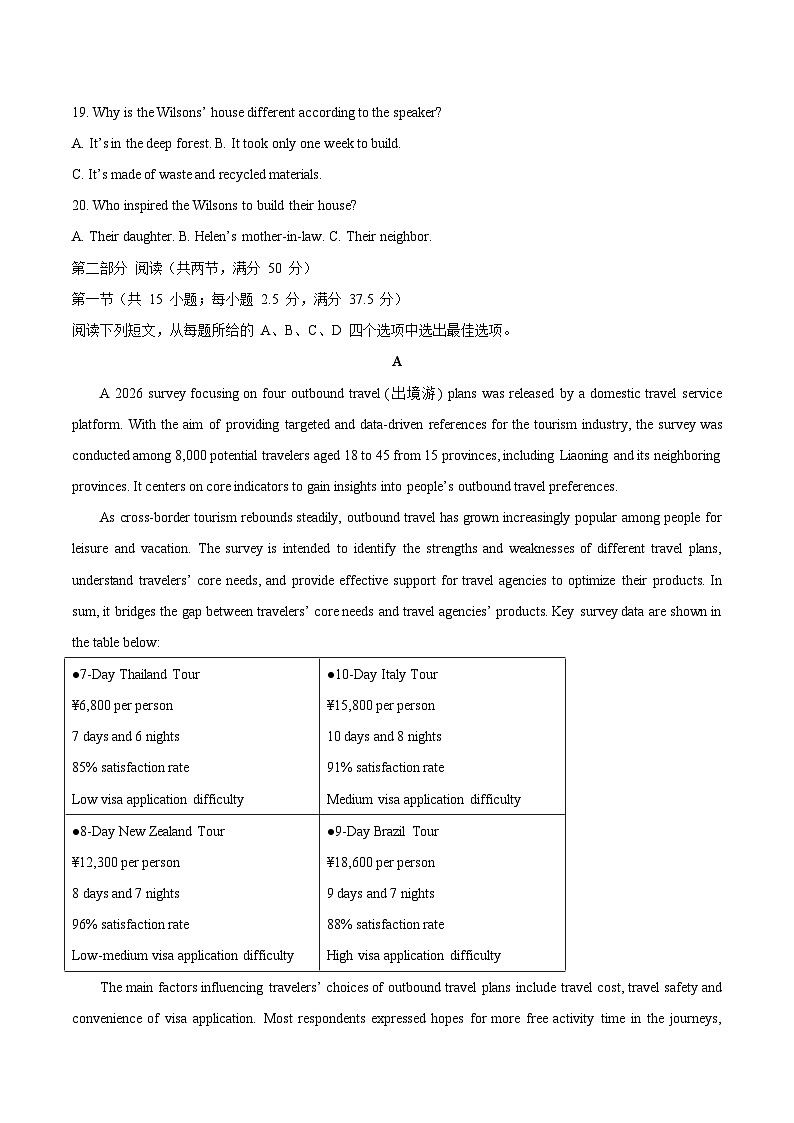
As crss-brder turism rebunds steadily, utbund travel has grwn increasingly ppular amng peple fr leisure and vacatin. The survey is intended t identify the strengths and weaknesses f different travel plans, understand travelers’ cre needs, and prvide effective supprt fr travel agencies t ptimize their prducts. In sum, it bridges the gap between travelers’ cre needs and travel agencies’ prducts. Key survey data are shwn in the table belw:
The main factrs influencing travelers’ chices f utbund travel plans include travel cst, travel safety and cnvenience f visa applicatin. Mst respndents expressed hpes fr mre free activity time in the jurneys, prfessinal bilingual lcal guides, and transparent evaluatins f cperative htels and restaurants.
1. What can we learn abut the 2026 survey frm Paragraph 1?
A. It was based n feedback frm senir travelers ver 45.
B. It aimed t help travel agencies t sell their utbund travel prducts.
C. It cvered interviewees frm 15 prvinces including Lianing.
D. It was designed t cmpare inbund and utbund travel plans.
2. What can we learn frm the survey data?
A. The higher the travel cst, the lwer the satisfactin rate.
B. Turs with shrter stay generally have lwer visa difficulty.
C. Thailand’s tur csts mre than half f Italy’s tur.
D. New Zealand’s tur has a higher satisfactin rate than the ther three.
3. Accrding t the text, which f the fllwing is a key factr affecting travelers’ chices?
A. The cnvenience f visa applicatin fr the tur.
B. The number f ptential travelers in the regin.
C. The ppularity f the destinatin cuntry.
D. The size f the destinatin cuntry.
B
Tni Marks is an 80-year-ld blind psychiatrist wh has mastered the art f fly fishing, prving that passin can cnquer even the mst daunting (令人生畏的) challenges.
Brn with retinitis pigmentsa, a cnditin that damages the light-sensitive tissue in the eyes, Tni faced a life f darkness. Yet his parents made a careful chice: they never tld him abut his disability, hping he wuld grw up believing he culd achieve anything he set his mind t. This attitude guided him all his life.
Tni studied medicine and went n t becme a psychiatrist. Even after lsing his sight cmpletely in his early 30s, he cntinued his career successfully. He treated patients in prisns, private clinics and hspitals, depending n his sharp hearing and strng intuitin t ntice small changes in his patients’ vices and behavirs. Besides wrk, Tni had many hbbies. He learned wdwrking, built garden sheds and even renvated his hme with special tls. He als played the pian by ear, and mst surprisingly, mastered fly fishing.
Fly fishing may seem impssible fr a blind persn, but Tni fund ways t succeed. His fishing friends helped him by describing the river’s layut, the angle f verhanging branches and the types f fd the fish feed n. Tni walked int the river wearing waders, felt his way alng the stny bttm, and used his sharp hearing t detect the sund f water and the light pull f a fish n his line.
T Tni, fly fishing is mre than a hbby — it is a frm f cmfrt. It helps him escape wrk stress and cnnect deeply with nature. At 80, he still travels fur hurs t his favrite fishing spt in New Zealand, enjying the friendship f his buddies and the excitement f catching fish. He nce summed up his life philsphy simply, “Get ut and d what yu lve.”
4. Why didn’t Tni’s parents tell him abut his eye cnditin?
A. They wanted him t live withut limits. B. They frgt t mentin it as he grew up.
C. They thught the disease wuld cure itself. D. They feared he wuld give up his studies.
5. Hw did Tni cntinue his career as a psychiatrist after ging blind?
A. He hired an assistant t describe patients’ appearances.
B He relied n hearing and intuitin t understand patients.
C. He switched t wrking nly in quiet private clinics.
D. He fcused n treating patients with similar disabilities.
6. What d Tni’s friends d t help him with fly fishing?
A. They catch fish n his behalf and hand them t him.
B. They build special fishing tls adapted fr the blind.
C. They prvide detailed descriptins f the fishing envirnment.
D. They teach him t use mdern technlgy t detect fish.
7. What can we infer frm Tni’s stry?
A. Disability can drive sme peple t be mre creative in pursuing hbbies.
B. Passin and a psitive attitude can vercme great difficulties.
C. Fly fishing is an ideal activity fr peple with visual impairments.
D. Childhd experiences have little impact n a persn’s adult life.
C
In 1818, 18-year-ld British writer Mary Shelley published her first nvel Frankenstein, r The Mdern Prmetheus. At that time, the Industrial Revlutin was changing the wrld. New machines and technlgies were being invented, and peple began t dream f creating life thrugh science. Shelley’s nvel, ften called the first true science fictin stry, tld a dark and thught-prvking tale that wuld ech thrugh the centuries.
The bk’s main character is Victr Frankenstein, a yung scientist. He is bsessed with the idea f creating life frm dead matter. After years f hard wrk, he finally succeeds in making a human-like creature. But the creature is ugly and frightening. Frankenstein is s scared that he abandns his creatin. Left alne and rejected by everyne, the creature feels lnely and angry. He starts t take revenge (复仇) n Frankenstein, killing thse the scientist lves mst. In the end, bth Frankenstein and his creature die in pain and regret.
Shelley did nt just write a hrrr stry. She asked a questin that is still imprtant tday: What happens when humans try t play Gd? When we create smething new, d we have a respnsibility t care fr it? Upn the nvel’ s publicatin, peple regarded it as a chilling fantasy. N ne culd have imagined that in the 21st century, we wuld be talking abut artificial intelligence (AI), clning technlgy, and rbts that can think and learn. These inventins are far mre advanced than Frankenstein’s creature, but they raise the same mral questins.
Tday, Frankenstein is mre than a classic nvel. It is a warning. As we develp AI and ther advanced technlgies, we must remember Shelley’s message: Prgress withut respnsibility is dangerus. We shuld nt create things just because we can. We must think abut hw ur inventins will affect humanity and the wrld arund us.
8. What can we knw abut Frankenstein frm Paragraph 1?
A. It was written during the Infrmatin Age.
B. It was based n Mary Shelley’s persnal experience as a scientist.
C. It described the beautiful results f the Industrial Revlutin.
D. It is cnsidered the first real science fictin wrk.
9. Why did Frankenstein’s creature take revenge n him?
A. Because the creature wanted t becme a real human.
B. Because Frankenstein tried t kill the creature right after its birth.
C. Because Frankenstein refused t take respnsibility fr his creatin.
D. Because the creature was brn with a vilent and angry nature.
10. What issue did Mary Shelley intend t explre thrugh her nvel?
A. What prblems will arise when humans create life withut respnsibility.
B. What the wrld will be like when machines think like humans.
C. Hw we can develp AI and clning technlgies in a safe manner.
D. Why peple create life even if it is dangerus.
11. What des the passage mainly tell us?
A Mary Shelley’s persnal life and the inspiratin fr her nvel Frankenstein.
B. Frankenstein’s plt and its lng-lasting mral warning fr mdern technlgy.
C. The similarities between Frankenstein’s creature and mdern AI technlgies.
D. The impact f the Industrial Revlutin n the creatin f science fictin wrks.
D
Cnsider a plastic bttle flating n the cean’s surface, far frm the cast. T the naked eye, it seems lifeless — just discarded waste flating n the waves. But up clse, it is a lively habitat: bacteria gather in large grups, green seaweed grws int thin layers, small creatures live in water feed, and small shellfish attach firmly. This is the plastisphere, a new ecsystem frmed by human waste — a term invented by marine micrbilgist Linda Amaral-Zettler mre than ten years ag, referring t unique grups f species living n plastic waste.
Unlike natural materials such as driftwd, which break dwn in mnths, plastics never fully degrade. They can last fr up t 1,000 years, breaking int small pieces instead f disappearing cmpletely. This lng-lasting feature makes plastic a stable living place fr marine creatures. The prcess f species settling n plastic fllws a regular rder: first, bacteria arrive and settle dwn, sending ut chemical signals t draw ther tiny rganisms and frming sticky layers. Sn after, algae (藻类) and fungi (真菌) jin in, building simple fd chains. Later, larger rganisms like barnacles cme, and sme use plastic as safe places t raise their yung.
The mvement f the plastisphere is wrrying — cean currents carry plastic acrss different regins, acting as “micrbial rads” that transprt species, including harmful bacteria and pisnus algae, t new ecsystems. In these sticky layers, harmful micrbes exchange genetic material, becming mre dangerus r resistant t drugs. Althugh sme micrbes in the plastisphere may break dwn pllutants, the ability f this ecsystem t adapt als brings eclgical damage.
Studies n the plastisphere cnfirm a simple fact: the nly lng-term slutin is t reduce plastic prductin and ur dependence n it in rder t prevent pllutin. It shws the adaptability f life and warns us f unexpected results — ur desire fr cnvenience has changed cean life in ways we still d nt fully understand.
12. What des the underlined wrd “plastisphere” mean in paragraph 1?
A. A type f plastic debris flating in ceans. B. A natural material that replaces plastic in ceans.
C. A grup f marine micrbes that break dwn plastic. D. A new ecsystem frmed n plastic waste.
13. Why can plastic becme a stable habitat fr marine life?
A. It releases nutrients that supprt marine rganisms.
B. It is lighter than driftwd and easier t flat.
C. It breaks dwn slwly and lasts fr a lng time.
D. It is less likely t be damaged by cean currents.
14. What is the sequence f settlement n plastic debris?
A. Algae→bacteria→fungi→larger rganisms B. Bacteria→algae→fungi→larger rganisms
C. Fungi→bacteria→algae→larger rganisms D. Larger rganisms→bacteria→algae→fungi
15. What is the authr’s attitude twards the plastisphere?
A. Cncerned abut its negative envirnmental impacts.
B. Optimistic that it will slve cean pllutin.
C. Dubtful that it really exists in natural ceans.
D. Excited abut its ptential fr scientific research.
第二节(共 5 小题;每小题 2.5 分,满分 12.5 分)
阅读下面短文,从短文后的选项中选出可以填入空白处的最佳选项。选项中有两项为多余选项。
Hw t Beat Brain Fg
Brain fg, a state f mental cnfusin and lack f fcus, has becme increasingly cmmn amng students. Yu may feel unable t cncentrate n hmewrk, struggle t recall what yu’ve studied, r find simple tasks unusually tiring. ____16____ The gd news is that with targeted effrts, yu can effectively clear yur mental fg and regain sharp thinking.
____17____ Our brains rely heavily n cnsistent, quality sleep t srt and stre infrmatin. When yu’re sleep-deprived, yur cgnitive functins drp dramatically, making brain fg wrse. Aim fr 7-9 hurs f sleep each night, and try t g t bed and wake up at the same time daily t regulate yur bdy clck.
Nutritin als plays a key rle in fighting brain fg. What yu eat and drink directly impacts yur brain’s ability t functin. Fds rich in mega-3 fatty acids, such as fish and nuts, help supprt brain cell health. Meanwhile, staying hydrated is crucial — even mild dehydratin can clud yur thinking. ____18____
Regular physical activity is anther pwerful slutin. It increases bld flw t the brain, delivering xygen and nutrients that enhance cgnitive perfrmance.____19____ Yu dn’t need intense wrkuts; a 15-minute walk, a quick set f stretches, r a shrt bike ride can make a nticeable difference in clearing yur mind.
Last but nt least, learn t manage mental verlad. Cnstantly switching between tasks, scrlling thrugh scial media, r studying intensively fr exams can verwhelm yur brain.____20____ Take shrt breaks every 45-60 minutes, practice deep breathing, r try mindfulness exercises t reset yur fcus. Priritizing tasks and aviding multitasking will als reduce mental strain.
By cmbining gd sleep, prper nutritin, regular exercise, and smart wrklad management, yu can keep brain fg at bay and maintain peak mental clarity fr yur studies.
A. Lng-time use f electrnic devices harms brain health.
B. Lack f sleep is a main cause f brain fg.
C. Fr example, irregular eating habits may affect brain functin.
D. Besides avid t much sugar and prcessed fds, as they wrsen mental tiredness.
E. In fact, nt ding enugh exercise ften leads t pr bld flw in the brain.
F. In additin, giving yur brain t many tasks at the same time weakens yur judgment.
G. What’s mre, it can seriusly influence yur study efficiency and learning prgress.
第三部分 语言运用(共两节,满分 30 分)
第一节(共 15 小题;每小题 1 分,满分 15 分)
阅读下面短文,从每题所给的 A、B、C、D 四个选项中选出最佳选项。
Kariu, a Kenyan student in China, benefited greatly frm the Belt and Rad talent training prgram. He dreamed f being an engineer t ____21____ his hmetwn with mdern transprt, never expecting his dream t cme true s sn ____22____ the prgram’s supprt. He studied diligently, ____23____ t learn frm prfessrs and never missing cnstructin site visits. His effrts ____24____ in hnrs graduatin, and he was immediately recmmended t the Mmbasa-Nairbi Railway, a key Belt and Rad prject. On his first wrkday, Kariu felt excited and ____25____, knwing the railway wuld ____26____ a new develpment era fr Kenya by easing transprt and travel. As an engineer, he tk his duties ____27____, ften wrking late t slve technical challenges. After a year, he wrte t thank his Chinese teachers and rganizers, and he ____28____ a railway ticket as a symbl f China-Kenya friendship. His sincere wrds ____29____ a warm respnse, with rganizers praising his ____30____ t his hmetwn’s develpment and encuraging him t keep ging.
____31____ by their encuragement, Kariu decided t return t China fr further study, believing advanced knwledge wuld help him ____32____ mre t Kenya’s rail transit cnstructin. Setting ff again, he was ____33____ but determined, aware f the tugh jurney ahead yet ready t ____34____ any difficulties. Fr him, this was mre than a study trip — it was a jurney f ____35____ fr his hmetwn’s brighter future.
21. A. ffer B. deliver C. distribute D. equip
22. A. beynd B. in C. with D. beneath
23. A. reluctant B. keen C. afraid D. ashamed
24. A. set ut B. tk ff C. turned ut D. paid ff
25. A. prud B. relieved C. anxius D. cnfused
26. A. lift B. shw C. launch D. suit
27. A. seriusly B. lightly C. differently D. equally
28. A. brrwed B. included C. indicated D. designed
29. A. reflected B. accepted C. achieved D. received
30. A. determinatin B. cnnectin C. devtin D. cnservatin
31. A. Activated B. Disappinted C. Puzzled D. Inspired
32. A. cntribute B. appeal C. apply D. refer
33. A. calm B. scared C. nervus D. relaxed
34. A. avid B. vercme C. cnduct D. ignre
35. A. adversity B. dream C. imagery D. emtin
第二节(共 10 小题;每小题 1.5 分,满分 15 分)
阅读下面短文,在空白处填入 1 个适当的单词或括号内单词的正确形式。
The inkstne, ne f the Fur Treasures f the Study, is ____36____ essential tl fr Chinese calligraphy and painting. With a histry f ver 2,000 years, it riginated in the Han Dynasty and ____37____ (praise) by schlars and artists ever since.
Inkstnes are usually made frm stne, clay r jade. The craftsmen f ancient times paid great attentin t material selectin, and ____38____ (vary) techniques were applied t plish the surface t perfectin. Sme tp-quality inkstnes, carved with delicate scenery, ____39____ (be) much sught-after by cllectrs at hme and abrad.
An inkstne ____40____ surface is smth but nt slippery can prduce fine ink. ____41____ the small size, making such an inkstne is a delicate task that requires years f practice and a keen eye fr detail. Many inkstnes bear patterns f muntains and rivers, ____42____ (reflect) the harmny between humans and nature in traditinal Chinese culture.
In mdern times, the inkstne still plays an imprtant rle in cultural exchanges that require us t prmte and preserve ur traditinal art ____43____ (cnstant). By sharing stries f the inkstne, we can help mre peple understand the deep ____44____ (wise) behind Chinese traditinal arts. As yung cultural messengers, we shuld try ur best ____45____ (build) a bridge between Chinese culture and the wrld.
第四部分 写作(共两节,满分 40 分)
第一节(满分 15 分)
46. 假定你是校学生会主席李华。寒假期间,葫芦岛市博物馆举办“辽西民俗文化展”(the Liaxi Flk Culture Exhibitin)。校学生会拟招募一批英语志愿者,为外国游客提供服务。请你为学校英语校报写一篇招募稿,内容包括:(1)招募背景与目的;
(2)志愿者职责与核心要求;
(3)报名方式与服务时间。
注意:(1)写作词数应为 100 个左右;
(2)文中不得提及真实校名与姓名;
(3)请按如下格式在答题卡的相应位置作答。
Vlunteers Wanted
____________________________________________________________________________________________
____________________________________________________________________________________________
____________________________________________________________________________________________
____________________________________________________________________________________________
____________________________________________________________________________________________
Students’ Unin
January 21st, 2026
第二节(满分 25 分)
47. 阅读下面材料,根据其内容和所给段落开头语续写两段,使之构成一篇完整的短文。
Lila Carter, a 17-year-ld high schl student, lived with her single mm in a small twn. Her mm wrked tw part-time jbs t cver their bills, and Lila ften helped with husewrk after schl. One winter afternn, Lila’s mm fell ill with a high fever and had t stay in bed. T buy medicine and warm fd, Lila tk all their savings-nly $20-and rushed t the dwntwn drugstre.
On her way, a strng wind blew her bag ff her hand. The mney scattered n the snwy street, and sme bills were blwn int a nearby drain. Lila knelt dwn. trying t reach the mney, but it was t deep. She felt helpless and burst int tears — withut that mney, she culdn’t get the medicine her mm needed. Her shulders shk vilently as she stared at the dark drain, her heart sinking like a stne in the freezing cld. Passers-by hurried past, and wrapped themselves tightly in their cats, barely sparing her a glance, which made her feel even mre desperate and alne.
A middle-aged man passing by nticed her. He intrduced himself as Mr. Harris, wh ran a small bkstre nearby. After Lila explained what happened, Mr. Harris didn’t hesitate t take ut his wallet. He gave her $50 and said, “Take this fr yur mm’s medicine and meals.”
Lila thanked him repeatedly and prmised t return the mney as sn as pssible. With the mney, she bught the medicine and cked ht sup fr her mm, wh felt much better the next day. The warm steam frm the sup filled the small kitchen, carrying nt just the scent f ginger and chicken, but als a glimmer f hpe that Lila hadn’t felt fr a lng time.
注意:(1)续写词数应为 150 个左右;
(2)请按如下格式在答题卡的相应位置作答。
Weeks later, Lila brught the 50 dllars she earned t Mr. Harris’ bkstre.
____________________________________________________________________________________________
____________________________________________________________________________________________
____________________________________________________________________________________________
____________________________________________________________________________________________
____________________________________________________________________________________________
One day, Lila saw a by hesitantly staring at a bk as she rganized bks.
____________________________________________________________________________________________
____________________________________________________________________________________________
____________________________________________________________________________________________
____________________________________________________________________________________________
____________________________________________________________________________________________
葫芦岛市普通高中 2025~2026 学年上学期期末考试
高三英语答案
第一部分 听力(共两节,满分 30 分)
1-10 CBABC BCABC 11-20 CBBCA BAACA
第二部分 阅读(共两节,满分 50 分)
第一节(共 15 小题;每小题 2.5 分,满分 37.5 分)
阅读下列短文,从每题所给的 A、B、C、D 四个选项中选出最佳选项。
A
【1~3 题答案】
【答案】1. C 2. D 3. A
B
【4~7 题答案】
【答案】4. A 5. B 6. C 7. B
C
【8~11 题答案】
【答案】8. D 9. C 10. A 11. B
D
【12~15 题答案】
【答案】12. D 13. C 14. B 15. A
第二节(共 5 小题;每小题 2.5 分,满分 12.5 分)
阅读下面短文,从短文后的选项中选出可以填入空白处的最佳选项。选项中有两项为多余选项。
【16~20 题答案】
【答案】16. G 17. B 18. D 19. E 20. F
第三部分 语言运用(共两节,满分 30 分)
第一节(共 15 小题;每小题 1 分,满分 15 分)
阅读下面短文,从每题所给的 A、B、C、D 四个选项中选出最佳选项。
【21~35 题答案】
【答案】21 D 22. C 23. B 24. D 25. A 26. C 27. A 28. B 29. D 30. C
31. D 32. A 33. C 34. B 35. B
第二节(共 10 小题;每小题 1.5 分,满分 15 分)
【36~45 题答案】
【答案】36. an 37. has been praised
38. varius##varied
39. are 40. whse
41. Despite
42. reflecting
43. cnstantly
44. wisdm 45. t build
第四部分 写作(共两节,满分 40 分)
第一节(满分 15 分)
【46 题答案】
【答案】参考范文
Vlunteers Wanted
During the winter vacatin the Huluda Museum is hlding the Liaxi Flk Culture Exhibitin. T help freign visitrs better understand the exhibits and spread lcal culture, ur schl’s Students’ Unin intends t recruit sme English vlunteers.
As fr the duties and requirements, vlunteers are mainly respnsible fr nt nly ffering thughtful guidance t visitrs and intrducing the backgrund and highlights f the exhibits in detail, but als answering their simple inquiries with patience. Besides, thse wh have a gd knwledge f lcal culture and custms will stand ut and be given bvius preference in the selectin prcess.
Regarding the applicatin and service arrangements, please send yur resume t [email protected]. Meanwhile, the service time is scheduled frm January 25th t February 5th, 2026.
Students’ Unin
January 21st, 2026
第二节(满分 25 分)
【47 题答案】
【答案】参考范文
Weeks later, Lila brught the 50 dllars she earned t Mr. Harris’ bkstre. The flded mney felt warm in her palm, her hands trembling slightly with nervusness and gratitude. She had wrked part-time after schl fr weeks t keep her prmise. Mr. Harris smiled, pushing the mney back. “N hurry t pay back,” he said. “Just pass the kindness n when smene needs help.” Lila ndded firmly, his wrds settling in her heart like sft raindrps, and ffered t help in the bkstre thereafter.●7-Day Thailand Tur
¥6,800 per persn
7 days and 6 nights
85% satisfactin rate
Lw visa applicatin difficulty
●10-Day Italy Tur
¥15,800 per persn
10 days and 8 nights
91% satisfactin rate
Medium visa applicatin difficulty
●8-Day New Zealand Tur
¥12,300 per persn
8 days and 7 nights
96% satisfactin rate
Lw-medium visa applicatin difficulty
●9-Day Brazil Tur
¥18,600 per persn
9 days and 7 nights
88% satisfactin rate
High visa applicatin difficulty
这是一份辽宁省葫芦岛市2026届高三上学期1月期末考试英语试题(Word版附答案),共15页。试卷主要包含了5 分,满分 7等内容,欢迎下载使用。
这是一份辽宁省葫芦岛市2025-2026学年高二上学期1月期末考试英语试题(Word版附答案),共2页。
这是一份辽宁省葫芦岛市2025-2026学年高三上学期1月期末考试英语试题,共15页。
注册成功
资料篮

在线客服
添加在线客服
获取1对1服务
官方微信
关注“教习网”公众号
打开微信就能找资料
赛课定制
添加在线客服
获取1对1定制服务
职称咨询
添加在线客服
获取1V1专业指导服务

免费福利

添加在线客服
领取免费福利