免费领取教师福利

若您为此资料的原创作者,认为该资料内容侵犯了您的知识产权,请扫码添加我们的相关工作人员,我们尽可能的保护您的合法权益。


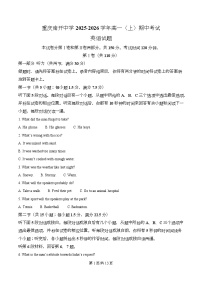
这是一份重庆市南开中学2025-2026学年高一上学期1月期末考试英语试题(Word版附解析),文件包含南开中学校2025-2026学年高一上学期1月期末英语试题Word版含解析docx、南开中学校2025-2026学年高一上学期1月期末英语试题Word版无答案docx等2份试卷配套教学资源,其中试卷共42页, 欢迎下载使用。
(本试卷分第Ⅰ卷和第Ⅱ卷两部分。共150分。考试时间120分钟。)
第Ⅰ卷(共110分)
第一部分 听力(共两节,满分30分)
做题时,请先将答案标在试卷上。录音内容结束后,你将有两分钟的时间将试卷上的答案转涂到答题卡上。
第一节(共5小题;每小题1.5分,满分7.5分)
听下面5段对话。每段对话后有一个小题,从题中所给的A、B、C三个选项中选出最佳选项,并标在试卷的相应位置。听完每段对话后,你都有10秒钟的时间来回答有关小题和阅读下一小题。每段对话仅读一遍。
1. What will the wman prbably get next?
A. A small snack. B. A cup f tea. C. A large meal.
2. Which type f mvie will the speakers see tday?
A. An actin mvie. B. A funny mvie. C. A scary mvie.
3. What is new t the man?
A. He has a new partner. B. He becmes a manager. C. He needs t wrk with a team.
4. Where are the speakers prbably?
A. In a huse. B. In a museum. C. In a stre.
5. What makes the man cnfused?
A. A Chinese dish. B. A Chinese character. C. A Chinese custm.
第二节(共15小题;每小题1.5分,满分22.5分)
听下面5段对话或独白。每段对话或独白后有几个小题,从题中所给的A、B、C三个选项中选出最佳选项,并标在试卷的相应位置。听每段对话或独白前,你将有5秒钟的时间阅读各个小题;听完后,各小题将给出5秒钟的作答时间。每段对话或独白读两遍。
听第6段材料,回答第6、7题。
6. What is the main idea f the cnversatin?
A. Ways t learn new skills.
B. Schedules fr the cming hliday.
C. New Year’s persnal grwth plans.
7. What des the wman want t learn?
A. Reading skills. B. Hme building. C. Public speaking.
听第7段材料,回答第8、9题。
8. When did the man buy the huse?
A. Three mnths ag. B. Six mnths ag. C. Nine mnths ag.
9. What is the wman’s future plan fr her living place?
A. Sharing an apartment with thers.
B. Buying a new huse dwntwn.
C. Mving away frm the city.
听第8段材料,回答第10至12题。
10. What is the prbable relatinship between the speakers?
A. Family members. B. Teacher and student. C. Schl friends.
11. What type f music des the wman like?
A. Rck music. B. Cuntry music. C. Classical music.
12. What did the man d during his hliday?
A. He visited his grandparents.
B. He went t a music festival.
C. He applied fr a jb.
听第9段材料,回答第13至16题。
13. Hw did the wman feel at the beginning?
A. Amazed. B. Cncerned. C. Angry.
14. What des the wman want t shw the man?
A. Her talent. B. Her career. C. Her skill.
15. What rle des the man value mst?
A. Being a successful businessman.
B. Being a great tennis player.
C. Being a rle mdel.
16. What des the man suggest the wman d?
A. Push herself harder. B. Try t enjy challenges. C. Rest and relax mre ften.
听第10段材料,回答第17至20题。
17. When is the annuncement prbably made?
A. In the early mrning. B. At mid-afternn. C. At night.
18. Wh is the speaker?
A. A htel wner. B. A tur guide. C. A bus driver.
19. What has been prepared fr the listeners?
A. Hats. B. Sunglasses. C. Sun cream.
20. Which activity will cst extra mney?
A. Enjying a bat trip. B. Ging swimming. C. Playing beach vlleyball.
第二部分 阅读(共两节,满分50分)
第一节(共15小题;每小题2.5分,满分37.5分)
阅读下列短文,从每题所给的A、B、C和D四个选项中,选出最佳选项,并在答题卡上将该项涂黑。
A
Discver Pu’er: Where Tea Culture Meets Natural Wnders
Nestled in suthwest Yunnan, Pu’er is a hidden gem (宝石) that ffers a perfect blend f rich tea culture, stunning natural landscapes, and diverse ethnic traditins. As the birthplace f the wrld-famus Pu’er tea, this regin invites travelers t immerse themselves in a unique cultural experience.
Must-visit Attractins
The Jingmai Muntain Ancient Tea Frest, a UNESCO Wrld Heritage site, features 28,000 acres f thusand-year-ld tea trees hidden in mist. There yu can wander thrugh traditinal Dai and Balang ethnic villages like Nugan and Wengji, where yu can witness authentic tea-making traditins and enjy breathtaking views f the sea f cluds.
Pu’er Sun River Frest Park ffers an incredible wildlife experience with its 94.5% frest cverage. Get up clse with red pandas, white rhins, and diverse flra while hiking thrugh subtrpical rainfrests. The park’s high xygen cntent makes it a wnderful xygen bar fr rejuvenatin.
Cultural Immersin
Explre the Tea Hrse Ancient Rad, an ancient trade rute that cnnected China with Sutheast Asia. Visit the well-preserved Nakeli Tea Hrse Pst Statin t learn abut caravan (商队) histry and experience traditinal crafts like rare wd carving and fabric dyeing.
Cffee Paradise
Beynd tea, Pu’er is als China’s cffee capital. Visit cffee plantatins like Xia Azi Cffee Estate t learn abut cffee cultivatin and enjy hand-brewed Yunnan small-grain cffee. The regin’s unique climate prduces beans with trpical fruit qualities and caramel richness.
Practical Tips
The best time t visit is frm Octber t April when the weather is pleasant. Allw 3-5 days t full experience Pu’er’s highlights. Dn’t miss lcal specialties like chicken tfu, Dai-style grilled fish, and sur rice ndles. Accmmdatin ranges frm city htels t traditinal hmestays in ethnic villages.
Pu’er ffers a slwer pace f life where yu can sip tea in ancient villages, hike thrugh pristine frest, and cnnect with diverse ethnic cultures — a truly authentic Yunnan experience.
1. Which activity is unavailable at the Jingmai Muntain Ancient Tea Frest?
A. Getting clse t wildlife.
B. Seeing centuries-ld tea trees.
C. Visiting traditinal ethnic villages.
D Observing genuine tea-making custms.
2. Which place shuld a traveler wh wants t engage in traditinal crafts chse?
A. Xia Azi Cffee Estate.
B. Pu’er Sun River Frest Park.
C. Nakeli Tea Hrse Pst Statin.
D The Jingmai Muntain Ancient Tea Frest.
3. What d we knw abut traveling in Pu’er?
A. It mainly attracts experts in tea r plants.
B. It requires a high level f physical fitness.
C. It ffers a rich mix f activities in ne trip.
D. It is best fr thse wh enjy fast-paced city life.
B
Fan Jinshi, knwn as “the Daughter f Dunhuang”, was brn in Beijing in 1938 and develped a passin fr cultural relics under her father’s influence, a Tsinghua University graduate devted t classical art. In 1958, she achieved a remarkable milestne by gaining admissin t Peking University, where she buried herself in the study f archaelgy. It was during an internship in 1962 that she first stepped in the Mga Grttes and instantly fell under their spell. Fascinated by the breathtaking murals and sculptures that bre witness t centuries f histry, she made a life-changing decisin: t devte her life t guarding this unparalleled cultural treasure after her graduatin in 1963.
Life in the remte desert was far frm easy. Fierce sandstrms swept there withut warning, leaving everything in a veil f dust; the living areas were spartan, lacking even basic cmfrts; and the lng, painful separatin frm her family thusands f miles away weighed heavily n her heart. Hwever, she never gave up.
Fr ver half a century, she pured her heart and sul int the research f the grttes, leading her team t finish classifying mst caves accrding t histrical perids, an achievement that laid a slid fundatin fr future archaelgical studies, and cmpiling (编纂) the first vlume f The Cmplete Wrks f Dunhuang Grttes. Beynd her academic achievements, Fan Jinshi std as a pineer in cultural relic prtectin. Facing natural ersin and turist pressures, Fan spared n effrt t advcate fr legal prtectin. Her persistent effrts paid ff when the Regulatins n the Prtectin f the Mga Grttes was fficially made, which prvides a legal prtectin fr the site. What’s mre, she dared t embrace innvatin, launching the grundbreaking “Digital Dunhuang” prject, which allws peple arund the glbe t admire Dunhuang’s charm nline withut setting ft in the desert, thus ensuring the permanent preservatin and sustainable legacy f this cultural gem.
Nw well int her eighties, she still burns with a passinate devtin t Dunhuang’s cultural heritage. Thugh her steps have slwed and her hair has turned gray, she cntinues t ffer guidance n grtt cnservatin, deliver lectures t inspire the yunger generatin, and tirelessly prmte Dunhuang culture t the wrld.
4. When did Fan Jinshi decide t guard the Mga Grttes?
A. Since influenced by her father in 1938.
B. When admitted t Peking University in 1958.
C. During her internship in 1962.
D. After her graduatin in 1963.
5. What des the underlined wrd “spartan” in Paragraph 2 prbably mean?
A. Simple and tugh.
B. Cmfrtable and warm.
C. Faraway and quiet.
D. Huge and cnvenient.
6. What des the third paragraph mainly talk abut?
A. Fan’s effrts and devtin t fighting against verturism.
B. Fan’s persistence in studying the splendid Dunhuang culture.
C. Fan’s pineering spirit t vercme the prfessinal challenge.
D. Fan’s academic achievements and cntributins t the grttes’ prtectin.
7. What can we learn abut Fan Jinshi frm the last paragraph?
A. She has stpped wrking due t her age.
B. She stays passinate and cntinues her wrk.
C. She fcuses mainly n academic research at present.
D. She gives lectures instead f wrking n the grttes.
C
New research suggests peple may nt always want help in sticking t their New Year’s reslutins, challenging the cmmn view f a “planner-der” cnflict in behaviral science.
A team frm UK and German universities surveyed 240 adults t explre hw peple identify with their “planner” (self-cntrl-fcused) and “der” (desire-driven) selves. Published in Behaviral Public Plicy, the study fund that while participants differed in the relative imprtance they attached t desire and self-cntrl, verall, attitudes in favur f desire were almst as cmmn as attitudes in favur f self-cntrl.
Public plicies designed t “push” peple twards healthy lifestyles are ften based n the grunds that peple think f their planners as their true selves and dislike the actins f their ders. Hwever, in their study published tday in the jurnal Behaviral Public Plicy, the authrs argue this assumptin verlks the pssibility that peple value desire as well as self-cntrl and apprve f their wn flexible attitudes t reslutins.
Rbert Sugden, a prfessr f ecnmics at UEA, said, “Our key message is nt abut whether pushes twards healthy lifestyles are gd fr peple’s lng-term health r happiness. It is abut whether such pushes can be based n the grunds that they help individuals t vercme what they themselves acknwledge as self-cntrl prblems.” Fr example, respndents favred desire fr sugary drinks r desserts yet priritized self-cntrl fr exercise — viewing small indulgences (放纵) as psitive expressins f desire.
In the nline survey, participants recalled either a jyful meal r a satisfying health effrt, then expressed their pinins abut self-cntrl and desire. Surprisingly, the differences in recalled episde didn’t significantly affect their attitudes. Mst agreed bth lng-term planning and ccasinal small jys were imprtant.
The study cncludes identifying when peple want help with self-cntrl is mre cmplex than thught, emphasizing that desires deserve equal attentin. Breaking a health-riented reslutin by rdering a dessert is perhaps a mre psitive way than nt taking ne’s daily run n a wet day.
8. What des the “planner-der” cnflict refer t?
A. The difference between frmal and infrmal help.
B. The cnflict between individual and public interests.
C. The cntrast between past experiences and future plans.
D. The gap between lng-term gals and shrt-term desires.
9. Why d public plicies “push” peple tward healthy lifestyles?
A. T prmte desire in daily life.
B. T reduce scial pressure n individuals.
C. T help peple vercme self-cntrl prblems.
D. T balance shrt-term jys and lng-term health
10. What did the study find abut desire?
A. It is valued almst as much as self-cntrl.
B. It is strngly influenced by past experiences.
C. It is less imprtant than self-cntrl fr health.
D. It is mainly expressed thrugh skipping exercise.
11. What can we infer frm the text?
A. All peple regret breaking their New Year’s reslutins.
B. Small indulgences are seen as harmful by mst participants.
C. The “push” plicies may nt agree with peple’s actual needs.
D. Past happy meals make peple less likely t value self-cntrl.
D
Russia is widely prtrayed as the mst alchl-dependent cuntry in the wrld. Critics f the cuntry say that drinking is almst an inbrn trait f the Russian peple. Hwever, there is mre t the stry.
The cnsumptin f alchlic beverages was unusual in ancient Russia. Befre the adptin f Christianity in Russia in the 10th century, there were n vineyards (葡萄园) and therefre n wine. Peple nly drank beverages with lw alchl cntent. Vdka, Russia’s natinal drink, was nt a Russian inventin. The liquid was riginally a grape alchl intrduced frm France in the late 14th century. The first Russian-made vdka appeared in the 15th century, and the drink remained relatively lw in alchl cntent until the mid-18th century.
There is cntradictry infrmatin abut Russians’ preference fr alchl in the 15th and 16th centuries. Sme dcuments nted that Russians “indulge in excessive drinking whenever the ccasin arises,” while thers claimed that Russians “rarely drink wine.” The heaviest drinkers in medieval Eurpe were actually Germans. There were many sayings abut their desire fr alchl, such as “drunk as a German.”
The Russian state played a significant rle in the spread f alchl cnsumptin in the cuntry. In the 19th century, the emperrs began t establish a state mnply (垄断), largely due t the rise f illegal prductin f lw-quality vdka. Thus, nly the gvernment was permitted t prduce the alchl. This sn earned the state huge prfits, but it als encuraged vdka cnsumptin. The situatin wrsened when the industrial prductin f vdka began in the cuntry, causing its prices t drp sharply and making it available t even lw-incme citizens.
Meanwhile, a pwerful anti-alchl mvement started in the 19th century. Gvernment plicies were made and public rganizatins established t prevent the spread f alchlism in the cuntry. The mvement cntinued ver the years; hwever, the prblem remains. Althugh Russia des nt ccupy first place when it cmes t alchl cnsumptin per persn, it is still clse t the tp.
12. What is the main purpse f the secnd paragraph in the passage?
A. T discuss the cntent f alchlic drinks in ancient Eurpe
B. T highlight the French impact n Russians’ drinking habits.
C. T argue against the assumptin that Russians are brn drinkers.
D. T link Russians’ vdka cnsumptin t their adptin f Christianity.
13. What d we knw abut vdka prductin?
A. Vdka prductin in Russia started in the 15th century.
B. The first vdka made frm wheat was imprted frm France.
C. Germany was the biggest vdka prducer in medieval Eurpe.
D. Russian peple were encuraged t make their wn vdka in the 19th century.
14. What des the underlined “This” in the furth paragraph refer t?
A. The alchl.B. The gvernment.
C. The illegal prductin.D. The state mnply.
15 Hw des the authr cnclude the passage in the last paragraph?
A. By prviding further facts.
B By summarizing the main ideas.
C. By raising a new prblem.
D. By making a future predictin.
第二节(共5小题;每小题2.5分,满分12.5分)
根据短文内容,从短文后的选项中选出能填入空白处的最佳选项。选项中有两项为多余选项。
Cultivating Yur Inner Humanist: A Guide fr Science Students
Fr high schl students majring in science, equatins, experiments and data ften dminate their academic lives. Hwever, nurturing humanistic literacy (人文素养) is equally vital — it enriches perspectives, fsters creativity and builds a mre balanced intellectual fundatin. ____16____.
Start with strategic reading
Yu dn’t need t read classic nvels cver-t-cver vernight. ____17____. Read a thught-prvking essay frm The Atlantic n technlgy’s scietal impact. Explre bigraphies f scientists like Marie Curie r Alan Turing, which shw hw persnal belief and histrical cntext shape discvery. The gal is t regularly encunter narratives, philsphical questins, and ethical (伦理的) dilemmas that challenge a purely technical viewpint.
____18____
Mve beynd memrizing facts. After reading an article n AI, write a shrt paragraph analyzing its ptential scietal impact. Discuss a histrical event and its cnnectin t a scientific discvery. This practice builds yur ability t think critically, express subtle thughts, and frm reasned arguments — skills essential fr future research and leadership.
Engage in deliberate dialgue
____19____. Jin a debate club, a philsphy discussin grup, r yur schl newspaper. When discussing climate change, fr instance, practice expressing clearly nt just the data, but als its ecnmic and ethical dimensins. Listen t perspectives frm students in histry r art classes. ____20____, a vital skill fr any leader.
In essence, humanistic literacy is nt a distractin frm science studies — it is a pwerful tl that empwers yung scientists t becme thughtful, well-runded cntributrs t sciety.
A. Practice reflective thinking
B. Schedule micr-reading daily
C. Begin with accessible, high-impact wrks
D. Seek cnversatins utside the science lab
E. Try t memrize as many classical qutatins as pssible
F. This teaches yu t cmmunicate cmplex ideas t diverse audiences
G. The earlier science students start cultivating humanistic literacy, the wider and sharper their minds becme
第三部分 语言运用(共两节,满分30分)
第一节(共15小题;每小题1分,满分15分)
阅读下面短文,从各题所给的A、B、C、D四个选项中选出可以填入空白处的最佳选项。
On February 23, the city was bathed in sunshine. I pushed my 9-mnth-ld sn Itan’s strller t a park, where we tried the playgrund fr the first time. When I saw his excited face as he swung, my heart was full f deep ____21____. Fr mtherhd, I sang traditinal nursery rhymes n ur way hme, prmising we’d return the next day.
Exhausted frm daily chres, I slept ____22____ that night. But at 5 a.m. the next day, explsins tre me frm sleep. My phne shwed dzens f missed calls and tw wrds: “It started.” The attack had begun. Hw dare they! I shk with ____23____, nt fear, staring at my belved apartment — ur safe haven. But when I saw Itan sleeping, the chice became ____24____: we must flee with nly essentials.
The 30-hur jurney was tugh, as we had t avid dangerus rutes. Yet I felt n ____25____, repeating the wrds: “My hme is where my baby is safe.” Once in relative safety, I cntacted my team at 100% LIFE, a HIV service prvider I lead as CEO. In ne day, we ____26____ int a humanitarian fundatin, wrking 24/7 t help the war victims.
Over time, I’ve traveled t seven cuntries, ____27____ checking news f hme. The pain f lsses burned deeply, but it als ____28____ me — like a phenix, I was rebrn thrugh grief. Witnessing the suffering f wmen and children during the war brught a prfund ____29____. I realized grief has n ____30____; what matters is turning pain int actin.
With renewed spirits, I c-funded the Radiate Life Fundatin t ____31____ wmen t rebuild their lives. We teach practical skills and ffer supprt, letting them knw they’re nt ____32____. Tday, Itan and I have swung n playgrunds wrldwide, but I hld firm t the ____33____ that we’ll return t ur park ne day. Thrugh war and lss, we’ve learned t ____34____ hpe, stand tgether, and turn darkness int ____35____.
21. A. regretB. appreciatinC. dubtD. anxiety
22. A. lightlyB. restlesslyC. deeplyD. prly
23 A. angerB. jyC. cnfusinD. panic
24. A. cmplexB. bviusC. impssibleD. uncertain
25. A. cnfidenceB. reliefC. hesitatinD. pain
26. A. ranB. transfrmedC. splitD. lked
27. A. rarelyB. ccasinallyC. secretlyD. cnstantly
28. A. cnsumedB. shapedC. interestedD. distracted
29. A. insightB. fearC. disappintmentD. cmplaint
30. A. riginB. endC. harmD. purpse
31. A. askB. helpC. persuadeD. beg
32. A. alneB. ashamedC. afraidD. affected
33. A. dreamB. factC. recrdD. advice
34. A. guard againstB. leave behindC. hld ntD. sweep away
35. A. sadnessB. lightC. silenceD. memry
第二节(共10小题;每小题1.5分,满分15分)
阅读下面材料,在空白处填入1个恰当的单词或者括号内单词的正确形式。
Learning a new language is nt just abut memrizing wrds. It is a jurney that pens drs t new cultures and gateways t mre life pssibilities and ____36____ (require) dedicatin and smart strategies. Many peple start learning a language just with the gal f traveling r wrking abrad, ____37____ they sn discver greater benefits than they expected.
One effective way t learn is thrugh daily practice. Even 15 minutes a day can make a big difference. Fr example, listening t pdcasts r sngs helps imprve ____38____ (prnunce) and intnatin, while ____39____ (keep) a diary in the target language builds writing skills. It is als imprtant t interact with native speakers because this allws learners t pick up ____40____ (nature) expressins that textbks may nt teach. Yu can listen t language learning pdcasts when taking a walk r watch mvies withut subtitles after yu get familiar with the plts. There are als nline language exchange grups ____41____ yu can practice with peple frm different cuntries.
Mistakes are part f ____42____ prcess. Instead f fearing them, learners shuld regard errrs as pprtunities t grw. A study ____43____ (cnduct) by language experts finds that learners wh embrace mistakes make prgress ____44____ (fast) than thse wh dn’t.
In cnclusin, language learning is a lng jurney withut shrtcuts. ____45____ the right attitude and methds, everyne can unlck a new wrld thrugh wrds.
第Ⅱ卷(共40分)
第一部分 词汇考查(共两节;满分30分)
第一节 单词填空(共15小题;每小题1分,满分15分)
根据首字母或括号中的提示填写单词。
46. When yu meet a wrd yu dn’t knw, a dictinary is ne f the best r__________ surces. (根据首字母单词拼写)
47. The s__________ meaning f the dragn — gd luck and pwer — deeply rts in Chinese traditinal culture. (根据首字母单词拼写)
48. Her accurate and clear d__________ f the accident has helped the plice quickly. (根据首字母单词拼写)
49. Great artwrks always reflect the artist’s amazing talent and c__________. (根据首字母单词拼写)
50. Hw teenagers cmmunicate with thers ften m__________ the value they learn frm their family and schl. (根据首字母单词拼写)
51. She f__________ him fr his mistake at last because she believed everyne deserves a secnd chance. (根据首字母单词拼写)
52. The lcal gvernment has launched a prject fr the p__________ f the ld streets, aiming t keep their ld lk while imprving the living cnditins. (根据首字母单词拼写)
53. He has earned great __________ (尊重) frm the neighbrs because f his devtin t taking care f the aged in the cmmunity. (根据汉语提示单词拼写)
54. The teacher prvided sme __________ (具体的) examples t help us understand the cmplex grammar rule. (根据汉语提示单词拼写)
55. The athlete’s cuntless __________ (拼搏) against injuries and failures made his champinship even mre meaningful. (根据汉语提示单词拼写)
56. As fr the ecsystem, t keep it __________ (平衡) needs the jint effrts f scientists and the general public. (根据汉语提示单词拼写)
57. The schl will __________ (颁布) a series f regulatins t reduce fd waste n campus. (根据汉语提示单词拼写)
58. His __________ (错失) f the schlarship pprtunity left him disappinted but mre determined. (根据汉语提示单词拼写)
59. Her __________ (书法) is s elegant that it has been displayed in the schl art exhibitin. (根据汉语提示单词拼写)
60. The cmmittee will discuss next week whether the __________ (提案) is gd fr public transprt. (根据汉语提示单词拼写)
第二节 原文填空(共30个空;每空0.5分,满分15分)
根据背诵的内容填写单词,每空一词。
61. There are many reasns why this has been pssible, but ne f the main ______ has been the Chinese writing system. (根据句意填空)
62. Over the years, the system develped int different frms, as it was a time when peple were divided ______, leading t many varieties f ______ and characters. (根据句意填空)
63. Written Chinese has als becme an imprtant ______ by which China’s present is cnnected with its past. (根据句意填空)
64. I felt as if I had reached the ______ that I had been fighting fr. (根据句意填空)
65. She is always sentimental and her md ______ with the weather. (根据句意填空)
66. Althugh Peter meant n harm, his partner ______ an immediate aplgy fr the bad jke. (根据句意填空)
67. Readers always ______ what they read t their wn experiences. (根据句意填空)
68. Dn’t be s extreme! Yur ______ are just based n ______. (根据句意填空)
69. T begin with, there is a cmmn misunderstanding that sme f us get ______ with grammar, which is especially true fr students. (根据句意填空)
70. Be sure t ______ fcused n that reasn, since it will help yu get thrugh the times when learning seems hard. (根据句意填空)
71. Obviusly, there is n magic way t learn English ______. … It is highly recmmended that we practice reading and speaking English n a daily ______. (根据句意填空)
72. ______ develpment is necessary if we want t imprve sciety. (根据句意填空)
73. The grup asked fr ______ frm different departments and ______ funds within the internatinal cmmunity. … Finally, a dcument was ______, and the wrk began in 1960. (根据句意填空)
74. Perhaps the best example is shwn by UNESCO, which ______ a prgram that prevents wrld cultural heritage sites arund the wrld frm disappearing. (根据句意填空)
75. By sharing s many ______ phts ver the Internet, the grup hpes t prmte wider interest arund the wrld in China’s ancient histry, culture and traditins. They als hpe t ______ educate peple abut the imprtance f _________ histric and cultural relics fr future ______ t understand and appreciate. (根据句意填空)
76. When her husband disappeared in the darkness, wrds ______ her, and tears ______ dwn her cheeks. (根据句意填空)
77. Tm ______ ut and slammed the dr, ______ against his parents’ decisin. (根据句意填空)
78. The students wh gt ______ in it met at the schl gate at 7 ’clck as ______ and then went t the Great Wall. Upn arriving there, they picked up the litter and ______ ff the ugly graffiti n the Great Wall. (根据句意填空)
第二部分 句子表达(共5小题;每题2分,满分10分)
根据括号中的提示将下列句子翻译成英文。
79. 众所周知,作为公民我们应当树立强烈的责任感。(as引导的定语从句) (汉译英)
_______________________________________________________________________________________________
80. 这款全新而简洁的应用程序对学生的线上学习大有帮助。(f+n.)(汉译英)
_______________________________________________________________________________________________
81. 如果这支专业团队能为我们提供一份详尽的介绍,我将不胜感激。(appreciate)(汉译英)
_______________________________________________________________________________________________
82. 这家公司不仅提供优质的服务,而且还承诺为所有产品提供快速配送。(倒装句)(汉译英)
_____________________________________________________________________
83. 尽管职业生涯中历经各种起伏,他依然认为自己付出的每一份努力都是值得的。(despite)(汉译英)
这是一份重庆市南开中学2025-2026学年高一上学期1月期末考试英语试题(Word版附解析),文件包含南开中学校2025-2026学年高一上学期1月期末英语试题Word版含解析docx、南开中学校2025-2026学年高一上学期1月期末英语试题Word版无答案docx等2份试卷配套教学资源,其中试卷共42页, 欢迎下载使用。
这是一份重庆市南开中学2025-2026学年高二上学期1月期末考试英语试题(Word版附解析),文件包含重庆市南开中学校2025-2026学年高二上学期1月期末英语试题Word版含解析docx、重庆市南开中学校2025-2026学年高二上学期1月期末英语试题Word版无答案docx等2份试卷配套教学资源,其中试卷共38页, 欢迎下载使用。
这是一份重庆市南开中学校2025-2026学年高一上学期开学考试英语试题(Word版附解析),文件包含重庆市南开中学校2025-2026学年高一上学期开学考试英语试题Word版含解析docx、重庆市南开中学校2025-2026学年高一上学期开学考试英语试题Word版无答案docx等2份试卷配套教学资源,其中试卷共41页, 欢迎下载使用。

注册成功
资料篮

在线客服
添加在线客服
获取1对1服务
官方微信
关注“教习网”公众号
打开微信就能找资料
赛课定制
添加在线客服
获取1对1定制服务
职称咨询
添加在线客服
获取1V1专业指导服务

免费福利


.png)