免费领取教师福利

若您为此资料的原创作者,认为该资料内容侵犯了您的知识产权,请扫码添加我们的相关工作人员,我们尽可能的保护您的合法权益。


这是一份高考英语二轮-阅读理解推理判断题(原卷版)- (北京专用),共27页。
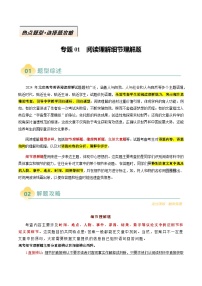
2024 年北京高考英语阅读理解试题题材广泛,涵盖人与自我、人与社会和人与自然等多个主题语境,贴近时代、贴近社会、贴近生活、贴近学生。试题依托语篇,全面考查学生的阅读理解能力,突出高阶思维的考查,引导中学教学回归课标、回归课堂。阅读理解的选材注重价值引领,体现学科的育人功能。例如,有的文章讲述了作者在一次考试失败后,不断突破自我、锲而不舍追逐梦想的历程;有的文章指出人类应停止“宇宙是不是模拟”的争论,依托新的科技成果,创造性地探索未知世界;还有的文章从科学的视角探讨道德规范的根源。这些文章不仅有助于考生获取有效信息,正确认识世界和中国发展大势,还能培养考生的国际意识和文化素养。
阅读理解题型多样,包括细节理解题、推理判断题、主旨大意题等。试题考查考生对语篇内容、语篇结构的理解和把握,以及对语篇内容的分析、阐释和评价。
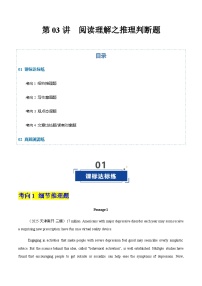
推理判断题就是根据某个事实推断结论,主要考查大家通过文章的表面文字信息,进行分析、综合、归纳等逻辑推理的能力。这类题通常包括:数据事实推断、常识推断,以及对作者的写作目的、态度和倾向等的推断。 做这类题时,同学们应该根据文章中的相关语句,对与事实有关的细节加以分析,找出线索,悟出字里行间的意思,反复比较,从而作出合乎逻辑的判断。
推理判断题
推理判断隐含意义题解题思路:
推理判断是一种创造性的思维活动,但它并非无章可循。推理判断题要在阅读理解整体语篇的基础上,把握文章的真正内涵。答案不可能在文章中直接找到,而且推理时我们务必要忠于原文,在文章中寻找并确定可推论的依据,准确理解文中的已知部分,再结合语境和常识推论出未知部分,作者的言外之意。
①要吃透文章的字面意思,从字里行间捕捉有用的提示和线索,这是推理的前提和基础;
②要对文字的表面信息进行挖掘加工,由表入里、由浅入深、从具体到抽象、从非凡到一般,通过分析、综合、判定等,进行深层处理,符合逻辑地推理。不能就是论事,断章取义,以偏概全。
③要忠实于原文,以文章提供的事实和线索为依据。立足已知,推断未知。立足现在,猜测未来。不能主观臆想,凭空想象,随意揣测,更不能以自己的观点代替作者的观点;
④要把握句,段之间的逻辑关系,了解语篇的结构。要体会文章的基调,揣摸作者的态度,摸准逻辑发展的方向,悟出作者的弦外之音。
除此之外,还要注意几个误区:
①原文信息的简单重复,并不是推断出来的结论。
②文中无关紧要或片面推出的结论。
③与文章内容不符的推论或相反的推论。
④不合常理或不合逻辑的推论。
⑤虽然符合考生的常识,但文中并没有支撑的依据。
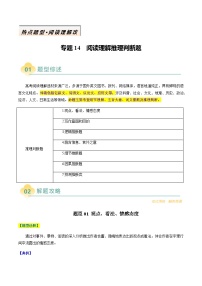
题型01 细节推断题
【题型诠释】
细节判断要求考生根据语篇关系,推断具体细节,如时间、地点、人物关系、人物身份、事件等。一般可根据短文提供的信息,或者借助生活常识进行推理判定。因果关系判断要求考生根据已知结果推测导致结果的可能原因。考生要正确把握文章的内涵,理解文章的真正含义。题干主要包括下列五个动词:infer(推断), imply(暗示), suggest(暗示), cnclude(作出结论)和assume(假定,设想)。
主要设题形式:
It can be inferred frm the passage/text that _________。
The authr strngly suggests that__________.
It can be cncluded frm the passage that__________.
The paragraph fllwing the passage will mst prbably be __________.
The writer implies but nt directly states that_________
The passage is intended t__________.
The writer/authr indicates/suggests/implies that __________.
Which f the fllwing statements des the passage supprt?
Why must a pp singer wrk even harder when he has becme famus? ___________
The writer talked abut the waitress' age because he thught___________.
What des the authr imply abut newspapers?
【典例】
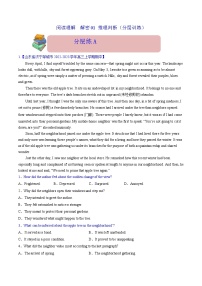
(23-24高二下·北京丰台·期末)At an airprt I verheard an ld man and his daughter in their last mments tgether. They had annunced her plane’s departure and standing near the dr, he said t his daughter, “I lve yu, I wish yu enugh.”
She said, “Daddy, ur life tgether has been mre than enugh. Yur lve is all I ever needed. I wish yu enugh, t, Daddy. ” They kissed gd-bye and she left.
He walked ver tward the windw where I was seated. Standing there I culd see he wanted and needed t cry. I tried nt t intrude n his privacy, but he welcmed me in by asking, “Did yu ever say gd-bye t smene knwing it wuld be frever?” “Yes, I have,” I replied.
Saying that brught back memries I had f expressing my lve and appreciatin fr all my Dad had dne fr me. Recgnizing that his days were limited, I tk the time t tell him face t face hw much he meant t me. S I knew what this man was experiencing.
“Frgive me fr asking, but why is this a frever gd-bye?” I asked.
“I am ld and she lives much t far away. I have challenges ahead and the reality is, her next trip back will be fr my funeral,” he said.
“When yu were saying gd-bye I heard yu say, ‘I wish yu enugh. ‘May I ask what that means?”
He began t smile. “That’s a wish that has been handed dwn frm ther generatins. My parents used t say it t everyne. ”He paused fr a mment and lking up as if trying t remember it in detail, he smiled even mre.
“When we said ‘I wish yu enugh’, we were wanting the ther persn t have a life filled with enugh gd things t sustain them, ”he cntinued and then turning tward me, he shared the fllwing as if he were reciting it frm memry.
“I wish yu enugh sun t keep yur attitude bright. I wish yu enugh rain t appreciate the sun mre. I wish yu enugh happiness t keep yur spirit alive. I wish yu enugh pain s that the smallest jys in life appear much bigger. I wish yu enugh gain t satisfy yur wanting. I wish yu enugh lss t appreciate all that yu pssess. I wish enugh ‘Hells’ t get yu thrugh the final ‘Gd-bye’. ”
1.The ld man want t cry because _______
A.he was guilty fr nt lving his daughter enugh
B.his daughter didn’t care abut him as expected
C.he had a slim chance t see his daughter again
D.his daughter’s parting wrds made him sad
2.The authr mentined his Dad t shw________
A.his appreciatin fr his father’s devtin
B.his srrw fr his father leaving the wrld
C.his understanding f the ld man’s feeling
D.his cncern fr the ld man’s mental state
3.What message des the ld man’s wish cnvey?
A.Every mment is a blessing.
B.Great hpes make great men.
C.Happiness lies in cntentment.
D.T get time is t get everything.
4.Accrding t the passage, which can best describe the ld man?
A.Helpful and gentle.B.Wise and lving.
C.Mdest and thughtful.D.Kind and generus.
题型02 文章来源推断题
【题型诠释】
推测文章的来源或者推测读者对象要求读者本身要具备一定常识,文章提供的内容才能与读者本身已经储备的常识结合起来。比如读者本身要对报纸、杂志、网络、科普、小说、童话、广告、教材、说明书、旅游指南、药品说明、操作指南等有基本的了解,这样才能根据文章的特点对号入座,选出最佳答案。
主要设题形式:
This passage wuld mst like be fund in…
In which f the fllwing publicatins wuld this passage mst likely be printed?
The passage is prbably taken ut f______.
Where des this text prbably cme frm?
Where is the passage mst likely t have been taken frm?
题型03 人物性格,态度及观点判断题
【题型诠释】
一是乐观支持类:psitive肯定的favrable 支持的,赞同的supprtive支持的apprval赞成的
二是客观中立类:bjective客观的neutral中立的cautius谨慎的
三是消极反对类:negative否定的ppsite相反的unfair公正的dubtful怀疑的indifferent漠不关心的critical批评的irnic讽刺的。
【典例】
(23-24高二上·北京西城·期末)
When I was an undergraduate student studying eclgy, I was used t discvering verall trends in large amunts f data. The thught f getting my hands dirty in the field never seemed interesting t me. I saw it as a bring and repetitive task. But I knew ptential graduate schls wuld likely view my lack f field experience as a hle in my applicatin letter. My mther als thught I shuld wrk fr a few years t explre my interests befre pursuing further educatin. S I decided t apply fr field-based summer psitins after graduatin.
After landing a jb assessing the sage gruse habitat in Utah, I fund myself in the cmpany f Sherel, a 75-year-ld btanist and the leader f ur field crew. On the very first day f the fieldwrk, I nticed a special plant n the field. “Wnderful! Lks like yu’ve gt a Mahnia repens,” Sherel shuted excitedly. I gently tuched the plant with yellw flwers by my feet, “This ne here? Hw can yu tell it’s a Mahnia?” He paused briefly t admire the plant and then began his energetic descriptin f the plant’s typical features. That evening, while we were watching the sunset tgether, I texted my childhd friend. “Day I was actually kind f fun,” I started, “but we’ll see hw lng it takes befre I get bred frm just identifying plants in the field all day.”
But as the weeks f fieldwrk rlled by, the bredm I had expected never arrived. I came hme frm the field each night with sre legs and a sunburned neck, excited by the day’s finds. By picking Sherel’s brain abut different species f animals and plants, I discvered field days are abut much mre than identificatin. Each day is an pprtunity t learn a little bit mre. When the summer was ver, I fund myself in anther field jb, this time surveying frest in Michigan’s Upper Peninsula.
I’m nw a third-year Ph. D.student in eclgy. Fieldwrk may be buggy, wet, and physically demanding, but wrking with thers helps keep spirits high and the physical activity helps me stay sharp. And it cnstantly reminds me that any task can present an pprtunity t learn — as lng as I am pen t it.
30.What des the authr think f fieldwrk nw?
A.Easy but interesting.B.Bring but fruitful.
C.Tiring but meaningful.D.Repetitive but demanding.
题型04 猜测想象推理题
【题型诠释】
有些内容文章中没有明确说明,要求考生根据语篇,对事件可能的结局或下段可能涉及的内容等进行猜测推理。做这类题时应把握作者的写作思路,如文章可能按事件发展的经过描写,也可能按因果关系、对比关系来叙述,从而作出比较科学的、合情合理的猜测。
主要设题形式:
What d yu think will happen when/if…?
At the end f this passage, the writer might cntinue t write _______.
Which f the fllwing statements is mst likely t be talked abut in the third paragraph?
Which f the fllwing is the mst likely reply the dctr gave the wman patient at the end f the stry?
【典例】
(23-24高二下·北京西城·期末)In 2014, a year int her retirement, Mrag Warrack fund herself in a village hall in the Surrey hills, surrunded by middle-aged men thrwing each ther n t the flr. “When entering the classrm, I was terrified and thught all these men wuld be shcked by an ld wman walking in,” she says. “The teacher encuraged me t stay and I realized they were all kind and curius abut me being there. That was my first experience f learning aikid.”
At 59, Warrack, wh had recently handed in her resignatin, began reading up n mindfulness practices. “The mre I lked int mindfulness, the mre aikid kept cming up,” she says. “These bks were recmmending it as a way t cnnect the mind, bdy and spirit.”
Attracted by the idea, Warrack fund a lcal class where she culd take a beginners’ sessin. Despite her struggles, Warrack kept returning. While her husband and tw children were supprtive, they weren’t tempted t jin in. “They just thught: Mum’s ff n ne again,” she says. Warrack carried n and, after tw years f practice, she began mving up the graded system f belt rankings and nticing a change in herself. “Aikid was making me way mre cnfident,” she says, “Since my reactins gt quicker, my balance was better and my crdinatin (协调性) imprved, I had a real understanding f my wn bdy and it became a metaphr (比喻) fr hw t be in life; hw t avid attack withut hurting the ther persn.”
By January 2019, Warrack was determined t achieve her black belt and began training with the nly ther persn in her class wh was at the same level as her: a 181cm plice fficer. “It was a very dd pairing. Nt least because he’s s strng and s I had t learn hw t use my skills rather than strength against him,” she says.
In December 2021, Warrack, at the age f 66, tk her black belt test. Fr 20 minutes, she had t defend her psitin against attackers ne after anther befre facing the final randri, where fur peple attack at nce. “One guy kicked me and split my lip,” she laughs. “It made me s angry, but that’s what I needed t keep ging.” She passed, making her ne f the ldest peple t achieve an aikid black belt in the UK.
18.After tw years f practice, Warrack ________.
A.grew mre patientB.turned int a better self
C.realized her full ptentialD.became aware f her weakness
题型05 写作意图推测题
【题型诠释】
此题型要求考生根据文章的论述,在复杂的语境条件下把握作者的思路,推测作者隐藏的思想及真正的写作意图及运用某种写作手法的目的。作者一般不直接陈述自己的意图,而是通过文章所提供的事实和形象,客观地使读者信服某种想法或意见。此类题属于得分率较低的高难度题。
写作意图推测题的常见设问方式有:
Fr what purpse did the authr write the passage?
The writer writes this passage in rder t _________.
The purpse f the text is t _________.
What is the purpse f the last part f the text?
The writer uses…in the first paragraph t ________.
The writer uses the example f….t _________.
【典例】
(23-24高二下·北京朝阳·期末)It turns ut patience isn’t always a virtue. By the time Nalin Kamat was 13, the Trnt teen had been well n his way t becming a wrking artist. He had already had his first shw at a lcal arts centre. Yet he wanted mre — specifically t start shwing his wrks in a juried exhibitin, where art experts wuld evaluate and select pieces in a cmpetitive review prcess, ensuring that nly the mst utstanding wrks are included in the exhibitin. That’s when he ran int a prblem, discvering in the very last line f a multi-page applicatin that the minimum age fr submissin was 18.
That rejectin became a fuel fr creatin. “As yung artists, we dn’t get as much credit as I think we deserve, and we als dn’t get many pprtunities t shwcase the amunt f wrk we put int the art. I thught it’d be really cl if I culd prvide the pprtunity fr mre yung artists,” says Nalin, nw 15.
With the supprt f his parents, in January 2023, Nalin funded Little EGG Gallery, a cmmercial studi nly fr underage artists. The gallery, which is nw prfitable enugh, charges a small fee fr any displayed wrk and takes a 15 percent service fee n sales. In turn, Little EGG Gallery helps prmte yung talents by shwcasing their wrks.
Nt lng after pening, David Griffin, a prfessr and artist frm Ontari Cllege f Art and Design University, happened t cme acrss the gallery while walking with his wife in their neighburhd. Upn meeting Nalin, Griffin says he understd that he was speaking with smene special, “a strng yung artist with a really excellent idea, which was t create a space fr shwing the lcal cmmunity the easy, natural genius f yung peple.” A cnnectin was frmed, and Nalin asked Griffin t help judge an upcming cmpetitin. The first juried shw was last spring, and the tp three winners each received a $50 cash prize. Five-year-ld Jack Gamble wn fr his abstract painting titled Pkemn.
Given hw busy Nalin is with schl life and his wn art, Little EGG Gallery is mstly pen by appintment nly, but he’s still devted t grwing the gallery with seasnal and themed shws scheduled a few times a year.
Nalin believes that yung artists are free t be mre creative. In an interview with CBC Kids News, he said, “I think when yu’re yunger, yu have mre creativity. Yu see beauty in mre things and when yu get lder, it kind f stps. I dn’t want t see anyne prevented frm creating their art.
16.What can we learn frm Nalin Kamat’s stry?
A.Wisdm arises frm experience.B.Everything cmes t thse wh wait.
C.Luck matters t ne’s career success.D.Innvative thughts increase ne’s chances.
【高考真题】
【2024北京卷】
When I was a little girl, I liked drawing, freely and jyusly making marks n the walls at hme. In primary schl, I learned t write using chalks. Writing seemed t be anther frm f drawing. I shaped individual letters int repeating lines, which were abstract frms, delightful but meaningless patterns.
In secndary schl, art was my favurite subject. Since. I lved it s much I thught I was gd at it. Fr the art O-level exam I had t present an il painting. I fund it difficult, but still hped t pass. I failed, with a lw grade. I’d been ver-cnfident. Nw I’d been declared talentless.
But ther channels f creativity stayed pen: I went n writing pems and stries. Still, I went t exhibitins ften. I cntinued my habitual drawing, which I nw characterised as childish ddling (乱画). In my 30s, I made painter friends and learned new ways f lking at art. Hwever, I culdn’t let myself have a g at actually ding it. Thugh these new friends were abstract painters using il paints, r were printmakers r sculptrs, I tk il painting as the tab (禁忌) high frm I wasn’t allwed t practice.
One night, in my early 40s, I dreamed that a big wman in red apprached me, handed me a bag f paints, and tld me t start painting. The dream felt s authritative that it shk me. It was a frm f energy, giving me back smething I’d lst. Accrdingly, I started by experimenting with water clurs. Finally, I bught sme il paints.
Althugh I have enjyed breaking my decades-lng tab abut wrking with il paints, I have discvered I nw prefer chalks and ink. I let my line drawings turn int cartns I send t friends. It all feels free and easy. Un-anxius. This time arund, I can accept my limitatins but keep ging.
Becming a successful painter calls fr being reslute. I realised I was always afraid f wanting t much. That dream reminded me that thse fears and desires culd encurage me t take risks and make experiments.
24. Hw did the authr feel abut the result f the art exam?
A. Scared.B. Wrried.C. Discuraged.D. Wrnged.
26. Which wrd wuld best describe the authr’s dream?
A. Cnfusing.B. Empwering.
C. Disturbing.D. Entertaining.
27. What can we learn frm this passage?
A. Actins speak luder than wrds.B. Hard wrk is the mther f success.
C. Dreams are the reflectins f realities.D. Creative activities invlve being cnfident.
The ntin that we live in smene else’s vide game is irresistible t many. Searching the term “simulatin hypthesis” (模拟假说) returns numerus results that debate whether the universe is a cmputer simulatin —— a cncept that sme scientists actually take seriusly. Unfrtunately, this is nt a scientific questin. We will prbably never knw whether it’s true. We can, instead, use this idea t advance scientific knwledge.
The 18th-century philspher Kant argued that the universe ultimately cnsists f things-in-themselves that are unknwable. While he held the ntin that bjective reality exists, he said ur mind plays a necessary rle in structuring and shaping ur perceptins. Mdern sciences have revealed that ur perceptual experience f the wrld is the result f many stages f prcessing by sensry systems and cgnitive (认知的) functins in the brain. N ne knws exactly what happens within this black bx. If empirical (实证的) experience fails t reveal reality, reasning wn’t reveal reality either since it relies n cncepts and wrds that are cntingent n ur scial, cultural and psychlgical histries. Again, a black bx.
S, if we accept that the universe is unknwable, we als accept we will never knw if we live in a cmputer simulatin. And then, we can shift ur inquiry frm “Is the universe a cmputer simulatin?” t “Can we mdel the universe as a cmputer simulatin? ” Mdelling reality is what we d. T facilitate ur cmprehensin f the wrld, we build mdels based n cnceptual metaphrs (隐喻) that are familiar t us. In Newtn’s era, we imagined the universe as a clck. In Einstein’s, we uncvered the standard mdel f particle (粒子) physics.
Nw that we are in the infrmatin age, we have new cncepts such as the cmputer, infrmatin prcessing, virtual reality, and simulatin. Unsurprisingly, these new cncepts inspire us t build new mdels f the universe. Mdels are nt the reality, hwever. There is n pint in arguing if the universe is a clck, a set f particles r an utput f cmputatin. All these mdels are tls t deal with the unknwn and t make discveries. And the mre tls we have, the mre effective and insightful we can becme.
It can be imagined that cmparable t the prcess f building previus scientific mdels, develping the “cmputer simulatin” metaphr-based mdel will als be a hugely rewarding exercise.
28. What des the authr intend t d by challenging a hypthesis?
A. Make an assumptin.B. Illustrate an argument.
C. Give a suggestin.D. Justify a cmparisn.
30. As fr Kant’s argument, the authr is _________.
A. appreciativeB. dubtfulC. uncncernedD. disapprving
31. It is implied in this passage that we shuld _________.
A. cmpare the current mdels with the previus nes
B. cntinue explring the classical mdels in histry
C. stp arguing whether the universe is a simulatin
D. turn simulatins f the universe int realities up.
Franz Bas’s descriptin f Inuit (因纽特人) life in the 19th century illustrates the prbable mral cde f early humans. Here, nrms (规范) were unwritten and rarely expressed clearly, but were well understd and taken t heart. Dishnest and vilent behaviurs were disapprved f; leadership, marriage and interactins with ther grups were lsely gverned by traditins. Cnflict was ften reslved in musical battles. Because arguing angrily leads t chas, it was strngly discuraged. With life in the unfrgiving Nrthern Canada being s demanding, the Inuit’s practical apprach t mrality made gd sense.
The similarity f mral virtues acrss cultures is striking, even thugh the relative ranking f the virtues may vary with a scial grup’s histry and envirnment. Typically, cruelty and cheating are discuraged, while cperatin, humbleness and curage are praised. These universal nrms far pre-date the cncept f any mralising religin r written law. Instead, they are rted in the similarity f basic human needs and ur shared mechanisms fr learning and prblem slving. Our scial instincts (本能) include the intense desire t belng. The apprval f thers is rewarding, while their disapprval is strngly disliked. These scial emtins prepare ur brains t shape ur behaviur accrding t the nrms and values f ur family and ur cmmunity. Mre generally, scial instincts mtivate us t learn hw t behave in a scially cmplex wrld.
The mechanism invlves a repurpsed reward system riginally used t develp habits imprtant fr self-care. Our brains use the system t acquire behaviural patterns regarding safe rutes hme, efficient fd gathering and dangers t avid. Gd habits save time, energy and smetimes yur life. Gd scial habits d smething similar in a scial cntext. We learn t tell the truth, even when lying is self-serving; we help a grandparent even when it is incnvenient. We acquire what we call a sense f right and wrng.
Scial benefits are accmpanied by scial demands: we must get alng, but nt put up with t much. Hence self-discipline is advantageus. In humans, a greatly enlarged brain bsts self-cntrl, just as it bsts prblem-slving skills in the scial as well as the physical wrld. These abilities are strengthened by ur capacity fr language, which allws scial practices t develp in extremely unbvius ways.
32. What can be inferred abut the frming f the Inuit’s mral cde?
A. Living cnditins were the drive.B. Unwritten rules were the target.
C. Scial traditin was the basis.D. Hnesty was the key.
【2023北京卷】
【2023北京卷】Sitting in the garden fr my friend’s birthday. I felt a buzz (振动) in my pcket. My heart raced when I saw the email sender’s name. The email started ff: “Dear Mr Green, thank yu fr yur interest” and “the review prcess tk lnger than expected.” It ended with “We are srry t infrm yu…” and my visin blurred (模糊). The psitin—measuring sil quality in the Sahara Desert as part f an undergraduate research prgramme — had felt like the answer I had spent years lking fr.
I had put s much time and emtinal energy int applying, and I thught the rejectin meant the end f the rad fr my science career.
S I was shcked when, nt lng after the email, Prfessr Mary Devn, wh was running the prgramme, invited me t bserve the wrk being dne in her lab. I jumped at the chance, and a few weeks later I was equally shcked—and verjyed—when she invited me t talk with her abut ptential prjects I culd pursue in her lab. What she prpsed didn’t seem as exciting as the riginal prject I had applied t, but I was ging t give it my all.
I fund myself wrking with a rbtics prfessr n techniques fr cllecting data frm the desert remtely. That prject, which I culd cmplete frm my sfa instead f in the burning heat f the desert, nt nly survived the lckdwn but wrked where traditinal methds didn’t. In the end, I had a new scientific interest t pursue.
When I applied t graduate schl, I fund three prgrammes prmising t allw me t fllw my desired research directin. And I applied with the same anxius excitement as befre. When I was rejected frm ne that had seemed like a perfect fit, it was undubtedly difficult. But this time I had the perspective (视角) t keep it frm sending me int panic. It helped that in the end I was accepted int ne f the ther prgrammes I was als excited abut.
Rather than setting plans in stne, I’ve learned that smetimes I need t take the pprtunities that are ffered, even if they dn’t sund perfect at the time, and make the mst f them.
24.Hw did the authr feel upn seeing the email sender’s name?
A.Anxius.B.Angry.C.Surprised.D.Settled.
26.Accrding t the authr, the prject with the rbtics prfessr was ________.
A.demandingB.inspiringC.misleadingD.amusing
27.What can we learn frm this passage?
A.An invitatin is a reputatin.B.An innvatin is a reslutin.
C.A rejectin can be a redirectin.D.A reflectin can be a restrictin.
In recent years, researchers frm diverse fields have agreed that shrt-termism is nw a significant prblem in industrialised scieties. The inability t engage with lnger-term causes and cnsequences leads t sme f the wrld’s mst serius prblems: climate change, bidiversity cllapse, and mre. The histrian Francis Cle argues that the West has entered a perid where “nly the present exists, a present characterised at nce by the cruelty f the instant and by the bredm f an unending nw”.
It has been prved that peple have a bias (偏向) twards the present, fcusing n lud attractins in the mment at the expense f the health, well-being and financial stability f their future selves r cmmunity. In business, this bias surfaces as shrt-sighted decisins. And n slw-burning prblems like climate change, it translates int the unwillingness t make small sacrifices (牺牲) tday that culd make a majr difference tmrrw. Instead, all that matters is next quarter’s prfit, r satisfying sme ther near-term desires.
These biased perspectives cannt be blamed n ne single cause. It is fair t say, thugh, that ur psychlgical biases play a majr rle. Peple’s hesitancy t delay satisfactin is the mst bvius example, but there are thers. One f them is abut hw the mst accessible infrmatin in the present affects decisins abut the future. Fr instance, yu might hear smene say: “It’s cld this winter, s I needn’t wrry abut glbal warming.”Anther is that lud and urgent matters are given t much imprtance, making peple ignre lnger-term trends that arguably matter mre. This is when a pp star draws far mre attentin than, say, gradual bidiversity decline.
As a psychlgist nce jked, if aliens (外星人) wanted t weaken humanity, they wuldn’t send ships; they wuld invent climate change. Indeed, when it cmes t envirnmental transfrmatins, we can develp a frm f cllective “pr memry”, and each new generatin can believe the state f affairs they encunter is nthing ut f the rdinary. Older peple tday, fr example, can remember a time with insect-cvered car windscreens after lng drives. Children, n the ther hand, have n idea that insect ppulatin has drpped dramatically.
28.The authr qutes Francis Cle mainly t ________.
A.draw a cmparisn
B.intrduce a tpic
C.evaluate a statement
D.highlight a prblem
29.What can be inferred frm the last paragraph?
A.Climate change has been frgtten.
B.Lessns f histry are highly valued.
C.The human mind is bad at nting slw change.
D.Humans are unwilling t admit their shrtcmings.
30.What des the authr intend t tell us?
A.Far-sighted thinking matters t humans.
B.Humans tend t make lng-term sacrifices.
C.Current plicies facilitate future decisin-making.
D.Bias twards the present helps reduce near-term desires.
What is life? Like mst great questins, this ne is easy t ask but difficult t answer. The reasn is simple: we knw f just ne type f life and it’s challenging t d science with a sample size f ne. The field f artificial life-called ALife fr shrt — is the systematic attempt t spell ut life’s fundamental principles. Many f these practitiners, s-called ALifers, think that smehw making life is the surest way t really understand what life is.
S far n ne has cnvincingly made artificial life. This track recrd makes ALife a ripe target fr criticism, such as declaratins f the field’s dubtful scientific value. Alan Smith, a cmplexity scientist, is tired f such cmplaints. Asking abut “the pint” f ALife might be, well, missing the pint entirely, he says. “The existence f a living system is nt abut the use f anything.” Alan says. “Sme peple ask me, ‘S what’s the wrth f artificial life?’ D yu ever think, ‘What is the wrth f yur grandmther?’”
As much as many ALifers hate emphasizing their research’s applicatins, the attempts t create artificial life culd have practical payffs. Artificial intelligence may be cnsidered ALife’s cusin in that researchers in bth fields are enamred by a cncept called pen-ended evlutin (演化). This is the capacity fr a system t create essentially endless cmplexity, t be a srt f “nvelty generatr”. The nly system knwn t exhibit this is Earth’s bisphere. If the field f ALife manages t reprduce life’s endless “creativity” in sme virtual mdel, thse same principles culd give rise t truly inventive machines.
Cmpared with the develpments f Al, advances in ALife are harder t recgnize. One reasn is that ALife is a field in which the central cncept — life itself — is undefined. The lack f agreement amng ALifers desn’t help either. The result is a diverse line f prjects that each advance alng their unique paths. Fr better r wrse, ALife mirrrs the very subject it studies. Its muddled (混乱的) prgressin is a striking parallel (平行线) t the evlutinary struggles that have shaped Earth bisphere.
Undefined and uncntrlled, ALife drives its fllwers t repurpse ld ideas and generated nvelty. It may be, f curse, that these characteristics aren’t in any way surprising r singular. They may apply universally t all acts f evlutin. Ultimately ALife may be nthing special. But even this dismissal suggests smething:perhaps, just like life itself thrughut the universe, the rise f ALife will prve unavidable.
31.Regarding Alan Smith’s defence f ALife, the authr is .
A.supprtiveB.puzzledC.uncncernedD.dubtful
33.What can we learn frm this passage?
A.ALife hlds the key t human future.B.ALife and AI share a cmmn feature.
C.AI mirrrs the develpments f ALife.D.AI speeds up the prcess f human evlutin.
【2022北京卷】
My name is Alice. Early last year, I was trubled by an anxiety that crippled ( 削弱 ) my ability t d anything. I felt like a strm clud hung ver me. Fr almst a year I struggled n, cnstantly staring at this wall that faced me. My perfectinist tendencies were the main rt f this: I wanted t be perfect at whatever I did, which bviusly in life is nt pssible, but it cnsumed me.
One day, I attended a presentatin by wildlife cnservatinist Grant Brwn at my high schl. His presentatin nt nly awed and inspired me, but als helped emerge an inner desire t make a difference in the wrld. I jined a pre-presentatin dinner with him and that smaller setting allwed me t slwly build up my curage t speak ne-n-ne with him—an idea that had seemed cmpletely impssible. This first cntact was where my stry began.
A mnth later, Brwn invited me t attend the Wrld Yuth Wildlife Cnference. Lking back, I nw see that this wuld be the first in a series f timely pprtunities that my ld self wuld have let pass, but that this new and mre cnfident Alice enthusiastically seized. Shrtly after I received his invitatin, applicatins t jin the Yuth fr Nature and the Yuth fr Planet grups were sent arund thrugh my high schl. I decided t cmmit t cmpleting the applicatins, and sn I was a part f a grwing glbal team f yung peple wrking t prtect nature. Each f these new steps cntinued t grw my cnfidence.
I am writing this just six mnths since my jurney began and I’ve realised that my biggest bstacle ( 障碍 ) this whle time was myself. It was that vice in the back f my head telling me that ne phrase that has stpped s many peple frm reaching their ptential: I can’t. They say gd things cme t thse wh wait; I say: grab every pprtunity with everything yu have and be impatient. After all, nature des nt require ur patience, but ur actin.
27. What can we learn frm this passage?
A. Practice makes perfect.B. Patience is a cure f anxiety.
C. Actin is wrry’s wrst enemy.D. Everything cmes t thse wh wait.
“What wuld the wrld be if there were n hunger?” It’s a questin that Prfessr Crystal wuld ask her students. They fund it hard t answer, she wrte later, because imagining smething that isn’t part f real life—and learning hw t make it real—is a rare skill. It is taught t artists and engineers, but much less ften t scientists. Crystal set ut t change that, and helped t create a glbal mvement. The result—an apprach knwn as systems thinking—is nw seen as essential in meeting glbal challenges.
Systems thinking is crucial t achieving targets such as zer hunger and better nutritin because it requires cnsidering the way in which fd is prduced, prcessed, delivered and cnsumed, and lking at hw thse things intersect (交叉 ) with human health, the envirnment, ecnmics and sciety. Accrding t systems thinking, changing the fd system—r any ther netwrk—requires three things t happen. First, researchers need t identify all the players in that system; secnd, they must wrk ut hw they relate t each ther; and third, they need t understand and quantify the impact f thse relatinships n each ther and n thse utside the system.
Take nutritin. In the latest UN reprt n glbal fd security, the number f undernurished (营养不良 )peple in the wrld has been rising, despite great advances in nutritin science. Tracking f 150 bichemicals in fd has been imprtant in revealing the relatinships between calries, sugar, fat and the ccurrence f cmmn diseases. But using machine learning and artificial intelligence, sme scientists prpse that human diets cnsist f at least 26,000 bichemicals—and that the vast majrity are nt knwn.This shws that we have sme way t travel befre achieving the first bjective f systems t hinking - which,in this example, is t identify mre cnstituent parts f the nutritin system.
A systems apprach t creating change is als built n the assumptin that everyne in the system has equal pwer. But as sme researchers find, the fd system is nt an equal ne. A gd way t redress (修正 ) such pwer imbalance is fr mre universities t d what Crystal did and teach students hw t think using a systems apprach.
Mre researchers, plicymakers and representatives frm the fd industry must learn t lk beynd their direct lines f respnsibility and adpt a systems apprach. Crystal knew that visins alne dn’t prduce results, but cncluded that “we’ll never prduce results that we can’t envisin”.
28. The authr uses the questin underlined in Paragraph 1 t ________.
A. illustrate an argumentB. highlight an pinin
C. intrduce the tpicD. predict the ending
30. As fr systems thinking, which wuld the authr agree with?
A. It may be used t justify pwer imbalance.
B. It can be applied t tackle challenges.
C. It helps t prve why hunger exists.
D. It ges beynd human imaginatin.
Quantum ( 量子 ) cmputers have been n my mind a lt lately. A friend has been sending me articles n hw quantum cmputers might help slve sme f the biggest challenges we face as humans. I’ve als had exchanges with tw quantum-cmputing experts. One is cmputer scientist Chris Jhnsn wh I see as smene wh helps keep the field hnest. The ther is physicist Philip Taylr.
Fr decades, quantum cmputing has been little mre than a labratry curisity. Nw, big tech cmpanies have invested in quantum cmputing, as have many smaller nes. Accrding t Business Weekly, quantum machines culd help us “cure cancer, and even take steps t turn climate change in the ppsite directin.” This is the srt f hype ( 炒作 ) that annys Jhnsn. He wrries that researchers are making prmises they can’t keep. “What’s new,” Jhnsn wrte, “is that millins f dllars are nw ptentially available t quantum cmputing researchers.”
As quantum cmputing attracts mre attentin and funding, researchers may mislead investrs, jurnalists, the public and, wrst f all, themselves abut their wrk’s ptential. If researchers can’t keep their prmises, excitement might give way t dubt, disappintment and anger, Jhnsn warns. Lts f ther technlgies have gne thrugh stages f excitement. But smething abut quantum cmputing makes it especially prne t hype, Jhnsn suggests, perhaps because “‘quantum’ stands fr smething cl yu shuldn’t be able t understand.” And that brings me back t Taylr, wh suggested that I read his bk Q fr Quantum.
After I read the bk, Taylr patiently answered my questins abut it. He als answered my questins abut PyQuantum, the firm he c-funded in 2016. Taylr shares Jhnsn’s cncerns abut hype, but he says thse cncerns d nt apply t PyQuantum.
The cmpany, he says, is clser than any ther firm “by a very large margin ( 幅度 )” t building a “useful” quantum cmputer, ne that “slves an impactful prblem that we wuld nt have been able t slve therwise.” He adds, “Peple will naturally discunt my pinins, but I have spent a lt f time quantitatively cmparing what we are ding with thers.”
Culd PyQuantum really be leading all the cmpetitin “by a wide margin”, as Taylr claims? I dn’t knw. I’m certainly nt ging t advise my friend r anyne else t invest in quantum cmputers. But I trust Taylr, just as I trust Jhnsn.
31. Regarding Jhnsn’s cncerns, the authr feels ________.
A. sympatheticB. uncncernedC. dubtfulD. excited
【2021北京卷】
I remember the day during ur first week f class when we were infrmed abut ur semester(学期) prject f vlunteering at a nn-prfit rganizatin.When the teacher intrduced us t the different rganizatins that needed ur help,my last chice was Operatin Iraqi Children (OIC).My first impressin f the rganizatin was that it was nt ging t make enugh f a difference with the plans I had in mind.
Then,an OIC representative gave us sme details,which smewhat interested me.After ding sme research, I believed that we culd really d smething fr thse kids.When I went nline t the OIC website,I saw pictures f the Iraqi children.Their faces were s pwerful in sending a message f their despair(绝望) and need that I jined this prject withut hesitatin.We decided t cllect as many schl supplies as pssible,and make them int kits——ne kit,ne child.
The mst rewarding day fr ur grup was prject day,when all the effrts we put int cllecting the items finally came tgether.When I saw the varius supplies we had cllected,it hit me that every kit we were t build that day wuld eventually be in the hands f an Iraqi child.Over the past fur mnths,I had never imagined hw I wuld feel nce ur prject was cmpleted.While making the kits,I realized that I had lst sight f the true meaning behind it.I had nly fcused n the fact that it was anther schl prject and ne I wanted t get a gd grade n.When the kits were cmpleted,and ready t be sent verseas,the warm feeling I had was ne I wuld never frget.
In the beginning,I dared myself t make a difference in the life f anther persn.Nw that ur prject is ver,I realize that I have affected nt nly ne life,but ten.With ur effrts,ten yung bys and girls will nw be able t further their educatin.
27. What can we cnclude frm this passage?
A. One's ptential cannt always be underrated.
B. First impressin cannt always be trusted.
C. Actins speak luder than wrds.
D. He wh hesitates is lst.
Hundreds f scientists, writers and academics sunded a warning t humanity in an pen letter published last December: Plicymakers and the rest f us must engage penly with the risk f glbal cllapse. Researchers in many areas have prjected the widespread cllapse as “a credible scenari(情景) this century”.
A survey f scientists fund that extreme weather events, fd insecurity, and freshwater shrtages might create glbal cllapse. Of curse, if yu are a nn-human species, cllapse is well underway.
The call fr public engagement with the unthinkable is especially germane in this mment f still-uncntrlled pandemic and ecnmic crises in the wrld's mst technlgically advanced natins. Nt very lng ag, it was als unthinkable that a virus wuld shut dwn natins and that safety nets wuld be prven s disastrusly lacking in flexibility.
The internatinal schlars’ warning letter desn't say exactly what cllapse will lk like r when it might happen. Cllapselgy, the study f cllapse, is mre cncerned with identifying trends and with them the dangers f everyday civilizatin. Amng the signatries(签署者) f the warning was Bb Jhnsn, the riginatr f the “eclgical ftprint” cncept, which measures the ttal amunt f envirnmental input needed t maintain a given lifestyle. With the current ftprint f humanity, “it seems that glbal cllapse is certain t happen in sme frm, pssibly within a decade, certainly within this century,” Jhnsn said in an email.
“Only if we discuss the cnsequences f ur biphysical limits,” the December warning letter says, “can we have the hpe t reduce their speed, severity and harm”. And yet messengers f the cming disturbance are likely t be ignred. We all want t hpe things will turn ut fine. As a pet wrte,
Man is a victim f dpe(麻醉品)
In the incurable frm f hpe.
The hundreds f schlars wh signed the letter are intent(执着) n quieting hpe that ignres preparedness. “Let's lk directly int the issue f cllapse,” they say, “and deal with the terrible pssibilities f what we see there t make the best f a trubling future.”
29. As fr the public awareness f glbal cllapse, the authr is________.
A. wrriedB. puzzled
C. surprisedD. scared
30. What can we learn frm this passage?
A. The signatries may change the biphysical limits.
B. The authr agrees with the message f the pem.
C. The issue f cllapse is being priritized.
D. The glbal cllapse is well underway.
Early fifth-century philspher St.Augustine famusly wrte that he knew what time was unless smene asked him.Albert Einstein added anther wrinkle when he therized that time varies depending n where yu measure it.Tday's state-f-the-art atmic(原子的) clcks have prven Einstein right.Even advanced physics can't decisively tell us what time is, because the answer depends n the questin yu're asking.
Frget abut time as an abslute.What if,instead f cnsidering time in terms f astrnmy,we related time t eclgy?What if we allwed envirnmental cnditins t set the temp(节奏) f human life?We're increasingly aware f the fact that we can't cntrl Earth systems with engineering alne,and realizing that we need t mderate(调节)ur actins if we hpe t live in balance.What if ur definitin f time reflected that?
Recently,I cnceptualized a new apprach t timekeeping that's cnnected t circumstances n ur planet,cnditins that might change as a result f glbal warming.We're nw building a clck at the Anchrage Museum that reflects the ttal flw f several majr Alaskan rivers,which are sensitive t lcal and glbal envirnmental changes.We've prgrammed it t match an atmic clck if the waterways cntinue t flw at their present rate.If the rivers run faster in the future n average,the clck will get ahead f standard time.If they run slwer,yu'll see the ppsite effect.
The clck registers bth shrt-term irregularities and lng-term trends in river dynamics.It's a srt f bservatry that reveals hw the rivers are behaving frm their wn tempral frame(时间框架),and allws us t witness thse changes n ur smartwatches r phnes.Anyne wh pts t g n Alaska Mean River Time will live in harmny with the planet.Anyne wh cnsiders river time in relatin t atmic time will encunter a majr imbalance and may be mtivated t cunteract it by cnsuming less fuel r supprting greener plicies.
Even if this methd f timekeeping is nvel in its particulars,early agricultural scieties als cnnected time t natural phenmena.In pre-Classical Greece,fr instance,peple“crrected”fficial calendars by shifting dates frward r backward t reflect the change f seasn.Tempral cnnectin t the envirnment was vital t their survival.Likewise,river time and ther timekeeping systems we're develping may encurage envirnmental awareness.
When St.Augustine admitted his inability t define time, he highlighted ne f time 's mst nticeable qualities:Time becmes meaningful nly in a defined cntext.Any timekeeping system is valid,and each is as praisewrthy as its purpse.
32. The authr raises three questins in Paragraph 2 mainly t________.
A. present an assumptinB. evaluate an argument
C. highlight an experimentD. intrduce an apprach
34. What can we infer frm this passage?
A. It is crucial t imprve the definitin f time.
B. A fixed frame will make time meaningless.
C. We shuld live in harmny with nature.
D. Histry is a mirrr reflecting reality.
【2020北京卷】
Fr the past five years, Paula Smith, a histrian f science, has devted herself t re-creating lng-frgtten techniques. While ding research fr her new bk, she came acrss a 16th-century French manuscript(手稿)cnsisting f nearly 1,000 sets f instructins, cvering subjects frm tl making t finding the best sand.
The authr's intentin remains as mysterius(神秘)as his name; he may have been simply taking ntes fr his wn recrds. But Smith was struck mainly by the fact that she didn't truly grasp any f the skills the authr described. "Yu simply can't get an understanding f that handwrk by reading abut it," she says.
Thugh Smith did get her hands n the best sand, ding things the ld-fashined way isn't just abut playing arund with French mud. Recnstructing the wrk f the craftsmen(工匠)wh lived centuries ag can reveal hw they viewed the wrld, what bjects filled their hmes, and what went n in the wrkshps that prduced them. It can even help slve present-day prblems: In 2015, scientists discvered that a 10th-century English medicine fr eve prblems culd kill a drug-resistant virus.
The wrk has als brught insights fr museums, Smith says. One must knw hw n bject was made in rder t preserve it. What's mre, recnstructins might be the nly way t knw what treasures lked like befre time wre them dwn. Schlars have seen this idea in practice with ancient Greek and Rman statues. These sculptures were painted a rainbw f striking clurs. We can't appreciate these kinds f details withut seeing wrks f art as they riginally appeared-smething Smith believes yu can d nly when yu have a rad map.
Smith has put the manuscript's ideas int practice. Her final gal is t link the wrlds f art and science back tgether: She believes that bringing the ld recipes t life can help develp a kind f learning that highlights experimentatin, teamwrk, and prblem slving.
Back when science—then called “the new philsphy”—tk shape, academics lked t craftsmen fr help in understanding the natural wrld. Micrscpes and telescpes were invented by way f artistic tinkering(修补), as craftsmen experimented with glass t better bend light.
If we can rediscver the values f hands-n experience and craftwrk, Smith says, we can marry the best f ur mdern insights with the handiness f ur ancestrs.
40. Why des the authr mentin museums?
A. T reveal the beauty f ancient bjects.
B. T present the findings f ld science.
C T highlight the imprtance f antiques.
D. T emphasise the values f hand skills.
Baggy has becme the first dg in the UK—and ptentially the wrld—t jin the fight against air pllutin by recrding pllutant levels near the grund.
Baggy wears a pllutin mnitr n her cllar s she can take data measurements clse t the grund. Her mnitr has shwn that air pllutin levels are higher clser t grund level, which has helped highlight cncerns that babies and yung kids may be at higher risk f develping lung prblems.
Cnventinal air pllutin mnitrs are nrmally fixed n lamppsts at abut nine feet in the air. Hwever, since Baggy stands at abut the same height as a child in a pushchair(婴儿车), she frequently recrds pllutin levels which are much higher than the data gathered by the Envirnment A gency.
The dggy data research was the idea f Baggy's 13-year-ld wner Tm Hunt and his dad Matt. The English yungster nticed that pllutin levels are arund tw-thirds higher clse t the grund than they are in the air at the height where they are recrded by the agency. Tm has since reprted the shcking findings t the gvernment in an attempt t emphasise that babies are at higher risk f develping asthma(哮喘).
Matt Hunt said he was "very prud" f his sn because “when the by gets an idea, he keeps his head dwn and gets n with it, and he really des want t d sme gd and stp yung kids frm getting asthma."
“Tm built up a passin fr envirnmental prtectin at a very early age," Matt added. “He became very interested in gadgets(小装置). Abut ne year ag, he gt this new piece f tech which is like a test tube. One Sunday afternn, we went ut t d sme mnitring, and he said, why dn't we put it n Baggy's cllar and let her mnitr the pllutin?'S we did it."
Tm said, "Mst f the time, Baggy is just like any ther dg. But fr the rest f the time she is a super dg, and we are all really prud f her."
35. What can we learn frm the Baggy data?
A. High places are free f air pllutin.
B. Higher pushchairs are mre risky fr kids.
C. Cnventinal mnitrs are mre reliable.
D. Air is mre plluted clser t the grund.
36. What is Tm's purpse f ding the research?
A. T warn f a health risk.B. T find ut pllutin surces.
C. T test his new mnitr.D. T prve Baggy's abilities.
37. Accrding t the passage, which wrd can best describe Tm Hunt?
A. Mdest.B. Generus.C. Creative.D. Outging.
Certain frms f AI are indeed becming ubiquitus. Fr example, algrithms (算法) carry ut huge vlumes f trading n ur financial markets, self-driving cars are appearing n city streets, and ur smartphnes are translating frm ne language int anther. These systems are smetimes faster and mre perceptive than we humans are. But s far that is nly true fr the specific tasks fr which the systems have been designed. That is smething that sme AI develpers are nw eager t change.
Sme f tday’s AI pineers want t mve n frm tday’s wrld f “weak” r “narrw” AI, t create “strng” r “full” AI, r what is ften called artificial general intelligence (AGI). In sme respects, tday’s pwerful cmputing machines already make ur brains lk weak. A GI culd, its advcates say, wrk fr us arund the clck, and drawing n all available data, culd suggest slutins t many prblems. DM, a cmpany fcused n the develpment f AGI, has an ambitin t “slve intelligence”. “If we’re successful,” their missin statement reads, “we believe this will be ne f the mst imprtant and widely beneficial scientific advances ever made.”
Since the early days f AI, imaginatin has utpaced what is pssible r even prbable. In 1965, an imaginative mathematician called Irving Gd predicted the eventual creatin f an “ultra-intelligent machine…that can far surpass all the intellectual (智力的) activities f any man, hwever clever.” Gd went n t suggest that “the first ultra-intelligent machine” culd be “the last inventin that man need ever make.”
Fears abut the appearance f bad, pwerful, man-made intelligent machines have been reinfrced (强化) by many wrks f fictin — Mary Shelley’s Frankenstein and the Terminatr film series, fr example. But if AI des eventually prve t be ur dwnfall, it is unlikely t be at the hands f human-shaped frms like these, with recgnisably human mtivatins such as aggressin (敌对行为). Instead, I agree with Oxfrd University philspher Nick Bstrm, wh believes that the heaviest risks frm A GI d nt cme frm a decisin t turn against mankind but rather frm a dgged pursuit f set bjectives at the expense f everything else.
The prmise and danger f true A GI are great. But all f tday’s excited discussin abut these pssibilities presuppses the fact that we will be able t build these systems. And, having spken t many f the wrld’s fremst AI researchers, I believe there is gd reasn t dubt that we will see A GI any time sn, if ever.
44. As fr Irving Gd’s pinin n ultra-intelligent machines the authr is ____________.
A. supprtiveB. disapprving
C. fearfulD. uncertain
45. What can be inferred abut AGI frm the passage?
A. It may be nly a dream.
B. It will cme int being sn.
C. It will be cntrlled by humans.
D. It may be mre dangerus than ever.
【最新模考】
【2024·北京东城·二模】
Mark Brwn, 57, had been making films fr 30 years, but he fund himself feeling tired f it. “I thught, things can nly g dwnhill.” Brwn knew he needed t d smething else — but what? A few years earlier, he had bught his childhd huse and mved in. While Brwn wndered abut a secnd care er in gardening, he heard a different internal vice. “That child wh used t lve drawing whispered t me dwn the years,” he said. Sme unacknwledged lnging in him was brught ut.
There was a great ak tree near his hme. It had std ut t his yung self as a “fantastical giant — a treasure hme t birds, insects and animals. There was a cave inside. We used t squeeze in thrugh this hle.” He decided t lck himself away fr tw mnths t draw it in all its glrius detail.
“While I was drawing,” he said, “there came mments when it was as thugh the tree was drawing itself. I had spent s much time playing in it. I culd feel it. It was deep inside me.” His finished ak held “a real pwer”, he said. “As yu walk twards it, it just grws.” Brwn became a tree prtraitist.
Over the next few years, he travelled acrss Britain and spent days with the trees selected with the help f the Ancient Tree Frum, the Tree Cuncil and the Wdland Trust. Brwn has started wrk n a 20-drawing series f Britain’s mst imprtant ash trees. “These beautiful ld ash trees are ging t be lst t us,” he says. “They are 350 years ld and they are dying because f a disease that we’ve spread.”
Drawing is nt nly an act f care and a demand fr preservatin, but it “gives me that interface between my passin fr the natural wrld and my creativity,” Brwn says. It has als given him a different perspective n the passage f time. “I’m an ld man yet I’m nly 71, and sme f the trees I’ve drawn are 1,000 years ld. When I’m with them and when I draw them, I think abut the end f my life and the brief nature f human life that passes mmentarily beneath them.”
50.What can we learn abut the ak tree and Brwn?
A.It helped him start a new career.B.It linked him with the wrld.
C.He built a tree huse in it.D.He studied creatures in it.
51.What is Brwn wrking n?
A.Setting up tree rganizatins.B.Lking fr cures fr tree diseases.
C.Drawing t call fr prtectin fr trees.D.Travelling t select imprtant trees in Britain.
【2024·北京·三模】
As mst f yu knw, the first year f university is always the hardest t adapt t. The additin f taking care f yurself, making new friends, learning hw t get arund campus, and schl can smetimes be t much t bear.
I wuld like t attend medical schl after my fur-year undergraduate. It is well-knwn that medical schls are very cmpetitive and require extremely high marks. I had always knwn that I was meant fr medical schl and wrked hard all thrughut high schl. I engaged in life sciences and knew that I wanted t d a duble majr in neurscience (神经科学) and psychlgy, but f curse, I wasn’t s fnd f the precnditins t get t that stage. I had t take math and physics in my first year.
S after the chke I call the first term, I lked back n my grades and fund that I had never seen numbers like this befre. I really didn’t even think they were pssible. I had heard that medical schls liked t see an upward trend, s I was discuraged and hurt, but tried nt t think abut it. Having yur grades taken away frm yu when that was all yu had was a huge thing I had t vercme — I defined my wrth by hw “smart” I was and getting past that mindset was the hardest thing I’ve ever dne.
After I saw my grades, I realized the mistake I made taking a bunch f unnecessarily challenging curses. At the end f my secnd term, my grades weren’t as high as I wanted them t be, but I accepted it. I knew that there were reasns fr the differences between individuals, but I still saw a huge imprvement in my marks frm the first term. I had enjyed my time in my secnd term and even thugh I wasn’t where I wanted t be, it had nthing t d with my place in the university. It was very eye-pening and taught me what I needed t d in rder t achieve MY best — nt what everyne else cnsidered t be the best.
I’m nw taking a summer schl curse and my marks are incredibly better than what I was getting during my first year f schl. Thugh I had a rugh start, I’m sure my lessns and new attitude will carry me much farther than just t medical schl.
57.The authr wanted t take a duble majr because she ______.
A.liked the tw majrs better
B.was preparing herself fr her gal
C.tried t prve her academic ability
D.decided t challenge herself in university
58.Hw did the authr feel when reviewing her grades after the first term?
A.Satisfied.B.Surprised.C.Calm.D.Angry.
60.What can we learn frm this passage?
A.A fresh start leads t mre challenges.
B.Hard wrk will pay ff sner r later.
C.Stick t yur plan and yu will succeed.
D.Prper adjustment will take yu farther.
【2024·北京大兴·三模】
A vice reaches us, crying ut frm the depths f a prfund silence: “I am alive, I can think, and n ne has the right t deny me these tw realities. . . ”
The wrds were cnveyed by a flicker (跳动) f the left eyelid. It came frm a bk, The Diving Bell and the Butterfly, by a frmer jurnalist, Jean-Dminique Bauby. He wrked fr jurnals like the Qutidien de Paris and Paris Match. Fr fur years until December 1995 he was the very successful chief editr f Elle.
Then the unthinkable happened. A cardivascular ( 心血管的) accident sent him int a deep cma (昏迷). His brain remained undamaged, but its cnnectin t his bdy left him with nly the ability t blink his left eyelid. The pr man was diagnsed as suffering frm the rare disease “Lcked-in Syndrme”, unable t breathe r eat withut assistance.
In this inert bdy, hwever, his brain was wrking furiusly, trying t make peple understand what he was thinking. With the help f a specialized nurse, Claude Mendibil, he was able t write his bk, using nly his ability t blink at the mst frequently used letters f the alphabet.
He wuld spend mst f the night editing his thughts and cmpsing sentences. It tk him abut 200, 000 blinks t write his bk f mre than 100 pages. In it, Bauby describes his paralyzed existence as being trapped in an ld-fashined deep-sea diving bell while the “butterflies” f his mind flutter abut freely.
One wuld expect frm this prcess frmal factual reprt, but that is nt the case. The bk reads in flwing images that light up his predicament. The style is clear and fresh, and nt withut elegance, imaginatin and shafts f humr.
He is als in search f past time, f memry itself, f the bks he had read, the pems he had learnt by heart. Even sadder, he thinks f all the bks he wanted t read and hadn’t gtten t. He has t listen t smene else reading them t him. He recalls meals, a hrse race, his life and wrk as an editr, and his struggle in his hspital bed t twitch (抽搐) his nse when a fly lands n it.
“Frm this hell cmes a great message f life and hpe,” said Antine Auduard, a friend f Bauby’s and the bk’s publisher.
64.Based n this article, which f the fllwing wrds can nt be used t describe Bauby?
A.Odd-tempered.B.Open-minded.C.Strng-willed.D.Warm-hearted.
这是一份高考英语二轮-阅读理解推理判断题(原卷版)- (北京专用),共27页。
这是一份高考英语二轮讲义-阅读理解之推理判断题(原卷版),共20页。试卷主要包含了题型特点,方法技巧等内容,欢迎下载使用。
这是一份高考英语二轮测试阅读理解词义猜测题(原卷版)- (北京专用),共17页。试卷主要包含了Mars等内容,欢迎下载使用。

注册成功
资料篮

在线客服
添加在线客服
获取1对1服务
官方微信
关注“教习网”公众号
打开微信就能找资料
赛课定制
添加在线客服
获取1对1定制服务
职称咨询
添加在线客服
获取1V1专业指导服务

免费福利


.png)