免费领取教师福利

若您为此资料的原创作者,认为该资料内容侵犯了您的知识产权,请扫码添加我们的相关工作人员,我们尽可能的保护您的合法权益。


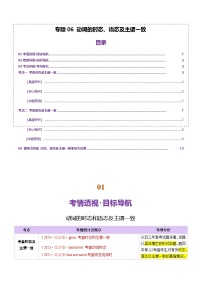
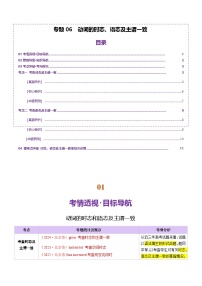
这是一份高考英语一轮讲义-高考高频考点动词时态&语态(学生版),共13页。学案主要包含了命题规律,备考策略,命题预测,be dne,will+d,be+t d,be+ding,一般现在时等内容,欢迎下载使用。
1. 高考真题考点分布
2. 命题规律及备考策略
【命题规律】
阅读理解:考查动词或短语的词义辨析及熟词生义;
完形填空:主要考查在特定语境中动词和动词短语的熟词生义和词义辨析。动词词义辨析题主要考查结合语境区分动词词义的能力,在平时的学习中应当掌握常用动词的基本意义,注意一词多义和熟词生义;养成推敲句子的含义以及对语境理解的习惯。
语法填空: 考查动词作谓语和非谓语的用法,动词和其它词的搭配,
【备考策略】
1.长难句中首先考虑找到谓语,提炼句子的主干;
2.解决熟词生义时务必瞻前顾后,根据上下文进行合理推断;
3. 掌握谓语的考点和解题策略;
4. 掌握非谓语的考点和解题策略;
5. 在复杂语境中根据前后文进行词类转换。
【命题预测】
预计2025年的高考动词和动词短语考查语境复杂化和综合化的特点。
动词(Verbs)
重点用法① 动词的种类
用法:1.行为动词:包括及物动词和不及物动词。及物动词必须带宾语;不及物动词不能直接带宾语,但跟一个介词后,就可带介词宾语。
He sent me a new bike.他送了我一辆新的自行车。
Keith wrks hard.基思工作努力。
I’m waiting fr yu.我正在等你。
2.系动词:本身有词义,与后面的表语构成合成谓语。常见的系动词除be以外,还有lk,feel,taste,get,turn,keep,smell,becme等。
Jack is twelve years ld.杰克12岁。
It gets cld.天气变冷了。
3.助动词:本身没有词义,只是帮助行为动词构成谓语,表示时态、语态、语气以及构成疑问句和否定句等。常见的助动词有be,have,d,will,shall等。
He will g back.他要回来了。
It is made in China.它是中国制造的。
I haven’t had my breakfast yet.我还没吃早饭呢。
4.情态动词:有词义但并不完全,不能单独作谓语,要与行为动词连用,表示能力、许可、可能性、必要、意图等。情态动词后多跟动词原形,没有人称和数的变化。常见的情态动词有can,must,may,need,shall,will,culd,shuld,wuld等。
Birds can fly.鸟会飞。
May I cme in?我可以进来吗?
重点用法② 动词第三人称单数的构成
用法:1.一般情况下,在词尾加-s。
help→helps knw→knws
2.以字母s,x,ch,sh,结尾的动词,在词尾加-es。
guess→guesses d→des
3.以辅音字母加y结尾的动词,先变y为i,再加-es。
fly→flies try→tries
重点用法③ 动词过去式和过去分词的构成
用法:1.一般情况下,在词尾加-ed。
wrk→wrked→wrked pen→pened→pened
2.以字母e结尾的动词,在词尾加-d。
clse→clsed→clsed live→lived→lived
3.以“辅音字母+y”结尾的动词,变y为i,再加-ed。
study→studied→studied try→tried→tried
4.以“元音字母+y”结尾的动词,直接在词尾加-ed。
play→played→played stay→stayed→stayed
5.末尾只有一个辅音字母的动词(x除外),双写这个辅音字母,再加-ed。
stp→stpped→stpped regret→regretted→regretted
6.以重读r音节结尾的动词,先双写r,再加-ed。
refer→referred→referred prefer→preferred→preferred
提示:动词过去式和过去分词的不规则变化主要有四种形式:
(1)A→A→A型:set→set→set
(2)A→B→A型:run→ran→run
(3)A→B→B型:win→wn→wn
(4)A→B→C型:see→saw→seen
重点用法④ 动词现在分词的构成
用法:1.一般情况下,在词尾加-ing。
drink→drinking catch→catching
2.以不发音的字母e结尾的动词,先去e,再加-ing。
take→taking make→making
3.以重读闭音节或r音节结尾,末尾只有一个辅音字母时,先双写辅音字母,再加-ing。
beg→begging begin→beginning
4.以ie结尾的重读开音节的动词,先变ie为y,再加-ing。
die→dying lie→lying
提示:以y结尾的动词,y不变,直接加-ing;少数以e,ye等不发音的e结尾的动词,不去e,直接加-ing。
play→playing dye→dyeing
语法填空里面动词填空,占比很大。动词解题,可能是原形,谓语动词,非谓语动词,词形状换。如果确定需要谓语动词,则主要考虑三个方面:时态,语态,主谓一致。
Ⅰ、定义与分类
1、时态
时态是英语中一个重要的语法范畴,它表示不同时间发生的动作或存在的状态以及动作发生或存在的方式。
动作发生的时间可分为现在、过去、将来和过去将来四种形式,
动作发生的方式可分为一般、完成、进行和完成进行四种形式。
将时间形式和动作方式结合起来,就构成了英语的16种时态形式。
时态表解
2、语态
英语动词有2种语态:主动语态和被动语态:【be dne】
语态表解
Ⅱ、时态种类
一、一般现在时
1、构成
1.主语+be+其他 2.主语+d+其他 3.主语+des+其他
注:have 的单数第三人称形式为has。
2、用法
1.表示主语现在的特征、性格和状态
—D yu sing? —A little.
She is at hme.
2.表示经常性的或习惯性的动作或存在的状态。常用的时间状语:always, ften, usually, frequently, seldm, smetimes, every day/week/mnth/year...
She visits her parents every day.
He always sleeps with the windws pen.
Students ften travel hundreds f miles t get here.
3.表示客观真理、格言以及不受时间限制的客观存在。
The earth mves arund the sun.
Clumbus prved that the earth is rund.
Summer fllws spring.
4.在时间、条件、让步状语从句中遵守“主将从现”,
即:主句使用一般将来时,从句使用一般现在时。
The vlleyball match will be put ff if it rains.
I’ll give her the telex when she cmes.
5.表示按时间表、计划、规定发生的动作。限于begin, cme, leave, g, arrive, pen, start, stp, clse, return 等一类动词。
The train starts at 10 ' clck in the mrning.
The plane fr Wuhan takes ff at 8:30 this mrning.
二、一般过去时
1、构成
1.动词 be → was, were 2.动词 have, has → had
3.助动词d, des → did 4.行为动词用过去式
2、用法
1. 表示在过去某个时间所发生的动作或存在的状态。
常用的时间状语有: yesterday, the day befre yesterday, last year, in 2021, the ther day, tw years ag, last mnth, ...
We went t the cinema last night.
We had lunch the ther day at ur favrite restaurant.
注:表示过去的一系列动作,尽管有先后,都用一般过去时,最后两个动词之间用 and 连结。如:He std up, lked arund and left.
2.表示在过去一段时间内的经常性、反复性或习惯性动作。
常用的时间状语有:every day, ften, smetimes...
used t , wuld常用来表示过去经常或反复发生的行为。
We ften played tgether when we were children.
In the year 1775, there was a wine shp.
We used t get up at five every mrning when were at schl.
三、一般将来时
1、构成
1.will+d (I /we shall) 2.be ging t+d 3.be+t d
4. be abut t d sth 5.be+ding 现在进行时 6.一般现在时
2、用法
1. 【will+d】表示客观上势必将要发生的事情或临时做出的打算。
常用的时间状语有:next time, tmrrw, befre lng, later n, in the future...
I’ll (shall / will) d a better jb next time.
The cncert will start in a minute.
2. 【be ging t+d】表示主观计划,打算做某事或根据某种迹象表明某事即将发生。
We are nt ging t stay there lng. I’m afraid they’re ging t lse the game.
Lk at thse black cluds. It’s ging t rain.
3.【be+t d】表示按计划、约定或按职责、义务必须去做的事或即将发生的动作。
He is t leave fr Beijing tmrrw. Tell him he’s nt t be back late.
N student is t leave the rm.
4.【be abut t d sth】表示不久或即将要发生的动作,一般不与具体时间状语连用。
Lk! The race is abut t start. The autumn harvest is abut t start.
【be abut t d sth when 正准备做某事突然...】
5.【be+ding】表示将来,表示计划好或准备要做某事
The ship is leaving fr New Yrk sn.
He is cming up t Beijing University next term.
6.【一般现在时】表示将来,按规定或时间表预计要发生的事。
The train leaves at 7:25 this evening.
四、过去将来时
1、构成
1.wuld d 2.was/were ging t, was/were t d, was/were abut t d
2、用法
表示从过去某一时间看将来要发生的动作或存在的状态,常用于宾语从句中。
She said she wuld be there at seven 'clck.
He said he wuld wait fr us at the bus stp.
She was abut t walk ut f the dr when the telephne rang.
五、现在完成时【不与具体的过去时间状语或 when 连用】
1、构成 have/has dne
2、用法
1.表示过去的动作或事情对现在所造成的影响。
常用的时间状语有:recently, lately, befre, yet, ever, never, nce, just...
The huse has changed hands several times recently.
I haven't heard any news frm my sn lately.
2.表示从过去某一时刻开始持续到现在的动作,这一动作还可能持续下去。
常用的时间状语有:since, up till nw, s far, fr a lng time, in the last/past few years...
He has wrked in the factry since last year.
Yet this system has wrked pretty well up till nw.
3.表示“这是第几次做某事”。
This/It is+the first/secnd...+( that ) + 从句,从句用现在完成时
This is the first time I have eaten dumplings.
It is the furth time that she has made such a mistake.
六、过去完成时
1、构成 had dne
2、用法
1. 表示在过去某一时刻或某一动作之前已经完成了的动作。【过去的过去】
When we arrived, he had already left.
2.表示开始于过去某一时间的动作或状态延续到过去另一时间,并且可能持续下去,常与fr, since连用。
These neighbring states had lived in peace fr centuries.
3. 表示过去未曾实现的愿望、打算或计划,主要用于 hpe, want, expect, think, suppse, plan, mean, intend 等动词。
I had meant t cme, but smething happened.
We had thught t return early but they wuldn’t let us g.
I had intended t make a cake, but I ran ut f time.
4.表示“这是第几次做某事”。
This/It was+the first/secnd...+( that ) + 从句, 从句用过去完成时。
This was the first time they had met in thirty-nine years.
It was the first time we had spken tgether.
5. 表示“一...就...”。
“”和“n sner... than...”,主句用过去完成时。
We had n sner left the village than it began t rain.
→ N sner had we left the village than it began t rain.
The game had hardly begun when it started raining.
→ Hardly had the game begun when it started raining.
七、现在进行时
1、构成
am / is /are + ding
2、用法
1.表示说话时正在进行的动作或存在的状态。
Please dn't make s much nise. I'm writing a cmpsitin.
Lk at the picture. The children are flying kites in the park.
2.表示现阶段正在进行的动作或发生的事情。
We are wrking in a factry these days.
We are wrking under extreme pressure at the mment.
3.与ften, always, cnstantly, frequently, cntinually, frever, all the time等连用,表示赞叹、赞扬、厌恶、不满等感情色彩。
He's always quarrelling with thers.
She is cnstantly wrrying abut her sn's health.
4. cme, g, start, pen, clse, arrive, return, begin, leave等动词用于进行时,表示按计划、安排即将发生的动作。
They are leaving fr New Yrk tmrrw.
The cmpany is pening a new flagship stre in Lndn.
八、过去进行时
1、构成
was / were + ding
2、用法
1.表示过去某一时刻或某一阶段正在进行的动作或发生的事情。常与过去的时间状语连用。
I was having a shwer at that time.
It was raining when they left the statin.
2.表示过去一个动作发生时,另一个动作正在进行。
When Paul kncked at the dr Jim was watching TV in the living rm.
3.与always, all the time, frever, frequently等连用,表示说话人的感叹、厌恶等情绪。
He was always shwing ff at parties when yung.
She was frever cmplaining.
4. cme, g, arrive, begin, leave等动词用于过去进行时,表示过去按计划、安排将要发生的动作。
I phned my mther t ask what time she was cming hme.
I had a pretty gd idea what she was ging t d.
1.I’m British. Sn after mving t Switzerland, I (thrw) a huse-warming party and was greatly surprised when all 30 guests shwed up exactly n time.(所给词的适当形式填空)
2.This device, hwever (use) a thermelectric generatr, which creates energy frm differences in temperature.(所给词的适当形式填空)
3.There (be) a dramatic rise in the number f extreme weather events ver the past 20 years, caused largely by rising glbal temperatures, accrding t a new reprt frm the United Natins. (所给词的适当形式填空)
1.In the experiment, the-researchers first /measured hw many tears (prduce) by dgs when they were just spending time at hme with their wners.(所给词的适当形式填空)
2.I decided t vlunteer fr this year’s half-marathn after the chairman f the rganizing cmmittee (visit) my schl. (所给词的适当形式填空)
3.It (impact) the nrmal frmatin f the lwer half f the bdy. (所给词的适当形式填空)
1.Accrding t Giraffa camelpardalis reticulata, acrss Africa, all giraffe ppulatins (decline) by ver 70 percent in the past 20 years frm 36,000 t less than 9,000 tday. (所给词的适当形式填空)
2.Chang Shana, an utstanding designer and educatr in China, was just 13 when her lve affair with Dunhuang (begin). (所给词的适当形式填空)
3.Yung athletes (wear) sprts clthing bearing Chinese elements, such as dragns and pandas. (所给词的适当形式填空)
4.In the past decades, with the rapid develpment f science and technlgy, ur daily life (change) a lt. (所给词的适当形式填空)
5.The cuntry will carry ut three mre missins -the launch f the Tianzhu-5 carg craft and the Shenzhu-15 crewed spaceship, as well as bringing theShenzhu-14 crew back t Earth -befre it (cmplete) the in-rbit cnstructin f the space statin by the end f this year. (所给词的适当形式填空)
6.The hst (cntact) me in advance by the time he reached the pub packed with peple. (所给词的适当形式填空)
7.Between rws f trees (stand) a new building, which is suppsed t be ur new library. (所给词的适当形式填空)
8.At the tp f the hill (lie) an ld cttage which has a wnderful view f the whle city. (所给词的适当形式填空)
9.It is the secnd time in a rw that Suzhu (tp) the ranking. (所给词的适当形式填空)
10.These beautiful blackfaced spnbills are sme f the wrld's rarest birds. The birds (fly) all the way frm their summer hme t this wetland, where they will spend the winter. Nw, they circle and land. (所给词的适当形式填空)
1.Life teaches us nt t regret ver yesterday, fr it (pass) and is beynd ur cntrl.
2.Experts say these texts culd prve the gvernment in the third century BC handed ut cruel punishments t peple wh (break) these rules. (所给词的适当形式填空)
3.A white telephne bth (电话亭), knwn as the Phne f the Wind, (sit) in a garden n tp f a hill. (所给词的适当形式填空)
4.Yu can charge them at maximum rate and the rest f the energy (g) ut as heat. (所给词的适当形式填空)
5.The nly thing she knew was that the cash in that envelpe (belng) t smene else. (所给词的适当形式填空)
6.The scientific literature evaluating these techniques (stretch) back decades and acrss thusands f articles. (所给词的适当形式填空)
7.It was the first time she (leave) her mtherland. (所给词的适当形式填空)
【答案】had left
【详解】考查固定句型和时态。句意:这是她第一次离开祖国。“It was +第几次+ that sb. had dne sth.”表示“这是某人第几次做某事”,为固定结构,故本空用leave“离开”的过去完成时形式had left。故填had left。
8.I (intend) t say hell t Linda, but she gt int her car and drve ff befre I culd say a wrd. (所给词的适当形式填空)
9.Tw years ag, she bught an expensive bike and then she (persuade) me t buy ne. (所给词的适当形式填空)
10.It (bther) me t think f her alne in that big huse. (所给词的适当形式填空)
(2023·北京·高考真题)
阅读下面短文,根据短文内容填空。在未给提示词的空白处仅填写1个恰当的单词,在给出提示词的空白处用括号内所给词的正确形式填空。
Every culture is riddled with unwritten rules, such as nes n punctuality (守时). I’m British. Sn after mving t Switzerland, I 34 (thrw) a huse-warming party and was greatly surprised when all 30 guests shwed up 35 (exact) n time. Years later, having mved t France. I turned up at the appinted hur fr a dinner, nly t find that n ther guest 36 (arrive) and my hstess was still in her sleeping suit.
(2023·北京·高考真题)
阅读下面短文,根据短文内容填空。在未给提示词的空白处仅填写1个恰当的单词,在给出提示词的空白处用括号内所给词的正确形式填空。
Mangrves, knwn as “red frest” in China, grw between land and sea, characterised by their cmplex rts. When 37 (see) frm afar, the mangrve frests appear mre splendid.
Mangrves can help sften waves and prtect 38 (city) frm castal winds. Fr these reasns, they are praised as “castal guardians”. Up t nw, China 39 (establish) a number f prtected areas with mangrves.
(2022·北京·高考真题)阅读下列短文,根据短文内容填空。在未给提示词的空白处仅填写1个恰当的单词,在给出提示词的空白处用括号内所给词的正确形式填空。
Helen was walking dwn the street late 34 the evening, her arms filled with grcery bags. Fcused n balancing the bags, she didn’t ntice her wallet falling ut f her pcket. As Helen walked n, she heard a man charging twards her. Fearful that he might have an intentin 35 (harm) her, Helen started t run. Eventually, the man 36 (catch) up with her, and he was nly trying t return her wallet!
(2022·北京·高考真题)阅读下列短文,根据短文内容填空。在未给提示词的空白处仅填写1个恰当的单词,在给出提示词的空白处用括号内所给词的正确形式填空。
Since peple can’t always eat ut r ck fr 40 (they), they get takeut r rder delivery. Mre takeut and mre fd delivery equal mre waste, especially plastic waste. That includes cups, bttles, and bags, mst f 41 are nly gd fr ne use. That’s a big prblem and it is getting even 42 (bad). The use f thse plastics 43 (increase) by 300% since 2019. The wrld wn’t survive if this situatin cntinues.
(2021·北京·高考真题)阅读下列短文,根据短文内容填空.在未给提示词的空白处仅填写1个恰当的单词,在给出提示词的空白处用括号内所给词的正确形式填空。
Why d we dream?Scientists aren't cmpletely sure,and they have diverse 34 (idea).Dreams might be a side effect f memry making.When yu sleep,yur brain srts thrugh everything 35 happened during the day,trying t link new experiences t ld memries.As it 36 (cnnect) things,yur brain turns them int a stry,and yu get a dream.
(2021·北京·高考真题)阅读下列短文,根据短文内容填空.在未给提示词的空白处仅填写1个恰当的单词,在给出提示词的空白处用括号内所给词的正确形式填空。
There 40 (be) a dramatic rise in the number f extreme weather events ver the past 20 years, 41 (cause) largely by rising glbal temperatures,accrding t a new reprt frm the United Natins. Frm 2000 t 2019, there were 7,348 majr natural disasters arund the wrld, 42 (result) in USD 2,970 billin in ecnmic lss.Much f this increase can be due t climate change. The findings shw a critical need 43 (invest) in disaster preventin.
题型
动词
语法填空
考查方向
考频
考点
2023
动的时态
3
(thrw) --- threw
(arrive)-------had arrived
establish)------has established
2022
动的时态
3
catch---------caught
have------has
increase-----has increased
2021
动的时态
2
cnnect--------cnnects
be------has been
1、一般现在时
d
des
am, is, are
2、一般过去时
did
was
were
1)经常,重复,客观事实,真理或格言。
2)every day,every few years, nce a week, twice a year, ften, usually, cnstantly, frequently, always, smetimes, seldm(很少), hardly, n Sunday =every Sunday
1)过去习惯性的动作或存在的状态。
2)in the past, every day last year, n Sundays last year, yesterday, , just nw(刚才), the ther day(前几天), last year/night/mnth
3、现在进行时
am
is ding
are
4、过去进行时
was
ding
were
1)正在
2)nw, at the mment, at present, fr the time being(现在),right nw
1)过去正在。
2)at 3 'clck yesterday; this time last mnth, 由when 引起的句中, while两端都用进行时
5、现在完成时
has
dne
have
→
6、过去完成时
had dne
1)已经
2)since+过去,主句: 现完。in/ ver/ fr/ during the past/last 30 years, lately, recently, just (刚刚), s far, by nw, up t nw; up until nw (直到现在), already(肯); yet(否, 疑)
以前,曾经。过去的过去
by the end f
by the time
three days befre
tw weeks earlier
7、现在完成进行时
has
been ding
have
→
8、过去完成进行时
had been ding
一直
一直
9、现在将来时
will d
→
10、过去将来时
wuld d
将,会
sn, tmrrw, this evening, tnight,in 5 hurs, after 5 ’clck, in the future, next year/ mnth/ mrning/ Sunday/ week
将,会
1、一般现在时
am
is dne
are
2、一般过去时
was
dne
were
被
被
3、现在进行时
am
is being dne
are
4、过去进行时
was
being dne
were
正在被
正在被
5、现在完成时
has
been dne
have
→
6、过去完成时
had been dne
已经被
曾经被,以前被
7、现在将来时
will be dne
→
8、过去将来时
wuld be dne
将被,会被
将被,会被
情况
变化规则
例词
一般情况
直接加s
wrk-wrks learn-learns cme-cmes
play-plays want-wants need-needs
结尾为s, x, ch, sh,
在词尾加es
pass-passes discuss-discusses fix-fixes
teach-teaches wash-washes d-des
结尾为“辅音字母加y”
变y为i再加es
study-studies carry-carries
cry-cries wrry-wrries
情况
变化规则
例词
一般情况
直接加ed
lk—lked watch—watched
stay—stayed expect—expected
以e结尾的动词
在词尾加d
hpe—hped like—liked
以“辅音字母加y”结尾
变y为i再加ed
study—studied carry—carried
cry—cried wrry—wrried
以重读闭音节或/r/音节结尾,词尾只有一个辅音字母时
双写词尾的辅音字母再加ed
stp—stpped clap—clapped
plan—planned prefer—preferred
refer—referred beg—begged
admit—admitted permit—permitted
这是一份高考英语一轮讲义-高考高频考点动词时态&语态(学生版),共13页。学案主要包含了命题规律,备考策略,命题预测,be dne,will+d,be+t d,be+ding,一般现在时等内容,欢迎下载使用。
这是一份高考英语一轮讲义-高考高频考点动词时态&语态(教师版),共18页。学案主要包含了命题规律,备考策略,命题预测,be dne,will+d,be+t d,be+ding,一般现在时等内容,欢迎下载使用。
这是一份高考英语一轮讲义-高考高频动词(学生版) -(新高考通用),共76页。学案主要包含了派生词等内容,欢迎下载使用。

注册成功
资料篮

在线客服
添加在线客服
获取1对1服务
官方微信
关注“教习网”公众号
打开微信就能找资料
赛课定制
添加在线客服
获取1对1定制服务
职称咨询
添加在线客服
获取1V1专业指导服务

免费福利


.png)