 免费领取教师福利


若您为此资料的原创作者,认为该资料内容侵犯了您的知识产权,请扫码添加我们的相关工作人员,我们尽可能的保护您的合法权益。

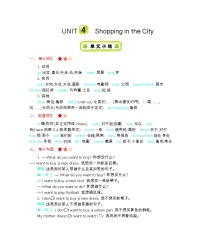
这是一份小学英语人教大同版(2024)四年级上册(2024)Unit 4 Food shopping精品导学案,共8页。
知识归纳
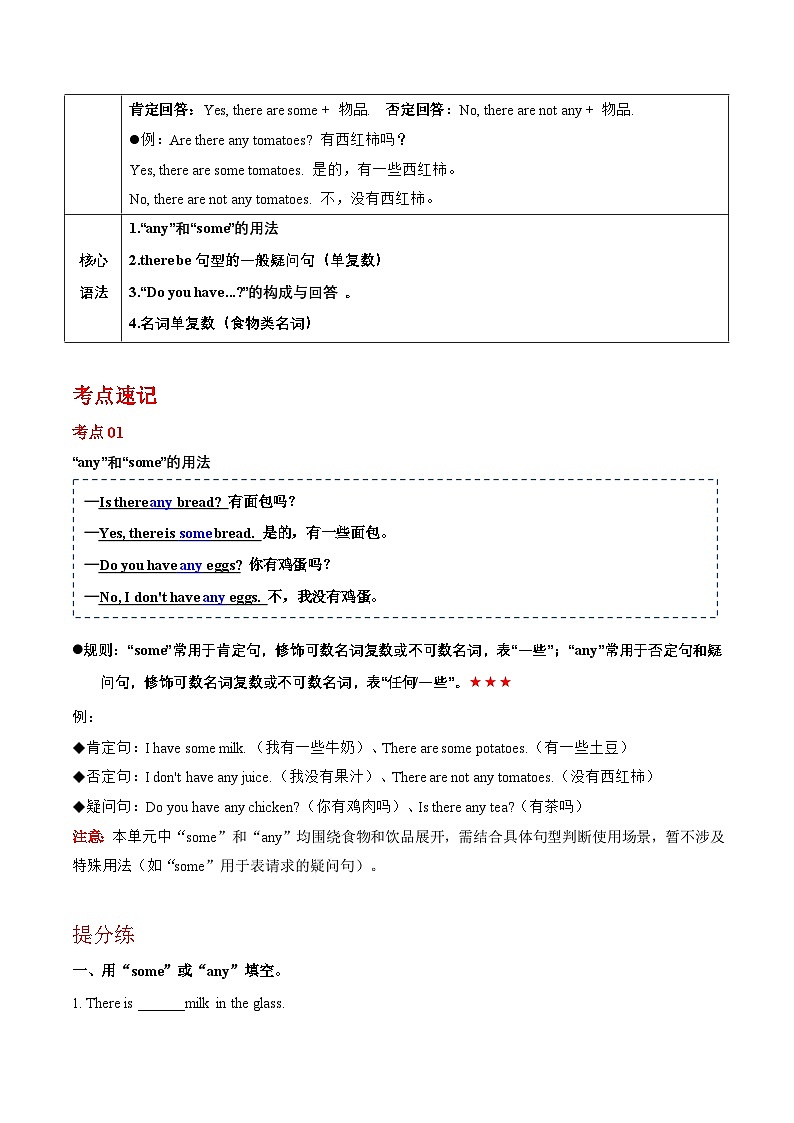
考点速记
考点01
—Is there any bread? 有面包吗?
—Yes, there is sme bread. 是的,有一些面包。
—D yu have any eggs? 你有鸡蛋吗?
—N, I dn't have any eggs. 不,我没有鸡蛋。
“any”和“sme”的用法
规则:“sme”常用于肯定句,修饰可数名词复数或不可数名词,表“一些”;“any”常用于否定句和疑问句,修饰可数名词复数或不可数名词,表“任何/一些”。★★★
例:
肯定句:I have sme milk.(我有一些牛奶)、There are sme ptates.(有一些土豆)
否定句:I dn't have any juice.(我没有果汁)、There are nt any tmates.(没有西红柿)
疑问句:D yu have any chicken?(你有鸡肉吗)、Is there any tea?(有茶吗)
注意:本单元中“sme”和“any”均围绕食物和饮品展开,需结合具体句型判断使用场景,暂不涉及特殊用法(如“sme”用于表请求的疑问句)。
提分练
一、用“sme”或“any”填空。
1. There is ______ milk in the glass.
2. D yu have ______ tmates in yur bag?
3. I dn't have ______ bread fr breakfast.
4. Are there ______ eggs in the fridge?
5. She has ______ juice fr lunch.
二、选择正确的单词填空:
1. There are ______ (sme/any) ptates n the table.
2. D yu have ______ (sme/any) chicken?
3. He desn't have ______ (sme/any) tea.
4. Is there ______ (sme/any) rice in the bwl?
5. We have ______ (sme/any) biscuits fr snacks.
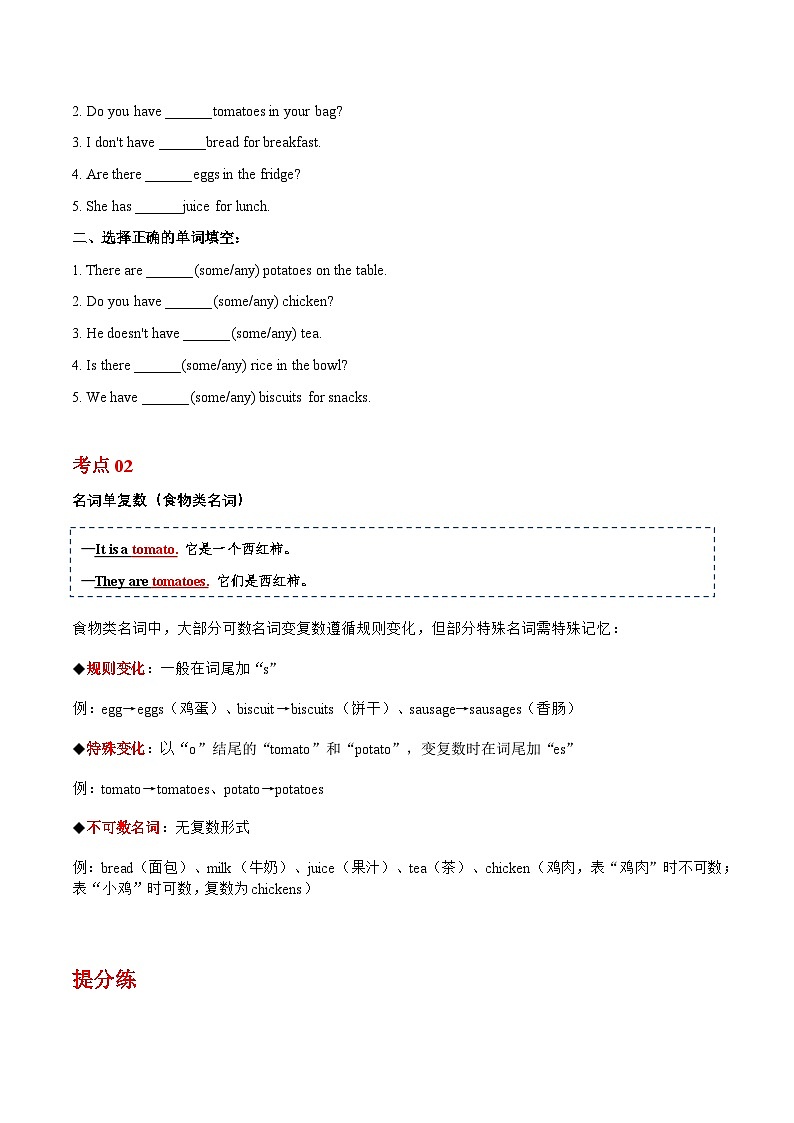
考点02
名词单复数(食物类名词)
—It is a tmat. 它是一个西红柿。
—They are tmates. 它们是西红柿。
食物类名词中,大部分可数名词变复数遵循规则变化,但部分特殊名词需特殊记忆:
规则变化:一般在词尾加“s”
例:egg→eggs(鸡蛋)、biscuit→biscuits(饼干)、sausage→sausages(香肠)
特殊变化:以“”结尾的“tmat”和“ptat”,变复数时在词尾加“es”
例:tmat→tmates、ptat→ptates
不可数名词:无复数形式
例:bread(面包)、milk(牛奶)、juice(果汁)、tea(茶)、chicken(鸡肉,表“鸡肉”时不可数;表“小鸡”时可数,复数为chickens)
提分练
一、用所给单词的适当形式填空。
1. I have three ______ (tmat) in the basket.
2. There are tw ______ (ptat) n the plate.
3. She buys sme ______ (egg) frm the supermarket.
4. We need five ______ (biscuit) fr the party.
5. He eats sme ______ (chicken) fr dinner.
二、判断句子正(√)误(×):
1. There are sme tmats.( )
2. I have tw ptats.( )
3. She has sme bread.( )
4. Are there any egg?( )
5. He desn't have any juice.( )
考点03
一般疑问句“Is ”“Are ”的用法
—Is there any milk in the bttle? 瓶子里有牛奶吗?
—Yes, there is. 是的,有。
—Are there any eggs in the bx? 盒子里有鸡蛋吗?
—Is it a pencil case?
—Yes, it is. —这是一个铅笔盒吗? —是的,它是。
句型结构:
1. 询问单数/不可数物品:Is there any + 物品(单数/不可数)?
—肯定回答:Yes, there is.
—否定回答:N, there are nt.
2. 询问复数物品:Are there any + 物品(复数)?
—肯定回答:Yes, there are.
—否定回答:N, there are nt.
考点03
一、根据答语补全问句。
1. ______ ______ any juice in the cup?(根据答语“Yes, there is.”补全)
2. ______ ______ any tmates n the table?(根据答语“N, there are nt.”补全)
3. ______ ______ any bread in the bag?(根据答语“Yes, there is.”补全)
4. ______ ______ any eggs in the fridge?(根据答语“Yes, there are.”补全)
5. ______ ______ any milk in the bttle?(根据答语“N, there are nt.”补全)
二、翻译句子。
1. Is there any tea in the cup?(翻译成中文)
2. Are there any ptates in the basket?(翻译成中文)
3. Is there any bread n the plate?(翻译成中文)
4. Are there any tmates in the fridge?(翻译成中文)
5. Is there any juice in the bttle?(翻译成中文)
考点04
一般疑问句“D yu ”的用法
—D yu have any chicken? 你有鸡肉吗?
—Yes, I d. 是的,我有。
—D yu have any biscuits? 你有饼干吗?
—N, I dn't. 不,我没有。
句型结构:D yu have any + 物品(单数/复数/不可数)?
肯定回答:Yes, I d.
否定回答:N, I dn't.
该句型用于询问对方是否拥有某物,“have”在此处表“拥有”,疑问句中用“any”修饰物品,需根据物品类型(单数/复数/不可数)灵活搭配,无需变化“have”的形式(主语为“yu”,用原形“have”)。
提分练
一、根据答语补全问句。
1. ______ ______ ______ any milk?(根据答语“Yes, I d.”补全)
2. ______ ______ ______ any tmates?(根据答语“N, I dn't.”补全)
3. ______ ______ ______ any bread?(根据答语“Yes, I d.”补全)
4. ______ ______ ______ any eggs?(根据答语“N, I dn't.”补全)
5. ______ ______ ______ any juice?(根据答语“Yes, I d.”补全)
二、改错(选出错误选项并改正):
1. D yu has any chicken? ( )______
A. D B. has C. any
2. Des yu have any eggs? ( )______
A. Des B. yu C. have
3. D yu have sme bread? ( )______
A. D B. sme C. bread
4. D yu have any tmat? ( )______
A. D B. any C. tmat
5. Des yu have any juice? ( )______
A. Des B. yu C. juice
参考答案
(1)“any”和“sme”的用法
一、1. sme(解析:肯定句中用“sme”修饰不可数名词“milk”)
2. any(解析:疑问句中用“any”修饰可数名词复数“tmates”)
3. any(解析:否定句中用“any”修饰不可数名词“bread”)
4. any(解析:疑问句中用“any”修饰可数名词复数“eggs”)
5. sme(解析:肯定句中用“sme”修饰不可数名词“juice”)
二、选择正确的单词填空:
1. sme(解析:肯定句,用“sme”修饰“ptates”)
2. any(解析:疑问句,用“any”修饰“chicken”)
3. any(解析:否定句,用“any”修饰“tea”)
4. any(解析:疑问句,用“any”修饰“rice”)
5. sme(解析:肯定句,用“sme”修饰“biscuits”)
(2)名词单复数(食物类名词)
一、用所给单词的适当形式填空。
1. tmates(解析:“three”后接复数,“tmat”的复数为“tmates”)
2. ptates(解析:“tw”后接复数,“ptat”的复数为“ptates”)
3. eggs(解析:“sme”后接复数,“egg”的复数为“eggs”)
4. biscuits(解析:“five”后接复数,“biscuit”的复数为“biscuits”)
5. chicken(解析:“chicken”表“鸡肉”时不可数,用原形)
二、判断句子正(√)误(×)。
1. ×(解析:“tmat”的复数为“tmates”,应改为“There are sme tmates.”)
2. ×(解析:“ptat”的复数为“ptates”,应改为“I have tw ptates.”)
3. √(解析:“bread”不可数,“sme bread”搭配正确)
4. ×(解析:“any”后接复数,“egg”的复数为“eggs”,应改为“Are there any eggs?”)
5. √(解析:“juice”不可数,否定句用“any”修饰,搭配正确)
(3)一般疑问句“Is ”“Are ”的用法
一、【解析】
1. Is there(解析:答语用“there is”,问句对应“Is there”,修饰不可数名词“juice”)
2. Are there(解析:答语用“there are nt”,问句对应“Are there”,修饰复数“tmates”)
3. Is there(解析:答语用“there is”,问句对应“Is there”,修饰不可数名词“bread”)
4. Are there(解析:答语用“there are”,问句对应“Are there”,修饰复数“eggs”)
5. Is there(解析:答语用“there are nt”,问句对应“Is there”,修饰不可数名词“milk”)
二、【解析】
1. 杯子里有茶吗?(解析:“Is there any...”表“有……吗”,“tea”译为“茶”)
2. 篮子里有土豆吗?(解析:“Are there any...”表“有……吗”,“ptates”译为“土豆”)
3. 盘子里有面包吗?(解析:“Is there any...”表“有……吗”,“bread”译为“面包”)
4. 冰箱里有西红柿吗?(解析:“Are there any...”表“有……吗”,“tmates”译为“西红柿”)
5. 瓶子里有果汁吗?(解析:“Is there any...”表“有……吗”,“juice”译为“果汁”)
(4)一般疑问句“D yu ”的用法
一、【解析】
1. D yu have(解析:答语用“I d”,问句对应“D yu have”,修饰不可数名词“milk”)
2. D yu have(解析:答语用“I dn't”,问句对应“D yu have”,修饰复数“tmates”)
3. D yu have(解析:答语用“I d”,问句对应“D yu have”,修饰不可数名词“bread”)
4. D yu have(解析:答语用“I dn't”,问句对应“D yu have”,修饰复数“eggs”)
5.D yu have(解析:答语用“I d”,问句对应“D yu have”,修饰不可数名词“juice”)
二、【解析】
1. B,改为“have”(解析:主语“yu”,疑问句中“have”用原形,“has”错误)
2. A,改为“D”(解析:主语“yu”,疑问句助动词用“D”,“Des”错误)
3. B,改为“any”(解析:疑问句中用“any”修饰“bread”,“sme”错误)
4. C,改为“tmates”(解析:“any”后接复数,“tmat”的复数为“tmates”)
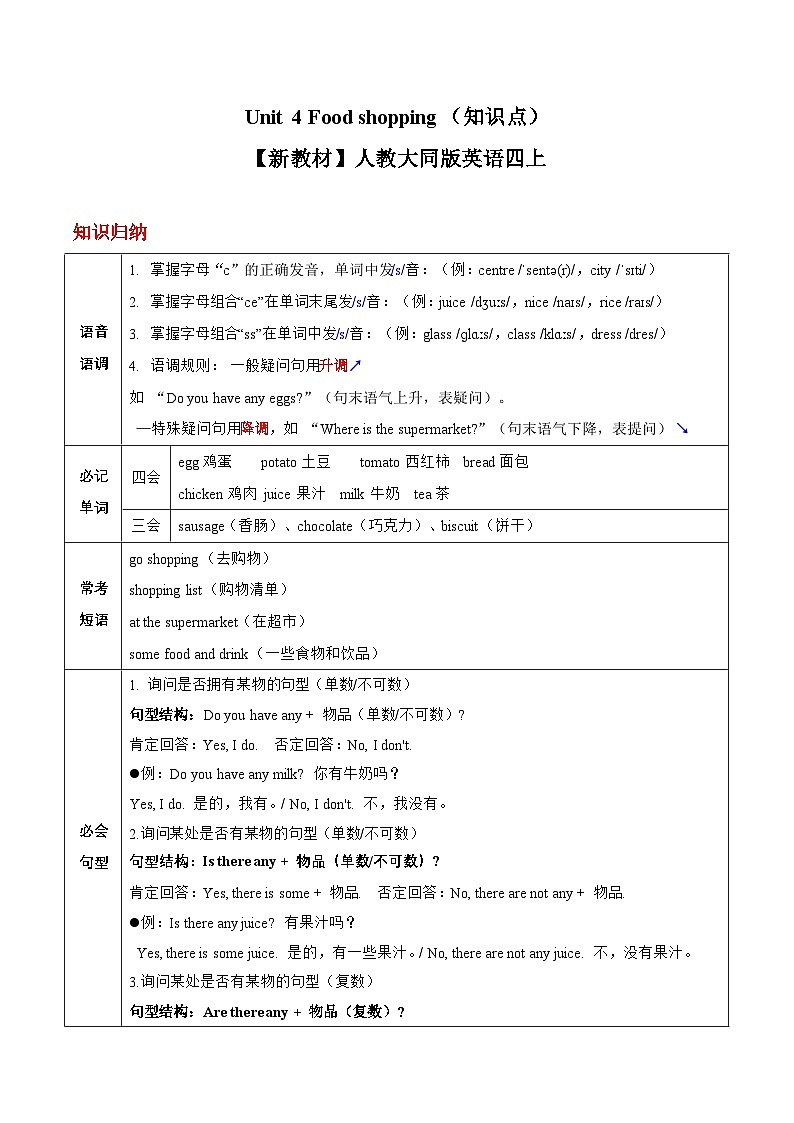
5. A,改为“D”(解析:主语“yu”,疑问句助动词用“D”,“Des”错误)语音语调
掌握字母“c”的正确发音,单词中发/s/音:(例:centre /ˈsentə(r)/,city /ˈsɪti/)
掌握字母组合“ce”在单词末尾发/s/音:(例:juice /dʒuːs/,nice /naɪs/,rice /raɪs/)
掌握字母组合“ss”在单词中发/s/音:(例:glass /ɡlɑːs/,class /klɑːs/,dress /dres/)
语调规则: 一般疑问句用升调↗
如 “D yu have any eggs?”(句末语气上升,表疑问)。
—特殊疑问句用降调,如 “Where is the supermarket?”(句末语气下降,表提问) ↘
必记单词
四会
egg鸡蛋 ptat土豆 tmat西红柿 bread面包
chicken鸡肉 juice果汁 milk牛奶 tea茶
三会
sausage(香肠)、chclate(巧克力)、biscuit(饼干)
常考短语
g shpping(去购物)
shpping list(购物清单)
at the supermarket(在超市)
sme fd and drink(一些食物和饮品)
必会句型
询问是否拥有某物的句型(单数/不可数)
句型结构:D yu have any + 物品(单数/不可数)?
肯定回答:Yes, I d. 否定回答:N, I dn't.
例:D yu have any milk? 你有牛奶吗?
Yes, I d. 是的,我有。/ N, I dn't. 不,我没有。
2.询问某处是否有某物的句型(单数/不可数)
句型结构:Is there any + 物品(单数/不可数)?
肯定回答:Yes, there is sme + 物品. 否定回答:N, there are nt any + 物品.
例:Is there any juice? 有果汁吗?
Yes, there is sme juice. 是的,有一些果汁。/ N, there are nt any juice. 不,没有果汁。
3.询问某处是否有某物的句型(复数)
句型结构:Are there any + 物品(复数)?
肯定回答:Yes, there are sme + 物品. 否定回答:N, there are nt any + 物品.
例:Are there any tmates? 有西红柿吗?
Yes, there are sme tmates. 是的,有一些西红柿。
N, there are nt any tmates. 不,没有西红柿。
核心语法
1.“any”和“sme”的用法
2.there be句型的一般疑问句(单复数)
3.“D yu ”的构成与回答 。
4.名词单复数(食物类名词)
这是一份小学英语人教大同版(2024)四年级上册(2024)Unit 4 Food shopping精品导学案,共8页。
这是一份Unit 6 Shopping (知识清单)-四年级英语下册同步高效课堂系列(人教PEP版),共10页。学案主要包含了“三会”词汇,“二会”词汇,短语,句型,情景选择,判断每组中画线部分读音是否相同,句型转换,匹配题等内容,欢迎下载使用。
这是一份小学英语冀教版(三起)2024四年级上册Lesson 15 In the City学案设计,共4页。学案主要包含了学习目标,学习重点,学习难点,学习过程,达标检测等内容,欢迎下载使用。
 新教材
新教材注册成功
资料篮

在线客服
添加在线客服
获取1对1服务
官方微信
关注“教习网”公众号
打开微信就能找资料
赛课定制
添加在线客服
获取1对1定制服务
职称咨询
添加在线客服
获取1V1专业指导服务

免费福利

.png)
.png)
.png)
