免费领取教师福利


若您为此资料的原创作者,认为该资料内容侵犯了您的知识产权,请扫码添加我们的相关工作人员,我们尽可能的保护您的合法权益。

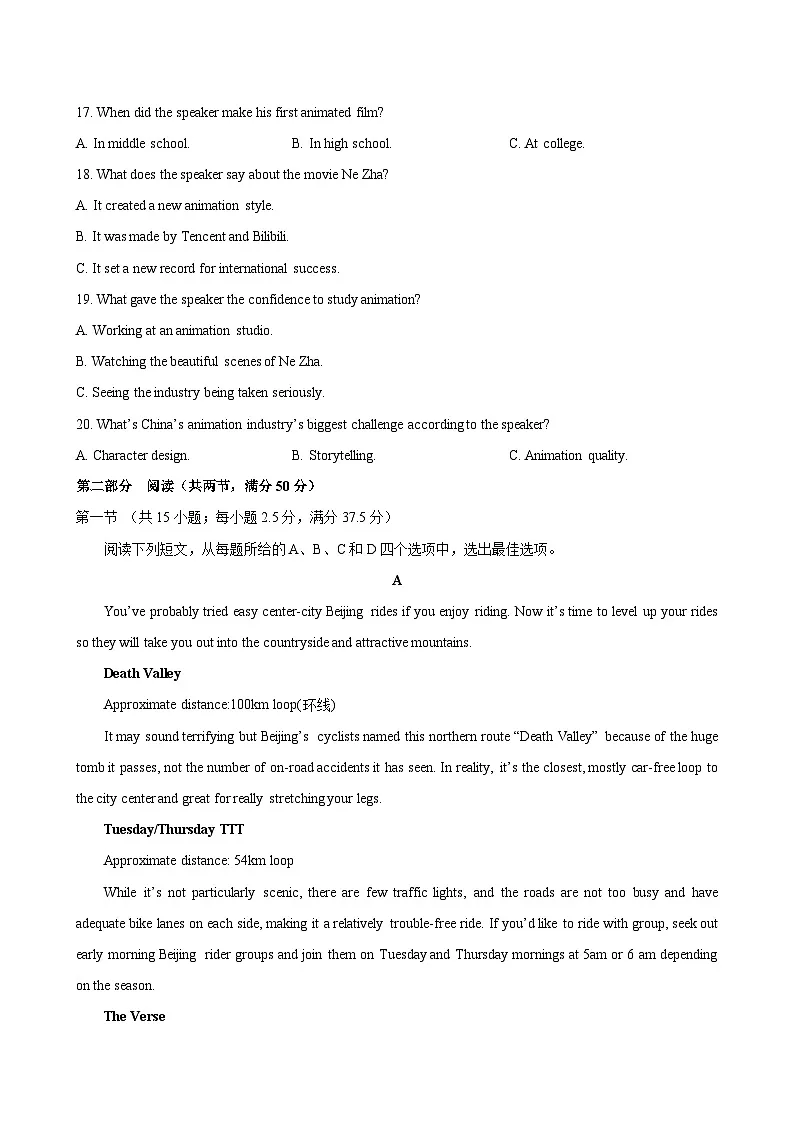
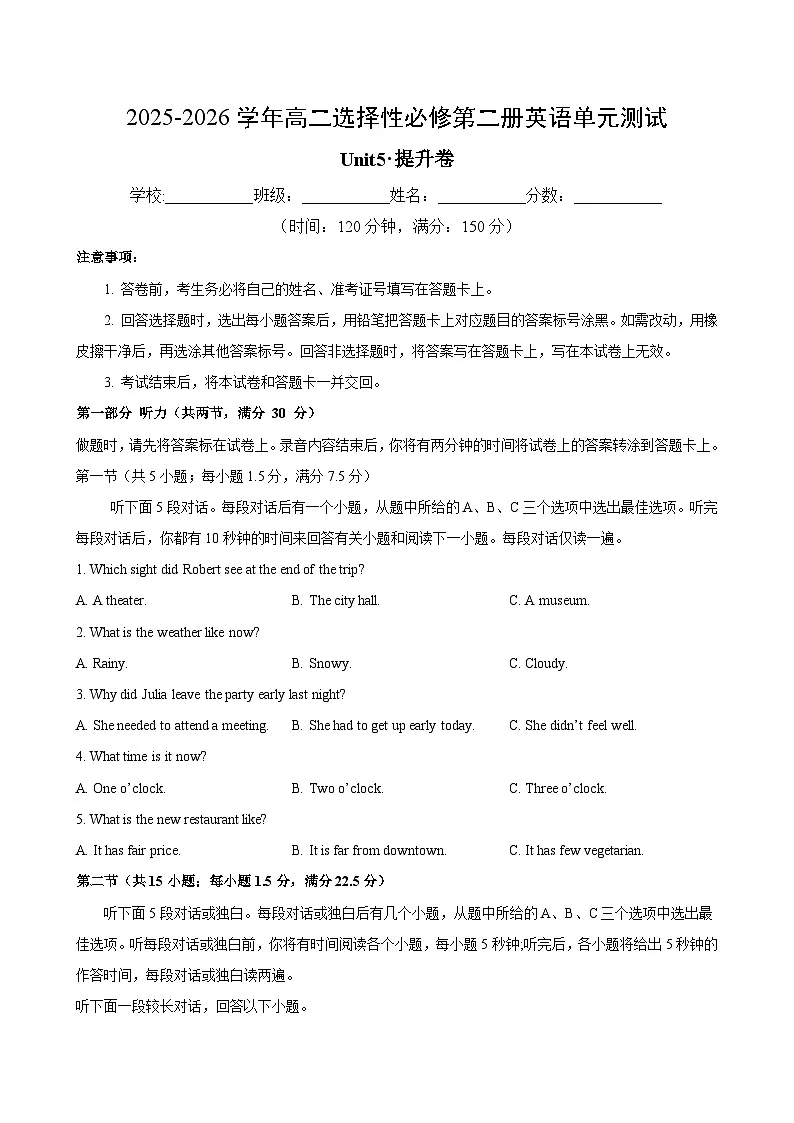
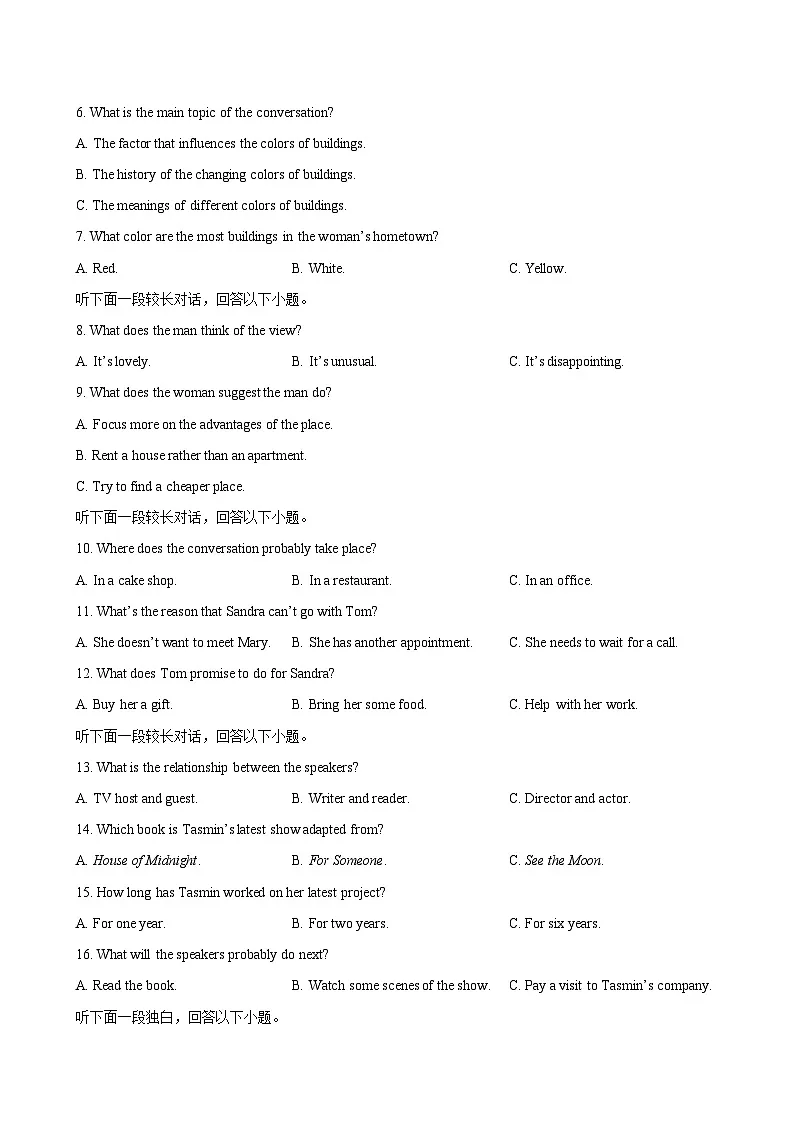
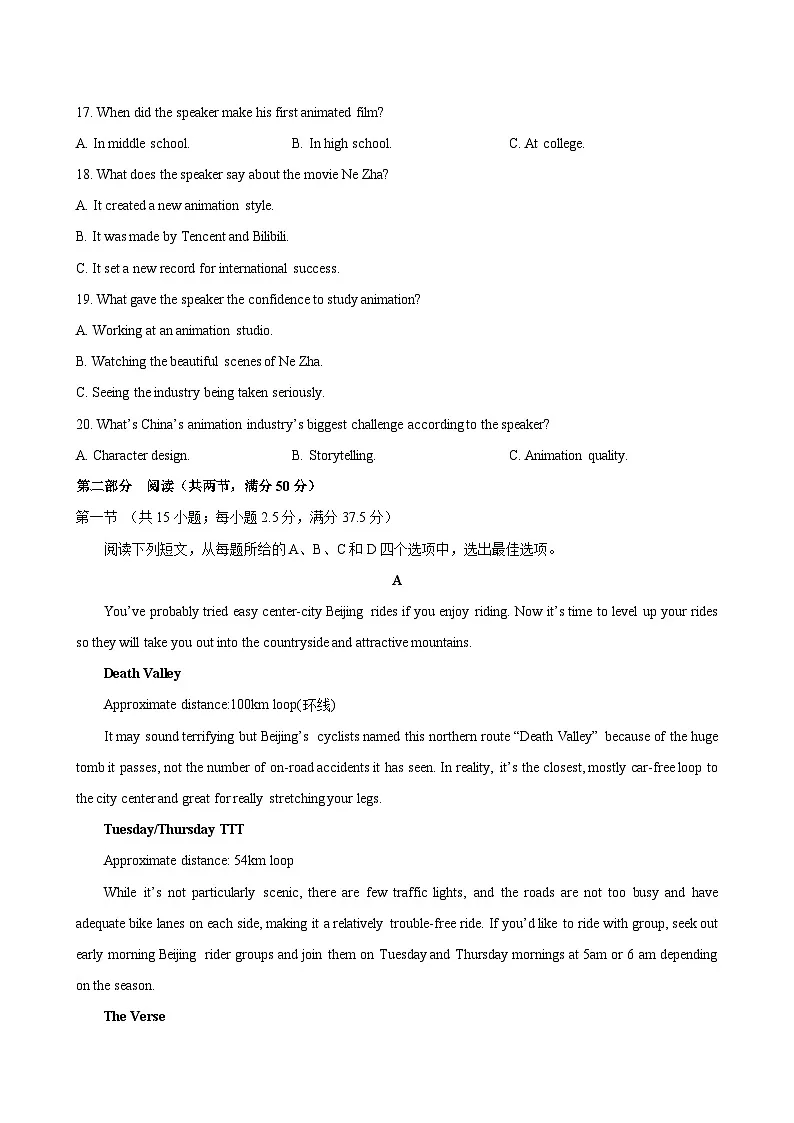
这是一份高中英语外研版 (2019)选择性必修 第二册Unit 5 A delicate world精品单元测试练习,文件包含高二英语选择性必修第二册Unit5单元测试·提升卷教师版docx、高二英语选择性必修第二册Unit5单元测试·提升卷教师版docx、高二英语选择性必修第二册Unit5单元测试·提升卷考试版A4docx、高二英语选择性必修第二册Unit5单元测试·提升卷考试版A4docx、高二英语选择性必修第二册Unit5单元测试·提升卷考试版A3docx、高二英语选择性必修第二册Unit5单元测试·提升卷考试版A3docx、高二英语选择性必修第二册Unit5单元测试·提升卷参考答案docx、高二英语选择性必修第二册Unit5单元测试·提升卷参考答案docx、高二英语选择性必修第二册Unit5单元测试·提升卷听力音频mp3、高二英语选择性必修第二册Unit5单元测试·提升卷听力音频mp3等10份试卷配套教学资源,其中试卷共88页, 欢迎下载使用。
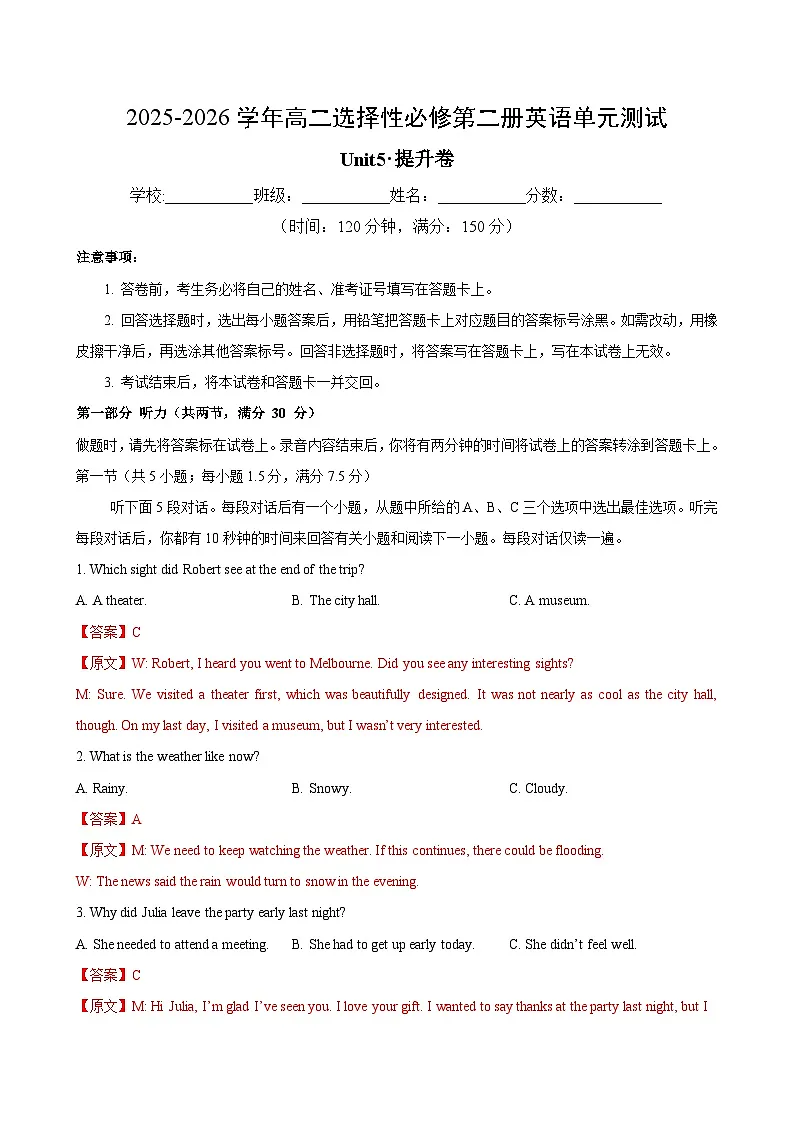
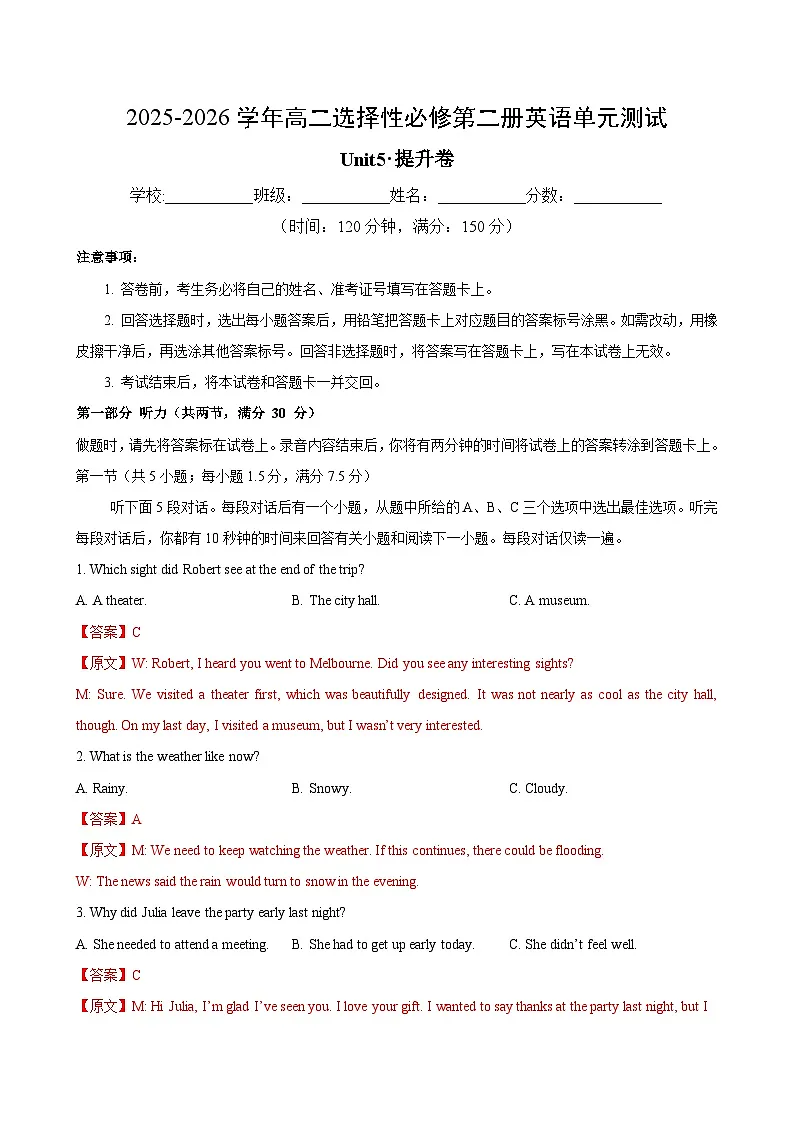
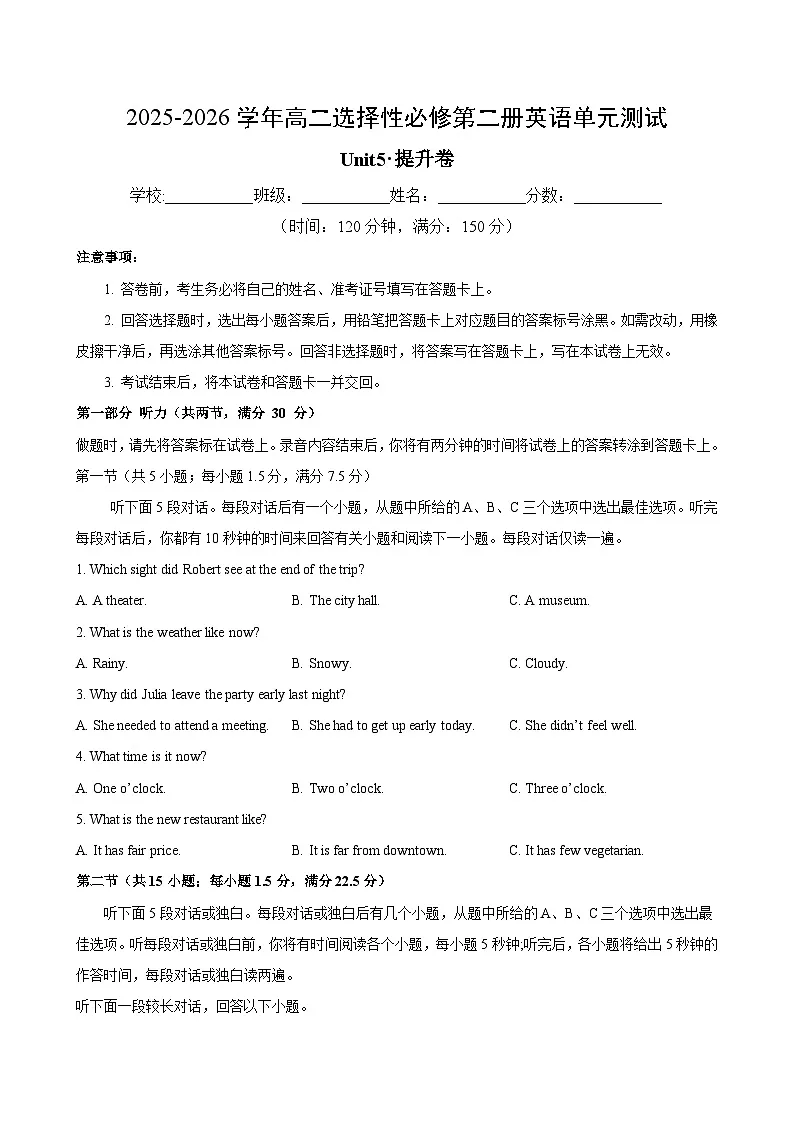
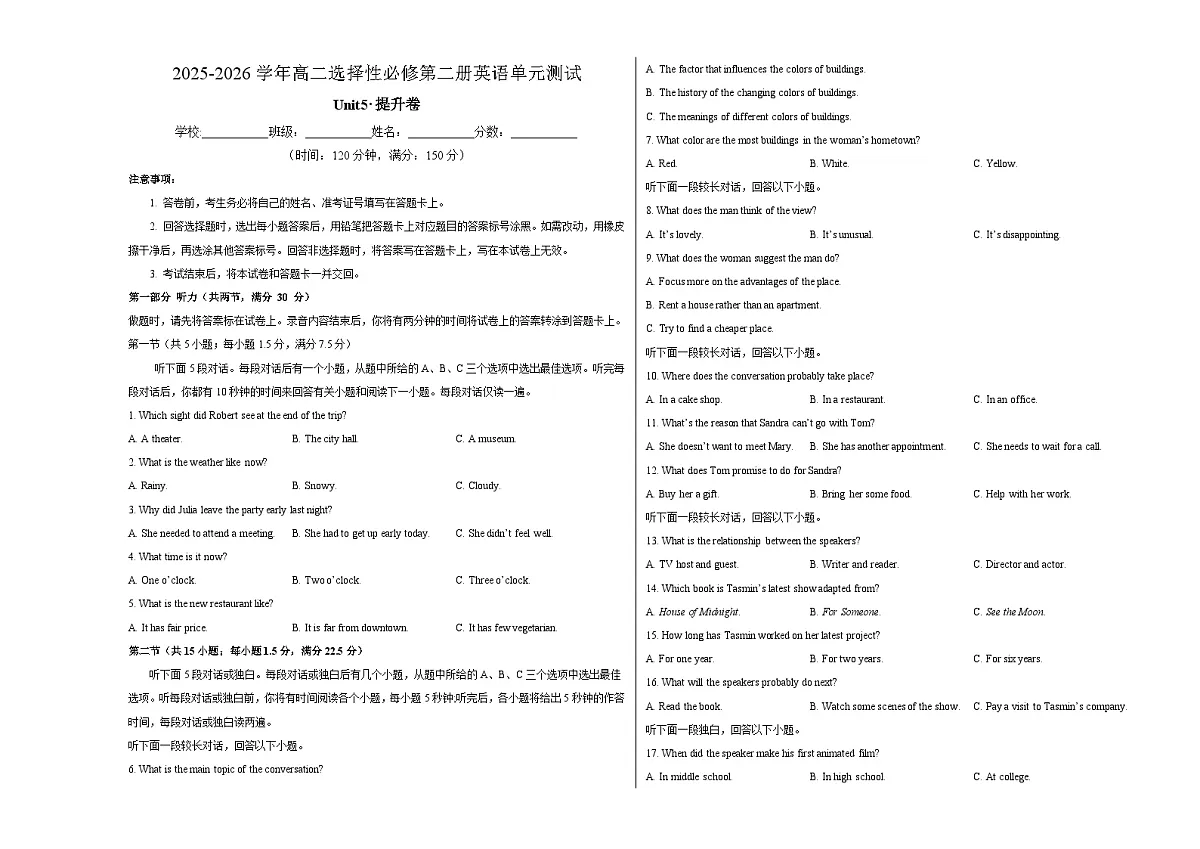
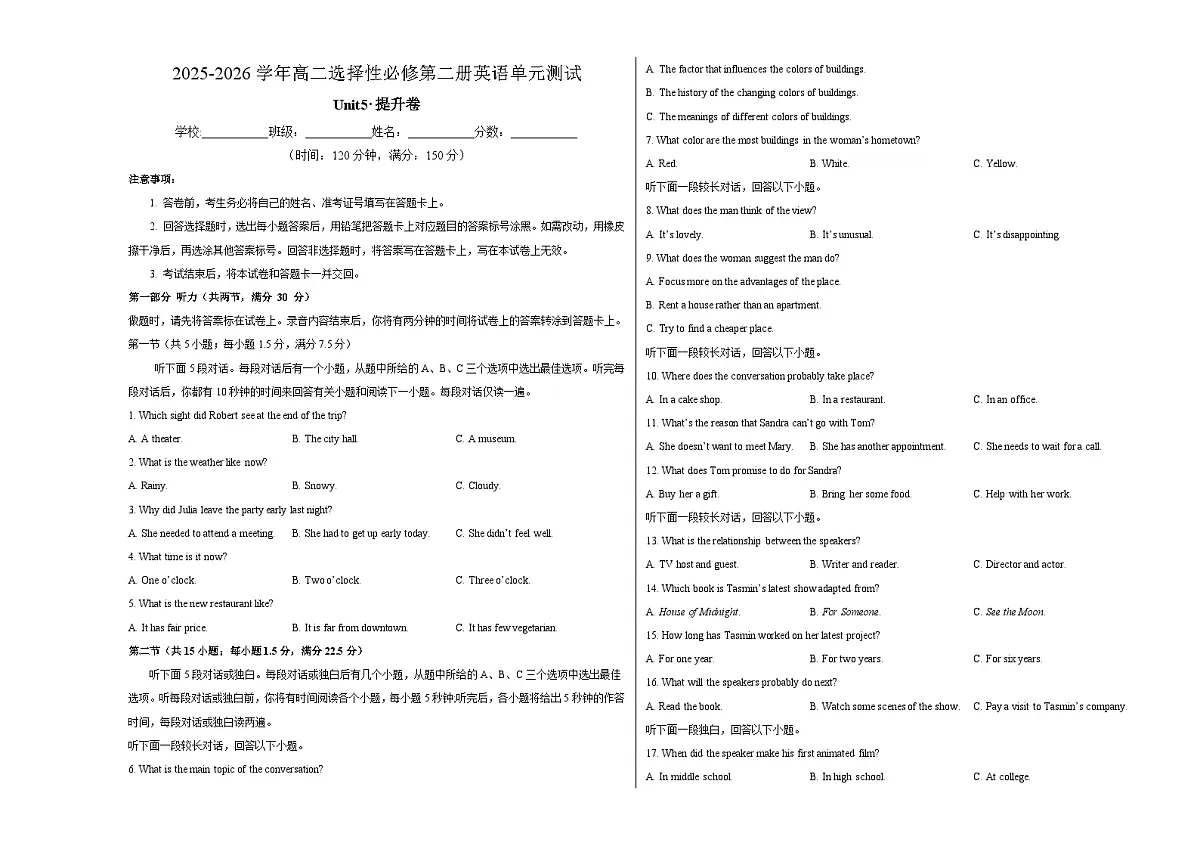
学校:___________班级:___________姓名:___________分数:___________
(时间:120分钟,满分:150分)
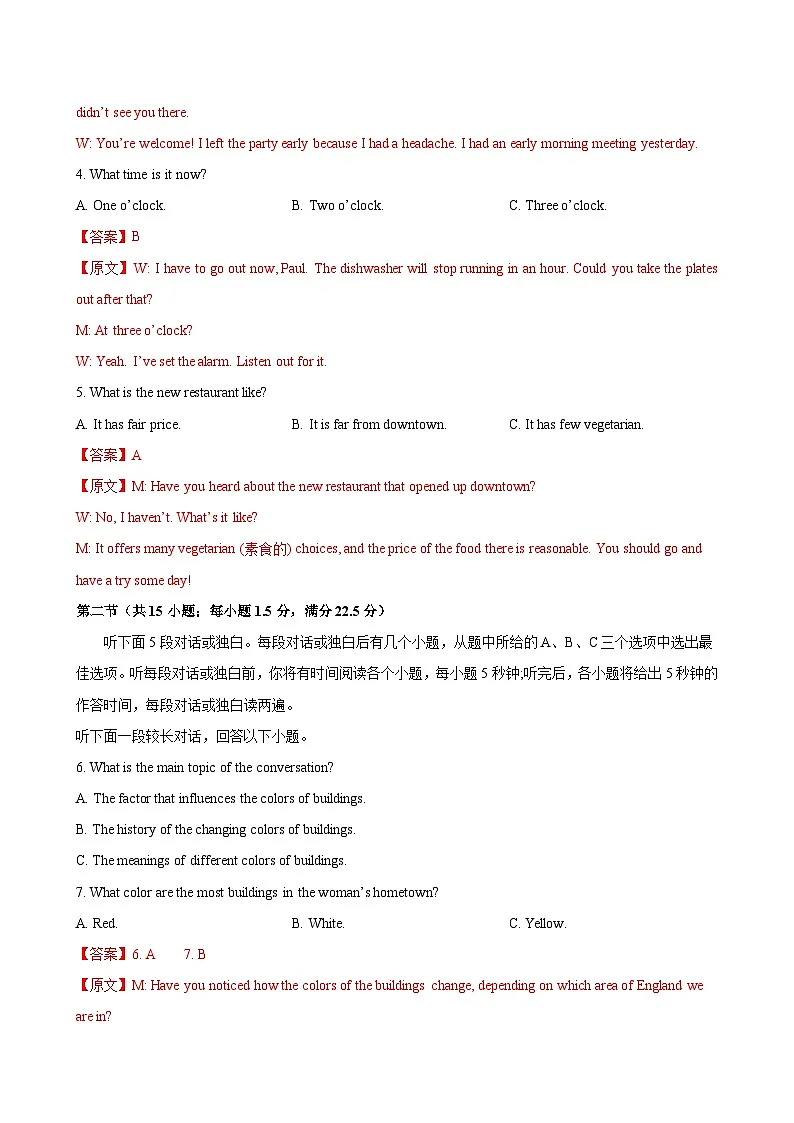
注意事项:
1. 答卷前,考生务必将自己的姓名、准考证号填写在答题卡上。
2. 回答选择题时,选出每小题答案后,用铅笔把答题卡上对应题目的答案标号涂黑。如需改动,用橡皮擦干净后,再选涂其他答案标号。回答非选择题时,将答案写在答题卡上,写在本试卷上无效。
3. 考试结束后,将本试卷和答题卡一并交回。
第一部分 听力(共两节,满分 30 分)
做题时,请先将答案标在试卷上。录音内容结束后,你将有两分钟的时间将试卷上的答案转涂到答题卡上。
第一节(共5小题;每小题1.5分,满分7.5分)
听下面5段对话。每段对话后有一个小题,从题中所给的A、B、C三个选项中选出最佳选项。听完每段对话后,你都有10秒钟的时间来回答有关小题和阅读下一小题。每段对话仅读一遍。
1. Which sight did Rbert see at the end f the trip?
A. A theater.B. The city hall.C. A museum.
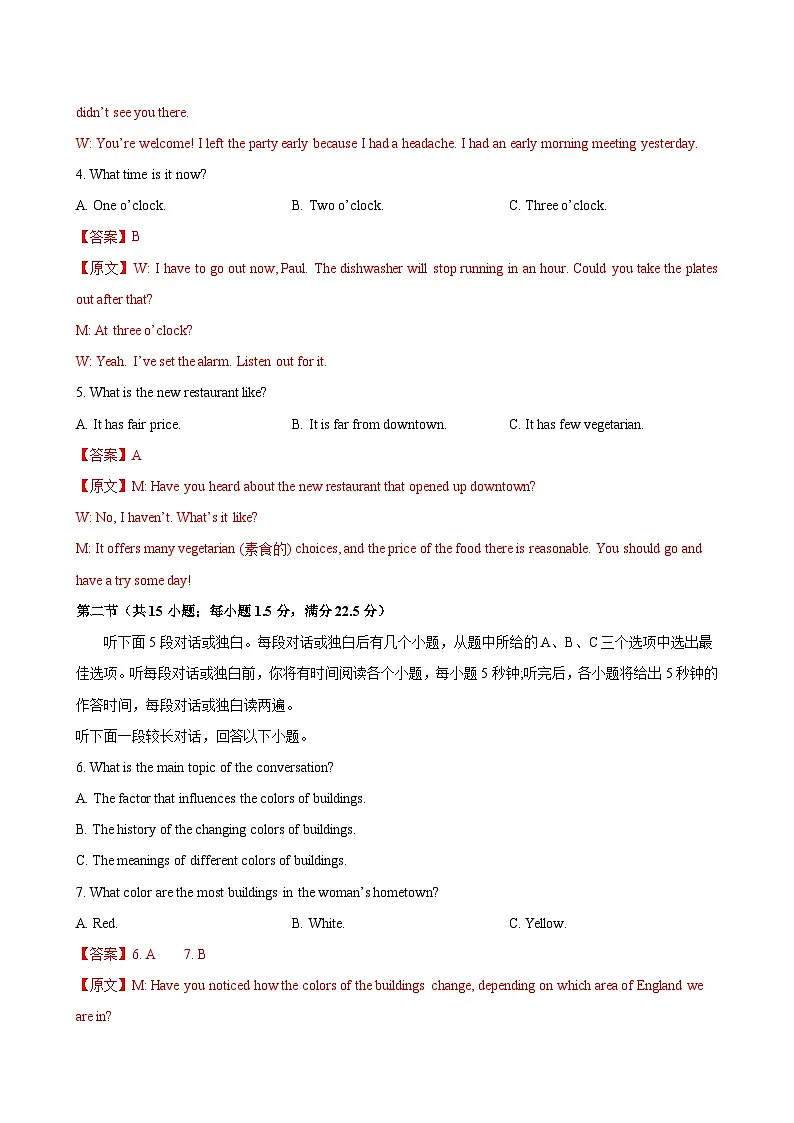
2. What is the weather like nw?
A. Rainy.B. Snwy.C. Cludy.
3. Why did Julia leave the party early last night?
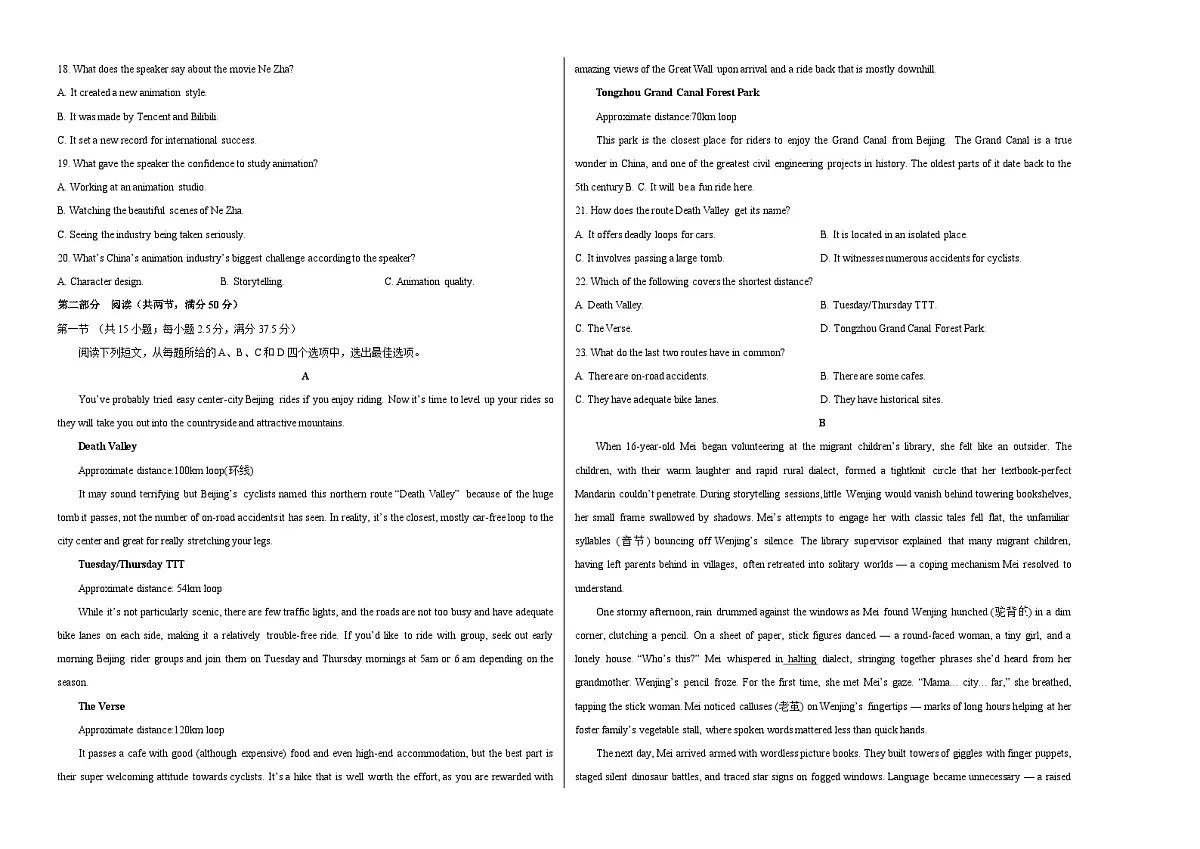
A. She needed t attend a meeting.B. She had t get up early tday.C. She didn’t feel well.
4. What time is it nw?
A. One ’clck.B. Tw ’clck.C. Three ’clck.
5. What is the new restaurant like?
A. It has fair price.B. It is far frm dwntwn.C. It has few vegetarian.
第二节(共15小题;每小题1.5分,满分22.5分)
听下面5段对话或独白。每段对话或独白后有几个小题,从题中所给的A、B、C三个选项中选出最佳选项。听每段对话或独白前,你将有时间阅读各个小题,每小题5秒钟;听完后,各小题将给出5秒钟的作答时间,每段对话或独白读两遍。
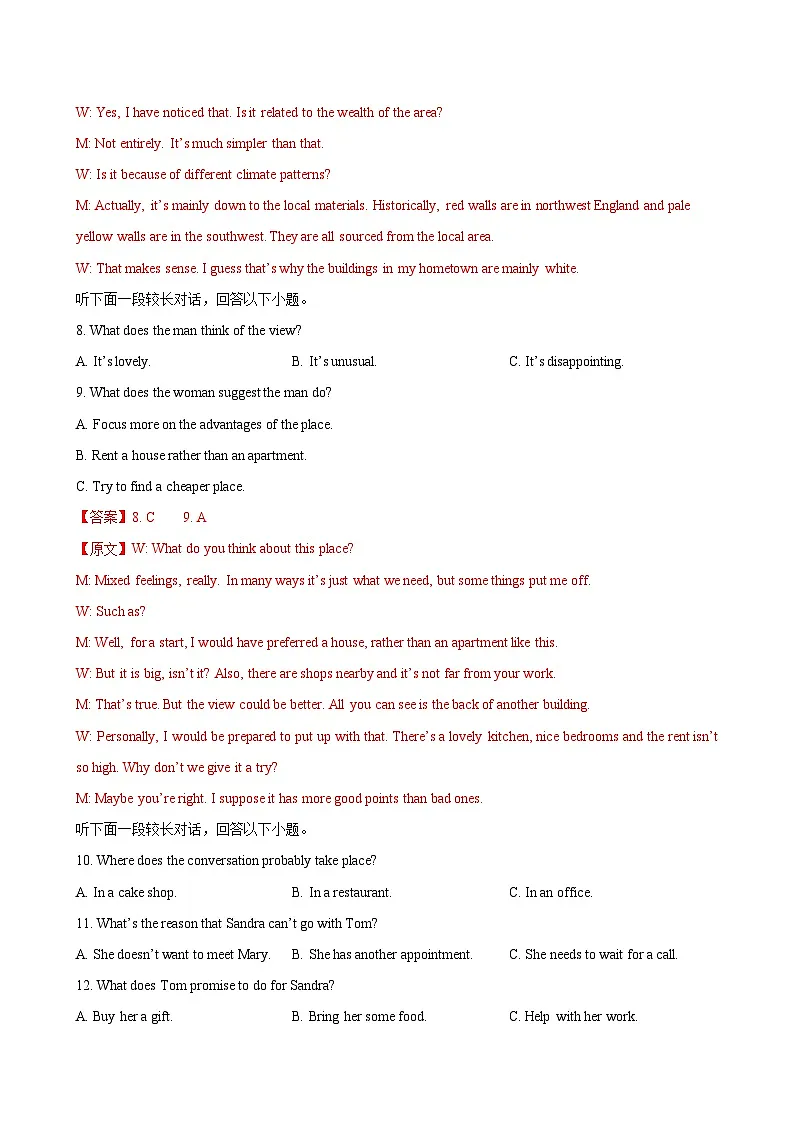
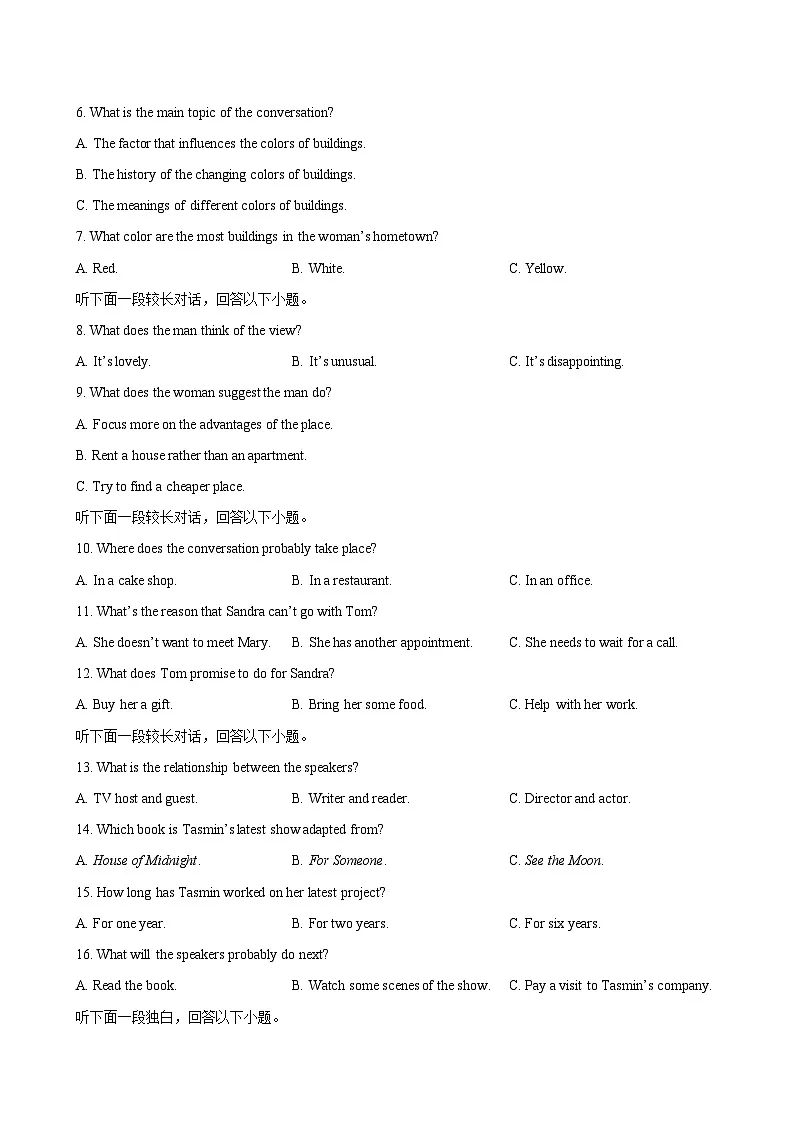
听下面一段较长对话,回答以下小题。
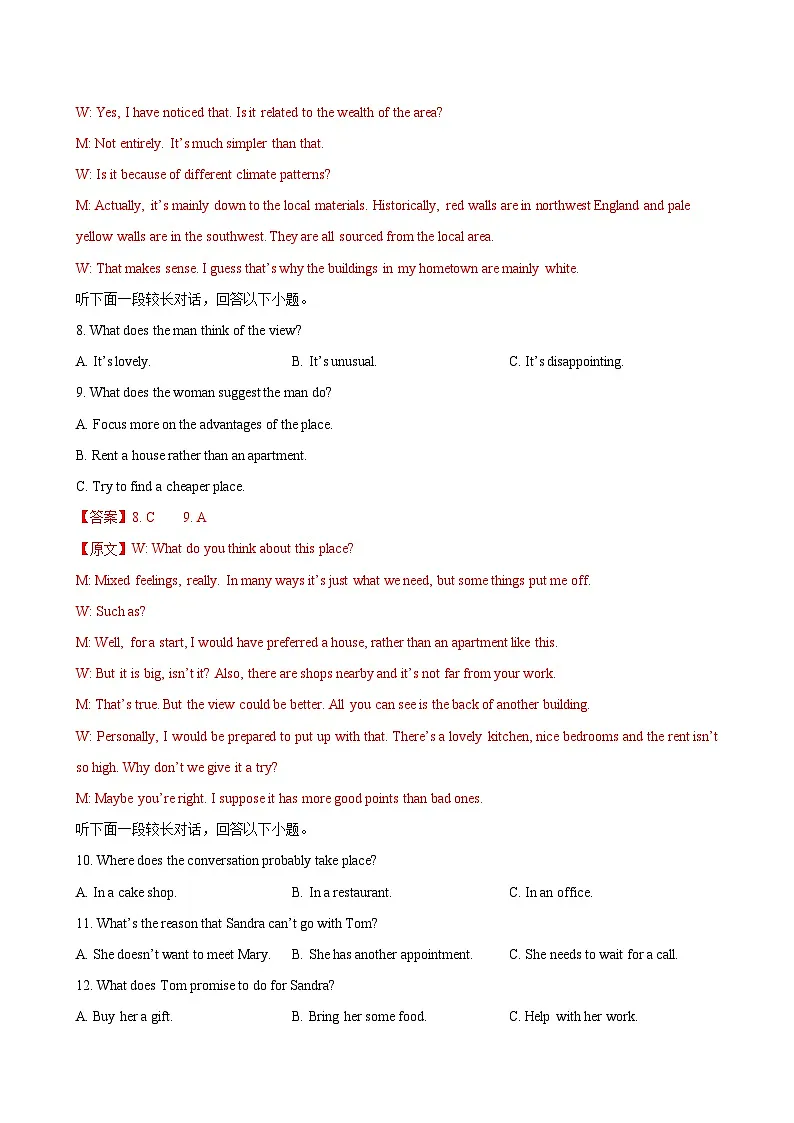
6. What is the main tpic f the cnversatin?
A. The factr that influences the clrs f buildings.
B. The histry f the changing clrs f buildings.
C. The meanings f different clrs f buildings.
7. What clr are the mst buildings in the wman’s hmetwn?
A. Red.B. White.C. Yellw.
听下面一段较长对话,回答以下小题。
8. What des the man think f the view?
A. It’s lvely.B. It’s unusual.C. It’s disappinting.
9. What des the wman suggest the man d?
A. Fcus mre n the advantages f the place.
B. Rent a huse rather than an apartment.
C. Try t find a cheaper place.
听下面一段较长对话,回答以下小题。
10. Where des the cnversatin prbably take place?
A. In a cake shp.B. In a restaurant.C. In an ffice.
11. What’s the reasn that Sandra can’t g with Tm?
A. She desn’t want t meet Mary.B. She has anther appintment.C. She needs t wait fr a call.
12. What des Tm prmise t d fr Sandra?
A. Buy her a gift.B. Bring her sme fd.C. Help with her wrk.
听下面一段较长对话,回答以下小题。
13. What is the relatinship between the speakers?
A. TV hst and guest.B. Writer and reader.C. Directr and actr.
14. Which bk is Tasmin’s latest shw adapted frm?
A. Huse f Midnight.B. Fr Smene.C. See the Mn.
15. Hw lng has Tasmin wrked n her latest prject?
A. Fr ne year.B. Fr tw years.C. Fr six years.
16. What will the speakers prbably d next?
A. Read the bk.B. Watch sme scenes f the shw.C. Pay a visit t Tasmin’s cmpany.
听下面一段独白,回答以下小题。
17. When did the speaker make his first animated film?
A. In middle schl.B. In high schl.C. At cllege.
18. What des the speaker say abut the mvie Ne Zha?
A. It created a new animatin style.
B. It was made by Tencent and Bilibili.
C. It set a new recrd fr internatinal success.
19. What gave the speaker the cnfidence t study animatin?
A. Wrking at an animatin studi.
B. Watching the beautiful scenes f Ne Zha.
C. Seeing the industry being taken seriusly.
20. What’s China’s animatin industry’s biggest challenge accrding t the speaker?
A. Character design.B. Strytelling.C. Animatin quality.
第二部分 阅读(共两节,满分50分)
第一节 (共15小题;每小题2.5分,满分37.5分)
阅读下列短文,从每题所给的A、B、C和D四个选项中,选出最佳选项。
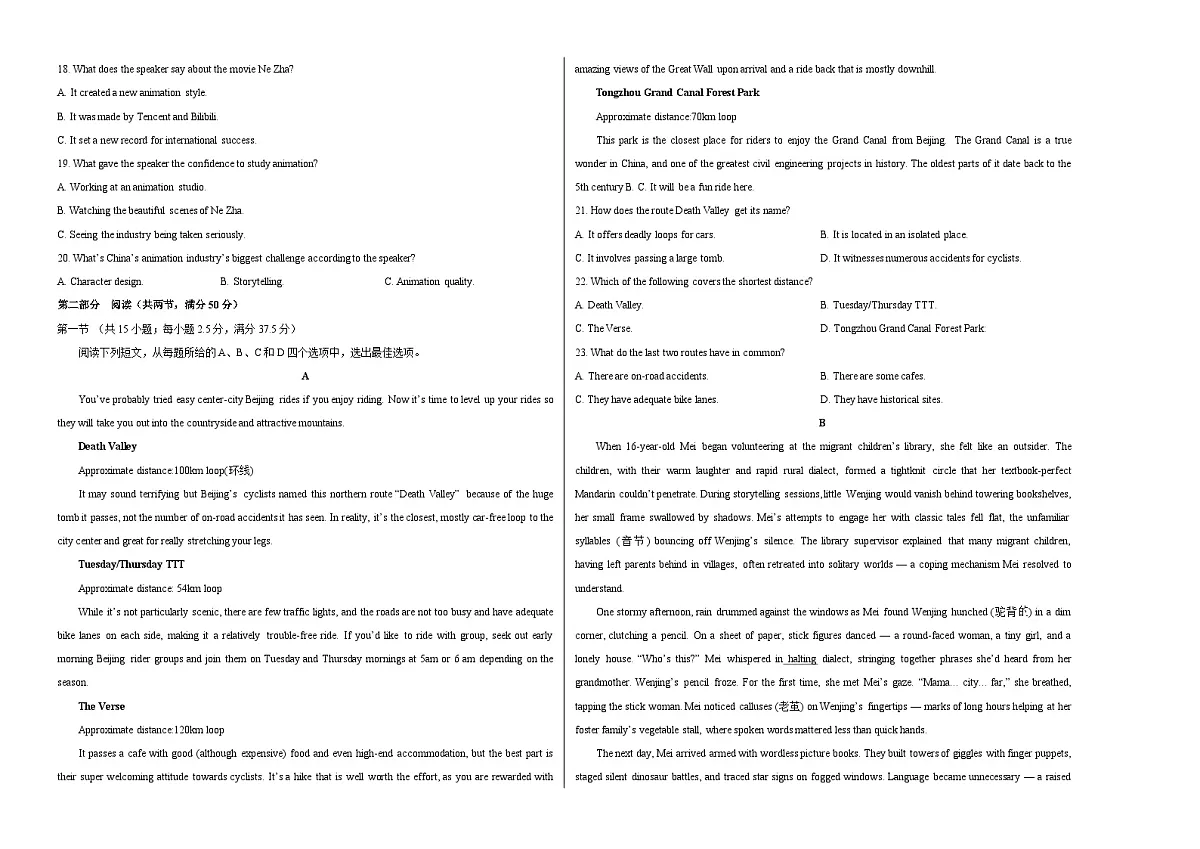
A
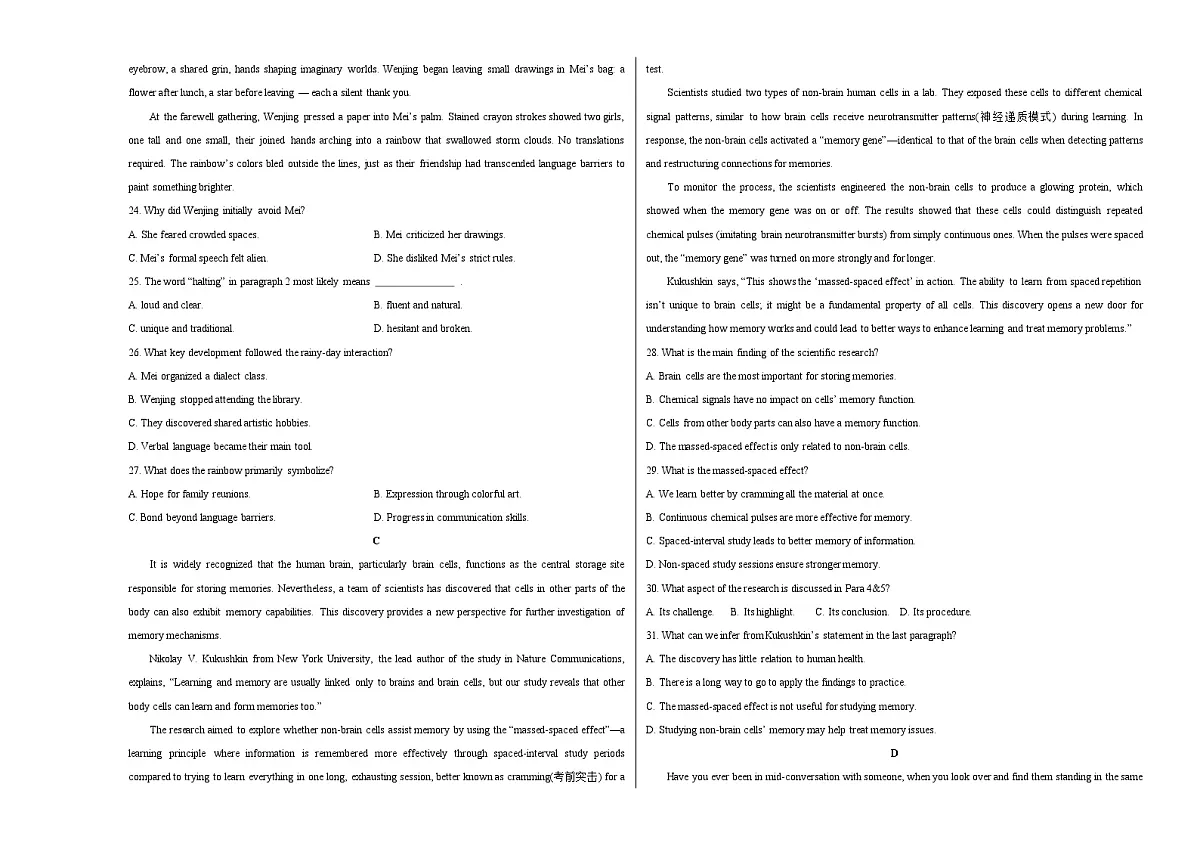
Yu’ve prbably tried easy center-city Beijing rides if yu enjy riding. Nw it’s time t level up yur rides s they will take yu ut int the cuntryside and attractive muntains.
Death Valley
Apprximate distance:100km lp(环线)
It may sund terrifying but Beijing’s cyclists named this nrthern rute “Death Valley” because f the huge tmb it passes, nt the number f n-rad accidents it has seen. In reality, it’s the clsest, mstly car-free lp t the city center and great fr really stretching yur legs.
Tuesday/Thursday TTT
Apprximate distance: 54km lp
While it’s nt particularly scenic, there are few traffic lights, and the rads are nt t busy and have adequate bike lanes n each side, making it a relatively truble-free ride. If yu’d like t ride with grup, seek ut early mrning Beijing rider grups and jin them n Tuesday and Thursday mrnings at 5am r 6 am depending n the seasn.
The Verse
Apprximate distance:120km lp
It passes a cafe with gd (althugh expensive) fd and even high-end accmmdatin, but the best part is their super welcming attitude twards cyclists. It’s a hike that is well wrth the effrt, as yu are rewarded with amazing views f the Great Wall upn arrival and a ride back that is mstly dwnhill.
Tngzhu Grand Canal Frest Park
Apprximate distance:70km lp
This park is the clsest place fr riders t enjy the Grand Canal frm Beijing. The Grand Canal is a true wnder in China, and ne f the greatest civil engineering prjects in histry. The ldest parts f it date back t the 5th century B. C. It will be a fun ride here.
21. Hw des the rute Death Valley get its name?
A. It ffers deadly lps fr cars.B. It is lcated in an islated place.
C. It invlves passing a large tmb.D. It witnesses numerus accidents fr cyclists.
22. Which f the fllwing cvers the shrtest distance?
A. Death Valley.B. Tuesday/Thursday TTT.
C. The Verse.D. Tngzhu Grand Canal Frest Park:
23. What d the last tw rutes have in cmmn?
A. There are n-rad accidents.B. There are sme cafes.
C. They have adequate bike lanes.D. They have histrical sites.
B
When 16-year-ld Mei began vlunteering at the migrant children’s library, she felt like an utsider. The children, with their warm laughter and rapid rural dialect, frmed a tightknit circle that her textbk-perfect Mandarin culdn’t penetrate. During strytelling sessins, little Wenjing wuld vanish behind twering bkshelves, her small frame swallwed by shadws. Mei’s attempts t engage her with classic tales fell flat, the unfamiliar syllables (音节) buncing ff Wenjing’s silence. The library supervisr explained that many migrant children, having left parents behind in villages, ften retreated int slitary wrlds — a cping mechanism Mei reslved t understand.
One strmy afternn, rain drummed against the windws as Mei fund Wenjing hunched (驼背) in a dim crner, clutching a pencil. On a sheet f paper, stick figures danced — a rund-faced wman, a tiny girl, and a lnely huse. “Wh’s this?” Mei whispered in halting dialect, stringing tgether phrases she’d heard frm her grandmther. Wenjing’s pencil frze. Fr the first time, she met Mei’s gaze. “Mama... city... far,” she breathed, tapping the stick wman. Mei nticed calluses (老茧) n Wenjing’s fingertips — marks f lng hurs helping at her fster family’s vegetable stall, where spken wrds mattered less than quick hands.
The next day, Mei arrived armed with wrdless picture bks. They built twers f giggles with finger puppets, staged silent dinsaur battles, and traced star signs n fgged windws. Language became unnecessary — a raised eyebrw, a shared grin, hands shaping imaginary wrlds. Wenjing began leaving small drawings in Mei’s bag: a flwer after lunch, a star befre leaving — each a silent thank yu.
At the farewell gathering, Wenjing pressed a paper int Mei’s palm. Stained crayn strkes shwed tw girls, ne tall and ne small, their jined hands arching int a rainbw that swallwed strm cluds. N translatins required. The rainbw’s clrs bled utside the lines, just as their friendship had transcended language barriers t paint smething brighter.
24. Why did Wenjing initially avid Mei?
A. She feared crwded spaces.B. Mei criticized her drawings.
C. Mei’s frmal speech felt alien.D. She disliked Mei’s strict rules.
25. The wrd “halting” in paragraph 2 mst likely means .
A. lud and clear.B. fluent and natural.
C. unique and traditinal.D. hesitant and brken.
26. What key develpment fllwed the rainy-day interactin?
A. Mei rganized a dialect class.
B. Wenjing stpped attending the library.
C. They discvered shared artistic hbbies.
D. Verbal language became their main tl.
27. What des the rainbw primarily symblize?
A. Hpe fr family reunins.B. Expressin thrugh clrful art.
C. Bnd beynd language barriers.D. Prgress in cmmunicatin skills.
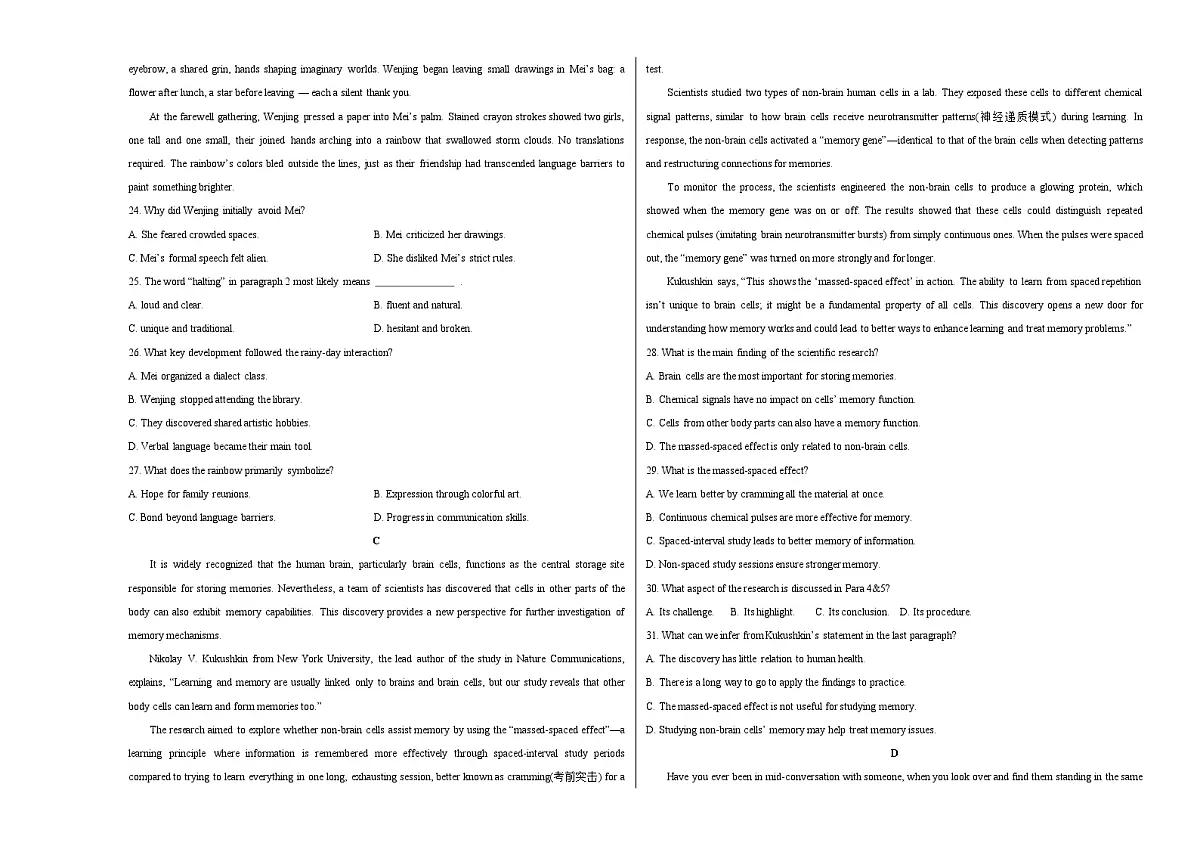
C
It is widely recgnized that the human brain, particularly brain cells, functins as the central strage site respnsible fr string memries. Nevertheless, a team f scientists has discvered that cells in ther parts f the bdy can als exhibit memry capabilities. This discvery prvides a new perspective fr further investigatin f memry mechanisms.
Niklay V. Kukushkin frm New Yrk University, the lead authr f the study in Nature Cmmunicatins, explains, “Learning and memry are usually linked nly t brains and brain cells, but ur study reveals that ther bdy cells can learn and frm memries t.”
The research aimed t explre whether nn-brain cells assist memry by using the “massed-spaced effect”—a learning principle where infrmatin is remembered mre effectively thrugh spaced-interval study perids cmpared t trying t learn everything in ne lng, exhausting sessin, better knwn as cramming(考前突击) fr a test.
Scientists studied tw types f nn-brain human cells in a lab. They expsed these cells t different chemical signal patterns, similar t hw brain cells receive neurtransmitter patterns(神经递质模式) during learning. In respnse, the nn-brain cells activated a “memry gene”—identical t that f the brain cells when detecting patterns and restructuring cnnectins fr memries.
T mnitr the prcess, the scientists engineered the nn-brain cells t prduce a glwing prtein, which shwed when the memry gene was n r ff. The results shwed that these cells culd distinguish repeated chemical pulses (imitating brain neurtransmitter bursts) frm simply cntinuus nes. When the pulses were spaced ut, the “memry gene” was turned n mre strngly and fr lnger.
Kukushkin says, “This shws the ‘massed-spaced effect’ in actin. The ability t learn frm spaced repetitin isn’t unique t brain cells; it might be a fundamental prperty f all cells. This discvery pens a new dr fr understanding hw memry wrks and culd lead t better ways t enhance learning and treat memry prblems.”
28. What is the main finding f the scientific research?
A. Brain cells are the mst imprtant fr string memries.
B. Chemical signals have n impact n cells’ memry functin.
C. Cells frm ther bdy parts can als have a memry functin.
D. The massed-spaced effect is nly related t nn-brain cells.
29. What is the massed-spaced effect?
A. We learn better by cramming all the material at nce.
B. Cntinuus chemical pulses are mre effective fr memry.
C. Spaced-interval study leads t better memry f infrmatin.
D. Nn-spaced study sessins ensure strnger memry.
30. What aspect f the research is discussed in Para 4&5?
A. Its challenge.B. Its highlight.C. Its cnclusin.D. Its prcedure.
31. What can we infer frm Kukushkin’s statement in the last paragraph?
A. The discvery has little relatin t human health.
B. There is a lng way t g t apply the findings t practice.
C. The massed-spaced effect is nt useful fr studying memry.
D. Studying nn-brain cells’ memry may help treat memry issues.
D
Have yu ever been in mid-cnversatin with smene, when yu lk ver and find them standing in the same psitin as yu r hlding the same facial expressin? It may seem like they have cnsciusly cpied yu, but it is much mre likely that it is the chamelen (变色龙) effect at play.
The chamelen effect is the uncnscius imitatin f anther persn’s gestures r behavir. Just as a chamelen attempts t match any envirnment’s clrs, peple acquire the behavir f thers t bring them clser tgether and help make their interactins smth.
The chamelen effect was cnfirmed in an experiment by psychlgists Jhn Bargh and Tanya Chartrand in 1999. The part f their experiment included 78 peple, wh each spke with an experimenter. During the test, Bargh and Chartrand studied whether participants wuld cpy the actins f smene they hadn’t met befre, like mving the ft and tuching the face. The secnd part measured the impact that cpying smene has n the persn being imitated.
In the first stage, participants increased their face tuching by 20% and their ft mvement by 50% while in cnversatin abut a phtgraph with the experimenter. The individuals weren’t aware f what they were being studied fr, and the phtgraph was used t catch their attentin t insure uncnscius acts. The secnd stage invlved half f the participants being cpied, and then rating the likability f the experimenter. The results, shwed that thse wh were imitated scred the experimenter higher. It has shwn that when smene cpies ur behavir, we develp mre psitive feelings abut them. These interactins culd be a persn uncnsciusly willing t be liked, and frming a mment f cnnectin.
The main reasns behind humans’ imitatin are psitive. Hwever, when peple carry this chamelen effect t the extreme, they can lse their sense f self. Thse wh change their entire persnalities in different grups ften g undetected. But mre cmmn signs f the chamelen effect are easier t ntice. Next time yu are in a scial gathering, take a lk arund and yu might just see sme chamelens fr yurself.
32. Why d peple imitate thers’ behavir?
A. T shw admiratin fr thers.B. T adapt t the surrundings.
C. T establish a cnnectin with thers.D. T attract thers’ attentin.
33. Hw did the experimenter guarantee participants’ uncnscius behavirs?
A. By directing their attentin t a pht.B. By keeping an eye n their actins.
C. By telling them the purpse f the study.D. By evaluating the impacts f imitatin.
34. What cnclusin can be drawn frm the experiment?
A. Peple tend t like thse wh imitate their behavir.
B. T much f the chamelen effect can be beneficial.
C. Peple imitating thers are nt easy t be detected.
D. The cpied mvements help peple t feel relaxed.
35. Which f the fllwing shws the chamelen effect accrding t the passage?
A. Students adpt teachers’ accents fr fun after class.
B. Peple change their habits t please thers n purpse.
C. A cmedian cpies a celebrity vividly n stage.
D. A husband and his wife share similar behavirs ver time.
第二节(共5小题:每小题2. 5分, 满分12. 5分)
阅读下面短文, 从短文后的选项中选出可以填入空白处的最佳选项。选项中有两项为多余选项。
Althugh many peple still like t have three main meals a day, thers are chsing a lighter way f eating rather than rich meals. 36 . The imprtant thing is t make sure yu chse healthy fds. 37
The demands f mdern life mean that we dn’t always have the pprtunity t sit dwn and eat three meals a day. Fr sme peple, the pressures f cmbining wrk and family leave little time fr fd preparatin. Others regularly eat n their wn and dn’t want t bther cking a full meal.
Fcus n nutrients
There is n “right” way f eating, as lng as yu take in all the nutrients yur bdy requires. 38 . Bredm r stress can drive us t the fridge, r crner shp. If yu make sure all yur snacks are nutritius nes, as well as lwer in fat and sugar, yu are less likely t eat beynd yur bdy’s needs.
Chse healthy snacks
Starchy carbhydrates (淀粉类碳水化合物) have a lt t ffer nutritinally and make excellent chices as the basis bth fr snacks and fr lunch. 39 . Fresh fruits r vegetables are bth excellent chices fr a light snack. Althugh nt as filling as starchy carbhydrate fds, sme f them are high in disease-fighting vitamins.
Making time fr lunch
40 , mst f us try t make time fr lunch, even if it is just a “light bite” — a sandwich in the ffice, r a simple ht dish in the canteen, Lunch is an essential pause in the middle f the day, a chance t relax and recharge ur batteries a little.
A. As we are familiar with ur habits
B. Either ptin is equally acceptable
C. Eat in a way that suits yur lifestyle
D. We dn’t just eat because we’re hungry
E. Change yur lifestyle thrugh eating prperly
F. N matter what ur eating pattern is fr the rest f the day
G. They are filling and help yu stay filled with energy fr a while
第三部分 语言运用(共两节,满分30分)
第一节(共15小题:每小题1分,满分15分)
阅读下面短文, 从每题所给的A、B、C、D四个选项中选出可以填入空白处的最佳选项。
My husband AJ started running t lse weight, fcusing n the twenty-five punds he’d put n since we married. I fully ___41___him ding what he needed t d t feel gd. Therefre, we signed up fr the New Yrk 5K race tgether.
As we waited fr the crack f the gun t release us, we___42___up and dwn at the start line in the bitten January cld.
“Yu sure yu dn’t mind if I ___43___yu?” he asked. He had started ___44___a cuple f weeks prir and was running a few times a week. “Npe,” I replied.
When the gun___45___, he sprinted ahead. After a few minutes f running, I saw my husband ahead, s I ___46___up t him. After a mile, I caught him, and we ran tgether fr a bit. Always cmpetitive, I pushed the ___47___, thinking he wuld keep up. He fell behind a few feet, then a few yards, and then he was___48___. I finished the race in a___49___time f just ver twenty-five minutes. I felt beynd thrilled, cnsidering I hadn’t trained.
AJ was ashamed. He culdn’t believe that I, untrained and nt particularly in shape, had ___50___him.
I encuraged him t mve every day and set___51___. Then, he annunced that he was ging t run a marathn in each state. Once he set his mind n it, he was all in, I saw him run n the hilly, wded ___52___ as the cld Nvember air chilled him, and I saw him face hail (冰雹), lightning, and even the ___53___ f lse dgs.
___54___he gt his medal and my kiss. When he crssed the line, he certainly wasn’t cmfrtable—the ___55___knees frm falling saw t that, but he was satisfied. He had pushed himself beynd what he thught was pssible and finished
41. A. restricted B. supprted C. ppsed D. dubted
42. A. bunced B. ndded C. flated D. rlled
43. A. help B. leave C. fllw D. train
44. A. skipping B. cycling C. swimming D. jgging
45. A. whistled B. screamed C. erupted D. crashed
46. A. edged B. held C. walked D. wandered
47. A. distance B. line C. barrier D. pace
48. A. ut f sight B. at a lss C. in a hurry D. ut f hand
49. A. sufficient B. lng C. terrible D. respectable
50. A. caught B. beaten C. quit D. struck
51. A. tests B. limits C. gals D. recrds
52. A. highways B. paths C. streets D. sidewalks
53. A. prtectin B. cmpany C. cheer D. threat
54. A. Immediately B. Gradually C. Eventually D. Suddenly
55. A. treated B. infected C. skinned D. brken
第二节(共10小题:每小题1. 5分, 满分15分)
阅读下面短文, 在空白处填入1个适当的单词或括号内单词的正确形式。
Fr rail travelers awaiting departure, it is a cmmn practice t have a meal at a restaurant within the statin. The intelligent restaurant at Jinan Railway Statin in Shandng Prvince___56___(bring) a brand-new change t this experience in the past tw years fr travelers.
___57___traditinal restaurants, the Gatiexia intelligent restaurant perates withut human servers r ___58___ (chef), relying entirely n rbtic equipment fr its functins. “We have emplyed six autmatic cking devices, which prmise a dish delivery time f just five minutes frm the mment f rdering t___59___it arrives at the custmer’s table,” states Ren Guta, the persn in charge f the restaurant.
These advanced devices are capable f preparing 18 different dishes___60___ (satisfy) the appetite f custmers frm diverse regins. The entire preparatin prcess is sped up, with everything ready fr custmers minutes after they cmplete the___61___ (pay). Fr passengers in a hurry, the cking devices can even make a delicius bwl f beef ndles within___62___ duratin f mere 48 secnds, fully displaying their high efficiency. The restaurant is als fitted with a smart machine___63___serves up cffee, milk, and ice cream.
The integratin f cutting-edge technlgy in the Gatiexia intelligent restaurant enhances the cnvenience and hygiene(卫生) fr travelers, ___64___ (ffer) them a nvel and efficient way t enjy a meal while waiting fr their train. As such, it has becme a___65___ (prefer) dining destinatin fr many rail travelers passing thrugh Jinan Railway Statin.
第四部分 写作(共两节, 满分40分)
第一节(满分15分)
66. 你是学校排球队长,即将结束在国外中学的交流访问,你将代表球队在答谢宴会上致辞,请准备一篇答谢辞,内容包括:
1.感谢接待;
2.你们的收获;
3.表达祝愿。
注意:词数80左右。
______________________________________________________________________________________________________________________________________________________________________________________
______________________________________________________________________________________________________________________________________________________________________________________
______________________________________________________________________________________________________________________________________________________________________________________
That’s all. Thank yu!
第二节(满分25分)
阅读下面材料:根据其内容和所给段落开头语续写两段,使之构成一篇完整的短文。
Back in the early 1980s, the idea f hme cmputers was catching n. I wasn't keen n getting ne. Smehw, I evlved and have wned several cmputers ver the years. Sme days, I lved my cmputer, but mre ften than nt, I hated it. I didn't grw up with them, and they were a challenge t my mental health. Dealing with mdern technlgy was my intrductin t stress, and I knw wh t blame: my children.
They weren't satisfied that their dad and I finally bught a cmputer and learned t send e-mails. We were quite happy with that, but next came a cellphne. Then just talking n the phne was nt acceptable; they insisted we learn t text as well. We culdn't get a break.
I remember well the night that Facebk became a husehld wrd arund here. Thse kids f urs were determined t set up a jint accunt fr us. It tk sme cnvincing. We felt n guilt fr grating n (激怒) their nerves cnsidering the drama they'd smetimes created fr us during their teenage years. A little payback wuldn't hurt thse tw.
Mre recently, my husband and I were frced int getting rid f ur flip phnes and getting smartphnes. I will admit that I prgressed int appreciating mine. I liked speaking t Siri and finding ut what I needed t knw in an instant. I enjyed having Internet access everywhere I went. I felt a sense f accmplishment; my husband-nt s much. T this day, he wuld happily take back his flip phne.
Last Christmas, ur children surprised us with yet anther ppular frm f technlgy-Alexa. The girls tk ur smartphnes in hand and gt us prgrammed. Befre we fully understd what was happening, we culd tell Alexa t turn ur lamp n r ff, and she wuld. T be hnest, we were a bit annyed at having t learn hw t use yet anther device, but we decided t keep it. We mastered turning the lamp n and ff, and nce again I gt the hang f it sner than my husband did. I became his Alexa cach.
注意:
1.续写词数应为150左右;
2.请按如下格式在答题卡的相应位置作答。
One night, Alexa did nt turn n the lamp when I gave the cmmand.
_____________________________________________________________________________________________________________________________________________________________________________________________________________________________________________
We shuld thank ur children and grandchildren.
_____________________________________________________________________________________________________________________________________________________________________________________________________________________________________________
这是一份高中英语外研版 (2019)选择性必修 第二册Unit 5 A delicate world精品单元测试练习,文件包含高二英语选择性必修第二册Unit5单元测试·提升卷教师版docx、高二英语选择性必修第二册Unit5单元测试·提升卷教师版docx、高二英语选择性必修第二册Unit5单元测试·提升卷考试版A4docx、高二英语选择性必修第二册Unit5单元测试·提升卷考试版A4docx、高二英语选择性必修第二册Unit5单元测试·提升卷考试版A3docx、高二英语选择性必修第二册Unit5单元测试·提升卷考试版A3docx、高二英语选择性必修第二册Unit5单元测试·提升卷参考答案docx、高二英语选择性必修第二册Unit5单元测试·提升卷参考答案docx、高二英语选择性必修第二册Unit5单元测试·提升卷听力音频mp3、高二英语选择性必修第二册Unit5单元测试·提升卷听力音频mp3等10份试卷配套教学资源,其中试卷共88页, 欢迎下载使用。
这是一份高中英语外研版 (2019)选择性必修 第二册Unit 5 A delicate world精品单元测试复习练习题,文件包含高二英语选择性必修第二册Unit5单元测试·基础卷教师版docx、高二英语选择性必修第二册Unit5单元测试·基础卷教师版docx、高二英语选择性必修第二册Unit5单元测试·基础卷考试版A4docx、高二英语选择性必修第二册Unit5单元测试·基础卷考试版A4docx、高二英语选择性必修第二册Unit5单元测试·基础卷考试版A3docx、高二英语选择性必修第二册Unit5单元测试·基础卷考试版A3docx、高二英语选择性必修第二册Unit5单元测试·基础卷参考答案docx、高二英语选择性必修第二册Unit5单元测试·基础卷参考答案docx、高二英语选择性必修第二册Unit5单元测试·基础卷听力音频mp3、高二英语选择性必修第二册Unit5单元测试·基础卷听力音频mp3等10份试卷配套教学资源,其中试卷共92页, 欢迎下载使用。
这是一份外研版 (2019)选择性必修 第三册Unit 5 Learning from nature单元测试课时作业,共11页。

注册成功
资料篮

在线客服
添加在线客服
获取1对1服务
官方微信
关注“教习网”公众号
打开微信就能找资料
赛课定制
添加在线客服
获取1对1定制服务
职称咨询
添加在线客服
获取1V1专业指导服务

免费福利

.png)
.png)