 免费领取教师福利



若您为此资料的原创作者,认为该资料内容侵犯了您的知识产权,请扫码添加我们的相关工作人员,我们尽可能的保护您的合法权益。

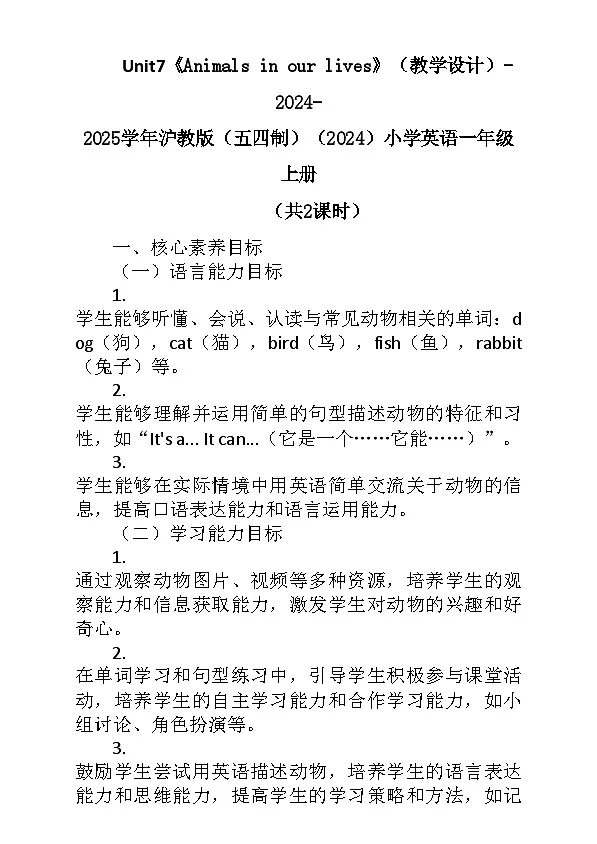
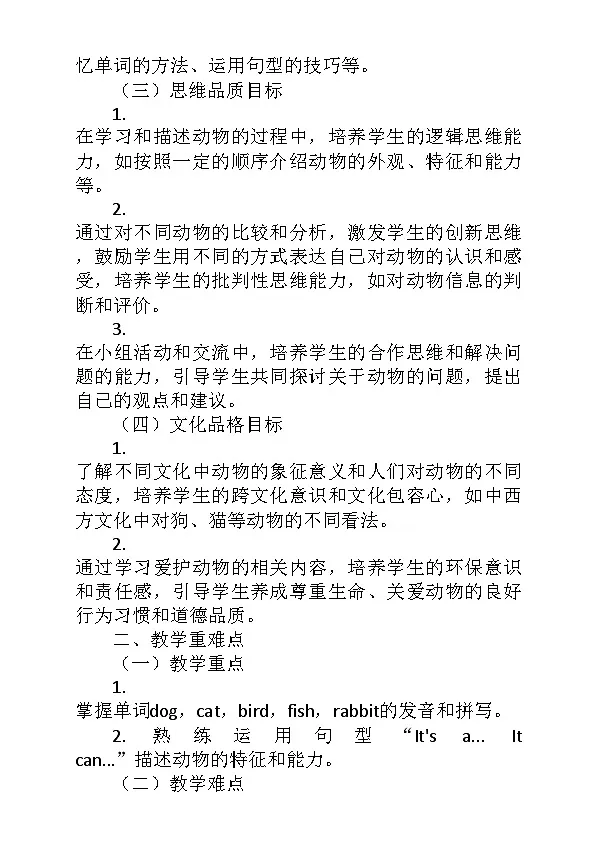
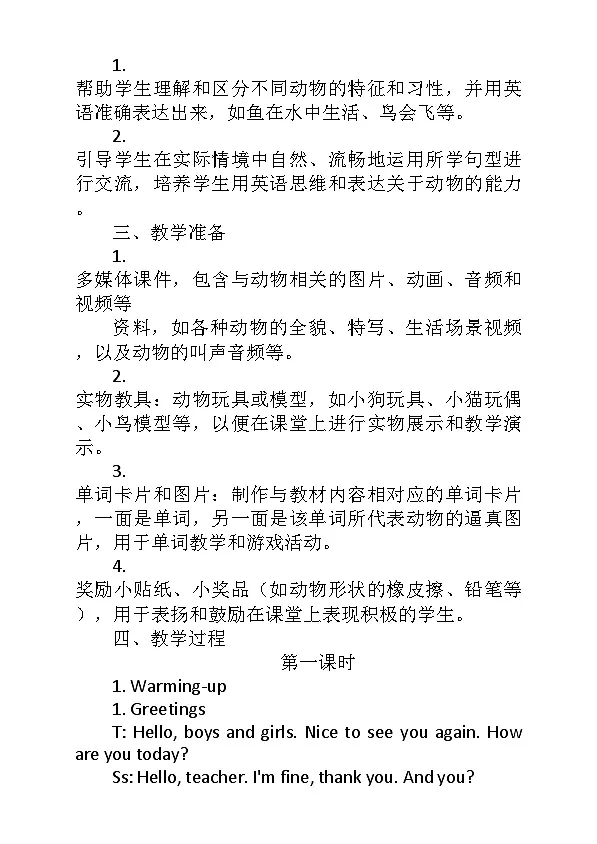
这是一份小学英语沪教版(五四制)(2024)一年级上册(2024)Unit 7 Animals in our lives公开课教案,共23页。教案主要包含了核心素养目标,教学重难点,教学准备,教学过程,板书设计等内容,欢迎下载使用。
一、核心素养目标
(一)语言能力目标
1. 学生能够听懂、会说、认读与常见动物相关的单词:dg(狗),cat(猫),bird(鸟),fish(鱼),rabbit(兔子)等。
2. 学生能够理解并运用简单的句型描述动物的特征和习性,如“It's a... It can...(它是一个……它能……)”。
3. 学生能够在实际情境中用英语简单交流关于动物的信息,提高口语表达能力和语言运用能力。
(二)学习能力目标
1. 通过观察动物图片、视频等多种资源,培养学生的观察能力和信息获取能力,激发学生对动物的兴趣和好奇心。
2. 在单词学习和句型练习中,引导学生积极参与课堂活动,培养学生的自主学习能力和合作学习能力,如小组讨论、角色扮演等。
3. 鼓励学生尝试用英语描述动物,培养学生的语言表达能力和思维能力,提高学生的学习策略和方法,如记忆单词的方法、运用句型的技巧等。
(三)思维品质目标
1. 在学习和描述动物的过程中,培养学生的逻辑思维能力,如按照一定的顺序介绍动物的外观、特征和能力等。
2. 通过对不同动物的比较和分析,激发学生的创新思维,鼓励学生用不同的方式表达自己对动物的认识和感受,培养学生的批判性思维能力,如对动物信息的判断和评价。
3. 在小组活动和交流中,培养学生的合作思维和解决问题的能力,引导学生共同探讨关于动物的问题,提出自己的观点和建议。
(四)文化品格目标
1. 了解不同文化中动物的象征意义和人们对动物的不同态度,培养学生的跨文化意识和文化包容心,如中西方文化中对狗、猫等动物的不同看法。
2. 通过学习爱护动物的相关内容,培养学生的环保意识和责任感,引导学生养成尊重生命、关爱动物的良好行为习惯和道德品质。
二、教学重难点
(一)教学重点
1. 掌握单词dg,cat,bird,fish,rabbit的发音和拼写。
2. 熟练运用句型“It's a... It can...”描述动物的特征和能力。
(二)教学难点
1. 帮助学生理解和区分不同动物的特征和习性,并用英语准确表达出来,如鱼在水中生活、鸟会飞等。
2. 引导学生在实际情境中自然、流畅地运用所学句型进行交流,培养学生用英语思维和表达关于动物的能力。
三、教学准备
1. 多媒体课件,包含与动物相关的图片、动画、音频和视频等
资料,如各种动物的全貌、特写、生活场景视频,以及动物的叫声音频等。
2. 实物教具:动物玩具或模型,如小狗玩具、小猫玩偶、小鸟模型等,以便在课堂上进行实物展示和教学演示。
3. 单词卡片和图片:制作与教材内容相对应的单词卡片,一面是单词,另一面是该单词所代表动物的逼真图片,用于单词教学和游戏活动。
4. 奖励小贴纸、小奖品(如动物形状的橡皮擦、铅笔等),用于表扬和鼓励在课堂上表现积极的学生。
四、教学过程
第一课时
1. Warming-up
1. Greetings
T: Hell, bys and girls. Nice t see yu again. Hw are yu tday?
Ss: Hell, teacher. I'm fine, thank yu. And yu?
T: I'm very well t. Are yu ready fr ur interesting English class?
Ss: Yes!
设计意图:通过日常问候,拉近师生距离,营造轻松愉快的课堂氛围,为课堂教学做好准备,同时激发学生的学习积极性。
2. Sing a sng
T: Let's start ur class with a fun sng abut animals. D yu knw the “Old MacDnald Had a Farm” sng? Let's sing it tgether and d
the actins.(播放歌曲视频,师生一起跟着唱并模仿农场里动物的动作)
Old MacDnald had a farm, E-I-E-I-O.
And n his farm he had sme cws, E-I-E-I-O.
With a m m here and a m m there.
Here a m, there a m, everywhere a m m.
Old MacDnald had a farm, E-I-E-I-O.
...
设计意图:以一首与动物相关的欢快歌曲导入新课,激发学生的学习兴趣,让学生在欢快的旋律和动作中初步感受动物的氛围,同时也为后续的教学内容做好铺垫,活跃课堂气氛。
2. Presentatin
1. Learn the wrds
(1) Dg
T: Nw, listen. What's this sund?(播放狗叫声音频)Wf wf. Yes, it's a dg.(展示狗的图片并拿出小狗玩具)Lk, this is a dg.(板书“dg”)Read after me, “dg”.(教师示范发音,强调“”的发音,学生跟读)
Ss: Dg.
T: What des a dg lk like?(引导学生描述狗的样子)
S1: A dg has fur legs.
S2: A dg has a tail.
T: Very gd. Dgs are ur gd friends. They are very cute and lyal.(教师简单介绍狗的特点)
设计意图:通过播放狗叫声音频和展示图片、实物,让学生多感官地感知“dg”这个单词,加深学生对单词的印象。引导学生描述狗的样子,培养学生的观察能力和语言表达能力,同时简单介绍狗的特点,增加学生对狗的了解和喜爱。
(2) Cat
T: Listen again. What's this sund?(播放猫叫声音频)Mew mew. It's a cat.(展示猫的图片并拿出小猫玩偶)This is a cat.(板书“cat”)Say “cat”.(教师示范发音,学生跟读)
Ss: Cat.
T: Can yu imitate the actin f a cat?(让学生模仿猫的动作,如走路、伸懒腰等)
The students imitate the actins f a cat.
T: Cats are very lvely. They like t sleep and play.(教师介绍猫的习性)
设计意图:同样通过声音、图片和实物相结合的方式教授“cat”单词,并让学生模仿猫的动作,增加课堂的趣味性和学生的参与度。介绍猫的习性,让学生对猫有更深入的认识。
(3) Bird
T: Nw, lk at this picture.(展示鸟的图片)What's this? It's a bird.(板书“bird”)The bird can fly.(教师做出飞的动作)Read
“bird”.(教师示范发音,注意“ir”的发音,学生跟读)
Ss: Bird.
T: What clr can birds be?
S3: Birds can be many clrs, like blue, green, yellw...
T: Yes, birds are very beautiful and they can sing very well. Listen.(播放鸟叫声音频)
设计意图:展示鸟的图片并结合动作和鸟叫声音频教授“bird”单词,让学生直观地感受鸟的特征。引导学生思考鸟的颜色,拓展学生的思维,同时播放鸟叫声,让学生更全面地了解鸟。
(4) Fish
T: Lk at this.(展示鱼的图片)It's a fish.(板书“fish”)Fish live in the water.(教师做出游泳的动作)Can yu swim like a fish?(让学生模仿游泳的动作)
The students try t swim like a fish.
T: Fish are very clrful and they swim very fast.(教师介绍鱼的特点)
设计意图:通过展示图片、动作和简单介绍鱼的生活环境及特点来教授“fish”单词,让学生在形象的教学中理解和记忆单词。让学生模仿游泳动作,增加学习的趣味性和学生的体验感。
(5) Rabbit
T: And this ne.(展示兔子的图片并拿出兔子模型)What's this? It's a rabbit.(板书“rabbit”)The rabbit has lng ears and a shrt tail.
(教师指着兔子的耳朵和尾巴)Say “rabbit”.(教师示范发音,学生跟读)
Ss: Rabbit.
T: D yu like rabbits? Why?
S4: I like rabbits because they are very cute and they can jump.
T: Yes, rabbits are very lvely and they can jump high.(教师模仿兔子跳的动作)
设计意图:利用图片、实物和描述兔子的特征来教授“rabbit”单词,引导学生表达对兔子的喜爱及原因,培养学生的语言表达能力和情感态度。模仿兔子跳的动作,让课堂更加生动有趣。
2. Practice the wrds
(1) Game: Animal Flashcards
The teacher shws the flashcards f the wrds “dg”, “cat”, “bird”, “fish”, “rabbit” quickly ne by ne. The students need t say the wrd as fast as they can when they see the card. Fr example, when the teacher shws the card with a picture f a dg, the students say “dg” ludly.
T: Nw, let's play a game. Lk at the flashcards carefully and say the wrds quickly.
The game can be repeated several times t reinfrce the students' memry f the wrds.
设计意图:通过闪卡游戏,让学生在快速识别图片和说出单词的
过程中巩固所学的动物词汇,提高学生的反应能力和对单词的认读能力,增加学习的趣味性和紧张感。
(2) Wrd Puzzle
The teacher prepares sme wrd puzzles n the multimedia curseware. Each puzzle is made up f the letters f an animal wrd. Fr example, fr the wrd “cat”, the puzzle may shw “c - a - t” in a jumbled rder. The students need t put the letters in the crrect rder t frm the wrd.
T: Lk at the screen. Can yu slve this wrd puzzle? What wrd is it?
Ss: Cat! (The students try t arrange the letters and say the wrd when they figure it ut.)
After slving a few puzzles, the teacher can ask individual students t cme t the frnt and perate the cmputer t slve the puzzles, and the ther students watch and cheer.
设计意图:利用单词拼图游戏,增加学习的趣味性和挑战性,培养学生的观察力和逻辑思维能力。让学生上台操作电脑解决拼图,增强学生的参与感和自信心,同时也能激发其他学生的学习积极性。
3. Text learning
1. Listen and watch
Open the multimedia curseware and play the vide f a shrt dialgue abut animals.
A: Lk, there are many animals.
B: Yes, it's a z. What's that?
A: It's a dg. It's very cute.
B: And what's this?
A: It's a cat. The cat can run.
The students listen and watch carefully, and try t understand the cntext.
设计意图:通过播放与动物相关的对话视频,让学生初步感知教材中的语言内容,了解如何用英语描述动物和在动物园的场景中进行简单交流,培养学生的听力和理解能力。
2. Listen and repeat
Play the dialgue again sentence by sentence. The students listen and repeat, paying attentin t the prnunciatin and intnatin.
T: Nw, listen and repeat after the vide. Pay attentin t hw they say it.
A: Lk, there are many animals.
Ss: Lk, there are many animals.
...
After repeating several times, ask individual students t repeat a sentence t check their prnunciatin.
设计意图:逐句跟读对话,让学生模仿正确的发音和语调,提高学生的口语表达能力。同时,检查个别学生的发音,及时纠正错误,
确保学生的发音准确。
3. Explain the text
T: Lk at the dialgue. They are talking abut animals in the z. When they see an animal, they say “It's a...” t intrduce what it is. And then they say smething abut the animal, like “It's very cute.” r “The cat can run.” D yu understand?
Ss: Yes.
T: Nw, let's practice this dialgue with ur partners. Yu can pint t the pictures f animals n the bk r n the screen and say the sentences.
设计意图:对对话进行详细讲解,帮助学生理解对话的含义和重点句型的用法。让学生与同伴进行对话练习,并结合图片进行指认和描述,使学生能够将所学知识与实际情境相结合,提高语言运用能力。
4. Practice
1. Rle-play
Divide the students int pairs. One student acts as a zkeeper and shws the pictures f animals t the ther student, using the sentences “It's a... It's very... It can...” t intrduce the animals. The ther student listens and asks questins if they have any. Then they switch rles.
Fr example:
A: (shws a picture f a dg) It's a dg. It's very cute. It can run and
jump.
B: What des the dg like t eat?
A: The dg likes t eat bnes.
Then they change rles and cntinue the cnversatin.
设计意图:通过角色扮演活动,让学生在实际情境中运用所学的句型进行交流,增强学生的口语表达能力和表演能力,同时培养学生的合作学习意识和人际交往能力。让学生互相提问,促进学生的思考和语言运用的灵活性,拓展学生关于动物的知识。
2. Grup Activity: Animal Guessing Game
Divide the students int grups f fur. One student in each grup thinks f an animal and describes it using the sentences “It's a... It's... It can...” withut saying the name f the animal. The ther students in the grup need t guess what the animal is.
Fr example:
S1: It's a small animal. It's white. It can run very fast.
S2: Is it a rabbit?
S1: N, it isn't.
S3: Is it a muse?
S1: Yes, it is.
After each student has a turn t describe an animal, the grup can discuss and chse the mst interesting descriptin t share with the class.
设计意图:以小组活动的形式进行动物猜谜游戏,培养学生的听力理解能力、语言表达能力和逻辑思维能力。学生在描述动物时需要运用所学的句型和词汇,同时要考虑如何让其他同学更容易猜出,而猜的同学则需要认真倾听和思考。通过小组讨论和分享,让学生互相学习和交流不同的表达方式,提高学生的参与度和学习兴趣。
5. Summary
1. Review the wrds and sentences
T: What have we learned tday? Let's review tgether. We learned sme new wrds abut animals, like “dg”, “cat”, “bird”, “fish”, “rabbit”. And we als learned sme sentences t describe animals, such as “It's a... It's... It can...”
Ss: Yes.
T: Let's say the wrds and sentences again.
Ss: Dg, cat... It's a dg. It's very cute. It can run.
设计意图:与学生一起回顾本节课所学的重点内容,包括单词和句型,帮助学生梳理知识框架,加深对所学知识的记忆,确保学生对本节课的学习内容有一个清晰的认识。
2. Encurage students
T: Yu have all dne a great jb tday. Yu learned the names f different animals in English and hw t describe them. Animals are ur friends in the wrld. We shuld lve and prtect them. Keep up the gd wrk and yu will learn mre abut animals in English. I'm prud
f yu all.
设计意图:对学生的学习表现进行肯定和鼓励,增强学生的学习自信心和积极性。同时,引导学生认识到动物是我们的朋友,培养学生爱护动物的意识和情感,将英语学习与情感教育相结合。
6. Hmewrk
1. Listen t the dialgue in the textbk and repeat it three times t yur parents r family members. Then tell them abut yur favrite animal using the sentences we learned tday.
设计意图:通过听读作业,巩固学生的听力和口语表达能力,让学生在家庭环境中也能进行英语学习,同时增进学生与家人之间的互动和交流。让学生向家人介绍自己最喜欢的动物,进一步强化学生对所学知识的运用能力。
2. Draw a picture f yur favrite animal and write a few sentences belw the picture t describe it. Yu can shw yur picture and sentences t yur classmates in the next class.
设计意图:布置绘画作业,让学生将所学的英语知识与绘画相结合,通过绘制自己最喜欢的动物并描述它,加深对动物词汇和句型的记忆和理解。同时,让学生在课堂上展示自己的作品并进行介绍,可以锻炼学生的口语表达能力和自信心,也为学生提供了一个互相学习和交流的机会。
第二课时
1. Revisin
1. Wrd Review Game: Simn Says with Animal Actins
The teacher plays the game “Simn Says” with a twist related t animals. The teacher gives cmmands like “Simn says jump like a rabbit.” “Simn says swim like a fish.” “Simn says walk like a dg.” “Simn says fly like a bird.” If the teacher says a cmmand withut “Simn Says”, the students shuld nt d the actin. The students wh d the wrng actin are ut f the game. The last student left in the game is the winner.
Fr example:
T: Simn says mew like a cat.
The students mew and imitate the actins f a cat.
T: Run like a hrse. (withut saying “Simn Says”)
The students shuld nt d the actin. If sme students d it by mistake, they are ut f the game.
设计意图:通过“Simn Says”游戏结合动物动作的方式,复习上节课所学的动物单词和相关动作,增加游戏的趣味性和挑战性,激发学生的学习兴趣和竞争意识。同时,让学生通过实际的动作模仿来巩固对单词的记忆和理解,锻炼学生的听力和反应能力,活跃课堂气氛。
2. Dialgue Review
Ask sme pairs f students t cme t the frnt and rle-play the dialgue they learned in the last class abut animals in the z. They can
use sme expressins and gestures t make the dialgue mre vivid.
A: Lk, there is a dg in the z.
B: Oh, it's s cute. What can the dg d?
A: The dg can run and jump. It's very active.
B: And what's that ver there?
A: It's a bird. The bird can fly and sing. It's beautiful.
After the rle-plays, ask the ther students t cmment n their perfrmances and crrect any mistakes if necessary.
设计意图:让学生进行对话复习,检查学生对对话内容的掌握情况,同时培养学生的口语表达能力和表演能力。鼓励学生运用表情和手势使对话更加生动,能够提高学生的学习积极性和创造力。其他学生的评价和纠错环节可以培养学生的倾听能力和批判性思维能力。
2. Presentatin
1. Learn mre abut animals' habits and characteristics
T: Nw, let's learn mre abut ur animal friends. D yu knw where dgs like t sleep?(引导学生思考并回答)
Ss: They like t sleep in their kennels.(学生可能会根据自己的了解回答,教师给予肯定或补充)
T: Yes, dgs usually like t sleep in a warm and cmfrtable place, like their kennels r near their wners. And cats, what d they like t d in the daytime?(展示猫白天睡觉的图片)
Ss: Cats like t sleep in the daytime.
T: Right. Cats are ften lazy in the daytime and becme mre active at night. What abut birds? Hw d they build their hmes?(展示鸟筑巢的图片或视频)
S1: Birds use twigs and grass t build their nests.
T: Very gd. Birds are very clever in building their nests. And fish, they live in the water. What d they need t breathe?(引导学生思考鱼在水中呼吸的方式)
S2: Fish breathe with gills.
T: That's crrect. Fish use their gills t take in xygen frm the water. Nw, let's talk abut rabbits. What d rabbits like t eat?(展示兔子吃胡萝卜的图片)
Ss: Rabbits like t eat carrts and grass.
T: Yes, rabbits are herbivres. They mainly eat plants.
设计意图:通过提问和展示图片、视频等方式,引导学生进一步了解动物的生活习性和特点,丰富学生对动物的认知,培养学生的观察能力和思考能力。让学生积极参与讨论,提高学生的学习积极性和主动性。
2. Practice describing animals' habits
(1) Pair wrk
The students wrk in pairs. They chse an animal and discuss its habits and characteristics using the sentences “It likes t... It can... It lives in/n...” Fr example:
S1: Let's talk abut the dg. It likes t play with balls. It can run very fast. It lives with peple.
S2: Yes, and it als likes t bark t prtect its hme.
After a few minutes f discussin, each pair can share their ideas with the class.
设计意图:通过两两合作练习,让学生在实际交流中巩固所学的关于动物习性和特点的描述,提高学生的口语表达能力和合作学习能力。让学生自己选择动物进行讨论,增加学生的自主性和兴趣。
(2) Grup activity
Divide the students int grups. Each grup is given a task t create a mini-pster abut an animal f their chice. They need t draw a picture f the animal and write dwn sme sentences t describe its habits, characteristics and where it lives. They can use the infrmatin they have learned in class and als d sme research if they want.
Fr example, a grup chses t d a pster abut the elephant. They draw an elephant and write: “The elephant is a very big animal. It has a lng trunk. It likes t eat leaves and grass. It lives in the frest. It can carry heavy things with its trunk.”
After they finish, each grup presents their pster t the class and explains what they have drawn and written.
设计意图:以小组活动的形式,让学生通过制作海报来综合运用所学的知识描述动物,培养学生的团队合作能力、创造力和书面表达
能力。同时,让学生通过自主研究获取更多关于动物的信息,拓展学生的知识面。展示和讲解海报的环节可以锻炼学生的口语表达能力和自信心。
3. Text extensin
1. Listen and watch a new dialgue
Shw a new dialgue n the multimedia curseware. The dialgue is between tw friends talking abut their favrite animals and why they like them.
C: Hi, what's yur favrite animal?
D: My favrite animal is the panda. They are s cute and lvely.
C: Yes, I like pandas t. They are black and white. What d pandas like t eat?
D: Pandas like t eat bamb. They spend mst f their day eating and sleeping.
C: That's interesting. Why d yu like pandas s much?
D: Because they are unique and they are a symbl f China. I feel very prud when I see them.
Play the vide and let the students listen and watch carefully.
设计意图:通过展示新的对话,拓展学生的学习内容,让学生在不同的情境中进一步感受如何用英语谈论自己喜欢的动物以及喜欢的原因,培养学生的听力和理解能力。同时,引入熊猫这一具有中国特色的动物,激发学生的民族自豪感和对动物的喜爱之情。
2. Discuss and act ut
After watching the dialgue, ask the students t discuss in pairs what they have learned frm the dialgue and then act it ut. Encurage them t add sme f their wn wrds and expressins t make the dialgue mre vivid.
S1: We learned hw t talk abut ur favrite animals and the reasns why we like them.
S2: Yes, we can als say sme interesting facts abut ur favrite animals.
Then they act ut the dialgue:
S1: Hi, what's yur favrite animal?
S2: My favrite animal is the mnkey. They are very clever and funny.
S1: Why d yu like mnkeys?
S2: Because they can climb trees and they always make me laugh. And they like t eat bananas.
S1: That's true. Mnkeys are really interesting animals.
设计意图:让学生通过讨论和表演新对话,进一步理解和掌握所学的语言知识在实际情境中的运用,培养学生的口语表达能力、合作学习能力和创新思维能力。同时,引导学生在对话中加入自己的想法和感受,提高学生的语言运用灵活性和个性化表达能力,以及对动物的深入了解和喜爱。
3. Create yur wn dialgue
Ask the students t wrk in grups f fur t create a new dialgue abut animals in a certain situatin, such as at a pet stre, in a frest r n a farm. They need t use the wrds and sentences abut animals and their habits they have learned. They shuld write dwn their dialgues first and then practice acting them ut.
Fr example:
Grup 1's dialgue (at a pet stre):
E: Lk at this pet stre. There are s many animals.
F: Yes, I want t buy a pet. What d yu think is a gd pet?
G: I think a dg is a gd chice. Dgs are friendly and lyal. They can play with yu and prtect yu.
H: But I like cats. Cats are cute and clean. They like t sleep and are very quiet.
E: Well, we can ask the shpkeeper fr sme advice.
Shpkeeper: Hell, kids. Dgs need mre exercise and attentin, while cats are mre independent. It depends n what yu like and hw much time yu can spend with yur pet.
After the grups have finished creating and practicing their dialgues, ask sme grups t perfrm in frnt f the class and let the ther students listen and evaluate.
设计意图:通过小组合作创作对话,培养学生的创造力和综合语
言运用能力,让学生在自主创作的过程中,灵活运用所学的动物词汇、习性描述和句型来构建与特定情境相关的对话,同时提高学生的团队协作能力和书面表达能力。表演环节可以让学生展示自己的学习成果,增强学生的自信心和学习兴趣。其他学生的评价可以促进学生之间的相互学习和提高。
4. Practice and cnslidatin
1. Listen and match
The teacher prepares sme sentences abut animals' habits and characteristics n cards, such as “The fish can swim in the water.” “The bird can fly in the sky.” “The dg likes t play with bnes.” “The rabbit likes t eat carrts.” etc. The teacher als prepares sme pictures f animals ding different activities. The students need t listen t the sentences ne by ne and match them with the crrect pictures.
Fr example:
T: Listen carefully. The fish can swim in the water.
The students find the picture f a fish swimming and match it with the sentence.
After all the sentences are matched, ask sme students t cme t the frnt and shw their answers and explain why they match them that way.
S1: I match this sentence with this picture because the sentence says the fish can swim in the water and in the picture the fish is
swimming.
设计意图:通过听和匹配的练习,考查学生对所学动物习性和特点相关内容的理解和听力能力,同时培养学生的观察能力和逻辑思维能力。让学生解释匹配的原因,可以锻炼学生的语言表达能力和对知识的理解运用能力。
2. Animal Strytelling
The teacher asks the students t think abut an interesting stry with an animal as the main character. Then they need t tell a shrt stry in English. They can start with “Once upn a time, there was a...” r “One day, an animal...” Fr example:
S2: Once upn a time, there was a little rabbit. It was very brave. One day, it saw a big carrt in the garden. But there was a fence arund the garden. The rabbit didn't give up. It fund a hle in the fence and gt int the garden. It ate the big carrt and was very happy.
S3: One day, a bird was flying in the sky. Suddenly, it saw a beautiful flwer n the grund. It wanted t smell the flwer. S it flew dwn and landed next t the flwer. But when it was abut t smell the flwer, a little by came. The by wanted t catch the bird. The bird was very clever. It flew away quickly and the by culdn't catch it.
After each student tells their stry, the ther students can ask questins r give cmments.
设计意图:让学生讲述动物故事,能够锻炼学生的口语表达能力
和叙事能力,同时发挥学生的想象力,让学生更加深入地了解动物的特点和行为,增强学生对动物的喜爱之情。其他学生的提问和评论可以促进学生之间的互动和交流,提高学生的倾听能力和思维能力。
3. Sentence Making Cmpetitin abut Animals
Divide the students int several grups. The teacher gives an animal name, such as “dg” r “cat”. Each grup needs t make as many sentences as pssible abut the animal within a limited time, using the wrds and sentences they have learned abut animals' habits and characteristics. Fr example, fr the wrd “dg”, the grups can make sentences like “The dg is a faithful animal.” “The dg can guard the huse.” “The dg likes t play with its wner.” etc.
The grup that makes the mst crrect and creative sentences wins.
After the cmpetitin, praise the winning grup and encurage all the students t keep learning and using English t talk abut animals.
设计意图:通过句子创作竞赛,激发学生的学习积极性和创造力,让学生在紧张而有趣的氛围中灵活运用所学知识进行句子创作,培养学生的语言运用能力和思维能力。以动物名称为主题进行句子创作,能够加深学生对动物习性和特点的描述能力,同时鼓励学生积极参与英语学习,提高学生的学习兴趣和自信心。
5. Summary
1. Review the key pints
T: Tday, we have learned mre abut animals. We learned abut their habits and characteristics and hw t talk abut ur favrite animals and the reasns why we like them. We als created dialgues and tld stries abut animals. Can yu remember what we learned?
Ss: Yes.
T: Let's review the wrds and sentences tgether.
Ss: Dg, cat... It likes t... It can... My favrite animal is... Because...
T: Very gd. Yu have all dne a great jb in learning English and understanding animals.
设计意图:与学生一起回顾本节课所学的重点内容,包括动物的习性和特点、喜欢的动物及原因、对话和故事创作等,帮助学生梳理知识框架,加深对所学知识的记忆,确保学生对本单元的知识有一个全面的掌握。
2. Encurage students
T: Yu are all very gd at using English t talk abut animals. Animals are an imprtant part f ur wrld. We shuld respect and prtect them. Keep learning and explring abut animals in English. I believe yu will be able t knw mre abut the animal kingdm and express yurself better in English in the future. I'm prud f yu all.
设计意图:对学生的学习表现进行肯定和鼓励,增强学生的学习自信心和积极性。同时,再次强调动物的重要性和我们应该保护动物的意识,引导学生将英语学习与对动物的了解和保护相结合,培养学
生的环保意识和责任感,鼓励学生继续努力学习英语,提高英语表达能力和对动物的认知水平。
6. Hmewrk
1. Write a shrt passage abut an animal yu like. Yu need t describe its appearance, habits and why yu like it. Use the English wrds and sentences we learned in this unit.
Fr example:
My favrite animal is the elephant. The elephant is very big. It has a lng trunk and big ears. It likes t eat grass and leaves. It can use its trunk t pick up things and spray water. I like elephants because they are very gentle and intelligent. They are als very imprtant in the ecsystem.
设计意图:通过写作作业,让学生将所学的英语知识进行综合运用,培养学生的书面表达能力和思维能力。同时,让学生描述自己喜欢的动物,能够加深学生对动物相关词汇和句型的理解和记忆,提高学生的学习兴趣和积极性,也有助于学生对动物的深入观察和思考。
2. Watch a dcumentary r a vide abut animals with yur parents and then share what yu have learned frm it with yur classmates in the next class. Yu can talk abut a new animal yu saw r smething interesting yu learned abut animals' lives.
设计意图:布置观看动物纪录片或视频的作业,让学生在课外通过不同的媒体形式进一步了解动物,拓宽学生的知识面和视野。与家
长一起观看可以增进亲子互动,同时让学生在下节课分享所学到的内容,能够提高学生的口语表达能力和在实际情境中运用英语的能力,也为学生提供了一个互相学习和交流的机会,激发学生对动物的探索兴趣。
五、板书设计
Unit7 Animals in ur lives
Wrds:
dg cat bird fish rabbit
Sentences:
It's a...
It's... (cute, lvely, big, small, etc.)
It can... (run, jump, fly, swim, etc.)
It likes t... (eat, sleep, play, etc.)
设计意图:板书设计清晰明了,将本单元的重点单词和句型分别列出。单词部分展示了与常见动物相关的词汇,方便学生直观地看到所学内容。句型部分列出了描述动物的基本句型,包括介绍动物是什么、它的特点以及它能做什么和喜欢做什么,为学生的语言运用提供了示范和引导。通过板书的呈现,能够帮助学生在课堂学习过程中更好地理解和记忆重点知识,同时在练习和表达时可以随时参考板书进行组织和输出,提高课堂教学效果。
这是一份小学英语沪教版(五四制)(2024)一年级上册(2024)Unit 7 Animals in our lives公开课教案,共23页。教案主要包含了核心素养目标,教学重难点,教学准备,教学过程,板书设计等内容,欢迎下载使用。
这是一份小学英语沪教版(五四制)(2024)一年级上册(2024)Unit 7 Animals in our lives表格教案设计,共9页。教案主要包含了教材分析,教学目标,教学重难点,教学方法和学习策略,教学准备,教学过程,板书设计,教学反思等内容,欢迎下载使用。
这是一份英语四年级上册(2024)Unit 2 Where do animals live?教案,共25页。教案主要包含了语篇研读,教学目标,教学重难点,教学过程设计,作业设计等内容,欢迎下载使用。
 新教材
新教材注册成功
资料篮

在线客服
添加在线客服
获取1对1服务
官方微信
关注“教习网”公众号
打开微信就能找资料
赛课定制
添加在线客服
获取1对1定制服务
职称咨询
添加在线客服
获取1V1专业指导服务

免费福利


.png)
.png)
(1)(1).png)
