免费领取教师福利


若您为此资料的原创作者,认为该资料内容侵犯了您的知识产权,请扫码添加我们的相关工作人员,我们尽可能的保护您的合法权益。


这是一份2025年高考真题——英语(全国一卷)(Word版附答案),共13页。试卷主要包含了5分, 满分37等内容,欢迎下载使用。
本试卷满分150分, 考试用时120分钟。
第一部分听力(共两节, 满分30分)
第二部分阅读(共两节, 满分50分)
第一节(共15小题; 每小题2.5分, 满分37.5分)
阅读下列短文, 从每题所给的A、B、C、D四个选项中选出最佳选项。
A
The greening f planes, trains and autmbiles
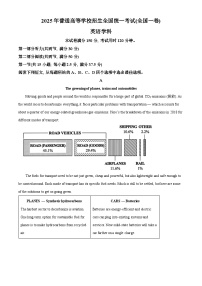
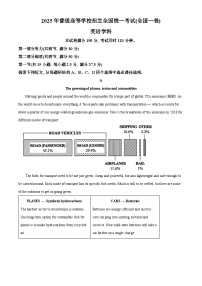
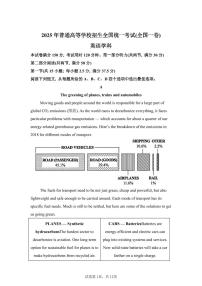
Mving gds and peple arund the wrld is respnsible fr a large part f glbal CO2 emissins (排放). As the wrld races t decarbnize everything, it faces particular prblems with transprtatin — which accunts fr abut a quarter f ur energy-related greenhuse gas emissins. Here’s the breakdwn f the emissins in 2018 fr different mdes f transprt.
The fuels fr transprt need t be nt just green, cheap and pwerful, but als lightweight and safe enugh t be carried arund. Each mde f transprt has its specific fuel needs. Much is still t be settled, but here are sme f the slutins t get us ging green.
This energy transitin (变革) is glbal, and the amunt f renewable energy the wrld will need is “a little bit mind-blwing,” says mechanical engineer Keith Wipke at the Natinal Renewable Energy Labratry. It’s estimated that the glbal demand fr electricity culd mre than duble by 2050. Frtunately, analyses suggest that renewables are up t the task. “We need t speed up the develpment f green energy, and it will all get used,” says Wipke.
1. What percentage f glbal transprt emissins did rad vehicles accunt fr in 2018?
A. 11.6%.B. 45.1%.C. 74.5%.D. 86.1%.
2. Which mde f transprt can g green cmparatively easily?
A. Planes.B. Trucks.C. Trains.D. Ships.
3 What des Wipke suggest regarding energy transitin?
A. Limiting fuel cnsumptin.B. Putting mre effrt int renewables.
C. Imprving energy efficiency.D. Making electricity mre affrdable.
B
In my ninth-grade writing class last year, I met a cwby wh saved his twn, a strict father wh demanded his sn earn straight A’s, and a mdern-day Juliet wh died f heartbreak after her parents rejected the lve f her yung life. Mre than nce, I fund myself wndering just hw my students, wh’d created these peple, knew their subjects s well.
But things were different fr their first essay, which was abut the questin: “Why is writing imprtant?” Mst f the essays filled less than ne page, and few cntained a sentence that culd be interpreted as a thesis (论点) statement. I was shcked. Then I realized that the prblem was the questin itself. They culd have written pages n the necessity f cmputers, but writing, in and f itself, simply didn’t strike them as imprtant. This wuld have t change.
As a new unit started, I asked everyne t write a persuasive piece n a health-related tpic f their chice. This time they fund the exercise much mre interesting. Fr the next tw assignments, a persnal-narrative unit fllwed by a creative-writing wrkshp, I nly required that the piece meet the specificatins f its genre (体裁) and that it cntain a thesis. The results were staggering. The students tk n diverse tpics and turned in stries, 10 t 20 pages each, with characters that bradened my view and tuched my heart.
I walked int class believing that writing is imprtant as a means f cmmunicatin. Hwever, my students demnstrated smething mre imprtant t me. When the final bell rang in June, I walked away with a yearbk full f messages abut writing’s mst pwerful significance — the ability t cnnect peple, t put us in anther’s skin, t teach us what it means t be human.
4. Wh are the peple mentined at the beginning f paragraph 1?
A Ninth graders.B. Students’ parents.
C. Mdern writers.D. Fictinal characters.
5. Why did the students perfrm prly in writing their first essay?
A. They were nt given enugh time.B. They had a very limited vcabulary.
C. They misunderstd the questin.D. They had little interest in the tpic.
6. What des the underlined wrd “staggering” in paragraph 3 mean?
A. Mixed.B. Amazing.C. Similar.D. Disturbing.
7. What des the authr’s experience shw?
A. Teaching is learning.B. Still waters run deep.
C. Knwledge is pwer.D. Practice makes perfect.
C
While safety imprvements might have been made t ur streets in recent years, transprt studies als shw declines in pedestrian (行人) mbility, especially amng yung children. Many parents say there’s t much traffic n the rads fr their children t walk safely t schl, s they pack them int the car instead.
Dutch authrs Thalia Verkade and Marc te Brömmelstret are bthered by facts like these. In their new bk Mvement: Hw t Take Back Our Streets and Transfrm Our Lives, they call fr a rethink f ur streets and the rle they play in ur lives.
Life n city streets started t change decades ag. Whle neighburhds were destryed t make way fr new rad netwrks and kids had t play elsewhere. Sme cmmunities fught back. Mst famusly, a Canadian jurnalist wh had mved her family t Manhattan in the early 1950s led a campaign t stp the destructin f her lcal park. Describing her alarm at its prpsed replacement with an expressway, Jane Jacbs called n her mayr (市长) t champin “New Yrk as a decent place t live, and nt just rush thrugh.” Similar campaigns ccurred in Australia in the late 1960s and 1970s as well.
Althugh these campaigns were widespread, the reality is that the majrity f the western cities were cmpletely redesigned arund the needs f the mtr car. The number f cars n rads has been increasing rapidly. In Australia we nw have ver twenty millin cars fr just ver twenty-six millin peple, amng the highest rate f car wnership in the wrld.
We invest a lt in rads that help us rush thrugh, but we fail t accunt fr the true csts. D we really recgnise what it csts us as a sciety when children can’t mve safely arund ur cmmunities? The authrs f Mvement have it right: it’s time t think differently abut that street utside yur frnt dr.
8. What phenmenn des the authr pint ut in paragraph 1?
A. Cars ften get stuck n the rad.B. Traffic accidents ccur frequently.
C. Peple walk less and drive mre.D. Pedestrians fail t fllw the rules.
9. What were the Canadian jurnalist and ther campaigners trying t d?
A. Keep their cities livable.B. Prmte cultural diversity.
C Help the needy families.D. Make expressways accessible.
10. What can be inferred abut the campaigns in Australia in the late 1960s and 1970s?
A. They bsted the sales f cars.B. They turned ut largely ineffective.
C. They wn gvernment supprt.D. They advcated building new parks.
11. What can be a suitable title fr the text?
A. Why the Rush?B. What’s Next?
C. Where t Stay?D. Wh t Blame?
D
Micrplastics have becme a cmmn surce f pllutin acrss the Earth — they have settled in the deep sea and n the Himalayas, stuck inside vlcanic rcks, filled the stmachs f seabirds and even fallen in fresh Antarctic snw. They are even appearing inside humans.
Nw, new research suggests that a simple, cheap measure may significantly reduce the level f micrplastics in water frm yur tap (水龙头): biling and filtering (过滤) it. In a study published Wednesday in Envirnmental Science & Technlgy Letters, researchers frm China fund that biling tap water fr just five minutes — then filtering it after it cls — culd remve at least 80 percent f its micrplastics.
Crucially, this prcess relies n the water cntaining enugh calcium carbnate (碳酸钙) t trap the plastics. In the study, biling hard water cntaining 300 milligrams f calcium carbnate led t an almst 90 percent drp in plastics. But in samples with less than 60 milligrams f calcium carbnate, biling reduced the level f plastics by just 25 percent. Additinally, the research didn’t include all types f plastics. The team fcused nly n three cmmn types — plystyrene, plyethylene and plyprpylene — and they didn’t study ther chemicals previusly fund in water such as vinyl chlride.
Still, the findings shw a ptential path frward fr reducing micrplastic expsure — a task that’s becming increasingly difficult. Even bttled water, scientists fund earlier this year, cntains 10 t 1,000 times mre micrplastics than riginally thught.
Scientists are still trying t determine hw harmful micrplastics are — but what they d knw has raised cncerns. The new study suggests biling tap water culd be a tl t limit intake. “The way they demnstrated hw micrplastics were trapped thrugh the biling prcess was nice,” Carline Gauchtte-Lindsay, an envirnmental engineer f the University f Glasgw in Sctland wh was nt invlved in the research, tells New Scientist. “We shuld be lking int upgrading drinking water treatment plants s they remve micrplastics.”
12. Hw des the authr present the issue in the first paragraph?
A. By quting an expert.B. By defining a cncept.
C. By giving examples.D. By prviding statistics.
13. What determines the effectiveness f trapping micrplastics in water?
A. The hardness f water.B. The length f cling time.
C. The frequency f filtering.D. The type f plastic in water.
14. What des the authr try t illustrate by mentining bttled water in paragraph 4?
A. The imprtance f plastic recycling.B. The severity f the micrplastic prblem.
C. The danger in verusing pure water.D. The difficulty in treating plluted water.
15. What is Gauchtte-Lindsay’s suggestin abut?
A. Chice f new research methds.B. Pssible directin fr further study.
C. Need t invlve mre researchers.D. Ptential applicatin f the findings.
第二节(共5小题; 每小题2.5分, 满分12.5分)
阅读下面短文, 从短文后的选项中选出可以填入空白处的最佳选项。选项中有两项为多余选项。
An Unsung Her
Need a break between classes r just a quick pick-me-up in the mrning? The Cllege Cafe has just that, and mre. _____16_____
Catherine Murphy, a cafe wrker in a green shirt and black hat, makes sure that each custmer gets exactly what they rder. She ges back and frth between machines t make the drinks. _____17_____ As the custmer grabs the drink frm her hand, she smiles and says, “Hell, hw is yur day?” Even when the line is getting lnger, she desn’t let it get in the way f her genuine cnversatins.
Murphy gets up at a quarter t five and drives thirty minutes every day t get t wrk n time. _____18_____ “I d s because I like t make cffee fr the students. I knw they need it in the mrning,” Murphy said. Being a mther and wife has helped her becme the wman she is. She believes she is here t serve.
One thing Murphy may nt knw is that her smile is cntagius (有感染力) and can be the difference in a student having a much better day than they were having befre seeing her. Janna Wright, a senir plitical science majr, lves cffee and ges t the cafe at least six days a week. _____19_____ “Catherine always has a huge smile n her face, which always puts me in a cheerful md,” Wright said.
“I enjy wrking in the cafe,” Murphy said. _____20_____ She has every intentin f staying and cntinuing ding what she lves.
A. The cafe clses at 9 pm every day.
B. She has tw children aged eight and fur.
C. Smetimes she arrives early t serve the students early.
D. After finishing an rder, she calls ut the name n the cup.
E. Nt nly des this cafe serve up drinks, it als serves up smiles.
F. Ging t the cafe starts her day ff gd and gets her ready fr class.
G. She has served here fr 17 years and can’t imagine wrking anywhere else.
第三部分语言运用(共两节, 满分30分)
第一节(共15小题; 每小题1分, 满分15分)
阅读下面短文, 从每题所给的A、B、C、D四个选项中选出最佳选项。
One August afternn, I sat in my kitchen staring at a glass vase that hadn’t seen daylight since my wedding.
My husband and I had just sld ur huse and we were busy ___21___ the belved hme ur family had spent 23 years filling up. We had decided n key items fr the ___22___ we were mving t in twn, dnated what we culd, and rented a place t ___23___ ur suppsedly imprtant bjects. That left a huse still ___24___ with things that, while nt particularly ___25___, didn’t belng in a landfill (垃圾填埋场).
I tk a picture f the vase and psted it nline, fr $10. A cuple f messages came in, ne wanting additinal ___26___, anther asking fr a price cut. As ur ___27___ day drew near, I settled n a new price ($0) and repsted it. The ___28___: “I hate this vase. Maybe yu wn’t.” In an instant, a wman raced int my huse and left happily with the vase.
___29___, I psted mre. My daily psts and the ___30___ I received became a precius ray f light in the chas f my huse. Each exchange prvided a chance t ___31___ the landfill and t please anther persn I might nt therwise have ___32___.
I sit in my apartment tday, lving each f the ___33___ that share ur small space. I take ___34___ in knwing that, smewhere nearby, smene is ___35___ smething that culdn’t cme with us.
21. A. painting verB. lking arundC. emptying utD. pulling dwn
22. A. htelB. fficeC. cttageD. apartment
23. A. streB. displayC. sellD. repair
24. A. cveredB. decratedC. stuffedD. equipped
25. A. cnventinalB. valuableC. cmplicatedD. tlerable
26. A. feesB. phtsC. receiptsD. mdels
27. A. mveB. payC. marketD. wrk
28. A. warningB. requestC. descriptinD. reply
29 A. CnfusedB. InterestedC. DisappintedD. Encuraged
30. A. visitsB. reprtsC. adviceD. mney
31. A. remveB. spareC. findD. check
32. A. investigatedB. recgnizedC. encunteredD. recmmended
33. A. giveawaysB. pstsC. cntributinsD. belngings
34. A. jyB. partC. careD. time
35. A. anticipatingB. appreciatingC. deliveringD. withdrawing
第二节(共10小题; 每小题1.5分, 满分15分)
阅读下面短文, 在空白处填入1个适当的单词或括号内单词的正确形式。
An exhibitin at the Jiushi Art Museum in Shanghai is featuring artwrk inspired by G, r weiqi in Chinese, ____36____ riginated in China mre than 4,000 years ag.
G is ne f ____37____ earliest binary-based (基于二元的) games. The mvements f the black and white pieces reflect the basic ideas f Eastern philsphy, accrding t Tu Ningning, wh is in charge f the exhibitin.
“The exhibitin brings tgether G culture, cutting-edge technlgy and cntemprary art,” says Tu. “We hpe ____38____ (present)the rather abstract G game and AI in a visual cntext, and initiate dialgues with minimalist art, cnceptual art and expressinism.”
“In a G game, each mve shuld serve a lng-term gal. Yu try t lead the ppnent int yur trap and frce them t fllw yur ‘____39____ (guide)’ till they lse,” explains Wang Wei, a G player amng the visitrs t the exhibitin.
“The players’ persnalities ____40____ (reveal) during the game, and ne’s weaknesses are expsed t the ppnent,” she adds. “A decent winner always ____41____ (try) t beat the ppnent ____42____ n mre than ne r tw pints as a gesture (姿态) f respect fr the ther side. ”
Tu says that the balance between the black and white pieces, the beauty in the ____43____ (strategy) placement f the pieces, ____44____ the energy flw fllwing each mve inspired artists t create il paintings, sculptures, ____45____ (digital) generated pictures and silk-screen prints fr the exhibitin.
第四部分 写作(共两节, 满分40分)
第一节(满分15分)
46. 假定你是李华,你班的英语报要增设一个栏目。外教 Jenny 提出“Fun at my schl”和“Guess wh I am”两个选项供大家选择。请给Jenny写一封邮件,内容包括:
(1)你的选择;
(2)说明理由。
注意:
(1)写作词数应为80个左右;
(2)请按如下格式在答题卡的相应位置作答。
Dear Jenny,
I really like the idea f adding a new clumn t ur English newspaper.
___________________________________________________________________________________________________________________________________________________________________________________________________________________________________________________________________________________________________________________________________________________________________________________________________________________________________________________________________________________________
Yurs,
Li Hua
第二节(满分25分)
47. 阅读下面材料,根据其内容和所给段落开头语续写两段,使之构成一篇完整的短文。
My wife and I wanted t share ur new hme with family and friends by hsting a small gathering in the early summer. She had prepared lts f snacks, while my jb was t have the backyard in rder.
There was plenty f space fr the kids t run and play. There was just ne thing I hadn’t cunted n: My brther chse t bring his dg Tby, a 50-pund ball f fire. Thugh friendly, he culd easily knck ver my niece’s small bys and my six-mnth-ld granddaughter. S, when my brther shwed up, I asked him t watch Tby and keep him utside.
My plan was wrking ut just fine. Tby was using up his energy by running back and frth in the backyard and giving the kids plenty f rm. Unexpectedly, after supper, the weather changed. It started t rain and everyne went indrs.
It was an awkward mment. I didn’t want Tby t be running arund in the huse, and my brther wasn’t happy with driving hme with a wet dg. Eventually, my brther decided t leave rather than frce the issue.
A few days passed, and I hadn’t heard anything frm my brther. I texted him and expressed wishes fr him t cme ut again. His reply came as a surprise — a shck, actually: “Nt a chance.” Clearly, he was unhappy ver the way we had parted. After all, I had left him little chice. Well, he’ll get ver it, I reasned.
Tw mnths passed. My wife suggested I get in tuch with my brther, but I resisted, thinking he shuld call first. Hwever, my cnscience (良心) kept bthering me. I tried t put myself in my brther’s shes. He was facing health issues and his wife f thirty-five years had passed away a few mnths earlier. Tby was his cnstant cmpanin, the ne wh kept him ging.
注意:
(1)续写词数应为150个左右;
(2)请按如下格式在答题卡的相应位置作答。
I realized it was me wh was at fault.
___________________________________________________________________________________________________________________________________________________________________________________________________________________________________________________________________________________________________________________________________________________________________________________________________________________________________________________________________________________________
With the biscuits my wife had made, I arrived at my brther’s dr.
___________________________________________________________________________________________________________________________________________________________________________________________________________________________________________________________________________________________________________________________________________________________________________________________________________________________________________________________________________________________
2025年普通高等学校招生全国统一考试(全国一卷)
英语学科
本试卷满分150分, 考试用时120分钟。
第一部分听力(共两节, 满分30分)
第二部分阅读(共两节, 满分50分)
第一节(共15小题; 每小题2.5分, 满分37.5分)
阅读下列短文, 从每题所给的A、B、C、D四个选项中选出最佳选项。
A
【1~3题答案】
【答案】1. C 2. C 3. B
B
【4~7题答案】
【答案】4. D 5. D 6. B 7. A
C
【8~11题答案】
【答案】8. C 9. A 10. B 11. A
D
【12~15题答案】
【答案】12. C 13. A 14. B 15. D
第二节(共5小题; 每小题2.5分, 满分12.5分)
阅读下面短文, 从短文后的选项中选出可以填入空白处的最佳选项。选项中有两项为多余选项。
【16~20题答案】
【答案】16. E 17. D 18. C 19. F 20. G
第三部分语言运用(共两节, 满分30分)
第一节(共15小题; 每小题1分, 满分15分)
阅读下面短文, 从每题所给的A、B、C、D四个选项中选出最佳选项。
【21~35题答案】
【答案】21. C 22. D 23. A 24. C 25. B 26. B 27. A 28. C 29. D 30. A 31. B 32. C 33. D 34. A 35. B
第二节(共10小题; 每小题1.5分, 满分15分)
【36~45题答案】
【答案】36. which
37. the 38. t present
39. guidance
40. are revealed
41. tries 42. by
43. strategic
44. and 45. digitally
第四部分 写作(共两节, 满分40分)
第一节(满分15分)
【46题答案】
【答案】One pssible versin:
Dear Jenny,
I really like the idea f adding a new clumn t ur English newspaper. I’m writing t express that my predilectin ges t “Guess wh I am”, which capitalizes n an bject clause t signal its ptential cntents.
The clumn will serve as a catalyst fr clser bnds between students. Redubling effrts t bst academic perfrmance, we pay little heed t ther classmates’ persnalities, hbbies, strengths, and even aspiratins. Such an inviting clumn, adpting a “descriptin and guess” apprach, must expse everyne t thers’ characteristics, thus strengthening mutual understanding. Mre imprtantly, mre friendships will be frged, since the clumn enables us t befriend smene n the same wavelength.
This eye-catching clumn, I’m firmly cnvinced, wn’t fail t grant the whle class a harmnius atmsphere.
Yurs,
Li Hua
第二节(满分25分)
【47题答案】
【答案】One pssible versin:
I realized it was me wh was at fault. I had been s fcused n keeping the party under cntrl that I failed t cnsider hw imprtant Tby was t my brther during this difficult time. My pride had kept me frm reaching ut, and nw mnths had passed withut a prper cnversatin. One evening, I picked up the phne and left him a vice message, aplgizing fr my behavir and asking if we culd meet. T my relief, he called back the next day, and we agreed t get tgether sn.
With the biscuits my wife had made, I arrived at my brther’s dr. He pened it with a surprised smile, and fr a mment, neither f us spke. Then we hugged — smething we hadn’t dne since befre his wife passed away. We sat n the prch with Tby resting beside us, and I handed him the bx f biscuits. “Thank yu,” he said quietly. We talked fr hurs, laughing, remembering ld times, and slwly rebuilding what had been lst. As I watched Tby gently rest his head n my brther’s leg, I knew we were finally n the path t healing.
PLANES — Synthetic hydrcarbns
The hardest sectr t decarbnize is aviatin One lng-term ptin fr sustainable fuel fr planes is t make hydrcarbns frm recycled air.
CARS — Batteries
Batteries are energy-efficient and electric cars can plug int existing systems and services. New slid-state batteries will take a car farther n a single charge.
TRAINS — Electricity
Sme trains are already electrified thrugh rails r wires; thers can be made electric in pretty simple ways.
TRUCKS — Hydrgen
fuel cells
Hydrgen fuel cells are a lighter chice than batteries fr trucks, but making green hydrgen is expensive.
SHIPS — Liquid ammnia
Liquid ammnia is easy t keep and transprt, but it is hard t ignite (点燃) and requires an engine redesign.
这是一份2025年高考真题——英语(全国一卷)(Word版附答案),共13页。试卷主要包含了5分, 满分37等内容,欢迎下载使用。
这是一份2025年高考真题——英语(全国一卷)(Word版附解析),文件包含2025年高考真题英语全国一卷Word版含解析docx、2025年高考真题英语全国一卷Word版无答案docx等2份试卷配套教学资源,其中试卷共31页, 欢迎下载使用。
这是一份2025年高考真题——英语(全国一卷) Word版无答案,共10页。试卷主要包含了5分, 满分37等内容,欢迎下载使用。

注册成功
资料篮

在线客服
添加在线客服
获取1对1服务
官方微信
关注“教习网”公众号
打开微信就能找资料
赛课定制
添加在线客服
获取1对1定制服务
职称咨询
添加在线客服
获取1V1专业指导服务

免费福利


.png)