免费领取教师福利
若您为此资料的原创作者,认为该资料内容侵犯了您的知识产权,请扫码添加我们的相关工作人员,我们尽可能的保护您的合法权益。


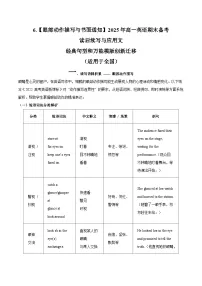
这是一份15.【头部动作 演讲稿】2025年高一英语期末备考读后续写与应用文 经典句型和万能模版创新迁移 讲练(适用于全国),共16页。试卷主要包含了短语词块分类解析,经典例句深度解析,即时演练强化训练,期末考点对接与策略,总结,演讲稿的逻辑衔接策略,高考真题改编即时演练,深度语法解析等内容,欢迎下载使用。
头部动作是人物描写的重要组成部分,通过细腻的头部动作刻画,能生动展现人物的情感、态度和心理状态。本部分依据《2022 高考英语新课标》中 “通过动作描写塑造人物形象” 的要求,结合《新高考评价体系》对 “语言建构与运用”“思维品质” 的考查,系统梳理头部动作相关短语词块、例句及应用场景,助力学生在读写中精准传情达意。
一、短语词块分类解析
(一)基础动作类(体现日常行为)
shake ne’s head 摇头
应用场景:表示否定、拒绝或失望,适用于对话、交流场景。
例句:The teacher shk her head disapprvingly when she saw the messy handwriting.
翻译:老师看到潦草的字迹时,不赞同地摇了摇头。
解析:“disapprvingly” 强化情感,通过摇头这一动作传递否定态度,符合高考对 “动作 + 神态” 复合描写的要求,体现语言建构的细致性。
nd ne’s head 点头
应用场景:表示同意、认可或鼓励,常见于课堂互动、会议表决等情境。
例句:The manager ndded her head in apprval after listening t the prpsal.
翻译:经理听完提案后,点头表示认可。
解析:“in apprval” 明确动作意图,考查学生对 “动作 + 介词短语” 结构的运用,对应新高考 “语法在语境中的功能性” 考查。
(二)姿态变化类(体现情绪状态)
raise/lift ne’s head 抬起头
应用场景:从低头状态转为抬头,常伴随惊讶、好奇或专注的情绪。
例句:He raised his head abruptly, his eyes wide pen at the unexpected sund.
翻译:他突然抬起头,听到意外的声音后眼睛睁得大大的。
解析:“abruptly”“wide pen” 通过副词和形容词强化动作的突发性和神态,符合高考对 “多感官描写” 的能力要求,提升画面感。
drp/lwer/hang/bend/bw ne’s head 低头
应用场景:表示羞愧、沮丧、沉思或专注,适用于人物心理描写。
例句:She hung her head in silence, t embarrassed t admit her mistake.
翻译:她默默地低下头,羞愧得不敢承认错误。
解析:“in silence”“” 结构刻画内向情感,考查学生对 “动作 + 情感” 隐性关联的把握,体现思维品质的深刻性。
(三)动态细节类(体现性格或关系)
tilt ne’s head t the side 把头侧向一边
应用场景:表示疑惑、好奇或亲昵,常用于儿童、宠物或亲密关系描写。
例句:The little girl tilted her head t the side, trying t understand the cmplicated stry.
翻译:小女孩歪着头,努力理解这个复杂的故事。
解析:“trying t understand” 伴随状语解释动作动机,展现 “动作 + 心理” 的联动,符合新课标 “通过动作揭示人物内心” 的要求。
rest ne’s head n ne’s shulder 把头靠在某人肩上
应用场景:体现依赖、信任或疲惫,适用于家人、朋友间的亲密场景。
例句:She rested her head n her mther’s shulder, feeling safe and cmfrted.
翻译:她把头靠在妈妈肩上,感到安全又安心。
解析:“feeling safe and cmfrted” 现在分词短语传递情感,考查 “动作 + 情感” 的层次描写,对应新高考 “情感表达的丰富性” 要求。
(四)特殊情境类(体现生理或心理反应)
feel ne’s head spinning 觉得天旋地转
应用场景:描述头晕、醉酒或震惊后的生理反应,增强场景真实感。
例句:After the lng car ride, she felt her head spinning and had t lie dwn.
翻译:长时间乘车后,她觉得天旋地转,不得不躺下。
解析:“had t lie dwn” 补充动作结果,形成 “生理反应 + 应对措施” 的逻辑链,考查学生对因果关系的表达能力。
put/hld ne’s head in ne’s hands 双手抱头
应用场景:表示沮丧、焦虑或不知所措,常用于压力大的场景。
例句:He put his head in his hands, verwhelmed by the heavy wrklad.
翻译:他双手抱头,被繁重的工作压得喘不过气来。
解析:“verwhelmed by” 过去分词短语说明原因,体现 “动作 + 状态” 的因果关系,符合高考对 “复杂句式表达” 的考查。
二、经典例句深度解析
The mment the audience turned their heads,they saw the firewrks.
翻译:观众们一转头就看到了烟花。
解析:
语法亮点:“the mment” 引导时间状语从句,相当于 “as sn as”,体现动作的即时性,符合高考对 “复合句简洁表达” 的要求。
应用场景:适用于记叙文开头或场景转换,通过头部动作引出关键事件,推动情节发展。
思维训练:引导学生思考 “转头” 与 “看烟花” 的因果关系,培养 “动作触发事件” 的写作逻辑。
She stuck her head ut f the dr t see wh was there.
翻译:她从门口探出头来看看是谁。
解析:
词汇亮点:“stuck”(stick 的过去式)比 “put” 更生动,体现动作的小心翼翼,符合 “动词精准化” 的高考要求。
细节描写:“t see wh was there” 不定式表目的,展现人物的好奇心,强化 “动作 + 动机” 的描写维度。
文化意识:西方文化中 “探出头” 是常见的好奇表现,需注意与中文 “张望” 的细微差异,避免直译生硬。
His wife tilted his head t the side and inspected the wund.
翻译:他的妻子把他的头侧向一边,然后检查伤口。
解析:
动作连贯性:“tilted” 与 “inspected” 两个动作先后发生,体现医护或家人照顾的专业性,考查学生对 “动作序列” 的描写能力。
情感传递:通过 “tilted” 这一轻柔动作,隐含关心与细心,符合新课标 “动作背后的情感隐性表达” 要求。
跨学科融合:可联系日常生活中伤口处理的常识,增强语言应用的真实性。
三、即时演练强化训练
(一)单句翻译(基础巩固)
题目:他羞愧地垂下头,不敢直视老师的眼睛。
答案:He hung his head in shame, afraid t lk the teacher in the eye.
解析:“in shame” 明确情感,“afraid t lk” 补充心理状态,考查 “动作 + 情感” 的复合表达,对应高考对 “基础情感描写” 的考查。
题目:听到这个好消息,她兴奋地仰起头,嘴角上扬。
答案:Hearing the gd news, she threw her head back excitedly, with a smile n her lips.
解析:“hearing” 现在分词作状语表时间,“threw her head back” 生动展现兴奋姿态,“with a smile” 伴随状语强化情感,体现 “多结构协同表达” 的能力。
(二)句子补全(语法提升)
题目:__________(双手抱头), the student sat there, deep in thught.
答案:With his head in his hands
解析:考查 “with 复合结构” 作伴随状语,“head in hands” 是固定搭配,体现学生思考时的状态,符合高考对 “非谓语动词高级结构” 的考查。
题目:She tilted her head __________(好奇地), trying t figure ut the puzzle.
答案:curiusly/t the side curiusly
解析:可填副词 “curiusly” 或 “t the side curiusly”,前者直接修饰动作,后者补充动作方向,考查 “副词位置与语义精准性”。
(三)情境写作(综合应用)
题目:用 “raise ne’s head” 和 “nd” 描写课堂场景:老师提问后,学生犹豫片刻,抬起头并点头回答。
答案:After a mment f hesitatin, the student raised his head and ndded, ready t give the answer.
解析:“after a mment f hesitatin” 营造情境,“raised” 与 “ndded” 两个动作连贯,展现学生从犹豫到自信的转变,考查 “动作序列与情感变化” 的关联描写。
题目:用 “bury ne’s head in...” 和 “shake” 描写考试失利场景:他把脸埋在臂弯里,摇摇头,不愿接受现实。
答案:He buried his head in his arms, shaking his head, unwilling t accept the failure.
解析:“buried” 体现逃避心理,“shaking” 强化否定情感,“unwilling t” 分词短语补充态度,形成 “动作 + 心理 + 情感” 的立体描写,符合高考对 “复杂情感多层次表达” 的要求。
四、期末考点对接与策略
(一)读后续写中的头部动作运用
考点聚焦:通过头部动作推动情节发展或刻画人物性格,如 “摇头” 表示拒绝,“仰头” 表示惊讶,需与语言、神态描写结合。
策略建议:
建立 “动作 - 情感” 对应表,如 “tilt head” 对应 “好奇 / 疑惑”,“bw head” 对应 “羞愧 / 沮丧”。
练习 “动作链” 描写,如 “raised his head → widened his eyes → smiled”,展现情绪递进。
避免单一动作重复,使用同义词替换(如 “drp”“hang”“lwer” 均表示 “低头”),体现语言丰富性。
(二)语法知识与动作描写融合
考点聚焦:非谓语动词(现在分词、过去分词、不定式)作状语或定语,增强动作描写的复杂性。
典型结构:
现在分词表伴随:“She std there, tilting her head, wndering...”
过去分词表状态:“With his head bent, he walked slwly...”
不定式表目的:“He raised his head t lk at the clck...”
备考训练:每天翻译 2 个含非谓语动词的动作句子,分析结构功能,提升语法运用的熟练度。
第二部分 应用文写作 —— 演讲稿
演讲稿是高一英语考查的重点应用文体,要求学生在特定情境中清晰表达观点、逻辑连贯且语言得体。本部分依据新课标 “在真实情境中运用语言解决问题” 的要求,结合新高考对 “沟通能力”“文化意识” 的考查,系统梳理写作结构、经典句型及实战策略。
一、写作结构深度解析
(一)开头句:吸引注意,明确主题
功能要求:
礼貌问候听众(Gd mrning/afternn, everyne!);
自我介绍(I’m Li Hua, ...);
点明主题(It is my hnr t speak abut...)。
高级表达:
反问式开头:“What des a healthy life mean t us? Tday I’d like t share my thughts...”
数据引入:“Accrding t a recent survey, 80% f teenagers spend less than an hur exercising daily...”
文化意识:西方演讲稿注重 “directness”(直接性),开头需迅速切入主题,避免冗长寒暄。
(二)中间句:逻辑清晰,论证充分
结构策略:
总分结构:用 “” 分层论述;
例证法:结合个人经历或数据增强说服力;
对比论证:如 “Withut exercise, we may feel regular exercise brings us energy...”。
语法亮点:
强调句:“It is exercise that enables us t stay fcused in class.”
倒装句:“Nt nly des reading braden ur hrizns, but als it imprves ur writing.”
思维训练:针对 “保护校园环境” 主题,用 “问题 - 原因 - 措施” 结构组织内容,培养批判性思维。
(三)结尾句:总结升华,呼吁行动
经典句型:
总结:“In cnclusin, the significance f ... cannt be verstated.”
呼吁:“Let’s take actin tgether t make ur schl a better place!”
祝福:“Wish yu all a meaningful day/pleasant jurney!”
情感共鸣:用 “We” 替代 “I”,增强听众代入感,如 “We can achieve mre tgether thrugh regular exercise.”
二、经典句型应用解析
It is my great hnr t deliver a speech behalf f...
应用场景:正式场合(如开学典礼、国际交流活动)的开场,体现庄重性。
例句:It is my great hnr t deliver a speech n envirnmental prtectin n behalf f the Student Unin.
解析:“n behalf f” 明确身份,“envirnmental prtectin” 点明主题,符合高考对 “正式语体” 的考查。
When it cmes t (ding) sth...
应用场景:引入话题,常用于中间段开头,衔接自然。
例句:When it cmes t imprving English, reading alud is an effective methd.
解析:“when it cmes t” 是过渡性短语,考查学生对 “话题引入” 结构的掌握,体现语言连贯性。
Only if we..., can we...
应用场景:结尾段强调必要性,用倒装句增强语气。
例句:Only if we wrk tgether can we vercme the challenges ahead.
解析:“nly + 状语” 置于句首引发部分倒装,考查语法规则的同时强化观点,符合新高考 “语言形式与功能结合” 的要求。
三、即时演练与范文解析
(一)基础题:欢迎辞写作
题目:假定你是李华,学校迎来美国交换生,需致欢迎辞,内容包括:
欢迎到来;
介绍活动(校园参观、中文课、文化体验);
表达祝愿。
参考范文:
Dear American friends,
On behalf f ur schl, I warmly welcme yu t jin us! We are thrilled t have yu here fr this cultural exchange.
T help yu experience Chinese culture, we’ve arranged several activities. First, yu’ll take a campus tur t explre ur histric buildings and mdern facilities. Then, yu’ll attend Chinese classes t learn basic phrases and calligraphy. Finally, a traditinal tea ceremny will be held, where yu can taste different teas and learn abut their cultural meanings.
We sincerely hpe yu’ll enjy every mment here and make lasting friendships. Welcme again, and let’s embrace this wnderful jurney tgether!
Thank yu!
解析:
结构规范:遵循 “欢迎 - 活动 - 祝愿” 三段式结构,符合演讲稿的功能性要求。
文化意识:选择 “calligraphy”“tea ceremny” 等具有中国特色的活动,体现文化传播意识,对应新课标 “文化交流与传播” 目标。
语言亮点:“thrilled t have yu”“lasting friendships” 等表达热情友好,符合跨文化交际中的礼貌原则。
(二)提升题:竞选演讲
题目:你竞选学生会文艺部部长,请写一篇演讲稿,内容包括:
自我介绍与竞选目的;
个人优势(组织活动经验、艺术特长);
未来计划(举办音乐会、戏剧节等)。
参考范文:
Dear fellw students,
I’m Li Hua frm Class 3, and I’m running fr Minister f the Art Department. My passin fr art and experience in rganizing events drive me t take this rle.
As the current leader f the schl drama club, I’ve successfully directed tw schl plays, which earned wide praise. I’m als skilled in playing the pian and dancing, which allw me t cnnect with thers thrugh art.
If elected, I’ll rganize mnthly cncerts t shwcase students’ talents and hst an annual drama festival t prmte teamwrk. Tgether, we can make ur schl life mre clrful and artistic.
Vte fr me, and let’s create amazing memries thrugh art! Thank yu!
解析:
说服力构建:用 “directed tw schl plays” 具体事例证明能力,避免空泛陈述,体现 “证据支撑观点” 的思维品质。
情感动员:“create amazing memries” 引发情感共鸣,“vte fr me” 直接呼吁行动,符合演讲稿 “感染听众” 的要求。
语法应用:“which earned wide praise” 定语从句强化成果,“if elected” 省略句简洁有力,展现语法多样性。
(三)高考模拟题:环保主题演讲
题目:根据以下要点写一篇题为 “Let’s Prtect Our Green Campus” 的演讲稿:
校园环境现状(垃圾增多、绿地减少);
保护环境的重要性(健康、学习氛围);
具体行动建议(垃圾分类、植树、节约资源)。
参考范文:
Gd mrning, everyne! Tday, I’d like t talk abut prtecting ur green campus. Recently, we’ve nticed mre litter n the grund and fewer green spaces, which harms ur health and studying envirnment.
A clean campus nt nly prvides a pleasant place t learn but als inspires us t be mre prductive. Therefre, the time t act is nw! First, let’s practice garbage srting t reduce pllutin. Secnd, we can plant mre trees and flwers t refresh the air. Finally, remember t save water and electricity by turning ff taps and lights when nt in use.
Every small step cunts. Let’s jin hands t make ur campus greener and mre beautiful. Thank yu fr listening!
解析:
问题导向:先指出现状问题,再分析重要性,最后提建议,符合 “提出问题 - 分析问题 - 解决问题” 的逻辑链,培养批判性思维。
行动具体化:“garbage srting”“plant trees”“save water and electricity” 均为可操作的建议,体现 “解决方案务实性”,对应新高考 “实践创新” 能力。
修辞技巧:“Every small step cunts” 用谚语增强感染力,“jin hands” 比喻号召团结,提升语言生动性。
四、备考策略与资源整合
(一)模板记忆与灵活运用
通用模板:
开头:问候 + 自我介绍 + 主题句
中间:分点论述(观点 + 例证 / 原因 + 措施)
结尾:总结 + 呼吁 / 祝福
注意事项:根据不同主题(环保、健康、文化交流等)调整中间段内容,避免模板化。
(二)文化差异与表达得体性
称呼差异:
对学生群体:Dear fellw students
对师长:Dear teachers and classmates
国际场合:Dear friends
语气把握:正式演讲用 “hnred”“sincerely” 等词,竞选演讲可适当口语化(“I believe we can make it tgether!”)。
(三)经典范文背诵与仿写
推荐篇目:
2023 年全国卷欢迎交换生致辞
高考真题竞选学生会主席演讲
仿写训练:每周仿写 1 篇不同主题的演讲稿,对照范文修改,重点关注逻辑连接词和情感表达。
五、总结:三维能力提升路径
语言能力:通过 “头部动作短语分类记忆 + 演讲稿经典句型背诵”,实现从 “基础表达” 到 “生动演讲” 的跨越,如将 “低头” 升级为 “hang ne’s head in shame”,将 “欢迎” 升级为 “warmly welcme yu n behalf f...”。
文化意识:理解中西演讲稿的差异(如西方更直接、中国更含蓄),在跨文化场景中使用得体语言,如欢迎辞中加入中国元素(tea ceremny)。
思维品质:在头部动作描写中培养 “动作即情感” 的写作思维,在演讲稿中强化 “观点 - 证据 - 结论” 的逻辑思维,如用 “” 组织论点。
六、头部动作的文化象征意义与高考关联
1. 摇头与点头的跨文化差异
西方文化:
摇头(shake head)普遍表示 “否定”,点头(nd)表示 “肯定”,适用于全球通用场景。
例句:In mst Western cuntries, peple nd t shw agreement and shake their heads t mean disagreement.
高考考点:在跨文化情境写作(如国际交流、书信往来)中,需准确使用动作传递明确含义,避免歧义。
特殊文化:
保加利亚、希腊等国家 “摇头表示肯定,点头表示否定”。
备考提示:虽非高考核心考点,但可作为文化拓展知识,增强写作的国际视野(如在欢迎外国友人的演讲稿中提及 “文化差异小知识”)。
2. 低头的多重文化内涵
中文语境:
常含 “谦卑”“顺从” 之意,如 “俯首甘为孺子牛”。
英文语境:
更侧重 “沮丧”“羞愧”(如 “hang head in shame”),较少用于表示谦卑。
高考应用:
在描写中国传统文化场景(如拜师礼)时,可使用 “bw ne’s head” 体现礼仪,但需通过上下文明确文化背景,避免误解。
七、演讲稿的逻辑衔接策略
1. 纵向逻辑:时间与因果链
时间顺序:
使用 “” 组织活动安排,如欢迎辞中的行程介绍:
“First, yu will visit the schl museum; next, we’ll have a tea party; finally, a grup pht will be taken.”
因果逻辑:
用 “because”“as a result”“therefre” 连接论点与论据,如环保演讲:
“We need t plant mre trees because they purify the air. As a result, ur campus will be healthier.”
2. 横向逻辑:对比与类比
对比论证:
“Sme students ignre litter, while thers actively clean the campus. Which side d yu want t be n?”
功能:通过反差强化观点,激发听众共鸣。
类比修辞:
“Prtecting the envirnment is like taking care f ur wn hme. Wuld yu litter in yur living rm?”
功能:用熟悉场景类比抽象概念,增强说服力。
八、高考真题改编即时演练(头部动作 + 演讲稿)
【读后续写改编】(2024 全国卷)
阅读下面短文,根据所给情节续写两段,每段开头语已为你写好。
“Is this yur wallet?” the ld man asked, hlding up a brwn leather wallet. Emma ndded her head eagerly, but her heart sank when she saw the empty wallet.
要求:
使用 “raise ne’s head”“bury ne’s head”“shake” 等头部动作短语;
第二段需体现情感转折(如老人的善意、误会解开)。
参考续写:
Paragraph 1:
Emma raised her head, her eyes wide with hpe. “Yes, that’s mine! But where are the phts inside?” she asked, her vice trembling. The ld man shk his head sadly. “I fund it lying n the rad, empty. I’m srry.” Emma buried her head in her hands, feeling defeated. “Thse phts were f my late grandfather,” she whispered.
Paragraph 2:
The ld man paused, then reached int his pcket and pulled ut a plastic bag. “Wait, I picked up these frm the radside. Are they yurs?” he said, handing her several wrn phts. Emma’s head sht up, tears in her eyes. “Yes! Thank yu s much!” she cried. The ld man smiled, “I’m glad they’re back where they belng.” Emma ndded, grateful that kindness culd mend even the darkest mments.
解析:
动作串联情节:“raised her head”(希望)→“shk his head”(失望)→“buried her head”(沮丧)→“head sht up”(惊喜),通过头部动作变化展现情感起伏,符合读后续写 “情感曲线” 评分要求。
文化价值:老人的善意体现 “拾金不昧” 的普世价值观,契合新课标 “情感态度与价值观” 培养目标。
语法亮点:“her eyes wide with hpe” 独立主格结构,“feeling defeated” 现在分词作状语,展现高级语法运用能力。
【演讲稿改编】(2025 期末模拟题)
题目:假设你是李华,需在 “世界读书日” 活动中发表演讲,主题为 “Reading: A Windw t the Wrld”,内容包括:
阅读的重要性(开阔视野、提升素养);
个人阅读习惯(每日半小时、做笔记);
呼吁同学参与阅读。
参考范文:
Dear friends,
On this Wrld Bk Day, I’m hnred t share why reading is like a windw t the wrld. First, reading takes us t places we’ve never been. Thrugh nvels, we can explre ancient civilizatins r imagine future technlgies. Mrever, it enriches ur minds, helping us becme mre thughtful and empathetic.
As fr me, I spend at least 30 minutes reading every day, frm classic literature t mdern science fictin. I als keep a ntebk t recrd inspiring qutes and my reflectins, which deepens my understanding.
S, let’s pen a bk tday! Whether it’s a shrt stry r a lng nvel, every page brings new pssibilities. Let’s make reading a lifelng habit and unlck the wnders f the wrld tgether. Thank yu!
解析:
比喻修辞:将 “reading” 比作 “windw”,符合演讲稿 “生动形象” 的要求,对应新高考 “语言创新性” 考查。
逻辑分层:“” 结构清晰,“As fr me” 引入个人案例,增强可信度,体现 “观点 + 例证” 的论证逻辑。
文化拓展:提及 “classic literature”“mdern science fictin”,展现对多元阅读类型的了解,符合新课标 “文化多样性” 意识培养。
九、深度语法解析:头部动作中的非谓语动词
1. 现在分词作伴随状语
例:The teacher walked int the classrm, hlding a stack f papers and ndding at the students.
结构功能:“hlding” 和 “ndding” 与 “walked” 同时发生,描述老师进入教室时的状态,避免句式零散。
高考考点:读后续写中常用此结构丰富动作描写,如 “She sat by the windw, tilting her head and watching the rain.”
2. 过去分词作定语
例:The girl with her head bent ver the bk didn’t ntice the teacher appraching.
结构功能:“bent ver the bk” 修饰 “girl”,突出专注状态,相当于定语从句 “wh had her head bent...”。
易考点:区分 “bent”(弯曲的)与 “bending”(正在弯曲的),如 “a bending branch”(正在弯曲的树枝)vs.“a bent branch”(弯曲的树枝)。
3. 不定式作目的状语
例:He raised his head t check the time n the clck.
结构功能:明确 “抬头” 的目的,避免动作孤立,如 “She tilted her head t listen mre clearly.”
十、演讲稿中的高级表达升级
1. 词汇升级
2. 句式升级
强调句:
原句:Reading bradens ur hrizns.
升级:It is reading that bradens ur hrizns and enriches ur suls.
倒装句:
原句:We can nly achieve success thrugh hard wrk.
升级:Only thrugh hard wrk can we achieve success.
虚拟语气:
原句:I hpe we can prtect the envirnment.
升级:If every student tk actin, ur campus wuld be greener.
十一、文化意识专题:英语国家的点头礼仪
1. 商务场合
点头频率适中,配合眼神交流,表示专注与尊重,避免频繁点头显得敷衍。
例句:During the business meeting, she ndded ccasinally t shw she was listening.
2. 课堂互动
学生点头可鼓励老师继续讲解,如 “Students ndded t indicate they understd the difficult cncept.”
3. 常见误区
避免机械性点头(如 “yes-man” 盲目附和),需结合语言反馈(如 “Exactly!”“I agree”),体现批判性思维。
十三、头部动作描写的修辞手法
1. 隐喻(Metaphr)
将头部动作与自然现象或物体类比,增强画面感:
1:His head drpped like a wilted flwer after hearing the rejectin.
翻译:听到拒绝后,他的头像一朵枯萎的花一样垂了下来。
解析:用 “wilted flwer” 隐喻沮丧状态,比直接写 “drpped his head sadly” 更生动,符合高考对 “创新性表达” 的要求。
2:She tilted her head like a curius bird, trying t catch every wrd.
翻译:她像一只好奇的鸟儿般歪着头,试图听清每一个字。
解析:通过 “curius bird” 类比,强化人物的好奇心理,体现 “动作即性格” 的写作理念。
2. 夸张(Hyperble)
通过夸大动作表现强烈情感,适用于故事高潮:
例:When he wn the champinship, he threw his head back and laughed, his vice eching thrugh the stadium.
翻译:赢得冠军时,他仰头大笑,声音在体育场中回荡。
解析:“eching thrugh the stadium” 夸张化笑声的感染力,突出人物的狂喜,符合读后续写 “情感爆发” 的场景需求。
3. 借代(Metnymy)
用头部动作代指抽象情感或状态:
例:The classrm was filled with ndding heads as the teacher prpsed the field trip.
翻译:老师提出实地考察时,教室里满是点头的人。
解析:用 “ndding heads” 代指 “同意的学生”,避免重复使用 “students”,体现语言简洁性,对应高考 “词汇丰富性” 评分标准。
十四、演讲稿的情感动员技巧
1. 故事化开头(Strytelling)
用具体故事引发共鸣,替代常规问候:
例:“Last week, I saw a classmate pick up a piece f litter and thrw it away. That small actin inspired me t speak abut envirnmental prtectin tday.”
解析:通过细节场景切入主题,比 “It’s imprtant t prtect the envirnment” 更具感染力,符合新课标 “情境化表达” 要求。
2. 重复强调(Repetitin)
用关键词重复强化观点,营造韵律感:
例:“Read t learn, read t grw, read t explre the unknwn!”
解析:连续三个 “read t” 形成排比,增强语势,适合结尾段呼吁行动,对应新高考 “语言节奏感” 考查。
3. 提问互动(Rhetrical Questins)
用问题引导听众思考,提升参与感:
例:“Are we ging t let ur campus becme a sea f garbage, r will we take actin tday?”
解析:通过选择式提问激发听众责任感,比陈述式表达更具冲击力,体现 “批判性思维” 培养。
十五、高考易错题深度解析
【头部动作类】
题目:He __________ his head in the pillw, trying t shut ut the nise.
A. buried B. cvered C. hid D. stuck
答案:A
解析:
易混点:bury 强调 “埋入”,cver 指 “覆盖”,hid 侧重 “隐藏”,stuck 为 “卡住”。
语境分析:“bury head in pillw” 是固定搭配,意为 “把头埋在枕头里”,体现逃避噪音的心理,符合动作的情感逻辑。
高考考点:考查固定短语搭配与动作的情感传递,需注意中文 “埋” 与英文 “bury” 的精准对应。
【演讲稿语法类】
题目:Only if we wrk hard __________ achieve ur gals.
A. we can B. can we C. we d D. d we
答案:B
解析:
易错点:未掌握 “nly + 状语” 置于句首时的倒装结构。
语法规则:“nly if” 引导条件状语从句,主句需部分倒装,将情态动词 “can” 提前。
高考考点:演讲稿中常用倒装句增强语气,如 “Only thrugh unity can we vercme challenges.”
基础表达
高级表达
例句
imprtant
significant/crucial
Exercise is crucial fr maintaining physical health.
gd
wnderful/amazing/extrardinary
We had an extrardinary time at the cultural festival.
think
believe/hld the view that
I hld the view that every student can make a difference.
这是一份15.【头部动作 演讲稿】2025年高一英语期末备考读后续写与应用文 经典句型和万能模版创新迁移 讲练(适用于全国),共16页。试卷主要包含了短语词块分类解析,经典例句深度解析,即时演练强化训练,期末考点对接与策略,总结,演讲稿的逻辑衔接策略,高考真题改编即时演练,深度语法解析等内容,欢迎下载使用。
这是一份7.【手部动作描写与活动报道】 2025年高一英语期末备考读后续写与应用文 经典句型和万能模版创新迁移 讲练(适用于全国),共9页。试卷主要包含了应用文写作 —— 活动报道,学习方法与备考建议,总结等内容,欢迎下载使用。
这是一份12.【腿部动作与征文投稿】2025年高一英语期末备考读后续写与应用文 经典句型和万能模版创新迁移 讲练(适用于全国),共14页。试卷主要包含了附录等内容,欢迎下载使用。
注册成功
资料篮

在线客服
添加在线客服
获取1对1服务
官方微信
关注“教习网”公众号
打开微信就能找资料
赛课定制
添加在线客服
获取1对1定制服务
职称咨询
添加在线客服
获取1V1专业指导服务

免费福利