

还剩6页未读,
继续阅读
所属成套资源:新高考数学二轮复习 专题突破 (含解析)
成套系列资料,整套一键下载
新高考数学二轮复习 专题突破 专题1 第6讲 母题突破2 恒成立问题与有解问题(含解析)
展开
这是一份新高考数学二轮复习 专题突破 专题1 第6讲 母题突破2 恒成立问题与有解问题(含解析),共9页。
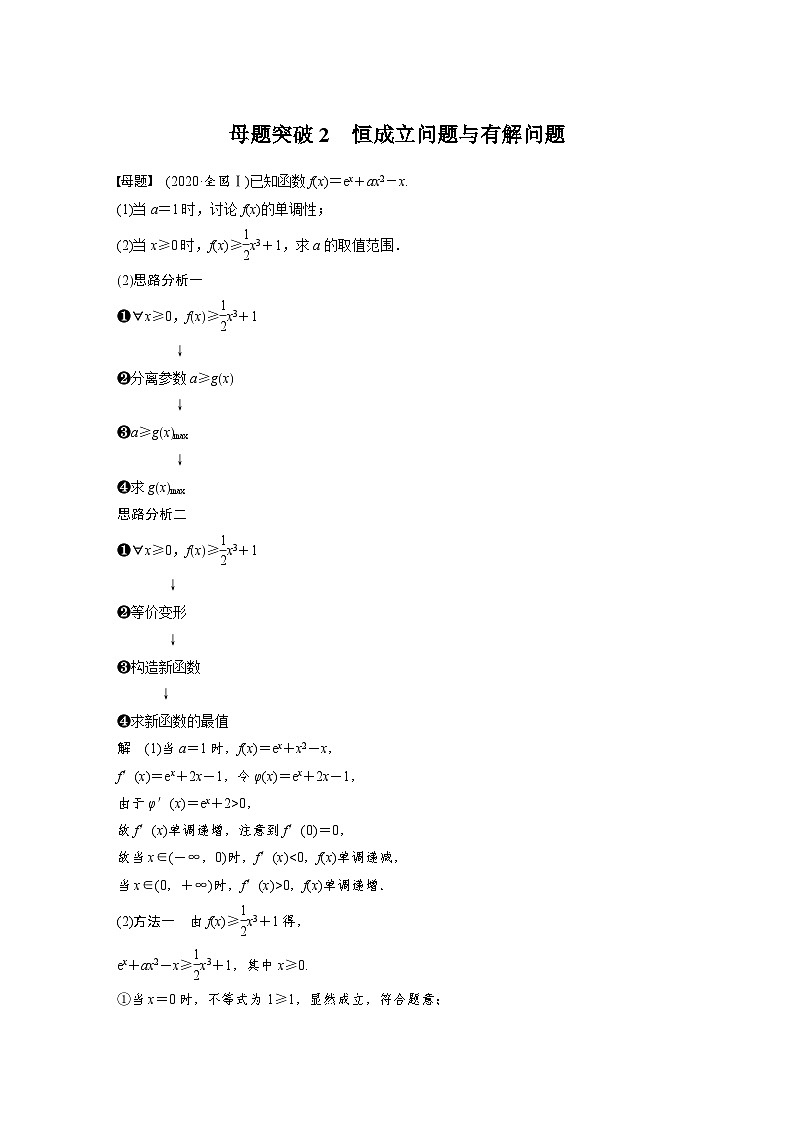
(1)当a=1时,讨论f(x)的单调性;
(2)当x≥0时,f(x)≥eq \f(1,2)x3+1,求a的取值范围.
2思路分析一
❶∀x≥0,fx≥eq \f(1,2)x3+1
↓
❷分离参数a≥gx
↓
❸a≥gxmax
↓
❹求gxmax
思路分析二
❶∀x≥0,fx≥eq \f(1,2)x3+1
↓
❷等价变形
↓
❸构造新函数
↓
❹求新函数的最值
解 (1)当a=1时,f(x)=ex+x2-x,
f′(x)=ex+2x-1,令φ(x)=ex+2x-1,
由于φ′(x)=ex+2>0,
故f′(x)单调递增,注意到f′(0)=0,
故当x∈(-∞,0)时,f′(x)<0,f(x)单调递减,
当x∈(0,+∞)时,f′(x)>0,f(x)单调递增.
(2)方法一 由f(x)≥eq \f(1,2)x3+1得,
ex+ax2-x≥eq \f(1,2)x3+1,其中x≥0.
①当x=0时,不等式为1≥1,显然成立,符合题意;
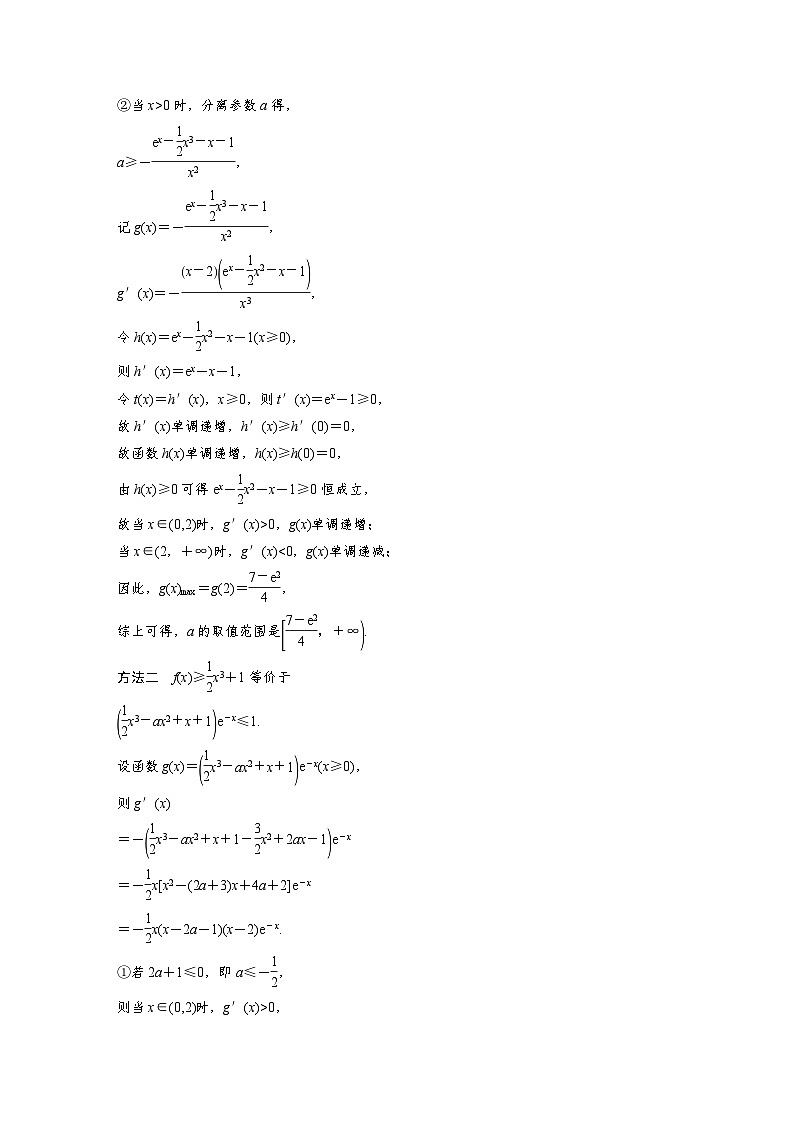
②当x>0时,分离参数a得,
a≥-eq \f(ex-\f(1,2)x3-x-1,x2),
记g(x)=-eq \f(ex-\f(1,2)x3-x-1,x2),
g′(x)=-eq \f(x-2\b\lc\(\rc\)(\a\vs4\al\c1(ex-\f(1,2)x2-x-1)),x3),
令h(x)=ex-eq \f(1,2)x2-x-1(x≥0),
则h′(x)=ex-x-1,
令t(x)=h′(x),x≥0,则t′(x)=ex-1≥0,
故h′(x)单调递增,h′(x)≥h′(0)=0,
故函数h(x)单调递增,h(x)≥h(0)=0,
由h(x)≥0可得ex-eq \f(1,2)x2-x-1≥0恒成立,
故当x∈(0,2)时,g′(x)>0,g(x)单调递增;
当x∈(2,+∞)时,g′(x)<0,g(x)单调递减;
因此,g(x)max=g(2)=eq \f(7-e2,4),
综上可得,a的取值范围是eq \b\lc\[\rc\)(\a\vs4\al\c1(\f(7-e2,4),+∞)).
方法二 f(x)≥eq \f(1,2)x3+1等价于
eq \b\lc\(\rc\)(\a\vs4\al\c1(\f(1,2)x3-ax2+x+1))e-x≤1.
设函数g(x)=eq \b\lc\(\rc\)(\a\vs4\al\c1(\f(1,2)x3-ax2+x+1))e-x(x≥0),
则g′(x)
=-eq \b\lc\(\rc\)(\a\vs4\al\c1(\f(1,2)x3-ax2+x+1-\f(3,2)x2+2ax-1))e-x
=-eq \f(1,2)x[x2-(2a+3)x+4a+2]e-x
=-eq \f(1,2)x(x-2a-1)(x-2)e-x.
①若2a+1≤0,即a≤-eq \f(1,2),
则当x∈(0,2)时,g′(x)>0,
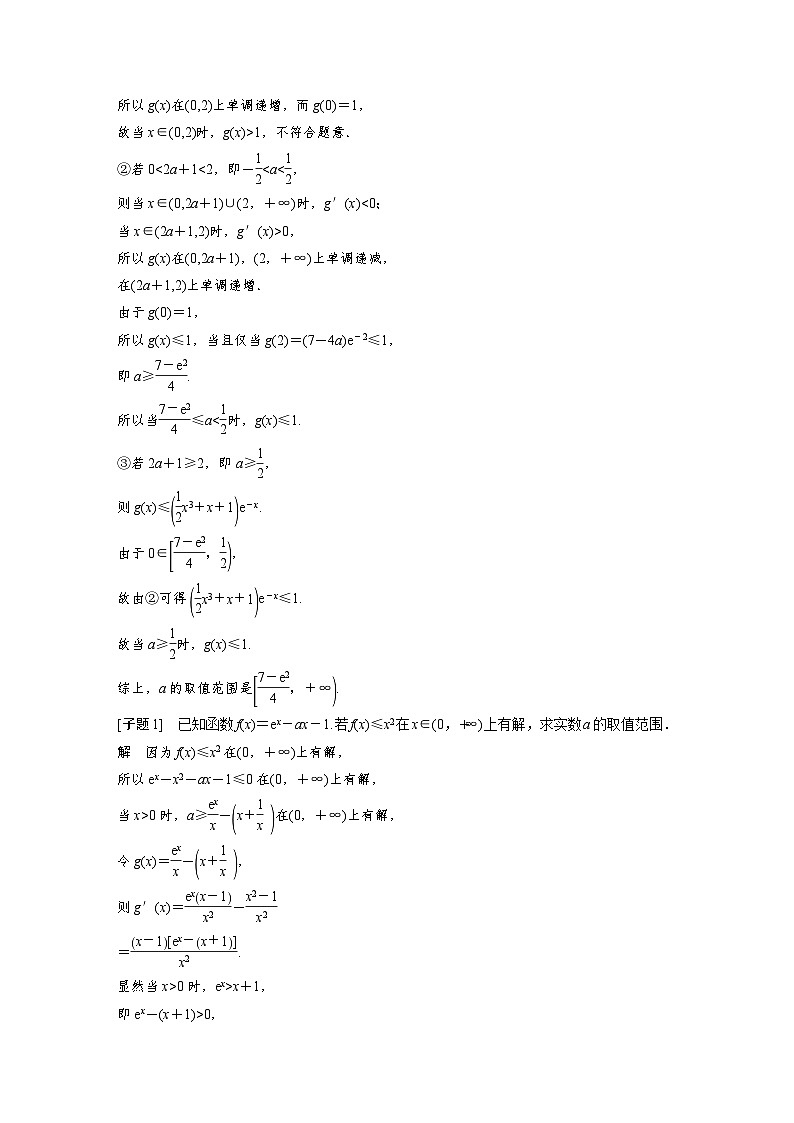
所以g(x)在(0,2)上单调递增,而g(0)=1,
故当x∈(0,2)时,g(x)>1,不符合题意.
②若0<2a+1<2,即-eq \f(1,2)则当x∈(0,2a+1)∪(2,+∞)时,g′(x)<0;
当x∈(2a+1,2)时,g′(x)>0,
所以g(x)在(0,2a+1),(2,+∞)上单调递减,
在(2a+1,2)上单调递增.
由于g(0)=1,
所以g(x)≤1,当且仅当g(2)=(7-4a)e-2≤1,
即a≥eq \f(7-e2,4).
所以当eq \f(7-e2,4)≤a③若2a+1≥2,即a≥eq \f(1,2),
则g(x)≤eq \b\lc\(\rc\)(\a\vs4\al\c1(\f(1,2)x3+x+1))e-x.
由于0∈eq \b\lc\[\rc\)(\a\vs4\al\c1(\f(7-e2,4),\f(1,2))),
故由②可得eq \b\lc\(\rc\)(\a\vs4\al\c1(\f(1,2)x3+x+1))e-x≤1.
故当a≥eq \f(1,2)时,g(x)≤1.
综上,a的取值范围是eq \b\lc\[\rc\)(\a\vs4\al\c1(\f(7-e2,4),+∞)).
[子题1] 已知函数f(x)=ex-ax-1.若f(x)≤x2在x∈(0,+∞)上有解,求实数a的取值范围.
解 因为f(x)≤x2在(0,+∞)上有解,
所以ex-x2-ax-1≤0在(0,+∞)上有解,
当x>0时,a≥eq \f(ex,x)-eq \b\lc\(\rc\)(\a\vs4\al\c1(x+\f(1,x)))在(0,+∞)上有解,
令g(x)=eq \f(ex,x)-eq \b\lc\(\rc\)(\a\vs4\al\c1(x+\f(1,x))),
则g′(x)=eq \f(exx-1,x2)-eq \f(x2-1,x2)
=eq \f(x-1[ex-x+1],x2).
显然当x>0时,ex>x+1,
即ex-(x+1)>0,
当0当x>1时,g′(x)>0,
所以g(x)在(0,1)上单调递减,在(1,+∞)上单调递增,
所以当x=1时,g(x)min=e-2,
所以a≥e-2,
综上可知,实数a的取值范围是[e-2,+∞).
[子题2] (2022·山东百事联盟联考)已知函数f(x)=aeax+a(a>0),g(x)=2eq \b\lc\(\rc\)(\a\vs4\al\c1(x+\f(1,x)))ln x.若对∀x>0,f(x)≥g(x)恒成立,求实数a的取值范围.
解 由f(x)≥g(x)得a(eax+1)≥2eq \b\lc\(\rc\)(\a\vs4\al\c1(x+\f(1,x)))ln x,即ax(eax+1)≥(x2+1)ln x2,
即(eax+1)ln eax≥(x2+1)ln x2,
设h(x)=(x+1)ln x,则h(eax)=(eax+1)ln eax,
h(x2)=(x2+1)ln x2,
由h′(x)=ln x+eq \f(1,x)+1,设m(x)=ln x+eq \f(1,x)+1,可得m′(x)=eq \f(x-1,x2),
所以当0当x>1时,m′(x)>0,m(x)单调递增,
所以m(x)min=h′(x)min=h′(1)=2>0,
所以h(x)在(0,+∞)上单调递增,所以eax≥x2对∀x>0恒成立,
即a≥eq \f(2ln x,x)对∀x>0恒成立,
设n(x)=eq \f(2ln x,x),则n′(x)=eq \f(21-ln x,x2),
当00,n(x)单调递增;
当x>e时, n′(x)<0,n(x)单调递减,
所以n(x)max=n(e)=eq \f(2,e),故a≥eq \f(2,e),
所以实数a的取值范围为eq \b\lc\[\rc\)(\a\vs4\al\c1(\f(2,e),+∞)).
规律方法 (1)由不等式恒成立求参数的取值范围问题的策略
①求最值法:将恒成立问题转化为利用导数求函数的最值问题.
②分离参数法:将参数分离出来,进而转化为a>f(x)max或a(2)不等式有解问题可类比恒成立问题进行转化,要理解清楚两类问题的差别.
1.(2022·福州模拟)已知函数f(x)=xln x.
(1)求曲线y=f(x)在点(1,f(1))处的切线方程;
(2)当x≥1,f(x)≤ax2-a,求a的取值范围.
解 (1)f′(x)=ln x+1,f′(1)=1,又f(1)=0,
故f(x)在点(1,f(1))处的切线方程为y=x-1.
(2)当x≥1时,令g(x)=xln x-a(x2-1),
得g(1)=0,g′(x)=ln x+1-2ax,
令h(x)=ln x+1-2ax,
则h′(x)=eq \f(1,x)-2a=eq \f(1-2ax,x).
①若a≤0,得h′(x)>0,则g′(x)在[1,+∞)上单调递增,
故g′(x)≥g′(1)=1-2a≥0,
所以g(x)在[1,+∞)上单调递增,
所以g(x)≥g(1)=0,
从而xln x-a(x2-1)≥0,不符合题意;
②若a>0,令h′(x)=0,得x=eq \f(1,2a).
(ⅰ)若01,
当x∈eq \b\lc\[\rc\)(\a\vs4\al\c1(1,\f(1,2a)))时,
h′(x)>0,g′(x)在eq \b\lc\[\rc\)(\a\vs4\al\c1(1,\f(1,2a)))上单调递增,
从而g′(x)>g′(1)=1-2a>0,
所以g(x)在eq \b\lc\[\rc\)(\a\vs4\al\c1(1,\f(1,2a)))上单调递增,
此时g(x)≥g(1)=0,不符合题意;
(ⅱ)若a≥eq \f(1,2),则0h′(x)≤0在[1,+∞)上恒成立,
所以g′(x)在[1,+∞)上单调递减,
g′(x)≤g′(1)=1-2a≤0,
从而g(x)在[1,+∞)上单调递减,
所以g(x)≤g(1)=0,
所以xln x-a(x2-1)≤0恒成立.
综上所述,a的取值范围是eq \b\lc\[\rc\)(\a\vs4\al\c1(\f(1,2),+∞)).
2.(2022·榆林模拟)已知函数f(x)=aex+1,g(x)=ln x.
(1)讨论函数h(x)=g(x)+eq \f(xfx-x,ex)的单调性;
(2)若xf(x)<-g(x)+1,求a的取值范围.
解 (1)因为h(x)=g(x)+eq \f(xfx-x,ex)=ln x+ax,x>0,
所以h′(x)=eq \f(1,x)+a,
若a≥0,则h′(x)>0在(0,+∞)上恒成立,
故h(x)在(0,+∞)上单调递增;
若a<0,则当x∈eq \b\lc\(\rc\)(\a\vs4\al\c1(0,-\f(1,a)))时,h′(x)>0;
当x∈eq \b\lc\(\rc\)(\a\vs4\al\c1(-\f(1,a),+∞))时,h′(x)<0.
故h(x)在eq \b\lc\(\rc\)(\a\vs4\al\c1(0,-\f(1,a)))上单调递增,在eq \b\lc\(\rc\)(\a\vs4\al\c1(-\f(1,a),+∞))上单调递减.
综上所述,当a≥0时,h(x)在(0,+∞)上单调递增;
当a<0时,h(x)在eq \b\lc\(\rc\)(\a\vs4\al\c1(0,-\f(1,a)))上单调递增,
在eq \b\lc\(\rc\)(\a\vs4\al\c1(-\f(1,a),+∞))上单调递减.
(2)由xf(x)<-g(x)+1等价于
a令t=xex(t>0),
φ(t)=eq \f(-ln t+1,t),
则φ′(t)=eq \f(ln t-2,t2),
由φ′(t)=0,可得t=e2,
当t∈(0,e2)时,φ′(t)<0,φ(t)单调递减;
当t∈(e2,+∞)时,φ′(t)>0,φ(t)单调递增.
故φ(t)min=φ(e2)=-eq \f(1,e2),
所以a的取值范围为eq \b\lc\(\rc\)(\a\vs4\al\c1(-∞,-\f(1,e2))).
专题强化练
1.(2022·河北联考)已知函数f(x)=ax2ln x与g(x)=x2-bx.
(1)若f(x)与g(x)在x=1处有相同的切线,求a,b的值.
(2)若对∀x∈[1,e],都∃b∈eq \b\lc\[\rc\](\a\vs4\al\c1(1,\f(e,2)))使f(x)≥g(x)恒成立,求a的取值范围.
解 (1)f′(x)=2axln x+ax,g′(x)=2x-b,
∵函数f(x)与g(x)在x=1处有相同的切线,
∴eq \b\lc\{\rc\ (\a\vs4\al\c1(f1=g1,,f′1=g′1,))
即eq \b\lc\{\rc\ (\a\vs4\al\c1(0=1-b,,a=2-b,))
∴eq \b\lc\{\rc\ (\a\vs4\al\c1(a=1,,b=1.))
(2)欲使f(x)≥g(x)恒成立,
即ax2ln x≥x2-bx成立,
即axln x-x≥-b成立,
∵∃b∈eq \b\lc\[\rc\](\a\vs4\al\c1(1,\f(e,2)))使f(x)≥g(x)恒成立,
∴axln x-x≥-eq \f(e,2)恒成立,
当x=1时,有-1≥-eq \f(e,2)成立,
∴a∈R,
当x∈(1,e]时,a≥eq \f(x-\f(e,2),xln x),
令G(x)=eq \f(x-\f(e,2),xln x),
则G′(x)=eq \f(\f(e,2)ln x-x+\f(e,2),xln x2),
令m(x)=eq \f(e,2)ln x-x+eq \f(e,2),
则m′(x)=eq \f(e,2x)-1,且m′eq \b\lc\(\rc\)(\a\vs4\al\c1(\f(e,2)))=0,
当10,
当eq \f(e,2)∴m(x)在eq \b\lc\(\rc\)(\a\vs4\al\c1(1,\f(e,2)))上单调递增,eq \b\lc\(\rc\)(\a\vs4\al\c1(\f(e,2),e))上单调递减,
m(1)=-1+eq \f(e,2)>0,meq \b\lc\(\rc\)(\a\vs4\al\c1(\f(e,2)))=eq \f(e,2)ln eq \f(e,2)>0,m(e)=0,
∴当x∈(1,e]时,m(x)≥0,
即G′(x)≥0,G(x)在(1,e]上单调递增,
当x=e时,G(x)有最大值,且G(e)=eq \f(1,2),
∴a≥eq \f(1,2),
综上所述,a的取值范围是eq \b\lc\[\rc\)(\a\vs4\al\c1(\f(1,2),+∞)).
2.(2022·吕梁模拟)已知函数f(x)=ln(x+1)-ax.
(1)讨论函数f(x)的单调性;
(2)当x≥0时,不等式f(x)≤ex-1恒成立,求实数a的取值范围.
解 (1)由题意得x>-1,f′(x)=eq \f(1,x+1)-a.
当a≤0时,f′(x)>0,
故函数f(x)在区间(-1,+∞)上单调递增;
当a>0时,
在区间eq \b\lc\(\rc\)(\a\vs4\al\c1(-1,-1+\f(1,a)))上,f′(x)>0,
在区间eq \b\lc\(\rc\)(\a\vs4\al\c1(-1+\f(1,a),+∞))上,f′(x)<0,
所以函数f(x)在区间eq \b\lc\(\rc\)(\a\vs4\al\c1(-1,-1+\f(1,a)))上单调递增,
在区间eq \b\lc\(\rc\)(\a\vs4\al\c1(-1+\f(1,a),+∞))上单调递减.
综上所述,当a≤0时,函数f(x)在区间(-1,+∞)上单调递增;当a>0时,函数f(x)在区间eq \b\lc\(\rc\)(\a\vs4\al\c1(-1,-1+\f(1,a)))上单调递增,
在区间eq \b\lc\(\rc\)(\a\vs4\al\c1(-1+\f(1,a),+∞))上单调递减.
(2)由f(x)≤ex-1,
可得ln(x+1)-ax+1-ex≤0,
设g(x)=ln(x+1)-ax+1-ex,g(0)=0,
则g′(x)=eq \f(1,x+1)-a-ex.
设h(x)=g′(x)=eq \f(1,x+1)-a-ex,
则h′(x)=-eq \f(1,x+12)-ex<0,
所以函数g′(x)在区间[0,+∞)上单调递减,
则g′(x)≤g′(0)=-a.
当a≥0时,g′(x)≤0,g(x)在区间[0,+∞)上单调递减,所以g(x)≤g(0)=0恒成立;
当a<0时,g′(0)=-a>0,
因为g′(x)在区间[0,+∞)上单调递减,
所以∃x0∈(0,+∞),在区间(0,x0)上,
有g′(x)>0,所以g(x)在区间(0,x0)上单调递增,
所以在区间(0,x0)上g(x)>g(0)=0,不合题意.
综上所述,实数a的取值范围为[0,+∞).
(1)当a=1时,讨论f(x)的单调性;
(2)当x≥0时,f(x)≥eq \f(1,2)x3+1,求a的取值范围.
2思路分析一
❶∀x≥0,fx≥eq \f(1,2)x3+1
↓
❷分离参数a≥gx
↓
❸a≥gxmax
↓
❹求gxmax
思路分析二
❶∀x≥0,fx≥eq \f(1,2)x3+1
↓
❷等价变形
↓
❸构造新函数
↓
❹求新函数的最值
解 (1)当a=1时,f(x)=ex+x2-x,
f′(x)=ex+2x-1,令φ(x)=ex+2x-1,
由于φ′(x)=ex+2>0,
故f′(x)单调递增,注意到f′(0)=0,
故当x∈(-∞,0)时,f′(x)<0,f(x)单调递减,
当x∈(0,+∞)时,f′(x)>0,f(x)单调递增.
(2)方法一 由f(x)≥eq \f(1,2)x3+1得,
ex+ax2-x≥eq \f(1,2)x3+1,其中x≥0.
①当x=0时,不等式为1≥1,显然成立,符合题意;
②当x>0时,分离参数a得,
a≥-eq \f(ex-\f(1,2)x3-x-1,x2),
记g(x)=-eq \f(ex-\f(1,2)x3-x-1,x2),
g′(x)=-eq \f(x-2\b\lc\(\rc\)(\a\vs4\al\c1(ex-\f(1,2)x2-x-1)),x3),
令h(x)=ex-eq \f(1,2)x2-x-1(x≥0),
则h′(x)=ex-x-1,
令t(x)=h′(x),x≥0,则t′(x)=ex-1≥0,
故h′(x)单调递增,h′(x)≥h′(0)=0,
故函数h(x)单调递增,h(x)≥h(0)=0,
由h(x)≥0可得ex-eq \f(1,2)x2-x-1≥0恒成立,
故当x∈(0,2)时,g′(x)>0,g(x)单调递增;
当x∈(2,+∞)时,g′(x)<0,g(x)单调递减;
因此,g(x)max=g(2)=eq \f(7-e2,4),
综上可得,a的取值范围是eq \b\lc\[\rc\)(\a\vs4\al\c1(\f(7-e2,4),+∞)).
方法二 f(x)≥eq \f(1,2)x3+1等价于
eq \b\lc\(\rc\)(\a\vs4\al\c1(\f(1,2)x3-ax2+x+1))e-x≤1.
设函数g(x)=eq \b\lc\(\rc\)(\a\vs4\al\c1(\f(1,2)x3-ax2+x+1))e-x(x≥0),
则g′(x)
=-eq \b\lc\(\rc\)(\a\vs4\al\c1(\f(1,2)x3-ax2+x+1-\f(3,2)x2+2ax-1))e-x
=-eq \f(1,2)x[x2-(2a+3)x+4a+2]e-x
=-eq \f(1,2)x(x-2a-1)(x-2)e-x.
①若2a+1≤0,即a≤-eq \f(1,2),
则当x∈(0,2)时,g′(x)>0,
所以g(x)在(0,2)上单调递增,而g(0)=1,
故当x∈(0,2)时,g(x)>1,不符合题意.
②若0<2a+1<2,即-eq \f(1,2)
当x∈(2a+1,2)时,g′(x)>0,
所以g(x)在(0,2a+1),(2,+∞)上单调递减,
在(2a+1,2)上单调递增.
由于g(0)=1,
所以g(x)≤1,当且仅当g(2)=(7-4a)e-2≤1,
即a≥eq \f(7-e2,4).
所以当eq \f(7-e2,4)≤a
则g(x)≤eq \b\lc\(\rc\)(\a\vs4\al\c1(\f(1,2)x3+x+1))e-x.
由于0∈eq \b\lc\[\rc\)(\a\vs4\al\c1(\f(7-e2,4),\f(1,2))),
故由②可得eq \b\lc\(\rc\)(\a\vs4\al\c1(\f(1,2)x3+x+1))e-x≤1.
故当a≥eq \f(1,2)时,g(x)≤1.
综上,a的取值范围是eq \b\lc\[\rc\)(\a\vs4\al\c1(\f(7-e2,4),+∞)).
[子题1] 已知函数f(x)=ex-ax-1.若f(x)≤x2在x∈(0,+∞)上有解,求实数a的取值范围.
解 因为f(x)≤x2在(0,+∞)上有解,
所以ex-x2-ax-1≤0在(0,+∞)上有解,
当x>0时,a≥eq \f(ex,x)-eq \b\lc\(\rc\)(\a\vs4\al\c1(x+\f(1,x)))在(0,+∞)上有解,
令g(x)=eq \f(ex,x)-eq \b\lc\(\rc\)(\a\vs4\al\c1(x+\f(1,x))),
则g′(x)=eq \f(exx-1,x2)-eq \f(x2-1,x2)
=eq \f(x-1[ex-x+1],x2).
显然当x>0时,ex>x+1,
即ex-(x+1)>0,
当0
所以g(x)在(0,1)上单调递减,在(1,+∞)上单调递增,
所以当x=1时,g(x)min=e-2,
所以a≥e-2,
综上可知,实数a的取值范围是[e-2,+∞).
[子题2] (2022·山东百事联盟联考)已知函数f(x)=aeax+a(a>0),g(x)=2eq \b\lc\(\rc\)(\a\vs4\al\c1(x+\f(1,x)))ln x.若对∀x>0,f(x)≥g(x)恒成立,求实数a的取值范围.
解 由f(x)≥g(x)得a(eax+1)≥2eq \b\lc\(\rc\)(\a\vs4\al\c1(x+\f(1,x)))ln x,即ax(eax+1)≥(x2+1)ln x2,
即(eax+1)ln eax≥(x2+1)ln x2,
设h(x)=(x+1)ln x,则h(eax)=(eax+1)ln eax,
h(x2)=(x2+1)ln x2,
由h′(x)=ln x+eq \f(1,x)+1,设m(x)=ln x+eq \f(1,x)+1,可得m′(x)=eq \f(x-1,x2),
所以当0
所以m(x)min=h′(x)min=h′(1)=2>0,
所以h(x)在(0,+∞)上单调递增,所以eax≥x2对∀x>0恒成立,
即a≥eq \f(2ln x,x)对∀x>0恒成立,
设n(x)=eq \f(2ln x,x),则n′(x)=eq \f(21-ln x,x2),
当0
当x>e时, n′(x)<0,n(x)单调递减,
所以n(x)max=n(e)=eq \f(2,e),故a≥eq \f(2,e),
所以实数a的取值范围为eq \b\lc\[\rc\)(\a\vs4\al\c1(\f(2,e),+∞)).
规律方法 (1)由不等式恒成立求参数的取值范围问题的策略
①求最值法:将恒成立问题转化为利用导数求函数的最值问题.
②分离参数法:将参数分离出来,进而转化为a>f(x)max或a
1.(2022·福州模拟)已知函数f(x)=xln x.
(1)求曲线y=f(x)在点(1,f(1))处的切线方程;
(2)当x≥1,f(x)≤ax2-a,求a的取值范围.
解 (1)f′(x)=ln x+1,f′(1)=1,又f(1)=0,
故f(x)在点(1,f(1))处的切线方程为y=x-1.
(2)当x≥1时,令g(x)=xln x-a(x2-1),
得g(1)=0,g′(x)=ln x+1-2ax,
令h(x)=ln x+1-2ax,
则h′(x)=eq \f(1,x)-2a=eq \f(1-2ax,x).
①若a≤0,得h′(x)>0,则g′(x)在[1,+∞)上单调递增,
故g′(x)≥g′(1)=1-2a≥0,
所以g(x)在[1,+∞)上单调递增,
所以g(x)≥g(1)=0,
从而xln x-a(x2-1)≥0,不符合题意;
②若a>0,令h′(x)=0,得x=eq \f(1,2a).
(ⅰ)若0
当x∈eq \b\lc\[\rc\)(\a\vs4\al\c1(1,\f(1,2a)))时,
h′(x)>0,g′(x)在eq \b\lc\[\rc\)(\a\vs4\al\c1(1,\f(1,2a)))上单调递增,
从而g′(x)>g′(1)=1-2a>0,
所以g(x)在eq \b\lc\[\rc\)(\a\vs4\al\c1(1,\f(1,2a)))上单调递增,
此时g(x)≥g(1)=0,不符合题意;
(ⅱ)若a≥eq \f(1,2),则0
所以g′(x)在[1,+∞)上单调递减,
g′(x)≤g′(1)=1-2a≤0,
从而g(x)在[1,+∞)上单调递减,
所以g(x)≤g(1)=0,
所以xln x-a(x2-1)≤0恒成立.
综上所述,a的取值范围是eq \b\lc\[\rc\)(\a\vs4\al\c1(\f(1,2),+∞)).
2.(2022·榆林模拟)已知函数f(x)=aex+1,g(x)=ln x.
(1)讨论函数h(x)=g(x)+eq \f(xfx-x,ex)的单调性;
(2)若xf(x)<-g(x)+1,求a的取值范围.
解 (1)因为h(x)=g(x)+eq \f(xfx-x,ex)=ln x+ax,x>0,
所以h′(x)=eq \f(1,x)+a,
若a≥0,则h′(x)>0在(0,+∞)上恒成立,
故h(x)在(0,+∞)上单调递增;
若a<0,则当x∈eq \b\lc\(\rc\)(\a\vs4\al\c1(0,-\f(1,a)))时,h′(x)>0;
当x∈eq \b\lc\(\rc\)(\a\vs4\al\c1(-\f(1,a),+∞))时,h′(x)<0.
故h(x)在eq \b\lc\(\rc\)(\a\vs4\al\c1(0,-\f(1,a)))上单调递增,在eq \b\lc\(\rc\)(\a\vs4\al\c1(-\f(1,a),+∞))上单调递减.
综上所述,当a≥0时,h(x)在(0,+∞)上单调递增;
当a<0时,h(x)在eq \b\lc\(\rc\)(\a\vs4\al\c1(0,-\f(1,a)))上单调递增,
在eq \b\lc\(\rc\)(\a\vs4\al\c1(-\f(1,a),+∞))上单调递减.
(2)由xf(x)<-g(x)+1等价于
a
φ(t)=eq \f(-ln t+1,t),
则φ′(t)=eq \f(ln t-2,t2),
由φ′(t)=0,可得t=e2,
当t∈(0,e2)时,φ′(t)<0,φ(t)单调递减;
当t∈(e2,+∞)时,φ′(t)>0,φ(t)单调递增.
故φ(t)min=φ(e2)=-eq \f(1,e2),
所以a的取值范围为eq \b\lc\(\rc\)(\a\vs4\al\c1(-∞,-\f(1,e2))).
专题强化练
1.(2022·河北联考)已知函数f(x)=ax2ln x与g(x)=x2-bx.
(1)若f(x)与g(x)在x=1处有相同的切线,求a,b的值.
(2)若对∀x∈[1,e],都∃b∈eq \b\lc\[\rc\](\a\vs4\al\c1(1,\f(e,2)))使f(x)≥g(x)恒成立,求a的取值范围.
解 (1)f′(x)=2axln x+ax,g′(x)=2x-b,
∵函数f(x)与g(x)在x=1处有相同的切线,
∴eq \b\lc\{\rc\ (\a\vs4\al\c1(f1=g1,,f′1=g′1,))
即eq \b\lc\{\rc\ (\a\vs4\al\c1(0=1-b,,a=2-b,))
∴eq \b\lc\{\rc\ (\a\vs4\al\c1(a=1,,b=1.))
(2)欲使f(x)≥g(x)恒成立,
即ax2ln x≥x2-bx成立,
即axln x-x≥-b成立,
∵∃b∈eq \b\lc\[\rc\](\a\vs4\al\c1(1,\f(e,2)))使f(x)≥g(x)恒成立,
∴axln x-x≥-eq \f(e,2)恒成立,
当x=1时,有-1≥-eq \f(e,2)成立,
∴a∈R,
当x∈(1,e]时,a≥eq \f(x-\f(e,2),xln x),
令G(x)=eq \f(x-\f(e,2),xln x),
则G′(x)=eq \f(\f(e,2)ln x-x+\f(e,2),xln x2),
令m(x)=eq \f(e,2)ln x-x+eq \f(e,2),
则m′(x)=eq \f(e,2x)-1,且m′eq \b\lc\(\rc\)(\a\vs4\al\c1(\f(e,2)))=0,
当1
当eq \f(e,2)
m(1)=-1+eq \f(e,2)>0,meq \b\lc\(\rc\)(\a\vs4\al\c1(\f(e,2)))=eq \f(e,2)ln eq \f(e,2)>0,m(e)=0,
∴当x∈(1,e]时,m(x)≥0,
即G′(x)≥0,G(x)在(1,e]上单调递增,
当x=e时,G(x)有最大值,且G(e)=eq \f(1,2),
∴a≥eq \f(1,2),
综上所述,a的取值范围是eq \b\lc\[\rc\)(\a\vs4\al\c1(\f(1,2),+∞)).
2.(2022·吕梁模拟)已知函数f(x)=ln(x+1)-ax.
(1)讨论函数f(x)的单调性;
(2)当x≥0时,不等式f(x)≤ex-1恒成立,求实数a的取值范围.
解 (1)由题意得x>-1,f′(x)=eq \f(1,x+1)-a.
当a≤0时,f′(x)>0,
故函数f(x)在区间(-1,+∞)上单调递增;
当a>0时,
在区间eq \b\lc\(\rc\)(\a\vs4\al\c1(-1,-1+\f(1,a)))上,f′(x)>0,
在区间eq \b\lc\(\rc\)(\a\vs4\al\c1(-1+\f(1,a),+∞))上,f′(x)<0,
所以函数f(x)在区间eq \b\lc\(\rc\)(\a\vs4\al\c1(-1,-1+\f(1,a)))上单调递增,
在区间eq \b\lc\(\rc\)(\a\vs4\al\c1(-1+\f(1,a),+∞))上单调递减.
综上所述,当a≤0时,函数f(x)在区间(-1,+∞)上单调递增;当a>0时,函数f(x)在区间eq \b\lc\(\rc\)(\a\vs4\al\c1(-1,-1+\f(1,a)))上单调递增,
在区间eq \b\lc\(\rc\)(\a\vs4\al\c1(-1+\f(1,a),+∞))上单调递减.
(2)由f(x)≤ex-1,
可得ln(x+1)-ax+1-ex≤0,
设g(x)=ln(x+1)-ax+1-ex,g(0)=0,
则g′(x)=eq \f(1,x+1)-a-ex.
设h(x)=g′(x)=eq \f(1,x+1)-a-ex,
则h′(x)=-eq \f(1,x+12)-ex<0,
所以函数g′(x)在区间[0,+∞)上单调递减,
则g′(x)≤g′(0)=-a.
当a≥0时,g′(x)≤0,g(x)在区间[0,+∞)上单调递减,所以g(x)≤g(0)=0恒成立;
当a<0时,g′(0)=-a>0,
因为g′(x)在区间[0,+∞)上单调递减,
所以∃x0∈(0,+∞),在区间(0,x0)上,
有g′(x)>0,所以g(x)在区间(0,x0)上单调递增,
所以在区间(0,x0)上g(x)>g(0)=0,不合题意.
综上所述,实数a的取值范围为[0,+∞).
相关试卷
新高考数学二轮复习 专题突破 专题6 第4讲 母题突破2 定点问题(含解析): 这是一份新高考数学二轮复习 专题突破 专题6 第4讲 母题突破2 定点问题(含解析),共7页。
新高考数学二轮复习 专题突破 专题6 第4讲 母题突破1 范围、最值问题(含解析): 这是一份新高考数学二轮复习 专题突破 专题6 第4讲 母题突破1 范围、最值问题(含解析),共9页。
新高考数学二轮复习 专题突破 专题1 第6讲 母题突破3 零点问题(含解析): 这是一份新高考数学二轮复习 专题突破 专题1 第6讲 母题突破3 零点问题(含解析),共8页。


