免费领取教师福利


若您为此资料的原创作者,认为该资料内容侵犯了您的知识产权,请扫码添加我们的相关工作人员,我们尽可能的保护您的合法权益。


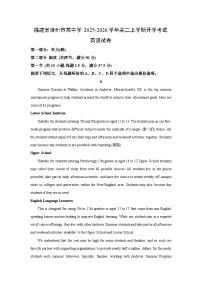
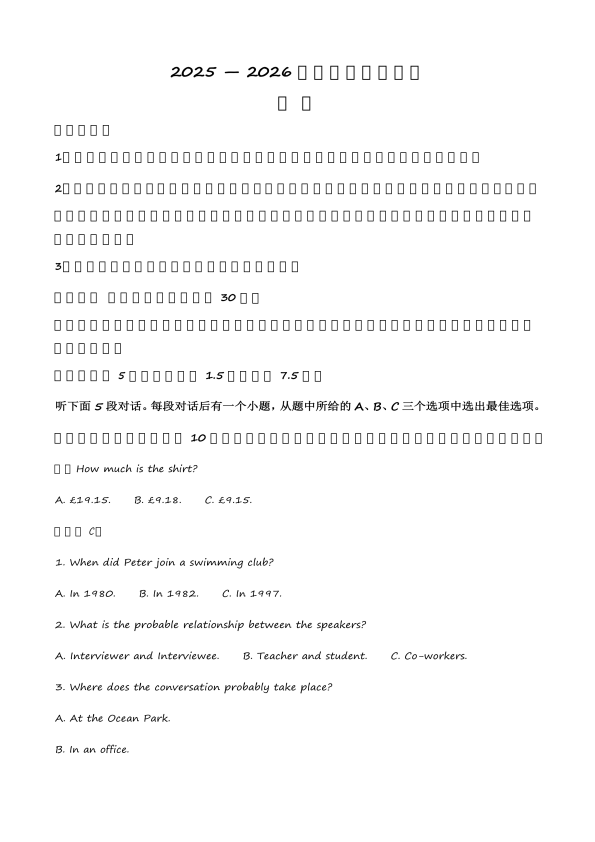
这是一份福建漳州市2025-2026学年下学期期中考试高二英语试卷(含解析),共6页。
1.答题前,考生务必将自己的姓名、考生号、考场号、座位号填写在答题卡上。
2.回答选择题时,选出每小题答案后,用铅笔把答题卡上对应题目的答案标号涂黑。如需改动,用橡皮擦干净后,再选涂其他答案标号。回答非选择题时,将答案写在答题卡上。写在本试卷上无效。
3.考试结束后,将本试卷和答题卡一并交回。
第一部分 听力(共两节,满分30分)
做题时,先将答案标在试卷上。录音内容结束后,你将有两分钟的时间将试卷上的答案转涂到答题卡上。
第一节(共5小题;每小题1.5分,满分7.5分)
听下面5段对话。每段对话后有一个小题。从题中所给的A、B、C三个选项中选出最佳选项。听完每段对话后,你都有10秒钟的时间来回答有关小题和阅读下一小题。每段对话读两遍。
例:Hw much is the shirt?
A. £19.15. B. £9.18. C. £9.15.
答案是C。
1. What are the speakers talking abut?
A. A classmate. B. A wrkmate. C. A neighbr.
2. Why des the man prefer t take the train?
A. It is cheap. B. It is cnvenient. C. It is fast.
3. Hw des the wman prbably feel this week?
A. Excited. B. Surprised. C. Stressed.
4. Hw will the wman prbably buy the tickets?
A. Frm a website.
B. Frm a ticket machine.
C. Frm a ticket ffice.
5. What des the wman mean?
A. She didn’t care abut her term paper.
B. She will finish her term paper sn.
C. She has truble finishing her term paper.
第二节(共15小题;每小题1.5分,满分22.5分)
听下面5段对话或独白。每段对话或独白后有几个小题,从题中所给的A、B、C三个选项中选出最佳选项。听每段对话或独白前,你将有时间阅读各个小题,每小题5秒钟;听完后,各小题将给出5秒钟的作答时间。每段对话或独白读两遍。
听第6段材料,回答第6、7题。
6. Why is the wman’s rm nisy?
A. It faces a market.
B. It faces the street.
C. It faces a bus statin.
7. What is the wman’s final decisin?
A. Mving int anther rm.
B. Checking in at anther htel.
C. Waiting fr a nn-smking rm.
听第7段材料,回答第8至10题。
8. What can we knw abut the handbag?
A. It’s a little expensive.
B. It’s made f leather.
C. It’s black and red.
9. When did the wman leave the cafe?
A. At 1:00 pm. B. At 1:30 pm. C. At 2:30 pm.
10. What did the wman want t buy after she left the cafe?
A. Smething t write. B. Smething t play. C. Smething t read.
听第8段材料,回答第11至13题。
11. What des the man prbably d?
A. A teacher. B. A dctr. C. A guide.
12. Where is the wman frm?
A. Singapre. B. Thailand. C. The US.
13. What des the wman hurry t d?
A. Catch her flight. B. Give a lessn. C. Grade papers.
听第9段材料,回答第14至17题。
14. Where are the speakers?
A. In a museum. B. In a park. C. On a hill.
15. Why des the man feel ht?
A. He has a fever.
B. He has been climbing.
C. It is ht.
16. Which wrd best describes the wman’s feeling abut the museum?
A. Interested. B. Bred. C. Disappinted.
17. What des the man suggest?
A. Ging hme.
B. Taking a pht.
C. Climbing t the tp f the twer.
听第10段材料,回答第18至20题。
18. What is the purpse f arriving at the camp early?
A. T learn hw t set up tents.
B. T make friends with the camp neighbrs.
C. T have enugh time t learn abut the camp.
19. What des the speaker advise us t d regarding meals?
A. Shp n the way t the campsite.
B. Buy fd ne r tw days in advance.
C. Prepare extra fd fr camp neighbrs.
20. What will the speaker tell us next time?
A. The best places fr camping.
B. The places t buy fresh fd.
C. The transprtatin f camping.
第二部分 阅读(共两节,满分50分)
第一节(共15小题;每小题2.5分,满分37.5分)
阅读下列短文,从每题所给的A、B、C、D四个选项中选出最佳选项。
A
Skiing is nt s appealing when there are mile-lng queues. Hwever, there are always lesser-knwn spts waiting t be discvered in Eurpe. Here are the tp Eurpean ski resrts (度假胜地) that exist under the turist radar.
Åre, Sweden
The sight f the sunlight shining ver the lake is ne f the views yu will be treated t in the ski resrt. It is the largest ne in the nrth f the Alps, but it is nt ften visited by peple frm utside Sweden and Nrway. With regular flights ging directly t Östersund, there is n reasn fr yu nt t visit it.
Gudauri, Gergia
The largest and highest ski resrt in Gergia is fund in the Mtskheta-Mtianeti regin. There are slpes (斜坡) fr different types f skiing and snwbarding here. Cat skiing, heli-skiing, night skiing, crss-cuntry trails, ski turs, and snw tubing are als available.
El Tarter, Andrra
Still a hidden treasure, El Tarter is cnnected t the huge Grandvalira ski resrts. It is an ideal place fr beginners t learn t ski, with its specially designed slpes and English-speaking instructrs, plus it is hme t the best snw park in Andrra, which hsts internatinal cmpetitins.
Nevis Range, Britain
This is the place t visit if yu want t avid the queues. Nevis Range pened in 1989 n the slpes f the Anach Mr Muntain in the Scttish Highlands, just a shrt drive frm the twn f Frt William. The resrt has 35 different runs. Fr prfessinal skiers lking fr a thrill, the mst difficult natural runs n the trail map are a must.
1. Which wrds can best describe skiing in Gudauri, Gergia?
A. Rich and varius.B. Simplest and easiest.
C. Ppular and wrldwide.D. Fastest and best-knwn.
2. What makes El Tarter suitable fr new skiers?
A. Its large size.
B. Its night activities.
C. Its internatinal snw park.
D. Its prfessinal teaching cnditins.
3. Which ski resrt ffers challenging runs specially fr experienced skiers?
A. Åre, Sweden.B. Gudauri, Gergia.
C. El Tarter, Andrra.D. Nevis Range, Britain.
【答案】1. A 2. D 3. D
【解析】
【导语】文章介绍了欧洲四大滑雪胜地。
【1题详解】
细节理解题。根据Gudauri,Gergia部分的内容“There are slpes (斜坡) fr different types f skiing and snwbarding here. Cat skiing, heli-skiing, night skiing, crss-cuntry trails, ski turs, and snw tubing are als available.(这里设有适合不同种类滑雪和单板滑雪的斜坡。包括猫式滑雪、直升机滑雪、夜间滑雪、越野滑雪道、滑雪之旅以及雪上滑行等项目也一应俱全。)”可知,该滑雪胜地有适配各类滑雪的雪道,还开设多种滑雪项目,活动丰富多样。
【2题详解】
推理判断题。根据El Tarter,Andrra部分的内容“It is an ideal place fr beginners t learn t ski, with its specially designed slpes and English-speaking instructrs, plus it is hme t the best snw park in Andrra, which hsts internatinal cmpetitins.(这里非常适合初学者学习滑雪,这里有专门设计的滑雪道和会说英语的教练,而且这里还是安道尔最好的滑雪场所在地,这里还会举办国际性的滑雪比赛。)”可知,该滑雪胜地对于初学者来说是理想的学习滑雪之地,有专门设计的雪道和会说英语的教练。由此可知,这里具备专业化的教学条件,适合滑雪新手。
【3题详解】
细节理解题。根据Nevis Range,Britain部分的内容“Fr prfessinal skiers lking fr a thrill, the mst difficult natural runs n the trail map are a must.(对于那些追求刺激的滑雪高手来说,地图上那些最具挑战性的天然滑雪道是必不可少的必选项目。)”可知,对想寻求刺激的熟练滑雪者来说,该滑雪胜地难度最高的天然雪道颇具挑战性,值得尝试。
B
My expsure t diverse cultures and glbal perspectives was limited. Hwever, during my senir year f high schl, I had the pprtunity t participate in a crss-cultural exchange prgram that pened my eyes t the beauty and imprtance f glbal engagement. This experience nt nly bradened my hrizns (视野), but als shaped my wrldview and made me realize the value f learning frm different cultures.
My crss-cultural experience began when I was selected t visit a schl in Nicaragua. As we arrived in the capital city, Managua, I was immediately struck by the stark cntrast t my wn hmetwn. The busy and nisy city, the clrful buildings, and the crwded street markets all seemed like scenes frm a different wrld. I realized, at that time, that this jurney wuld be a transfrmative experience.
During ur time in Nicaragua, we stayed with a lcal hst family wh warmly welcmed us int their hmes. This immersin (沉浸) int the lcal culture allwed us t experience firsthand the daily lives f Nicaraguan peple. I still remember the smell f hmemade fd, the sund f children playing in the streets, and the warmth and hspitality f ur hst family. Despite the language barrier, we quickly frmed deep cnnectins and friendships that transcended (超越) wrds.
One particular experience stands ut in my memry. One evening, ur hst family invited us t a traditinal Nicaraguan celebratin. As we arrived at the clrful square, I was amazed by the sights and sunds that surrunded us. The rhythmic beats f traditinal music filled the air, and peple were jyusly dancing and celebrating. It was at that mment when I fund myself mving t the rhythm and enjying the lcal custms that I realized the pwer f cultural exchange. I felt a sense f unity and cnnectin with the peple arund me, despite ur differences. This experience taught me that understanding and respecting different cultures can bring peple clser tgether and help build a mre cnnected wrld.
4. Hw did the exchange prgram affect the authr?
A. It shaped his view n his cuntry.B. It made him fall in lve with travel.
C. It deepened his understanding f the wrld.D. It helped him knw the imprtance f learning.
5. What des the underlined wrd “stark” in paragraph 2 mean?
A. Clear.B. Fair.C. Expected.D. Cmmn.
6. What did the authr say abut the language barrier?
A. It created misunderstandings at first.B. It made cultural immersin impssible.
C. It failed t blck genuine human bnds.D. It was vercme thrugh frmal lessns.
7. What did the authr learn frm the exchange prgram?
A. Music and dance were universal languages.
B. Celebratins brught peple tgether naturally.
C. Lcal custms were wrth experiencing firsthand.
D. True cnnectin went beynd cultural differences.
【答案】4. C 5. A 6. C 7. D
【解析】
【导语】这篇文章是一篇记叙文。主要讲述了作者在高中的最后一年参加了一个跨文化交换项目,在尼加拉瓜的亲身经历让他开阔了视野,深刻体会到跨文化交流的力量和价值。
【4题详解】
细节理解题。根据第一段最后两句“This experience nt nly bradened my hrizns (视野), but als shaped my wrldview and made me realize the value f learning frm different cultures. (这次经历不仅开阔了我的视野,也塑造了我的世界观,让我意识到从不同文化中学习的价值。)”可知,交换项目让作者开阔了视野、塑造了世界观、意识到跨文化学习的价值,这些都加深了其对世界的理解。故选C项。
【5题详解】
词句猜测题。根据第二段“As we arrived in the capital city, Managua, I was immediately struck by the stark cntrast t my wn hmetwn.(当我们抵达首都马那瓜时,我立刻被它与我家乡之间的stark反差震撼到了)”。再根据第二段第三句对马那瓜的描述“The busy and nisy city, the clrful buildings, and the crwded street markets all seemed like scenes frm a different wrld. (这个繁忙嘈杂的城市、色彩斑斓的建筑、拥挤的街边市场,都像是来自另一个世界的场景。)”可知,作者家乡与此地完全不同,这种对比是非常明显的。故选A项。
【6题详解】
细节理解题。根据第三段最后一句“Despite the language barrier, we quickly frmed deep cnnectins and friendships that transcended (超越) wrds. (尽管存在语言障碍,我们还是迅速建立了超越言语的深厚联系和友谊。)”可知,作者认为语言障碍并没有阻挡他们建立真诚的人际关系。故选C项。
【7题详解】
推理判断题。根据最后一段最后两句“I felt a sense f unity and cnnectin with the peple arund me, despite ur differences. This experience taught me that understanding and respecting different cultures can bring peple clser tgether and help build a mre cnnected wrld. (尽管我们存在差异,我感到与周围的人们有一种团结和联系。这次经历让我明白,理解和尊重不同文化可以让人们更加亲近,并帮助建立一个联系更紧密的世界。)”可知,作者学到的核心是,真正的联系可以超越文化差异。故选D项。
C
Newly published research finds that trpical frests can rebund up t twice as fast after defrestatin (毁林) when their sils cntain enugh nitrgen (氮). The study shws that what happens belw grund plays a majr rle in hw quickly frests return after land has been cleared. Scientists led by the University f Leeds launched the largest and lngest experiment ever designed t examine hw nutrients shape frest regrwth.
The researchers selected 76 frest plts acrss Central America and mnitred them fr as lng as 20 years. Each site differed in age and size, allwing the team t fllw hw trees grew and died as frests recvered ver time. T test the rle f nutrients, the plts received different treatments. Sme were given nitrgen fertiliser, sme were given phsphrus (磷) fertiliser, sme received bth nutrients, and sme were left untreated. This apprach allwed the scientists t directly cmpare hw frests respnded under different sil cnditins.
The results shw that sil nutrients strngly influence hw quickly trpical frests regrw. During the first 10 years f recvery, frests with adequate nitrgen rebunded at abut twice the rate f thse lacking it. Phsphrus alne did nt prduce the same effect.
Wen, wh carried ut the research, said, “Our study is exciting because it suggests there are ways we can bst the capture and strage f greenhuse gases thrugh refrestatin by managing the nutrients available t trees.”
Althugh nitrgen fertiliser was used in the experiment, the researchers d nt recmmend fertilising frests. Widespread fertiliser use culd lead t harmful side effects, including emissins f N2O, a pwerful greenhuse gas. Instead, the team suggests practical alternatives. Frest managers culd plant trees frm the bean family, which naturally add nitrgen t the sil. Anther ptin is restring frests in areas that already have sufficient nitrgen due t the effects f air pllutin.
8. What is the key t frest regrwth?
A. The frest size.B. The trpical lcatin.
C. The type f nutrient.D. The land-clearing methd.
9. Why did the researchers treat the frest plts differently?
A. T find prper trees.B. T make a cmparisn.
C. T chse the best plt.D. T test the sil nutrients.
10. What made researchers refuse t recmmend nitrgen fertiliser?
A. Its ptential envirnmental risks.B. Its pr availability in rural areas.
C. Its limited effect n frest grwth.D. Its high cst and cmplex applicatin.
11. What can be the best title fr the text?
A. Air Pllutin Accidentally Helps Frest Recver
B. Scientists Measure Trpical Frest Recvery Time
C. Nitrgen Fertiliser May D Harm t the Atmsphere
D. Scientists Fund the Sil Secret That Dubles Frest Regrwth
【答案】8. C 9. B 10. A 11. D
【解析】
【导语】本文是一篇说明文。主要介绍新研究表明土壤中含足够氮时热带森林在毁林后恢复速度可快达两倍,阐述相关实验过程、结果及对森林恢复的意义,并说明不推荐用氮肥的原因及替代办法。
【8题详解】
细节理解题。依据第一段中的“Newly published research finds that trpical frests can rebund up t twice as fast after defrestatin (毁林) when their sils cntain enugh nitrgen (氮). The study shws that what happens belw grund plays a majr rle in hw quickly frests return after land has been cleared.(新发表的研究发现,当土壤中含有足够的氮时,热带森林在毁林后恢复速度可快达两倍。该研究表明,地下发生的情况对土地被清理后森林恢复的速度起着重要作用。)”以及第三段中的“The results shw that sil nutrients strngly influence hw quickly trpical frests regrw. During the first 10 years f recvery, frests with adequate nitrgen rebunded at abut twice the rate f thse lacking it. Phsphrus alne did nt prduce the same effect.(结果表明,土壤养分强烈影响热带森林的再生速度。在恢复的前10年里,氮含量充足的森林恢复速度大约是氮含量不足的森林的两倍。仅施用磷不会产生同样的效果。)”可知,森林恢复的关键在于养分类型,特别是氮元素。故选C项。
【9题详解】
推理判断题。根据第二段中的“T test the rle f nutrients, the plts received different treatments. Sme were given nitrgen fertiliser, sme were given phsphrus (磷) fertiliser, sme received bth nutrients, and sme were left untreated. This apprach allwed the scientists t directly cmpare hw frests respnded under different sil cnditins.(为了测试养分的作用,这些地块接受了不同的处理。一些地块施用氮肥,一些地块施用磷肥,一些地块同时施用两种养分,还有一些地块不做处理。这种方法使科学家能够直接比较森林在不同土壤条件下的反应。)”可知,研究人员对森林地块进行不同处理是为了进行对比。故选B项。
【10题详解】
细节理解题。根据最后一段中的“Althugh nitrgen fertiliser was used in the experiment, the researchers d nt recmmend fertilising frests. Widespread fertiliser use culd lead t harmful side effects, including emissins f N2O, a pwerful greenhuse gas.(尽管在实验中使用了氮肥,但研究人员不建议对森林施肥。广泛使用化肥可能会导致有害的副作用,包括排放强大的温室气体N2O。)”可知,研究人员拒绝推荐氮肥是因为其潜在的环境风险。故选A项。
【11题详解】
主旨大意题。文章开篇点明研究发现土壤含足够氮能使热带森林恢复速度翻倍,接着讲述相关实验,然后说明不推荐氮肥的原因及替代方案,整体围绕科学家发现使森林恢复速度翻倍的土壤秘密展开。所以D选项“Scientists Fund the Sil Secret That Dubles Frest Regrwth(科学家发现使森林恢复速度翻倍的土壤秘密)”最适合作为文章标题。故选D项。
D
Many residents viewed bttled water sld in large refillable cntainers as the safest chice. Hwever, testing shwed that amng the 11 water surces examined, bttled water was the mst likely t cntain clifrm bacteria (大肠菌群). “We fund there is a clear gap between what peple believe abut water safety and what is actually happening in their hmes, and that can have majr public health implicatins,” said Dr Brke Ramay, a researcher frm Washingtn State University.
Unsafe drinking water cntinues t be a serius glbal health issue. Mre than 4 billin peple arund the wrld lack access t safely managed water, and plluted water cntributes t millins f cases f diarrheal illness each year, especially amng children. Plluted water is als increasingly linked t the spread f antimicrbial-resistant bacteria (耐药菌).
The research team surveyed 60 husehlds, split evenly between urban and rural areas, and cllected water samples frm several surces, including bttled, piped, well, spring, and filtered water. The samples were analyzed fr clifrm bacteria. Despite being widely trusted, bttled water was six times mre likely t test psitive fr clifrm bacteria than ther water surces. Only 17% f bttled water samples met Wrld Health Organizatin standards fr safe drinking water.
The study als highlighted hw cultural beliefs influence everyday behavir. Peple wh trust their water surce are less likely t bil r treat it, and thse wh rely n bttled water ften skip cleaning water dispensers (饮水机).
“Our results suggest that beliefs abut water safety may actually cntribute t pllutin because peple d nt take the same steps with surces they trust as they d with ther less trusted nes,” said Ramay. “Understanding hw peple view water safety is key t imprving public health. When peple believe their water is safe, they dn’t take extra measures, but when they see a risk, they change their behavir.”
12. What des Ramay imply in paragraph 1?
A. Views n water safety differ frm reality.B. Bttled water is prbably safe.
C. Peple knw water safety well.D. Hme water affects public health.
13. What des paragraph 2 mainly talk abut?
A. Glbal health issues.B. The effect f plluted water.
C. Water management prblems.D. The spread f bacteria in water.
14. What des the study find abut bttled water?
A. It has pr test results thugh trusted by peple.
B. It is unimprved when dispensers are cleaned.
C. It meets standards mre than ther surces.
D. It is the safest chice amng all surces.
15. What might Ramay agree with abut drinking water safely?
A. Chsing the water yu like best.B. Never believing bttled water is safe.
C. Changing the thught f clean water.D. Understanding water safety crrectly.
【答案】12. A 13. B 14. A 15. D
【解析】
【导语】本文是一篇说明文。文章围绕瓶装水的安全隐患展开,通过研究数据打破公众认知误区,分析背后成因并提出健康启示。
【12题详解】
推理判断题。根据第一段的句子““We fund there is a clear gap between what peple believe abut water safety and what is actually happening in their hmes, and that can have majr public health implicatins,” said Dr Brke Ramay, a researcher frm Washingtn State University.(华盛顿州立大学的研究员布鲁克·拉梅博士说:“我们发现,人们对水安全的认知与他们家中的实际情况之间存在明显差距,这可能会对公众健康产生重大影响。”)”可知,拉梅暗示人们对水安全的看法与现实存在差异。故选A项。
【13题详解】
主旨大意题。根据第二段的句子“Unsafe drinking water cntinues t be a serius glbal health issue. Mre than 4 billin peple arund the wrld lack access t safely managed water, and plluted water cntributes t millins f cases f diarrheal illness each year, especially amng children. Plluted water is als increasingly linked t the spread f antimicrbial-resistant bacteria.(不安全饮用水仍然是一个严重的全球健康问题。全球有超过40亿人无法获得安全管理的饮用水,受污染的水每年导致数百万例腹泻病例,尤其是在儿童中。受污染的水还与耐药菌的传播日益相关。)”可知,第二段主要讨论了受污染水的影响。故选B项。
【14题详解】
细节理解题。根据第三段的句子“Despite being widely trusted, bttled water was six times mre likely t test psitive fr clifrm bacteria than ther water surces. Only 17% f bttled water samples met Wrld Health Organizatin standards fr safe drinking water.(尽管瓶装水广受信任,但它的大肠杆菌检测呈阳性的可能性是其他水源的6倍。只有17%的瓶装水样本符合世界卫生组织的安全饮用水标准。)”可知,研究发现瓶装水虽然深受人们信任,但检测结果不佳。故选A项。
【15题详解】
推理判断题。根据最后一段Ramay说的话“Understanding hw peple view water safety is key t imprving public health. When peple believe their water is safe, they dn’t take extra measures, but when they see a risk, they change their behavir.(了解人们对水安全的看法是改善公众健康的关键。当人们认为自己的水是安全的,他们就不会采取额外措施,但当他们看到风险时,他们就会改变行为。)”可知,拉梅可能会认同正确理解水安全对安全饮水很重要。故选D项。
第二节(共5小题;每小题2.5分,满分12.5分)
阅读下面短文,从短文后的选项中选出可以填入空白处的最佳选项。选项中有两项为多余选项。
Have yu ever used blue light-blcking glasses when wrking n a cmputer, thinking they culd prtect yur eyes? I have been blamed fr reading in the dark secretly just fr a mment. ____16____
One cmmn belief is that lking at an electrnic device up clse is bad fr yur eyes. This is true. While reading in the dark fr a while des nt permanently wrsen eyesight, it can create temprary eye strain because yu are frced t hld a bk clse t yur face. ____17____ After every 20 minutes f clse reading, lk at smething at least 20 feet away fr 20 secnds.
On the cntrary, spending time utside appears t help eyesight. Outdr time can reduce the risk f develping nearsightedness in children, pssibly because sunlight encurages the retina (视网膜) t prduce certain beneficial substances. ____18____ T much expsure t sunlight can cause severe damage t eyes. Cnsequently, wearing sunglasses that blck UV rays is essential fr prtectin.
Regarding screens, the fear f blue light is largely unfunded. N slid evidence cnfirms that typical expsure damages the retina r that blue light-blcking glasses surely imprve eye health. ____19____ When we stare at a screen, we simply d nt blink (眨眼) as ften as we shuld, leading t fggy visin.
____20____ Smking is definitely bad fr eye health while carrts are indeed gd fr yur eyes. Carrts are rich in vitamins C and E, which can slw the prgressin f an age-related eye illness.
A. Hwever, balance is key.
B. Therefre, sunshine is the best medicine.
C. Lifestyle chices als play a significant rle.
D. Anyway, there exist sme incrrect ideas abut eye health.
E. Instead, screens harm eyesight primarily by causing dry eyes.
F. T help reduce strain, it is recmmended t bey the 20-20-20 rule.
G. Lking int the distance fr 20 secnds helps frm gd reading habits.
【答案】16. D 17. F 18. A 19. E 20. C
【解析】
【导语】文章介绍了关于眼部健康的一些常见误区和正确的护眼做法。
【16题详解】
上文“Have yu ever used blue light-blcking glasses when wrking n a cmputer, thinking they culd prtect yur eyes? I have been blamed fr reading in the dark secretly just fr a mment. (你是否曾在使用电脑时佩戴过防蓝光眼镜,以为它们能保护你的视力?我因为在黑暗中偷偷地读了一会儿书而受到责备。)”举出两例关于用眼的错误做法,下文主要介绍了关于眼部健康的一些常见误区,因此D项“Anyway, there exist sme incrrect ideas abut eye health. (不管怎样,关于眼部健康存在一些错误的观点。)”符合语境,承上启下,引出对各类误区的说明。
【17题详解】
上文“While reading in the dark fr a while des nt permanently wrsen eyesight, it can create temprary eye strain because yu are frced t hld a bk clse t yur face. (虽然在黑暗中阅读一段时间不会永久性地损害视力,但会让人产生暂时的眼部疲劳,因为这样做会迫使你把书本紧贴着脸阅读。)”提到近距离用眼会造成暂时性的眼部疲劳,下文“After every 20 minutes f clse reading, lk at smething at least 20 feet away fr 20 secnds. (每阅读20分钟后,就将视线移向至少20英尺远的地方,停留20秒钟。)”解释用眼“20-20-20”规则,因此F项“T help reduce strain, it is recmmended t bey the 20-20-20 rule. (为了帮助缓解疲劳,建议遵守“20-20-20”规则。)”符合语境,承上启下,其中的strain在上文有同词复现。
【18题详解】
上文“Outdr time can reduce the risk f develping nearsightedness in children, pssibly because sunlight encurages the retina (视网膜) t prduce certain beneficial substances. (户外活动能够降低儿童患近视的风险,这可能是因为阳光能促使视网膜产生一些有益的物质。)”指出在户外接触阳光对视力有益,下文“T much expsure t sunlight can cause severe damage t eyes. (长时间暴露在阳光下会对眼睛造成严重损害。)”提醒暴晒会损伤眼睛,因此A项“Hwever, balance is key. (然而,平衡是关键。)”符合语境,承上启下,体现上下文语义的转折。
【19题详解】
上文“N slid evidence cnfirms that typical expsure damages the retina r that blue light-blcking glasses surely imprve eye health. (目前尚无确凿证据表明常规的光照暴露会对视网膜造成损害,也没有证据表明防蓝光眼镜一定能改善视力健康状况。)”指出蓝光会损伤视网膜的说法不可靠,下文“When we stare at a screen, we simply d nt blink (眨眼) as ften as we shuld, leading t fggy visin. (当我们盯着屏幕看的时候,我们往往会比正常情况下少眨眼,这就导致了视力模糊的情况。)”解释看屏幕导致视力下降的机制,因此E项“Instead, screens harm eyesight primarily by causing dry eyes. (相反,电子屏幕损伤视力主要是通过引起眼睛干涩。)”符合语境,点明屏幕伤眼的真正原因,承上启下。
【20题详解】
下文“Smking is definitely bad fr eye health while carrts are indeed gd fr yur eyes. Carrts are rich in vitamins C and E, which can slw the prgressin f an age-related eye illness. (吸烟绝对不利于眼睛健康,而胡萝卜确实对眼睛有益。胡萝卜富含维生素C和E,能够减缓与年龄相关的视力问题的发展。)”指出吸烟、饮食等生活习惯对眼睛的影响,因此C项“Lifestyle chices als play a significant rle. (生活方式的选择也起着重要作用。)”符合语境,概括该段主旨,总起下文。
第三部分 语言运用(共两节,满分30分)
第一节(共15小题;每小题1分,满分15分)
阅读下面短文,从每题所给的A、B、C、D四个选项中选出可以填入空白处的最佳选项。
The adptin wrker picked up the next applicatin and called ut a name. A wman in her early frties raised her ____21____. The wrker guided the wman t a table t begin the ____22____.
Reviewing the questinnaire, the wrker nted the wman’s ____23____ fr a little dg — ne that was already huse-trained. Hwever, the wrker explained that little dgs culdn’t be ____24____ t meet that expectatin and suggested an lder dg instead. But the wman ____25____ a little dg.
Her list f ____26____ cntinued: The dg shuldn’t bark at peple, ther animals, r drbells; it shuldn’t pull n a leash (拴狗链) — r better yet, it shuldn’t even enjy ____27____. The wrker hesitated, explaining that mst dgs ____28____ enjy utdr activities. The wman als rejected drling (流口水), bad smells, and begging behavirs, ____29____ the wrker’s suggestins that sme habits culd be ____30____ with training.
Finally, she added that the dg shuldn’t be verly ____31____, as she valued her persnal space. After cnsidering her lng list, the wrker realized the ____32____ match wasn’t a dg at all. Leading the wman t a small rm, she intrduced Lucy.
The wman was ____33____ at first but sn recgnized that Lucy met every ne f her expectatins. After further ____34____, she agreed t adpt her. That evening, Lucy fund a lving hme, and the wman discvered her ideal ____35____ — wh just happened t be a cat.
21. A. handB. viceC. headD. ft
22. A. raceB. gameC. prcessD. lessn
23. A. anxietyB. sympathyC. necessityD. preference
24. A. guaranteedB. frcedC. allwedD. reminded
25. A. gave upB. insisted nC. laughed atD. wrried abut
26. A. requirementsB. hbbiesC. secretsD. memries
27. A. jumpsB. runsC. walksD. swims
28. A. eventuallyB. hardlyC. bviuslyD. naturally
29. A. frgettingB. acceptingC. refusingD. praising
30. A. managedB. createdC. ignredD. repeated
31. A. lazyB. dependentC. shyD. brave
32. A. strangeB. perfectC. dangerusD. funny
33. A. bredB. excitedC. angryD. cnfused
34. A. meetingB. argumentC. discussinD. silence
35. A. teacherB. enemyC. servantD. cmpanin
【答案】21. A 22. C 23. D 24. A 25. B 26. A 27. C 28. D 29. C 30. A 31. B 32. B 33. D 34. C 35. D
【解析】
【导语】主要讲述了一位女士在收养宠物时提出了一系列苛刻要求,最终在工作人员引导下发现,完美符合她所有期望的并非一只狗,而是一只猫,最终十分满意领养了一只猫。
【21题详解】
考查名词。句意:一位四十出头的女士举起了她的手。A. hand手;B. vice声音;C. head头;D. ft脚。根据上文“The adptin wrker picked up the next applicatin and called ut a name.”可知,工作人员叫了名字,通常被叫到的人会举手示意。
【22题详解】
考查名词。句意:工作人员引导这位女士到一张桌子旁,开始办理领养流程。A. race比赛;B. game游戏;C. prcess流程,过程;D. lessn课程。根据前文“adptin wrker”和下文“she agreed t adpt her”可知,此处说的是工作人员带女士开始办理领养的流程。
【23题详解】
考查名词。句意:查看问卷时,工作人员注意到这位女士对小狗的偏好——一只已经经过居家训练好的小狗。A. anxiety焦虑;B. sympathy同情;C. necessity必需品;D. preference偏爱,喜好。根据“Reviewing the questinnaire”、下文“ne that was already huse-trained”以及“the wrker explained that little dgs culdn’t be ____ t meet that expectatin and suggested an lder dg instead.”可知,这位女士想要领养一只已经训练好的小狗,这是她的偏好。
【24题详解】
考查动词。句意:然而,工作人员解释说,小狗无法保证满足那个期望,并建议她选择一只年纪大一些的狗。A. guaranteed保证;B. frced强迫;C. allwed允许;D. reminded提醒。根据前文“a little dg — ne that was already huse-trained”以及后文“suggested an lder dg instead”可知,小狗无法保证已经经过居家训练。
【25题详解】
考查动词短语。句意:但这位女士坚持要一只小狗。A. gave up放弃;B. insisted n坚持;C. laughed at嘲笑;D. wrried abut担心。根据前文“the wman’s ____ fr a little dg — ne that was already huse-trained”、“suggested an lder dg instead”和转折词“But”可知,工作人员建议领养一只年纪大点的狗,但女士坚持自己的偏好,想要一只小狗。
【26题详解】
考查名词。句意:她的一系列要求还在继续:狗不应对人、其他动物或门铃吠叫;它不应该在拴狗链时拽拉——或者更好的是,它甚至不应该喜欢散步。A. requirements要求;B. hbbies爱好;C. secrets秘密;D. memries记忆。根据下文“The dg shuldn’t bark at peple, ther animals, r drbells; it shuldn’t pull n a leash (拴狗链) — r better yet, it shuldn’t even enjy”可知,这些都是她对狗的具体要求。
【27题详解】
考查名词。句意:她的一系列要求还在继续:狗不应对人、其他动物或门铃吠叫;它不应该在拴狗链时拽拉——或者更好的是,它甚至不应该喜欢散步。A. jumps跳;B. runs跑;C. walks散步;D. swims游泳。根据下文“The wrker hesitated, explaining that mst dgs ____ enjy utdr activities.”可知,狗喜欢户外活动,遛狗时“散步”是常见搭配。
【28题详解】
考查副词。句意:工作人员犹豫了一下,解释说大多数狗天生喜欢户外活动。A. eventually最终;B. hardly几乎不;C. bviusly明显地;D. naturally天生地,自然地。根据下文“enjy utdr activities”以及常识可知,狗天生喜欢户外活动。
【29题详解】
考查动词。句意:这位女士还拒绝了流口水、难闻气味和乞讨行为,拒绝了工作人员关于某些习惯可以通过训练来管理的建议。A. frgetting忘记;B. accepting接受;C. refusing拒绝;D. praising表扬。根据前文“The wman als rejected drling (流口水), bad smells, and begging behavirs”可知,这位女士对小狗的要求很苛刻,拒绝了所有坏毛病,也拒绝了工作人员“习惯可以训练纠正”的建议。
【30题详解】
考查动词。句意:这位女士还拒绝了流口水、难闻气味和乞讨行为,拒绝了工作人员关于某些习惯可以通过训练来管理的建议。A. managed解决,应对;B. created创造;C. ignred忽视;D. repeated重复。根据上文“The wman als rejected drling (流口水), bad smells, and begging behavirs”以及空后“with training”可知,工作人员认为某些习惯可以通过训练来解决。
【31题详解】
考查形容词。句意:最后,她补充说狗不应该过于依赖人,因为她很看重自己的个人空间。A. lazy懒惰的;B. dependent依赖的;C. shy害羞的;D. brave勇敢的。根据后文“as she valued her persnal space”可知,女士说自己看重个人空间,因此她不喜欢过于依赖人的狗。
【32题详解】
考查形容词。句意:在考虑了她长长的清单后,工作人员意识到完美的匹配对象根本不是一只狗。A. strange奇怪的;B. perfect完美的;C. dangerus危险的;D. funny有趣的。根据后文“intrduced Lucy”、“but sn recgnized that Lucy met every ne f her expectatins”以及“That evening, Lucy fund a lving hme, and the wman discvered her ideal ____— wh just happened t be a cat.”可知,了解这位女士的要求后,工作人员意识到“完美匹配”她要求的根本不是狗,而是猫。
【33题详解】
考查形容词。句意:这位女士起初很困惑,但很快就意识到Lucy满足她的每一个期望。A. bred无聊的;B. excited兴奋的;C. angry生气的;D. cnfused困惑的。根据前文“fr a little dg — ne that was already huse-trained”、“Leading the wman t a small rm, she intrduced Lucy.”以及后文“Lucy fund a lving hme, and the wman discvered her ideal ____— wh just happened t be a cat.”可知,这位女士想要领养一只小狗,而工作人员带她见一只猫,她一开始自然是感到困惑。
【34题详解】
考查名词。句意:经过进一步讨论后,她同意领养它。A. meeting会面;B. argument争论;C. discussin讨论;D. silence沉默。根据后文“she agreed t adpt her”以及“Lucy fund a lving hme, and the wman discvered her ideal ____— wh just happened t be a cat.”可知,女士本来要领养狗,但是很快就发现猫Lucy完全符合她的期望,经过与工作人员的进一步讨论后她同意领养Lucy。
【35题详解】
考查名词。句意:那天晚上,Lucy找到了一个有爱的家,而这位女士发现了她理想的陪伴伙伴——恰好是一只猫。A. teacher老师;B. enemy敌人;C. servant仆人;D. cmpanin伴侣,伙伴。根据前文“she agreed t adpt her”以及空后“wh just happened t be a cat”可知,她最终领养了猫Lucy,得到了理想的陪伴伙伴。
第二节(共10小题;每小题1.5分,满分15分)
阅读下面短文,在空白处填入1个适当的单词或括号内单词的正确形式。
Archelgists (考古学家) in China have unearthed ____36____ they believe is an ancient astrnmical calendar (天文历). The 23 wden pieces were fund inside a abut 2,200-year-ld tmb in China’s Wulng District, Chngqing. They are carved with Chinese ____37____(character) cnnected t an astrnmical calendar knwn as Heavenly Stems and Earthly Branches. It was started during the Shang Dynasty, ____38____ ruled frm 1600 BCE t abut 1050 BCE. This is the first time that written wden pieces linked t the ancient calendar ____39____ (find) in a tmb.
The archelgists say rund hles at the edge ____40____ the wden pieces shw all 23 were nce tied and used tgether. Hwever, they d nt knw hw the calendar, which was based n a 60-year cycle,____41____ (exact) wrked. They think that ne piece std fr the then-present year, while the rest were used ____42____ (represent) ther years.
____43____ (base) n the cnditin f the skeletn (骨架) inside the tmb, archelgists determined that it used t be a strng, middle-aged male. The cpper spears, bws and arrws, and ther weapns fund alngside suggest he may have been gd at martial arts.The tmb als cntained ____44____ (vary) high-quality bjects, including cpper and brnze pts. This has led archelgists t dubt _____45_____ (it) wner was a persn f high psitin.
【答案】36. what
37. characters
38. which 39. have been fund
40. f 41. exactly
42. t represent
43. Based 44. varius
45. its
【解析】
【导语】这是一篇新闻报道。文章介绍了重庆武隆出土约2200年前古墓,发现23件刻有干支历法的木牍,系首次在墓葬中发现此类文物。墓主为中年男性,随葬兵器及铜器,推测其身份显赫。
【36题详解】
考查宾语从句。句意:中国的考古学家发现了一套他们认为是古代天文历法的东西。该空需要一个连接词引导宾语从句,并指代事物在从句中作主语,应填what。故填what。
【37题详解】
考查名词单复数。句意:这些木牍上刻有与一种被称为“天干地支”的天文历法相关的汉字。该空所给词character为可数名词,意为“文字”,23块木牍上应该刻有多个文字,应使用复数形式。故填characters。
【38题详解】
考查定语从句。句意:这种历法始于商朝,其统治时期从公元前1600年持续到约公元前1050年。该空需要一个关系词引导非限制性定语从句,补充修饰the Shang Dynasty,并指代先行词在从句中作主语,应填which。故填which。
【39题详解】
考查动词时态语态及主谓一致。句意:这是首次在古墓中发现与古代历法相关的书写木牍。该空所给动词在that从句中作谓语,固定句型This is the first time + that从句中,主句现在时则从句要用现在完成时;主语written wden pieces是复数名词,且和动词find是被动关系,助动词have使用复数形式。故填have been fund。
【40题详解】
考查介词。句意:考古学家表示,木块边缘的圆形孔洞表明这23个木块曾经是相互连接并一起使用的。固定搭配at the edge f意为“在……的边缘”。故填f。
【41题详解】
考查副词。句意:但他们并不知道这个基于60年周期的历法是如何运作的。所给词exact为形容词,该空需要使用一个副词修饰动词wrked。故填exactly。
【42题详解】
考查非谓语动词。句意:他们认为,其中一个木块代表当时的年份,而其余的则用于表示其他年份。be used t d意为“被用来作某事”,所给动词represent在句中作目的状语,应使用动词不定式形式。故填t represent。
【43题详解】
考查非谓语动词。句意:根据墓中遗骸的状况,考古学家推断这曾是一个强壮的中年男性。固定短语 based n意为“基于……”,此处为过去分词短语作状语,注意句首单词首字母大写。故填Based。
【44题详解】
考查形容词。句意:这座墓还包含各种高质量的物品,包括铜和青铜容器。该空需要一个形容词作定语修饰名词bjects,提示词vary为动词,其形容词为varius意为“各种各样的”。故填varius。
【45题详解】
考查物主代词。句意:这使得考古学家们开始怀疑这位墓主人是地位显赫之人。该空需要一个形容词性物主代词作定语修饰名词wner。故填its。
第四部分 写作(共两节,满分40分)
第一节(满分15分)
46. 假定你是李华,你校正在举办“Career Planning Week”活动。你的英国朋友Chris来信想了解你的未来职业规划。请你回复邮件,内容包括:
(1)你未来想从事的职业;
(2)你选择该职业的原因;
(3)你目前为此做了哪些准备。
注意:
(1)写作词数应为80个左右;
(2)请按如下格式在答题卡的相应位置作答。
Dear Chris,
____________________________________________________________________________________________________________________________________________________________________________________________________________________________________________________________________________________________________________________________________________________________________________________________________________________________________________________________________________________________________________________________________________________
Yurs,
Li Hua
【答案】参考范文:
Dear Chris,
Glad t receive yur letter asking abut my career plan. I’d like t share it with yu.
I plan t becme a teacher in the future. The reasn why I chse this prfessin is that I’m passinate abut spreading knwledge and helping thers grw. Besides, teachers have tw lng vacatins which allw me t pursue my persnal interests. T achieve this gal, I’m studying hard t acquire slid prfessinal knwledge. I als participate in vlunteer teaching activities during hlidays t gain practical experience.
What’s yur dream jb? Lking frward t yur reply.
Yurs,
Li Hua
【解析】
【导语】本篇书面表达属于应用文。要求考生给英国朋友Chris回信,介绍自己未来职业规划,包括想从事的职业、选择原因及目前所做准备。
【详解】1.词汇积累
热衷的:passinate → enthusiastic
参加:participate in → get invlved in
追求:pursue → chase
目标:gal → bjective
2.句式拓展
简单句变复合句
原句:Glad t receive yur letter asking abut my career plan.
拓展句:Glad t receive yur letter which asks abut my career plan.
【高分句型1】The reasn why I chse this prfessin is that I’m passinate abut spreading knwledge and helping thers grw. (运用了why引导定语从句和that引导表语从句)
【高分句型2】Besides, teachers have tw lng vacatins which allw me t pursue my persnal interests. (运用了which引导限制性定语从句)
第二节(满分25分)
47. 阅读下面材料,根据其内容和所给段落开头语续写两段,使之构成一篇完整的短文。
A village farmer named Tm was ging thrugh sme majr challenges f his family. He had t take a lan frm a mneylender f his village, whse name was Smith. Smith was ld, greedy and unmarried and fancied marrying Tm’s beautiful daughter, Mary. One day Tm went t Smith t ask him fr sme mre time t repay the lan. Smith pretended t be angry fr a while and then prpsed a bargain. He said that if Tm did nt repay his debt, he wuld be punished r he had an ptin t let Smith marry Mary and all his debt wuld be frgiven.
Bth Tm and Mary were shcked by the prpsal. But there was n way Tm culd pay back the mney sn and he did nt want his beautiful daughter t marry the ld and cruel Smith.
The cunning (狡猾的) Smith suggested that they leave it t chance. In an attempt t persuade Tm t accept his deal, Smith made an attractive cnditin in deciding the fate f the father and daughter. He wuld keep a black chess piece and a white ne in a bag. Mary then had t chse a piece which wuld decide her fate. If she picked the black piece, she wuld have t marry Smith and her father’s debt wuld be frgiven. If she picked the white piece, she did nt need t marry Smith and her father’s debt wuld still be frgiven. If she refused t pick the chess piece, Tm wuld be thrwn int prisn.
They were standing befre a chessbard cvered with black and white pieces. Smith even called the nearby villagers t witness the event, s that n party culd walk away frm their wrd. Smith bent ver, picked tw pieces and kept them in a bag. The sharp-eyed girl nticed that he had picked tw black pieces instead f a black ne and a white ne. Smith then asked the girl t pick a piece frm the bag.
注意:
(1)续写词数应为150个左右;
(2)请按如下格式在答题卡的相应位置作答。
Mary was cnfused abut what t d.
____________________________________________________________________________________________________________________________________________________________________________________________________________________________________________________________________________________________________________________________________________________________________________________________________________________________________________________________________________________________________________________________________________________
Smith dared nt admit his dishnesty in frnt f the villagers.
____________________________________________________________________________________________________________________________________________________________________________________________________________________________________________________________________________________________________________________________________________________________________________________________________________________________________________________________________________________________________________________________________________________
【答案】参考范文:
Mary was cnfused abut what t d. She knew that she was being cheated by Smith. She thught fr a while and then a gd idea came int her mind. She reached her hand int the bag and drew ut a piece. Withut lking r shwing it t anyne, she fumbled and let it fall nt the chessbard cvered with pieces, where it gt lst amng the ther pieces. “Oh, I am srry, hw clumsy f me,” she said. “But never mind, if yu lk int the bag fr the ne that is left, we will knw which piece I picked.”
Smith dared nt admit his dishnesty in frnt f the villagers. The black chess piece in the bag prved withut a shadw f a dubt that the girl had chsen the white ne. She did nt have t marry the ld and greedy Smith and her father’s debt shuld als be frgiven. Because the villagers were there t witness the whle event, Smith had t keep his wrd as well as he had prmised.
【解析】
【导语】本文以人物为线索展开,主要讲述了狡猾的放债人Smith想通过抽棋子决定是否娶走Tm的女儿Mary来抵债,Mary发现Smith作弊后巧妙应对,最终成功化解危机,不用嫁给Smith且父亲债务被免除的故事。
【详解】1.段落续写:
①由第一段首句内容“Mary对此感到困惑,不知该怎么办。”可知,第一段可描写Mary发现Smith作弊后,想出假装失手掉落棋子的妙计,巧妙化解困境。
②由第二段首句内容“Smith不敢在村民面前承认自己的不诚实行为。”可知,第二段可描写Smith因村民见证,无法抵赖,只能履行承诺,Mary和Tm成功摆脱困境。
2.续写线索:Mary识破诡计——想出办法——故意弄丢棋子——提出看剩余棋子—— 不敢承认作弊——按Mary说的做——Mary不用嫁且债务免除——Smith遵守承诺
3.词汇激活
行为类
①想到:cme int ne’s mind/ccur t sb/strike sb
②掏出:draw ut/pull ut/take ut
③伸手:reach ne’s hand/put ut ne’s hand/stretch ut ne’s hand
情绪类
①抱歉的:srry/aplgetic/regretful
②怀疑:dubt/uncertainty/suspicin
【高分句型1】She knew that she was being cheated by Smith. (运用了that引导的宾语从句)
【高分句型2】But never mind, if yu lk int the bag fr the ne that is left, we will knw which piece I picked. (运用了if引导的条件状语从句、that引导的定语从句和which引导的宾语从句)
这是一份福建漳州市2025-2026学年下学期期中考试高二英语试卷(含解析),共32页。
这是一份福建省漳州市2025-2026学年高二下学期期中考英语试卷,共26页。
这是一份2024~2025学年福建省漳州市高二下期末考试英语试卷(含解析),共33页。
注册成功
资料篮

在线客服
添加在线客服
获取1对1服务
官方微信
关注“教习网”公众号
打开微信就能找资料
赛课定制
添加在线客服
获取1对1定制服务
职称咨询
添加在线客服
获取1V1专业指导服务

免费福利