 免费领取教师福利

若您为此资料的原创作者,认为该资料内容侵犯了您的知识产权,请扫码添加我们的相关工作人员,我们尽可能的保护您的合法权益。


这是一份福建省福州市2026届高三下学期五月质量检测英语试卷(Word版附解析),共7页。
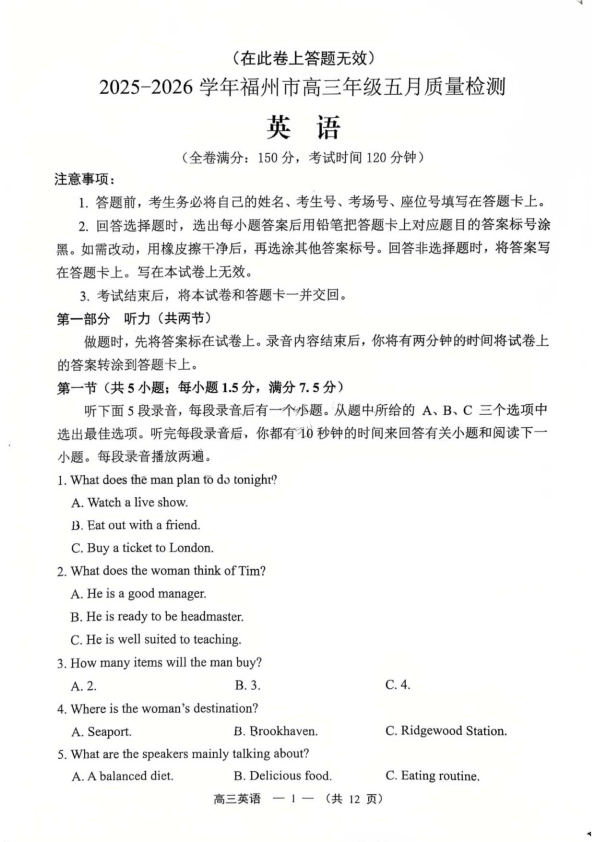
(全卷满分:150 分,考试时间 120 分钟)
注意事项:
1.答题前,考生务必将自己的姓名、考生号、考场号、座位号填写在答题卡上。
2.回答选择题时,选出每小题答案后用铅笔把答题卡上对应题目的答案标号涂黑。如需改动,
用橡皮擦干净后,再选涂其他答案标号。回答非选择题时,将答案写在答题卡上。写在本试
卷上无效。
3.考试结束后,将本试卷和答题卡一并交回。
第一部分 听力(共两节)
做题时,先将答案标在试卷上。录音内容结束后,你将有两分钟的时间将试卷上的答案转涂
到答题卡上。
第一节(共 5 小题;每小题 1.5 分,满分 7.5 分)
听下面 5 段录音,每段录音后有一个小题。从题中所给的 A、B、C 三个选项中选出最佳选项。
听完每段录音后,你都有 10 秒钟的时间来回答有关小题和阅读下一小题。每段录音播放两遍。
1. What des the man plan t d tnight?
A. Watch a live shw. B. Eat ut with a friend. C. Buy a ticket t Lndn.
2. What des the wman think f Tim?
A. He is a gd manager.
B. He is ready t be headmaster.
C. He is well suited t teaching.
3. Hw many items will the man buy?
A. 2. B. 3. C. 4.
4. Where is the wman’s destinatin?
A. Seaprt. B. Brkhaven. C. Ridgewd Statin.
5. What are the speakers mainly talking abut?
A. A balanced diet. B. Delicius fd. C. Eating rutine.
第二节(共 15 小题;每小题 1.5 分,满分 22.5 分)
听下面 5 段录音。每段录音后有几个小题,从题中所给的 A、B、C 三个选项中选出最佳选项。
第 1页/共 12页
听每段录音前,你将有时间阅读各个小题,每小题 5 秒钟;听完后,每小题都有 5 秒钟的作
答时间。每段录音播放两遍。
听第 6 段录音,回答第 6、7 题。
6. What is the prbable relatinship between the speakers?
A. Friends. B. Teacher and student. C. Interviewer and interviewee.
7. What is Jenny mainly ding in China nw?
A. Wrking. B. Studying. C. Travelling.
听第 7 段录音,回答第 8 至 10 题。
8. Where des the cnversatin take place?
A. On a train. B. On a platfrm. C. In a shpping mall.
9. When will the wman’s train leave?
A. In 10 minutes. B. In 15 minutes. C. In 45 minutes.
10. What is the wman cmplaining abut?
A. Nt enugh seating n the train.
B. The WiFi hasn’t imprved.
C. The ticket is t expensive.
听第 8 段录音,回答第 11 至 13 题。
11. Wh is the man mst likely t be?
A. A tur guide. B. A z keeper. C. A charity manager.
12. What will the students see in the mrning?
A. Penguins. B. Giraffes. C. Tigers.
13. What time will the students prbably see the giraffes?
A. At 10:45. B. At 11:15. C. At 15:00.
听第 9 段录音,回答第 14 至 16 题。
14. What is Lydia ding with OpenClaw?
A. T send daily wrk emails.
B. T check available schedules.
C. T make appintments with clients.
15. What did Lydia buy the secnd-hand cmputer fr?
A. T run OpenClaw. B. T stre imprtant files. C. T prepare fr her exams.
第 2页/共 12页
16. Why is Lydia using OpenClaw nw instead f waiting?
A. She needs it fr urgent wrk.
B. She finds it safer t use.
C. She wants t try it ut.
听第 10 段录音,回答第 17 至 20 题。
17. What was the Eurpeans’ attitude tward cffee in the beginning?
A. Dubtful. B. Favrable. C. Negative.
18. When did Americans begin t drink cffee?
A. The 1600s. B. The 1700s. C. The 1800s.
19. Where is cffee usually rasted?
A. In cffee-buying cuntries.
B. In cffee-grwing cuntries.
C. In ht areas near the equatr.
20. Which type f cffee is used in cheap instant cffee?
A. Arabica cffee. B. Rbusta cffee. C. Freeze-dried cffee.
第二部分 阅读(共两节,满分 50 分)
第一节(共 15 小题;每小题 2.5 分,满分 37.5 分)
阅读下列短文,从每题所给的 A、B、C、D 四个选项中选出最佳选项。
A
Need mre than just light? Our adjustable Sptlight Desk Lamp brings targeted natural LED lighting t yur
wrkspace — perfect fr fcused tasks, frm drafting and drawing t reading and wrking late. The all-metal
swing arm design and clean industrial lk make it a statement piece fr yur hme ffice, studi, r creative desk.
Bright, flexible, and built t last.
Key Features
·Sptlight precisin light: A fcused light that reduces light waste and imprves clearness fr clse-up wrk.
·Stepless dimming (10%-100%): Adjust brightness smthly with a ne-tuch cntrl.
·Flexible & fully adjustable: Three-directin adjustable arm plus a turnable lamp head fr different angles and
heights.
·Eye-friendly lighting: N blue light, visual discmfrt, r flicker (频闪) (RG0).
·True clr: CRI≥95 fr accurate clr appearance (useful fr art and design wrk).
第 3页/共 12页
Price
·Regular price: $219.99
·Sale price: $199.99 (Save 9%)
Returns
·30-day return plicy: items can be returned r exchanged within 30 days f delivery.
Returnable items (within 30 days) Nn-returnable items
Damaged/brken/siled n arrival Incrrect size/clr Items utside the 30-day time
received frame
Unwashed, unwrn, unused items that did nt meet Washed, wrn, used, r misused
expectatins item
·Return cnditins: items must be in the same cnditin as received, with labels, in riginal packaging, and
with a receipt f purchase.
·Authrizatin required: all returns must be authrized via the Supprt Center. A return withut an RMA
(Return Merchandise Authrizatin) frm will nt be accepted.
·Hw t start a return: email [email protected] and btain an RMA and return address.
1. Wh wuld find the Sptlight Desk Lamp particularly useful?
A. A pian tuner. B. A fashin designer. C. A flight attendant. D. A fitness instructr.
2. What is a selling pint f the lamp?
A. Adjustable clrs. B. Better clarity. C. Wider light cverage. D. Fixed brightness.
3. In which f the fllwing situatins can a custmer return the lamp?
A. Used fr tw mnths. B. Withut the receipt.
C. Damaged n delivery. D. Withut its riginal packaging.
B
Recently, I was talking with the mther f a student I taught nearly 15 years ag. “He still has his magazine! I
knw exactly where it is,” she said. It might be surprising that a yung adult has kept a middle schl English
assignment fr ver a decade, but I ften hear this abut my favrite activity: the magazine prject.
Originally, this prject was designed t slve a cmmn prblem in teaching writing: Hw can we fully
engage students s that they will take the time t edit, revise, and plish their wrk? I knw that letting students
chse their writing tpics can imprve engagement, s I created a prject that asks students t chse a tpic f
第 4页/共 12页
persnal interest and spend mst f a semester writing, designing, and publishing their wn magazine n that tpic.
The cmbinatin f tpic chice and a final published magazine greatly imprves my students’ investment in their
writing all semester lng.
When I intrduce the prject, this big chice usually attracts students, but many dn’t believe that they really
d get t chse. They fire questins at me, asking if their whle magazine can be abut adventure rides, r the vast
mystery f space. I always assure them that they can write abut whatever interests them. I can’t pssibly anticipate
what kinds f writing might engage every eighth grader, and giving them a free chice is the best way t d that.
Cnsequently, ur classrm becmes lively as writers eagerly share ideas.
Twenty-five years ag, students stuck their pages tgether. But nw we give them the ptin f creating an
nline magazine using mdern technlgy. This eliminates printing expenses while develping valuable cmputer
skills. We usually schedule the final due date just befre ur schl’s pen huse s that the magazines can be
displayed fr the cmmunity.
These unique magazines make a pwerful statement abut what matters t ur students. And every time a
frmer student tells me they still keep their magazine, it cnfirms the true meaning f this prject.
4. What was the students’ main prblem in writing?
A. Lw cnfidence. B. Limited techniques. C. Weak mtivatin. D. Insufficient materials.
5. What made students highly engaged in the prject?
A. Chances fr adventures. B. Persnal chice f tpics.
C. Talks with famus writers. D. Discussin f mysteries.
6. What des the authr want t cnvey in the last paragraph?
A. Academic pressure limits creativity. B. Gd habits shuld be frmed early.
C. Mdern technlgy transfrms educatin. D. Persnal invlvement creates lasting value.
7. Which f the fllwing best describes the authr?
A. Innvative and supprtive. B. Thughtful and brave.
C. Energetic and cmpetitive. D. Humble and respnsible.
C
A husehld washing machine can generate up t 500 grams f micrplastics each year, with much ending up
at wastewater treatment plants and ultimately spread nt fields.
Scientists have been seeking ways t remve micrplastics befre they enter the envirnment. “Existing filter
(过滤) systems, hwever, have serius disadvantages,” explains Dr. Leandra Hamann f the University f Bnn.
第 5页/共 12页
“Sme quickly becme blcked, thers d nt wrk efficiently.”
T find a better slutin, Hamann turned t bilgy fr ideas. The team fcused n fish that feed by filtering
water — the result f evlutin. Their gill arch (鳃弓) system frms a structure that is widest at the muth and
narrws twards the gullet (食道). The structure is cvered in tiny teeth, creating a natural filter netwrk. “During
fd intake, the water flwing thrugh it is filtered, and the micrplastic-free water is then released back int the
envirnment,” explains Hamann. “Hwever, sme rganisms are t big fr this. Thanks t the shape, they then
rll twards the gullet, where they are cllected until the fish swallws, which empties the system.”
This nature-inspired design prevents blckages and traps nearly all micrplastics — exactly the tw key
advantages needed fr a washing machine micrplastic filter. T build a versin fr washing machines, the
researchers recreated the gill arch system and tested varius filter sizes and pening angles. After cmparing
different structural dimensins, ultimately, the team identified a cmbinatin f parameters, which enabled the
system t separate mre than 99% f the micrplastics withut blckage in lab experiments. With n cmplex
mving parts, the design is lw-cst. Captured micrplastics culd be pressed inside the machine t squeeze ut
remaining water, with the resulting tiny plastic balls remved and thrwn in the rdinary garbage.
The researchers hpe cmpanies will refine the design fr ptential cmmercial applicatin, which culd at
least partially reduce micrplastic spread. The need is pressing: studies suggest micrplastics may pse severe
health risks, and they’ve already been fund in breast milk — and even human brains.
8. What d the researchers aim t d?
A. T remve micrplastics cmpletely. B. T vercme the existing drawbacks.
C. T upgrade wastewater treatment plants. D. T imprve washing machine efficiency.
9. What is paragraph 3 mainly abut?
A. What prblems plastics bring t fish. B. Where sme rganisms are cllected.
C. Why the gill arch system has tiny teeth. D. Hw fish trap micrplastics frm water.
10. What des the underlined “parameters” in paragraph 4 prbably mean?
A. Lab methds. B. Mechanical tls. C. Prcessed data. D. Replacement parts.
11. What can be inferred frm the last paragraph abut the design?
A. It can end micrplastics spread. B. It will pse ptential health risks.
C. It will revlutinize hme appliances. D. It may have applicatin prspects.
D
“I just need yu t validate (认可) my feelings.” It’s a phrase cnstantly heard — and it reveals smething
第 6页/共 12页
fascinating abut ur cultural mment. Validatin has becme the currency f care, the thing we believe we need
mst frm thers. But what if the deepest human need is t knw we matter — regardless f whether thers see
things ur way?
Validatin came int psychlgy as a crrective tl. In the mid-20th century, Carl Rgers advcated
empathetic listening and uncnditinal psitive regard, reacting against then mainstream practice, which ften
interpreted, crrected, r reframed clients’ experiences. T him, validatin meant: yur feelings exist, they make
sense within yur internal wrld, and they deserve t be heard.
Hwever, as psychlgical language migrated int (融入) ppular culture, validatin gradually detached frm
its clinical rts. It changed int a brader mral expectatin: if I feel smething, thers shuld validate it. This
shift has had prfund cnsequences and validatin becmes an exhausting test, a relatinal chre, a skill t
perfrm.
In fact, what mst f us are really lking fr when we fish fr validatin is being valued. Being valued des
nt depend n mment-t-mment agreement, nr des it require cnstant cnfirmatin. Being valued means being
seen as a whle persn and accepted regardless f the experience ne is having.
When smene is valued, they can be crrected withut being devalued; they can be disagreed with withut
feeling rejected. A parent wh values their child can say, “I lve yu, and I’m nt buying yu that ty.” Validatin
may ease an emtinal state, but being valued shapes the self. Validatin can be spken; value is felt.
The exit frm endless validatin-seeking is clear: learn t distinguish between having emtins and being
defined. A mature sense f wrth cmes frm internalized experiences f being valued: by thers first, and
eventually by yurself. It grws when yu can reflect n yur emtins, differentiate past frm present, and remain
slid even when yur perceptins are challenged. This is what allws bth cnnectin and grwth.
12. Why did Carl Rgers stand fr validatin?
A. T fllw mainstream pinin. B. T crrect patients’ cnclusins.
C. T make validatin a destinatin. D. T value clients’ inner experience.
13. What des the underlined “this shift” in paragraph 3 refer t?
A. The unwillingness t reflect. B. The fear f mral expectatin.
C. The enthusiasm fr ppular culture. D. The strng desire fr full agreement.
14. What des the authr agree with abut being valued?
A. It helps cnstruct self-cncept. B. It prvides cnstant agreement.
C. It ffers psychlgical security. D. It avids varius frms f crrectin.
第 7页/共 12页
15. What enables peple’s cnnectin and grwth?
A. The cnstant challenge f validatin. B. The pursuit f a realistic sense f self.
C. A rejectin f internalized experiences. D. A changeable and questining mindset.
第二节(共 5 小题;每小题 2.5 分,满分 12.5 分)
阅读下面短文,从短文后的选项中选出可以填入空白处的最佳选项。选项中有两项为多余选项。
William Shakespeare may have written that “all the wrld’s a stage”, but sadly theaters witness a decline in
schl visits due t budget pressures. ____16____
The mst bvius benefit is academic. Students watching a live play utperfrm thse seeing the same play as
a film adaptatin n knwledge f cntent and vcabulary. ____17____ When seeing it brught t life, they can
build a thrugh understanding in discussing the staging and interpretatins f stage directins.
Live theater als teaches hw t develp relatinships. Peple’s heart rates synchrnize (同步) in a theater
audience. This is a behavir that has been shwn t enhance scial bnding. ____18____ In fact, the cmmn
heightened emtin f watching a play als teaches students that it’s k t feel and express emtins such as
sadness.
____19____ Schls really welcme using theater and plays t pen up difficult discussins where students
can explre diverse perspectives and accept thers with an pen mind. As a result, students are mre likely t
accept statements such as “I think peple can have different pinins abut the same thing”.
Finally, theater helps pen students’ eyes up t the range f jbs available within the industry. ____20____
There are many backstage rles, which ften dn’t becme bvius until yu experience a live perfrmance.
Given these significant benefits — academic, emtinal, scial, and ccupatinal — schls shuld
guarantee that students never miss ut n these transfrmative experiences.
A. Plays dn’t just require actrs.
B. Live theater makes class discussin intlerable.
C. The actual jurney t the theater als bsts scial tlerance.
D. A synchrnized audience is perfect fr building scial tlerance.
E. The shared experience f smething mving helps peple cnnect.
F. Yet, live theater experiences remain vital fr students’ develpment.
G. Fr thse studying English plays, a text f a play is merely a blueprint.
第三部分 语言运用(共两节,满分 30 分)
第一节(共 15 小题;每小题 1 分,满分 15 分)
第 8页/共 12页
阅读下面短文,从每题所给的 A、B、C、D 四个选项中选出最佳选项。
We had many family traditins. Fr my birthday, which is in Octber, the kids insisted we jump int a pile f
____21____ fr “my traditin”. We wuld pile them up, bury each ther and stuff them dwn the back f ur shirts.
Even as my kids grew lder, they ____22____ t let the traditin die. But I never quite gt the ____23____ — t
me, it seemed a little childish.
Then the kids grew up and ____24____ hme. My daughter vlunteered in Bulgaria, and my sn was away fr
cllege. Realizing it wuld be my first birthday withut them, I began t ____25____ them.
On my birthday mrning, I was smewhat ____26____ t find tw pieces f mail, ne frm each f them. I
was eager t see what kind f birthday ____27____ they had fr me.
I pened my daughter’s envelpe first, and caught my breath as a bright red leaf ____28____. Stuck t the leaf
was a pst-it nte. I read it, unable t cntain my ____29____. “Dad, this is a Bulgarian leaf. The residents helped
me ____30____ yur traditin. Dn’t frget, I’m still part f ur family.” My sn’s envelpe had a glden leaf in it.
____31____ fr him, there was n nte. Yet I culd ____32____ him simply putting a leaf in an envelpe, knwing
I wuld understand.
That mrning I finally understd family traditins: security, ____33____, and an identity larger than
themselves. They are the ____34____ that hlds families tgether. Since that day, I have never dubted the
____35____ and meaning f valued family traditins.
21. A. bks B. leaves C. gifts D. bxes
22. A. ffered B. agreed C. hped D. refused
23. A. pint B. cncept C. secret D. difference
24. A. left B. hit C. returned D. welcmed
25. A. supprt B. believe C. miss D. call
26. A. curius B. surprised C. cnfident D. relieved
27. A. wishes B. memries C. invitatin D. dinner
28. A. dried ut B. flew away C. fell ut D. blew by
29. A. dubts B. srrw C. panic D. tears
30. A. start B. hnr C. challenge D. understand
31. A. Painful B. Frtunate C. Suitable D. Typical
32. A. picture B. bserve C. remember D. leave
33. A. dignity B. fulfillment C. reputatin D. belnging
第 9页/共 12页
34. A. blanket B. standard C. glue D. gal
35. A. rigin B. pwer C. sign D. result
第二节(共 10 小题;每小题 1.5 分,满分 15 分)
阅读下面短文,在空白处填入 1 个适当的单词或括号内单词的正确形式。
In Chenjiangu village in Henan prvince, cuntless arms rse slwly like cluds ____36____ (part). The
weight f hundreds f bdies shifted frm ne leg t the ther. The palms extended frward in cntrlled grace —
all in perfect unisn (一致).
The hundreds f taijiquan practitiners ____37____ (be) a mix f lcals and visitrs. They traveled thusands
f miles ____38____ (specific) t the birthplace f the martial art ____39____ the first Internatinal Taijiquan Day
n Saturday. The scene is repeated daily thrughut China, where ____40____ number f taijiquan practitiners is
currently arund 78.6 millin.
On TikTk, vides shw practitiners frm arund the wrld. They learn training rutines, discuss the art’s
philsphy and dcument their taijiquan jurneys, the destinatin f ____41____, in many cases, ends up being
Chenjiangu. Fr Western learners, taijiquan ffers a different way f understanding the bdy. It changes the fcus
frm external ____42____ (strng) t internal awareness. They practice t seek health, but ften find smething
____43____ (deep) in the prcess.
The philsphy f taijiquan traces back t Chenjiangu. In the 17th century, Chen Wangting integrated
principles frm the ancient Bk f Changes, r I Ching, and Taist breathing techniques ____44____ (create) the
martial art. Over centuries, it has evlved int a discipline fr health and mind-bdy develpment. Its practice
____45____ (grund) in the principles f balance and dynamic flw, making it suitable fr individuals f all ages
and physical abilities.
第四部分 写作(共两节,满分 40 分)
第一节(满分 15 分)
46. 假定你是李华,你的英国笔友 Mary 制作了一张关于中国茶文化的海报(见下图),来信征求你的意见。
请给她写一封回信,内容包括:
1.你的评价;
2.你的建议。
第 10页/共 12页
注意:
(1)写作词数为 80 左右;
(2)请按如下格式在答题卡的相应位置作答。
Dear Mary,
I am really glad t receive yur pster abut Chinese tea culture.
____________________________________________________________________________________________
____________________________________________________________________________________________
____________________________________________________________________________________________
____________________________________________________________________________________________
____________________________________________________________________________________________
Yurs,
Li Hua
第二节(满分 25 分)
47. 阅读下面材料,根据其内容和所给段落开头语续写两段,使之构成一篇完整的短文。
“1, 2, 3, FIRE DRAGON!” I shuted, my vice cutting thrugh the sweat-filled air as ur team fllwed the
call. But beneath the surface f ur harmnized cheers, a gap was grwing.
We were preparing fr the Chinese Cultural Evening (CCE), ur biggest perfrmance f the year, and the
pressure hung heavy ver us like a strm clud. Tw-hur practices were like endless marathns: hlding the
dragn’s bamb spine (脊椎) until ur hands bled, bending ur bdies t fllw the dragn head’s lead until ur
muscles screamed, with pains n ur knees and exhaustin in ur bnes. Nine f us — thse inside the dragn’s
bdy — pushed each ther harder, perfecting every mvement, while the tenth member, Emma, wh held the
pearl (宝珠), nw std ff t the side.
The pearl was suppsed t be the dragn’s guiding light — the frce that guided the dragn frward,
symblizing wisdm and purpse. But Emma, nce eager t lead ur dance, nw stayed away frm the grup
第 11页/共 12页
during practices, her mvements slw, her eyes lcked n the flr. She thught hlding the pearl was nt as
imprtant as being part f the dragn bdy. The cnflict wrsened when, during a practice fr a key trick —
where the dragn was suppsed t “fllw” the pearl in a graceful mvement — Emma’s slw, unenthusiastic
waves upset the entire team. The dragn head fell, the bdy fell apart, and the tail hit a pile f chairs, making all the
decratins crash ludly nt the flr.
“Emma, can yu please fcus and keep up?” Jake, ur dragn head, shuted, his vice sharp with frustratin.
“We’re nt here t waste time — this is CCE, nt a casual practice!” Emma’s face turned red, and she held the
pearl tighter. The rest f the team whispered in agreement, their glances fixed between Emma and me, waiting fr
me t take charge.
As team leader, I felt a knt (结) in my stmach: I culd have sclded Emma, demanded she d better, but that
wuld nly increase ur tensin.
注意:
(1)续写词数应为 150 左右;
(2)请按如下格式在答题纸的相应位置作答。
I called a break, determined t bring us clser tgether.
____________________________________________________________________________________________
____________________________________________________________________________________________
____________________________________________________________________________________________
____________________________________________________________________________________________
____________________________________________________________________________________________
With a new sense f unity, the atmsphere f ur practice changed.
____________________________________________________________________________________________
____________________________________________________________________________________________
____________________________________________________________________________________________
____________________________________________________________________________________________
____________________________________________________________________________________________
第 12页/共 12页
这是一份福建省福州市2026届高三下学期五月质量检测英语试卷(Word版附解析),共7页。
这是一份福建省福州市2026届高三下学期5月质量检测英语试卷(PDF版附答案),文件包含文科综合试卷-高三模拟监测docx、文科综合试卷-高三模拟监测pdf、高三模考文综答案doc等3份试卷配套教学资源,其中试卷共32页, 欢迎下载使用。
这是一份福建省福州市普通高中2023届高三英语下学期5月质量检测试卷(Word版附解析),共22页。试卷主要包含了15等内容,欢迎下载使用。
注册成功
资料篮

在线客服
添加在线客服
获取1对1服务
官方微信
关注“教习网”公众号
打开微信就能找资料
赛课定制
添加在线客服
获取1对1定制服务
职称咨询
添加在线客服
获取1V1专业指导服务

免费福利

.png)

.png)
