 免费领取教师福利


若您为此资料的原创作者,认为该资料内容侵犯了您的知识产权,请扫码添加我们的相关工作人员,我们尽可能的保护您的合法权益。


这是一份2026届上海市浦东新区高考二模练习英语试卷(学生版),文件包含广东省2026年普通高等学校招生全国统一考试模拟测试二数学试题pdf、广东省2026年普通高等学校招生全国统一考试模拟测试二数学试题答案解析pdf等2份试卷配套教学资源,其中试卷共14页, 欢迎下载使用。
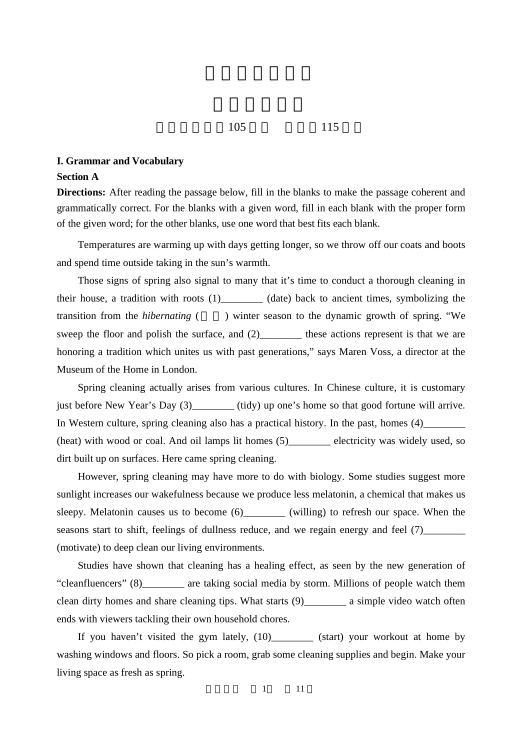
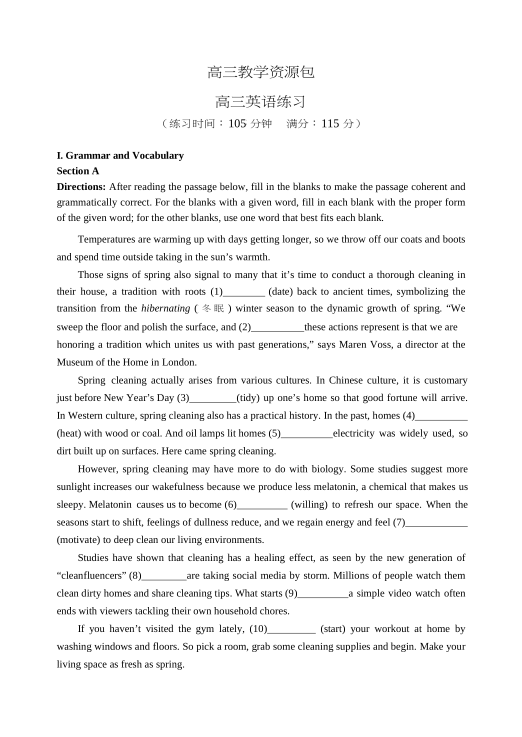
Sectin A
Directins: After reading the passage belw, fill in the blanks t make the passage cherent and grammatically crrect. Fr the blanks with a given wrd, fill in each blank with the prper frm f the given wrd; fr the ther blanks, use ne wrd that best fits each blank.
Temperatures are warming up with days getting lnger, s we thrw ff ur cats and bts and spend time utside taking in the sun’s warmth.
Thse signs f spring als signal t many that it’s time t cnduct a thrugh cleaning in their huse, a traditin with rts ____1____ (date) back t ancient times, symblizing the transitin frm the hibernating (冬眠) winter seasn t the dynamic grwth f spring. “We sweep the flr and plish the surface, and ____2____ these actins represent is that we are hnring a traditin which unites us with past generatins,” says Maren Vss, a directr at the Museum f the Hme in Lndn.
Spring cleaning actually arises frm varius cultures. In Chinese culture, it is custmary just befre New Year’s Day ____3____ (tidy) up ne’s hme s that gd frtune will arrive. In Western culture, spring cleaning als has a practical histry. In the past, hmes ____4____ (heat) with wd r cal. And il lamps lit hmes ____5____ electricity was widely used, s dirt built up n surfaces. Here came spring cleaning.
Hwever, spring cleaning may have mre t d with bilgy. Sme studies suggest mre sunlight increases ur wakefulness because we prduce less melatnin, a chemical that makes us sleepy. Melatnin causes us t becme ____6____ (willing) t refresh ur space. When the seasns start t shift, feelings f dullness reduce, and we regain energy and feel ____7____ (mtivate) t deep clean ur living envirnments.
Studies have shwn that cleaning has a healing effect, as seen by the new generatin f “cleanfluencers” ____8____ are taking scial media by strm. Millins f peple watch them clean dirty hmes and share cleaning tips. What starts ____9____ a simple vide watch ften ends with viewers tackling their wn husehld chres.
If yu haven’t visited the gym lately, _____10_____ (start) yur wrkut at hme by washing windws and flrs. S pick a rm, grab sme cleaning supplies and begin. Make yur living space as fresh as spring.
Sectin B
Directins: Cmplete the fllwing passage by using the wrds in the bx. Each wrd can nly be used nce. Nte that there is ne wrd mre than yu need.
China’s first rbt Peking Opera has drawn attentin fr its cstumes, classic pieces, and the team-up between a fully made-up rbt and a human perfrmer.
Vides frm the first shw f Farewell My Cncubine (《霸王别姬》) shw “Schlar 01,” China’s first rbt dctral student, stepping nstage. Dressed as the histrical ____11____ Xiang Yu, the rbt mves, raises its arms, and shifts its eyes t the beat f music, perfrming alngside Wu Xiafeng, a Peking Opera majr.
Thse vides triggered widespread discussin. Fr sme audience, the perfrmance was “full f futuristic charm,” an inventive____12____f traditinal pera and cutting-edge technlgy. Others questined whether a machine, hwever____13____, culd truly belng n a stage fr which human perfrmers have spent their whle lives training.
Yet what ____14____n stage tuched smething deeper than the nvelty f a rbt in face paint. The interactin f human breath and machine cde suggested a(n) ____15____ pssibility: That technlgy might extend beynd the languages f traditinal peras.
The rbt’s ____16____added a strange clarity t the unique mvements that have defined Peking Opera fr centuries. Wen Mu, the directr f the perfrmance, stated it aimed t ffer a glimpse f what a data-driven interpretatin f the frm culd lk like. One that can be repeated, fine-tuned and built upn in ways n human bdy wuld tlerate. And beynd the mechanics, the integratin f rbtics and Peking Opera is____17____ new life int the ancient art, drawing in yungsters.
After the perfrmance, teenagers wh had never watched a full traditinal pera suddenly fund themselves discussing face-painting styles. Whatever ne makes f the aesthetics (审美), it is clear that the prductin succeeded in ____18____ the cnversatin arund Peking Opera. A rbt dressed as Xiang Yu des ffer yunger and glbal audiences an accessible drway int a dense, centuries-ld traditin. Fr a cultural frm that is s ften ____19____ “t distant,” this is n small achievement.
And perhaps that is where the Shanghai experiment lands mst thughtfully as a reminder that the future f an ancient art depends n hw carefully its devted prtectrs ____20____ prgress and preservatin. Rbtics can enrich the stage, but it shuld nt replace the human instinct and emtinal intelligence n which Peking Opera’s survival depends.
II. Reading Cmprehensin
Sectin A
Directins: Fr each blank in the fllwing passages there are fur wrds r phrases marked A, B, C and D. Fill in each blank with the wrd r phrase that best fits the cntext.
Letting kids run wild utside
A grup f children is attempting t mve a large stick int place, discussing where it shuld g. Anther child kneels beside a puddle (水坑), drawing a treasure map in the mud. What is ____21____ in this scene? There are n parents standing clse by, telling them t “be careful”. This kind f ____22____ adventure — what scial media has called “unstructured child summer” — is gaining attentin. A study fund children spend 35 percent less time playing utdrs than their parents did. Scientists say the ____23____ matters because nature play is gd fr executive functin, emtinal regulatin and mre.
Letting children spend their days in wild spaces may lk simple, but t the brain, these mments are a ____24____. “Our research shws children allwed t participate in utdr play becme mre independent and self-sufficient,” says Martha Thrne, a prfessr at Queen Maud University Cllege. She adds____25____ play is linked t higher physical and mental well-being, and children wh take physical risks ften becme better at judging ther kinds. Thrne ntes this kind f play ften ____26____ a “flw state,” a sweet spt where challenges are engaging but nt verwhelming. In this state, learning ptential is at its peak. She als ntes nature play is ften mre ____27____ than playgrund interactins because it leads t grup prjects. ____28____inevitably arise, but kids have strnger mtivatin t wrk them ut, building skills that serve them well thrughut life.
It is widely claimed that sprts and ther indr activities have their benefits, but ____29____ them exclusively means kids aren’t develping executive functin skills independently. Withut practice navigating truble r nvel situatins n their wn, teens and yung adults may ____30____ when real life desn’t fllw a pattern.
It’s usually easier t build these skills early, when brains are mst ____31____. “The early years are really frmative years fr feeling cmfrtable and capable in nature.” Still, Thrne emphasizes ____32____ ver age. She says, “A child shuld develp at their wn pace and vercme challenges step-by-step because then they learn hw t ____33____risks and handle them within their level.”
Our experiences with nature in childhd have the ptential fr a lifelng impact. A review f schl-led green space prgrams fund ____34____ imprvements t students’ md and peer cnnectin. ____35____, playing with nature isn’t just gd fr children. It’s gd fr the balance f nature. Peple wh spend time in nature as children are mre likely t care fr it as adults.
21. A. cnfusingB. alarmingC. missingD. disappinting
22. A. cautiusB. independentC. exclusiveD. lnely
23. A. returnB. prgressC. structureD. trend
24. A. natural breakB. mysterius wrldC. cmplex netwrkD. training grund
25. A. aimlessB. adventurusC. cnventinalD. demanding
26. A. generatesB. affectsC. requiresD. predicts
27. A. subjectiveB. availableC. cperativeD. fundamental
28. A. InterruptinsB. CnflictsC. SlutinsD. Details
29. A. getting thrughB. identifying withC. lnging frD. relying n
30. A. adaptB. struggleC. regretD. persevere
31. A. passiveB. receptiveC. selectiveD. bjective
32. A. speedB. ruleC. abilityD. nature
33. A. escapeB. shareC. verlkD. weigh
34. A. rushedB. sustainedC. targetedD. limited
35. A. MreverB. TherefreC. HweverD. Otherwise
Sectin B
Directins: Read the fllwing three passages. Each passage is fllwed by several questins r unfinished statements. Fr each f them there are fur chices marked A, B, C and D. Chse the ne that fits best accrding t the infrmatin given in the passage yu have just read.
(A)
When I was abut t start my Ph.D. studies, I was full f excitement, nursing a firm belief: I wuld becme a scientist.
On the first day, I immediately felt ut f place. The labratry was full f shiny instruments I had nly ever seen in textbks. My teacher handed me a tube and asked me t set up a reactin I had never dne befre. I stayed in the lab until midnight, afraid f being left behind.
Mst f all, I was hit hard by the language barrier. I was used t classes taught in my mther tngue, but here, everyne spke English. After the presentatin that left me red in the face, just as I was cnsidering leaving science, a senir lab member pulled me aside. “Yu are nt here because f yur English,” he reminded me. “Yu came here because yu can think.” His simple wrds gave me the curage t cntinue. I carried a tape recrder t every class, replaying presentatins t fill gaps. My English prgress was slw but steady. By the time I defended my Ph.D., I culd express my ideas clearly, and I had cme t see my accent nt as a barrier, but as a part f my identity that I was prud f. My cnfidence had skyrcketed.
After cntinuing training in Canada and the US, I returned t my hmeland t run my wn lab. I assumed my students wuldn’t suffer frm the language barrier as I had. But gradually I saw they faced with the same dubts — anxiety abut career, cnfusin abut identity. I realized my jb was t teach them t think critically and, mst f all, give them cnfidence t succeed in science and in life.
One afternn, I saw a student wrestling with varius samples, her glved hands carefully labeling tube after tube, just like mine used t. Remembering my frustratin and what my lab partner nce tld me, I said, “ Yu are nt here because 38 . Yu are here because yu can think.” Her smile tld me she was inspired by these wrds.
Tday, what I value mst in my jb is the transfrmatin I see in the students wh arrive nervus but leave cnfident enugh t challenge me, their prfessr. Every time I walk int the classrm, I see a yunger versin f myself, and remember the bridge I had t crss t get where I am tday. Fr me, helping thers crss that bridge is the true reward f scientific life.
36. The underlined phrase ut f place in Para. 2 is clsest in meaning t ______.
A. indifferentB. amazedC. relievedD. incmpetent
37. What can be learned abut the authr’s experience as a Ph.D.?
A. She had t give up due t language and academic pressure.
B. She eventually gained cnfidence t express herself clearly.
C. She was the nly nn-native English speaker in her labratry.
D. She accepted mre help frm her teacher than frm her lab mates.
38. Which f the fllwing sentences best fits the blank 38 in Para. 5?
A. yur English is perfectB. yu use shiny instruments
C. yu wash tubes carefullyD. yur experiments always wrk
39. What mral des the authr want t cnvey thrugh the stry?
A. Language barriers are the biggest challenge in scientific research.
B. Returning t ne’s hmeland is the fundamental gal fr scientists.
C. A scientist’s true reward lies in building the next generatin’s cnfidence.
D. Hard wrk and determinatin are essential fr a successful scientific career.
(B)
40. Which f the fllwing is included in the LifeBk service?
A. A guaranteed minimum f 200 pages per bk.
B. A cmplete audi recrding f yur life stries.
C. A 20-hur in-persn interactins t gather yur stries.
D. A family jurney featuring interest-free payment plans.
41. Wh is mst likely t be interested in LifeBk’s service?
A. A university student studying writing skills.
B. A prfessinal writer seeking a publisher fr a nvel.
C. A cmpany planning t publish a bk abut its histry.
D. A persn hping t recrd life experiences fr grandchildren.
42. What is the tne f this passage?
A. Frmal and serius.B. Critical and warning.
C. Persuasive and warm.D. Humrus and casual.
(C)
Understanding a simple-lking sentence such as “I read this article” actually requires sme cmplicated cnceptual cmputatin. But the human brain rutinely des this wrk nearly immediately based n the language’s grammatical rules, says linguist (语言学家) Clara Beckett in the Netherlands. And Beckett’s team has nw fund that the human brain accmmdates fundamental grammatical differences acrss languages by adjusting hw it prcesses each sentence.
Fr a recent study in PLOS Bilgy, the researchers bserved variatins in Dutch-speaking participants’ brain waves while they listened t a Dutch-language audibk. T visualize these changes, the scientists quantify hw many new “predictins” the brain makes f wrds that culd cme next in a sentence. This framewrk was then tested against three different parsing strategies, r linguistic mdels that illustrate hw the brain builds infrmatin ver time.
Previus English-based studies with a similar setup cncluded in favr f a mdel where listeners “wait and see” hw each phrase in a sentence will end befre interpreting it. But the Dutch speakers in Beckett’s study leaned strngly tward a highly predictive mdel; participants tended t finish each phrase in their head befre it was cmplete. (A third mdel, in which listeners wait t hear all the phrases in a sentence befre interpreting any part f it, is seldm used in either language.)
In Dutch language structure, verbs cme near the end f a sentence rather than immediately after the subject like they d in English, explains study lead authr Linden in New Yrk University. Fr instance, “‘I ate a ckie with chclate’ in Dutch wuld be ‘I the ckie with chclate ate.’ Yu wuld have t wait very lng fr the verb t cme,” Linden says. “And that’s prbably unrealistically late; yu’re prbably much mre predictive in prcessing” the sentence.
Neither parsing strategy is necessarily “better r wrse” than the ther, Linden adds. “It just happens t be suited t the language peple are prcessing. S we seem t be quite flexible in that yu might prcess ne language differently frm anther simply because they have different prperties.”
The findings supprt the need fr scientists t incrprate mre diversity when crafting linguistic mdels, says Zining Qiu, a linguist wh was nt invlved in the new study. Her wn wrk has illustrated hw different brain regins activate when prcessing English r Chinese sentences because f their differing linguistic prperties. If these studies are dne nly in English-speaking adults, she says, crucial differences in prcessing will be missed. Qiu maintains that this limitatin defeats the purpse f the mdels, which are meant t prvide a realistic picture f human language-based thinking.
Diversifying subjects in studies f hw the brain prcesses language “is ging t help us capture hw the brain is understanding the structured meaning f language, and the scial utility f language, in many different ways,” Beckett says. “There’s s much yet t be understd in the brain.”
43. Which f the fllwing situatins best shws the result f cnceptual cmputatin (Para.1)?
A. A child repeats “kangar” after hearing it frm her mther.
B. A listener instantly knws wh did what in “Dad made pizza”.
C. A student takes ntes t break dwn a cmplicated argument.
D. A prcessr ttals the number f wrds in a sentence in n time.
44. The linguistic mdel in Dutch is highly predictive because _______.
A. Dutch verbs arrive late, frcing the brain t predict early
B. Dutch-language audibks help visualize the meaning
C. Dutch speakers use varius mdels t analyze sentences
D. Dutch listeners “wait and see” hw each phrase will end
45. Zining Qiu wuld mst likely agree that _______.
A. English-based studies have huge scientific value
B. existing linguistic mdels may nt apply universally
C. nly nn-English languages deserve further investigatin
D. findings frm Dutch speakers cntradict previus research
46. Which f the fllwing might be the best title f the passage?
A. Eurpean grammar rulesB. Understanding the brain
C. Cmparing Dutch and EnglishD. Language n the mind
Sectin C
Directins: Read the passage carefully. Fill in each blank with a prper sentence given in the bx. Each sentence can be used nly nce. Nte that there are tw mre sentences than yu need.
The Pwer f Pebbling
Every day, despite ur demanding rles, we exchange small digital clips and emjis. These are meaningful signals that keep us cnnected, a way f saying, “I’m thinking f yu.”
In many ways, this is ur newfund practice that keeps us cnnected when life pulls us in different directins. ____47____Inspired by Gent penguins (巴布亚企鹅) wh ffer pebbles t mates, pebbling in human relatinships invlves small, thughtful gestures that shw smene is n ur mind. In a digital age, this means sharing vides, r articles that mirrr ur inner circles, serving as a mdern lve language that narrws emtinal and physical distance.
Technlgy can be a regenerative frce fr cnnectin, thugh peple remain dubtful abut its rle in human relatinships. ____48____ While there may be sme truth t these cncerns, it’s als imprtant t detail hw technlgy can enhance ur relatinships. Fr thse wh are interested in less straight ways f knwing, the attempts fr digital cnnectin can remind us that relatinships are nt always defined by being physically clse r respnsive.
____49____ Fr thse wh find traditinal frms f cmmunicatin challenging, pebbling can be a strng alternative fr expressing affectin and maintaining clseness withut the pressure f sustained cnversatin. Traditinal expressins f affectin may nt feel genuine, but pebbling can allw fr relatinal develpment thrugh digital actins.
In ur fast-paced wrld, it’s tempting t dismiss these digital cnnectins. Yet, by nticing hw peple create new frms f relatinships, we can enrich ur understanding. Screen time shuld nt be seen nly as an enemy f cnnectin. ____50____ If that is the case, then ur wrk is t keep searching and learning frm hw peple adapt as relatinships keep evlving.
A. Critics argue that screens have replaced face-t-face cnversatins and that scial media ften creates shallw cnnectins.
B. In fact, pebbling can serve as a gentle bridge fr thse wh are nt used t cnventinal clseness.
C. It is easy t verlk pebbling as an especially valuable frm f cmmunicatin fr sciable peple.
D. It’s nt surprising that this practice has earned a name: Pebbling.
E. Rather, it can be a new path t building and maintaining clse relatinships.
F. When transferred t human relatinships, this practice invlves tiny, cnsiderate gestures.
III. Summary Writing
51. Directins: Read the fllwing passage. Summarize the main idea and the main pint(s) f the passage in n mre than 60 wrds. Use yur wn wrds as far as pssible.
The Secret f Belly Fat (腹部脂肪)
Belly fat refers t the unnecessary fat stred deep in the belly arund the internal rgans. It has lng been thught t be particularly bad fr yur heart, increasing the risk f high bld pressure. Hwever, recent scientific studies are casting new light n its mre cmplex functins.
A large-scale study published in Neurlgy has fund that peple with mre belly fat tend t have less gray matter in their brains. Since gray matter helps with thinking and memry, this reductin in size means t much belly fat culd lead t memry prblems later in life. Scientists believe belly fat may harm the brain by prducing harmful substances that cause gray matter t decrease and gradually damage the brain ver time.
Hwever, nt all belly fat is harmful. Emerging research frm the Karlinska Institute reveals that there are several types f belly fat, and sme can actually help yur bdy. Fr example, fat lcated near yur intestine (肠子) cntains many defense cells that help fight diseases. This fat acts like an rgan that talks t yur bdy’s defense netwrk. Furthermre, ther studies distinguish between different types f fat cell. Unlike white fat that stres energy, brwn and light yellw-brwn fat burn calries t prduce heat and can help lwer bld pressure, which means sme belly fat can prtect yur heart and imprve yur health.
Thus, belly fat represents a bilgical mystery: while t much fat leads t disease, certain fat tissues play prtective rles in fighting illness and prcessing energy. This tw-sided fact emphasizes that health depends nt just n fat quantity, but n its type and functin. Maintaining a balanced diet, engaging in regular physical activity, and managing stress effectively can help cntrl harmful belly fat while prmting the beneficial frms, cntributing t verall well-being.
___________________________________________________________________________________________________________________________________________________________________________________________________________________________________________________________________________________________________________________________________________________________________________________________________________
IV. Translatin
Directins: Translate the fllwing sentences int English, using the wrds given in the brackets.
52. 元宵节当天,志愿者们忙着在社区准备节日庆祝活动。(engage)(汉译英)
______________________________________________________
53. 第一次乘坐高铁远行,我学会了找站台,也学会了和陌生人打交道。(The first time) (汉译英)
______________________________________________________
54. 乡村生态研学中,呼吸着清新的空气,听着鸟鸣声,我意识到放慢脚步,才能看见风景。(aware) (汉译英)
______________________________________________________
55. 这家位于大学内拐角处的咖啡店看似普普通通,实则咖啡豆品质上乘,难怪多年来深受师生青睐。(lcate) (汉译英)
______________________________________________________
V. Guided Writing
56. Directins: Chse ne f the tw tasks belw and write an English cmpsitin in 120-150 wrds accrding t the instructins given belw in Chinese.
甲题
明启中学计划在微信公众号(public accunt)推出栏目“Weekend Spts fr Students”,邀请学生推荐值得参观的城市文化场馆。假如你是学校高三学生李华,请给公众号负责老师写一封信,信件内容包括:
(1)推荐一个场馆(图书馆/美术馆/科技馆);
(2)说明你为什么推荐这个场馆;
(3)就该场馆在公众号上的呈现形式提出建议(如图文、短视频等),并说明理由。
___________________________________________________________________________________________________________________________________________________________________________________________________________________________________________________________________________________________________________________________________________________________________________________________________________
乙题
假如你是明启中学环保社团成员李华。你校将举办“绿色校园周” (Green Campus Week) 活动,现向全校征集活动方案。请你以社团名义提交一份英文提案,内容包括:
(1)你提议的一项具体环保活动(如废旧物品改造、校园植物认养、节能挑战等);
(2)该活动的目的与预期效果;
(3)活动的具体实施步骤。
___________________________________________________________________________________________________________________________________________________________________________________________________________________________________________________________________________________________________________________________________________________________________________________________________________A. balance B. breathing C. expanding D. figure E. labeled F. meeting G. precisin H. skilled I. transitin J. unexpected K. unflded
这是一份2026届上海市浦东新区高考二模练习英语试卷(学生版),文件包含广东省2026年普通高等学校招生全国统一考试模拟测试二数学试题pdf、广东省2026年普通高等学校招生全国统一考试模拟测试二数学试题答案解析pdf等2份试卷配套教学资源,其中试卷共14页, 欢迎下载使用。
这是一份2026年上海市浦东新区高三下学期二模英语试卷(含答案),文件包含新部编版八年级语文下册第六单元教学目标测评卷PPT参考答案课件pptx、新部编版八年级语文下册第六单元教学目标测评卷A3原卷版doc、新部编版八年级语文下册第六单元教学目标测评卷A3解析版doc等3份课件配套教学资源,其中PPT共28页, 欢迎下载使用。
这是一份2026年上海市浦东新区高三下学期二模英语试卷(含答案),共16页。
注册成功
资料篮

在线客服
添加在线客服
获取1对1服务
官方微信
关注“教习网”公众号
打开微信就能找资料
赛课定制
添加在线客服
获取1对1定制服务
职称咨询
添加在线客服
获取1V1专业指导服务

免费福利

.png)

.png)
