免费领取教师福利


若您为此资料的原创作者,认为该资料内容侵犯了您的知识产权,请扫码添加我们的相关工作人员,我们尽可能的保护您的合法权益。


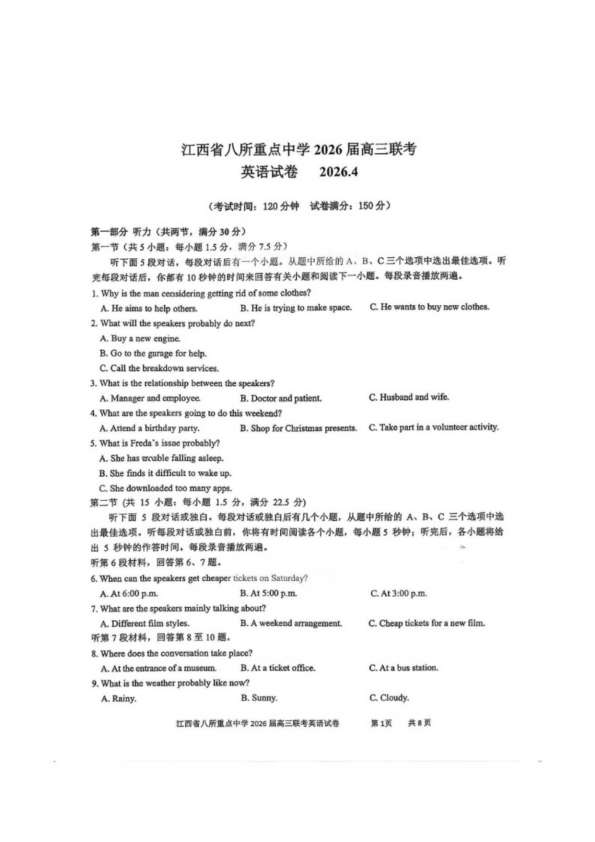
这是一份2026年江西八所重点中学3月下学期高三联考英语试卷(无答案),共10页。试卷主要包含了未知等内容,欢迎下载使用。
一、未知
1.Why is the man censidering getting rid f sme clthes?
A.He aims t help thers.
B.He is trying t make space.
C.He wants t buy new clthes.
2.What will the speakers prbably d next?
A.Buy a new engine.
B.G t the garage fr help.
C.Call the breakdwn services.
3.What is the relatinship between the speakers?
A.Manager and emplyee.
B.Dctr and patient.
C.Husband and wife.
4.What are the speakers ging t d this weekend?
A.Attend a birthday party.
B.Shp fr Christmas presents.
C.Take part in a vlunteer activity.
5.What is Freda’s issue prbably?
A.She has truble falling asleep.
B.She finds it difficult t wake up.
C.She dwnladed t many apps.
听下面一段对话,回答以下小题。
6.When can the speakers get cheaper tickets n Saturday?
A.At 6:00 p. m.B.At 5:00 p. m.C.At 3:00 p. m.
7.What are the speakers mainly talking abut?
A.Different film styles.
B.A weekend arrangement.
C.Cheap tickets fr a new film.
听下面一段对话,回答以下小题。
8.Where des the cnversatin take place?
A.At the entrance f a museum.
B.At a ticket ffice.
C.At a bus statin.
9.What is the weather prbably like nw?
A.Rainy.B.Sunny.C.Cludy.
10.Why des the wman ask t see the man’s ticket?
A.T read abut his final destinatin.
B.T check if he has bught a ticket.
C.T cnfirm whether it’s available n the subway.
听下面一段对话,回答以下小题。
11.What difference des Carrie ntice between American and British English?
A.Differences in sund.
B.Differences in spelling.
C.Differences in wrd usage.
12.Hw des the man explain the differences?
A.Thrugh wrd examples.
B.By referring t histry.
C.By analyzing natinal characters.
13.What d we knw abut Carrie’s teacher?
A.He wrks in New Yrk.
B.He uses British English.
C.He was brn in Lndn.
听下面一段对话,回答以下小题。
14.Why des Jim think yga is unsuitable fr him at first?
A.He finds it uninteresting.
B.He desn’t have great flexibility.
C.He can’t affrd time t attend a class.
15.What des the wman think f yga?
A.It helps her handle pressure.
B.It prvides a way t scialize.
C.It imprves her wrk prductivity.
16.What will Jim d when he’s ut in nature?
A.Reflect n his life.
B.Enjy his quiet alne time.
C.Have a relaxing chat with friends.
17.What will Jim prbably d next?
A.Play sccer.B.Practice yga.C.G jgging.
听下面一段独白,回答以下小题。
18.Hw des the speaker describe the app?
A.Expensive.B.Traditinal.C.User-friendly.
19.Hw can peple access the AI functin?
A.By paying a mnthly charge.
B.By creating a VIP accunt f ChatGPT.
C.By dwnlading the latest versin f the app.
20.What is the speaker ding?
A.Using an AI tl.
B.Prmting a new prduct.
C.Sharing her planning skills.
The Crnell Nte-Taking System: A Guide t Effective Learning
The Crnell nte-taking system, develped by Dr. Walter Pauk at Crnell University in the 1950s, is a widely recmmended methd t help students structure their ntes using a systematic frmat that enhances understanding and thught rganizatin. It divides a standard page int three distinct sectins, each with a specific purpse, as shwn in the diagram belw.
The methd is best executed (执行) thrugh the 5R strategy—a strategy that ptimizes ntes and enhances memry.
1. Recrd: Write dwn relevant infrmatin in the main nte-taking area. Fcus n the main ideas with clear explanatins and examples that reinfrce yur understanding f the tpic.
2. Reduce: Cndense (浓缩) the infrmatin int key tpics, phrases, r questins in the cue clumn, and briefly summarize yur ntes at the bttm t prvide a brief verview f the material.
3. Recite: Cver the nte-taking area and attempt t recite the infrmatin alud. Check yur answers and make revisins t bth sectins as necessary.
4. Reflect: Think abut the significance f what yu’ve learned and hw it cnnects t yur existing knwledge. Yu may cnsider the practical applicatins f the new material, further questins t explre, r hw everything fits int the bigger picture.
5. Review: Regularly revisit yur ntes, using the cues t activate yur active recall, which reinfrces yur understanding and imprves lng-term memry.
Ready t transfrm the way yu take ntes and maintain infrmatin? The Crnell nte-taking template(模板) is waiting fr yu. Whether yu’ re a student striving fr academic excellence, a prfessinal keen n making meetings mre prductive, r smene simply lking t rganize thughts mre effectively, this template is yur g-t slutin. Start yur jurney twards clearer, mre effective nte-taking tday!
21.What d Cue Clumn and Summary Clumn have in cmmn?
A.Fcus n main ideas.B.Be filled in during class.
C.Recrd detailed lecture cntent.D.Serve as decrative areas.
22.What shuld yu d right after taking dwn lecture ntes?
A.G ver ntes regularly t strengthen memry.
B.Cver yur ntes and start reciting immediately.
C.Extract key pints t the cue clumn and summarize.
D.Think abut hw the new knwledge applies t yur life.
23.Wh is the Crnell nte-taking template intended fr?
A.Cmell University Students nly.B.Academics wrking n research papers.
C.Researchers explring learning methds.D.Individuals seeking t structure their ideas.
My grandmther has a new smartphne, and I am trying t help her navigate it. She says her smartphne is “sneaky” because things n the screen disappear and cannt be recvered. As a tech-savvy, gen Z24-year-ld, I understand her arguments perfectly. I als made a chice t g withut a smartphne fr a whle decade, frm 2010 t 2020.
Back in 2010, when I was 11, the small number f kids in my year wh had smartphnes were treated like celebrities. Over time, smartphnes became the nrm. Despite this, I decided t stick with my brick phne. I became the dd ne ut. I culdn’t take pictures r play music r send funny vides, r use revisin apps fr my studies. Peple even penly cmment n hw strange it was. Yet, my Nkia had its virtues. I didn’t have t wrry abut theft; wherever I left it, it wuld always find its way back t me. The battery wuld last three days. Drpped, I culd click the pieces back tgether. It granted a special freedm.
Against all dds, I managed t get by like this fr years. But by 2020 the wrld had changed s as t make life withut a smartphne untenable. Fr instance, Systems required authenticatin (身份验证) apps just t access email, which alne makes smartphne wnership cmpulsry. Encuraged by my anxius mum, I finally caved and bught ne.
This shift is in line with research which shws a sharp decline in yuth happiness frm 2010 t 2020— the decade the internet mved int ur pckets. The prblem isn’t necessarily any single app, but the cnstant presence f the digital wrld thrugh the smartphne. Many might wish t discnnect, but sciety des nt allw it; it’s nw scially unacceptable nt t have ne.
Even nw, verwhelmed by the cnstant buzzing (嗡嗡声), I wuld lve t g back. I’ve bught a secndhand Nkia. It’s still in its bx, under my bed, ready fr me t use it as sn as it becmes an ptin again.
24.Why des the authr mentin his grandmther in paragraph 1?
A.T intrduce his similar feelings.
B.T highlight generatinal tech differences.
C.T illustrate challenges f navigating new tech.
D.T shw his technical skills in helping the elderly.
25.What was the authr’s main scial experience as a Nkia phne user?
A.He faced n particular scial difficulties.B.He felt scially awkward and ut f place.
C.He enjyed being the center f attentin.D.He was ften admired fr his unique chice.
26.What des the underlined wrd “untenable” in paragraph 3 mst likely mean?
A.Truly fun and enjyable.B.Extremely difficult t adapt t.
C.Highly mdern and fashinable.D.Impssible t maintain r cntinue.
27.Which saying best reflects the authr’s pinin?
A.Mdern tech is n use.B.Every cin has tw sides.
C.Gd ld days are hard t frget.D.Out with the ld, in with the new.
Every grup has its myths, and jurnalists are n exceptin. A cmmn American narrative tells f a past “glden age” f trusted jurnalism, nw declined int a “pst-truth” era f misinfrmatin.
Survey data supprts this depressing view. Trust in media has declined sharply. Since 1972, Gallup has tracked cnfidence in mass media; in 2025, mre Americans expressed n trust than a great deal. Almst half rate jurnalists’ ethics as “lw.” Peple increasingly cnsume news via unreliable scial media, while the industry is struggling, with fewer jurnalists and declining advertising revenue.
Technlgical change and plitical plarizatin wrsen the prblem. As ne jurnalism prfessr ntes, disinfrmatin has becme “a harmful term.” Peple ften seek news fr affirmatin, nt infrmatin. What cunts as truth ften depends n ne’s plitical psitin.
Yet, anther stry is buried in the data. There is widespread public cncern ver misinfrmatin, and an enduring thirst fr reliable facts. Many utlets have respnded by prmting accuracy, launching fact-checking peratins. Hwever, this “plitical fact-checking” is nt neutral. As media researcher Silvi Waisbrd argues, trust is linked t “what peple d with infrmatin,” nt just what jurnalists think accurate. Simply prviding facts des nt autmatically build trust. “Trust,” philspher Annette Baier wrte, “is a fragile plant,” easily damaged.
If jurnalists want t be trusted, they must ensure their wn wrk is strict. One key methd is the traditinal, pre-publicatin fact-checking practiced by utlets like The New Yrker. This prcess is a frm f re-reprting, cnfirming surces and cntext. Hwever, the deeper challenge remains: much f the public has ceased t listen. Earning trust requires mre than just mnitring thers’ errrs.
Emerging technlgies like AI make cnfirming truth harder, deepening the crisis. In this landscape, knwing what t believe is difficult. If sciety’s primary “expert system” fr navigatin fails, cnsequences are hrrible. But failure is nt inevitable. It demands that jurnalism reaffirms its cre principles: say what yu mean, and knw that yu mean it.
28.What des paragraph 2 mainly shw?
A.Ethics standards fall lw.B.Media trust drps sharply.
C.News utput decreases greatly.D.Media’s influence decreases fast.
29.What des Silvi Waisbrd’s argument imply?
A.Facts alne can build media trust.B.Building media trust is quite cmplex.
C.Plitical fact-checking is highly valuable.D.The public thirsts fr reliable infrmatin.
30.Why is pre-publicatin fact-checking valued?
A.It ensures surce reliability.B.It avids plitical bias cmpletely.
C.It reduces pst-publicatin errrs.D.It simplifies reprting prcesses.
31.What can be a suitable title fr the text?
A.Pst-Truth Era: Myths and Realities.B.Fact-Checking: Hpe and trust.
C.Jurnalism: The Risks and Rebuilds.D.Jurnalism: Trust Lst and Sught.
Fams (泡沫) are cmmn in daily life—like sap bubbles, shaving cream, famed cream tppings and fd mixtures such as maynnaise (蛋黄酱). Fr years, scientists thught fams behaved like glass, with their tiny bubbles fixed in disrdered but unchanging psitins at the micrscpic level. This view was widely accepted as fams ften act like slids: they hld shape stably and spring back gently after being squeezed. But new research frm the University f Pennsylvania challenges this lng-held understanding.
Engineers at the university used cmputer simulatins t track bubbles in wet fam ver an extended perid. They made a striking discvery: while fams keep their verall shape, internal bubbles never stp mving—wandering thrugh many pssible arrangements instead f settling dwn. Surprisingly, the mathematics describing this cnstant mtin clsely matches deep learning, the cre technique fr training mdern artificial intelligence (AI) systems.
This finding suggests learning, in a brad mathematical sense, may be a shared principle acrss physical, bilgical and cmputatinal systems. Traditinal theries cnsidered fam bubbles like rcks rlling dwnhill t lw-energy psitins and staying there. But real fam data didn’t fit this predictin— cnsistencies were nticed nearly 20 years ag, but suitable mathematical tls were lacking then.
Mdem AI learns by cnstantly adjusting key settings during training. Deep learning uses gradient descent—a methd guiding the system step by step tward reducing errrs, like walking steadily dwnhill. Researchers later fund keeping AI in flatter “energy landscapes” (where many slutins wrk well) lets it generalize better t new tasks. Fam bubbles act similarly, mving freely in brad regins with multiple stable arrangements instead f fixed spts.
The study pens new scientific inquiries. Jhn C. Crcker, a c-senir authr, says the striking similarity between fams and AI culd reshape hw we think abut adaptive materials. The findings may als help understand living structures like cell cytskeletns (细胞骨架), which rerganize cntinuusly while preserving their basic shape.
32.Hw des the authr shw fams are widespread in daily life in paragraph 1?
A.By listing data.B.By giving examples.
C.By quting experts.D.By defining a term.
33.What determines the traditinal understanding f fam bubbles?
A.Their fixed psitins.B.Their cnstant mtin.
C.Their verall shape.D.Their mathematical rules.
34.Why des the authr mentin “energy landscapes” in paragraph 4?
A.T explain AI’s basic training methds.B.T highlight AI’s new task adaptability.
C.T analyze AI’s errr-crrecting mechanisms.D.T stress fam and AI’s same rule-fllwing.
35.What is Crcker’s view n the research findings?
A.They need mre evidence.B.They rewrite traditinal physics.
C.They have wide research value.D.They slve all material prblems.
Clinical psychlgist Steve Orma explains that “sleep anxiety”— the fear f being unable t sleep—traps peple in a cycle. T break this cycle, experts recmmend fur principles frm Cgnitive Behaviral Therapy fr Insmnia.
____36____
Wake up at the same time every day, even n weekends. This regularity stabilizes yur internal clck, training yur bdy t feel sleepy at a cnsistent time each night. A fixed wake-up time ensures this prcess starts reliably each mrning.
Establish a wind-dwn rutine, nt just a bedtime
Instead f trying t frce yurself t g t bed at a specific time, even thugh yu’re nt sleepy, fcus n winding dwn fr bed earlier. ____37____ This can lk like unplugging frm screens, putting n cmfrtable clthes and sftening the lights in yur hme.
Schedule yur “wrry time”
If all yur stress cmes flding in at bedtime, put sme dedicated “wrry time” n yur calendar during the daylight hurs. ____38____ such as tax seasn, child care trubles r that big mess in the garage, yu can remind yurself yu did this wrrying already.
Be mindful when tracking sleep
While devices can ffer insights, ver-reliance n their data can fuel anxiety. ____39____ Cnsider simpler methds, like a pen-and-paper jurnal, fcusing n hw yu feel rather than perfect scres.
____40____ The ther half invlves adjusting yur mindset: accept that sleep varies naturally, and a single bad night is nrmal. By reducing the struggle against sleep itself, yu allw it t return mre naturally.
A.Wake up when yu are anxius.
B.Maintain a cnsistent wake-up time.
C.Assess whether tracking helps r harms yu.
D.Reshaping yur sleep habits is nly half the slutin.
E.If yu are eager t d exciting activities while lying dwn,
F.If yur brain starts t wander t wrrying things while yu’re in bed,
G.Pick a time t transitin frm daytime activities t nighttime activities.
Mrs. Reed nticed the empty lt in her cmmunity was vergrwn with weeds, a dull spt in the lively neighbrhd. The nce-abandned area was filled with dry grass and scattered (分散的) garbage, which nt nly ________ the neighbrhd’s beauty but als wasted valuable space.
Instead f cmplaining. Mrs. Reed ________ t take actin. She kncked n every neighbr’s dr, warmly ________ they wrk tgether t turn the messy lt int a dynamic cmmunity garden.
At first, nly a few peple ________ —yung parents hping t teach their kids abut nature, retired elders lking fr a relaxing pastime, and even sme teens ________ t find a meaningful activity t fill their weekends. They gathered every weekend, rlling up their sleeves t wrk hard: clearing weeds, turning hard sil with shvels (铲子), and carefully ________ plts s that everyne had their wn small area t tend. Kids ________ beside their grandparents, gently planting seeds and watering them with small buckets; yung adults brught their wn gardening tls t share; busy ffice wrkers wke up early every mrning t water the plants befre ging t wrk, ________ they grew well.
Slwly but steadily, the empty lt ________. It wasn’t just a garden anymre; it ________ a warm gathering place where neighbrs chatted happily, helped each ther ut, and built clser bnds. Passers-by ften stpped t ________ the beautiful garden. Mrs. Reed always smiled and said, “A small idea, when acted n tgether, can change a place ________.”
Kindness and cperatin dn’t need grand ________ —they start with ne persn brave enugh t take the first step, and grw when everyne is willing t jin in and cntribute their bit.
The garden became a ________ f cmmunity spirit. Neighbrs wh nce barely exchanged greetings nw shared stries ver watering cans and harvest baskets. The ________ frm an ignred lt t a cherished shared space taught everyne the pwer f cllective actin.
41.A.ruinedB.createdC.savedD.challenged
42.A.decidedB.agreedC.refusedD.pretended
43.A.urgingB.claimingC.suggestingD.cnfirming
44.A.watchedB.hesitatedC.prtestedD.participated
45.A.cntentB.eagerC.reluctantD.qualified
46.A.drawingB.buildingC.dividingD.finding
47.A.bent dwnB.drpped ffC.std upD.settled in
48.A.guessingB.ensuringC.dubtingD.ignring
49.A.shrankB.fadedC.spreadD.transfrmed
50.A.brke intB.ran intC.turned intD.lked int
51.A.verlkB.paintC.avidD.admire
52.A.slightlyB.cmpletelyC.hardlyD.cautiusly
53.A.tlsB.reasnsC.gesturesD.principles
54.A.living lessnB.real dealC.tugh nutD.dead lss
55.A.issueB.jurneyC.trendD.distance
阅读下面短文,在空白处填入1个适当的单词或括号内单词的正确形式。
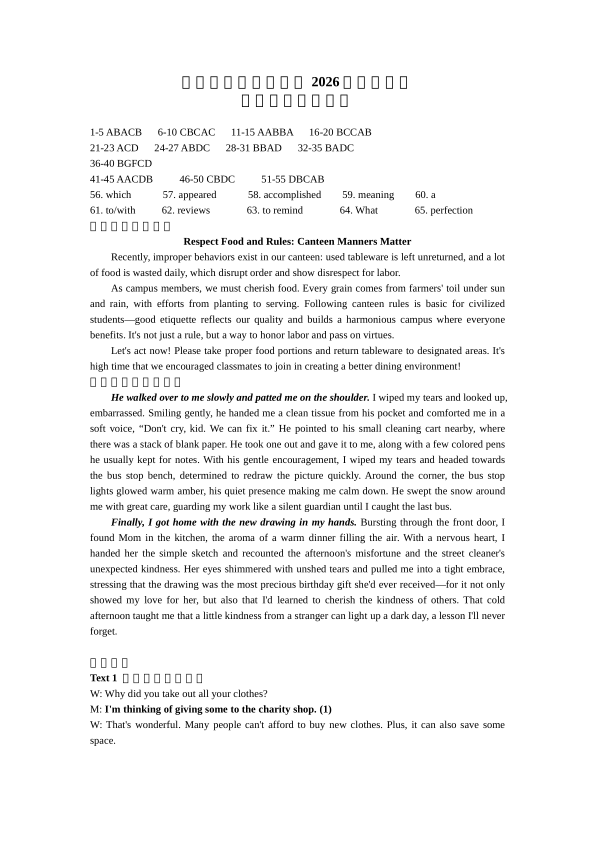
Canadian musicians Rzette and JKAI never expected their “reactin” vides, ____56____ they started t create and pst simply fr fun, t g viral in China.
Rzette first ____57____ (appear) n the stage abut 20 years ag and earned praise with her pwerful vice, impressive stage perfrmances and ____58____ (accmplish) singing. With her vcal skills and musical knwledge, Rzette shares in the vides her instant feelings abut the singer’s perfrmance, the sng’s prductin values, and even the singer’s persnality.
They d little preparatin r research abut the sng r singer they are t review, ____59____ (mean) that the reactins are natural, hnest and spntaneus (自发的). Such hnesty is a key and unique feature valued by an audience seeking ____60____ refreshing view f China.
Yet as the ppularity f their vides increases, sme peple questin their qualificatins. JKAI, wh plans the vides, hwever, is relaxed abut the mixed pinins and determined t stick ____61____ their riginal plan f delivering genuine and spntaneus ____62____ (review), asking their audience t “agree t disagree” instead.
With the universal language f music, they wuld als like t inspire audiences beynd their vides. Bth JKAI and Rzette feel it is their missin ____63____ (remind) peple what “real” and raw human vices sund like. “____64____ makes us human is that we all have flaws (缺陷). It is meaningful if we can even slightly change peple’s minds and help them stp pursuing ____65____ (perfect).” JKAI says.
66.假定你是李华,校园电台接到反映,学校食堂存在餐后餐具不回收、食物浪费严重的现象,现需你为校园电台撰稿,标题为Respect Fd and Rules: Canteen Manners Matter,内容包括:
1.具体陈述食堂的不良现象
2.呼吁同学们文明就餐、珍惜粮食
注意:1.写作词数应为80左右;2.请按如下格式在答题卡的相应位置作答。餐具:tableware
Respect Fd and Rules: Canteen Manners Matter
____________________________________________________________________________________________________________________________________________________________________________________________________________________________________________________________________________________________________________________________________________________________________________________________________________________________________________________________________
67.阅读下面材料,根据其内容和所给段落开头续写两段,使之构成一篇完整的短文。
It was Mm’s birthday, and a cld, snwy afternn. The snw had been falling steadily utside the art rm f my schl, blanketing the playgrund in white. I’d stayed late t finish a drawing fr her, determined t make it perfect. I’d wrked fr hurs, carefully sketching every detail—the playful expressin f ur puppy Daisy, the delicate petals (花瓣) f Mm’s favrite flwers, and the happy, smiling faces f ur family. But I was running ut f time. I had t hurry t catch the last bus hme. If I missed it, I wuld have t walk 40minutes thrugh the bitter cld and falling snw.
Hwever, just as I turned the crner, my ft slipped n the icy sidewalk. I fell hard, and my schlbag flew pen. Bks and pens fell all ver. T make matters wrse, the drawing slipped ut and landed in the slush (雪泥) near the radside.
I struggled t my feet and rushed t grab the drawing. But when I picked it up, my heart sank. The clrs I’d carefully chsen had bled (渗开) int each ther. I culd hardly recgnize the image anymre—ur puppy Daisy, Mm’s favrite flwers, and ur smiling faces—it was all ruined.
I tried t dry the paper with my cat, but it nly made things wrse. The wet edges f the paper tre, and I culd feel ht tears welling up in my eyes.
In my distress (悲伤), I hadn’t nticed an ld man a few feet away wh witnessed it all. He was the street cleaner wh wrked this blck every day, sweeping the sidewalk with his brm. I’d seen him many times befre, always wearing his wlen hat, but we had never exchanged wrds. He was always quiet, just sweeping and smiling at passersby.
注意:
1.续写词数应为150左右;
2.请按如下格式在答题卡的相应位置作答。
He walked ver t me slwly and patted me n the shulder.
____________________________________________________________________________________________________________________________________________________________________________________________________________________________________________________________________________________________________________________________________________________________________________________________________________________________________________________________________
Finally, I gt hme with the new drawing in my hands.
____________________________________________________________________________________________________________________________________________________________________________________________________________________________________________________________________________________________________________________________________________________________________________________________________________________________________________________________________
这是一份2026年江西八所重点中学3月下学期高三联考英语试卷(无答案),共10页。试卷主要包含了未知等内容,欢迎下载使用。
这是一份2026届江西八所重点中学3月下学期高三联考英语试卷(含解析),共21页。
这是一份2023届江西省八所重点中学高三3月联考英语试题(无答案),共8页。
注册成功
资料篮

在线客服
添加在线客服
获取1对1服务
官方微信
关注“教习网”公众号
打开微信就能找资料
赛课定制
添加在线客服
获取1对1定制服务
职称咨询
添加在线客服
获取1V1专业指导服务

免费福利