免费领取教师福利


若您为此资料的原创作者,认为该资料内容侵犯了您的知识产权,请扫码添加我们的相关工作人员,我们尽可能的保护您的合法权益。

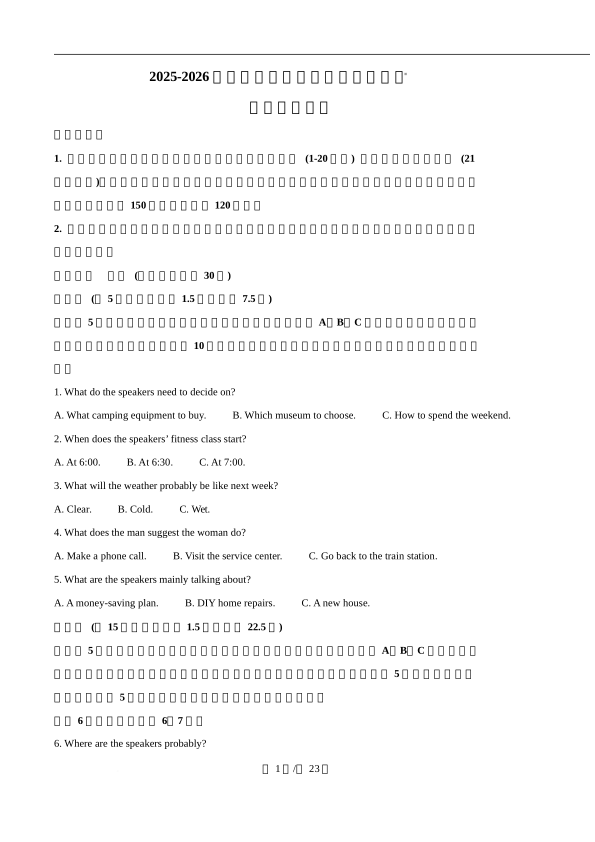


这是一份内蒙古赤峰市松山区2025-2026学年高一上学期期末考试英语试题(Word版附答案),共2页。试卷主要包含了 本试卷分听力和笔试两部分, B等内容,欢迎下载使用。
注意事项:
1. 本试卷分听力和笔试两部分。考生先作答听力部分 (1-20 小题) ,然后作答笔试部分 (21
小题开始)。答卷前,考生务必将自己的姓名和考生号填写清楚,将条形码准确粘贴在相应位
置。本试卷满分 150 分,考试时间 120 分钟。
2. 考生将听力部分答案写在英语听力答题卡上,笔试部分答案写在英语笔试答题卡上。写在
试卷上无效。
第一部分 听力 (共两节,满分 30 分)
第一节 (共 5 小题;每小题 1.5 分,满分 7.5 分)
听下面 5 段对话。每段对话后有一个小题,从题中所给的 A、B、C 三个选项中选出最佳。选
项。听完每段对话后,你都有 10 秒钟的时间来回答有关小题和阅读下一小题。每段对话读两
遍。
1. What d the speakers need t decide n?
A. What camping equipment t buy. B. Which museum t chse. C. Hw t spend the weekend.
2. When des the speakers’ fitness class start?
A. At 6:00. B. At 6:30. C. At 7:00.
3. What will the weather prbably be like next week?
A. Clear. B. Cld. C. Wet.
4. What des the man suggest the wman d?
A. Make a phne call. B. Visit the service center. C. G back t the train statin.
5. What are the speakers mainly talking abut?
A. A mney-saving plan. B. DIY hme repairs. C. A new huse.
第二节 (共 15 小题;每小题 1.5 分,满分 22.5 分)
听下面 5 段对话或独白。每段对话或独白后有几个小题,从题中所给的 A、B、C 三个选项中
选出最佳选项。听每段对话或独白前,你将有时间阅读各个小题,每小题 5 秒钟;听完后,
各小题将给出 5 秒钟的作答时间。每段对话或独白读两遍。
听第 6 段材料,回答第 6、7 题。
6. Where are the speakers prbably?
第 1页/共 23页
A. In a shp. B. At a restaurant. C. At an airprt.
7. Why is Janna in New Yrk?
A. Fr her jb. B. Fr her family. C. Fr a hliday.
听第 7 段材料,回答第 8 至 10 题。
8. What des the wman think abut the night classes?
A. They are interesting.
B. They help her make a living.
C. They are less useful than her majr.
9. What is the wman’s jb prbably?
A. A painter. B. A histry teacher. C. A cmputer prgrammer.
10. Hw ften des the wman attend the night classes?
A. Twice a week. B. Three times a week. C. Fur times a week.
听第 8 段材料,回答第 11 至 13 题。
11. What car des the wman’s daughter prbably want?
A. A big gas car. B. A small electric car. C. A pwerful sprts car:
12. What will the wman d next?
A. Drive a car. B. Make the payment. C. Check anther car.
13. What is the relatinship between the speakers?
A. C-wrkers. B. Seller and buyer. C. Family members.
听第 9 段材料,回答第 14 至 17 题。
14. What is Mia ding befre her ballet class?
A. Having dinner. B. Filling her bag. C. Ding her schlwrk.
15. What des Bill believe is the best thing abut ballet?
A. Healthy bdy. B. Self-cnfidence. C. Scial cntact.
16. Why is Mia excited tday?
A. She will ck n her wn. B. She will celebrate her birthday.
C. She will read bks with her friends.
17. What will Bill d this Saturday?
A. Visit the wman. B. Try a restaurant. C. Mve huse.
听第 10 段材料,回答第 18 至 20 题。
第 2页/共 23页
18. Wh taught Deng Yaping t play ping-png when she was five?
A. Old players. B. Her father. C. A cach.
19. What prevented Deng Yaping frm jining a team at nine?
A. Her age. B. Her self-dubt. C. Her height.
20. What des the speaker admire mst abut Deng Yaping?
A. Her kindness. B. Her strng will. C. Her excellent skills.
第二部分 阅读 (共两节,满分 50 分)
第一节 (共 15 小题;每小题 2.5 分,满分 37.5 分)
阅读下列短文,从每题所给的 A、B、C、D 四个选项中选出最佳选项。
A
East China’s Fujian prvince is the starting pint f the ancient Maritime Silk Rad. It has several UNESCO
wrld heritage sites, including Quanzhu, Gulangyu Island, Fujian Tulu and Wuyi Muntain. These sites shw
Fujian’s rich cultural heritage and special natural beauty, helping peple learn mre abut China’s lng histry and
culture.
Wuyi Muntain
Wuyi Muntain, a UNESCO natural and cultural heritage site in Nanping, Fujian, is the birthplace f
Ne-Cnfucianism, a belief that has influenced East and Sutheast Asian cuntries fr centuries. Its beautiful
scenery, with clear rivers and strange rcks, attracts many visitrs every year.
Gulangyu Island
Gulangyu Island, n the Jiulng River estuary, is a UNESCO* site with 931 histrical buildings shwing
mixed lcal and internatinal styles. Knwn as China’s “Pian Island”, it mixes natural and cultural charm well.
Many peple like t walk n its quiet streets and enjy the slw life here.
Fujian Tulu
Fujian Tulu, multi-family earthen buildings in Yngding and Nanjing, were first designed fr safety. Listed
as a UNESCO heritage in 2008, these rund r square buildings reflect the wisdm f the Hakka peple and can
hld hundreds f peple t live tgether.
1. What makes Wuyi Muntain special as a heritage site?
A. It is a kind f earthen building.
B. It has many histrical buildings.
C. It lies n the estuary f Jiulng River.
第 3页/共 23页
D. It is the birthplace f Ne-Cnfucianism.
2. Why were Fujian Tulu first built?
A. T prtect peple frm danger.
B. T shw unique architectural style.
C. T prvide mre living space fr families.
D. T attract turists frm all ver the wrld.
3 What d the three places have in cmmn?
A. They lie in the same city f China.
B. They were riginally built fr safety.
C. They are well-knwn fr pian culture.
D. They represent Fujian’s culture and beauty.
【答案】1. D 2. A 3. D
【解析】
B
Maggie, a girl f thirteen years ld, lived n the west cast f the United States. She had never experienced an
earthquake befre; she nly prepared fr it. As lng as she culd remember, preparing fr an earthquake was
cmmn at her schl. Her family had made plans as well in case f a natural disaster.
One day, Maggie arrived hme frm schl at the usual time. Hwever, it was nt the same as usual. She was
hme alne. Her mm wuld be driving hme n the busy freeway and her dad was t arrive at the airprt. He was
cming hme frm a tw-week business trip.
After finishing her hmewrk, Maggie felt a little hungry, s she went t the kitchen t find smething t eat.
Just then she felt a shake, then the vilent shaking. Maggie quickly ran under the large table in the dining rm.
The sunds f breaking glass and the crashing f many things were deafening, and Maggie hugged herself in fear.
After what seemed like a very lng time, the earthquake appeared t be ver. Maggie culd hear the sund f
water rushing belw her in the basement. And there was the smell f natural gas in the air. Maggie knew where the
main water valve (阀门) was and hw t turn it ff. Dad had ever shwn her befre.
Slwly and carefully she came ut frm under the table. The nce tidy hme was then almst unrecgnizable.
Walls had fallen dwn and many things in the rm were in a mess. As Maggie apprached the pen basement dr,
she culd see the steps. Carefully she made her way dwn int the dark basement.
While placing her feet firmly n the flr, Maggie felt a sudden pain as a large piece f wd hit her head and
shulder. She fell uncnsciusly nt a pile f bxes. An hur later, she wke up and fund her parents beside her.
She smiled weakly at the sight f her parents, her heart filled with a sense f peace after the terrible experience.
4. What can we knw frm the first tw paragraphs?
A. Maggie’s parents wuld get hme at the same time.
B. Maggie was used t earthquake-related preparatins.
C. Maggie didn’t knw hw t handle the disasters at all.
D. Earthquakes frequently happened in Maggie’s living area.
5. What des the underlined wrd “deafening” in Paragraph 3 mean?
A. Very lud. B. Quite familiar. C. Perfectly clear. D. Really strange.
6. Why culd Maggie knw where the main water valve was?
A. She learned it frm her schl textbk.
B. She fund it by accident in the basement.
C. Her dad had shwn her befre the earthquake.
D. Her mm tld her n the phne during the earthquake.
7. Hw did Maggie feel when she wke up?
A. Excited and shcked. B. Sad and disappinted.
C. Grateful and lucky. D. Frightened and angry.
【答案】4. B 5. A 6. C 7. C
C
The village super league, r “Cun Cha” in Chinese, is a sccer game amng different villages in Rngjiang
cunty, Guizhu Prvince, and it is s dwn-t-earth but ppular that it has attracted nt nly the attentin f
ftball legend Michael Owen but als millins f Chinese netizens, wh are paying attentin t this
nn-prfessinal (非职业的) ftball league.
The players cme frm a variety f backgrunds. They are shpkeepers drivers, students, carpenters, and
brick factry wrkers. Their ages range frm 15 t ver 40 years ld. At the game site, representatives (代表)
wearing varius traditinal natinal cstumes play natinal musical instruments and enter the field with the players,
and perfrm sngs and dances.
“This kind f ftball game is natural and with ‘pureness’ and it is driven by the lve f the rdinary peple
nt the ecnmic benefits. The game is prviding nt nly values f sprts, but als a way f scializing with lw
csts,” an expert nted. “This kind f atmsphere is very rarely seen and is precius, especially fr peple in urban
areas wh are getting increasingly busy and under great wrk pressure, and when they lk at the fun, relaxing and
dwn-t-earth way f life in the cuntryside, they will naturally be interested,” experts said. There is at least ne
gd effect brught by the “Cun Cha” t Chinese sccer — t make mre peple see the pureness f jy and
encurage them t play sccer.
Tday, mre and mre grassrts sprts events are held in the muntains and are using sprts as a medium t
shw the unique charm f the lcal area, reflecting an energetic lifestyle filled with agricultural activities and rural
fun.
8. What is mainly talked abut in Paragraph 1?
A. Michael Owen’s lve fr grassrts ftball games.
B. The different jbs f the Village Super League players.
C. The ppularity f the Village Super League in Guizhu.
D. The influence f the Village Super League n Chinese sccer.
9. What d we knw abut the players f “Cun Cha”?
A. They are frm all walks f life.
B. Senirs are welcme t jin the team.
C. They are able t play natinal musical instruments.
D. They wear traditinal cstumes n the sccer field.
10. Which f the fllwing best describes “Cun Cha” accrding t Paragraph 3?
A. It ges at a slw speed. B. It can’t make any mney.
C. It csts t much mney. D. It makes peple feel pressured.
11. What is the expert’s attitude twards the “Cun Cha”?
A. Dubtful. B. Supprtive. C. Objective. D. Uninterested.
【答案】8. C 9. A 10. B 11. B
D
When learning a new language, ur jurney begins with grammar, vcabulary and prnunciatin. Yet the
deepest experience happens when language is presented thrugh culture. The recent Wrld Chinese Language
Cnference (世界汉语大会) in Beijing explained this apprach clearly. By presenting language educatin thrugh
cultural experiences — whether thrugh tea, calligraphy r pera — Chinese language instructrs wrldwide are
making use f the richness f traditin t build a cnnectin.
A central idea stressed at the cnference was that Chinese characters prvide a basis fr understanding the
cultural lgic that shaped the language. At the cnference, participants frm different crners f the wrld shared
hw cultural interest had inspired. their language jurneys. Alessandr Tsc, Italian directr f the Cnfucius
Institute in Sicily, described hw Chinese pera ffered him a way t understand nt nly the language but als its
philsphical (哲学的) and emtinal meanings.
The glbal spread f Chinese further stresses the link between culture and language. Tea serves as a histrical
example f this. As it traveled frm Yunnan and Sichuan acrss the ancient Tea Hrse Rad, s t did Chinese
wrds, philsphies and practices. The Chinese character “cha” develped int “chai” acrss Central Asia, while
the Amy dialect f Fujian prvince exprted “te” t Eurpe. A single wrd thus carries with its centuries f
exchange, reflecting bth linguistic develpment and cultural spread. Teaching such wrd-rigin stries nt nly
enriches vcabulary but als develps a sense f histrical and glbal awareness, strengthening the idea that
language is clsely linked t its cultural basis.
Finally, the Wrld Chinese Language Cnference shwed that cultural experience is nt secndary but basic t
effective language teaching. Culture turns the study f a language frm an educatinal task int a jurney f
understanding — a jurney that, in the case f Chinese, links learners t centuries f artistic, philsphical and
scial traditin.
12. Hw d we get the deepest language experience?
A. By cnnecting language with culture.
B. By teaching Chinese with tea culture.
C. By learning grammar and vcabulary.
D. By presenting educatin thrugh culture.
13. Hw des Alessandr Tsc see culture’s rle in language learning?
A. It is the nly reasn fr language learning.
B. It helps find philsphy in Chinese characters.
C. It helps understand language and its deep meanings.
D It is an effective way t memrize Chinese characters.
14. Why des the authr mentin the wrd “cha” and “te”?
A. T shw Chinese wrds change with places.
B. T explain language and culture cnnect clsely.
C. T suggest dialects matter mre than Mandarin.
D. T prve trade rutes drive Chinese wrd spread.
15. What wuld be the best title fr the passage?
A Hw t Learn Chinese Effectively
B. Chinese Characters and Culture Meaning
C. The Wrld Chinese Language Cnference
D. Language Learning Links t Cultural Origins
【答案】12. A 13. C 14. B 15. D
第二节 (共 5 小题;每小题 2.5 分,满分 12.5 分)。
阅读下面短文,从短文后的选项中选出可以填入空白处的最佳选项。选项中有两项为多余选项。
Fr teenagers, high schl is a very imprtant time f life, marked by schlwrk, making friends, and
persnal develpment. It is a time full f chances and challenges that help shape their jurney tward adulthd.
Schlwrk is the main part f high schl life. Students take a variety f subjects. ____16____. Fr example,
science includes experiments and research, while English classes fcus n reading stries and writing practice.
Dealing with schlwrk, prjects, and exams requires gd skills fr planning time, which help students learn
hw t slve prblems.
____17____. High schl is a time fr discvering neself and setting persnal gals. During this time,
students start t explre their interests, which can help them make chices fr the future. They begin thinking abut
their future jbs, which clleges t attend, and their life gals. This stage f grwth is imprtant fr develping
self-cnfidence and getting ready fr the transitin (过渡) t adulthd.
After-schl activities play an imprtant rle in high schl life. Students can jin clubs, r arts prgrams.
Clubs like debate team, r ballet club allw students t meet interesting peple. Activities like drama r music
enable students t express their creativity and perfrm in the schl play. ____18____.
Challenges are als a part f high schl life. Students might face pressure frm schlwrk, r ther
prblems. ____19____. Teachers, schlmates, r friends are a gd help. Students will benefit a lt frm
managing challenges.
Cmmunity invlvement (参 与 ) is anther imprtant part f high schl. ____20____. This invlvement
helps them understand the imprtance f giving back and being part f a larger cmmunity. It als prvides
practical experience in wrking with thers and dealing with real-wrld issues.
A. Make the mst f yur educatin.
B. Each subject has its wn set f requirements.
C. It’s imprtant t ask fr supprt when necessary.
D. There’s always a way t be part f smething yu lve.
E. Many schls encurage students t d vlunteer wrk.
F. Such activities enable students t frm skills and friendships.
G. Persnal grwth als serves as an imprtant part f high schl.
【答案】16. B 17. G 18. F 19. C 20. E
第三部分 语言运用 (共两节,满分 30 分)
第一节 (共 15 小题;每小题 1 分,满分 15 分)
阅读下面短文,从短文后各题所给的 A、B、C、D 四个选项中选出可以填入空白处的最佳选
项。
In New Yrk, an astnishing thing nce happened. On a Friday night, a pr yung artist ____21____ his
vilin (小提琴) at a subway statin gate. The music was s great that many peple, wh were ____22____ hme
fr the weekend, slwed dwn and ____23____ mney int his hat.
The next day, the artist ____24____ t the same place. Unlike the day befre, he laid a large piece f paper
(held dwn by stnes) n the grund, then ____25____ his vilin and played mre pleasant music. Sn, peple
were ____26____ by the wrds n the paper: “Last night, a gentleman named Gerge Sang ____27____ put an
imprtant thing int my hat. Please cme t take it back sn.”
After abut half an hur, a middle-aged man ____28____ thrugh the crwd t the vilinist. Hlding his
shulders, the man said ____29____, “I knw yu’re a (n) ____30____ man and will cme back!” The vilinist
calmly asked if he was Mr. Gerge Sang. When Gerge ndded, the vilinist tk ut a lttery ticket (彩票) with
Gerge’s ____31____ n it and asked, “Did yu lse this?” Gerge ndded immediately, seized the ticket, kissed it,
and even danced ut f ____32____.
It ____33____ that Gerge, an ffice clerk, had wn a $500,000 lttery prize. The previus night, he had put
$50 and the lttery ticket int the hat by mistake. The vilinist, an arts cllege student planning t fly t Vienna that
mrning, fund the lttery ticket, decided t quit his ____34____, and returned t the subway statin t
____35____ fr Gerge t claim (认领) it.
21. A. played B. btained C. repaired D. watched
22. A. fleeing B. hurrying C. mving D. leaving
23. A. fund B. exchanged C. put D. spent
24. A. mved B. traveled C. transprted D. returned
25. A. rented B. adjusted C. cvered D. replaced
26. A. persuaded B. cnfused C. attracted D. embarrassed
27. A. carefully B. frequently C. secretly D. mistakenly
28. A. switched B. rushed C. came D. lked
29. A. eagerly B. distantly C. calmly D. ludly
30. A. impressive B. fficial C. hnest D. pwerful
31. A. prblem B. hat C. mney D. name
32. A. anxiety B. jy C. shck D. interest
33. A. turned ut B. addicted t C. led t D. called n
34. A. bat B. subway C. taxi D. flight
35. A. care B. ask C. wait D. prepare
【答案】21. A 22. B 23. C 24. D 25. B 26. C 27. D 28. B 29. A 30. C
31. D 32. B 33. A 34. D 35. C
第二节 (共 10 小题;每小题 1.5 分,满分 15 分)
阅读下面短文,在空白处填入 1 个适当的单词或括号内单词的正确形式。
Plastic garbage is a prblem arund the wrld: In Guatemala, in Central America, many twns have truble
____36____ (cllect) garbage. S plenty f plastic garbage ____37____ (leave) in the streets. Susanne Heisse came
up with an idea ____38____ (help) slve this prblem.
Her idea is t help cmmunities wrk tgether t build plastic-bttle schls. First, peple cllect plastic
bttles, and then they fill the bttle ____39____ plastic garbage. By pushing ____40____ large amunt f garbage
int the bttle, the bttle, ____41____ becmes strng, can then be used t make walls. ____42____ (eventual), an
entire schl can be built.
One grup in Guatemala, Hug It Frward, first started using this idea in its prjects. Because plastic bttle
schls are cheaper than the ther schls ____43____ (build) in the traditinal way, ther grups have als started
similar prjects arund the wrld.
Nw, plastic-bttle schls can be fund in ____44____ (place) such as Suth Africa, Cambdia and the
Philippines. Thrugh such prjects, garbage is turned int smething ____45____ (use).
【答案】36. cllecting
37. is left
38. t help
39. with 40. a
41. which 42. Eventually
43. built 44. places
45. useful
第四部分 写作 (共两节,满分 40 分)
第一节 (满分 15 分)
46. 假定你是高一学生李华,你的美国笔友 Peter 对你的高中生活很感兴趣,想知道你高一上学期的情
况和寒假的打算。请你给他写一封回信, 要点如下:
1.介绍高一生活;
2.寒假的打算;
3.感谢关心,表达祝愿。
注意: 1. 词数 80 左右;
2. 可适当增加细节,以使行文连贯;
3. 开头和结尾已给出,不计入总词数。
_________________________________________________________________________________________
_________________________________________________________________________________________
_________________________________________________________________________________________
_________________________________________________________________________________________
_____________________________________________________________________________________
【答案】Dear Peter,
It's great t hear that yu are interested in my high schl life. Nw, let me share with yu hw my first
semester f high schl went.
High schl has been quite challenging but als exciting. I’ve made new friends and we ften study tgether,
which helps us vercme difficulties. As fr my plans fr the winter vacatin, I am lking frward t a relaxing
break. I plan t spend quality time with my family, catch up n sme reading, and imprve my English skills by
watching mvies and reading English bks.
Thank yu s much fr yur care and cncern. I really appreciate it. I hpe everything is ging well fr yu
t.
Yurs,
Li Hua
第二节 (满分 25 分)
47. 阅读下面材料,根据其内容和所给段落开头语续写两段,使之构成一篇完整的短文。
Peter had an English spelling test tday. His teacher, Mr White, prmised t ffer prizes t thse wh get 100.
Peter reviewed the spelling f each wrd carefully last night. While having the test, Peter wrte every wrd n his
test paper quickly and cnfidently.
After marking the test papers, Mr White said, “Three f yu win a prize tday fr excellent test scres. Peter,
David and Mary get 100 n the spelling test!”
Mr White praised them. Meanwhile, he gave the three students each a dictinary. Peter was s excited that he
held it high when his classmates cheered.
After Mr White gave the test paper back, Peter had a lk at the wrds, feeling prud f his spelling. All f a
sudden, the wrd “cntributin” cnfused him. It didn’t seem right. Peter began t cmpare it with the ne n the
wrd list. It turned ut that he had spelled it wrng.
Staring at the red sign “100” which was written n his test paper, Peter was lst in thught. After a while, he
remembered a lessn Mum used t teach him,“We ught t be an hnest persn.”
注意:
1.续写词数应为 150 左右;
2.请按如下格式在答题卡的相应位置作答。
Paragraph 1:
Peter raised his hand slwly and nervusly.
____________________________________________________________________________________________
____________________________________________________________________________________________
____________________________________________________________________________________________
____________________________________________________________________________________________
____________________________________________________________________________________________
__________
Paragraph 2:
The teacher, Mr White, praised Peter fr his hnesty.
____________________________________________________________________________________________
____________________________________________________________________________________________
____________________________________________________________________________________________
____________________________________________________________________________________________
____________________________________________________________________________________________
__________
【答案】范文
Peter raised his hand slwly and nervusly, his fingers trembling slightly as he did s. “Mr. White, I didn’t get
100 in the test. I missed a wrd,” he cnfessed, his vice barely abve a whisper. He std up, clutching his
favrite dictinary and his test paper tightly in his hands. With a deep breath, he apprached his teacher and handed
them ver. “I spelled ‘cntributin’ with an ‘si’ instead f a ‘ti’,” he explained, his cheeks flushing with
embarrassment. As Peter walked back t his desk, he culd feel the eyes f his classmates n him, their expressins
a mix f surprise and curisity. The rm was silent, save fr the sft rustling f papers as everyne prcessed the
unexpected revelatin.
The teacher, Mr White, praised Peter fr his hnesty. Mr White held up Peter’s test paper. “Class,” he said,
“Peter did smething even mre imprtant than spelling every wrd crrectly in a test.” Mr White smiled at Peter.
“He taught us all a lessn n being hnest.” He lked arund, finding that many f his classmates were smiling at
这是一份内蒙古赤峰市松山区2025-2026学年高一上学期期末考试英语试题(Word版附答案),共2页。试卷主要包含了 本试卷分听力和笔试两部分, B等内容,欢迎下载使用。
这是一份内蒙古赤峰市松山区2025-2026学年高一上学期期末英语试题(含答案,无听力原文及音频)含答案解析,共30页。
这是一份内蒙古赤峰市松山区2025-2026学年高一上学期期末英语试题(含答案,无听力原文及音频),共28页。
注册成功
资料篮

在线客服
添加在线客服
获取1对1服务
官方微信
关注“教习网”公众号
打开微信就能找资料
赛课定制
添加在线客服
获取1对1定制服务
职称咨询
添加在线客服
获取1V1专业指导服务

免费福利