免费领取教师福利
若您为此资料的原创作者,认为该资料内容侵犯了您的知识产权,请扫码添加我们的相关工作人员,我们尽可能的保护您的合法权益。


这是一份2026广东省高三下学期一模英语试题含答案,文件包含试卷2026届广东高三一模英语试题docx、广东2026年普通·高等学校招生全国统一考试模拟测试一英语试题2026高三广东一模英语答案pdf等2份试卷配套教学资源,其中试卷共12页, 欢迎下载使用。
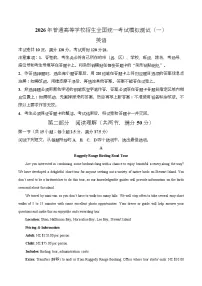
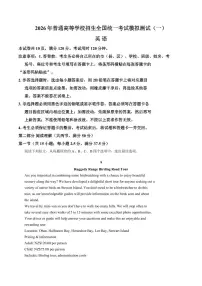
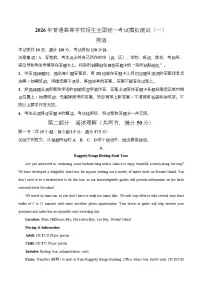
本试卷共 10 页,满分 120 分。考试用时 120 分钟。
注意事项:1.答卷前,考生务必将自己所在的市(县、区)、学校、班级、姓名、考场号、
座位号和考生号填写在答题卡上,将条形码横贴在每张答题卡的“条形码粘贴处”。
2.作答选择题时,选出每小题答案后,用 2B 铅笔在答题卡上将对应题目选项的答案信息点
涂黑;如需改动,用橡皮擦干净后,再选涂其他答案。答案不能答在试卷上。
3.非选择题必须用黑色字迹的钢笔或签字笔作答,答案必须写在答题卡各题目指定区域内相
应位置上;如需改动,先画掉原来的答案,然后再写上新答案;不准使用铅笔和涂改液。不
按以上要求作答无效。
4.考生必须保证答题卡的整洁。考试结束后,将试卷和答题卡一并交回。
第二部分 阅读理解(共两节,满分 50 分)
第一节(共 15 小题;每小题 2.5 分,满分 37.5 分)
阅读下列短文,从每题所给的 A、B、C、D 四个选项中,选出最佳选项。
A
Ruggedy Range Birding Rad Tur
Are yu interested in cmbining sme birdwatching with a chance t enjy beautiful scenery alng the way?
We have develped a delightful shrt tur fr anyne seeking ut a variety f native birds n Stewart Island. Yu
dn’t need t be a birdwatcher t d this tur, as ur knwledgeable guides will prvide infrmatin n the birds
seen and abut the island.
We travel by mini-van s yu dn’t have t walk t many hills. We will stp ften t take several easy shrt
walks f 5 t 15 minutes with sme excellent pht pprtunities. Yur driver r guide will help answer yur
questins and make this an enjyable and rewarding tur.
Lcatin: Oban, Halfmn Bay, Hrseshe Bay, Lee Bay, Stewart Island
Pricing & Infrmatin
Adult: NZ $120.00 per persn
Child: NZ $75.00 per persn
Includes: Birding tur, administratin csts
Extra: Transfers (转移) t and/ r frm Ruggedy Range Bking Office where tur starts/ ends: NZ $10.00
ne-way r NZ $20.00 return per persn.
Grup size: 4 t 8 persns
Imprtant: Turs can perate fr 2 r 3 persns with NZ $25.00 per persn extra charge. If yur bking is fr
less than the minimum, check t see if we have achieved the minimum r, we can reserve spaces, whilst we await
further bkings.
Duratin: 2 hurs
Nte: Subject t ur availability, we may be able t ffer lnger turs.
Departure Time: 9:00 a. m. r 1:00 p. m. r 3:30 p. m.
Imprtant: Departure times can be flexible t fit in with yur schedule and ur availability.
Start/ End: Rugged y Range Bking Office
Suitable fr: Reasnable fitness
Nte: Nt suitable fr children belw the age f 10.
21. What des Birding Rad Tur ffer?
A. Free transprtatin. B. Infrmative guiding.
C. Expert pht service. D. Tailred travel rutes.
22. Hw much shuld a cuple with a teenage child pay if they want t frm a tur grup?
A. $315. B. $340. C. $365. D. $390.
23. Which f the fllwing is required fr turists?
A. Reaching the minimum age. B. Experience in birdwatching.
C. Arriving befre a fixed time. D. Reservatin in grups f fur.
B
When I wrte my first bk three years ag, the wrds came naturally. Eight weeks f even rhythm (节奏)
and it was finished with ease. S when I sat dwn t write my secnd bk, I expected the same effrtless flw.
Instead, I fund myself staring at a blinking (闪烁的) typing line that seemed t flash with quiet accusatin. I
culdn’t begin.
Day after day, I repeated the same rutines: I set up the perfect wrkspace, blcked ut hurs fr writing, and
reread ld pages that had nce made me prud. Nne f it helped. Fr a while, I blamed myself, mistaking my
prcrastinatin (拖延) fr laziness r lack f discipline. Still, the familiar mtins kept me ccupied while the wrk
itself remained still.
Eventually, exhaustin sftened my stress, and I stpped pushing. What if the resistance was trying t tell me
smething? I pened my jurnal and started writing—nt abut the bk, but abut why I culdn’t write it. The
truth that pured ut was simple and childlike: What if this bk isn’t as gd as the first? What if readers decide a
wman like me has already said everything she knws? Beneath the delay, I fund fear — nt f the wrk, but f
judgment. Prcrastinatin had becme a safety net; staying still meant aviding being seen and pssibly fund
lacking.
S I tried smething different. I set a timer fr five minutes and wrte whatever came. A sentence, half an idea,
a small whisper f a scene. My hand mved first, and my mind fllwed. Piece by piece, thse small beginnings
grew int the bk I had been afraid t start.
By the time I finished, I saw prcrastinatin differently. It was never merely delay. It was a quiet dialgue
between the part f me that wants t try and the part that fears the fall. What I nce called wasted time was, in truth,
the stillness befre curage — the quiet reward f writing.
24. Why did the authr keep fllwing the same rutines?
A. T lk fr creative inspiratin. B. T vercme her prcrastinatin.
C. T gain a false sense f prgress. D. T imprve her writing technique.
25. What actually prevented the authr frm writing?
A. Lack f new ideas. B. Pursuit f perfectin.
C. Desire fr scial fame. D. Cncern ver disapprval.
26. Hw did the authr manage t restart her writing?
A. By taking ne step at a time. B. By fcusing n small details.
C. By reflecting n the utcme. D. By fllwing a flexible schedule.
27. What message des the authr seem t deliver in the last paragraph?
A. Curage helps fight against fear. B. Stillness can be part f creativity.
C. Prcrastinatin is a waste f time. D. Writers shuld avid taking breaks.
Cristian Rnald sits n his bed, reminding himself that “sleep is the mst imprtant tl that I have,” and
that a disciplined rutine shapes his perfrmance. The fitness-tracking band n his wrist reflects the clse attentin
he gives t his bdy. But this nce-specialized habit has gradually mved beynd prfessinal sprts, becming
part f the lives f rdinary peple wh want a clearer sense f their health cnditin.
Many wearables n the market prvide reliable heart-rate tracking and basic physilgical (生理的) data,
sufficient fr general everyday mnitring. Sme advanced mdels, hwever, g further. They shw hw habits
like late-night eating r drinking directly influence recvery and readiness fr the next day. Rather than ffering
separate data pints, these devices track hw small changes build up ver time, revealing behaviral patterns that
shape verall health trends.
Health specialist Jess Whitmre says wearables have becme essential tls fr tp athletes, wh nw cnsult
their data as naturally as they tie their bts. Yet nt everyne welcmes this shift tward cnstant mnitring.
Sprts dietitian Jess McGregr warns that the expectatin t “train like an athlete” can push rdinary peple tward
perfectinism and anxiety. The urge t imprve everything — sleep scres, readiness ratings, daily stress — can
make lives center arund numbers. While these numbers ffer insight, they cannt replace subjective awareness f
energy, emtins r recvery needs. “Everything is being digitized and reduced t numbers,” McGregr says.
Perhaps that is the quiet reminder hidden beneath all the data. “When numbers begin t shadw ur days, the
watch n ur wrist can make us frget the bdy’s gentler signals,” says Dr. Zachary Walstn. He adds, “Living a
healthy life still means adding enjyable habits, like evening walks r taking the stairs, and appreciating the
pleasure and freedm they bring, rather than simply chasing device targets.”
28. What can we learn abut fitness tracking frm paragraph 1?
A. It cntrls sprts training rutines.
B. It is adpted t treat sleep disrders.
C. It is cmmn amng rdinary peple.
D. It guarantees tp athletic perfrmance.
29. What makes advanced wearables different frm ther prducts?
A. They are designed specifically fr night eating.
B. They ffer separate and independent data pints.
C. They reveal cnnectins between habits and health.
D. They prvide rich and slid physilgical infrmatin.
30. What is Jess McGregr wrried abut regarding using wearables?
A. Reduced enjyment in daily rutines.
B. Lack f timely prfessinal guidance.
C. Physical injuries frm training t hard.
D. Mental pressure frm chasing numbers.
31. What des Dr. Zachary Walstn suggest peple d?
A. Listen t yur physical signals. B. Predict bdy respnses frm data.
C. Abandn fitness tracking devices. D. Set clear targets fr daily exercise.
D
What if the cmputers f tmrrw didn’t depend n metal and plastic, but instead grew frm the sil beneath
ur feet? This idea is turning int reality in a labratry, where researchers at The Ohi State University have fund
that cmmn fungi — such as shiitake and buttn mushrms — can be used t create memry cmpnents fr
cmputing.
These mushrm-based devices act as rganic memristrs (忆 阻 器 ), shrt fr memry resistrs. Unlike
traditinal resistrs, memristrs have the unique ability t retain infrmatin abut past electrical states. When
current flws in ne directin, their resistance increases; when it flws the ppsite way, their resistance decreases.
Even after the pwer is switched ff, the resistance level remains, thus allwing memristrs t functin like tiny
memry units inside a cmputer.
Mushrms cntain a dense, thread-like netwrk knwn as mycelium (菌丝体), which can send tiny electrical
signals — much like memristrs d. T test this, scientists attached wires t dried mushrms and sent small
electrical pulses thrugh them. The results were remarkable: the mushrms switched between electrical states up
t 5,850 times per secnd with abut 90% accuracy. Althugh their perfrmance drpped under higher electrical
frequencies, stability returned when several mushrms were linked tgether — suggesting a kind f cllective
intelligence, similar t hw brain cells functin tgether.
Beynd these exciting results, mushrms cme with majr envirnmental advantages. Traditinal memristrs
rely n scarce minerals and require high energy cnsumptin. Mushrms, hwever, are renewable, bidegradable,
and easy t grw. Their mycelium can als be shaped int custm structures, making them suitable fr wearable
electrnics, smart sensrs, and ther emerging technlgies.
“Everything needed t explre rganic cmputing culd be as small as a pile f natural waste and sme
hmemade electrnics — r as large as a culturing factry,” said Jhn LaRcc, the study’s lead authr. “All f it
is achievable with the resurces we already have.” In the nt-t-distant future, the cmputers n ur desks may
very well have taken rt — quite literally — in the frest.
32. What des the underlined wrd “retain” in paragraph 2 mean?
A. Track. B. Stre. C. Gather. D. Analyze.
33. What des the authr want t illustrate by mentining brain cells in paragraph 3?
A. The cmplex structure f mushrms.
B. The rapid electrical respnse f mycelium.
C. The cperative nature f mycelium netwrks.
D. The unstable perfrmance f mushrm devices.
34. What advantages d mushrm-based memristrs have accrding t paragraph 4?
A. They are rare and special. B. They are smart and pwerful.
C. They are creative and prductive. D. They are sustainable and adaptable.
35. What can be inferred abut rganic cmputing frm Jhn LaRcc’s wrds?
A. It has a lw barrier t entry. B. It will advance frest research.
C. It helps reduce agricultural waste. D. It will create mre jbs in factries.
第二节(共 5 小题;每小题 2.5 分,满分 12.5 分)
阅读下面短文,从短文后的选项中选出可以填入空白处的最佳选项。选项中有两项为多余选项。
We all experience mments like this: a friend desn’t reply t yur message, r smene walks right past yu
withut nticing. Mst peple mve n quickly, but fr thse wh are sensitive t rejectin, these small mments
feel heavy. 36 .
Rejectin sensitivity means ften expecting thers t reject yu, even when there is n real sign f it. Peple
wh think this way pay t much attentin t thers’ wrds, tne, r silence. A late reply can feel like “They dn’t
like me,” and a serius face may seem like “They’re upset with me.” Because f this fear, they try t prtect
themselves by aviding eye cntact, keeping quiet, r pulling away. 37 — smetimes creating the very
rejectin they were afraid f. The gd news is that gentle, intentinal habits can help.
Challenge yur first reactin. Feelings are nt facts. When yur mind jumps t the wrst explanatin, pause
and ask: What else culd this mean? 38 . Try writing dwn at least tw neutral (中性的) pssibilities befre
accepting the negative ne. This simple practice helps calm emtinal verreactin.
Express yur needs penly. Peple with rejectin sensitivity ften hide their feelings, hping thers will
understand withut being tld. 39 . Try speaking clearly and kindly: “When I didn’t hear back, I felt a bit
unsure. Culd we talk later?” Hnest cmmunicatin builds trust and reduces unnecessary wrry.
40 . If smene reaches ut t yu, ffer a small sign f penness — a smile, a shrt reply, r a simple
“thank yu.” These small gestures shw that yu welcme cnnectin. Over time, they help sften the habit f
pulling away.
A. Pursue strnger bnds with thers
B. But silence easily causes cnfusin
C. Respnd warmly when thers shw care
D. They are always searching fr ways t relieve their anxiety
E. Sadly, this distance can make them seem cld r unfriendly
F. They may immediately assume smething is wrng with them
G. Perhaps the ther persn is busy, stressed, r simply distracted
第三部分 语言运用(共两节,满分 30 分)
第一节(共 15 小题;每题 1 分,满分 15 分)
阅读下面短文,从短文后各题所给的 A、B、C 和 D 四个选项中,选出可以填入空白处的最佳
选项。
I majred in Mechanical Engineering in cllege and what I experienced during the jb-hunting seasn in my
final year changed my life cmpletely. At that time, I nly had ne 41 : t jin an autmaker giant in my
cuntry. I 42 ther pprtunities and pured all my energy int this cmpany. I cleared the written test and
felt 43 abut my interview perfrmance, but the results hit me hard — I was 44 .
Fr days, I culdn’t pull myself tgether, and I 45 the interviewers, my luck, everyne else but myself.
Everything 46 when I attended a seminar n the lcus f cntrl (控制源) — the idea that yu are 47
fr whatever happens t yu, whether gd r bad. This 48 me deeply and pushed me t lk inward.
I realized I had always shifted respnsibility utward — My parents’ fault, my schl’s issue — never mine.
When I reviewed my interview hnestly, I saw the 49 : I had knwledge gaps and cmmunicatin
weaknesses. S I 50 them. In the next interview, with better 51 and real self-awareness, I
perfrmed far better and 52 a psitin in a cmpany even better than the ne I had riginally dreamed f.
They say failure is a harsh (苛刻的) but far mre 53 teacher than success. That seasn, I graduated
nt just as an engineer, but as a student f life, learning that when yu 54 blaming the wrld and start
wning yur failures, yu 55 the pwer t build a better versin f yurself.
41. A. ptin B. appintment C. assignment D. dream
42. A. dismissed B. cmpared C. seized D. lacked
43. A. anxius B. cncerned C. cnfident D. curius
44. A. ignred B. rejected C. evaluated D. prmted
45. A. blamed B. frgave C. analyzed D. challenged
46. A. happened B. wrked C. changed D. failed
47. A. ready B. grateful C. respnsible D. qualified
48. A. terrified B. mved C. cnfused D. struck
49. A. truth B. hpe C. cnsequence D. excuse
50. A. lked fr B. wrked n C. hid frm D. lived with
51. A. payment B. preparatin C. reasn D. relatin
52. A. regained B. discvered C. ccupied D. secured
53. A. pwerful B. patient C. creative D. devted
54. A. delay B. regret C. stp D. mind
55. A. prve B. reclaim C. need D. understand
第二节(共 10 小题;每小题 1.5 分,满分 15 分)
阅读下面短文,在空白处填入 1 个适当的单词或括号内单词的正确形式。
Jrd Hammnd is a British phtgrapher wh first came t live in Chngqing in 2015. Since then, he 56
(regard) the city as his secnd hme. With cameras and curisity, he captures (拍摄) the cuntry’s landscapes and
peple, 57 (reveal) a China that is raw, up-clse and deeply human.
Befre mving t Chngqing, the biggest city Hammnd had ever experienced was Lndn. T him,
Chngqing was Lndn n a 58 (cmplete) different scale—mre intense, mre layered and mre alive.
59 (understand) the city, he started ging n lng walks with his camera. 60 started as a way t feel
mre cmfrtable sn became a daily habit, and eventually, a passin. Phtgraphy gave him a way t explre,
make sense f the surrundings, 61 cnnect with peple and stries.
Chngqing’s rich and clrful urban life inspired him. Frm the riverbanks t the skyscrapers, the visual
cntrasts were 62 (remark). Beynd the city, traveling t places like Yunnan and Guizhu prvinces
deepened his 63 (appreciate) fr China’s cultural and gegraphic diversity. Thse experiences helped him
realize that phtgraphy culd be mre than a persnal hbby — 64 culd be a frm f strytelling.
Thrugh his wrk and stries n scial media, Hammnd tries t shw daily life f Chinese 65 peple
arund the wrld. He hpes t present the real China by shwing these real stries and encurage freigners t see
the real China fr themselves.
第四部分 写作(共两节,满分 40 分)
第一节(满分 15 分)
你将参加英语课上“一分钟演讲”活动。请你针对学校羽毛球社团在招收新成员时设定技术门槛,不
接收零基础新成员的做法写一篇演讲稿,内容包括:
(1)陈述看法;
(2)提出建议。
注意:
(1)写作词数应为 80 左右;
(2)请按如下格式在答题卡的相应位置作答。
Shuld the Badmintn Club Set Entry Requirements?
Gd mrning, everyne.
Thank yu fr listening!
第二节(满分 25 分)
阅读下面材料,根据其内容和所给段落开头语续写两段,使之构成一篇完整的短文。
Every day after schl, Lucas and Nah pressed their nses against Mr. Hendersn’s shp windw. They
stared at the red bicycle that std prudly in the center f the display. Fr mnths, they had saved every spare cin,
yet the price still seemed far beynd their reach.
When the first snw f winter cvered their twn, the brthers saw an pprtunity. They grabbed their shvels
(铲子), determined t turn the snwfall int savings thrugh hard wrk.
They started in their wn neighbrhd. But many residents had already cleared their walkways, and thse
wh hadn’t nly ffered a few cins fr shrt paths. After several tiring hurs, they had earned just seven dllars
— far less than they hped.
Refusing t give up, they headed t Maple Street, where the huses were bigger and the driveways deeper in
snw. Nah kncked n the dr f a beautiful Victrian huse. Mrs. Williams answered, lking like she was in a
hurry. When Nah asked if she needed her driveway shveled, she agreed at nce. She tk a twenty-dllar bill
frm her purse and placed it int Nah’s hand.
“I have t rush ut,” she said with an encuraging smile. “I’ll leave it in yur capable hands.”
The bys stared at the bill, amazed. Twenty dllars — mre than they had made the entire day! Laughing in
disbelief, they set t wrk with fresh energy. The initial excitement carried them thrugh the first hur f wrk. But
as the afternn darkened and the temperature drpped, the wrk became harder. Their hands grew numb (麻木),
their muscles ached, and the lng driveway seemed endless.
Halfway thrugh, Lucas threw dwn his shvel in frustratin (沮丧). “Let’s just g. She’ll never knw we
didn’t finish.”
注意:
(1)续写词数应为 150 左右;
(2)请按如下格式在答题卡的相应位置作答。
Nah’s aching hands seemed t agree with his brther’s wrds.
As they cleared the final shvel f snw, Mrs. Williams’ car returned.
这是一份2026广东省高三下学期一模英语试题含答案,文件包含试卷2026届广东高三一模英语试题docx、广东2026年普通·高等学校招生全国统一考试模拟测试一英语试题2026高三广东一模英语答案pdf等2份试卷配套教学资源,其中试卷共12页, 欢迎下载使用。
这是一份2026届广东高三下学期一模英语试题(含答案),文件包含试卷2026届广东高三一模英语试题docx、2026高三广东一模英语答案pdf等2份试卷配套教学资源,其中试卷共12页, 欢迎下载使用。
这是一份2026广州高三下学期一模英语试题含答案,文件包含试卷2026年广东广州市普通高中毕业班综合测试一英语试题docx、2026年广州市普通高中毕业班综合测试英语卷一参考答案docx等2份试卷配套教学资源,其中试卷共12页, 欢迎下载使用。

注册成功
资料篮

在线客服
添加在线客服
获取1对1服务
官方微信
关注“教习网”公众号
打开微信就能找资料
赛课定制
添加在线客服
获取1对1定制服务
职称咨询
添加在线客服
获取1V1专业指导服务

免费福利


.png)