免费领取教师福利


若您为此资料的原创作者,认为该资料内容侵犯了您的知识产权,请扫码添加我们的相关工作人员,我们尽可能的保护您的合法权益。

这是一份高考英语二轮-微技能之心理描写(复习讲义)(全国通用)(学生版),共16页。学案主要包含了静态走向复杂等内容,欢迎下载使用。
01 \l "_Tc31597" 析·考情精解2
02 \l "_Tc19863" 构·知能架构3
03 \l "_Tc306" 破·考点攻坚6
\l "_Tc26902" 真题动向(2024•1月浙江卷)6
\l "_Tc700" 必备知识7
\l "_Tc700" 关键能力9
\l "_Tc700" 命题预测11
(2024·1月浙江卷)
阅读下面材料,根据其内容和所给段落开头语续写两段,使之构成一篇完整的短文。
Eva spent the first week f high schl trying t keep her head abve water. One f the majr headaches fr her was finding her way in the huge schl building. It was a six-stry building. On each flr, hallways stretched in fur directins, leading t classrms, labratries, and teachers’ ffices. Smewhere in the building, there was als a library, a cafeteria, and a gym.
Having a pr sense f directin, Eva fund it impssible t get arund in such a huge building. All the different hallways and rms were t much t think abut, let alne cmmit t memry. She decided that she wuld memrize where her classes were and then pretend that the rest f the place didn’t exist.
In her first P.E. class, Eva was shcked when Cach Pitt annunced that everyne had t run ne mile arund the track utside. She searched the faces f her classmates fr signs f panic. There was nthing she feared mre than having t run a whle mile. T Eva, “a mile” was used t describe lng distances. It was ten miles frm her hme t her grandfather’s, and that always seemed like a lng way, even in a car!
When Cach Pitt blew his whistle (哨子), Eva figured she wuld be left in the dust. Hwever, while sme f her classmates edged ahead, thers actually fell behind. “It’s just the beginning,” she thught. “I’ll cme in last fr sure.”
Sn Eva began t breathe hard, with her heart punding and legs shaking. Feeling desperate, Eva started using a mind trick n herself. She stpped thinking abut the wrd “mile.” Instead, she fcused n reaching the shadw east n the track by an ak tree up ahead. Then she cncentrated n jgging t the spt where the track curved (拐弯). After that, she tried t see if she culd cmplete her first lap. One lap turned int tw, then three, then fur.
注意:
(1)续写词数应为150左右;
(2)请按如下格式在答题卡的相应位置作答。
Paragraph 1: When Cach Pitt said “Nice wrk!” t her at the finish line, Eva was surprised.
_____________________________________________________________________________________________________________________________________________________________________________________________________________________________________________________________________________________________________________________________________________________________________________________________________________________________________________________________
Paragraph 2: Eva decided t use the same trick t deal with the schl building.
_____________________________________________________________________________________________________________________________________________________________________________________________________________________________________________________________________________________________________________________________________________________________________________________________________________________________________________________________
1. 紧张焦虑
2. 喜悦 / 兴奋
3. 尴尬 / 羞愧
4. 犹豫 / 纠结
5. 决心 / 坚定
能力1 理解差异与化解偏见
情境:转学到新城市的Jack,发现同桌Tm总是独来独往,午餐也总是一个人在教室吃便当,便当盒里总是朴素的饭菜。Jack下意识地认为Tm家境不好,性格孤僻。一次小组活动,Jack “好心”地想多承担工作,并对Tm说:“你的部分简单,我来帮你吧。” Tm愣了一下,深深地看了Jack一眼,没说话。Jack回到家,想起那个眼神,心里有些不自在。
注意:
(1)续写词数应为150左右;
(2)请按如下格式在答题纸的相应位置作答。
Paragraph 1: Lying in bed that night, Jack culdn’t shake ff Tm’s lk.
___________________________________________________________________________________________________________________________________________________________________________________________________________________________________________________________________________________________________________________________________________________________________________________________________________________________________________________________________________
Paragraph 2: The next day at schl, Jack decided t d smething different.
____________________________________________________________________________________________________________________________________________________________________________________________________________________________________________________________________________________________________________________________________________________________________________________________________________________________________________________________________________
能力2勇气与责任的重量
情境:学校艺术节,班长Mary负责保管班级租借的昂贵演出服。演出前夜,她检查时不小心将果汁洒在一件主跳舞裙上,留下明显污渍。专业干洗已来不及,而主演正是班里人缘不好、曾与她有过摩擦的Rse。Mary看着裙子,脑子一片空白。她有两个选择:1. 向老师坦白,但Rse可能会借题发挥,让自己难堪,并影响班级评分;2. 将裙子混入其中,推脱是保管时就这样,可能蒙混过关。
注意:
1. 续写词数应为150个左右;
2. 请按如下格式在答题卡的相应位置作答。
Paragraph 1: Staring at the stained dress, Mary’s hands turned cld.
____________________________________________________________________________________________________________________________________________________________________________________________________________________________________________________________________________________________________________________________________________________________________________________________________________________________________________________________________________
Paragraph 2: When the art festival began, Mary walked tward the teacher’s ffice with the dress in her hands. ____________________________________________________________________________________________________________________________________________________________________________________________________________________________________________________________________________________________________________________________________________________________________________________________________________________________________________________________________________
能力3捷径与原则的抉择
情境:数学一直是Kevin的弱项,而这次期末成绩关系到保送推荐。考试时,坐在他前面的学霸好友David,趁老师不注意,将写满答案的小纸条悄悄滑到Kevin桌下。Kevin盯着脚边的纸条,心脏狂跳。他知道,只要弯下腰,梦想就可能触手可及。他也想起父亲常说的话:“输掉比赛不可怕,可怕的是输掉自己。”
注意:(1)续写词数应为150左右:
(2)请按如下格式在答题卡的相应位置作答。
Paragraph 1: The little paper n the flr seemed t be burning a hle thrugh Kevin’s cnscience.
____________________________________________________________________________________________________________________________________________________________________________________________________________________________________________________________________________________________________________________________________________________________________________________________________________________________________________________________________________
Paragraph 2: When the exam ended, Kevin left the classrm, leaving the paper untuched n the flr.
____________________________________________________________________________________________________________________________________________________________________________________________________________________________________________________________________________________________________________________________________________________________________________________________________________________________________________________________________________
能力4离别与馈赠的意义
情境:爷爷即将搬去远方的养老院。整理旧物时,“我”发现了一个爷爷珍藏的铁皮盒子,里面全是“我”小时候的涂鸦、坏掉的玩具零件、第一次得奖的破旧奖状……这些“我”早已遗忘甚至视为垃圾的东西,却被爷爷如此郑重地保存。“我”原以为离别时,会是“我”安慰伤感的爷爷。
注意:(1)续写词数应为150左右:
(2)请按如下格式在答题卡的相应位置作答。
Paragraph 1: Hlding the rusty tin bx, I felt a lump in my thrat, all my prepared wrds f cmfrt frgtten.
____________________________________________________________________________________________________________________________________________________________________________________________________________________________________________________________________________________________________________________________________________________________________________________________________________________________________________________________________________
Paragraph 2: On the day f Grandpa’s departure, I handed him a carefully wrapped gift f my wn.
____________________________________________________________________________________________________________________________________________________________________________________________________________________________________________________________________________________________________________________________________________________________________________________________________________________________________________________________________________
考向1《The Ppsicle Kids》
(2025·全国天域名校协作体高三)阅读下面材料,根据其内容和所给段落开头语续写两段,使之构成一篇完整的短文。
The Ppsicle Kids
A nearly empty bx f Ppsicles (棒冰) in the freezer, left frm a grandchild’s visit, caught my attentin. Initially, I wanted t thrw it away, but my wife suggested we give the remaining Ppsicles t the neighbrhd children. Her suggestin changed ur life and led us t a future full f “Ppsicle Kids.”
My wife and I, retired n Scial Security, live in an apartment cmplex. After careers in sales and nursing, ur daily cncerns revlved arund aches, pains, and dinner. We ften wndered what gd we were t the wrld.
That changed dramatically after we gave away the first Ppsicle.
Minutes after watching a neighbr by, a secnd grader, walk away with an icy treat, ur drbell rang. An adrable blnd girl, abut six, smiled sweetly, “Is it true yu’re giving away Ppsicles?”
With the bx empty, we returned t ur cncerns.
Early the next mrning, the drbell rang repeatedly. Standing n ur prch were the fur children frm the previus day. They vcalized their wants, chanting (有节奏地喊), “We want Ppsicles! We want Ppsicles!”
Lking int their eager yung faces, I wndered, “What have I started?” Sensing a victry, they ndded eagerly when I explained the rules: ring the bell nce, ne Ppsicle per day, and share smething gd abut their day. But their thin shulders bent dwnwards in disappintment when I mentined they had t give smething in return. I came t the rescue, suggesting they share smething psitive abut their day, like what they learned at schl r helping anther student. Over time, new rules were added: “Ladies first,” “Dn’t interrupt,” and “Prperly get rid f the sticks.”
On hlidays, they expressed their understanding f why the day was celebrated. Over the years, abut fifty yungsters visited. Sme became part f my life, like the fur kids wh jined me n the steps ne spring t read “Where the Red Fern Grws.” We discussed catching crawfish, lving pets, and family relatinships. This simple act f sharing Ppsicles transfrmed ur life, bringing jy and meaning t bth the children and urselves.
注意:
1. 续写词数应为150个左右;
2. 请按如下格式在答题卡的相应位置作答。
One night, anther by appeared at the dr, saying “I dn’t want a Ppsicle; I just need t talk.”
____________________________________________________________________________________________________________________________________________________________________________________________________________________________________________________________________________________________________________________________________________________________________________________________________________________________________________________________________________
I’ve sensed it’s mre than Ppsicles that bring these kids t ur dr.
____________________________________________________________________________________________________________________________________________________________________________________________________________________________________________________________________________________________________________________________________________________________________________________________________________________________________________________________________________
考向2《害羞女孩与歌唱考试》
(2025·江苏南通二模)阅读下面材料,根据其内容和所给段落开头语续写两段,使之构成一篇完整的短文。
Grwing up, I was always shy and uncnfident in myself. Aside frm my parents, I felt thers fund my shyness difficult t accept. It used t be smething that affected my life in the mst negative way pssible. It made me unable t talk in any setting in which I felt uncmfrtable. This means that I wasn’t even able t speak in class, chat with my friends, rder my wn fd, etc.
At the 5th grade, my parents mved t a neighburing city because f the jb relcatin and I changed schls. I fund myself in a new classrm with a new teacher, whm we called Ms. S, surrunded by 30 new faces. This was fairly terrifying. And s when I was asked t stand up and intrduce myself, I was trembling.
Still then, I was labelled as “shy and quiet”. I didn’t have a lt f friends, nly spke in class if I really had t, kept everything t myself, avided public events, and panicked badly at the thught f ral presentatins in class.
This haunted (萦绕) me until ne day, Ms. S annunced in class that each f us was ging t be singing a sl in frnt f the class. I’d had n idea that this was ging t happen. When it was my turn, she called me up t the frnt, instructed the pian player t begin and I very unwillingly sang “Cuck, cuck, pray what d yu d…” in a barely audible, high-pitched vice, with the rest f silent children staring up at me. Ms. S std next t the pian, saying, “Luder! Luder!” But I didn’t knw hw t prject my vice; I culdn’t make it any luder.
I was really upset at it. I cried fr a few hurs. I suspected my childhd shyness was largely unsupprted in the new schl. This even made me nt want t g t schl.
注意:
1. 续写词数应为150个左右;
2. 请按如下格式在答题卡的相应位置作答。
After schl, Ms. S asked me t g int her ffice.
____________________________________________________________________________________________________________________________________________________________________________________________________________________________________________________________________________________________________________________________________________________________________________________________________________________________________________________________________________
I tk her wrd fr it and smething shifted fr me.
____________________________________________________________________________________________________________________________________________________________________________________________________________________________________________________________________________________________________________________________________________________________________________________________________________________________________________________________________________
考向3《长笛丢失与归还》
(2025·浙江强基联盟联考)阅读下面材料,根据其内容和所给段落开头语续写两段,使之构成一篇完整的短文。
There's an image f big cities as sulless places, where everyne appears t be lking ut nly fr themselves. Hwever, my wn experiences tell a different stry. During sme f the mst challenging times f my life, when I was struggling t find prper husing, I wrked as an artist n the street. Fr years, I played my flute(长笛)there, and in ding s, I discvered the natural kindness f peple. They shwed cmpassin withut expecting anything in return, driven purely by human gdwill.
This prfund realizatin tk hld when I was 21, living in Sydney. I wrked at a lcal pub, feeling lst and directinless. Amid the chas f my life, playing the flute was my nly cnstant surce f cmfrt. Lking back, my cnnectin with the flute began when I was 16. Earning a mere $2. 35 an hur at the supermarket, I saved fr tw lng years t buy it. Every day after wrk, playing the flute became my way f prcessing the day's emtins.
One day, while wrking at the pub, smene asked me what I was ding that night. “I’m ging t be playing the flute at—”I started t say, but then it struck me: I had frgtten t pick up my flute when I gt ff the train. Panic set in immediately. In a fit f frustratin, I threw the plastic chair I was hlding acrss the rm.
I rushed t the train statin, hping smene had handed in my flute. N luck. Still, I left my number, clinging t the slim hpe that it wuld turn up. Cnvinced that it was gne frever—after all, I hadn't even written my name n the case—I spent the next week drwning in self-blame, drinking heavily and feeling srry fr myself.
Then, ut f the blue, I received a call frm CityRail. They had my flute. I hurried t the lst prperty ffice at Central Statin. And there it was, amng all the ther lst items.
注意:
1. 续写词数应为150左右;
2. 请按如下格式在答题纸的相应位置作答。
As I went t grab it, the guards there asked fr my ID.
____________________________________________________________________________________________________________________________________________________________________________________________________________________________________________________________________________________________________________________________________________________________________________________________________________________________________________________________________________
Desperate and anxius, I said, “What if I play yu a tune?”
____________________________________________________________________________________________________________________________________________________________________________________________________________________________________________________________________________________________________________________________________________________________________________________________________________________________________________________________________________
必备知识
1. 紧张焦虑
2. 喜悦 / 兴奋
3. 尴尬 / 羞愧
4. 犹豫 / 纠结
5. 决心 / 坚定
能力1
理解差异与化解偏见(原创)
能力2
勇气与责任的重量(原创)
能力3
捷径与原则的抉择(原创)
能力4
离别与馈赠的意义(原创)
考向1
《The Ppsicle Kids》(新情境)
考向2
害羞女孩与歌唱考试(新情境)
考向3
长笛丢失与归还(新情境)
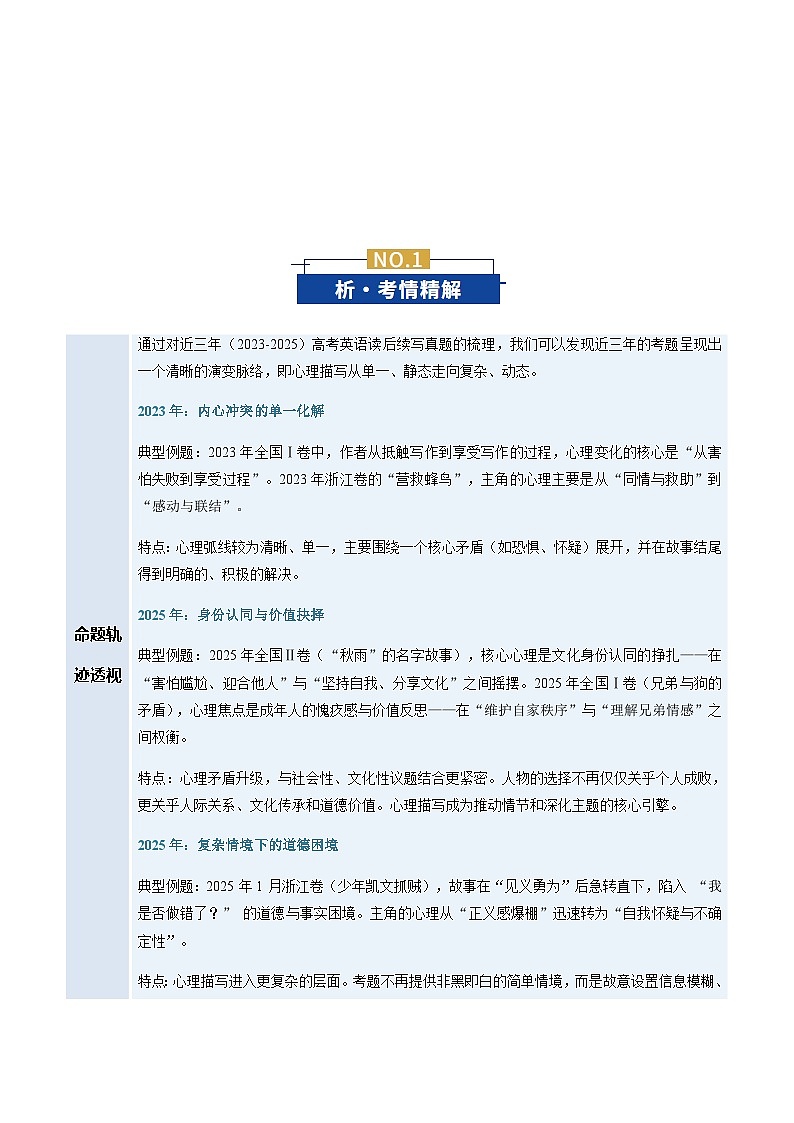
命题轨迹透视
通过对近三年(2023-2025)高考英语读后续写真题的梳理,我们可以发现近三年的考题呈现出一个清晰的演变脉络,即心理描写从单一、静态走向复杂、动态。
2023年:内心冲突的单一化解
典型例题:2023年全国Ⅰ卷中,作者从抵触写作到享受写作的过程,心理变化的核心是“从害怕失败到享受过程”。2023年浙江卷的“营救蜂鸟”,主角的心理主要是从“同情与救助”到“感动与联结”。
特点:心理弧线较为清晰、单一,主要围绕一个核心矛盾(如恐惧、怀疑)展开,并在故事结尾得到明确的、积极的解决。
2025年:身份认同与价值抉择
典型例题:2025年全国Ⅱ卷(“秋雨”的名字故事),核心心理是文化身份认同的挣扎——在“害怕尴尬、迎合他人”与“坚持自我、分享文化”之间摇摆。2025年全国Ⅰ卷(兄弟与狗的矛盾),心理焦点是成年人的愧疚感与价值反思——在“维护自家秩序”与“理解兄弟情感”之间权衡。
特点:心理矛盾升级,与社会性、文化性议题结合更紧密。人物的选择不再仅仅关乎个人成败,更关乎人际关系、文化传承和道德价值。心理描写成为推动情节和深化主题的核心引擎。
2025年:复杂情境下的道德困境
典型例题:2025年1月浙江卷(少年凯文抓贼),故事在“见义勇为”后急转直下,陷入 “我是否做错了?” 的道德与事实困境。主角的心理从“正义感爆棚”迅速转为“自我怀疑与不确定性”。
特点:心理描写进入更复杂的层面。考题不再提供非黑即白的简单情境,而是故意设置信息模糊、动机存疑的灰色地带,重点考察学生在不确定性中刻画人物复杂内心世界的能力。
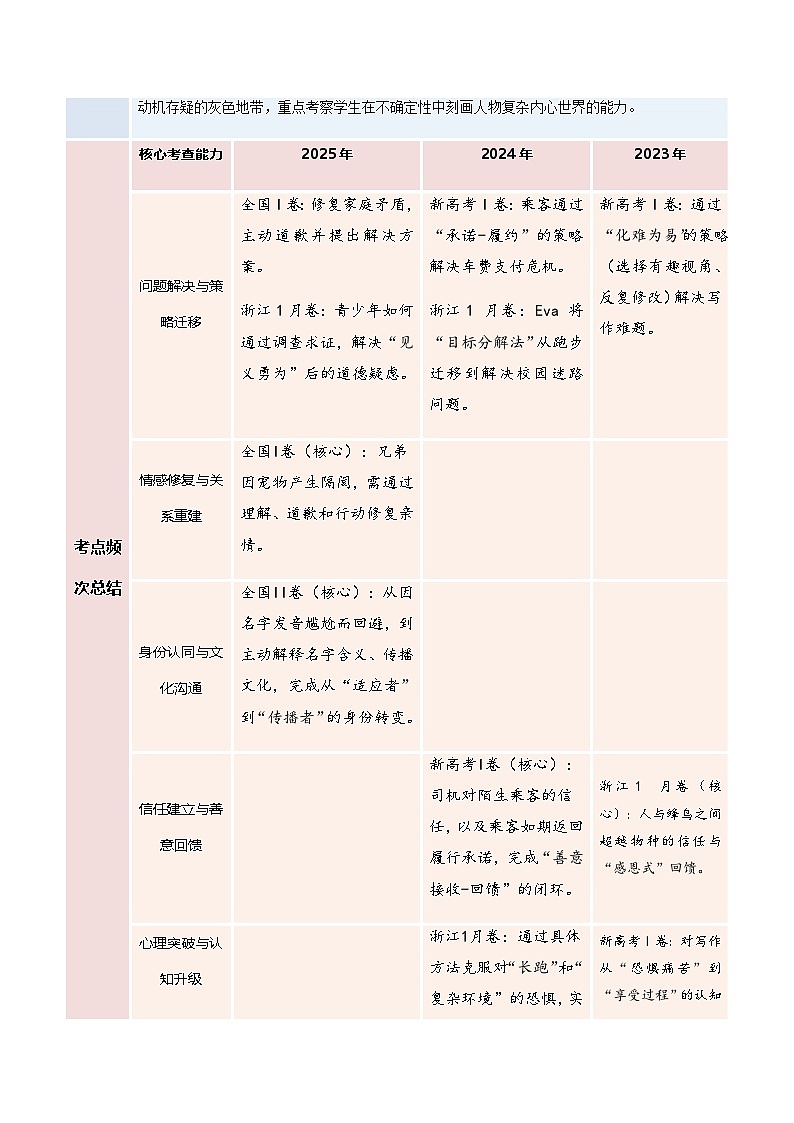
考点频次总结
核心考查能力
2025年
2024年
2023年
问题解决与策略迁移
全国I卷:修复家庭矛盾,主动道歉并提出解决方案。
浙江1月卷:青少年如何通过调查求证,解决“见义勇为”后的道德疑虑。
新高考I卷:乘客通过“承诺-履约”的策略解决车费支付危机。
浙江1月卷:Eva将“目标分解法”从跑步迁移到解决校园迷路问题。
新高考I卷:通过“化难为易”的策略(选择有趣视角、反复修改)解决写作难题。
情感修复与关系重建
全国I卷(核心):兄弟因宠物产生隔阂,需通过理解、道歉和行动修复亲情。
身份认同与文化沟通
全国II卷(核心):从因名字发音尴尬而回避,到主动解释名字含义、传播文化,完成从“适应者”到“传播者”的身份转变。
信任建立与善意回馈
新高考I卷(核心):司机对陌生乘客的信任,以及乘客如期返回履行承诺,完成“善意接收-回馈”的闭环。
浙江1月卷(核心):人与蜂鸟之间超越物种的信任与“感恩式”回馈。
心理突破与认知升级
浙江1月卷:通过具体方法克服对“长跑”和“复杂环境”的恐惧,实现自我认知的突破(“我能行”)。
新高考I卷:对写作从“恐惧痛苦”到“享受过程”的认知转变,发现自我潜能。
道德判断与求证精神
浙江1月卷(核心):在“见义勇为”与“可能冤枉好人”之间产生道德焦虑,并通过实际行动(询问邻居、前往警局)寻求真相,体现理性与善良的结合。
成长领悟与价值升华
所有卷别:最终都导向积极的领悟,如亲情可贵、文化自信、善良需智慧等。
2026命题
预测
2026年的读后续写命题将更青睐那些没有标准答案、充满内在冲突的情境。重点不再是“如何解决问题”,而是“如何面对和思考问题”。人物的心理成长,将体现为学会与困惑、遗憾、两难共处,并形成更成熟、更辩证的认知。
三大可能命题方向:
道德与情感的拉锯:类似于2025年浙江卷的升级版。例如,帮助了某人后却发现可能间接伤害了另一方。要求描写角色在“对与对”之间的纠结与抉择后的复杂心绪。
偏见与理解的破冰:故事开头可能因误解、文化差异或刻板印象产生冲突,续写需要完成从“先入为主的判断”到“深入理解后的共情”这一心理转变。描写重点在于打破偏见时内心的细微震动和认知重构。
遗憾与和解的接纳:事情可能无法回到原点或完美解决(如2025年全国Ⅰ卷)。续写任务可能是如何与不完美的结果、与过去的自己或与他人达成“和解”。心理描写的重点是接受遗憾、完成情感上的自我疗愈。
层面
较常见
更生动/强烈
偏文学性/隐喻
内心独白 (想法)
“What if I fail?”
(“要是失败了怎么办?”)
“My mind has gne cmpletely blank.”
(“我大脑一片空白。”)
“This feels like standing n the edge f a cliff.”
(“这感觉就像站在悬崖边上。”)
身体反应 (证据)
His palms were sweaty.
(他手心出汗。)
A cld sweat brke ut n the back f his neck.
(他后颈冒出一阵冷汗。)
Her heart was a frantic bird trapped in her ribs.
(她的心像只困在肋骨里的狂躁小鸟。)
下意识动作 (表现)
He kept shifting his weight frm ne ft t the ther.
(他不停地换脚支撑重心。)
His fingers fidgeted with the buttn n his sleeve.
(他的手指反复拨弄袖口的扣子。)
She tk a shallw, quick breath that did nthing t calm her.
(她短促地浅吸了一口气,但毫无安抚作用。)
层面
温和/满足
外放/激动
内敛/深刻
内心独白
“All the effrt paid ff!”
(“努力都没白费!”)
“I can’t believe this is happening!”
(“我真不敢相信!”)
“A warmth f pure cntentment settled in my chest.”
(“一种纯粹的满足感在我心中沉淀下来。”)
身体反应
A smile spread acrss her face.
(笑容在她脸上绽开。)
She felt a burst f energy cursing thrugh her veins.
(她感到一股能量在血管中奔涌。)
The tensin in his shulders melted away.
(他肩头的紧张感消融了。)
下意识动作
She let ut a lng, happy sigh.
(她发出了一声愉快的长叹。)
He pumped his fist in the air withut thinking.
(他不假思索地朝空中挥了一拳。)
She hugged the bk t her chest, as if hlding the jy itself.
(她把书紧紧抱在胸前,仿佛抱住了那份快乐。)
层面
轻微/难为情
强烈/丢脸
逃避/退缩
内心独白
“I wish I culd disappear right nw.”
(“我真想立刻消失。”)
“That was the mst humiliating thing ever.”
(“这真是有史以来最丢人的事。”)
“Just pretend it never happened.”
(“就当没发生过吧。”)
身体反应
Her cheeks grew warm.
(她的脸颊发烫。)
He felt a burning sensatin frm his neck t the tips f his ears.
(他感到从脖子到耳尖一阵灼烧感。)
She felt herself shrinking inside.
(她感觉自己从内部在缩小。)
下意识动作
She lked dwn at her shes.
(她低头看自己的鞋。)
He stammered, unable t frm a cmplete sentence.
(他结巴了,说不出一句完整的话。)
She tk a small step back, seeking distance.
(她向后退了一小步,试图拉开距离。)
层面
权衡利弊
内心冲突
无力决断
内心独白
“Optin A is safer, but Optin B has mre ptential…”
(“选A更稳妥,但选B潜力更大…”)
“A part f me wants t say yes, but anther part is screaming n.”
(“一部分的我想答应,但另一部分在大声拒绝。”)
“I’m paralyzed by the chice.”
(“我被这个选择 paralyze 了。”)
身体反应
She bit her lwer lip in cntemplatin.
(她若有所思地咬着下唇。)
A frwn creased his frehead as he wrestled with the decisin.
(他纠结于决定时,眉头皱了起来。)
She felt a weight f indecisin pressing dwn n her.
(她感到一种优柔寡断的重压。)
下意识动作
He paced back and frth in the small rm.
(他在小房间里来回踱步。)
Her hand hvered between the tw ptins, unable t cmmit.
(她的手在两个选项间悬停,无法落下。)
He put his head in his hands, blcking ut the wrld.
(他把头埋在双手里,隔绝了世界。)
层面
冷静决断)
重燃斗志)
破釜沉舟)
内心独白
“There’s n turning back nw.”
(“现在没有回头路了。”)
“I’ve cme t far t give up.”
(“我已经走了这么远,不能放弃。”)
“Even if I fail, I’ll knw I tried everything.”
(“即使失败,我也知道我竭尽全力了。”)
身体反应
A sense f calm fcus washed ver him.
(一种平静的专注感笼罩了他。)
She squared her shulders, feeling a new strength.
(她挺起肩膀,感到一股新的力量。)
His jaw was set in a hard line f determinatin.
(他的下巴绷紧,显出坚定的线条。)
下意识动作
She ndded t herself, the decisin made.
(她对自己点了点头,做出了决定。)
He rlled up his sleeves, ready t get t wrk.
(他卷起袖子,准备开始工作。)
She tk a deep, steadying breath and stepped frward.
(她深吸一口气稳住自己,然后向前迈步。)
这是一份高考英语二轮-微技能之心理描写(复习讲义)(全国通用)(学生版),共16页。学案主要包含了静态走向复杂等内容,欢迎下载使用。
这是一份高考英语二轮-微技能之心理描写(复习讲义)(全国通用)(教师版),共22页。学案主要包含了参考范文等内容,欢迎下载使用。
这是一份高考英语二轮专题-微技能之动作描写(复习讲义)(全国通用)(学生版),共21页。
注册成功
资料篮

在线客服
添加在线客服
获取1对1服务
官方微信
关注“教习网”公众号
打开微信就能找资料
赛课定制
添加在线客服
获取1对1定制服务
职称咨询
添加在线客服
获取1V1专业指导服务

免费福利

.png)
.png)