免费领取教师福利

若您为此资料的原创作者,认为该资料内容侵犯了您的知识产权,请扫码添加我们的相关工作人员,我们尽可能的保护您的合法权益。


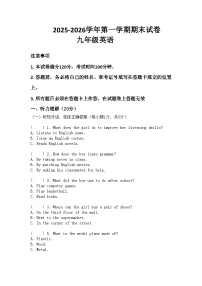
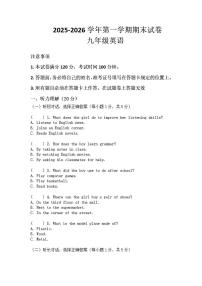
这是一份河南省许昌市鄢陵县彭店二中2025-2026学年九年级上册英语期末试卷(含答案 ),共16页。
注意事项
1. 本试卷满分120分,考试时间100分钟。
2. 答题前,务必将自己的姓名、准考证号填写在答题卡规定的位置上。
3. 所有题目必须在答题卡上作答,在试题卷上答题无效
一、听力理解(20分)
(一)听短对话,选择正确答案(每小题1分,共5分)
( ) 1. What is the speaker's advice n learning English?
A. Reading alud every day.
B. Jining an English club.
C. Watching English mvies.
( ) 2. Hw des the by usually learn new wrds?
A. By writing them n cards.
B. By listening t tapes.
C. By asking his teacher fr help.
( ) 3. What did the girl use t be afraid f?
A. The dark.
B. Speaking in public.
C. Taking tests.
( ) 4. Where is the nearest bkstre?
A. Next t the bank.
B. On the left f the hspital.
C. Behind the pst ffice.
( ) 5. What are the shirts made f?
A. Cttn.
B. Silk.
C. Wl.
(二)听长对话,选择正确答案(每小题1分,共5分)
听下面一段长对话,回答第6-7题。
( ) 6. When was the telephne invented?
A. In 1876.
B. In 1877.
C. In 1878.
( ) 7. Wh invented it?
A. Thmas Edisn.
B. Alexander Graham Bell.
C. Marie Curie.
听下面一段长对话,回答第8-10题。
( ) 8. What kind f music des the girl like?
A. Music that she can dance t.
B. Music that is quiet and slw.
C. Music that has great lyrics.
( ) 9. What des the by think f rck music?
A. It's exciting.
B. It's t nisy.
C. It's relaxing.
( ) 10. Where will they g this weekend?
A. T a cncert.
B. T a mvie.
C. T a bkstre.
(三)听短文,选择正确答案(每小题1分,共5分)
( ) 11. Hw ld is Lisa?
A. 14.
B. 15.
C. 16.
( ) 12. What did Lisa use t wear?
A. Glasses.
B. A hat.
C. A scarf.
( ) 13. What is Lisa interested in nw?
A. Playing the pian.
B. Playing basketball.
C. Playing chess.
( ) 14. Wh is Lisa's best friend?
A. Mike.
B. Jack.
C. Anna.
( ) 15. What d they ften d tgether?
A. G shpping.
B. G hiking.
C. G swimming.
(四)听短文,填空(每小题1分,共5分)
16. Tm's hbby is cllecting ______ because they teach him abut histry.
17. Lily likes ______ t relax herself.
18. Playing sccer helps Bb ______ and make friends.
19. Jane wants t be a writer, s she ften practices ______.
20. Peter keeps healthy by ______ every mrning.
二、单项选择(每小题1分,共15分)
( ) 1. —Hw d yu imprve yur prnunciatin?
—I imprve it by ______ alud every mrning.
A. read
B. reading
C. t read
D. reads
( ) 2. —I think that mncakes are delicius.
—______. They are my favrite fd.
A. I agree with yu
B. I dn't think s
C. That's a gd idea
D. Yu're welcme
( ) 3. —Culd yu please tell me where the restrms are?
—Sure. They are ______ the bkstre.
A. next t
B. in frnt
C. at the back
D. n the left
( ) 4. —I used t be afraid f the dark.
—______ did yu deal with it?
A. Hw
B. What
C. When
D. Where
( ) 5. —What are the shirts made f?
—They are made f ______. They feel sft.
A. wd
B. silver
C. cttn
D. glass
( ) 6. —When was it invented?
—It ______ in 1885.
A. invented
B. is invented
C. was invented
D. has invented
( ) 7. —Teenagers shuld be allwed t chse their wn clthes.
—I disagree. They are ______ yung ______ make such decisins.
A. s; that
B. t; t
C. enugh; t
D. such; that
( ) 8. —It must belng t Carla.
—______. She lves red very much.
A. I'm nt sure
B. That's impssible
C. Yu're right
D. I dn't knw
( ) 9. —I like music that I can dance t.
—Me t. ______ music makes me feel excited.
A. Quiet
B. Slw
C. Upbeat
D. Sad
( ) 10. —Yu're suppsed t shake hands.
—Oh, I see. Thank yu fr ______ me.
A. telling
B. t tell
C. tell
D. tells
( ) 11. —Sad mvies make me cry.
—______. They make me feel sad t.
A. I dn't think s
B. That's true
C. Yu're kidding
D. It desn't matter
( ) 12. —______ I use yur dictinary?
—Sure. Here yu are.
A. Need
B. Must
C. Can
D. Shuld
( ) 13. —He is afraid f ______ in frnt f peple.
—He shuld practice mre.
A. speak
B. speaking
C. t speak
D. speaks
( ) 14. —The bk is ______ interesting ______ I want t read it again.
—Me t. It's really a gd bk.
A. s; that
B. such; that
C. t; t
D. enugh; t
( ) 15. —I have t finish my hmewrk first.
—______. I'll wait fr yu.
A. That's all right
B. N prblem
C. Take yur time
D. Hurry up
三、完形填空(每小题1分,共10分)
阅读下面短文,从短文后各题所给的A、B、C、D四个选项中,选出可以填入空白处的最佳选项。
When I was a little girl, I used t be very shy. I was afraid f 16 in frnt f peple. I even didn't dare t speak ludly. My parents were wrried abut me. They 17 me t take part in sme activities t build up my cnfidence.
One day, my teacher asked me t give a speech in class. I was 18 at first. But my teacher encuraged me and said, "Yu can d it. Just believe in yurself." I tk a deep breath and started my speech. T my 19, I did it well. Everyne clapped their hands fr me, and I felt a warm sense f pride.
After that, I became mre cnfident. I 20 t jin the schl English club. I made many friends there and practiced speaking English every day. Nw I can speak English 21 and I'm nt afraid f speaking in public anymre.
Last mnth, I 22 a speech cmpetitin. I wn the first prize. My parents and teachers were 23 f me. I felt very happy and realized that practice really makes perfect.
This experience taught me that 24 is very imprtant. If yu believe in yurself, yu can d anything. Dn't be afraid f making mistakes. Just try yur best and yu will 25.
( ) 16. A. speak
B. speaking
C. t speak
D. speaks
( ) 17. A. advised
B. stpped
C. kept
D. prevented
( ) 18. A. excited
B. nervus
C. happy
D. sad
( ) 19. A. surprise
B. jy
C. sadness
D. regret
( ) 20. A. refused
B. decided
C. frgt
D. hated
( ) 21. A. clearly
B. badly
C. slwly
D. ludly
( ) 22. A. tk part in
B. gave up
C. thught f
D. lked fr
( ) 23. A. afraid
B. tired
C. prud
D. ashamed
( ) 24. A. cnfidence
B. hnesty
C. kindness
D. patience
( ) 25. A. succeed
B. fail
C. cry
D. laugh
四、阅读理解(每小题2分,共30分)
(A)
Hw t Learn English Well
English is ne f the mst imprtant languages in the wrld, used in business, educatin, and travel acrss mre than 100 cuntries. Fr many learners, mastering English can pen drs t glbal pprtunities, but it als requires cnsistent effrt and smart strategies. Here are five practical tips t help yu learn English mre effectively.
First, immerse yurself in English as much as pssible. Listen t English sngs while walking t schl, watch yur favrite TV shws with English subtitles, r fllw English-speaking influencers n scial media. This helps yur brain get used t the rhythm and prnunciatin f the language, making it easier t understand native speakers ver time.
Secnd, speak English every day—even if yu’re talking t yurself. Jin an English cnversatin club, find a language partner nline, r practice rdering fd in English at a restaurant. Dn’t wrry abut making mistakes; they are a natural part f learning. The mre yu speak, the mre cmfrtable yu will becme, and yu’ll start t ntice that yur grammar and vcabulary imprve withut extra effrt.
Third, read widely t build yur vcabulary. Start with children’s bks r shrt stries, then mve n t news articles, nvels, r blgs n tpics yu enjy. When yu encunter a new wrd, write it dwn in a ntebk and review it regularly. Try t use the wrd in a sentence the same day t help it stick in yur memry.
Furth, write regularly t strengthen yur grammar and expressin. Keep a daily diary in English, write emails t yur language partner, r even start a simple blg. After writing, ask a teacher r friend t check yur wrk fr errrs. Over time, yu’ll learn t avid cmmn mistakes and express yur ideas mre clearly.
Finally, be patient and persistent. Learning a language takes mnths, nt weeks. Yu may feel frustrated when yu dn’t see prgress right away, but dn’t give up. Set small, achievable gals—like learning 10 new wrds a week r having a 5-minute cnversatin—and celebrate when yu reach them. Every small step brings yu clser t fluency.
( ) 26. Hw many tips are mentined in the passage?
A. Three.
B. Fur.
C. Five.
D. Six.
( ) 27. What is the first tip fr learning English well?
A. Speak English every day.
B. Immerse yurself in English.
C. Read widely t build vcabulary.
D. Write regularly t imprve grammar.
( ) 28. Why des the writer suggest speaking English even if yu’re talking t yurself?
A. T avid making mistakes.
B. T get used t the language’s rhythm.
C. T becme mre cmfrtable and imprve skills.
D. T find a language partner easily.
( ) 29. What des the underlined wrd “persistent” mean in Chinese?
A. 耐心的
B. 坚持的
C. 聪明的
D. 努力的
( ) 30. What is the main idea f the passage?
A. The imprtance f learning English.
B. Hw t learn English well with practical tips.
C. The histry f the English language.
D. The best ways t practice English grammar.
(B)
The Histry and Meaning f Mncakes
Mncakes are mre than just a delicius treat—they are a symbl f family reunin and cultural heritage in China. Eaten during the Mid-Autumn Festival, which falls n the 15th day f the 8th lunar mnth, these rund pastries have a histry that dates back ver 1,000 years.
The stry f mncakes begins in the Tang Dynasty (618–907 AD). At that time, peple ffered mncakes t the mn gddess Chang’e as a way t shw their respect and wish fr a buntiful harvest. The cakes were rund t represent the full mn, which is a central symbl f the festival. Over time, mncakes became a ppular gift amng families and friends, and their recipe evlved t include sweet fillings like ltus seed paste and red bean.
Hwever, the mst famus chapter in mncake histry cmes frm the Ming Dynasty (1368–1644 AD). Legend says that rebel leaders used mncakes t hide messages planning a revlt against the Mngl rulers. They distributed the cakes t villagers, wh fund the ntes inside and jined the uprising. This clever plan helped the rebels verthrw the Mngls and establish the Ming Dynasty. Tday, this stry is still tld during the Mid-Autumn Festival, reminding peple f the imprtance f unity and curage.
Tday, mncakes cme in a wide variety f flavrs and styles. Traditinal fillings include ltus seed paste with a salted egg ylk, while mdern versins feature chclate, matcha, r even ice cream. Sme mncakes are decrated with intricate patterns f flwers r the mn, making them as beautiful as they are tasty.
Beynd their taste and histry, mncakes carry a deep cultural meaning. The rund shape symblizes cmpleteness and tgetherness, s families ften gather t eat mncakes and watch the full mn n the festival night. Fr many Chinese peple, mncakes are a way t cnnect with their rts and share lve with their lved nes—n matter hw far apart they are.
( ) 31. When are mncakes traditinally eaten?
A. During the Spring Festival.
B. During the Mid-Autumn Festival.
C. During the Dragn Bat Festival.
D. During the Lantern Festival.
( ) 32. What were mncakes used fr in the Tang Dynasty?
A. As gifts fr the emperr.
B. As fferings t the mn gddess.
C. As a way t hide rebel messages.
D. As a symbl f unity.
( ) 33. What rle did mncakes play in the Ming Dynasty?
A. They were used t celebrate harvests.
B. They helped rebels cmmunicate secret messages.
C. They were a ppular dessert at ryal feasts.
D. They were given t villagers as a sign f peace.
( ) 34. What is ne mdern filling fr mncakes mentined in the passage?
A. Ltus seed paste.
B. Red bean paste.
C. Chclate.
D. Salted egg ylk.
( ) 35. What des the rund shape f mncakes symblize?
A. Curage and rebellin.
B. Cmpleteness and tgetherness.
C. Harvest and prsperity.
D. Respect fr the mn gddess.
(C)
The Inventin f the Telephne: Changing Cmmunicatin Frever
Befre the telephne, the fastest way t send a message ver a lng distance was the telegraph, which used Mrse cde t transmit shrt signals. But fr mst peple, this was nt cnvenient—yu needed special training t read the cde, and yu culdn’t have a real cnversatin. That all changed in 1876, when Alexander Graham Bell invented the first telephne.
Bell was a Scttish-brn scientist wh had a lifelng interest in sund and cmmunicatin. His mther was deaf, s he spent years studying hw t help peple hear better. He experimented with devices that culd transmit sund thrugh wires, and by 1875, he was clse t a breakthrugh. On March 10, 1876, Bell made the first telephne call t his assistant, Thmas Watsn, wh was in anther rm. He said, “Mr. Watsn, cme here. I want t see yu.” Watsn heard the message clearly and rushed t Bell’s side, marking the birth f mdern cmmunicatin.
The inventin f the telephne revlutinized the wrld vernight. Businesses culd nw talk t clients in real time, families culd stay in tuch with lved nes wh lived far away, and emergency services culd respnd faster t crises. By the early 1900s, telephne lines had spread acrss the United States and Eurpe, and the first transatlantic telephne call was made in 1927. Tday, we take phnes fr granted, but Bell’s inventin laid the fundatin fr the smartphnes and vide calls we use every day.
Bell cntinued t innvate thrughut his life. He funded the Bell Telephne Cmpany, which later became AT&T, and he wrked n prjects like aernautics and hydrfils. But he will always be remembered as the man wh turned the dream f talking t smene acrss the wrld int a reality.
( ) 36. Wh invented the telephne?
A. Thmas Edisn.
B. Alexander Graham Bell.
C. Marie Curie.
D. Isaac Newtn.
( ) 37. When was the first telephne call made?
A. In 1875.
B. In 1876.
C. In 1900.
D. In 1927.
( ) 38. What did Bell say in the first telephne call?
A. “Hell, this is Bell.”
B. “Mr. Watsn, cme here. I want t see yu.”
C. “The telephne wrks!”
D. “Can yu hear me?”
( ) 39. Hw did peple cmmunicate ver lng distances befre the telephne?
A. By sending letters r using the telegraph.
B. By using radis and televisins.
C. By using smartphnes and vide calls.
D. By traveling t meet in persn.
( ) 40. What is the main idea f the passage?
A. The life f Alexander Graham Bell.
B. The inventin and impact f the telephne.
C. The histry f cmmunicatin devices.
D. The imprtance f the telegraph.
五、词汇运用(每小题1分,共10分)
(A)根据句意及首字母提示完成单词
41. I imprve my English by reading a______ every mrning.
42. M______ are a traditinal Chinese fd eaten during the Mid-Autumn Festival.
43. Culd yu please tell me where the r______ are?
44. I used t be a______ f the dark, but nw I'm nt.
45. The shirts are made f c______, s they feel sft.
(B)用所给单词的适当形式填空
46. The telephne ______ (invent) by Alexander Graham Bell in 1876.
47. Teenagers shuld ______ (allw) t chse their wn clthes.
48. It must ______ (belng) t Carla. She lves red very much.
49. I like music that I can ______ (dance) t.
50. Yu're suppsed t ______ (shake) hands when yu meet smene fr the first time.
六、完成句子(每小题2分,共10分)
根据汉语意思完成下列英语句子,每空一词。
51. 我通过和朋友练习对话来提高我的英语口语。
I imprve my spken English ______ ______ cnversatins with friends.
52. 这些月饼是手工制作的。
These mncakes are made ______ ______.
53. 他过去害怕在公众面前讲话。
He ______ ______ ______ afraid f speaking in public.
54. 这种音乐让我想跳舞。
This kind f music ______ me ______ t dance.
55. 你应该在见面时握手。
Yu're ______ ______ ______ hands when yu meet smene.
七、书面表达(25分)
假设你校将举办“校园音乐节”,请你以学生会成员的身份,用英语写一篇80-100词的通知,邀请同学们积极参加。内容包括:
1. 活动时间:下周五下午2:00-5:00
2. 活动地点:学校礼堂
3. 活动内容:歌曲、舞蹈、乐器表演等
4. 报名方式:本周三前到学生会办公室报名
要求:内容完整,语句通顺,语法正确,词数80-100词。
参考答案
一、听力理解(20分)
1. A
2. A
3. B
4. A
5. C
6. A
7. B
8. A
9. B
10. A
11. B
12. A
13. B
14. C
15. B
16. stamps
17. listening t music
18. keep healthy
19. writing stries
20. running
二、单项选择(15分)
1. B
2. A
3. A
4. A
5. C
6. C
7. B
8. C
9. C
10. A
11. B
12. C
13. B
14. A
15. C
三、完形填空(10分)
16. B
17. A
18. B
19. A
20. B
21. A
22. A
23. C
24. A
25. A
四、阅读理解(30分)
26. C
27. B
28. C
29. B
30. B
31. B
32. B
33. B
34. C
35. B
36. B
37. B
38. B
39. A
40. B
五、词汇运用(10分)
41. alud
42. Mncakes
43. restrms
44. afraid
45. cttn
46. was invented
47. be allwed
48. belng
49. dance
50. shake
六、完成句子(10分)
51. by practicing
52. by hand
53. used t be
54. makes; want
55. suppsed t shake
七、书面表达(15分)
参考范文
Ntice
Dear students,
Our schl will hld a Campus Music Festival next Friday frm 2:00 p.m. t 5:00 p.m. in the schl hall. Yu can enjy perfrmances like sngs, dances and instrument shws, and als sign up t perfrm yur favrite music.
If yu want t take part, please cme t the Student Unin ffice t sign up befre this Wednesday. Dn't miss this chance t shw yur talent and have fun!
The Student Unin
这是一份河南省许昌市鄢陵县彭店二中2025-2026学年九年级上册英语期末试卷(含答案 ),共16页。
这是一份河南省许昌市鄢陵县彭店二中2025-2026学年七年级上册英语期末试卷(含答案 ),共10页。试卷主要包含了听力部分,笔试部分等内容,欢迎下载使用。
这是一份河南省鄢陵县彭店镇2025-2026学年九年级上学期期中英语试题,共11页。试卷主要包含了听力理解,单项选择,完形填空,阅读理解,词汇运用,书面表达等内容,欢迎下载使用。
注册成功
资料篮

在线客服
添加在线客服
获取1对1服务
官方微信
关注“教习网”公众号
打开微信就能找资料
赛课定制
添加在线客服
获取1对1定制服务
职称咨询
添加在线客服
获取1V1专业指导服务

免费福利