免费领取教师福利



若您为此资料的原创作者,认为该资料内容侵犯了您的知识产权,请扫码添加我们的相关工作人员,我们尽可能的保护您的合法权益。


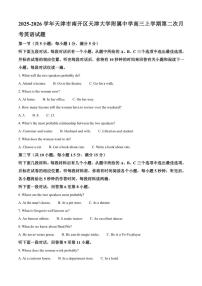
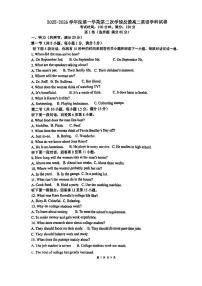
这是一份2025-2026学年天津市南开大学附属中学高二上学期第二次月考英语试卷,共13页。
第Ⅰ卷
注意事项:1. 考生务必将自己的姓名、准考号填写在答题卷和答题卡上。
2. 每小题选出答案后,用铅笔把答题卡上对应题目的答案标号涂黑。如需改动,用橡皮擦干净后,再涂其他答案标号。
第一部分:听力(共两节,满分20分)
第一节(共5小题;每小题1分,满分5分)
听下面5段对话。每段对话后有一个小题,从题中所给的A.B.C三个选项中选出最佳选项,并标在试卷的相应位置。听完每段对话后,你将有10秒钟的时间来回答有关小题和阅读下一小题。每段对话仅读一遍。
1. Whm did the wman buy the bks fr?
A. Her father. B. Her brther. C. Her mther.
2. When is the train leaving?
A. At 10:15. B. At 10:30. C. At 10:40.
3 Where is Angela nw?
A. In the gym. B. In the apartment. C. In the classrm.
4. What are the speakers mainly talking abut?
A. Their exam. B. Their hmewrk. C. Their prfessr.
5. What des the wman like t d?
A. Cllect stamps. B. Read bks. C. Take phts.
第二节(共10小题;每小题1.5分,满分15分)
听下面几段材料。每段材料后有几个小题,从题中所给的A、B、C三个选项中选出最佳选项,并标在试卷的相应位置。听每段材料前,你将有时间阅读各个小题,每小题5秒钟;听完后,各小题将给出5秒钟的作答时间。每段材料读两遍。
听下面一段对话,回答第6至第8小题。
6. What des the man suggest ding at first?
A. Ging sightseeing. B. Ding sme sprts. C. Enjying sme shws.
7. What des the man think f the car museum?
A. Funny. B. Bring. C. Expensive.
8. What will the Spanish family prbably d at last?
A. See a tennis match. B. Attend a pp festival. C. G sailing.
听下面一段对话,回答第9至第11小题。
9. When did the accident happen?
A. Arund 12:00 ’clck. B. Arund 1:00 pm. C. Arund 2:30 pm.
10. Hw many peple were there in the car?
A. Three. B. Fur. C. Tw.
11. What des the wman tell the man abut the car?
A. Its clr. B. Its mdel. C. Its number.
听下面一段独白,回答第12至第15小题。
12. Hw much d children need t pay fr the center?
A. £3.70. B. £3.00. C. £2.50.
13 Wh can get a special guided tur f the center?
A. Peple wh are in a grup f six r mre.
B. Peple wh are at the age f ver sixty.
C. Peple wh take an undersea vyage.
14 What activity is new at the center?
A. Feeding different animals.
B. Visiting a sea life theater.
C. Walking acrss a glass bridge.
15. What will the speaker talk abut next?
A. A gift shp. B. A bkstre. C. A dining area.
完形填空(每题1.5分,共20题,共计30分)
One day, we had a family dinner. While the adults were busy with their serius talk utside, I was left alne in the ___16___ t help my grandmther wash dishes. ___17___, my grandmther wuld tell me stries abut her childhd.
Brn just befre WWII, my grandmther ___18___ an entirely different childhd lifestyle frm mine. She did nt have a chance t attend ___19___. Like in typical families, where bys were ___20___ much mre than girls, my grandma had t stay at hme t d ___21___. The nly pprtunity she culd seize t ___22___ was when her brther was having Chinese ___23___ with the family tutr. She wuld sit quietly at the far end f the lng dinner table, listening ___24___ . This training taught her t read and write her Chinese upside dwn—a skill that has turned ut t be quite ___25___, especially whenever we share the newspaper.
On mst weekends, my grandmther, a yung girl then, and her brther wuld g t the ___26___. There, they wuld walk thrugh deep water, sit dwn crss-legged underwater and hld their ___27___ while they watched all actin ging n arund them. This is smething I ___28___ — her ability t pen her ___29___ underwater and still sit cmfrtably n the sea-bed.
My childhd is quite ___30___ cmpared with hers. I am ___31___ that I did nt need t ___32___ the hardships like she did. I’ve never faced the prblem f ___33___. I guess ur different childhd backgrund is what makes my grandmther such an amazing persn t ___34___ t: her stries always make my histry textbks ___35___.
16. A. sitting rmB. kitchenC. yardD. dining hall
17. A. As usualB. By the wayC. Fr exampleD. Here and nw
18. A. adjustedB. prmtedC. adaptedD. experienced
19. A. wrkB. schlC. curtD. press
20. A. favredB. tleratedC. trustedD. acknwledged
21. A. gardeningB. hmewrkC. businessD. husewrk
22. A. exerciseB. studyC. explreD. teach
23. A. fdB. guestsC. lessnsD. tea
24. A. carefullyB. directlyC. nervuslyD. urgently
25. A. prfessinalB. awkwardC. simpleD. practical
26. A. marketB. muntainC. beachD. class
27. A. secretB. breathC. viewD. tngue
28. A. admireB. nticeC. adptD. wander
29. A. handsB. muthC. eyesD. arms
30. A. difficultB. cmplicatedC. happyD. similar
31. A. gratefulB. surprisedC. cnvincedD. regretful
32. A. reflect nB. g thrughC. ask abutD. prepare fr
33. A. unemplymentB. healthC. educatinD. cmmunicatin
34. A. attendB. referC. leadD. talk
35. A. cme trueB. cme rundC. cme utD. cme alive
第四部分:阅读理解(每题2.5分,共20小题,共计50分)
阅读下列短文,从每题所给的A、B、C、D四个选项中,选出最佳选项。
A
Getting int cllege is a big step fr high schl graduates, and it cmes with a lt f changes. Fr mst students, it’s the first time they’re living away frm hme and managing their wn life. Nt surprisingly, adapting t this new lifestyle can be challenging. The fllwing fur tips will make high schl graduates better prepared fr cllege life.
Gal setting
When setting gals, whether they’re academic, career, r persnal, re-member they shuld be attainable but nt t easy, s that yu really have t push yurself t achieve them, and feel rewarded when yu d. Writing dwn yur gals and breaking dwn each huge, lng-term gal int smaller mre practical nes can help make it feel mre real, and writing ut a plan fr achieving it can give yu a radmap t success.
Interpersnal skills
At cllege, yu will interact with fellw students, prfessrs, librarians, and many thers. Strng interpersnal skills will help yu build relatinships during this time, and get mre ut f them. If yu feel that yur interpersnal skills need sme wrk, practice asking thughtful questins and listening clsely, develp yur understanding by putting yurself in smene else’s shes, and enhance yur self-cnfidence.
Studying
With fewer in-class hurs and mre n-yur-wn learning, yu’re required t really digest learning material rather than simply memrize facts. T be successful in cllege yu’ll need t learn hw t integrate large amunts f infrmatin btained thrugh reading, d research, and write papers. Organizatin is the key, s if yu are nt smene wh is naturally rganized, set up yur study schedule.
Budgeting
Managing mney is a critical life skill, and fr many, it is at cllege that they develp it fr the first time. Start by estimating yur financial balance. Then give high pririty t the expenses n basic needs and determine hw much mney t set aside every mnth t cver thse csts. Dn’t frget abut savings…and the fun stuff(mvies, dinners ut), t.
36. Wh is this passage mst prbably written fr?
A. Cllege teachers.
B. University graduates.
C. High schl teachers.
D. Wuld-be cllege students.
37. What is the authr’s suggestin fr reaching a huge gal?
A. Divide it int smaller, mre achievable nes.
B. Reward neself fr each gal ne has set.
C. Purchase a clear, updated radmap.
D. Push neself t an upper level.
38. One f the suggested ways t enhance yur interpersnal skills is t ________.
A. prepare cmplicated questins
B. try n smene else’s shes
C. listen t thers carefully
D. take advantage f thers
39. What is the key t successful cllege study accrding t the authr?
A. Being well-rganized.
B. Being well-infrmed.
C. Effective reading skills.
D. Reliable research methds.
40. T learn hw t manage mney, the first thing t d is________.
A. save mney fr financial investment
B. estimate ne’s incme and expenses
C. set aside mney fr fun activities
D. pen a persnal bank accunt
B
Lisa was running late. Lisa, 25, had a lt t d at wrk, plus visitrs n the way: her parents were cming in fr Thanksgiving frm her hmetwn. But as she hurried dwn the subway stairs, she started t feel uncmfrtably warm. By the time she gt t the platfrm, Lisa felt weak and tired—maybe it hadn’t been a gd idea t give bld the night befre, she thught. She rested herself against a pst clse t the tracks.
Several yards away Frank, 43, and his girlfriend, Jennifer, fund a spt clse t where the frnt f the train wuld stp. They were deep in discussin abut a huse they were thinking f buying.
But when he heard the scream, fllwed by smene yelling, “Oh, my Gd, she fell in!” Frank didn’t hesitate(犹豫). He jumped dwn t the tracks and ran sme 40 feet tward the bdy lying n the rails. “N! Nt yu! ”his girlfriend shuted after him.
She was right t be alarmed. By the time Frank reached Lisa, he culd feel the tracks shaking and see the light cming. The train was abut 20 secnds frm the statin.
It was hard t lift her. She was just ut. But he managed t raise her fur feet t the platfrm(站台) s that bystanders culd hld her by the legs and drag her away frm the edge. That was where Lisa briefly regained cnsciusness(知觉), felt herself being pulled alng the grund, and saw smene else hlding her purse.
Lisa thught she’d been rbbed. A wman held her hand and a man gave his shirt t help stp the bld puring frm her head. And she tried t talk but she culdn’t, and that was when she realized hw much pain she was in.
Plice and fire fficials sn arrived, and Frank tld the stry t an fficer. Jennifer said her byfriend was calm n their 40-minute train ride dwntwn - just as he had been secnds after the rescue(营救), which made her think abut her reactin at the time. “I saw the train cming and I was thinking he was ging t die,” she explained.
41. What was the mst prbable cause fr Lisa’s weakness?
A. She had run a lng way.B. She felt ht in the subway.
C. She had dne a lt f wrk.D. She had dnated bld the night befre.
42. Why did Jennifer try t stp her byfriend?
A. Because they wuld miss their train.
B. Because he didn’t see the train cming.
C. Because she was sure Lisa was hard t lift.
D. Because she was afraid the train wuld kill him.
43. Hw did Frank save Lisa?
A. By lifting her t the platfrm.B. By helping her rise t her feet.
C. By pulling her alng the grund.D. By dragging her away frm the edge.
44. When did Lisa becme cnscius again?
A. When the train was leaving.
B. After she was back n the platfrm.
C. After the plice and fire fficials came.
D. When a man was cleaning the bld frm her head.
45. The passage is intended t _____________
A. warn us f the danger in the subwayB. shw us hw t save peple in the subway
C. tell us abut a subway rescueD. reprt a traffic accident
C
While safety imprvements might have been made t ur streets in recent years, transprt studies als shw declines in pedestrian (行人) mbility, especially amng yung children. Many parents say there’s t much traffic n the rads fr their children t walk safely t schl, s they pack them int the car instead.
Dutch authrs Thalia Verkade and Marc te Brömmelstret are bthered by facts like these. In their new bk Mvement: Hw t Take Back Our Streets and Transfrm Our Lives, they call fr a rethink f ur streets and the rle they play in ur lives.
Life n city streets started t change decades ag. Whle neighburhds were destryed t make way fr new rad netwrks and kids had t play elsewhere. Sme cmmunities fught back. Mst famusly, a Canadian jurnalist wh had mved her family t Manhattan in the early 1950s led a campaign t stp the destructin f her lcal park. Describing her alarm at its prpsed replacement with an expressway, Jane Jacbs called n her mayr (市长) t champin “New Yrk as a decent place t live, and nt just rush thrugh.” Similar campaigns ccurred in Australia in the late 1960s and 1970s as well.
Althugh these campaigns were widespread, the reality is that the majrity f the western cities were cmpletely redesigned arund the needs f the mtr car. The number f cars n rads has been increasing rapidly. In Australia we nw have ver twenty millin cars fr just ver twenty-six millin peple, amng the highest rate f car wnership in the wrld.
We invest a lt in rads that help us rush thrugh, but we fail t accunt fr the true csts. D we really recgnise what it csts us as a sciety when children can’t mve safely arund ur cmmunities? The authrs f Mvement have it right: it’s time t think differently abut that street utside yur frnt dr.
46. Accrding t the passage, why d many parents chse t drive their children t schl?
A. Because walking t schl takes t much time.
B. Because they think the rads are t dangerus fr walking.
C. Because their children are t yung t walk alne.
D. Because schls encurage parents t drive.
47. What were the Canadian jurnalist and ther campaigners trying t d?
A. Keep their cities livable.B. Prmte cultural diversity.
C. Help the needy families.D. Make expressways accessible.
48. What can be inferred abut the campaigns in Australia in the late 1960s and 1970s?
A. They bsted the sales f cars.B. They turned ut largely ineffective.
C. They wn gvernment supprt.D. They advcated building new parks.
49. What can prbably be the pinin f the authrs the bk Mvement?
A. They think streets shuld be mainly fr cars.
B. They think streets shuld be safer and mre enjyable fr peple.
C. They want t build mre expressways in cities.
D. They believe children shuld nt g ut n streets.
50. What is the best title f the passage?
A. The develpment f cars in Western cuntries.
B. The effects f t many cars n peple’s life.
C. The benefits f driving children t schl.
D The imprtance f building mre expressways.
D
“Jin ur exciting wildlife watching turs and experience the hliday f a lifetime!” Ec-wildlife turs like this are becming mre and mre ppular with turists. The pprtunity t see whales and dlphins swimming in their natural habitat is s much better than seeing these great mammals in zs and aquariums. As yur bat edges ut int the blue water, a grup f dlphins cme t greet yu and swim arund the bat, jumping playfully arund yu. In sme places, tur cmpanies even encurage turists t g swimming with the dlphins. These intelligent mammals seem t enjy ur cmpany, and interact with us. But is it pssible that this kind f human activity is putting their survival at risk?
A recent study has shwn that the behaviur f whales and dlphins changes greatly when they are clse t bats. Interpreting the bats as a pssible danger, they start t breathe mre quickly. The bats drive them away frm the places where they feed and interrupt their rutine f resting and taking care f their yung. All f these factrs culd have a very negative effect n their general health.
Anther factr that shuld be taken int accunt is the effect f human attentin n the animals. As they becme mre used t interacting with humans, they becme less afraid f them. There have been several cases f tur bats running int dlphins r whales and causing their deaths. As dlphins live within clse cmmunities, events like these cause a lt f stress.
Perhaps the best way t prtect these animals is t reduce ur interactin with them. This we culd d by keeping a minimum distance between the animals and the bats, and by limiting the number f bats ut n the water at ne time. Mst imprtantly, instead f disrupting these animals’ rutines, we shuld try t adapt t them. In this way, we culd learn t exist in harmny with these wild animals and ensure ur cntinued c-existence n the planet that we all share.
51. Accrding t the text, which f the fllwing is NOT mentined as a change in whale and dlphin behavir when bats are nearby?
A. Their breathing becmes quicker.
B. They are driven away frm feeding grunds.
C. They actively attack the bats t defend themselves.
D. Their rutines f resting and caring fr their yung are interrupted.
52. What’s the effect f human attentin n the dlphins frm Paragraph 3?
A. Reduced ptential risks f accidents.
B. The gradual stress n dlphins’ cmmunities.
C. Dlphins’ better relatinship with humans.
D. Dlphins’ fear f human activities.
53. What measures des the article suggest t prtect whales and dlphins?
A. Ban all tur bats frm ging ut t sea frever.
B. Reduce peple’s interactin with them.
C. Encurage mre turists t swim with them.
D. Disturb the dlphins’ rutines.
54. What is the authr’s mst likely attitude twards “swim-with-dlphins” tur prgrams?
A. Psitive.B. Objective.C. Negative.D. Indifferent.
55. What is the authr’s purpse in writing this article?
A. T advertise exciting ec-wildlife watching turs.
B. T describe the playful nature f dlphins and whales.
C. T intrduce the experiences f seeing animals in the wild.
D. T analyze the prblems f wildlife tur and pssible measures.
第Ⅱ卷
书面表达(满分25分)
61. 假如你是李津,你的外国笔友Chris在来信中提到,他的学校正在推进科技与教学融合,但他对如何合理使用AI等工具进行高效学习感到困惑,担心过度依赖科技带来的弊端。请你给他回一封邮件,分享你的观点和具体建议。内容包括:
(1)理解Chris的困惑,并肯定科技对学习的积极作用;
(2)结合你使用的AI软件说明科技如何改变学习方式(Deepseek、豆包等);
(3)客观分析科技给教学带来的便利和潜在问题(如效率提升VS注意力分散);
(4)提出具体建议(如设定使用时间、遇到问题先积极思考等)。
注意:1. 词数不少于100;
2. 可适当增加细节,以使行文连贯;
3. 开头与结尾已经给出,不计入总词数。
Dear Chris,
I was glad t receive yur email and
________________________________________________________________________________________________________________________________________________________________________________________________________________________________________________________________________________________________________________________________________________________________________________________________________________________________________________________
Yurs sincerely,
Li Jin
这是一份2025-2026学年天津市南开大学附属中学高二上学期第二次月考英语试卷,共13页。
这是一份2025-2026学年天津市南开大学附属中学高二上学期第二次月考英语(含答案)试卷,共11页。
这是一份天津市南开中学2025-2026学年高二上学期第一次月考英语试卷,共16页。

注册成功
资料篮

在线客服
添加在线客服
获取1对1服务
官方微信
关注“教习网”公众号
打开微信就能找资料
赛课定制
添加在线客服
获取1对1定制服务
职称咨询
添加在线客服
获取1V1专业指导服务

免费福利


.png)