免费领取教师福利
若您为此资料的原创作者,认为该资料内容侵犯了您的知识产权,请扫码添加我们的相关工作人员,我们尽可能的保护您的合法权益。


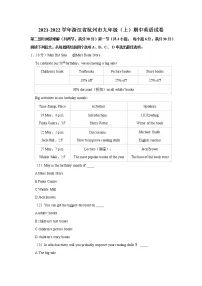
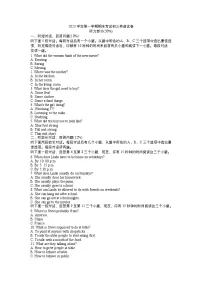
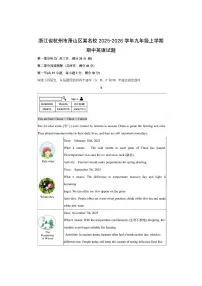
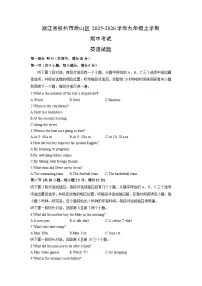
这是一份浙江省杭州市外国语学校2025-2026学年九年级上学期期中 英语试卷,共16页。
3. 请将你的班级、姓名、学号填写在“答题卷”的相应的位置。
4. 请将答案填涂在“答题卷”的相应位置上,否则无效。所有选择题请用2B铅笔在答题卷相应的位置上涂黑,其它题一律用黑色水笔答题。
5. 请勿使用修正带或修正液,否则答题无效。
第一部分 听力(共两节,满分20分)
第一节(共5小题,每小题1分,满分5分)
听下面5段对话。每段对话后有一个小题,从题中所给的A、B、C三个选项中选出最佳选项,并标在试卷的相应位置。听完每段对话后,你有10秒钟的时间来回答有关小题和阅读下一小题。每段对话仅读一遍。
1. What will Sarah d next Mnday?
A. Get a new cmputer. B. Delivery a speech. C. Enjy British fd.
2. Wh des the band need accrding t the wman?
A. A bass player. B. A singer. C. A guitar player.
3. Where des the cnversatin prbably take place?
A. In a bkstre. B. In a library. C. In a classrm.
4. Hw did the speakers cme t Seattle?
A. By plane. B. By car. C. By train.
5. What are the speakers mainly talking abut?
A. A visit t a dctr. B. A car accident. C. A hand injury.
第二节(共15小题,每小题1分,满分15分)
听下面4段对话或独白。每段对话或独白后有几个小题,从题中所给的A、B、C三个选项中选出最佳选项,并标在试卷的相应位置。听每段对话或独白前,你将有时间阅读各小题,每小题5秒钟;听完后,各小题给出5秒钟做答时间。每段对话或独白读两遍。
听下面一段对话,回答第6至8三个小题。
6. When will the wman’s flight arrive in Shanghai?
A. At 4:00 p.m. B. At 2:00 p.m. C. At 7:00 p.m.
7. What des the man advise the wman t d n the plane?
A. Watch dwnladed vides. B. D sme reading. C. Get sme sleep.
8. Hw might the wman g t her htel?
A. By subway. B. By taxi. C. On ft.
听下面一段对话,回答第9至11三个小题。
9. When will the man g t the restaurant?
A. On Tuesday. B. On Wednesday. C. On Thursday.
10. Wh will have dinner with the man?
A. A cuple. B. Sme friends. C. His family.
11. What will the man d next?
A. Prvide persnal infrmatin.
B. Tell the waitress his arriving time.
C. Ask fr a table at the nn-smking area.
听下面一段对话,回答第12至15四个小题。
12 Where des Mark usually read news nw?
A. In a newspaper. B. In a magazine. C. On the Internet.
13. What makes the wman surprised abut the machine?
A. It has a small glass windw.
B. It can make a pizza in a shrt time.
C. It ffers fur types f pizzas at a time.
14. What des the wman think f the machine?
A. It is quite necessary. B. It might nt be ppular. C. It will certainly succeed.
15 What is an advantage f the machine?
A. The 24-hur service. B. Tasty pizza made by it. C. The lw prductin cst.
听下面一段独白,回答第16至20五个小题。
16. Wh is the speaker prbably talking t?
A. Tennis players. B. News reprters. C. Event vlunteers.
17 Hw lng will the event last in ttal?
A Three days. B. Five days. C. Seven days.
18. What must be taken t attend the media meeting?
A. Match tickets. B. Infrmatin sheets. C. Media ID cards.
19. What can peple expect at the clsing ceremny?
A. Dance perfrmances. B. A firewrk display. C. A big party.
20. What will Mr. Brwn d later?
A. Talk abut sme rules.
B. Organize a media meeting.
C. Intrduce the match schedules.
第二部分 阅读理解(共两节,满分40分)
第一节(共15小题,每小题2分,满分30分)
阅读下列短文,从每题所给的四个选项(A、B、C和D)中选出最佳选项。
A
The greening f planes, trains and autmbiles
Mving gds and peple arund the wrld is respnsible fr a large part f glbal CO₂ emissins. As the wrld races t decarbnize everything, it faces particular prblems with transprtatin, which accunts fr abut a quarter f ur energy-related greenhuse gas emissins. Here’s the breakdwn f the emissins fr different mdes f transprt.
The fuels fr transprt need t be nt just green, cheap and pwerful, but als lightweight and safe enugh t be carried arund. Each mde f transprt has its specific fuel needs. Much is still t be settled, but here are sme f the slutins t get us ging green.
This energy transitin (变革) is glbal, and the amunt f renewable energy the wrld will need is “a little bit mind-blwing,” says mechanical engineer Keith Wipke at the Natinal Renewable Energy Labratry. It’s estimated that the glbal demand fr electricity culd mre than duble by 2050. Frtunately, analyses suggest that renewables are up t the task. “We need t speed up the develpment f green energy, and it will all get used,” says Wipke.
1. What percentage f glbal emissins des transprt accunt fr?
A. Abut 25%.B. Abut 45%.C. Abut 30%.D. Abut 10%.
2. Which mde f transprt can g green cmparatively easily?
A. Planes.B. Trucks.C. Trains.D. Ships.
3. What des Wipke suggest abut energy transitin?
A. Limiting fuel cnsumptin.B. Putting mre effrt int renewables.
C. Imprving energy efficiency.D. Making electricity mre affrdable.
4. Where is this passage mst likely t be fund?
A. In a science magazine fr the general public.B. In a financial reprt fr transprt cmpanies.
C. In an advertisement fr green fuels.D. In a persnal blg abut car service.
5. What structure is used t rganize the passage?
A. General-t-specific structure.B. Prblem-slutin structure.
C. Cmpare-and-cntrast structure.D. Cause-and-effect structure.
B
Tday’s grandparents are jining their grandchildren n scial media, but the different generatins’ nline habits culdn’t be mre different.
In the UK the ver-55s are jining Facebk in increasing numbers, meaning that they will sn be the site’s secnd biggest user grup, with 3.5 millin users aged 55 t 64 and 2.9 millin ver-65s.
Sheila, aged 59, says, “I jined t see what my grandchildren are ding, as my daughter psts vides and phts f them. It’s a much better way t see what they’re ding than waiting fr letters and phts in the pst. That’s hw we did it when I was a child, but I think I’m lucky I get t see s much mre f their lives than my grandparents did.”
Irnically, Sheila’s grandchildren are less likely t use Facebk themselves. Children under 17 in the UK are leaving the site-nly 2.2 millin users are under 17-but they’re nt ging far frm their smartphnes. Chle, aged 15, even sleeps with her phne.
Unlike her grandmther’s generatin, Chle’s age grup is spending s much time n their phnes at hme that they are missing ut n spending time with their friends in real life. Sheila, n the ther hand, has made cntact with ld friends frm schl she hasn’t heard frm in frty years.
Teenagers might have their parents t thank fr their smartphne and scial media addictin as their parents were the early users f the smartphne. Peter, 38 and father f tw teenagers, reprts that he used t be n his phne r laptp cnstantly. “I was always cnnected and I felt like I was always wrking,” he says. “Hw culd I tell my kids t get ff their phnes if I was always in frnt f a screen myself?” S, in the evenings and at weekends, he takes his SIM card ut f his smartphne and puts it int an ld- style mbile phne that can nly make calls and send text messages. “I’m nt cmpletely cut ff frm the wrld in case f emergencies, but the imprtant thing is I’m setting a better example t my kids and spending mre quality time with them.”
What’s yur view n this tpic? Pst yur cmment here.
6. Hw des the authr develp the main idea?
A. Prviding statistical data and research findings.B. Presenting persnal stries and examples.
C. Using expert pinins and qutatins.D. Making histrical cmparisns and predictins.
7. What is Sheila’s attitude twards scial media?
A. Interested.B. Wrried.C. Cnfused.D. Critical.
8. What des the wrd “irnically” in Paragraph 3 prbably mean?
A. Frtunately.B. Sadly.C. Exactly.D. Surprisingly.
9. Why des Peter change his habit f using the phne?
A. T cut ff frm the wrld at weekends.B. T spend mre quality time with his wife.
C. T test his ld-style mbile phne.D. T be a better parent fr his kids.
10. Which f the fllwing crrectly states different generatins’ digital habits accrding t the passage?
A. Teenagers blame their parents fr their internet addictin.
B. Parents pst their children’s phts n scial media.
C. Teens use scial media t cmmunicate with their friends.
D. Grandparents keep their phnes near them all the time.
C
In the tranquil crridrs f the City Museum, Geffrey, the new assistant, awaited the delivery f the latest wrk by the master painter knwn nly as Brush.
The dr pened and a delivery wman came in carrying a large canvas cvered in stunning clurs. She was nt carrying it prperly.
“Be careful,” shuted Geffrey, taking the frame frm her.
“Whatever,” she said, befre barging past him and int the ffice f the Curatr (馆长), carrying lts f paperwrk.
Geffrey carefully tk the painting t the mst prestigius lcatin within the museum and hung it n the wall.
The next day, the whle art wrld had cme t the museum t gaze upn the masterpiece. The rm was brimming with visitrs frm dawn till dusk. Even befre the day was ver, the papers were printing the critics’ (批评家的) pinins f the new wrk. They were amazed by its ‘explsive rit f clurs’, its ‘bld chrmatic assertin’ and ‘deep, raw emtinal resnance.’
Over the next week, as mre peple read the critics’ articles, mre peple visited the museum than ever befre, and the Curatr was delighted. The rm where the masterpiece was n display heaved with peple all day lng. They discussed increasingly prfund interpretatins f the wrk, deciphering (解读) the ‘brave explratin f frm and clur,’ and discussing its ‘deep impact n the psyche f the viewer.’
Then at the end f the week, befre he lcked the museum up, Geffrey heard a knck. A delivery man had arrived.
“I aplgise fr being a week late with this delivery,” he said, as he carefully handed Geffrey the real artwrk.
Geffrey’s cnfusin didn’t last lng. Mments after the delivery man left, the same delivery wman frm befre came ut f the Curatr’s ffice with the Curatr.
“Oh, yu’ve met Jennifer, ur Cleaner, haven’t yu?” said the Curatr.
“Oh, we met,” said the Cleaner. “Yu ran int me when I was taking ne f the dirty canvases frm the restratin department ut t the bin. Why n earth did yu want it? Is that anther ne yu’re carrying?”
Geffrey realised his mistake and knew there was n way t hide it. He had t tell the Curatr and the Cleaner. The Curatr turned white, while Jennifer fell t the flr in hysterical laughter.
The Curatr had t issue a statement. vernight, the critics wrte and published vehement retractins, explaining hw their earlier articles shuld have been interpreted as satirical r sarcastic.
The real artwrk was swapped in, and the critics came again. This time, they were cautius (谨慎的) befre they praised it, but the real artwrk’s value was hard t deny. The detail was magnificent, and there was n dubt that nly the enigmatic (神秘的) painter knwn as Brush culd have prduced it. They wrte new articles discussing its ‘prfund explratin f the human cnditin’ and its ‘fine balance between what is and what is nt’.
Once things had calmed dwn, Geffrey fund himself nce mre amng the museum’s tranquil crridrs. Then he happened t ntice that day’s newspaper. The headline read: “Identity (身份) f the Artist Knwn as Brush, Revealed.” There was a pht f Jennifer the Cleaner. Underneath, it read, “Artist als reveals title fr latest wrk: Dirty canvas”.
11. Why did the “masterpiece” attract s many visitrs?
A. Because the museum advertised it heavily.
B. Because the critics’ articles praised it highly.
C. Because the painter Brush was persnally present.
D. Because Geffrey gave detailed intrductins abut it.
12. What des the phrase “hysterical laughter” suggest abut Jennifer?
A. She was crying with sadness.B. She was laughing uncntrllably.
C. She was screaming in anger.D. She was laughing with regret.
13. What is the main theme f this stry?
A. Hw careful handling matters fr valuable artwrks.B. Hw daily wrk in a museum can be challenging.
C. Hw critics can change what we think abut art.D. Hw difficult it is t discver true artistic value.
14. What’s the crrect rder f the fllwing events?
a. The critics said they were wrng abut their earlier articles.
b. Geffrey hung the dirty canvas in the museum’s best lcatin.
c. The real painting finally arrived, delivered by an aplgetic man.
d. Jennifer, the cleaner, was revealed t be the artist knwn as Brush.
e. Newspapers printed amazed reviews praising the masterpiece’s clrs.
A. b-e-c-a-dB. e-b-c-d-aC. b-c-e-a-dD. c-b-e-d-a
15. Which f the fllwing wuld be the mst apprpriate title fr this stry?
A. Accidental Masterpiece.B. Critic’s Mistake.C. Lst Masterpiece.D. Careless Assistant.
第二节(共5小题,每小题2分,满分10分)
仔细阅读下文,回答下列问题。回答请勿超出限定字数。
Despite their many differences, all human beings share several defining characteristics, such as large brains and the ability t walk upright n tw legs.
The first unique human characteristic is that humans have extrardinarily large brains cmpared with ther animals. It seems bvius that evlutin shuld select fr larger brains. Mammals that weigh abut 60 kilgrams usually have a brain size f arund 200 cm³. In cntrast, humans have a brain size f 1,200-1,400 cm³.
Having a large brain cmes with a cst. It requires a lt f energy t functin. Althugh the human brain accunts fr nly 2-3% f bdy weight, it uses abut 25% f the bdy’s energy when at rest. Fr cmparisn, the brains f apes use nly abut 8% f energy. Early humans paid fr their large brains in tw ways. Firstly, they spent mre time in search f fd. Secndly, their muscles grew smaller and weaker. It’s hardly an bvius cnclusin that this is a gd way t survive. A chimpanzee can’t win an argument with a man, but it can tear the man apart like a rag dll.
Anther unique trait f humans is that we walk upright. Standing up, it’s easier t find fd r enemies. In additin, their arms that are unnecessary fr mving arund are freed fr ther purpses, like thrwing stnes r signaling. As a result, humans can perfrm very cmplex tasks with their hands.
Yet walking upright has its disadvantages. The bne structure f ur ancestrs develped fr millins f years t supprt a creature that walked n all furs and had a relatively small head. Adjusting t an upright psitin was quite a challenge, especially when the bnes had t supprt an extra-large skull. Humankind paid fr its brad visin and skillful hands with backaches and painful necks.
We assume that a large brain brings huge advantages. It seems bvius that these have made humankind the mst pwerful animal n earth. But humans enjyed all f these advantages fr a full 2 millin years during which they remained weak creatures. Thus, humans wh lived a millin years ag, despite their big brains and sharp stne tls, lived in cnstant fear f meat-eating animals.
16. What are the tw main human characteristics mentined in the passage? (n mre than 10 wrds)
_______________________________________________________________________
17. Why des the authr make a cmparisn between a chimpanzee and a man? (n mre than 15 wrds)
_______________________________________________________________________
18. Hw des walking upright help humans in daily life? (n mre than 18 wrds)
_______________________________________________________________________
19. What tw prblems des walking upright bring t humans? (n mre than 8 wrds)
_______________________________________________________________________
20. What des the passage say abut early humans even thugh they already had large brains and stne tls? (n mre than 18 wrds)
______________________________________________________________________
第Ⅱ卷
第三部分 语言知识运用(共两节,满分25分)
第一节:完形填空(共15小题,每小题1分,满分15分)
通读下面短文,掌握其大意,然后在各题所给的四个选项(A、B、C和D)中选出一个最佳选项。
During travel seasns, many peple tend t lk thrugh user reviews nline befre starting their trips. They usually make a ____21____ plan, including what t see, where t stay and even which dish t eat. ____22____, mre infrmatin means fewer surprises.
I am nt suggesting wandering ff t a ttally strange place withut pening a ____23____. I always make a simple plan, but I’m ready t ____24____ it if smething better cmes up.
A few years ag, a friend and I were driving thrugh a sleepy stretch f castal Suth Carlina. That was, until I ____25____ a white general stre with a sign utside advertising biled peanuts. I suggested we ____26____ fr sme, thugh I had n reasn t d s. Fr ne thing, we were ____27____ hungry. Fr anther, biled peanuts are disgusting. But smething abut the place was hard t resist.
As I chatted with the wner, anther custmer started t ____28____ my friend a technique fr trapping alligatrs with bare hands. He picked up the ____29____ by wrking in a nearby plantatin (种植园) and invited us t take a tur there. We willingly accepted his ____30____ and spent the next few hurs with him, climbing arund an ancient rice mill and bwing ur heads int frmer slave quarters (住所). It was the kind f afternn yu dn’t frget.
A summer trip is a rare chance t ____31____ rutine. It used t be ____32____ t distinguish independent travelers frm travelers fllwing flag-waving tur guides. But the line between them has becme less clear. ____33____ yur trip fllws a tightly ____34____ schedule inspired by user reviews, aren’t yu really just taking a virtual grup tur, with yur smartphne ____35____ the flag?
21. A. publicB. detailedC. newD. secret
22. A. BesidesB. HweverC. OtherwiseD. Therefre
23. A. streB. letterC. guidebkD. package
24. A. makeB. annunceC. drpD. discuss
25. A. spttedB. builtC. leftD. pened
26. A. payB. lkC. waitD. stp
27. A. slightlyB. hardlyC. usuallyD. really
28. A. askB. giveC. teachD. find
29. A. cinB. skillC. peanutD. speed
30. A. cmmentB. answerC. prmiseD. ffer
31. A. result frmB. learn frmC. break frmD. suffer frm
32. A. easyB. bringC. difficultD. interesting
33. A. BefreB. SC. AlthughD. If
34. A. plannedB. fcusedC. agreedD. passed
35. A. changingB. wavingC. seeingD. cvering
第二节:语篇填空(共10小题,每小题1分,满分10分)
阅读下面材料,在空白处填入适当的内容 (1个单词) 或括号内单词的适当形式。
Diwali, a Hindu (印度的) festival f lights, ____36____ (hld) in hnur f Lakshmi, the gddess f wealth. It has lng been a cultural hliday, during ____37____ peple get tgether, have parties, give gifts t each ther and generally pray fr ____38____ better-ff future. Fr sme cmmunities the day after Diwali marks the beginning f the new year.
____39____ (it) dates change each year because they are based n the Hindu lunar calendar but typically the festival is celebrated in Octber r Nvember. The celebratin usually ____40____ (last) fr several days. Peple will ften line candles and lamps thrughut their huses and alng their driveways ____41____ (light) up the surrundings.
Fr Hindus, Diwali is a time ____42____ charitable giving and selfless service. They are required t reflect n ____43____ they are grateful fr and hw they can shine light n thers as well. Hindus ____44____ (traditinal) perfrm a deep cleaning f their hmes and surrundings as cleanliness is believed t be a prayer fr the presence f wealth and well-being. If yu came t Diwali, yu ____45____ (see) clrful patterns f flwer pwder, rice r sand n the flr, which is meant t bring gd luck.
第四部分 写作(共三节,满分35分)
第一节:单词拼写(共10小题,每小题1分,满分10分)
根据下列句子及所给的首字母或中文在答题纸上用单词的正确形式填空(每空一词)。
46. The twn used t be quiet and ld-fashined. One day, a new factry pened, and everything changed almst vernight—tall buildings appeared, m________ facilities were built, and peple ________ (突然地) fund themselves living in a busy city.
47. Dzens f vlunteers jined the “Clean River” prject last weekend, hping t fix the river that had been seriusly p________ fr years. They wrked in teams, cllecting rubbish alng the muddy banks and pulling ut plastic bttles frm the water. They believe that every small actin culd help imprve the e________.
48. During the sprts meeting, Mr. Green was ________ the students carefully t make sure everyne fllwed the rules. He was especially prud f thse ________ (擅长运动的) students wh brke several schl recrds that day.
49. The lst puppy was r________ by a grup f students after schl, just as the rain started t pur dwn. They wrapped it in smene’s jacket and brught it back t their classrm, but their teacher said the puppy had t be taken t a vet u________ they were certain it wasn’t injured.
50. Frm a yung age, Tu Yuyu was e________ abut studying plants and medicine. She had a great t________ fr nticing small details and ding careful experiments. Her hard wrk later helped her find artemisinin (青蒿素), a medicine that has saved millins f lives.
第二节:选词组填空(共10题,每小题1分,满分10分)
用方框中所给词组的适当形式填空,每个词组限用一次,有两个多余。
51. Carlinhs Brwn, a famus Brazilian musician, ________ his lively perfrmances and creative fusin f traditinal and new-style rhythms that make audiences arund the wrld lve his music.
52. Our schl’s drama club has really imprved this year, putting n several successful perfrmances that drew large audiences. The members have grwn mre cnfident, especially ________ creativity and teamwrk.
53. —Mm says I can’t eat ice cream befre dinner. But I’ve been really gd all day.
—Well… yur mm ________. Eating t much nw culd spil yur appetite.
54. The visitrs ________hw well the lcal cmmunity had preserved its traditins. They watched clurful dances, tasted hmemade fd and listened t stries passed dwn fr generatins, realizing hw much pride the villagers tk in their culture.
55. This is the first time in my career I ________ s many services, all f which are imprtant fr high-level wrk, including prfessinal training prgrams, advanced research tls, and persnalized supprt that help me imprve bth my skills and perfrmance.
56. The Greens ________ their ld car fr mnths because it breaks dwn almst every week and csts a frtune t repair, but with the rising prices f new vehicles and daily expenses, they just can’t affrd t replace it right nw.
57. It was a cld Friday afternn, and ur schl team was playing against Riverside High. Our team ________ with a scre f 2-1 when ur captain gt injured unexpectedly. But instead f panicking, we encuraged each ther and tried ur best t keep the game under cntrl.
58. The emergency respnse team sent t handle the Hng Kng carg plane crash n Octber 20th ________ hundreds f firefighters, engineers, and helpers wh wrked day and night t cntrl the fire, clear the debris (残骸), and search fr the missing crew members.
59. In the cmpany, all custmer cmplaints and technical issues must ________ immediately, t prevent any disruptin t daily peratins and maintain client satisfactin.
60. While visiting a lcal exhibitin n Chinese traditinal art frms, I was thrilled t ________ a famus paper-cutting artist wh kindly shwed me hw each delicate design tells a stry abut Chinese culture and family values.
第三节:书面表达(共1小题,满分15分)
61. 同学们,我们每个人在成长过程中都会犯错,有时候我们在学习中犯错,有时候我们在生活中犯错。你是如何看待犯错的?《校园英语》杂志针对“Is making mistakes a gd thing r a bad thing?”向广大青少年征稿,请写一篇作文向该杂志社投稿,你的文章内容应包括:
● What des yur survey result shw?
● What’s yur pinin?
● State yur reasn(s) with ne r tw examples.
注意:
1. 开头已经写好,不计入词数;
2. 文中不要出现真实的班名或人名;
3. 词数不少于120词。
Recently, I did a survey in my class n the tpic f whether making mistakes is a gd thing r a bad thing. The result shws that_____________________________________________________________________________________________________________________________________________________________________________________________________________________________________________________________________________________________________________________________________________________________________________________________________________________________________________________________________________________________________________________________________________________________________
杭州外国语学校2025-1初三年级期中英语试卷
注意事项:1. 英语试卷总分值120分,总答题时间100分钟。
2. 本试卷分“试题卷”和“答题卷”。其中“试题卷”12页,“答题卷”2页。
3. 请将你的班级、姓名、学号填写在“答题卷”的相应的位置。
4. 请将答案填涂在“答题卷”的相应位置上,否则无效。所有选择题请用2B铅笔在答题卷相应的位置上涂黑,其它题一律用黑色水笔答题。
5. 请勿使用修正带或修正液,否则答题无效。
第一部分 听力(共两节,满分20分)
第一节(共5小题,每小题1分,满分5分)
听下面5段对话。每段对话后有一个小题,从题中所给的A、B、C三个选项中选出最佳选项,并标在试卷的相应位置。听完每段对话后,你有10秒钟的时间来回答有关小题和阅读下一小题。每段对话仅读一遍。
1. What will Sarah d next Mnday?
A. Get a new cmputer. B. Delivery a speech. C. Enjy British fd.
2. Wh des the band need accrding t the wman?
A. A bass player. B. A singer. C. A guitar player.
3. Where des the cnversatin prbably take place?
A. In a bkstre. B. In a library. C. In a classrm.
4. Hw did the speakers cme t Seattle?
A. By plane. B. By car. C. By train.
5. What are the speakers mainly talking abut?
A. A visit t a dctr. B. A car accident. C. A hand injury.
第二节(共15小题,每小题1分,满分15分)
听下面4段对话或独白。每段对话或独白后有几个小题,从题中所给的A、B、C三个选项中选出最佳选项,并标在试卷的相应位置。听每段对话或独白前,你将有时间阅读各小题,每小题5秒钟;听完后,各小题给出5秒钟做答时间。每段对话或独白读两遍。
听下面一段对话,回答第6至8三个小题。
6. When will the wman’s flight arrive in Shanghai?
A. At 4:00 p.m. B. At 2:00 p.m. C. At 7:00 p.m.
7. What des the man advise the wman t d n the plane?
A. Watch dwnladed vides. B. D sme reading. C. Get sme sleep.
8. Hw might the wman g t her htel?
A. By subway. B. By taxi. C. On ft.
听下面一段对话,回答第9至11三个小题。
9. When will the man g t the restaurant?
A. On Tuesday. B. On Wednesday. C. On Thursday.
10. Wh will have dinner with the man?
A. A cuple. B. Sme friends. C. His family.
11. What will the man d next?
A. Prvide persnal infrmatin.
B. Tell the waitress his arriving time.
C. Ask fr a table at the nn-smking area.
听下面一段对话,回答第12至15四个小题。
12. Where des Mark usually read news nw?
A In a newspaper. B. In a magazine. C. On the Internet.
13. What makes the wman surprised abut the machine?
A. It has a small glass windw.
B. It can make a pizza in a shrt time.
C. It ffers fur types f pizzas at a time.
14. What des the wman think f the machine?
A. It is quite necessary. B. It might nt be ppular. C. It will certainly succeed.
15. What is an advantage f the machine?
A. The 24-hur service. B. Tasty pizza made by it. C. The lw prductin cst.
听下面一段独白,回答第16至20五个小题。
16. Wh is the speaker prbably talking t?
A. Tennis players. B. News reprters. C. Event vlunteers.
17. Hw lng will the event last in ttal?
A. Three days. B. Five days. C. Seven days.
18. What must be taken t attend the media meeting?
A. Match tickets. B. Infrmatin sheets. C. Media ID cards.
19. What can peple expect at the clsing ceremny?
A. Dance perfrmances. B. A firewrk display. C. A big party.
20. What will Mr. Brwn d later?
A. Talk abut sme rules.
B. Organize a media meeting.
C. Intrduce the match schedules.
第二部分 阅读理解(共两节,满分40分)
第一节(共15小题,每小题2分,满分30分)
阅读下列短文,从每题所给的四个选项(A、B、C和D)中选出最佳选项。
A
【1~5题答案】
【答案】1. A 2. C 3. B 4. A 5. B
B
【6~10题答案】
【答案】6. B 7. A 8. D 9. D 10. B
C
【11~15题答案】
【答案】11. B 12. B 13. C 14. A 15. A
第二节(共5小题,每小题2分,满分10分)
【16~20题答案】
【答案】16. Large brains and the ability t walk upright.
17. T shw the cst f having a large brain in early humans.
18. It makes it easier t find fd r enemies and perfrm cmplex tasks with hands.
19. Backaches and painful necks.
20. They remained weak creatures and lived in cnstant fear f meat-eating animals.
第Ⅱ卷
第三部分 语言知识运用(共两节,满分25分)
第一节:完形填空(共15小题,每小题1分,满分15分)
【21~35题答案】
【答案】21. B 22. B 23. C 24. C 25. A 26. D 27. B 28. C 29. B 30. D 31. C 32. A 33. D 34. A 35. B
第二节:语篇填空(共10小题,每小题1分,满分10分)
【36~45题答案】
【答案】36. is held
37. which 38. a
39. Its 40. lasts
41. t light
42. fr 43. what
44. traditinally
45. wuld see
第四部分 写作(共三节,满分35分)
第一节:单词拼写(共10小题,每小题1分,满分10分)
根据下列句子及所给的首字母或中文在答题纸上用单词的正确形式填空(每空一词)。
【46题答案】
【答案】 ①. mdern##dern ②. suddenly
【47题答案】
【答案】 ①. plluted##lluted ②. envirnment##nvirnment
【48题答案】
【答案】 ①. verseeing##verseeing ②. athletic
【49题答案】
【答案】 ①. rescued##escued ②. unless##nless
【50题答案】
【答案】 ①. (e)nthusiastic ②. (t)alent
第二节:选词组填空(共10题,每小题1分,满分10分)
【51~60题答案】
【答案】51. is knwn fr
52. in terms f
53. has a pint
54. were impressed with
55. have had access t
56. have been fed up with
57. was taking the lead
58. cnsists f
59. be dealt with
60. bump int
第三节:书面表达(共1小题,满分15分)
【61题答案】
【答案】例文
Is making mistakes a gd thing r a bad thing?
Recently, I did a survey in my class n the tpic f whether making mistakes is a gd thing r a bad thing. The result shws that 65% f the students think it’s a gd thing, 20% think it’s bad, and 15% are neutral.
In my pinin, making mistakes is definitely gd. It’s a key t learning and grwing steadily. Take my English spelling as an example. I nce misspelled many wrds in a mnthly test. Instead f being upset, I made a detailed spelling list and reviewed it carefully every day. Sn, my spelling imprved a lt. Anther example: when I first learned t ride a bike, I kept falling dwn. But I learned t balance frm thse mistakes and can nw ride skillfully n the rad.
Mistakes are nt failures. They’re chances t imprve. Let’s learn frm them and mve frward.have access t bump int be fed up with in terms f take the lead in case
cnsist f impress…with… be knwn fr deal with have a pint by mistake
这是一份浙江省杭州市外国语学校2025-2026学年九年级上学期期中 英语试卷,共16页。
这是一份浙江省杭州中学2025-2026学年九年级上学期期中英语试卷,共10页。
这是一份浙江省杭州中学2025-2026学年度九年级(上)期中英语试卷(含答案),共19页。
注册成功
资料篮

在线客服
添加在线客服
获取1对1服务
官方微信
关注“教习网”公众号
打开微信就能找资料
赛课定制
添加在线客服
获取1对1定制服务
职称咨询
添加在线客服
获取1V1专业指导服务

免费福利


(1).png)