免费领取教师福利


若您为此资料的原创作者,认为该资料内容侵犯了您的知识产权,请扫码添加我们的相关工作人员,我们尽可能的保护您的合法权益。

这是一份期末重点、难点、考点、语法复习试卷-湘少版英语六年级下册(含答案),共9页。试卷主要包含了一般过去时表示过去的动作或状态等内容,欢迎下载使用。
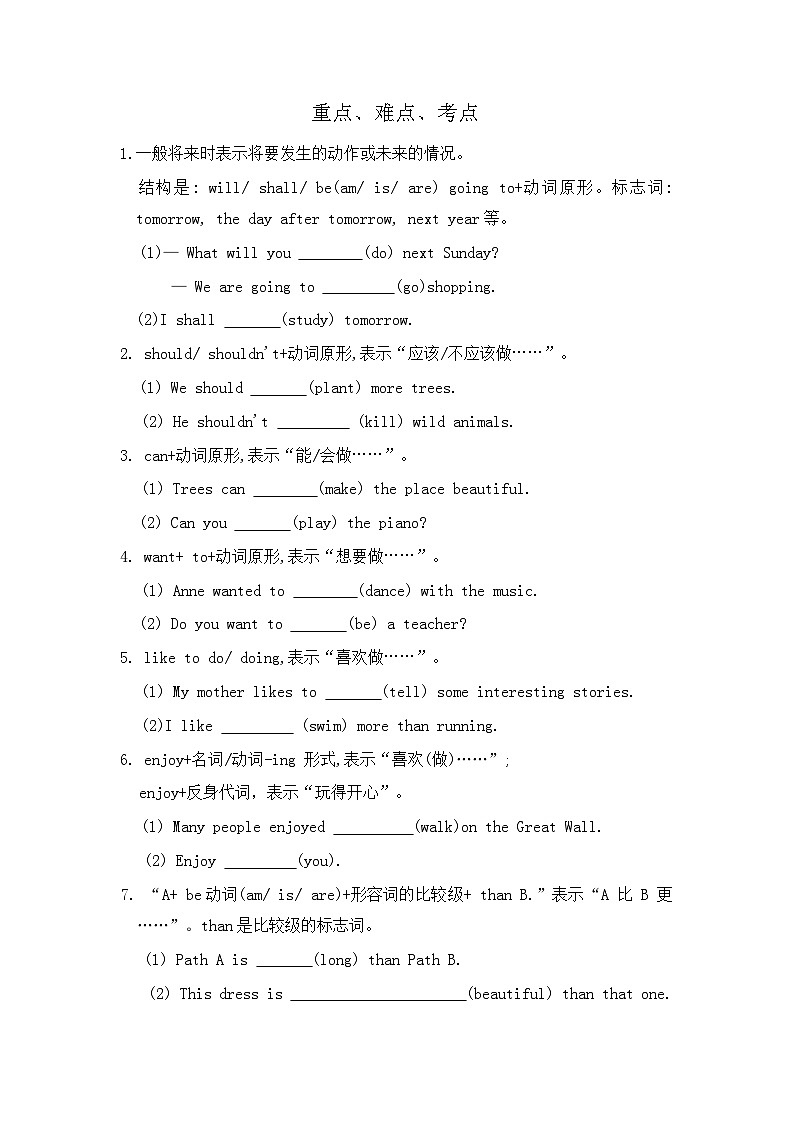
结构是: will/ shall/ be(am/ is/ are) ging t+动词原形。标志词: tmrrw, the day after tmrrw, next year等。
(1)— What will yu (d) next Sunday?
— We are ging t (g)shpping.
(2)I shall (study) tmrrw.
2. shuld/ shuldn't+动词原形,表示“应该/不应该做……”。
(1) We shuld (plant) mre trees.
(2) He shuldn't (kill) wild animals.
3. can+动词原形,表示“能/会做……”。
(1) Trees can (make) the place beautiful.
(2) Can yu (play) the pian?
4. want+ t+动词原形,表示“想要做……”。
(1) Anne wanted t (dance) with the music.
(2) D yu want t (be) a teacher?
5. like t d/ ding,表示“喜欢做……”。
(1) My mther likes t (tell) sme interesting stries.
(2)I like (swim) mre than running.
6. enjy+名词/动词-ing 形式,表示“喜欢(做)……”;
enjy+反身代词,表示“玩得开心”。
(1) Many peple enjyed (walk)n the Great Wall.
(2) Enjy (yu).
7. “A+ be动词(am/ is/ are)+形容词的比较级+ than B.”表示“A 比 B 更……”。than是比较级的标志词。
(1) Path A is (lng) than Path B.
(2) This dress is (beautiful) than that ne.
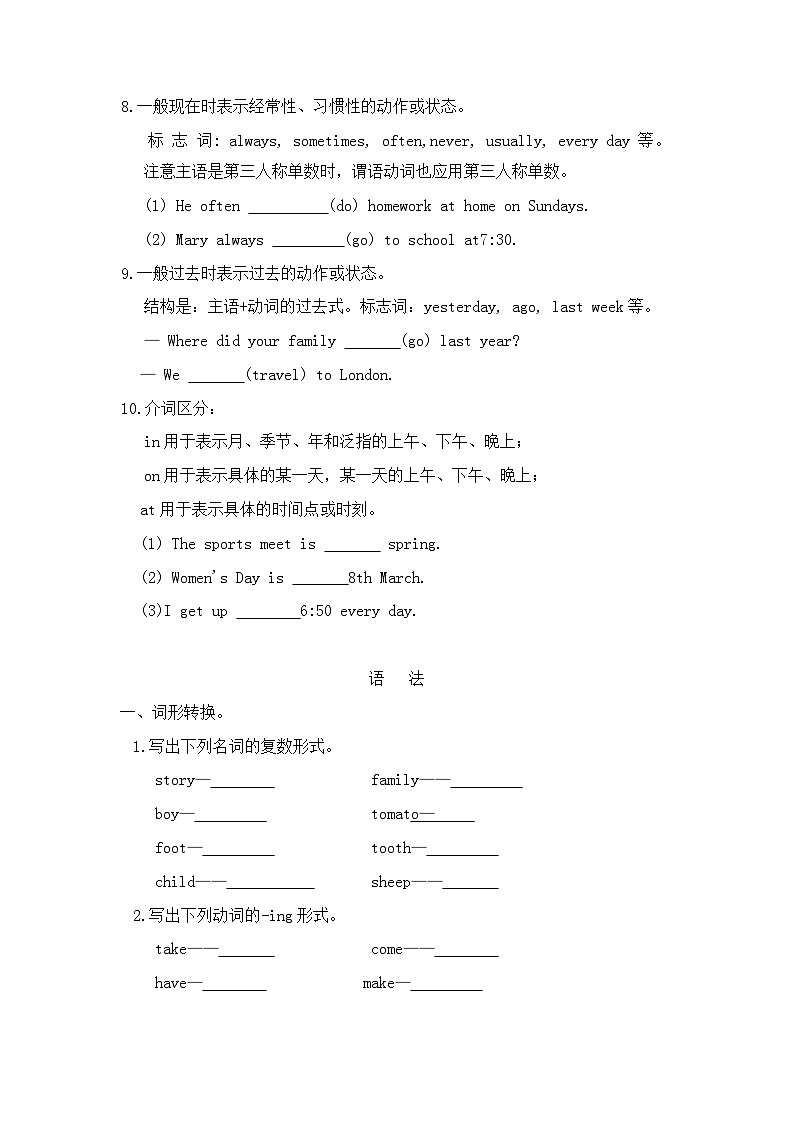
8.一般现在时表示经常性、习惯性的动作或状态。
标 志 词: always, smetimes, ften,never, usually, every day 等。 注意主语是第三人称单数时,谓语动词也应用第三人称单数。
(1) He ften (d) hmewrk at hme n Sundays.
(2) Mary always (g) t schl at7:30.
9.一般过去时表示过去的动作或状态。
结构是:主语+动词的过去式。标志词:yesterday, ag, last week等。
— Where did yur family (g) last year?
— We (travel) t Lndn.
10.介词区分:
in用于表示月、季节、年和泛指的上午、下午、晚上;
n用于表示具体的某一天,某一天的上午、下午、晚上;
at用于表示具体的时间点或时刻。
(1) The sprts meet is spring.
(2) Wmen's Day is 8th March.
(3)I get up 6:50 every day.
语 法
一、词形转换。
1.写出下列名词的复数形式。
stry— family——
by— tmat—
ft— tth—
child—— sheep——
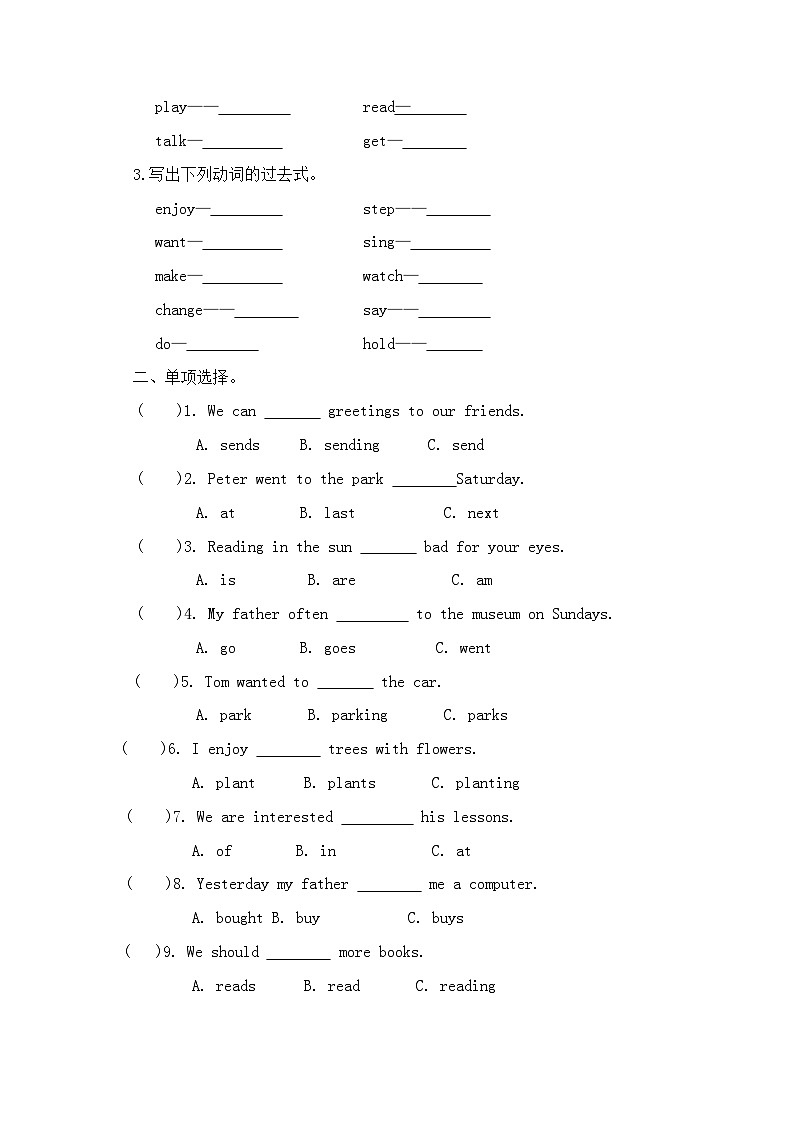
2.写出下列动词的-ing形式。
take—— cme——
have— make—
play—— read—
talk— get—
3.写出下列动词的过去式。
enjy— step——
want— sing—
make— watch—
change—— say——
d— hld——
二、单项选择。
( )1. We can greetings t ur friends.
A. sends B. sending C. send
( )2. Peter went t the park Saturday.
A. at B. last C. next
( )3. Reading in the sun bad fr yur eyes.
A. is B. are C. am
( )4. My father ften t the museum n Sundays.
A. g B. ges C. went
( )5. Tm wanted t the car.
A. park B. parking C. parks
( )6. I enjy trees with flwers.
A. plant B. plants C. planting
( )7. We are interested his lessns.
A. f B. in C. at
( )8. Yesterday my father me a cmputer.
A. bught B. buy C. buys
( )9. We shuld mre bks.
A. reads B. read C. reading
( )10. I like swimming than dancing.
A. much B. mre C. mst
三、用所给单词的正确形式填空。
1. Where are we (g) tday?
2. We’ ll (visit) yur grandparents.
3. Shall we g (shp) tmrrw?
4. We’ ll have dinner at yur (grandparents) hme.
5. My family ften (watch) a mvie n Sundays.
6. We will enjy (ur).
7. Mr Liu (take) his family t the beach last Sunday.
8. Sme bks are (interesting)than thers.
9. The elephant is (big) than the tiger.
10. (swim) is gd fr us.
11. We shuldn't (cut) dwn trees.
12. We can (take) lng walks.
四、圈出错误的一项,并在横线上改正。
1. He wants t travelling t China.
A B C
2. That piece f meat is gd than mine.
A B C
3. I'm nt afraid f difficult.
A B C
4. Plant trees is gd fr us.
A B C
5. He is ging t playing the vilin.
A B C
6. The Earth lk like a ball in space.
A B C
7. The stry is very interesting. I am interest in it.
A B C
8. He shuld learn t take care fr himself.
A B C
五、选择正确的疑问词填空。
Wh When What Hw much Where Why Which
1.— is n duty tday?
— Tm.
2.— did yu g yesterday?
—I went t the park.
3.— seasn d yu like best?
— Spring.
4.— d yu like winter?
— Because I can make a snwman.
5.— d yu get up every day?
— At 7:00 a. m.
6.— is the bk?
—10 yuan.
7.— did yu want t d?
—I wanted t read a bk.
六、按要求完成下列各题。
1. He is ging t play the vilin this evening.(对画线部分提问)
2. I can see sme birds in the tree.(改为一般疑问句)
3. We shuld stay at hme.(改为否定句)
4. Anne usually ges t bed early.(用 last night改写句子)
5. Hw d yu g t schl? (据实回答)
例:
七、根据例子,仿写句子。
He always ges t schl by bike.
(ften/ after dinner)
1.
例:
She saw a film last week.
(yesterday)
2.
例:
He is ging t swim this afternn.
(tmrrw)
3.
参考答案:
重点、难点、考点
1.(1) d; g (2) study
2.(1) plant (2) kill
3.(1) make (2) play
4.(1) dance (2) be
5.(1) tell (2) swimming
6.(1) walking
(2) yurself/ yurselves
7.(1) lnger (2) mre beautiful
8.(1) des (2) ges
9. g; travelled
10.(1) in (2) n (3) at
语 法
一、 1. stries
families
bys
tmates
feet
teeth
children
sheep
2. taking
cming
having
making
playing
reading
talking
getting
3. enjyed
stepped
wanted
sang
made
watched
changed
said
did
held
二、 1. C 2. B 3. A 4. B 5. A 6. C7. B 8. A 9. B 10. B
三、 1. ging
2. visit
3. shpping
4. grandparents’
5. watches
6. urselves
7. tk
8. mre interesting
9. bigger
10. Swimming
11. cut
12. take
四、 1. B, travel
2. B, better
3. C, difficulties
4. A, Planting
5. C, play
6. A, lks
7. B, interested
8. B, f
五、 1. Wh
2. Where
3. Which
4. Why
5. When
6. Hw much
7. What
六、 1. What is he ging t d this evening?
2. Can yu see any birds in the tree?
3. We shuldn't stay at hme.
4. Anne went t bed early last night.
5. 示例:I g t schl by bus.
七、 1. He ften reads newspapers after dinner.
2. He read a bk yesterday.
3. She is ging t take pictures/phts tmrrw.
这是一份期末重点、难点、考点、语法复习试卷-湘少版英语六年级下册(含答案),共9页。试卷主要包含了一般过去时表示过去的动作或状态等内容,欢迎下载使用。
这是一份期末词汇复习Unit 6—Unit 9试卷-湘少版英语六年级下册(含答案),共6页。试卷主要包含了给图片选择合适的短语,将景点与其所在国家连线,词汇归类,将序号填在横线上,单项选择,用所给单词的正确形式填空,选词填空,完形填空等内容,欢迎下载使用。
这是一份期末阅读理解复习(一)试卷-湘少版英语六年级下册(含答案),共4页。试卷主要包含了 Wh is Ken-kun?等内容,欢迎下载使用。
注册成功
资料篮

在线客服
添加在线客服
获取1对1服务
官方微信
关注“教习网”公众号
打开微信就能找资料
赛课定制
添加在线客服
获取1对1定制服务
职称咨询
添加在线客服
获取1V1专业指导服务

免费福利

.png)