 免费领取教师福利

若您为此资料的原创作者,认为该资料内容侵犯了您的知识产权,请扫码添加我们的相关工作人员,我们尽可能的保护您的合法权益。


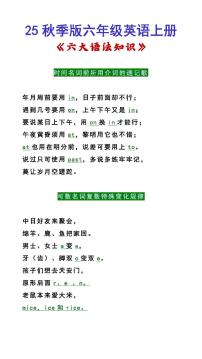
这是一份人教版六年级英语上册期末重点句型汇总知识点,共6页。
Unit 1
1.Hw d yu g t schl? 你是怎样去上学的?
2.where is the restaurant? 餐馆在哪里?
3. Usually I g t schl n ft. 我通常走路去上学。
4. Smetimes I g by bike. 有时候我骑自行车去。
5.问路之前,出于礼貌,我们要说“Excuse me”与后面的句子要用标点符号隔开。
6.Lk at the traffic lights, remember the traffic rules.
看着交通灯,记住交通规则。
7.Stp at a red light.Wait at a yellw light. G at a green light. 红灯停。黄灯等一等。绿灯行。
8.Red means stp, yellw means wait, green means g.
红色的意思是停止,黄色的意思是等待,绿色的意思是通行。
9.Hw can I get t the park? 我该怎样到达公园呢?
10.Yu can g by the N.15 bus. 你可以坐15路公交车去。
Unit 2
1.Let's g t the nature park.让我们一起去公园吧!
2.——Hw d we get there?我们怎样到达这里?
——By bus乘公交。
3.The park is ver there.公园在那里。
4.Let's g .我们一起出发吧!
5.Slw dwn and stp at a yellw light.黄灯等一等。
6.Stp and wait at a red light.红灯停。
G at a green light.绿灯行。
Unit 3
1.---What are yu ging t d tmrrw?
---I'm ging t have an art lessn.
此句是个一般将来时态的特殊疑问句。用了be ging t 结构。“be ging t +动词原形”构成一般将来时态,表示计划、安排将要做的事或根据目前推测将要发生的动作,意为“打算,将要”。
表示时间的单词:
evening晚上,傍晚 tnight在今晚 this mrning今天早晨
tmrrw明天 next week下周 this afternn今天下午
this evening 今天晚上 this weekend 下周末
动词短语原形:
make a snwman 堆雪人 take a trip去旅游
see a film看电影 visit my grandparents 拜访祖父母
watch TV看电视 learn hw t swim学怎样游泳
g skating去滑冰 rw a bat划船
g fishing 去钓鱼 g skiing去滑雪
g shpping去购物 make mncakes做月饼
read a pem读诗
eg:I'm ging t make a snwman.我打算去堆雪人。
We're ging fishing.我们打算去钓鱼。
2.We are ging t draw sme pictures in Renmin Park.
此句是be ging t 结构的肯定句式。
基本结构为:主语+ be ging t +动词原形+表示将来的时间。
Sme一些,用于肯定句中, 后接可数名词的复数形式或不可数名词,而在疑问句或否定中表示一些要用any。
3.---Where are yu ging?
---We're ging t the cinema.
此句是where 引导的一般将来时态的特殊疑问句,where意为“哪里”,它是对地点提问的特殊疑问词,因此回答时要回答一个具体的地点。
表示地点的词:
schl学校 park 公园 cinema电影院 hspital医院 htel旅馆
pst ffice邮局 bus stp公共汽车站 hme家 z动物园
supermarket超市 bkstre书店 museum博物馆 park公园
restaurant餐馆bank银行lake湖 library图书馆 garden花园
4.——When are yu ging?
——Next Mnday.
此句中when意为“什么时候, 何时”,它引导的疑问句用来对年、月、日等时间进行提问。
如:---When d yu g t schl in the mrning?
---At 8:00.
5.---Hw can yu learn t swim withut ging t a pl?
此句是由hw 引导的特殊疑问句, 询问别人做事的方式、方法。句中的can 意为“能够”,是情态动词,后面跟动词原形。“learn t d smething,”学习做某件事,一般表示还没学或还没做的事情,含义
将来的意思。
Unit 4
1.What's yur hbby? 你的爱好是什么?=What is yur hbby?
2.What are yur hbbies? 你的爱好是什么?
3.I like reading stries.我喜欢看故事书。
4.He likes cllecting stamps, t. 他也喜欢集邮。
5.Des she teach English?她是教英语的吗?
Yes, she des. /N, she desn't.
6.D yu like English ?Yes, I d./N, I dn't.
7.My name is Jhn.我是约翰。
8.His name is Zhang Peng.他是张鹏。
9.Her name is Amy.她是艾米。
10、What are yu ding? 你正在做什么?
11、I'm writing an email t my new pen pal. 我正在给我的新笔友写信。
Unit 5
1.What des yur mther d? 你妈妈是做什么的?
2.She is a TV reprter. 她是电视台记者。
3.Where des she wrk? She wrks in a car cmpany.
她在哪工作?她在汽车公司工作。
4.Hw des she g t wrk? She ges t wrk by bus.
她怎样去工作?她坐公交车工作。
5.Is yur father a pstman ?你的爸爸是邮递员吗?
Yes, he is . (是的,他是)N ,he isn't.(不,他不是)
6.Where des she wrk?她在哪里工作?
7.She wrks at a university.她在大学工作。
8.He is gd at playing ftball. 他擅长踢足球。
9.If yu like sprts, yu can be a cach.
如果你喜欢运动,你就有可能成为一名教练。
Unit 6
1.They are afraid f him.我害怕他。此句中be afraid f意为“害怕某人
例如:I am afraid f my maths teacher.我害怕我的数学老师。
2.The cat is angry with them.这只猫害怕他们。
此句中be angry with意为“ 对某人生气”。
3.What's wrng?=what's up? 怎么啦?出什么事了?
此句用于询问对方有什么问题或有什么不顺心的事情,意为:怎么啦?出什么事了?
例如:A: What's wrng, Jim? 吉姆,你怎么啦?
B: Maybe I am ill. 也许我病了。
4.He shuld see a dctr this mrning建议某人应该做某事的句型
此句中shuld 为情态动词,表示“应该,应当”。此句用来给别人提建议。
例如:He shuld wrk harder. 他应该更加努力。
5.What are yu ding?
此句是现在进行时态的特殊疑问句, 其基本结构为:疑问词+be+主语+其他?例如:
What is he ding nw?回答:He is swimming.
肯定句结构为:主语+be+动词-ing形式+其他.
例如:We are running nw.
这是一份人教版六年级英语上册期末重点句型汇总知识点,共6页。
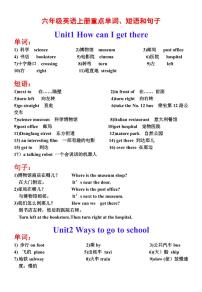
这是一份人教版六年级上册英语期末知识点,共19页。
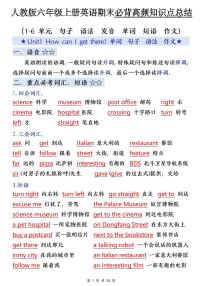
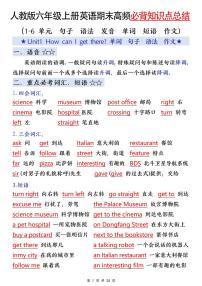
这是一份人教版六年级上册英语期末必备知识点汇总(单词+短语+句型+语法+写作),共24页。

注册成功
资料篮

在线客服
添加在线客服
获取1对1服务
官方微信
关注“教习网”公众号
打开微信就能找资料
赛课定制
添加在线客服
获取1对1定制服务
职称咨询
添加在线客服
获取1V1专业指导服务

免费福利


.png)
.png)
