免费领取教师福利

若您为此资料的原创作者,认为该资料内容侵犯了您的知识产权,请扫码添加我们的相关工作人员,我们尽可能的保护您的合法权益。


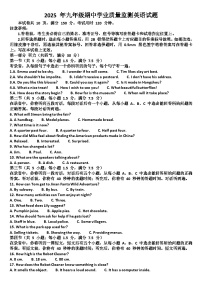
这是一份山东济南天桥区2025—2026学年九年级英语第一学期期中考试试题(含答案),共11页。
注意事项:
1.答卷前,考生务必将自己的姓名、准考证号、座号等填写在答题卡和试卷指定位置上。
2.回答选择题时,选出每小题答案后,用 2B 铅笔把答题卡上对应题目的答案标号涂黑。如需改动,用橡皮擦干净后,再选涂其他答案标号。回答非选择题时,用 0.5mm 黑色签字笔将答案写在答题卡上。写在本试卷上无效。
3.考试结束后,将本试卷和答题卡一并交回。
第一部分 听力 (共四节,满分 30 分)
第一节(共 5 个小题:每小题 1.5 分,满分 7.5 分)听录音,在每组句子中选出一个你所听到的句子。每个句子听一遍。
1.A. It was invented in 1893. B. Tea is ppular in China. C. I’ve learned a lt.
2.A. English isn’t t difficult. B. Billy didn’t use t be shy. C. Jane isn’t sleeping nw.
3.A. Was the shw interesting? B. Did yu pass the exam? C. Culd yu g with me?
4.A. What a nice treat! B. Hw delicius the zngzi is! C. What a fun festival!
5.A. Hw d yu read fast? B. What’s the shirt made f? C. Where can I buy stamps?
第二节(共 5 个小题:每小题 1.5 分,满分 7.5 分)在录音中,你将听到五段对话,每段对话后有一个小题,从每小题 A、B、C 中选出能回答所给问题的正确答案。每段对话听两遍。
6. What is Peter ging t d during the summer hlidays?
A.Visit his grandparents. B. G travelling with friends. C. Learn hw t fish.
7. Where is the restrm?
A. Beside the park. B. On Bhai Rad. C. Next t Bhai Rad.
8. What did Paula use t be like?
A. Strict. B. Serius. C. Humrus.
9. What shuld Mike d?
A. Read alud. B. Make wrd cards. C. Watch English mvies.
10. Which shirt will the wman prbably take?
A. The silk ne. B. The cttn ne. C. Neither f them.
第三节(共 5 个小题:每小题 1.5 分,满分 7.5 分)在录音中,你将听到一段对话,对话后有五个小题,从每小题 A、B、C 中选出能回答所给问题的正确答案。听对话前,你将有 40 秒钟的读题时间;听完后,你将有 40 秒钟的答题时间。对话听两遍。
11. What is Tm ding?
A. Reading a bk. B. Watching a vide. C. Making mncakes.
12. When was the event held in Mscw?
A. Frm Octber 6th t 8th. B. Frm Octber 8th t 10th. C. Frm December 6th t 8th.
13. Hw did Russian kids like the Chinese lin dances?
A. Cmmn. B. Bring. C. Wnderful.
14. Wh acted ut the stry f Chang’e?
A. Students. B. Teachers. C. Russian artists.
15. What might they d next time?
A. Tell stries. B. Taste mncakes. C. Make mncakes.
第四节(共 5 个小题:每小题 1.5 分,满分 7.5 分)在录音中,你将听到一篇短文,短文后有五个小题,从每小题 A、B、C 中选出能回答所给问题的正确答案。听短文前,你将有 40 秒钟的读题时间;听完后,你将有 40 秒钟的答题时间。短文听两遍。
16. Hw lng did Franklin study at schl?
A. Seventeen years. B. Seven years. C. Tw years.
17. Hw did Franklin study while wrking?
A. By reading bks. B. By selling inventins. C. By printing bks.
18. What did Franklin’s findings abut strms help t achieve?
A. Tell the weather. B. Make new inventins. C. Teach science.
19. What did Franklin d with his inventins?
A. Sld them. B. Kept them. C. Gave them away.
20. What is Franklin’s greatest gift t the wrld?
A. His special glasses. B. His learning spirit. C. His findings n strms.
第二部分 阅读(共两节,满分 50 分)
第一节 阅读理解(共 20 个小题:每小题 2 分,满分 40 分)阅读下列短文,从每题所给的 A、B、C、D 四个选项中选出最佳选项。
A
21.Where shuld students g t learn hw t make Chinese kites?
A. The Schl Music Rm.
B. The Schl Art Rm.
C. The Schl Dining Hall.
D. The Schl Craft Rm.
22.Hw lng des the Traditinal Chinese Music lessn last?
A. One hur.
B. One and a half hurs.
C. Tw hurs.
D. Tw and a half hurs.
23.Which lessn can yu take n Sunday afternn?
A. Traditinal Chinese Music.
B. Traditinal Chinese Art.
C. Traditinal Chinese Fd.
D. Traditinal Chinese Clthes.
24.Which f the fllwing is TRUE accrding t the material?
A. Students can try n Hanfu in the Schl Dining Hall.
B. Mrs. Li can teach students t play the Chinese instruments.
C. Mrs. Wang may knw a lt abut traditinal Chinese fd.
D. Yu can call 120-3541268 t ask abut Traditinal Chinese Clthes.
25.Where is the text prbably taken frm?
A. A strybk.
B. A science magazine.
C. A film review.
D. A schl ntice bard.
B
Sixteen years ag, American teenager Cnnr decided t mve t China. Neither his friends nr his family understd his decisin. Just like many Western peple, he thught China was a place with a slw life, quiet streets and traditinal custms. He was excited, but he didn’t realize that the reality (现实) wuld be cmpletely different and wuld change his life frever.
When his plane landed in Beijing, he was shcked by the size f the city and the number f peple. At first, he felt lst. Hwever, he sn fund that Beijing was lively, full f energy, bright lights and nn-stp change. Seeing streets rebuilt with new buildings in just a few mnths made him realize his ld ideas abut China were wrng.
Living in this active envirnment was challenging, but Cnnr gradually adapted. He learned Chinese, made friends with lcal peple, and started t understand the new culture arund him. He fund that peple here were very knwledgeable and ften enjyed talking abut interesting tpics. What’s mre, he nticed that this experience changed his wn persnality. Back in America, he had been a bit quiet, but living in China helped him becme much mre utging. It was like he discvered a new, mre cnfident part f himself.
Nw, 16 years later, China is Cnnr’s hme. He married a Chinese wman and they have a sn. His life in China taught him it’s imprtant t experience things himself instead f believing steretypes (刻板印象). It als taught him that ur views n the wrld can change wnderfully when we pen up t new places and peple. Fr Cnnr, China is where he truly grew up.
26.Hw did Cnnr feel when he decided t mve t China?
A. Excited.
B. Prud.
C. Shcked.
D. Cnfident.
27.What made Cnnr realize his ld ideas abut China were wrng?
A. The friendly lcal peple.
B. The traditinal Chinese fd.
C. The tpics peple talked abut.
D. The real situatin in Beijing.
28.Which best explains the underlined wrd “adapted” in paragraph 3?
A. Gt used t.
B. Succeeded in.
C. Helped with.
D. Stayed away frm.
29.What can we learn abut Cnnr?
A. He knew China well 16 years ag.
B. He desn’t speak any Chinese.
C. He cnsiders China t be his hme.
D. He used t be utging in America.
30.What des the writer suggest in the last paragraph?
A. Cnnr will return t America.
B. Experience shapes wrld views.
C. Steretypes are easy t change.
D. Marriage helped Cnnr grw.
C
Have yu ever wndered hw fd ends up n yur plate? Grwing fd is hard wrk, but tday, mdern technlgy is making farming smarter and better. In China, farmers and scientists are using new ideas t grw mre fd and, very imprtantly, t waste less. This helps make sure there is enugh fd fr everyne.
In sme places, the wrk desn’t stp after the harvest (收获). The fd, like rice and grain (谷物), is kept in very large buildings. In the past, bad insects culd smetimes eat the fd. But nw, sme f these buildings have a smart AI system (系统). This cmputer system watches the fd 24 hurs a day. If it sees any prblems, it sends an alarm. This is like having a clever rbt guard that keeps the fd safe and clean.
There is als smart technlgy fr preparing the fd. Fr example, when we get rice frm the fields, it has a brwn cat that we need t take ff. A cmpany in China has fund a new way t d this. Their special machines can take ff the cat very carefully. This methd wastes less rice and can prduce 32 kilgrams mre rice fr every tn. It is like peeling an apple perfectly, s that yu can eat mre f it.
These new ideas shw that farming is nt just abut wrking in the fields. It is als abut using science and technlgy t slve prblems. If we are smart abut hw we grw, keep, and prepare ur fd, we can make sure that every grain is used well. This is a great way t help feed mre peple and take care f ur wrld.
31.Why des the writer start the text with a questin?
A. T get readers interested in fd tpics.
B. T prvide mre infrmatin abut fd.
C. T intrduce mdern building technlgy.
D. T explain the difficulties f grwing fd.
32.Hw can the smart AI system prtect fd?
A. Kill bad insects.
B. Grw mre fd.
C. Send prblem alarms.
D. Build special buildings.
33.What can we infer frm the example f the special machines?
A. The brwn cat f rice is in fact cmpletely useless.
B. Peeling apples and peeling rice use the same technlgy.
C. Chinese cmpanies prduce the mst rice in the wrld.
D. The new methd f peeling rice leads t less fd waste.
34.What des the writer think f using technlgy in farming?
A. It nly wrks in fd strage.
B. It csts t much fr farmers.
C. It helps in many farming steps.
D. It brings mre truble than help.
35.What is the main idea f the passage?
A. Mdern technlgy helps farmers reduce fd waste.
B. Chinese cmpanies are better at making farming tls.
C. AI systems are the mst imprtant part in fd strage.
D. Grwing fd becmes much easier with new machines.
D
A new study shws that birds in cities stay active lnger because f artificial (人为的) light. It fund that birds in bright city areas sing fr mre time each day than thse in the quiet cuntryside.
Light pllutin cmes frm street lights, buildings, and cars. This brightens the natural darkness and can fl animals int thinking it is daytime fr lnger than it is.
Scientists studied mre than fur millin bird calls frm BirdWeather, a citizen-science prject (ne where the public gathers the infrmatin). Peple send in recrdings f birdsng and BirdWeather uses artificial intelligence (AI) t recgnise the sunds they send. Then it uses that infrmatin t study birds’ behaviur and ppulatin changes. The infrmatin that users sent in was cmpared with survey f light pllutin taken frm images cllected by satellites (卫星) in space.
Researchers listened t birdsng frm the mrnings and evenings when the birds were mst active. They fund that birds in twns r cities, which have lts f light pllutin, sing fr an average f 50 minutes lnger every day. They start abut 20 minutes earlier in the mrning and then cntinue fr abut 30 minutes mre in the evening.
Nt all birds act the same way tward artificial light. Birds with relatively larger eyes seemed mre sensitive (敏感的) t it. American rbins, Australian magpie-larks and Eurpean gldfinches remain active fr a lnger time each day than average, while small-eyed birds such as sparrws (麻雀) shwed less change.
Hwever, nt all birds act the same. Mre study is needed int hw birds are influenced. Fr example, Dr Brent Pease frm Suthern Illinis University, said it was unclear if less sleep time is bad fr birds. He pinted ut that “they have develped interesting strategies t deal with lss f sleep during migratry (迁徙的) perids.”
36.What des the writer want t tell us abut birds in cities in paragraph 1?
A. They sing less when it gets dark.
B. They sing much luder during daytime.
C. They stay active fr a lnger time each day.
D. Their singing time is similar t cuntry birds.
37.What des it refer t in paragraph 3?
A. AI.
B. The scientist.
C. The user.
D. BirdWeather.
38.Which are less sensitive t the artificial light accrding t paragraph 5?
A. Sparrws.
B. Eurpean gldfinches.
C. American rbins.
D. Australian magpie-larks.
39.What can we learn frm Dr Brent Pease’s wrds in the last paragraph?
A. Less sleep is certainly harmful t city birds.
B. Migratry birds never cme under lack f sleep.
C. Birds may have ways t slve the prblem f sleep lss.
D. Researchers have fully understd birds’ sleep strategies.
40.What can be a suitable title fr this text?
A. Birds Sing Beautifully in Cities.
B. City Lights Make Birds Sing Lnger.
C. Bird Weather Did a Survey n Air Pllutin.
D. Weather Influences Birds’ Singing a Lt.
第二节 阅读七选五(共 5 个小题:每小题 2 分,满分 10 分)
阅读下面短文,从短文后的选项中选出能填入空白处的最佳选项。选项中有两项为多余选项。
While surfing the internet, yu might have seen vides f cats taking a shwer. Mst cats fight r lk unhappy. 41. ____
Evlutin (进化) may be the first reasn. Different frm dgs, cats haven’t changed much ver the past 10,000 years. They still act a lt like their ancestr, the African wildcat. “African wildcats are typically ging t be hunting n land. S they didn’t really develp the habit f being in the water,” cat expert Kristyn Vitale tld Ppular Science. S it makes sense that tday’s cats dn’t jump int pls with much excitement.
42.____ Jennifer Vnk, a cat expert frm Oakland University, said that cats find being wet uncmfrtable, and it can mess with their sense f smell. 43. ____ It may als bring new smells they dn’t like, like the chemicals (化学物质) in tap water.
On the ther hand, getting wet may thrw ff a cat’s balance. Fr example, whiskers (胡须) help cats explre their surrundings and find their way. 44. ____
“In general, cats d nt need t be given a bath by their wners,” US prfessr Alisn Diesel tld VMBS News. 45. ____ Taking shwers may als harm cats, which can influence the human-animal relatinship.
第三部分 语言运用(共三节,满分 35 分)
第一节 补全对话(共 5 个小题:每小题 1 分,满分 5 分)阅读下面对话,从每题所给的 A、B、C、D 四个选项中,选出一个最佳答案完成对话。
Weiwei: Hi, Mark! The rbt shw is starting tday.
Mark: Really? 46. ____
Weiwei: Of curse! A new hme rbt named “Lingba” can understand yur feelings.
Mark: 47. ____ Can even a machine understand ur feelings? Hw des it d that?
Weiwei: By remembering yur habits. Fr example, if yu always listen t music after schl, the music player will turn itself n.
Mark: Ww, it’s like a real friend! 48. ____
Weiwei: A rbt can nw help patients learn t walk again. They’re changing ur lives.
Mark: That’s truly meaningful.
Weiwei: 49. ____
Mark: It is a challenge, but it’s getting better.
Weiwei: It seems rbts will be ur helpful partners in the future.
Mark: 50. ____ Let’s g and see the future fr urselves!
46A. Are there any new kinds f rbts?
B. May yu pay fr the machine?
C. Have yu ever watched the mvie?
D. Can the rbt help with chres?
47.A. That’s all right!
B. Enjy yurself!
C. What a funny jke!
D. That sunds amazing!
48.A. Can it talk?
B. Is it expensive?
C. Anything else?
D. Des it wrk well?
49.A. Wuld yu like t hang ut with me?
B. Can cmmn families wn these rbts?
C. Is it easy fr peple t take phts?
D. Can rbts play chess with humans?
50.A. See yu then.
B. I hpe nt.
C. I’m nt sure.
D. I agree with yu.
第二节 完形填空(共 15 个小题:每小题 1 分,满分 15 分)
阅读下面短文,从文后每题所给的 A、B、C、D 四个选项中选出可以填入空白处的最佳选项。
Fr his eleventh birthday, Lin was given a gift that wuld shape his life. On that day his father tk him t the Children’s Activity Centre and said he culd chse any 51. ____ that interested him. There was just ne requirement: Lin wuld have t 52. ____ t study it fr at least ne year.
T that pint Lin had had many hbbies, but 53. ____ kept his interest fr mre than a week r tw. His mum nce gave him a bag f stamps t encurage stamp cllecting. That hbby 54. ____ a week. Then his father gt him sme paints. Thse paints were nw under his bed, still 55. ____. This time Lin’s parents wuld let him 56. ____.
Lin’s eyes mved dwn the nticebard and stpped at “Phtgraphy”. He liked the idea f taking beautiful pictures, 57. ____ the ntice said that each student needed their wn camera. Althugh Lin’s family weren’t pr, they weren’t rich 58. ____, and a camera cst a lt f mney.
Knwing a camera was mre than his family culd easily affrd (买得起), he cntinued lking dwn the nticebard fr ther curses. The next curse t 59. ____ his eye was “Cking”. It sunded like smething he wuld enjy: inexpensive and 60. ____. It culd be dne alne and it was als creative.
His dad agreed althugh he had 61. ____. Much t his parents’ surprise, Lin kept his prmise. He studied 62. ____ at the centre every Saturday, and practised at hme, making delicius meals fr his family. Lin gt great satisfactin 63. ____ the pleasure his fd brught t thers.
The mnths turned t years but his lve fr cking 64. ____ changed.
Nw Lin is an adult and 65. ____ a successful restaurant. When custmers say they enjy his meals, he still gets the same pleasure he did as a child, and remembers the special gift he received all thse years ag.
51.A. curse B. bk C. game D. ntice
52.A. refuse B. prmise C. frget D. dare
53.A. all B. nne C. sme D. many
54.A. cst B. ended C. lasted D. spent
55.A. brken B. empty C. lst D. unpened
56.A. check B. decide C. guess D. wait
57.A. s B. if C. but D. because
58A. t B. either C. als D. neither
59.A. clse B. cver C. catch D. hurt
60.A. cnvenient B. difficult C. imprtant D. ppular
61.A. hpes B. dubts C. dreams D. ideas
62.A. cking B. painting C. phtgraphy D. sprts
63.A. abut B. except C. withut D. frm
64.A. always B. ften C. smetimes D. never
65. builds B. sells C. runs D. visits
第三节 阅读填空(共 10 个小题:每小题 1.5 分,满分 15 分)
阅读下面短文,在空白处填入 1 个适当的单词或括号内单词的正确形式。
Every day after schl, Ethan wuld rush hme, play his guitar and lse himself in the music. Playing was his greatest jy.
One day, there wuld be a lcal talent shw in his twn. Ethan decided 66. ____ (jin), but sn he started t wrry. He cmpared himself 67. ____ ther musicians and began t questin his skills. The fear f failure began t weigh n him.
Ethan’s grandfather nticed Ethan 68. ____ (truble). He then shared a stry frm when he was yung. “I nce dreamed f being a painter, 69. ____ self-dubt held me back,” he said. “I went t see 70. ____ ld artist, wh tld me t paint a picture in frnt f a crwd. I was scared and didn’t knw what t d.”The artist smiled and said,
“Dn’t wrry abut 71. ____ thers think. Paint frm yur heart. True beauty 72. ____ (cme) frm being real, nt being perfect.” With this advice, Ethan’s grandfather let his feelings guide him. The crwd watched as a beautiful picture tk shape.
Inspired (启发) by his grandfather’s stry, Ethan walked nt the stage 73. ____ (brave) and played like never befre. His fingers danced ver the strings (弦), creating music that tuched the hearts f his listeners.
Ethan didn’t win the talent shw, but he felt like a 74. ____ (win). He learned that success isn’t just abut winning a prize—it’s abut enjying what yu lve t d. The true prize is the jurney 75. ____ (it).
第四部分 写作(共两节,满分 35 分)
第一节 情境运用(共 5 个小题:每小题 2 分,满分 10 分)
根据所提供的图片,用一个完整的句子提问或应答。
76.A: Hw d yu imprve yur English?
B: ________________________.
77.A: Excuse me. ________________________?
B: Sure. Yu can g there by bus.
78.A: What d peple usually d during the Spring Festival?
B: ________________________.
79.A: Hw des Teng Fei get t schl?
B: ________________________. But nw he takes the subway.
80.A: Beautiful! ________________________?
B: It is made f leaves.
作文(满分 25 分)
假如你是 Tm,一名来自英国的留学生,请给远在国外的父母写一封信,讲述你在中国学习的经历。内容涵盖:
1.你学习汉语的具体方式(至少包含两点)。
2.你在中国了解到的一项中国传统文化(如传统艺术、民俗节日、生活文化等)。
注意:
(1)词数 100 左右。
(2)可以适当增加细节,以使行文连贯;
(3)不得出现真实的人名、校名等相关信息。
Dear mum and dad,
Hw’s everything ging?
Yurs,Tm
答案
第一部分 听力(共 30 分)
1.A 2. B 3. C 4. B 5. B
6.A 7. B 8. C 9. B 10. B
11.B 12. A 13. C 14. A 15. C
16.C 17. A 18. A 19. C 20. B
第二部分 阅读(共 50 分)
第一节 阅读理解(40 分)
21.B 22. B 23. D 24. C 25. D
26.A 27. D 28. A 29. C 30. B
31.A 32. C 33. D 34. C 35. A
36.C 37. D 38. A 39. C 40. B
第二节 阅读七选五(10 分)
41.E 42. B 43. D 44. G 45. A
第三部分 语言运用(共 35 分)
第一节 补全对话(5 分)
46.A 47. D 48. C 49. B 50. D
第二节 完形填空(15 分)
51.A 52. B 53. B 54. C 55. D
56.B 57. C 58. B 59. C 60. A
61.B 62. A 63. D 64. D 65. C
第三节 阅读填空(15 分)
66.t jin 67. with 68. was trubled 69. but 70. an 71.what 72. cmes 73. bravely
74. winner 75. itself
第四部分 写作(共 35 分)
第一节 情境运用(10 分)
76.I imprve my English by reading English bks and listening t English sngs.
77.Culd yu tell me hw t get t the museum?
78.Peple usually have a big dinner with family and visit relatives during the Spring Festival.
79.He used t get t schl by bike.
80.What is this beautiful craft made f?
第二节 作文(25 分)
Dear mum and dad,
Hw’s everything ging? I’m ding well in China. I’ve been learning Chinese hard. Every mrning, I read Chinese textbks alud t practice prnunciatin. After class, I ften talk with my Chinese classmates t imprve my speaking skills.
I als learned a lt abut Chinese culture. Last mnth, I jined a paper-cutting class. It’s an interesting traditinal art. The teacher shwed me hw t cut paper int different shapes like flwers and animals. It was difficult at first, but nw I can make simple paper-cuttings.I really enjy my life here.
Yurs,Tm
Chinese Culture Lessns
Traditinal Chinese Art
Things t d:
★ learn abut Chinese calligraphy (书法)
★ learn t make Chinese kites
Time: 8:00-9:30 n Saturday mrning
Place: Schl Art Rm
Teacher: Mrs. Li
Tel: 120-2436885
Traditinal Chinese Music
Things t d:
★ learn t play the erhu, the guzheng and the suna
★ enjy traditinal Chinese music
Time: 10:00-11:30 n Sunday mrning
Place: Schl Music Rm
Teacher: Mr. He
Tel: 120-6238526
Traditinal Chinese Fd
Things t d:
★ eat traditinal Chinese fd
★ learn t make zngzi, mncakes and jiazi
Time: 2:00-3:30 n Saturday afternn
Place: Schl Dining Hall
Teacher: Mrs. Wang
Tel: 120-3541268
Traditinal Chinese Clthes
Things t d:
★ try n Han and Tang clthes
★ knw abut Chinese clthes at different times
Time: 4:00-5:30 n Sunday afternn
Place: Schl Craft Rm
Teacher: Miss Yang
Tel: 120-1643856
A.She explained that cats can clean themselves.
B. Being wet may als influence cats’ senses.
C. Is it actually a gd idea t try t wash a cat t ften?
D. Water can hide a cat’s natural smell, making them upset.
E. Have yu ever wndered why mst cats dn’t like water?
F. Playing with sft balls can always make cats really happy.
G. When whiskers get wet, cats might nt sense mvements.
这是一份山东济南天桥区2025—2026学年九年级英语第一学期期中考试试题(含答案),共11页。
这是一份山东济南天桥区2024—2025学年九年级英语第一学期期中考试试题(含答案,无听力原文及音频),共9页。
这是一份山东省济南市天桥区2024-2025学年九年级上学期期中考试英语试题,文件包含教研室提供山东省济南市天桥区2024-2025学年九年级上学期期中考试英语试题docx、九年级期中教学诊断测试英语答案2024111docx等2份试卷配套教学资源,其中试卷共11页, 欢迎下载使用。
注册成功
资料篮

在线客服
添加在线客服
获取1对1服务
官方微信
关注“教习网”公众号
打开微信就能找资料
赛课定制
添加在线客服
获取1对1定制服务
职称咨询
添加在线客服
获取1V1专业指导服务

免费福利

.png)