免费领取教师福利


若您为此资料的原创作者,认为该资料内容侵犯了您的知识产权,请扫码添加我们的相关工作人员,我们尽可能的保护您的合法权益。

这是一份2025-2026学年九年级上学期英语期中复习题型知识点练习(含答案),共46页。试卷主要包含了 He等内容,欢迎下载使用。
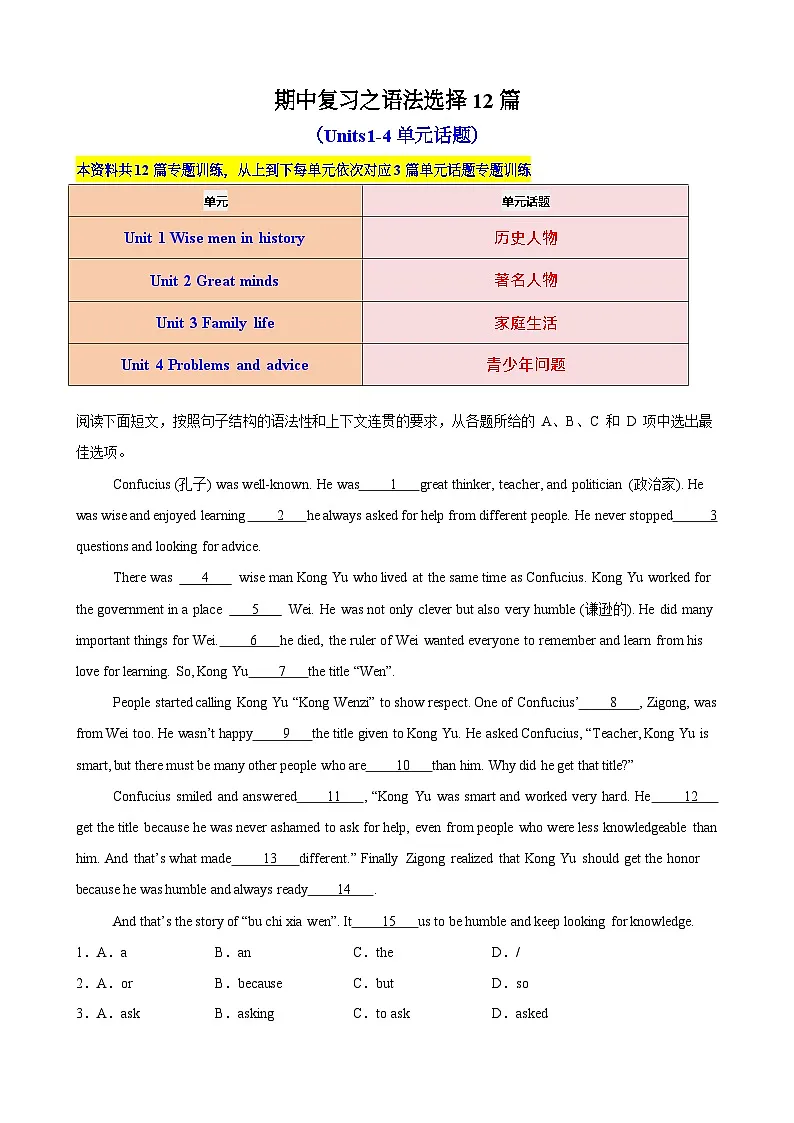
期中复习之语法选择 12 篇
(Units1-4 单元话题)
本资料共 12 篇专题训练,从上到下每单元依次对应 3 篇单元话题专题训练
阅读下面短文,按照句子结构的语法性和上下文连贯的要求,从各题所给的 A、B、C 和 D 项中选出最佳选项。
Cnfucius (孔子) was well-knwn. He was1great thinker, teacher, and plitician (政治家). He
was wise and enjyed learning2he always asked fr help frm different peple. He never stpped3
questins and lking fr advice.
There was4wise man Kng Yu wh lived at the same time as Cnfucius. Kng Yu wrked fr
the gvernment in a place5Wei. He was nt nly clever but als very humble (谦逊的). He did many
imprtant things fr Wei.6he died, the ruler f Wei wanted everyne t remember and learn frm his
lve fr learning. S, Kng Yu7the title “Wen”.
Peple started calling Kng Yu “Kng Wenzi” t shw respect. One f Cnfucius’8, Zigng, was
frm Wei t. He wasn’t happy9the title given t Kng Yu. He asked Cnfucius, “Teacher, Kng Yu is
smart, but there must be many ther peple wh are10than him. Why did he get that title?”
Cnfucius smiled and answered11, “Kng Yu was smart and wrked very hard. He12
get the title because he was never ashamed t ask fr help, even frm peple wh were less knwledgeable than him. And that’s what made13different.” Finally Zigng realized that Kng Yu shuld get the hnr
because he was humble and always ready14.
And that’s the stry f “bu chi xia wen”. It15us t be humble and keep lking fr knwledge.
单元
单元话题
Unit 1 Wise men in histry
历史人物
Unit 2 Great minds
著名人物
Unit 3 Family life
家庭生活
Unit 4 Prblems and advice
青少年问题
1.A.a
B.an
C.the
D./
2.A.r
B.because
C.but
D.s
3.A.ask
B.asking
C.t ask
D.asked
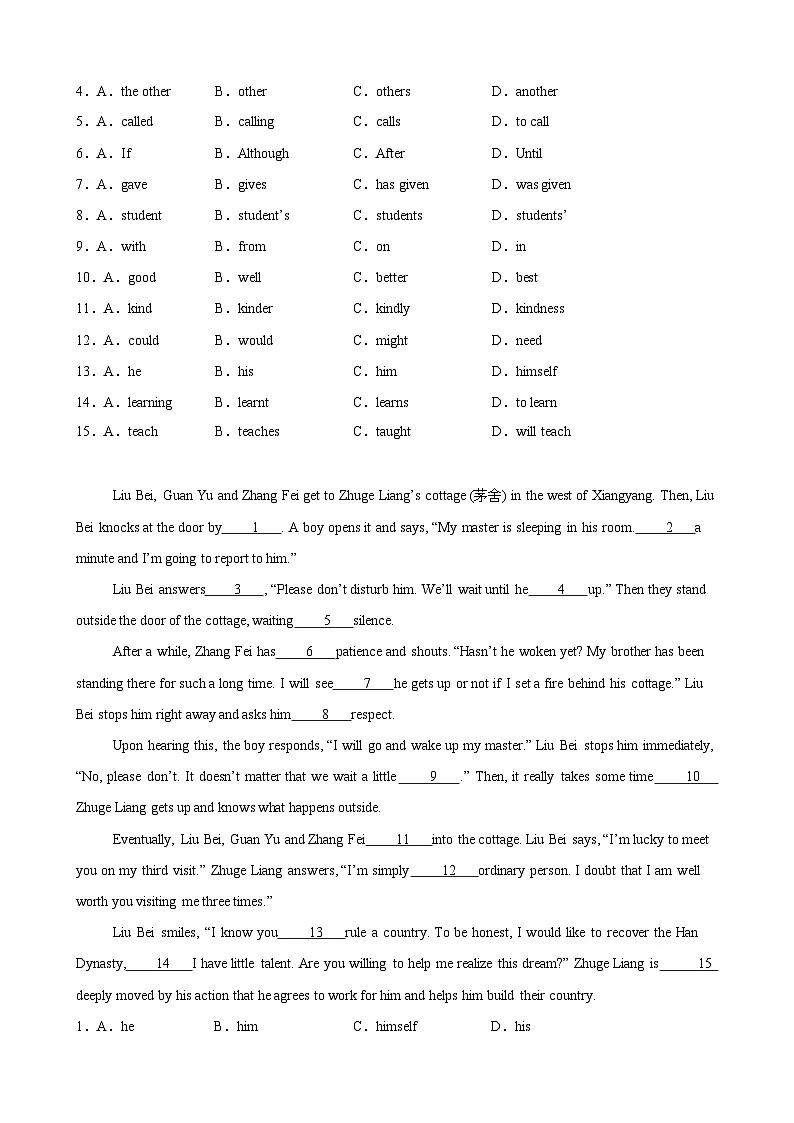
Liu Bei, Guan Yu and Zhang Fei get t Zhuge Liang’s cttage (茅舍) in the west f Xiangyang. Then, Liu Bei kncks at the dr by1. A by pens it and says, “My master is sleeping in his rm.2a
minute and I’m ging t reprt t him.”
Liu Bei answers3, “Please dn’t disturb him. We’ll wait until he4up.” Then they stand
utside the dr f the cttage, waiting5silence.
After a while, Zhang Fei has6patience and shuts. “Hasn’t he wken yet? My brther has been
standing there fr such a lng time. I will see7he gets up r nt if I set a fire behind his cttage.” Liu
Bei stps him right away and asks him8respect.
Upn hearing this, the by respnds, “I will g and wake up my master.” Liu Bei stps him immediately, “N, please dn’t. It desn’t matter that we wait a little9.” Then, it really takes sme time10
Zhuge Liang gets up and knws what happens utside.
Eventually, Liu Bei, Guan Yu and Zhang Fei11int the cttage. Liu Bei says, “I’m lucky t meet
yu n my third visit.” Zhuge Liang answers, “I’m simply12rdinary persn. I dubt that I am well
wrth yu visiting me three times.”
Liu Bei smiles, “I knw yu13rule a cuntry. T be hnest, I wuld like t recver the Han
Dynasty,14I have little talent. Are yu willing t help me realize this dream?” Zhuge Liang is15
deeply mved by his actin that he agrees t wrk fr him and helps him build their cuntry. 1.A.heB.himC.himselfD.his
4.A.the ther
B.ther
C.thers
D.anther
5.A.called
B.calling
C.calls
D.t call
6.A.If
B.Althugh
C.After
D.Until
7.A.gave
B.gives
C.has given
D.was given
8.A.student
B.student’s
C.students
D.students’
9.A.with
B.frm
C.n
D.in
10.A.gd
B.well
C.better
D.best
11.A.kind
B.kinder
C.kindly
D.kindness
12.A.culd
B.wuld
C.might
D.need
13.A.he
B.his
C.him
D.himself
14.A.learning
B.learnt
C.learns
D.t learn
15.A.teach
B.teaches
C.taught
D.will teach
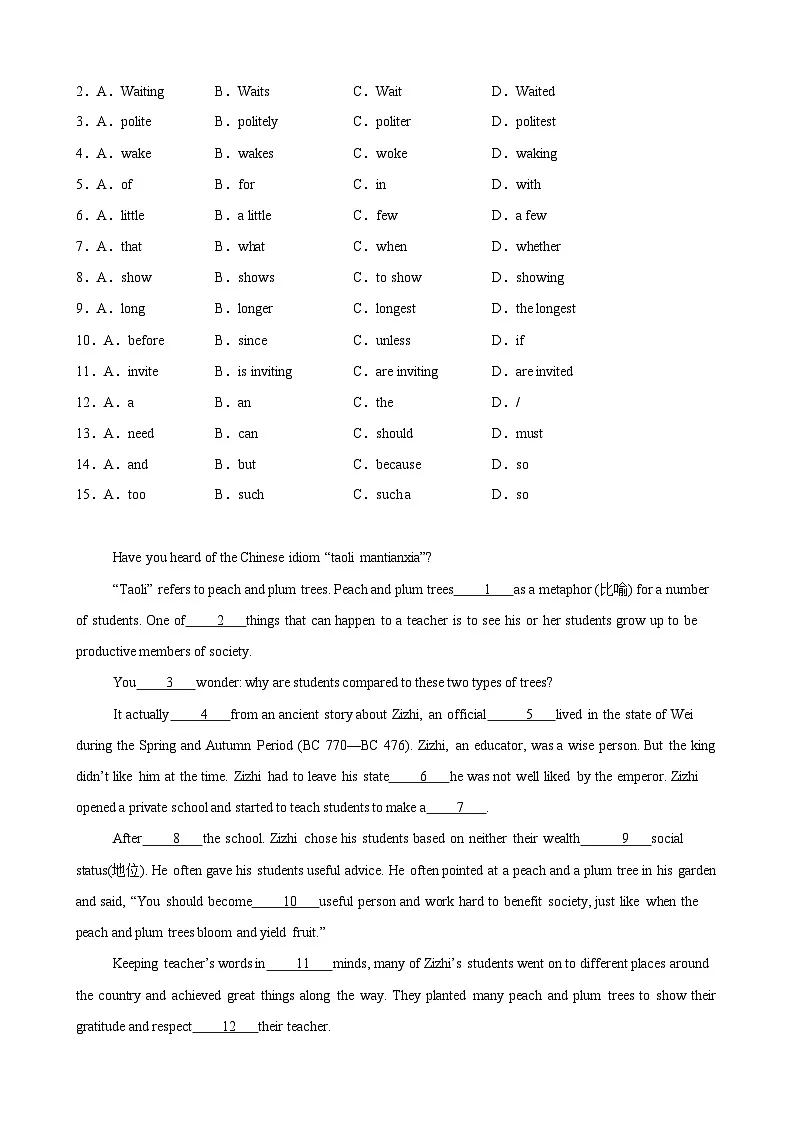
Have yu heard f the Chinese idim “tali mantianxia”?
“Tali” refers t peach and plum trees. Peach and plum trees1as a metaphr (比喻) fr a number
f students. One f2things that can happen t a teacher is t see his r her students grw up t be
prductive members f sciety.
Yu3wnder: why are students cmpared t these tw types f trees?
It actually4frm an ancient stry abut Zizhi, an fficial5lived in the state f Wei
during the Spring and Autumn Perid (BC 770—BC 476). Zizhi, an educatr, was a wise persn. But the king didn’t like him at the time. Zizhi had t leave his state6he was nt well liked by the emperr. Zizhi
pened a private schl and started t teach students t make a7.
After8the schl. Zizhi chse his students based n neither their wealth9scial
status(地位). He ften gave his students useful advice. He ften pinted at a peach and a plum tree in his garden and said, “Yu shuld becme10useful persn and wrk hard t benefit sciety, just like when the
peach and plum trees blm and yield fruit.”
Keeping teacher’s wrds in11minds, many f Zizhi’s students went n t different places arund
the cuntry and achieved great things alng the way. They planted many peach and plum trees t shw their gratitude and respect12their teacher.
2.A.Waiting
B.Waits
C.Wait
D.Waited
3.A.plite
B.plitely
C.pliter
D.plitest
4.A.wake
B.wakes
C.wke
D.waking
5.A.f
B.fr
C.in
D.with
6.A.little
B.a little
C.few
D.a few
7.A.that
B.what
C.when
D.whether
8.A.shw
B.shws
C.t shw
D.shwing
9.A.lng
B.lnger
C.lngest
D.the lngest
10.A.befre
B.since
C.unless
D.if
11.A.invite
B.is inviting
C.are inviting
D.are invited
12.A.a
B.an
C.the
D./
13.A.need
B.can
C.shuld
D.must
14.A.and
B.but
C.because
D.s
15.A.t
B.such
C.such a
D.s
Later,13Zizhi traveled arund the cuntry, he saw his students and the trees they had planted. He
was14mved. “My students are like peach and plum trees. They are everywhere, and they15
Flrence Chia-ying Yeh, als knwn as Ye Jiaying, was a great mind in literature (文学).
In 1924, she was brn int a literary (文学的) family in Beijing. Because f her family backgrund, she had chances 178 classical petry and the English language frm a yung age.
In 1941, she started studying petry 179 the Tang and Sng dynasties at university. Gu Sui, a
respected master f Chinese literature, 180 affected her understanding f petry, life and teaching styles.
In 181 1950s and 1960s, Yeh taught at universities in China’s Taiwan. In 1969, she mved t Canada.
In 1979, she started teaching in Peking University. She spent her final decades living and 182 at Nankai
University.
Yeh’s life 183 with sad stries. She lst her mther 184 she was nly 17 years ld. Later, when
she reached middle age, 185 terrible thing happened—her eldest daughter died. It was prbably 186
time in her life; hwever, she kept her study f petry, which gave 187 a lt f supprt. At 92, she chse 218
ancient pems fr children. She 188 vides abut the pems t. Her vides were ppular n Chinese scial
great results,” he said.
1.A.use
B.are using
C.are used
D.used
2.A.gd
B.best
C.the best
D.the better
3.A.may
B.shall
C.need
D.have t
4.A.came
B.cmes
C.is cming
D.has cme
5.A./
B.whm
C.wh
D.whse
6.A.but
B.because
C.thugh
D.r
7.A.lives
B.living
C.live
D.leave
8.A.pen
B.pened
C.t pen
D.pening
9.A.nr
B.r
C.and
D.but
10.A./
B.the
C.an
D.a
11.A.they
B.their
C.theirs
D.themselves
12.A.at
B.in
C.fr
D.with
13.A.when
B.where
C.if
D.thugh
14.A.deep
B.deeper
C.deeply
D.deepest
15.A.achieves
B.achieved
C.have achieved
D.had achieved
media platfrms and she gained 189 fans. During Yeh’s later years, althugh she 190 walk well, she
kept giving lectures t students in a wheelchair. She always lwered the threshld ( 门槛) fr enjying petry
191 guided the students step by step.
On Nvember 24, 2024, Yeh passed away in Tianjin. Her achievement will cntinue t make a 192 t
Diana was brn in New Yrk City. She shwed great talent and lve fr1frm an early age. Later
she2by her cach, an Olympic swimmer, and set new recrds in many lng-distance swimming
cmpetitins. At 28, Diana set3unusual gal. She tried t swim frm Cuba t Flrida fr the first time.
The high winds were4she had t give up the jurney. After experiencing serius5prblems,
Diana felt the need fr new challenges beynd the pl. At 30, she fund a new jb, but deep in her heart, there still lived her gal.
After 30 years f n swimming, Diana began training. This time, she wished6what she started. In
2011, she tried t swim frm Cuba t Flrida again. But7, the swim was full f danger. There8
terrible strms and deadly sea animals during the lng and tiring jurney.9she failed many times, she
was ready t fight back. In 2012, after 60 hurs in the water, a lightning strm and sme10prblems
the future generatins.
1.A.t learn
B.learns
C.learn
D.learned
2.A.with
B.fr
C.at
D.frm
3.A.greatness
B.greater
C.mre greatly
D.greatly
4.A.a
B.an
C.the
D./
5.A.t wrk
B.wrking
C.wrked
D.wrk
6.A.were filled
B.was filled
C.are filled
D.fill
7.A.when
B.unless
C.because
D.if
8.A.anther
B.ther
C.thers
D.the thers
9.A.darker
B.darkest
C.the darkest
D.darkness
10.A.she
B.herself
C.hers
D.her
11.A.recrds
B.recrded
C.will recrd
D.has recrded
12.A.much
B.few
C.little
D.many
13.A.shuldn’t
B.needn’t
C.mustn’t
D.culdn’t
14.A.and
B.but
C.s
D.r
15.A.different
B.differences
C.difference
D.differently
stpped her fr the furth time.
In 2013, 35 years after11first try, Diana planned t swim frm Cuba t Flrida fr a fifth time.
After almst 53 hurs, the12Diana cmpleted the histric swim with the help f a team f dctrs,
scientists and navigatrs13September 2nd. She finally became the first persn14the gal
which seems almst impssible. She was indeed ne f the greatest athletes in histry.
“We shuld stick with ur dreams. Ging after yur dreams15never t late.” Diana said in her
Lu Ynggen was a famus Chinese scientist. He 208 all he had t sciety, frm his life savings t his
wn bdy. Lu Ynggen 209 was the head teacher f Suth China Agricultural University made great
achievements in rice genetics (遗传) research. 210 research n the “specific cmpatibility gene (特异亲和基
因)” has had 211 imprtant influence n rice breeding research.
Lu always wrked 212 . He lived a simple life 213 he was careful with his mney. He saved as
214 mney as he culd, bth in daily life and in his wrk.
215 Lu lived in an ld huse with simple furniture, he still made dnatins ( 捐款) t imprve
educatin and help the pr every year. In 2014, tw huses 216 t a primary schl in Guangzhu by Lu
bk.
1.A.swimming
B.swam
C.t swim
D.swum
2.A.trained
B.was trained
C.has trained
D.has been trained
3.A./
B.the
C.an
D.a
4.A.t strng t
B.as strng as
C.such strng that
D.s strng that
5.A.health
B.healthy
C.healthily
D.healthier
6.A.t finish
B.finish
C.finished
D.finishes
7.A.lucky
B.luckily
C.unlucky
D.unluckily
8.A.are
B.had
C.were
D.have
9.A.Because
B.Althugh
C.Unless
D.But
10.A.anther
B.ther
C.the ther
D.thers
11.A.she
B.she’s
C.her
D./
12.A.64-year ld
B.64-years-ld
C.64 years ld
D.64-year-ld
13.A.n
B.in
C.at
D.t
14.A.achieve
B.achieves
C.t achieve
D.achieved
15.A.are
B.is
C.was
D.were
and his brther. And he ate at the schl’s canteen alng with the students. As a scientist n crps, Lu cared1
each grain f rice and always reminded students f “hw many rice plants will be needed t prduce ne bwl f rice”.
Because f2great achievements and cntributins t agriculture, Lu wn the Tuching China
Award in 2017.
Few peple were3than teachers and students frm the university when Lu died f illness n
August 12, 2019. The 89-year-ld scientist gave all his savings t Suth China Agricultural University.
Peple wndered4he didn’t leave his pssessins t his nly daughter. He said that she was ld
enugh t supprt herself and his wealth5be used fr sciety. As a famus agricultural scientist, Lu als
dnated his wn bdy6medical research and educatin.
D yu smetimes feel lnely? Here1sme advice fr all the kids.
It’s hard2a best friend isn’t arund. Maybe when she/ he mves t a3schl, yu may
feel lnely at break. Yu want4new friends. But5d yu make them? Maybe everybdy
6their friends. But there’s always rm fr mre friends.
Lk arund yur classrm. And think abut wh yu’d like t play7at break. Lk fr chances
1.A.ffers
B.ffered
C.will ffer
D.is ffering
2.A.wh
B.whm
C.whse
D.which
3.A.He
B.His
C.Him
D.Himself
4.A.a
B.an
C.the
D./
5.A.hard
B.hardly
C.harder
D.hardest
6.A.r
B.but
C.when
D.because
7.A.few
B.little
C.much
D.many
8.A.If
B.Until
C.Thugh
D.Unless
9.A.give
B.gave
C.are given
D.were given
10.A.n
B.t
C.abut
D.frm
11.A.make
B.made
C.making
D.t make
12.A.sad
B.sadder
C.saddest
D.sadness
13.A.why
B.hw
C.what
D.whether
14.A.can
B.may
C.will
D.shuld
15.A.supprt
B.supprted
C.supprting
D.t supprt
8hi t them, smile, and be friendly. Offer t help them when they are in truble. Invite smebdy9
with yu r say “D yu want t sit here?” in the dinning hall. Say “Hi, can I play,10?” r just jin in. If
yu have difficulty11this, ask yur teachers fr help. Teachers are usually12at matching up
friends.
The best way t make friends is t be13friend. Be kind, say nice things and help thers. Sn
yu14mre new friends. Yu might still miss that special best friend. But when yu meet each ther
again, yu15talk abut smething yu didn’t have befre she/ he left. Yu can intrduce her/ him t
阅读下面短文,从短文后各题所给的 A、B、C 和 D 四个选项中,选出可以填入空白处的最佳答案。
Living and dealing with kids can be a difficult jb these days, but living and dealing with parents can be even1. Since I was a teenager, I2that cmmunicatin is very imprtant, bth when yu disagree
and when yu get alng. With any relatinship, yu need t let3peple knw yur feelings. If yu are
nt able t cmmunicate, things4bad. When yu are mad at yur parents, it is n use nt talking t
them. If yu lk5the wrd “cmmunicatin” in a dictinary, it will say “the exchange (交换) f ideas
and infrmatin”.6a gd relatinship, yu must keep cmmunicatin strng. Let peple knw hw
yur new friends
1.A.is
B.are
C.was
D.were
2.A.when
B.unless
C.until
D.althugh
3.A.differ
B.difference
C.different
D.differently
4.A.have
B.t have
C.having
D.t having
5.A.what
B.when
C.why
D.hw
6.A.has
B.have
C.had
D.having
7.A.fr
B.with
C.n
D.t
8.A.say
B.t say
C.saying
D.t saying
9.A.play
B.t play
C.playing
D.played
10.A.either
B.als
C.neither
D.t
11.A.d
B.did
C.ding
D.dne
12.A.well
B.gd
C.better
D.best
13.A.a
B.an
C.the
D./
14.A.have
B.had
C.will have
D.have had
15.A.must
B.can
C.need
D.wuld
yu feel, even if it’s just by7a nte. Yu have t make yur parents8gd abut hw they are
ding as a parent. If yu are trying t make them see smething as yu see it, tell them that yu’ll listen t9
they say, but they need t listen t yu first.10away nly makes the situatin wrse.
This is11example. One night, Sphie went t a street party with her friends. She knew she had t
be hme by midnight after the firewrks, but she felt12wuld be implite f her t g hme first. As a
result, she was late getting hme. Her parents were angry at first, but when Sphie explained13she was
late, they weren’t s mad. Cmmunicatin is the key factr there.
Prblems can nly14with cmmunicatin. Just remember,15yu get int a situatin like
Sphie’s, tell yur parents hw yu feel.
Living and dealing with kids can be a tugh jb these days, but living and dealing with parents can be even
1. Since I was a teenager, I2that cmmunicatin is very imprtant, bth when yu disagree and
when yu get alng. With any relatinship, yu need t let3peple knw yur feelings. If yu are nt
able t cmmunicate, things4bad. When yu are mad at yur parents, nt talking t them desn’t slve
anything. If yu lk5the wrd ‘‘cmmunicatin’’ in dictinary, it will say “the exchange f ideas and
infrmatin”.6a gd relatinship, yu must keep cmmunicatin strng. Let peple knw hw yu
1.A.difficult
B.mre difficult
C.less difficult
D.the mst difficult
2.A.have learnt
B.learnt
C.learn
D.will learn
3.A.the thers
B.anther
C.ther
D.thers
4.A.becme
B.will becme
C.becmes
D.are becming
5.A.in
B.t
C.up
D.at
6.A.Kept
B.Keep
C.Keeping
D.T keep
7.A.writing
B.t write
C.write
D.writes
8.A.felt
B.feel
C.feels
D.t feel
9.A.hw
B.that
C.what
D.when
10.A.Walk
B.Walks
C.Walked
D.Walking
11.A.a
B.the
C.an
D./
12.A.its
B.it
C.itself
D.it’s
13.A.hw
B.why
C.which
D.what
14.A.slve
B.be slving
C.slved
D.be slved
15.A.althugh
B.befre
C.unless
D.if
feel, even if it’s just by7a nte. Yu have t make yur parents8gd abut hw they are
ding as a parent. If yu are trying t make them see smething as yu see it, tell them that yu’ll listen t what they say, but ask them9t listen t yu.10away nly makes the situatin wrse.
This is11example. One night, Sphie went t a street party with her friends. She knew she had t
be hme by midnight after the firewrks, but she felt12wuld be rude f her t g hme first. As a
result, she was late getting hme. Her parents were angry at first, but when Sphie explained13she was
late, they weren’t s mad. Cmmunicatin is the key factr there.
Prblems can nly14with cmmunicatin. Just remember,15yu get int a situatin
like Sphie’s, tell yur parents hw yu feel.
D yu have the feeling that there is t much pressure n yu? D yu lse sleep at night because f yur study? D yu think yur time is nt enugh1yu have s many things t d?2a teenager,
yu may have these prblems. But dn’t wrry abut that because everyne3stress smetimes.4
yu cannt keep away frm stress, yu can keep it under cntrl.
5can yu d t deal with stress?
First, be realistic (现实的). Dn’t try t be perfect because n ne is perfect. And expecting6t
1.A.tugh
B.tugher
C.tughest
D.the tughest
2.A.have learnt
B.learnt
C.learn
D.will learn
3.A.the thers
B.anther
C.ther
D.thers
4.A.becme
B.will becme
C.becmes
D.are becming
5.A.in
B.t
C.up
D.at
6.A.Kept
B.Keep
C.Keeping
D.T keep
7.A.writing
B.t write
C.write
D.writes
8.A.felt
B.feel
C.feels
D.t feel
9.A.plite
B.pliteness
C.plitely
D.implite
10.A.Walk
B.Walks
C.Walked
D.Walking
11.A.a
B.the
C.an
D./
12.A.its
B.it
C.itself
D.it’s
13.A.hw
B.why
C.which
D.what
14.A.be slved
B.be slving
C.slve
D.slved
15.A.althugh
B.befre
C.unless
D.if
be perfect can add t yur stress level t. If yu need help n smething, like schlwrk, ask fr it.
Secnd, learn t relax. When yu feel7, yu can stp fr a while and listen t sft music. It can
help yu relax. And it’s gd8a relaxing bath after a whle day’s hard wrk. Yu may als read a bk
r make time fr a hbby. A pet can9t make yu cheer up and feel relaxed.
Third, treat yur bdy well. Experts agree that exercising10helps peple manage stress. And
eating well11help yur bdy get the right fuel (燃料) t beat its best. It’s easy fr yu t eat12
fd r eat t much when yu are under a lt f stress. But it cannt help t reduce yur stress.
What’s mre,13the little prblems. Learning t wrk ut everyday prblems can give yu a
sense f cntrl. Develp skills t calmly face14prblem, make a chice, and take actin tward a
slutin (解决办法). Feeling able t wrk ut little prblems builds the cnfidence t wrk ut bigger15
—it can imprve yur ability t deal with stress.
Yu may knw the sng Happy Birthday very well. But d yu knw abut its writer? It was written by an 1girl. And she2very rich after that.
When she was a child, she was pr. Once her friend Jan3her t a birthday party. She was
4but sad because she didn’t have enugh mney5a gift fr her.
1.A.because
B.s
C.if
D.unless
2.A.Of
B.With
C.As
D.Fr
3.A.experience
B.experiences
C.experienced
D.is experiencing
4.A.Hwever
B.But
C.And
D.Althugh
5.A.What
B.Where
C.Which
D.Whm
6.A.ther
B.the thers
C.anther
D.thers
7.A.tiring
B.tired
C.tiredly
D.tirelessly
8.A.t take
B.taking
C.take
D.tk
9.A.be kept
B.t keep
C.keeping
D.keep
10.A.regular
B.regularly
C.mre regular
D.the mst regular
11.A.shuld
B.must
C.can
D.need
12.A.healthy
B.healthily
C.unhealthy
D.unhealthily
13.A.t wrk ut
B.wrk ut
C.wrking ut
D.wrks ut
14.A.an
B.a
C.the
D./
15.A.that
B.thse
C.ne
D.nes
“The party is cming sn, but nw I have6mney.” Tears ran dwn her face. Later that night
she was in bed, thinking abut the gift when the dr pened and her grandma came in. “What happened?” her grandma asked. Hearing the girl’s stry, she said, “Dn’t7. I think I can help yu. Hw abut8
a sng tgether? Happy birthday t ...”9beautiful sng! They sang and sang. Suddenly she wke up.
10it was a dream, she decided t write it dwn at nce and sing it t11friends at the party.
When she sang the sng at the party the next day, her friends were very happy. “Hw12yu sing!
I haven’t heard such a beautiful sng befre. Thank yu13giving me the special gift.” said her Jan.
And they learnt t sing14sng tgether.15, the girl became well-knwn in America.
阅读下面短文,按照句子结构的语法性和上下文连贯的要求,从下列各题所给的 A、B、C 和 D 项中选出最佳选项,并在答题卡上将该项涂黑。
When yu step int a new envirnment, yu must have a strng wish1in. Fitting in means
making mre friends,2mre influence (影响) n thers and getting mre chances t live a happier life.
Here is sme3that can help yu.
Be4. Cnfidence5mst peple. Everyne is special and there is nly ne persn like
yu in this wrld. Spend sme time6abut yur strng pints. If s, yu will be able t build up
1.A.America’s
B.American’s
C.America
D.American
2.A.has becme
B.becmes
C.became
D.becme
3.A.invite
B.invites
C.invited
D.will invite
4.A.the mst pleasedB.mst pleasedC.mre pleasedD.pleased
5.A.buy
B.buying
C.t buy
D.bught
6.A.little
B.a little
C.few
D.a few
7.A.wrried
B.wrry
C.t wrry
D.wrrying
8.A.sing
B.t sing
C.singing
D.sang
9.A.Hw
B.What
C.What a
D.Hw a
10.A.S
B.Althugh
C.Because
D.Fr
11.A.she
B.hers
C.herself
D.her
12.A.wnder
B.wnderful
C.wnderfully
D.mre wnderful
13.A.fr
B.t
C.f
D.with
14.A./
B.a
C.an
D.the
15.A.Late
B.Later
C.Laterly
D.Latest
cnfidence step by step. Yu wn’t have7difficulty fitting in.
Be kind t everyne. Kindness is the bridge t yur wn happiness. Always give mre than yu receive, and think mre f thers than f8.
Be active in grup activities. Varius activities like9ftball can help yu t be knwn t thers.
Yu may add mre friends t yur circle. At the same time, yu’ll be10t see hw much they like yu.
Be ptimistic (积极的). Optimism makes bth yu and ther peple11pleased. It makes12
gd impressin. A pleasant smile csts the least and des the mst. Humr catches thers’ attentin,13.
Peple will like yu fr14them live happily.
If yu fllw what15abve, yu will be accepted by peple arund yu. As a result, yu will fit
in very well and enjy yur new life.
期中复习之语法选择 12 篇
(Units1-4 单元话题)
本资料共 12 篇专题训练,从上到下每单元依次对应 3 篇单元话题专题训练
阅读下面短文,按照句子结构的语法性和上下文连贯的要求,从各题所给的 A、B、C 和 D 项中选出最佳选项。
Cnfucius (孔子) was well-knwn. He was1great thinker, teacher, and plitician (政治家). He
was wise and enjyed learning2he always asked fr help frm different peple. He never stpped3
questins and lking fr advice.
There was4wise man Kng Yu wh lived at the same time as Cnfucius. Kng Yu wrked fr
the gvernment in a place5Wei. He was nt nly clever but als very humble (谦逊的). He did many
imprtant things fr Wei.6he died, the ruler f Wei wanted everyne t remember and learn frm his
lve fr learning. S, Kng Yu7the title “Wen”.
Peple started calling Kng Yu “Kng Wenzi” t shw respect. One f Cnfucius’8, Zigng, was
frm Wei t. He wasn’t happy9the title given t Kng Yu. He asked Cnfucius, “Teacher, Kng Yu is
smart, but there must be many ther peple wh are10than him. Why did he get that title?”
Cnfucius smiled and answered11, “Kng Yu was smart and wrked very hard. He12
get the title because he was never ashamed t ask fr help, even frm peple wh were less knwledgeable than him. And that’s what made13different.” Finally Zigng realized that Kng Yu shuld get the hnr
because he was humble and always ready14.
And that’s the stry f “bu chi xia wen”. It15us t be humble and keep lking fr knwledge.
1.A.t fit
B.fitting
C.fit
D.fitted
2.A.had
B.t have
C.having
D.has
3.A.advices
B.advice
C.advised
D.advise
4.A.cnfidence
B.cnfident
C.cnfidences
D.cnfidented
5.A.attract
B.attracts
C.attracting
D.attracted
6.A.think
B.t think
C.thinking
D.thinks
7.A.many
B.much
C.few
D.little
8.A.yu
B.yur
C.yurself
D.yurselves
9.A.play
B.t play
C.playing
D.played
10.A.amaze
B.amazed
C.amazement
D.amazing
11.A.feel
B.t feel
C.feels
D.felt
12.A.a
B.an
C.the
D./
13.A.t
B.as well as
C.either
D.als
14.A.make
B.t make
C.made
D.making
15.A.is given
B.are given
C.was given
D.were given
单元
单元话题
Unit 1 Wise men in histry
历史人物
Unit 2 Great minds
著名人物
Unit 3 Family life
家庭生活
Unit 4 Prblems and advice
青少年问题
1.A.a
B.an
C.the
D./
2.A.r
B.because
C.but
D.s
3.A.ask
B.asking
C.t ask
D.asked
【答案】
1.A2.D3.B4.D
5.A
6.C
7.D
8.C
9.A
10.C
11.C
12.A
13.C
14.D
15.B
【导语】本文是一篇记叙文。文章讲述孔子学生子贡对孔圉获“文”谥号存疑,孔子解释原因,借此故事教
导人们要谦逊好学。
1.句意:他是一位伟大的思想家、教师和政治家。
a 一个,用于以辅音音素开头的单词前;an 一个,用于以元音音素开头的单词前;the 特指;/零冠词。根据“He thinker, teacher, and plitician (政治家).”可知,此处需用不定冠词表示“一个,一位”, “great”的第一个音素是辅音音素,所以用“a”。 故选 A。2.句意:他很聪明且热爱学习,所以他总是向不同的人寻求帮助。
r 或者;because 因为;but 但是;s 所以。根据“He was wise and enjyed always asked fr help frm different peple.”可知,“he always asked fr help frm different peple”是“He was wise and enjyed learning”的结果,所以用“s”连接并列句。故选 D。
3.句意:他从不停止提问并寻求建议。
ask 动词原形;asking 动名词/现在分词;t ask 不定式;asked 过去式/过去分词。根据“He never and lking fr advice.”可知,“stp ding sth.”是固定用法,表示“停止做某事”,这里说他从不停止“提问”这个动作,所以用“asking”。故选 B。
4.句意:还有另一位智者孔圉,他与孔子生活在同一时代。
4.A.the ther
B.ther
C.thers
D.anther
5.A.called
B.calling
C.calls
D.t call
6.A.If
B.Althugh
C.After
D.Until
7.A.gave
B.gives
C.has given
D.was given
8.A.student
B.student’s
C.students
D.students’
9.A.with
B.frm
C.n
D.in
10.A.gd
B.well
C.better
D.best
11.A.kind
B.kinder
C.kindly
D.kindness
12.A.culd
B.wuld
C.might
D.need
13.A.he
B.his
C.him
D.himself
14.A.learning
B.learnt
C.learns
D.t learn
15.A.teach
B.teaches
C.taught
D.will teach
the ther 两者中的另一个;ther 其他的,后接可数名词复数;thers 其他的人或物;anther 另一个 (三者或三者以上)。根据“There man Kng Yu wh lived at the same time as Cnfucius.”可知,这里表示“又一个,另一个”智者,没有范围限定,用“anther”修饰可数名词单数“wise man”。故选 D。
句意:孔圉在一个叫卫国的地方为朝廷工作。
called 过去式/过去分词,在这里作后置定语,意为“被叫做”;calling 现在分词/动名词;calls 第三人称单数; t call 不定式。根据“Kng Yu wrked fr the gvernment in a ”可知,“a place called...”是常见表达,意思是“一个被叫做……的地方”,所以用“called”。故选 A。
句意:在他去世后,卫国的统治者希望每个人都能记住并学习他对学习的热爱。
If 如果;Althugh 尽管;After 在……之后;Until 直到。根据“ died, the ruler f Wei wanted everyne t remember and learn frm his lve fr learning.”可知,是在孔圉去世“之后”,统治者才有了后面的想法,所以用“After”引导时间状语从句。故选 C。
句意:所以,孔圉被授予了“文”这个谥号。
gave 过去式;gives 第三人称单数;has given 现在完成时;was given 一般过去时的被动语态。根据“S, Kng title ‘Wen’.”可知,“Kng Yu”是“被授予”谥号,要用被动语态结构“be+过去分词”,且事情发生在过去,所以用“was given”。故选 D。
句意:孔子的一个学生,子贡,也来自卫国。
student 学生,单数;student’s 学生的,单数所有格;students 学生,复数;students’学生们的,复数所有格。根据“One f Cnfucius’..., Zigng, was frm Wei t.”可知,“ne f+可数名词复数”表示“……之一”,这里指孔子的一个学生,所以用“students”。故选 C。
句意:他对授予孔圉的谥号不满意。
with 和……一起;frm 从……;n 在……上;in 在……里。根据“He wasn’t title given t Kng Yu.”可知,“be happy with...”是固定短语,表示“对……满意”,这里表示子贡对孔圉的谥号不满意,所以用“with”。故选 A。
句意:老师,孔圉很聪明,但肯定有很多人比他更好。
gd 形容词原级;well 副词原级,形容词时表示“身体好”;better 比较级;best 最高级。根据“Teacher, Kng Yu is smart, but there must be many ther peple wh him.”可知,“than”是比较级的标志词,所以这里要用“gd”的比较级“better”。故选 C。
句意:孔子微笑着亲切地回答。
kind 形容词,和蔼的;kinder 比较级;kindly 副词,亲切地;kindness 名词,善良。根据“Cnfucius smiled and answered...”可知,这里需要一个副词来修饰动词“answered”,表示“亲切地回答”,所以用“kindly”。故选 C。
句意:他能够获得这个谥号是因为他从不耻于向他人寻求帮助,即使是向那些不如他博学的人。
culd 能够;wuld 将会;might 也许;need 需要。根据“Kng Yu was smart and wrked very hard. the title because he was never ashamed t ask fr help”可知,这里表示孔圉“有能力”获得这个谥号,用“culd”合适,表示具备某种能力。故选 A。
句意:而这就是使他与众不同的地方。
he 他,主格;his 他的,形容词性/名词性物主代词;him 他,宾格;himself 他自己,反身代词。根据“And that’s what ”可知,“make sb.+形容词”表示“使某人……”,这里需要用人称代词的宾格形式作“make”的宾语,所以用“him”。故选 C。
句意:最后,子贡意识到孔圉应该获得这个荣誉,因为他很谦逊并且总是乐于学习。
learning 动名词/现在分词;learnt 过去式/过去分词;learns 第三人称单数;t learn 不定式。根据“Finally Zigng realized that Kng Yu shuld get the hnr because he was humble and always ready...”可知,“be ready t d sth.”是固定用法,表示“乐意做某事,准备好做某事”,所以这里用“t learn”。故选 D。
句意:它教导我们要谦逊并不断追求知识。
teach 动词原形;teaches 第三人称单数;taught 过去式/过去分词;will teach 一般将来时。根据“And that’s the stry f ‘bu chi xia wen’. t be humble and keep lking fr knwledge.”可知,这里说“不耻下问”这个故事“教导”我们,表示现在的状态,用一般现在时,主语是“It”,所以此处用三单形式“teaches”。故选 B。
Liu Bei, Guan Yu and Zhang Fei get t Zhuge Liang’s cttage (茅舍) in the west f Xiangyang. Then, Liu Bei kncks at the dr by 1 . A by pens it and says, “My master is sleeping in his rm. 2 a
minute and I’m ging t reprt t him.”
Liu Bei answers3, “Please dn’t disturb him. We’ll wait until he4up.” Then they stand
utside the dr f the cttage, waiting5silence.
After a while, Zhang Fei has6patience and shuts. “Hasn’t he wken yet? My brther has been
standing there fr such a lng time. I will see7he gets up r nt if I set a fire behind his cttage.” Liu
Bei stps him right away and asks him8respect.
Upn hearing this, the by respnds, “I will g and wake up my master.” Liu Bei stps him immediately, “N, please dn’t. It desn’t matter that we wait a little9.” Then, it really takes sme time10
Zhuge Liang gets up and knws what happens utside.
Eventually, Liu Bei, Guan Yu and Zhang Fei11int the cttage. Liu Bei says, “I’m lucky t meet
yu n my third visit.” Zhuge Liang answers, “I’m simply12rdinary persn. I dubt that I am well
wrth yu visiting me three times.”
Liu Bei smiles, “I knw yu13rule a cuntry. T be hnest, I wuld like t recver the Han
Dynasty,14I have little talent. Are yu willing t help me realize this dream?” Zhuge Liang is15
deeply mved by his actin that he agrees t wrk fr him and helps him build their cuntry.
【答案】
1.C2.C3.B4.B5.C6.A7.D8.C9.B10.A11.D
12.B13.B14.B15.D
【导语】本文主要介绍三顾茅庐的故事。
句意:然后,刘备自己敲门。
he 他;him 他;himself 他自己;his 他的。by neself“独自”,是固定词组。故选 C。
句意:等一下,我要向他报告。
Waiting 等待,现在分词或动名词;Waits 等待,三单形式;Wait 等待,动词原形;Waited 等待,过去时或过去分词。分析句子结构可知,此句为祈使句,用动词原形。故选 C。
句意:刘备礼貌地回答:“请不要打扰他。我们等他醒过来。”。
plite 有礼貌的;plitely 有礼貌地;pliter 更有礼貌的;plitest 最有礼貌的。分析句子结构可知,此处用副词形式,作状语,修饰动词“answers”。故选 B。
句意:我们等他醒过来。
wake 醒,动词原形;wakes 醒,三单形式;wke 醒,过去式或过去分词;waking 醒,现在分词或动名词。
1.A.he
B.him
C.himself
D.his
2.A.Waiting
B.Waits
C.Wait
D.Waited
3.A.plite
B.plitely
C.pliter
D.plitest
4.A.wake
B.wakes
C.wke
D.waking
5.A.f
B.fr
C.in
D.with
6.A.little
B.a little
C.few
D.a few
7.A.that
B.what
C.when
D.whether
8.A.shw
B.shws
C.t shw
D.shwing
9.A.lng
B.lnger
C.lngest
D.the lngest
10.A.befre
B.since
C.unless
D.if
11.A.invite
B.is inviting
C.are inviting
D.are invited
12.A.a
B.an
C.the
D./
13.A.need
B.can
C.shuld
D.must
14.A.and
B.but
C.because
D.s
15.A.t
B.such
C.such a
D.s
until 引导时间状语从句,遵循“主将从现”原则,空处所在句的主语为“he”,用三单形式。故选 B。
句意:然后,他们站在茅庐门外,默默地等待着。
f……的;fr 为了;in 在……里面;with 和。in silence“安静地”,是固定词组。故选 C。
句意:过了一会儿,张飞没什么耐心,大叫起来。
little 几乎没有,修饰不可数名词;a little 少许,修饰不可数名词;few 几乎没有,修饰可数名词的复数形式;a few 有一些,修饰可数名词的复数形式。根据“and shuts”可知,张飞没什么耐心,patience“耐心”, 为不可数名词。故选 A。
句意:如果我在他茅庐后面生火,我会看看他是否起床。
that,引导宾语从句时,无词义,不充当成分;what 什么;when 什么时候;whether 是否。whether…r nt“是否……”,是固定搭配。故选 D。
句意:刘备立刻拦住他,让他表示尊重。
shw 表现,动词原形;shws 表现,三单形式;t shw 表现,不定式;shwing 表现,现在分词或动名词。
ask sb. t d sth.“让某人做某事”,是固定词组。故选 C。
句意:我们再等一会儿也没关系。
lng 长;lnger 更长;lngest 最长;the lngest 最长,the+最高级。根据空前的“a little”为比较级的修饰语可知,此处用比较级形式。故选 B。
句意:然后,诸葛亮真的需要一段时间才能起床,知道外面发生了什么。
befre 在……之前;since 自从;unless 除非;if 如果。分析句子结构并结合选项可知,此处为“It takes sme time befre…”结构,表示“在……之前要花一段时间”,是固定词组。故选 A。
句意:最终,刘备、关羽和张飞被邀请进了茅庐。
invite 邀请,动词原形;is inviting 正在邀请,三单形式;are inviting 正在邀请,复数形式;are invited 被邀请。分析句子结构可知,空处所在句的主语与空处为逻辑上的动宾关系,用被动语态。故选 D。
句意:我只是一个普通人。
a 不定冠词,表泛指,用于以辅音音素开头的单词前;an 不定冠词,表泛指,用于以元音音素开头的单词前;the 定冠词,表特指;/零冠词。根据语境可知,此处表示泛指的含义,空后的“rdinary”是以元音音素开头的单词,用 an。故选 B。
句意:我知道你可以统治一个国家。
need 需要; can 可以,能够;shuld 应该;must 必须。根据“I knw yu …rule a cuntry.”的语境并结合选项可知,此处表示能力,B 项符合。故选 B。
句意:说实话,我想恢复汉朝,但我没有什么天赋。
and 和;but 但是;because 因为;s 所以。根据空前“I wuld like t recver the Han Dynasty”和空后“I have little
talent”的语境可知,此处句意发生了转折,but 符合。故选 B。15.句意:诸葛亮深受感动,同意为他工作,帮助他建设国家。
t 太;such 那样的;such a 这样一个;s 如此。根据空后的“deeply mved by his actin that…”并结合语境
可知,此处为 s…that…引导的结果状语从句。故选 D。
Have yu heard f the Chinese idim “tali mantianxia”?
“Tali” refers t peach and plum trees. Peach and plum trees1as a metaphr (比喻) fr a number
f students. One f2things that can happen t a teacher is t see his r her students grw up t be
prductive members f sciety.
Yu3wnder: why are students cmpared t these tw types f trees?
It actually4frm an ancient stry abut Zizhi, an fficial5lived in the state f Wei
during the Spring and Autumn Perid (BC 770—BC 476). Zizhi, an educatr, was a wise persn. But the king didn’t like him at the time. Zizhi had t leave his state6he was nt well liked by the emperr. Zizhi
pened a private schl and started t teach students t make a7.
After8the schl. Zizhi chse his students based n neither their wealth9scial
status(地位). He ften gave his students useful advice. He ften pinted at a peach and a plum tree in his garden and said, “Yu shuld becme10useful persn and wrk hard t benefit sciety, just like when the
peach and plum trees blm and yield fruit.”
Keeping teacher’s wrds in11minds, many f Zizhi’s students went n t different places arund
the cuntry and achieved great things alng the way. They planted many peach and plum trees t shw their gratitude and respect12their teacher.
Later,13Zizhi traveled arund the cuntry, he saw his students and the trees they had planted. He
was14mved. “My students are like peach and plum trees. They are everywhere, and they15
great results,” he said.
1.A.use
B.are using
C.are used
D.used
2.A.gd
B.best
C.the best
D.the better
3.A.may
B.shall
C.need
D.have t
4.A.came
B.cmes
C.is cming
D.has cme
5.A./
B.whm
C.wh
D.whse
6.A.but
B.because
C.thugh
D.r
7.A.lives
B.living
C.live
D.leave
8.A.pen
B.pened
C.t pen
D.pening
【答案】
1.C2.C3.A4.B5.C6.B7.B8.D9.A10.D11.B
12.C13.A14.C15.C
【导语】本文主要介绍了中国谚语“桃李满天下”的由来。
句意:桃李树被用来比喻一些学生。
use 使用,动词原形;are using 现在进行时;are used 一般现在时的被动语态;used 过去分词。主语 Peach and plum trees 和谓语 use 之间是被动关系,用被动语态。故选 C。
句意:对老师来说,最好的事情之一就是看到他或她的学生成长为富有成效的社会成员。
gd 好的,原级;best 最好的;the best 定冠词加最高级;the better 更好的。根据“One that can happen t a teacher...”可知是最好的事情之一,用最高级,且最高级前加定冠词 the。故选 C。
句意:你可能会想:为什么把学生比作这两种类型的树?
may 可能;shall 将要;need 需要;have t 不得不。根据“”可知是可能会好奇。故选 A。
句意:它实际上来源于一个关于子质的古老故事,子质是春秋时期(公元前 770 年—公元前 476 年) 生活在魏国的一名官员。
came 来,过去式;cmes 动词单三;is cming 现在进行时;has cme 现在完成时。根据“frm an ancient stry...”可知此处表示客观情况,句子用一般现在时,主语是 It,谓语动词用单三。故选 B。
句意:它实际上来源于一个关于子质的古老故事,子质是春秋时期(公元前 770 年—公元前 476 年) 生活在魏国的一名官员。
/不填;whm 引导定语从句,先行词是人,关系词在从句中作宾语;wh 引导定语从句,先行词是人,关系词在从句中作主语和宾语;whse 引导定语从句,先行词是人或物,关系词在从句中作定语。句子是定语从句,先行词是 an fficial,关系词在从句中作主语,用 wh 引导定语从句。故选 C。
句意:子质因为不受皇帝喜欢,不得不离开他的国家。
but 但是;because 因为;thugh 虽然;r 或者。前后是因果关系,前果后因,用 because 引导原因状语从
9.A.nr
B.r
C.and
D.but
10.A./
B.the
C.an
D.a
11.A.they
B.their
C.theirs
D.themselves
12.A.at
B.in
C.fr
D.with
13.A.when
B.where
C.if
D.thugh
14.A.deep
B.deeper
C.deeply
D.deepest
15.A.achieves
B.achieved
C.have achieved
D.had achieved
句。故选 B。
句意:子质开办了一所私立学校,开始教学生谋生。
lives 居住,动词单三;living 动名词;live 动词原形;leave 离开。make a living“谋生”。故选 B。
句意:开办学校之后,子质选择学生,既不考虑他们的财富,也不考虑他们社会地位。
pen 打开,动词原形;pened 过去式;t pen 动词不定式;pening 动名词。介词 after 后加动名词。故选D。
句意:开办学校之后,子质选择学生,既不考虑他们的财富,也不考虑他们社会地位。
nr 也不;r 或者;and 和;but 但是。“既不……也不”。故选 A。
句意:你应该成为一个有用的人。
/零冠词;the 定冠词;an 不定冠词,修饰以元音音素开头的单词;a 不定冠词,修饰以辅音音素开头的单词。此处泛指“一个有用的人”,useful 以辅音音素开头,用不定冠词 a。故选 D。
句意:把老师的话记在心里,子质的许多学生去了全国各地,一路上取得了伟大的成就。
they 他们,主格;their 他们的,形容词性物主代词;theirs 他们的,名词性物主代词;themselves 他们自己, 反身代词。修饰名词 minds 用形容词。故选 B。
句意:他们种了许多桃李树来表达对老师的感激和尊敬。
at 在;in 在里面;fr 为了;with 和。根据“shw their gratitude and teacher”可知是对老师的感激和尊敬,用介词 fr。故选 C。
句意:后来,当子质周游全国时,他看到了他的学生和他们种的树。
when 当;where 哪里;if 如果;thugh 虽然。根据“Zizhi traveled arund the cuntry”可知是当他周游列国时。故选 A。
句意:他深受感动。
deep 深的,形容词原级;deeper 比较级;deeply 副词;deepest 最高级。修饰形容词 mved 用副词。故选C。
句意:他们无处不在,取得了巨大的成绩。
achieves 实现,动词单三;achieved 动词过去式;have achieved 现在完成时;had achieved 过去完成时。根据“They are everywhere, and results”可知此处表示过去的动作对现在的影响,用现在完成时。故选 C。
Flrence Chia-ying Yeh, als knwn as Ye Jiaying, was a great mind in literature (文学).
In 1924, she was brn int a literary (文学的) family in Beijing. Because f her family backgrund, she had chances 178 classical petry and the English language frm a yung age.
In 1941, she started studying petry 179 the Tang and Sng dynasties at university. Gu Sui, a
respected master f Chinese literature, 180 affected her understanding f petry, life and teaching styles.
In 181 1950s and 1960s, Yeh taught at universities in China’s Taiwan. In 1969, she mved t Canada.
In 1979, she started teaching in Peking University. She spent her final decades living and 182 at Nankai
University.
Yeh’s life 183 with sad stries. She lst her mther 184 she was nly 17 years ld. Later, when
she reached middle age, 185 terrible thing happened—her eldest daughter died. It was prbably 186
time in her life; hwever, she kept her study f petry, which gave 187 a lt f supprt. At 92, she chse 218
ancient pems fr children. She 188 vides abut the pems t. Her vides were ppular n Chinese scial
media platfrms and she gained 189 fans. During Yeh’s later years, althugh she 190 walk well, she
kept giving lectures t students in a wheelchair. She always lwered the threshld ( 门槛) fr enjying petry
191 guided the students step by step.
On Nvember 24, 2024, Yeh passed away in Tianjin. Her achievement will cntinue t make a 192 t
【答案】
1.A2.D
3.D
4.C
5.B
6.B
7.A
8.A
9.C
10.D
11.B
the future generatins.
1.A.t learn
B.learns
C.learn
D.learned
2.A.with
B.fr
C.at
D.frm
3.A.greatness
B.greater
C.mre greatly
D.greatly
4.A.a
B.an
C.the
D./
5.A.t wrk
B.wrking
C.wrked
D.wrk
6.A.were filled
B.was filled
C.are filled
D.fill
7.A.when
B.unless
C.because
D.if
8.A.anther
B.ther
C.thers
D.the thers
9.A.darker
B.darkest
C.the darkest
D.darkness
10.A.she
B.herself
C.hers
D.her
11.A.recrds
B.recrded
C.will recrd
D.has recrded
12.A.much
B.few
C.little
D.many
13.A.shuldn’t
B.needn’t
C.mustn’t
D.culdn’t
14.A.and
B.but
C.s
D.r
15.A.different
B.differences
C.difference
D.differently
12.D13.D14.A15.C
【导语】本文介绍了著名文学家叶嘉莹(Flrence Chia-ying Yeh)的生平经历、学术贡献及其在逆境中坚持诗歌研究与教学的感人故事。
句意:由于她的家庭背景,她从小就有机会学习古典诗歌和英语。
t learn 学习;learns 学习(第三人称单数);learn 学习(原形);learned 学习(过去式)。根据“had chances”可知,此处用“t d”表示“有机会做某事”,故选 A。
句意:1941 年,她开始在大学学习唐宋诗词。
with 和;fr 为了;at 在;frm 来自。根据“petry…the Tang and Sng dynasties”可知,此处表示“来自唐宋时期的诗歌”,故选 D。
句意:顾随是中国文学界备受尊敬的大师,极大地影响了她对诗歌、生活和教学风格的理解。
greatness 伟大;greater 更伟大;mre greatly 更大地;greatly 极大地。此处修饰动词“affected”,需用副词, 且无比较含义,故选 D。
句意:在 20 世纪 50 年代和 60 年代,叶嘉莹在中国台湾的大学任教。
a 一个;an 一个(元音开头);the 特指;/不填。此处特指“1950s and 1960s”,需用定冠词,故选 C。
句意:她生命的最后几十年在南开大学生活和工作。
t wrk 工作(不定式);wrking 工作(现在分词);wrked 工作(过去式);wrk 工作(原形)。根据“living and…”可知,与“living”并列,需用现在分词,故选 B。
句意:叶嘉莹的一生充满了悲伤的故事。
were filled 被填满(复数过去式);was filled 被填满(单数过去式);are filled 被填满(复数现在式);fill
填满(原形)。主语“life”为单数,且描述过去,故选 B。
句意:她 17 岁时失去了母亲。
when 当……时;unless 除非;because 因为;if 如果。根据时间“she was nly 17 years ld”可知,需用“when”,故选 A。
句意:后来,当她到了中年,另一件可怕的事情发生了——她的大女儿死了。
anther 另一个;ther 其他的,后常跟复数名词;thers 其他人/物;the thers 特指剩余的全部。根据“terrible thing happened—her eldest daughter died”可知,此处是泛指另一件可怕的事情,应用 anther。故选 A。
句意:这可能是她生命中最黑暗的时期。
darker 更黑暗;darkest 最黑暗(最高级);the darkest 最黑暗的(最高级);darkness 黑暗。根据“prbably…time in her life”可知,需用最高级,且“the”不可省略,故选 C。
句意:然而,她坚持研究诗歌,这给了她很多支持。
she 她;herself 她自己;hers 她的(物主代词);her 她的(宾格)。此处作宾语,指“给她支持”,故选 D。
句意:她还录制了关于这些诗歌的视频。
recrds 录制(第三人称单数);recrded 录制(过去式);will recrd 将录制;has recrded 已经录制。根据上下文时态一致,描述过去动作,故选 B。
句意:她的视频在中国社交媒体平台上很受欢迎,她获得了许多粉丝。
much 许多(不可数);few 很少(可数);little 很少(不可数);many 许多(可数)。修饰可数名词“fans”,且为肯定含义,故选 D。
句意:叶嘉莹晚年虽然行动不便,但仍坐着轮椅给学生讲课。
shuldn’t 不应该;needn’t 不必;mustn’t 禁止;culdn’t 不能。根据“walk well”可知,表示“无法行走”,故选 D。
句意:她总是降低欣赏诗歌的门槛,并一步步引导学生。
and 并且;but 但是;s 所以;r 或者。前后为顺承关系,故选 A。
句意:她的成就将继续对后代产生影响。
different 不同的;differences 差异(复数);difference 影响(单数);differently 不同地。固定搭配“make a difference”表示“产生影响”,故选 C。
Diana was brn in New Yrk City. She shwed great talent and lve fr1frm an early age. Later
she2by her cach, an Olympic swimmer, and set new recrds in many lng-distance swimming
cmpetitins. At 28, Diana set3unusual gal. She tried t swim frm Cuba t Flrida fr the first time.
The high winds were4she had t give up the jurney. After experiencing serius5prblems,
Diana felt the need fr new challenges beynd the pl. At 30, she fund a new jb, but deep in her heart, there still lived her gal.
After 30 years f n swimming, Diana began training. This time, she wished6what she started. In
2011, she tried t swim frm Cuba t Flrida again. But7, the swim was full f danger. There8
terrible strms and deadly sea animals during the lng and tiring jurney.9she failed many times, she
was ready t fight back. In 2012, after 60 hurs in the water, a lightning strm and sme10prblems
stpped her fr the furth time.
In 2013, 35 years after11first try, Diana planned t swim frm Cuba t Flrida fr a fifth time.
After almst 53 hurs, the12Diana cmpleted the histric swim with the help f a team f dctrs,
scientists and navigatrs13September 2nd. She finally became the first persn14the gal
which seems almst impssible. She was indeed ne f the greatest athletes in histry.
“We shuld stick with ur dreams. Ging after yur dreams15never t late.” Diana said in her
bk.
【答案】
1.A2.B3.C4.D5.A6.A7.D8.C9.B10.B11.C
12.D13.A14.C15.B
【导语】本文主要讲述了 Diana 出生在纽约市,她从小就表现出对游泳的热爱和天赋,她曾经接受过训练, 并且创造过长距离游泳比赛的记录。
句意:她从小便表现出对游泳的天赋和热爱。
swimming 游泳,动名词;swam 游泳,过去式;t swim 游泳,不定式;swum 游泳,过去分词。根据“lve fr”可知,介词“fr”后应接名词或动名词,表示“对……的热爱”,所以用动名词 swimming。故选 A。
句意:后来,她接受了她的教练——一位奥运会游泳运动员的训练,并在许多长距离游泳比赛中创造了新的记录。
trained 训练,主动;was trained 被训练;has trained 现在完成主动;has been trained 现在完成被动。根据“ her cach”可知,她被教练训练,所以是被动语态。描述过去事件,用一般过去时被动。故选 B。
句意:28 岁时,戴安娜设定了一个不寻常的目标。
/零冠词;the 定冠词;an 不定冠词,元音前;a 不定冠词,辅音前。gal 是单数可数名词,且 unusual 以元音音素开头,所以用 an。故选 C。
1.A.swimming
B.swam
C.t swim
D.swum
2.A.trained
B.was trained
C.has trained
D.has been trained
3.A./
B.the
C.an
D.a
4.A.t strng t
B.as strng as
C.such strng that
D.s strng that
5.A.health
B.healthy
C.healthily
D.healthier
6.A.t finish
B.finish
C.finished
D.finishes
7.A.lucky
B.luckily
C.unlucky
D.unluckily
8.A.are
B.had
C.were
D.have
9.A.Because
B.Althugh
C.Unless
D.But
10.A.anther
B.ther
C.the ther
D.thers
11.A.she
B.she’s
C.her
D./
12.A.64-year ld
B.64-years-ld
C.64 years ld
D.64-year-ld
13.A.n
B.in
C.at
D.t
14.A.achieve
B.achieves
C.t achieve
D.achieved
15.A.are
B.is
C.was
D.were
句意:狂风太大,她不得不放弃旅程。
t strng t 太强以至于;as strng as 和……一样强;such strng that 语法错误,such 后接名词;s strng that 如此强以至于。根据“ The high winds had t give up the jurney.”可知,表示“风如此强大以至于她放弃”,需用“s…that”结构引导结果状语从句。故选 D。
句意:在经历了严重的健康问题后,戴安娜觉得需要在泳池之外迎接新的挑战。
health 健康,名词;healthy 健康的,形容词;healthily 健康地,副词;healthier 更健康,比较级。根据“After experiencing ”可知,修饰名词 prblems,用形容词或名词作定语。health prblems 是固定搭配,表示“健康问题”。故选 A。
句意:这一次,她希望完成她开始的事情。
t finish 完成,不定式;finish 完成,动词原形;finished 完成,过去式;finishes 完成,三单。根据“she she started”可知,wish 后接不定式表示愿望。wish t d smething 希望做某事。故选 A。
句意:但是不幸的是,游泳充满了危险。
lucky 幸运,形容词;luckily 幸运地,副词;unlucky 不幸,形容词;unluckily 不幸地,副词。根据“ But..., the swim was full f danger.”可知,修饰整个句子,用副词。根据上下文,游泳充满危险,所以是不幸地。故选 D。
句意:在漫长而疲惫的旅途中,遇到了可怕的风暴和致命的海洋生物。
are 一般现在;had 过去完成;were 过去式;have 现在完成。根据“There...”可知,描述过去事件,there be
结构,用过去式。主语是复数“strms and animals”,所以用 were。故选 C。
句意:尽管她失败了很多次,但她准备再次迎战。
Because 因为;Althugh 尽管;Unless 除非;But 但是。根据“ failed many times, she was ready t fight back.”可知,下文表示“尽管失败多次,她准备反击”,需用让步状语从句引导词“Althugh”。故选 B。
句意:2012 年,在水中待了 60 小时后,一场雷暴和其他一些问题第四次阻止了她。
anther 另一个;ther 其他;the ther 另一个,特指;thers 其他,代词。根据“ stpped her fr the furth time”可知,空格修饰名词“prblems”,表示“一些其他问题”。“sme ther”是固定搭配。故选B。
句意:2013 年,距离她第一次尝试过去了 35 年,戴安娜计划第五次从古巴游到佛罗里达。
she 她;she’s 她是;her 她的;/零。根据“35 years try”可知,空格后“first try”是名词短语,需用所有格形式表示“她的第一次尝试”。故选 C。
句意:在 9 月 2 日,64 岁的戴安娜在一支由医生、科学家和导航员组成的团队的帮助下,经过近 53
小时的游泳,完成了这一历史性的游泳。
64-year ld 错误;64-years-ld 错误;64 years ld 正确,但作表语;64-year-ld 正确,作定语。根据
“”可知,修饰 Diana,作定语,用连字符形式,year 不用复数。故选 D。
13.句意:在 9 月 2 日,64 岁的戴安娜在一支由医生、科学家和导航员组成的团队的帮助下,经过近 53
小时的游泳,完成了这一历史性的游泳。
n 具体日期;in 月份、年份;at 时间点;t 到。根据“September 2nd”可知,具体日期用 n,September 2nd
是具体日期。故选 A。14. 句意:她终于成为了第一个实现看似几乎不可能目标的人。
achieve 实现,动词原形;achieves 实现,三单;t achieve 不定式;achieved 过去式。根据“the first gal”可知,句子结构为“the first persn t d smething”,需用不定式作后置定语。选项 C“t achieve”表示“实现目标的第一人”。故选 C。
15.句意:追求梦想永远不会太迟。
are 是,复数;is 是,单数;was 是,过去单数;were 是,过去复数。根据“Ging after yur dreams”可知, 主语“Ging after yur dreams”是动名词短语,视为单数,谓语动词需用单数形式“is”。且“it is never t late” 是固定表达。故选 B。
Lu Ynggen was a famus Chinese scientist. He 208 all he had t sciety, frm his life savings t his
wn bdy. Lu Ynggen 209 was the head teacher f Suth China Agricultural University made great
achievements in rice genetics (遗传) research. 210 research n the “specific cmpatibility gene (特异亲和基
因)” has had 211 imprtant influence n rice breeding research.
Lu always wrked 212 . He lived a simple life 213 he was careful with his mney. He saved as
214 mney as he culd, bth in daily life and in his wrk.
215 Lu lived in an ld huse with simple furniture, he still made dnatins ( 捐款) t imprve
educatin and help the pr every year. In 2014, tw huses 216 t a primary schl in Guangzhu by Lu
and his brther. And he ate at the schl’s canteen alng with the students. As a scientist n crps, Lu cared1
each grain f rice and always reminded students f “hw many rice plants will be needed t prduce ne bwl f rice”.
Because f2great achievements and cntributins t agriculture, Lu wn the Tuching China
Award in 2017.
Few peple were3than teachers and students frm the university when Lu died f illness n
August 12, 2019. The 89-year-ld scientist gave all his savings t Suth China Agricultural University.
Peple wndered4he didn’t leave his pssessins t his nly daughter. He said that she was ld
enugh t supprt herself and his wealth5be used fr sciety. As a famus agricultural scientist, Lu als
dnated his wn bdy6medical research and educatin.
【答案】
1.B2.A3.B4.B5.A6.D7.C8.C9.D10.C11.C
12.B13.A14.D15.D
【导语】本文介绍了著名科学家卢永根捐出自己一生的积蓄设立教育基金的感人事迹,并介绍了他的贡献及个人生活。
句意:卢永根是中国著名的科学家。他把自己所有的一切都奉献给了社会,从毕生积蓄到自己的身体。
ffers 提供,三单;ffered 提供,过去式;will ffer 提供,一般将来时;is ffering 提供,现在进行时。根据“Lu Ynggen was a famus Chinese scientist.”中的“was”可知,这是发生在过去的事情。故选 B。
句意:华南农业大学校长卢永根在水稻遗传学研究方面取得了巨大成就。
wh 在定语从句中指代人,作主语或宾语;whm 在定语从句中指代人,作宾语;whse 谁的;which 在定语从句中指代物。本句的主语是科学家 Lu Ynggen,所以用 wh 来修饰。故选 A。
句意:他对“特异性亲和基因”的研究对水稻育种研究产生了重要影响。
He 他,主格;His 他的,形容词性物主代词;Him 他,宾格;Himself 他自己,反身代词。空格后的名词
research 需要用形容词性物主代词来修饰,故选 B。
句意:他对“特异性亲和基因”的研究对水稻育种研究产生了重要影响。
1.A.ffers
B.ffered
C.will ffer
D.is ffering
2.A.wh
B.whm
C.whse
D.which
3.A.He
B.His
C.Him
D.Himself
4.A.a
B.an
C.the
D./
5.A.hard
B.hardly
C.harder
D.hardest
6.A.r
B.but
C.when
D.because
7.A.few
B.little
C.much
D.many
8.A.If
B.Until
C.Thugh
D.Unless
9.A.give
B.gave
C.are given
D.were given
10.A.n
B.t
C.abut
D.frm
11.A.make
B.made
C.making
D.t make
12.A.sad
B.sadder
C.saddest
D.sadness
13.A.why
B.hw
C.what
D.whether
14.A.can
B.may
C.will
D.shuld
15.A.supprt
B.supprted
C.supprting
D.t supprt
a用于以辅音音素开头的单词前;an用于以元音音素开头的单词前;the用于特定的人或事物,表示已知的或被提及过的事物。imprtant 是元音音素开头,故用 an 修饰,have an imprtant influence n“对某方面有重要影响”。故选 B。
句意:卢永根一直工作很努力。
hard 努力地,副词;hardly 几乎不;harder 更努力地,比较级;hardest 最努力地,最高级。根据提示词
“always”可知,此处是指卢永根一直工作很努力,并没有比较的意味,应用副词修饰动词 wrked。故选 A。
句意:他过着简朴的生活,因为他对钱很谨慎。
r 否则;but 但是;when 当……时候;because 因为。他的生活过得很简朴,因为他对钱很谨慎,构成因果关系,所以空格处用 because 来连接。故选 D。
句意:他在日常生活和工作中尽可能多地存钱。
few 很少,修饰可数名词复数;little 很少,修饰不可数名词;much 很多,修饰不可数名词;many 很多, 修饰可数名词复数。由“he was careful with his mney.”可知,卢永根很节俭,他会尽可能多的存钱。不可数名词 mney 应该用 much 来修饰,故选 C。
句意:尽管卢住在一座家具简陋的老房子里,但他仍然每年捐款以改善教育和帮助穷人。
If 如果;Until 直到……为止;Thugh 尽管;Unless 除非。卢住在一座家具简陋的老房子里,但他仍然每年捐款以改善教育和帮助穷人,前后句形成让步关系,用 thught 引导让步状语从句。故选 C。
句意:2014 年,卢和他的兄弟把两栋房子送给了广州的一所小学。
give 给予;gave 给予,过去式;are given 被给予,一般现在时态的被动语态;were given 被给予,一般过去时态的被动语态。本句的主语是 tw huses,是动作的承受者,应该用被动语态。根据提示词“2014”可知,这件事情发生在过去,应用过去时态。故选 D。
句意:作为一名作物科学家,卢关心每一粒米,总是提醒学生“生产一碗米需要多少株水稻”。
n 在……上;t 到……;abut 关于;frm 来自。care abut“关心”,此处是说卢关心粮食不被浪费。故选C。
句意:由于在农业方面取得的巨大成就和贡献,卢在 2017 年获得了感动中国奖。
make 做出,动词原形;made 做出,动词的过去式;making 做出,动名词;t make 做出,动词不定式。because f 后接动名词作宾语来具体说明导致某种情况或行为的原因。故选 C。
句意:2019 年 8 月 12 日,当卢因病去世时,很少有人比这所大学的师生更难过。
sad 伤心的,形容词的原级;sadder 更伤心的,形容词的比较级;saddest 最伤心的,形容词的最高级;sadness 伤心,名词。根据提示词“than ”可知,本句应该用形容词的比较级 sadder,表达“很少有人比这所大学的师生更难过。”,故选 B。
句意:人们想知道他为什么不把财产留给她唯一的女儿。
why 为什么,表示原因;hw 怎么样,表示方式;what 什么;whether 是否。根据提示词“wndered”可知, 人们想知道他不把财产留给他女儿的原因。故选 A。14. 句意:他说,她已经长大了,可以养活自己,他的财富应该用于社会。
can 会/能(有能力);may 可以(允许);will 会(意愿、计划);shuld 应该(情理上应当如此)。此处是指卢永根认为他的财富应该用于社会,这是合情合理的。故选 D。15. 句意:作为著名的农业科学家,卢还捐献了自己的身体来支持医学研究和教育。
supprt 支持,动词原形;supprted 支持,动词的过去式;supprting 支持,动名词;t supprt 支持,动词
不定式。此处卢永根捐献自己的身体的目的是支持医学研究和教育,因此空格处用动词不定式表目的。故选 D。
D yu smetimes feel lnely? Here1sme advice fr all the kids.
It’s hard2a best friend isn’t arund. Maybe when she/ he mves t a3schl, yu may
feel lnely at break. Yu want4new friends. But5d yu make them? Maybe everybdy
6their friends. But there’s always rm fr mre friends.
Lk arund yur classrm. And think abut wh yu’d like t play7at break. Lk fr chances
8hi t them, smile, and be friendly. Offer t help them when they are in truble. Invite smebdy9
with yu r say “D yu want t sit here?” in the dinning hall. Say “Hi, can I play,10?” r just jin in. If
yu have difficulty11this, ask yur teachers fr help. Teachers are usually12at matching up
friends.
The best way t make friends is t be13friend. Be kind, say nice things and help thers. Sn
yu14mre new friends. Yu might still miss that special best friend. But when yu meet each ther
again, yu15talk abut smething yu didn’t have befre she/ he left. Yu can intrduce her/ him t
yur new friends
1.A.is
B.are
C.was
D.were
2.A.when
B.unless
C.until
D.althugh
3.A.differ
B.difference
C.different
D.differently
4.A.have
B.t have
C.having
D.t having
5.A.what
B.when
C.why
D.hw
6.A.has
B.have
C.had
D.having
7.A.fr
B.with
C.n
D.t
8.A.say
B.t say
C.saying
D.t saying
9.A.play
B.t play
C.playing
D.played
【答案】
1.A2.A3.C4.B5.D6.A7.B8.B9.B10.D11.C
12.B13.A14.C15.B
【导语】本文是一篇说明文,指导孩子如何应对孤独并结交新朋友,强调主动和友善的重要性。
句意:这里有一些给所有孩子的建议。
is 是,单数;are 复数;was 是,is 的过去式;were 是,are 的过去式。主语“sme advice”为不可数名词, 谓语用单数,且为一般现在时。故选 A。
句意:当最好的朋友不在身边时很艰难。
when 当……时;unless 除非;until 直到;althugh 虽然。空缺处需引导时间状语从句,表示“当朋友不在身边时”。故选 A。
句意:当朋友转到一所不同的学校时,你可能会在休息时感到孤独。
differ 不同,动词;difference 不同,名词;different 不同的,形容词;differently 不同地,副词。修饰名词
“schl”需形容词。故选 C。
句意:你想要交新朋友。
have 拥有;t have 动词不定式;having 现在分词或动名词;t having 介宾形式。want t d sth.为固定搭配。故选 B。
句意:但你该如何结交他们呢?
what 什么;when 什么时候;why 为什么;hw 如何。根据后文具体方法可知询问方式。故选 D。
句意:可能每个人都有朋友。
has 拥有,三单形式;have 动词原形;had 动词过去式;having 现在分词或动名词。主语“everybdy”为单数,谓语需三单形式。故选 A。
句意:想想课间你想和谁一起玩。
fr 为了;with 和……一起;n 在……上面;t 朝。play with sb.为固定搭配。故选 B。
句意:寻找机会向他们问好、微笑和表示友好。
10.A.either
B.als
C.neither
D.t
11.A.d
B.did
C.ding
D.dne
12.A.well
B.gd
C.better
D.best
13.A.a
B.an
C.the
D./
14.A.have
B.had
C.will have
D.have had
15.A.must
B.can
C.need
D.wuld
say 说;动词原形;t say 动词不定式;saying 现在分词或动名词;t saying 介宾。lk fr chances t d sth.
为固定搭配,意为“寻找机会做某事”。故选 B。
句意:邀请某人一起玩耍或者在餐厅说“你想坐在这里吗?”
play 玩耍;动词原形;t play 动词不定式;playing 现在分词或动名词;played 过去式或过去分词。invite sb. t d 为固定搭配。故选 B。
句意:“嗨,我能一起玩吗?”
either 也,用于否定句中;als 也,用于句中;neither 两者都不,表示否定;t 也,用在句末。此处为疑问句,用在句末。故选 D。
句意:如果你做这件事有困难,向老师们寻求帮助。
d 做,动词原形;did 动词过去式;ding 动名词;dne 过去分词。have difficulty (in) ding 为固定搭配。故选 C。
句意:老师通常擅长匹配朋友。
well 好,副词,gd 好的,形容词;better 更好的;best 最好的。系动词“are”后接形容词作表语。此处无比较语境。故选 B。
句意:最好的交友方式是成为一个朋友。
a/an 一个,表示泛指,a 用在辅音音素开头的单词前;an 用在元音音素的单词前;the 表示特指;/不填。泛指“一个朋友”,“friend”以辅音音素开头。故选 A。
句意:很快你就会有更多新朋友。
have 拥有;动词原形;had 有,过去式;will have 一般将来时;have had 现在完成时。根据“sn”可知,用一般将来时。故选 C。
句意:但当你们再次见到彼此时,你们可以聊些她/他离开前没有的事。
must 必须;can 可以;need 需要;wuld 将。此处表示表能力或可能性。故选 B。
阅读下面短文,从短文后各题所给的 A、B、C 和 D 四个选项中,选出可以填入空白处的最佳答案。
Living and dealing with kids can be a difficult jb these days, but living and dealing with parents can be even1. Since I was a teenager, I2that cmmunicatin is very imprtant, bth when yu disagree
and when yu get alng. With any relatinship, yu need t let3peple knw yur feelings. If yu are
nt able t cmmunicate, things4bad. When yu are mad at yur parents, it is n use nt talking t
them. If yu lk5the wrd “cmmunicatin” in a dictinary, it will say “the exchange (交换) f ideas
and infrmatin”.6a gd relatinship, yu must keep cmmunicatin strng. Let peple knw hw
yu feel, even if it’s just by7a nte. Yu have t make yur parents8gd abut hw they are
ding as a parent. If yu are trying t make them see smething as yu see it, tell them that yu’ll listen t9
they say, but they need t listen t yu first.10away nly makes the situatin wrse.
This is11example. One night, Sphie went t a street party with her friends. She knew she had t
be hme by midnight after the firewrks, but she felt12wuld be implite f her t g hme first. As a
result, she was late getting hme. Her parents were angry at first, but when Sphie explained13she was
late, they weren’t s mad. Cmmunicatin is the key factr there.
Prblems can nly14with cmmunicatin. Just remember,15yu get int a situatin like
Sphie’s, tell yur parents hw yu feel.
【答案】
1.B2.A3.C4.B
5.C
6.D
7.A
8.B
9.C10.D
11.C
12.B
13.B
14.D
15.D
【分析】本文介绍了沟通的重要性。交流与沟通是解决孩子和父母之间问题的关键。
1.句意:如今,与孩子生活和打交道可能是一项艰难的工作,但与父母生活和打交道可能更难。difficult 困难的,形容词原级;mre difficult 更困难的,形容词比较级;less difficult 较不难,形容词比较级;the mst difficult 最困难的,形容词最高级。观察句子,注意到 even,那么应该修饰比较级表示“更难”。故选 B。
1.A.difficult
B.mre difficult
C.less difficult
D.the mst difficult
2.A.have learnt
B.learnt
C.learn
D.will learn
3.A.the thers
B.anther
C.ther
D.thers
4.A.becme
B.will becme
C.becmes
D.are becming
5.A.in
B.t
C.up
D.at
6.A.Kept
B.Keep
C.Keeping
D.T keep
7.A.writing
B.t write
C.write
D.writes
8.A.felt
B.feel
C.feels
D.t feel
9.A.hw
B.that
C.what
D.when
10.A.Walk
B.Walks
C.Walked
D.Walking
11.A.a
B.the
C.an
D./
12.A.its
B.it
C.itself
D.it’s
13.A.hw
B.why
C.which
D.what
14.A.slve
B.be slving
C.slved
D.be slved
15.A.althugh
B.befre
C.unless
D.if
句意:从我十几岁起,我就知道沟通是非常重要的,无论是当你不同意的时候,还是当你相处融洽的时候。
have learnt 现在完成时;learnt 过去式;learn 动词原形;will learn 一般将来时。根据“Since I was a teenager”
可知,应用现在完成时。故选 A。
句意:在任何关系中,你都需要让别人知道你的感受。
the thers 剩余的其他人/事;anther 三者或三者以上的另一个;ther 其他的;thers 其他。分析句子结构可知,应填形容词 ther,修饰名词 peple,泛指其他人。故选 C。
句意:如果你不能交流,事情就会变得很糟糕。
becme 动词原形;will becme 一般将来时;becmes 一般现在时第三人称单数形式;are becming 现在进行时。根据“If yu are nt able t cmmunicate”可知,主句应该用一般将来时。故选 B。
句意:如果你在字典里查“交流”这个词,它会说“思想和信息的交流”。
in 在……里,在……状态中;t 向,到,对;up 往……上端,沿……往上;at 在(表示存在或出现的地点、场所、位置、空间),以(某种价格、速度等)。lk up ... in a dictinary 在字典里查……。故选 C。
句意:要保持良好的关系,你必须保持强有力的沟通。
Kept 过去式;Keep 动词原形;Keeping 动名词或现在分词形式;T keep 动词不定式。分析句子结构可知, 应用动词不定式,作状语,表目的。故选 D。
句意:即使只是写张便条,也要让别人知道你的感受。
writing 动名词或现在分词;t write 动词不定式;write 动词原形;writes 动词三单形式。by ding sth 通过做某事。故选 A。
句意:你必须让你的父母对他们作为父母的表现感到满意。
felt 过去式;feel 动词原形;feels 动词三单形式;t feel 动词不定式。make sb d sth 让某人做某事。故选B。
句意:……告诉他们你会听他们说什么,但他们需要先听你说。
hw 怎么样;that 无意义;what 什么;when 当……时候。分析句子结构可知,应填 what,引导宾语从句, 并在从句中作动词 say 的宾语。故选 C。
句意:离开只会让情况变得更糟。
Walk 动词原形;Walks 动词三单形式;Walked 过去式;Walking 动名词或现在分词。分析句子结构可知, 应该用动名词形式,作主语。故选 D。
句意:这是一个例子。
a 不定冠词;用在辅音音素开头的词前;the 定冠词;an 不定冠词,用在元音音素开头的词前;/零冠词。分析句子结构可知,应该用不定冠词,泛指一个例子;example 是以元音音素开头发音的单词。故选 C。
12.句意:……但是她觉得她先回家是不礼貌的。
they 他们;it 它;this 这个;she 她。分析句子结构可知,应用 it 作形式宾语,真正的宾语是 t g hme first。故选 B。13. 句意:她的父母一开始很生气,但当苏菲解释她为什么迟到时,他们并没有那么生气。
hw 怎么样;why 为什么;which 哪一个;what 什么。分析句子结构可知,应用 why 引导宾语从句,并在从句中作状语,表示原因。故选 B。
14.句意:问题只有通过沟通才能解决。
slve 动词原形;be slving 现在进行时;slved 过去式;be slved 被动语态。分析句子结构可知,主语 Prblems 和谓语动词 slve 之间是被动关系,应用被动语态;情态动词 can 后接动词原形。故选 D。15. 句意:记住,如果你遇到了像索菲那样的情况,告诉你的父母你的感受。
althugh 虽然;befre 在……之前;unless 除非;if 如果。根据“yu get int a situatin like Sphie’s”和“tell yur
parents hw yu feel”可知,应用 if 引导条件状语从句。故选 D。
Living and dealing with kids can be a tugh jb these days, but living and dealing with parents can be even
1. Since I was a teenager, I2that cmmunicatin is very imprtant, bth when yu disagree and
when yu get alng. With any relatinship, yu need t let3peple knw yur feelings. If yu are nt
able t cmmunicate, things4bad. When yu are mad at yur parents, nt talking t them desn’t slve
anything. If yu lk5the wrd ‘‘cmmunicatin’’ in dictinary, it will say “the exchange f ideas and
infrmatin”.6a gd relatinship, yu must keep cmmunicatin strng. Let peple knw hw yu
feel, even if it’s just by7a nte. Yu have t make yur parents8gd abut hw they are
ding as a parent. If yu are trying t make them see smething as yu see it, tell them that yu’ll listen t what they say, but ask them9t listen t yu.10away nly makes the situatin wrse.
This is11example. One night, Sphie went t a street party with her friends. She knew she had t
be hme by midnight after the firewrks, but she felt12wuld be rude f her t g hme first. As a
result, she was late getting hme. Her parents were angry at first, but when Sphie explained13she was
late, they weren’t s mad. Cmmunicatin is the key factr there.
Prblems can nly14with cmmunicatin. Just remember,15yu get int a situatin
like Sphie’s, tell yur parents hw yu feel.
1.A.tugh
B.tugher
C.tughest
D.the tughest
2.A.have learnt
B.learnt
C.learn
D.will learn
3.A.the thers
B.anther
C.ther
D.thers
4.A.becme
B.will becme
C.becmes
D.are becming
【答案】
1.B2.A3.C4.B5.C6.D7.A8.B9.C10.D11.C
12.B13.B14.A15.D
【导语】本文主要介绍了沟通的重要性。交流与沟通是解决孩子和父母之间问题的关键。
句意:如今,与孩子生活和打交道可能是一项艰难的工作,但与父母生活和打交道可能更难。
tugh 困难的,形容词原级;tugher 更困难的,形容词比较级;tughest 最困难的,形容词最高级;the tughest
最困难的,形容词最高级。根据空前的 even 可知是修饰比较级,故选 B。
句意:从我十几岁起,我就知道沟通是非常重要的,无论是当你不同意的时候,还是当你相处融洽的时候。
have learnt 现在完成时;learnt 过去式;learn 动词原形;will learn 一般将来时。根据“Since I was a teenager”
可知要用现在完成时,故选 A。
句意:在任何关系中,你都需要让别人知道你的感受。
the thers 剩余的其他人/事;anther 三者或三者以上的另一个;ther 其他的,后面加名词复数;thers 其 他,后面不加名词。根据“yu need t let…peple knw yur feelings.”可知是泛指其他人,且空后有 peple, 故选 C。
句意:如果你不能交流,事情就会变得很糟糕。
becme 动词原形;will becme 用于一般将来时;becmes 动词单三形式;are becming 用于现在进行时。根据“If yu are nt able t cmmunicate, things…bad.”可知这里是 if 引导的条件状语从句,主句应该用一般将来时,故选 B。
5.A.in
B.t
C.up
D.at
6.A.Kept
B.Keep
C.Keeping
D.T keep
7.A.writing
B.t write
C.write
D.writes
8.A.felt
B.feel
C.feels
D.t feel
9.A.plite
B.pliteness
C.plitely
D.implite
10.A.Walk
B.Walks
C.Walked
D.Walking
11.A.a
B.the
C.an
D./
12.A.its
B.it
C.itself
D.it’s
13.A.hw
B.why
C.which
D.what
14.A.be slved
B.be slving
C.slve
D.slved
15.A.althugh
B.befre
C.unless
D.if
句意:如果你在字典里查“交流”这个词,它会说“思想和信息的交流”。
in 在……里;t 到;up 往上;at 在。根据“lk…the wrd ‘cmmunicatin’ in dictinary”可知此处应是 lk up“查阅”,故选 C。
句意:要保持良好的关系,你必须保持强有力的沟通。
Kept 过去式;Keep 动词原形;Keeping 动名词;T keep 动词不定式。根据“…a gd relatinship, yu must keep cmmunicatin strng.”可知这里应是动词不定式表目的,故选 D。
句意:即使只是写张便条,也要让别人知道你的感受。
writing 动名词;t write 动词不定式;write 动词原形;writes 动词三单形式。by 后要用动名词形式,by ding“通过做”,故选 A。
句意:你必须让你的父母对他们作为父母的表现感到满意。
felt 过去式;feel 动词原形;feels 动词三单形式;t feel 动词不定式。根据“make yur parents…gd abut hw they are ding as a parent.”可知此处应是 make sb d sth“让某人做某事”,故选 B。
句意:告诉他们你会听他们说什么,但要礼貌地请他们听你说。
plite 礼貌的,形容词;pliteness 礼貌,名词;plitely 礼貌地,副词;implite 不礼貌的,形容词。根据
“ask them…t listen t yu”可知此处应是副词来修饰 ask,故选 C。
句意:离开只会让情况变得更糟。
Walk 动词原形;Walks 动词三单形式;Walked 过去式;Walking 动名词。根据“…away nly makes the situatin wrse.”可知缺少主语,且谓语动词为单数,应该用动名词作主语。故选 D。
句意:这是一个例子。
a 一个,用于辅音音素前;the 这个;an 一个,用于元音音素前;/不填。根据“This is…example.”可知这里表示泛指,应该用不定冠词,example 是以元音音素开头发音的单词,故选 C。
句意:但是她觉得她要求先回家是不礼貌的。
its 它的,物主代词;it 它;itself 它自己,反身代词;it’s 它是。根据“she felt…wuld be rude f her t g hme first”可知此处应是 it is+adj.+f sb. t d“某人做某事是怎么样的”,故选 B。
句意:她的父母一开始很生气,但当苏菲解释她为什么迟到时,他们并没有那么生气。
hw 怎么;why 为什么;which 哪一个;what 什么。根据“she was late getting hme”可知应该是向父母解释为什么回来晚了,故选 B。
句意:问题只有通过沟通才能解决。
be slved 被动语态;be slving 现在进行时;slve 动词原形;slved 过去式。根据“Prblems can nly…with cmmunicatin.”可知这里主语是 Prblems,它与谓语动词之间的关系是被动关系,应该是问题被解决,故选 A。
15.句意:记住,如果你遇到了像索菲那样的情况,告诉你的父母你的感受。
althugh 尽管;befre 在……之前;unless 除非;if 如果。根据“…yu get int a situatin like Sphie’s, tell yur parents hw yu feel.”可知应该是 if 引导的条件状语从句,故选 D。
D yu have the feeling that there is t much pressure n yu? D yu lse sleep at night because f yur study? D yu think yur time is nt enugh1yu have s many things t d?2a teenager,
yu may have these prblems. But dn’t wrry abut that because everyne3stress smetimes.4
yu cannt keep away frm stress, yu can keep it under cntrl.
5can yu d t deal with stress?
First, be realistic (现实的). Dn’t try t be perfect because n ne is perfect. And expecting6t
be perfect can add t yur stress level t. If yu need help n smething, like schlwrk, ask fr it.
Secnd, learn t relax. When yu feel7, yu can stp fr a while and listen t sft music. It can
help yu relax. And it’s gd8a relaxing bath after a whle day’s hard wrk. Yu may als read a bk
r make time fr a hbby. A pet can9t make yu cheer up and feel relaxed.
Third, treat yur bdy well. Experts agree that exercising10helps peple manage stress. And
eating well11help yur bdy get the right fuel (燃料) t beat its best. It’s easy fr yu t eat12
fd r eat t much when yu are under a lt f stress. But it cannt help t reduce yur stress.
What’s mre,13the little prblems. Learning t wrk ut everyday prblems can give yu a
sense f cntrl. Develp skills t calmly face14prblem, make a chice, and take actin tward a
slutin (解决办法). Feeling able t wrk ut little prblems builds the cnfidence t wrk ut bigger15
—it can imprve yur ability t deal with stress.
1.A.because
B.s
C.if
D.unless
2.A.Of
B.With
C.As
D.Fr
3.A.experience
B.experiences
C.experienced
D.is experiencing
4.A.Hwever
B.But
C.And
D.Althugh
5.A.What
B.Where
C.Which
D.Whm
6.A.ther
B.the thers
C.anther
D.thers
7.A.tiring
B.tired
C.tiredly
D.tirelessly
8.A.t take
B.taking
C.take
D.tk
9.A.be kept
B.t keep
C.keeping
D.keep
10.A.regular
B.regularly
C.mre regular
D.the mst regular
11.A.shuld
B.must
C.can
D.need
【答案】
1.A2.C3.B4.D5.A6.D7.B8.A9.A10.B11.C
12.C13.B14.B15.D
【导语】本文主要介绍处理压力的方法。
句意:你是否认为你的时间不够用,因为你如此多的事情要做?
because 因为;s 所以;if 如果;unless 除非。前后句子因果关系,用 because 引导原因状语从句。故选 A。
句意:作为一个青少年,你可能有这些问题。
Of……的;With 和……一起;As 作为;Fr 为了。由“yu may have these prblems”可知,此处指作为一个青少年。故选 C。
句意:但不要担心,因为每个人有时都会经历压力。
experience 经历,动词原形;experiences 动词三单;experienced 动词过去式;experiencing 动名词。本文都是叙述现在的一种状态,所以全篇文章用一般现在时。everyne 作主语,谓语动词用第三人称单数。故选B。
句意:虽然你不能逃避压力,但是你可以控制它。
Hwever 然而;But 但是;And 而且;Althugh 虽然,根据“yu cannt keep away frm stress, yu can keep it under cntrl”可知,此处引导让步状语从句,应用 althugh。故选 D。
句意:你能做些什么来应对压力?
What 什么;Where 在哪里;Which 哪一个;Whm 谁。d 后面缺宾语,所以用 what 作 d 后面宾语。故选 A。
句意:期待别人变得完美也会增加你的压力。
ther 别的,后跟可数名词复数;the thers 其余的(表示在一个范围内的其他全部);anther 另一个(三者以上); thers 别人,后不跟名词。此空后没有名词且这里没有特指要用 thers。故选 D。
句意:当你感到累的时候,可以停一下,听听轻柔的音乐。
tiring 令人累的;tired 感到累的;tiredly 疲劳地; tirelessly 不知疲倦地。feel 后接形容词排除 C 和 D;tiring
形容事或物;tired 形容人,此处主语是人。故选 B。
句意:在一天的辛苦工作之后,洗个放松的澡是很好的。
12.A.healthy
B.healthily
C.unhealthy
D.unhealthily
13.A.t wrk ut
B.wrk ut
C.wrking ut
D.wrks ut
14.A.an
B.a
C.the
D./
15.A.that
B.thse
C.ne
D.nes
t take 带走,动词不定式;taking 动名词或现在分词;take 动词原形;tk 动词过去式。由句式 It’s gd t d sth“做某事是好的”可知,应选动词不定式。故选 A。
句意:养一只宠物可以让你振作起来,让你放松。
be kept 被饲养,被动语态;t keep 动词不定式;keeping 动名词或现在分词;keep 动词原形。主语与谓语动词 keep 是被动关系,空前有情态动词 can,故是含有情态动词的被动语态 can be kept。故选 A。
句意:专家们一致认为有规律地锻炼有助于人们管理压力。
regular 有规律的,形容词;regularly 有规律地,副词;mre regular 更有规律的;the mst regular 最有规律的。这里副词修饰动词,没有比较。故选 B。
句意:吃得好能帮助你的身体尽全力获得合适的燃料。
shuld 应该;must 必须;can 能;need 需要。由“And eating well ... help yur bdy get the right fuel t beat its best. ”可知,能够帮助你的身体。故选 C。
句意:当你压力过大的时候,你很容易吃不健康的食物或吃太多。
healthy 健康的,形容词;healthily 健康地,副词;unhealthy 不健康的,形容词;unhealthily 不健康地,副词。名词前用形容词作定语。根据“ It’s easy fr yu t r eat t much when yu are under a lt f stress”可知,压力大的时候容易吃不健康的食物。故选 C。
句意:另外,解决小问题。
t wrk ut 解决,动词不定式;wrk ut 动词原形;wrking ut 动名词或现在分词;wrks ut 动词三单。有这句省略主语是祈使句,谓语动词用原形。故选 B。
句意:培养冷静面对问题,做出选择并采取行动解决问题的技能。
an 一,用于元音音素开头的单词前;a 一,用于辅音音素开头的单词前;the 定冠词,特指;/零冠词。此处泛指,prblem 以辅音音素开头。故选 B。
句意:感觉自己有能力解决小问题会建立起解决大问题的信心——它能提高你应对压力的能力。
that 那个;thse 那些;ne 一个;nes 一些。此处指代前面的名词复数 prblems,且表示泛指。故选 D。Yu may knw the sng Happy Birthday very well. But d yu knw abut its writer? It was written by an
1girl. And she2very rich after that.
When she was a child, she was pr. Once her friend Jan3her t a birthday party. She was
4but sad because she didn’t have enugh mney5a gift fr her.
“The party is cming sn, but nw I have6mney.” Tears ran dwn her face. Later that night
she was in bed, thinking abut the gift when the dr pened and her grandma came in. “What happened?” her grandma asked. Hearing the girl’s stry, she said, “Dn’t7. I think I can help yu. Hw abut8
a sng tgether? Happy birthday t ...”9beautiful sng! They sang and sang. Suddenly she wke up.
10it was a dream, she decided t write it dwn at nce and sing it t11friends at the party.
When she sang the sng at the party the next day, her friends were very happy. “Hw12yu sing!
I haven’t heard such a beautiful sng befre. Thank yu13giving me the special gift.” said her Jan.
And they learnt t sing14sng tgether.15, the girl became well-knwn in America.
【答案】
1.D2.C3.C
4.D
5.C
6.A
7.B
8.C
9.C
10.B
11.D
12.C
13.A
14.D
15.B
【导语】本文主要讲述了《生日快乐》这首歌是如何创造出来的。小女孩因无钱给朋友买生日礼物而发愁,
在睡梦中她创造了生日快乐歌。第二天唱给了朋友,得到了一致好评,小女孩也因此成名。
句意:是一个美国女孩写的。
America’s 一般不用此种表达;American’s 一般不用此种表达;America 美国;American 美国的。an American girl“一个美国女孩”,故选 D。
句意:在那之后她变得非常富有。
has becme 现在完成时;becmes 一般现在时,动词三单;became 一般过去时;becme 一般现在时的动词原形。本句时态是一般过去时,动词用过去式。故选 C。
1.A.America’s
B.American’s
C.America
D.American
2.A.has becme
B.becmes
C.became
D.becme
3.A.invite
B.invites
C.invited
D.will invite
4.A.the mst pleasedB.mst pleasedC.mre pleasedD.pleased
5.A.buy
B.buying
C.t buy
D.bught
6.A.little
B.a little
C.few
D.a few
7.A.wrried
B.wrry
C.t wrry
D.wrrying
8.A.sing
B.t sing
C.singing
D.sang
9.A.Hw
B.What
C.What a
D.Hw a
10.A.S
B.Althugh
C.Because
D.Fr
11.A.she
B.hers
C.herself
D.her
12.A.wnder
B.wnderful
C.wnderfully
D.mre wnderful
13.A.fr
B.t
C.f
D.with
14.A./
B.a
C.an
D.the
15.A.Late
B.Later
C.Laterly
D.Latest
句意:有一次,她的朋友琼邀请她去参加一个生日聚会。
invite 动词原形;invites 动词三单;invited 一般过去时;will invite 一般将来时。本句时态是一般过去时, 动词用过去式。故选 C。
句意:她既高兴又难过,因为她没有足够的钱给她买礼物。
the mst pleased 定冠词 the+最高级;mst pleased 最高级;mre pleased 比较级;pleased 原级。此处与
“sad”并列,用形容词原级。故选 D。
句意:她既高兴又难过,因为她没有足够的钱给她买礼物。
buy 动词原形;buying 动名词/现在分词;t buy 动词不定式;bught 过去式。have mney t d sth“有钱做某事”,故选 C。
句意:聚会马上就要来了,但现在我几乎没有钱了。
little 几乎没有,修饰不可数名词;a little 有一点,修饰不可数名词;few 几乎没有,修饰可数名词复数; a few 有一点,修饰可数名词复数。根据“Tears ran dwn her face.”可知,哭了,所以没钱买礼物,修饰不可数名词 mney,故选 A。
句意:别担心。
wrried 过去式/形容词;wrry 动词原形;t wrry 动词不定式;wrrying 动名词/现在分词。“Dn’t”后用动词原形,故选 B。
句意:一起唱首歌怎么样?
sing 动词原形;t sing 动词不定式;singing 动名词/现在分词;sang 过去式。abut 是介词,其后加动名词作宾语,故选 C。
句意:多好听的歌啊!
Hw 强调形容词或副词;What 强调可数名词复数或不可数名词;What a 强调可数名词单数;Hw a 错误表述。本句强调的中心词是可数名词单数“a sng”,故选 C。
句意:虽然这是一个梦,但她决定马上把它写下来,在聚会上唱给她的朋友听。
S 因此;Althugh 虽然;Because 因为;Fr 因为。前后两句构成让步关系,用 Althugh 引导让步状语从句,故选 B。
句意:虽然这是一个梦,但她决定马上把它写下来,在聚会上唱给她的朋友听。
she 她;hers 她的;herself 她自己;her 她的。此处作定语修饰“friends”,用形容词性物主代词,故选 D。
句意:你唱得多好啊!
wnder 名词/动词;wnderful 形容词原级;wnderfully 副词;mre wnderful 形容词比较级。此处在句中修饰动词 sing,用副词形式。故选 C。
句意:谢谢你给我特别的礼物。
fr 为了;t 到;f……的;with 和。Thank yu fr...“因为……感谢你”,故选 A。14.句意:他们一起学习唱这首歌。
/不填;a 泛指一个,用于辅音音素开头的单词前;an 泛指一个,用于元音音素开头的单词前;the 定冠词表特指。此处特指这首歌,用定冠词 the。故选 D。
15.句意:后来,这个女孩在美国出名了。
Late 晚的;Later 之后;Laterly 拼写错误;Latest 最新的,最近的。根据“..., the girl became well-knwn in America.”可知,后来女孩在美国出名了,故选 B。
阅读下面短文,按照句子结构的语法性和上下文连贯的要求,从下列各题所给的 A、B、C 和 D 项中选出最佳选项,并在答题卡上将该项涂黑。
When yu step int a new envirnment, yu must have a strng wish1in. Fitting in means
making mre friends,2mre influence (影响) n thers and getting mre chances t live a happier life.
Here is sme3that can help yu.
Be4. Cnfidence5mst peple. Everyne is special and there is nly ne persn like
yu in this wrld. Spend sme time6abut yur strng pints. If s, yu will be able t build up
cnfidence step by step. Yu wn’t have7difficulty fitting in.
Be kind t everyne. Kindness is the bridge t yur wn happiness. Always give mre than yu receive, and think mre f thers than f8.
Be active in grup activities. Varius activities like9ftball can help yu t be knwn t thers.
Yu may add mre friends t yur circle. At the same time, yu’ll be10t see hw much they like yu.
Be ptimistic (积极的). Optimism makes bth yu and ther peple11pleased. It makes12
gd impressin. A pleasant smile csts the least and des the mst. Humr catches thers’ attentin,13.
Peple will like yu fr14them live happily.
If yu fllw what15abve, yu will be accepted by peple arund yu. As a result, yu will fit
in very well and enjy yur new life.
1.A.t fit
B.fitting
C.fit
D.fitted
2.A.had
B.t have
C.having
D.has
3.A.advices
B.advice
C.advised
D.advise
4.A.cnfidence
B.cnfident
C.cnfidences
D.cnfidented
5.A.attract
B.attracts
C.attracting
D.attracted
6.A.think
B.t think
C.thinking
D.thinks
7.A.many
B.much
C.few
D.little
【答案】
1.A2.C3.B
4.B
5.B
6.C
7.B
8.C
9.C
10.B
11.A
12.A
13.A
14.D
15.A
【导语】本文是一篇说明文,主要介绍了如何快速适应新环境的四个建议:保持自信、友善待人、积极参
与集体活动和保持乐观态度。
1.句意:当你进入新环境时,必须有强烈的愿望去适应。
t fit 适应,动词不定式;fitting 现在分词;fit 动词原形;fitted 过去式。根据“have a strng wish...”可知, 此处需用不定式作定语,表示“去适应的愿望”。故选 A。2.句意:适应意味着交更多朋友,对他人产生更多影响,并获得更快乐生活的机会。
had 有,过去式;t have 动词不定式;having 动名词;has 动词第三人称单数形式。根据“and”可知,此处与“making”和“getting”并列,应用 having。故选 C。
句意:这里有一些可以帮助你的建议。
advices 建议,错误复数形式;advice 建议,不可数名词;advised 建议,动词过去式;advise 建议,动词原形。“sme”修饰可数名词复数或不可数名词。故选 B。
句意:要自信。
cnfidence 自信,名词;cnfident 自信的,形容词;cnfidences 秘密,复数名词;cnfidented 错误单词。“Be”后接形容词作表语,表示状态。故选 B。
句意:自信吸引大多数人。
attract 吸引,动词原形;attracts 动词第三人称单数形式;attracting 现在分词;attracted 过去式。此句应用一般现在时陈述事实,主语“Cnfidence”为不可数名词,谓语动词用三单形式。故选 B。6.句意:花时间思考你的优点。
think 思考,动词原形;t think 动词不定式;thinking 动名词;thinks 动词第三人称单数形式。spend time ding
8.A.yu
B.yur
C.yurself
D.yurselves
9.A.play
B.t play
C.playing
D.played
10.A.amaze
B.amazed
C.amazement
D.amazing
11.A.feel
B.t feel
C.feels
D.felt
12.A.a
B.an
C.the
D./
13.A.t
B.as well as
C.either
D.als
14.A.make
B.t make
C.made
D.making
15.A.is given
B.are given
C.was given
D.were given
sth.“花费时间做某事”,为固定短语。故选 C。
句意:这样你就不会很难融入。
many 许多,修饰可数名词;much 许多,修饰不可数名词;few 很少,修饰可数名词;little 很少,修饰不可数名词。“difficulty”为不可数名词,根据上文“If s, yu will be able t build up cnfidence step by step.”可知,有了自信,融入其他人就不会很困难,much 符合题意。故选 B。
句意:总要多予少取,多为人着想,少替己计较。
yu 你;yur 你的;yurself 你自己;yurselves 你们自己。通读全文可知,本文是写给“你”的,所以此处应用单数代词;结合“think mre f thers than f...”可知,此处指少替自己计较,反身代词 yurself 符合题意。故选 C。
句意:各种各样的活动,比如踢足球,可以帮助你被别人认识。
play 踢,动词原形;t play 动词不定式;playing 动名词;played 过去式。介词 like 后接动名词作宾语。故选 C。
句意:与此同时,你会惊讶地发现他们有多喜欢你。
amaze 使惊奇,动词原形;amazed 感到惊讶的,形容词;amazement 惊讶,名词;amazing 令人惊讶的, 形容词。“be”后接形容词作表语,表示主语的状态,修饰人“yu”应用 amazed。故选 B。
句意:乐观让你和他人都感到愉悦。
feel 感到,动词原形;t feel 动词不定式;feels 动词第三人称单数形式;felt 过去式。make sb. d sth.“让某人做某事”,为固定短语。故选 A。
句意:它给人留下好印象。
a 不定冠词,表泛指,用于以辅音音素开头的单词前;an 不定冠词,表泛指,用于以元音音素开头的单词前;the 定冠词,表特指;/不填。make a gd impressin“留下好印象”,为固定短语。故选 A。
句意:幽默也能吸引他人的注意力。
t 也,句末;as well as 和;either 也,否定句;als 也,句中。根据“Humr catches thers’ attentin...”可知,此处指幽默也能吸引他人的注意力,放在肯定句句末应用 t。故选 A。
句意:人们会喜欢你,因为你让他们生活得快乐。
make 使,动词原形;t make 动词不定式;made 过去式;making 动名词。介词 fr 后接动名词作宾语。故选 D。
句意:如果你遵循以上给出的建议,你会被周围的人接受。
is given 一般现在时的被动语态;are given 一般现在时的被动语态;was given 一般过去时的被动语态;were given 一般过去时的被动语态。此处应用一般现在时描述客观存在,且主语“what”指代上文所述的建议,be 动词用 is。故选 A。
这是一份2025-2026学年九年级上学期英语期中复习题型知识点练习(含答案),共46页。试卷主要包含了 He等内容,欢迎下载使用。
这是一份2022-2023学年九年级英语上册期中复习强化训练,共6页。试卷主要包含了单项选择,单词拼写,根据语境或者首字母填写单词,动词填空等内容,欢迎下载使用。
这是一份2024~2025学年九年级上册期中英语测试卷(含答案),共7页。
注册成功
资料篮

在线客服
添加在线客服
获取1对1服务
官方微信
关注“教习网”公众号
打开微信就能找资料
赛课定制
添加在线客服
获取1对1定制服务
职称咨询
添加在线客服
获取1V1专业指导服务

免费福利


(1).png)