 免费领取教师福利
若您为此资料的原创作者,认为该资料内容侵犯了您的知识产权,请扫码添加我们的相关工作人员,我们尽可能的保护您的合法权益。

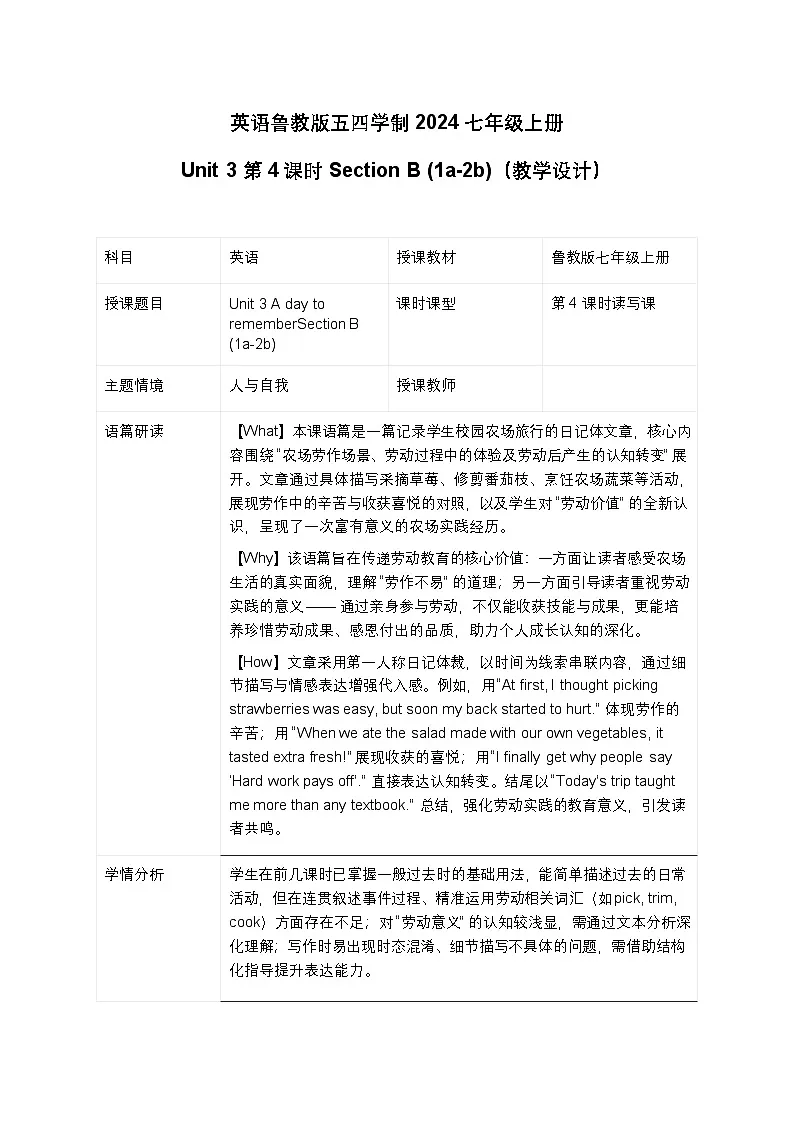
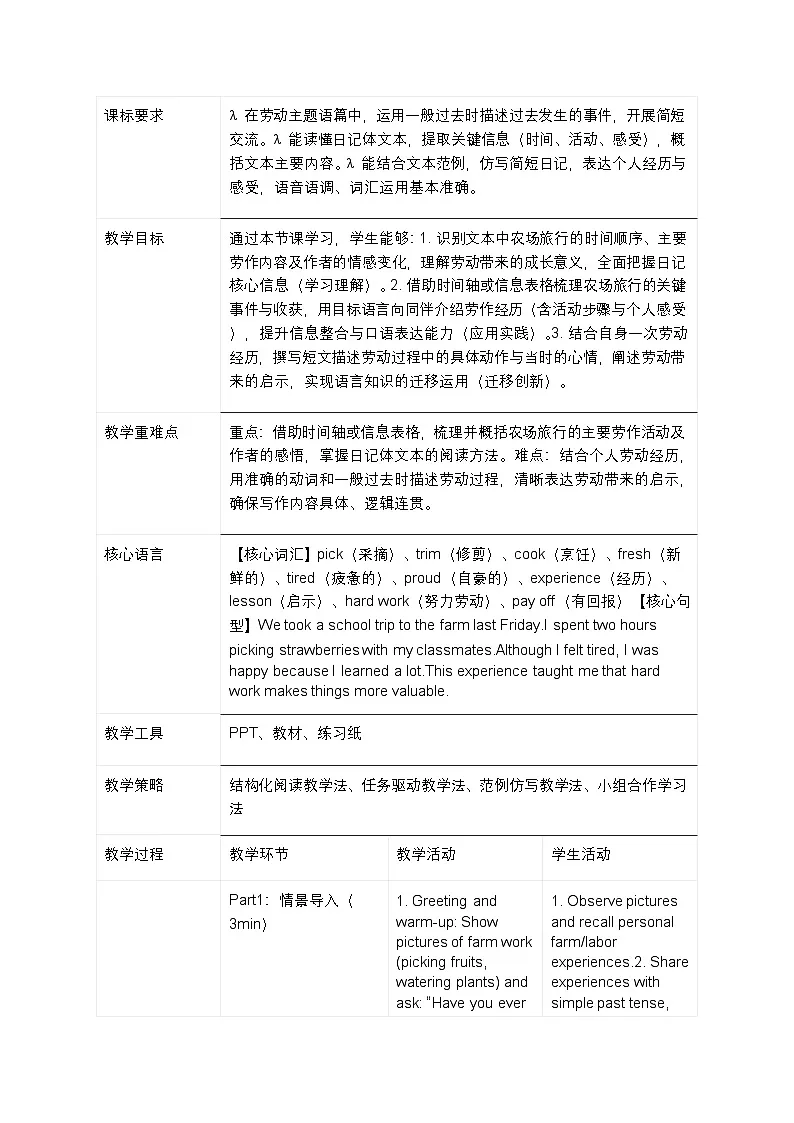
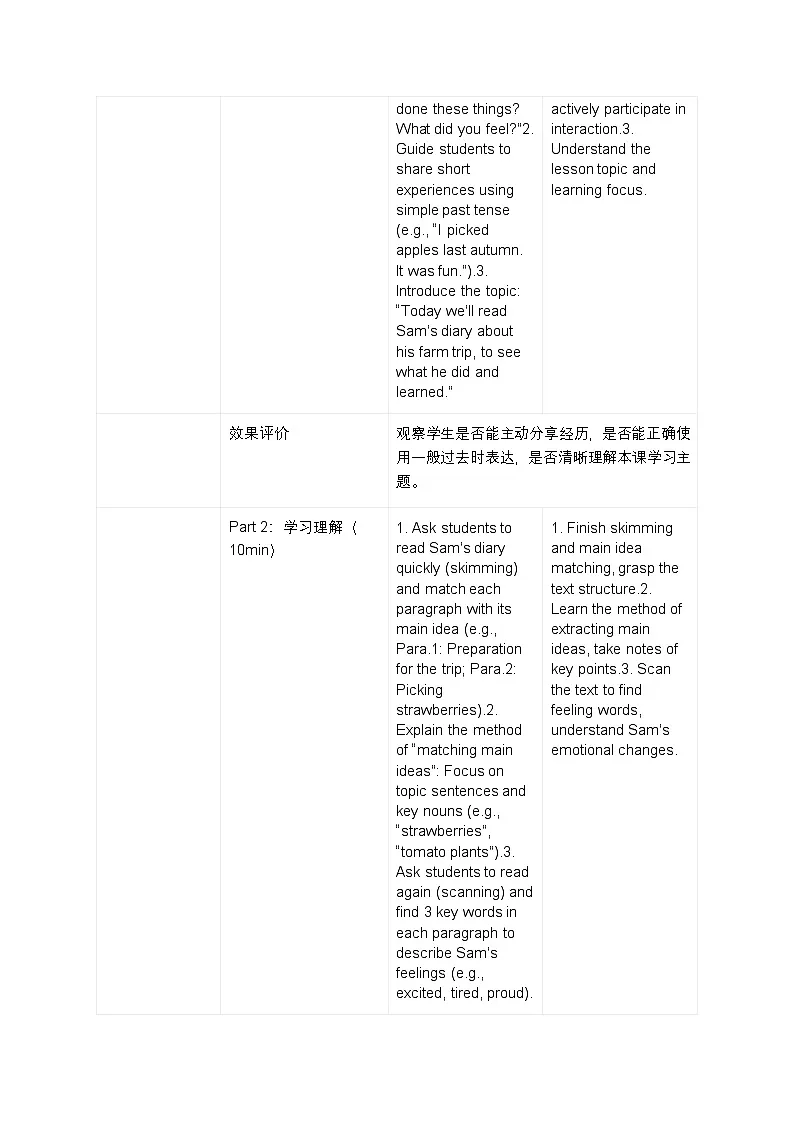
这是一份初中英语Unit 3 A Day to Remember Section B第4课时教学设计及反思,共7页。教案主要包含了What,核心词汇,核心句型等内容,欢迎下载使用。
科目
英语
授课教材
鲁教版七年级上册
授课题目
Unit 3 A day t rememberSectin B (1a-2b)
课时课型
第 4 课时读写课
主题情境
人与自我
授课教师
语篇研读
【What】本课语篇是一篇记录学生校园农场旅行的日记体文章,核心内容围绕 “农场劳作场景、劳动过程中的体验及劳动后产生的认知转变” 展开。文章通过具体描写采摘草莓、修剪番茄枝、烹饪农场蔬菜等活动,展现劳作中的辛苦与收获喜悦的对照,以及学生对 “劳动价值” 的全新认识,呈现了一次富有意义的农场实践经历。
【Why】该语篇旨在传递劳动教育的核心价值:一方面让读者感受农场生活的真实面貌,理解 “劳作不易” 的道理;另一方面引导读者重视劳动实践的意义 —— 通过亲身参与劳动,不仅能收获技能与成果,更能培养珍惜劳动成果、感恩付出的品质,助力个人成长认知的深化。
【Hw】文章采用第一人称日记体裁,以时间为线索串联内容,通过细节描写与情感表达增强代入感。例如,用 “At first, I thught picking strawberries was easy, but sn my back started t hurt.” 体现劳作的辛苦;用 “When we ate the salad made with ur wn vegetables, it tasted extra fresh!” 展现收获的喜悦;用 “I finally get why peple say ‘Hard wrk pays ff’.” 直接表达认知转变。结尾以 “Tday’s trip taught me mre than any textbk.” 总结,强化劳动实践的教育意义,引发读者共鸣。
学情分析
学生在前几课时已掌握一般过去时的基础用法,能简单描述过去的日常活动,但在连贯叙述事件过程、精准运用劳动相关词汇(如 pick, trim, ck)方面存在不足;对 “劳动意义” 的认知较浅显,需通过文本分析深化理解;写作时易出现时态混淆、细节描写不具体的问题,需借助结构化指导提升表达能力。
课标要求
在劳动主题语篇中,运用一般过去时描述过去发生的事件,开展简短交流。 能读懂日记体文本,提取关键信息(时间、活动、感受),概括文本主要内容。 能结合文本范例,仿写简短日记,表达个人经历与感受,语音语调、词汇运用基本准确。
教学目标
通过本节课学习,学生能够:1. 识别文本中农场旅行的时间顺序、主要劳作内容及作者的情感变化,理解劳动带来的成长意义,全面把握日记核心信息(学习理解)。2. 借助时间轴或信息表格梳理农场旅行的关键事件与收获,用目标语言向同伴介绍劳作经历(含活动步骤与个人感受),提升信息整合与口语表达能力(应用实践)。3. 结合自身一次劳动经历,撰写短文描述劳动过程中的具体动作与当时的心情,阐述劳动带来的启示,实现语言知识的迁移运用(迁移创新)。
教学重难点
重点:借助时间轴或信息表格,梳理并概括农场旅行的主要劳作活动及作者的感悟,掌握日记体文本的阅读方法。难点:结合个人劳动经历,用准确的动词和一般过去时描述劳动过程,清晰表达劳动带来的启示,确保写作内容具体、逻辑连贯。
核心语言
【核心词汇】pick(采摘)、trim(修剪)、ck(烹饪)、fresh(新鲜的)、tired(疲惫的)、prud(自豪的)、experience(经历)、lessn(启示)、hard wrk(努力劳动)、pay ff(有回报)【核心句型】We tk a schl trip t the farm last Friday.I spent tw hurs picking strawberries with my classmates.Althugh I felt tired, I was happy because I learned a lt.This experience taught me that hard wrk makes things mre valuable.
教学工具
PPT、教材、练习纸
教学策略
结构化阅读教学法、任务驱动教学法、范例仿写教学法、小组合作学习法
教学过程
教学环节
教学活动
学生活动
Part1:情景导入(3min)
1. Greeting and warm-up: Shw pictures f farm wrk (picking fruits, watering plants) and ask: “Have yu ever dne these things? What did yu feel?”2. Guide students t share shrt experiences using simple past tense (e.g., “I picked apples last autumn. It was fun.”).3. Intrduce the tpic: “Tday we’ll read Sam’s diary abut his farm trip, t see what he did and learned.”
1. Observe pictures and recall persnal farm/labr experiences.2. Share experiences with simple past tense, actively participate in interactin.3. Understand the lessn tpic and learning fcus.
效果评价
观察学生是否能主动分享经历,是否能正确使用一般过去时表达,是否清晰理解本课学习主题。
Part 2:学习理解(10min)
1. Ask students t read Sam’s diary quickly (skimming) and match each paragraph with its main idea (e.g., Para.1: Preparatin fr the trip; Para.2: Picking strawberries).2. Explain the methd f “matching main ideas”: Fcus n tpic sentences and key nuns (e.g., “strawberries”, “tmat plants”).3. Ask students t read again (scanning) and find 3 key wrds in each paragraph t describe Sam’s feelings (e.g., excited, tired, prud).
1. Finish skimming and main idea matching, grasp the text structure.2. Learn the methd f extracting main ideas, take ntes f key pints.3. Scan the text t find feeling wrds, understand Sam’s emtinal changes.
效果评价
观察学生是否能准确匹配段落与主旨,是否能快速找到情感关键词,是否理解文本的情感变化线索。
Part 3:应用实践(11min)
1. Distribute time-axis templates and ask students t read the diary carefully (third reading) t fill in the template: “Time” (e.g., 9:00 a.m.) → “Activity” (e.g., pick strawberries) → “Key detail” (e.g., back hurt but filled 2 baskets).2. Organize grup discussin: “What did Sam learn frm the trip? List 2-3 lessns.”3. Invite grups t share their time axes and discussin results, guide students t supplement and crrect.
1. Fill in the time axis with details, srt ut the text’s time sequence and key events.2. Discuss in grups, summarize Sam’s lessns frm the trip.3. Share grup results, listen t thers and supplement their wn ideas.
效果评价
观察学生时间轴填写的完整性与准确性,是否能积极参与小组讨论,是否能清晰表达 Sam 的劳动启示。
Part 4:迁移创新(11min)
1. Guide students t make a “Persnal Labr Experience Mind Map” in grups: Include “Time”, “Activity”, “Actins (e.g., I held a basket, I pulled weeds)”, “Feelings”, “Lessns”.2. Prvide a diary example (simplified) and remind students t use simple past tense and labr-related wrds.3. Ask students t write a shrt diary (80-100 wrds) based n the mind map.4. Organize “Diary Sharing Crner”: Invite 3-4 students t read their diaries, and thers give psitive feedback (e.g., “I like yur detail ‘My mm praised my salad’”).
1. Cperate in grups t make mind maps, srt ut persnal labr experiences.2. Learn frm the example, clarify the diary writing requirements.3. Write diaries independently, fcus n specific actins and true feelings.4. Share diaries and give feedback, imprve expressin and listening skills.
效果评价
观察学生思维导图的逻辑性与完整性,日记中是否能准确使用一般过去时和劳动词汇,是否能具体描述劳动过程与感受,分享时是否条理清晰。
Part 5:回顾总结(2min)
1. Use PPT t shw the “Text Structure & Key Pints” chart: “Genre (Diary)” → “Time Sequence” → “Main Activities” → “Cre Lessns”.2. Guide students t review tgether: “What did we learn abut reading diaries? What did we practice in writing?”
1. Fllw the chart t review the text structure and key knwledge.2. Answer the teacher’s questins, cnslidate the lessn cntent.
Part 6:考点速递(5min)
1. Explain key language pints: (1) Simple past tense f irregular verbs (e.g., take-tk, feel-felt); (2) Usage f “althugh” (e.g., Althugh it rained, we still enjyed the trip).2. Give 2-3 example questins (e.g., Fill in the blank: “She ______ (pick) 5 apples yesterday.”) and guide students t slve them.
1. Take ntes f key language pints, understand the usage rules.2. Slve example questins, apply the knwledge t specific exercises.
Part 7:随堂小练(3min)
Distribute shrt exercise papers: 1. Fill in the blanks with the crrect frm f verbs (simple past tense); 2. Chse the right wrd t cmplete sentences (e.g., tired/prud). Ask students t finish in class.
1. Cmplete exercises independently within the time limit.2. Check answers with the teacher after finishing.
Part 8:家庭作业
基础作业:1. Crrect the 随堂 exercise with the textbk; 2. Recite 5 cre wrds and 2 cre sentences.进阶作业:Revise the class diary, add 1 mre detail (e.g., “My friend helped me when I culdn’t reach the high strawberries”).拓展作业:Interview a family member abut their favrite labr experience, write 3 sentences t recrd it (using simple past tense).
1. Recrd hmewrk requirements clearly.2. Chse apprpriate hmewrk accrding t persnal level and finish it n time.
板书设计
教学反思
优点:1. 采用 “时间轴 + 思维导图” 的可视化工具,帮助学生梳理文本逻辑与个人经历,有效提升信息整合能力;2. 设计 “分享劳动经历” 导入与 “日记分享角” 输出环节,实现 “输入 - 内化 - 输出” 的闭环,激发学生参与热情;3. 分层作业兼顾不同水平学生,注重语言知识与生活实践的结合,符合 “双减” 要求。改进方向:1. 部分学生写作时劳动动作描写较笼统(如 “did farm wrk”),后续需补充 “劳动动作词库”(如 dig, pull, wash)并提供例句示范;2. 迁移创新环节的日记写作时间稍紧,可适当压缩小组讨论时间,预留更多写作时间;3. 可增加 “同伴互评表”(从 “时态准确性”“细节丰富度”“情感真实性” 评分),提升写作反馈的针对性。后续计划:制作 “劳动主题词卡” 与 “日记写作模板”,帮助基础薄弱学生提升表达能力;设计 “班级劳动日记集” 展示活动,增强学生写作成就感。
 新教材
新教材
注册成功
资料篮

在线客服
添加在线客服
获取1对1服务
官方微信
关注“教习网”公众号
打开微信就能找资料
赛课定制
添加在线客服
获取1对1定制服务
职称咨询
添加在线客服
获取1V1专业指导服务

免费福利

.png)
.png)
.png)
