 免费领取教师福利
若您为此资料的原创作者,认为该资料内容侵犯了您的知识产权,请扫码添加我们的相关工作人员,我们尽可能的保护您的合法权益。

这是一份小学英语沪教牛津版(六三制一起)(2024)四年级上册(2024)Unit 1 Where do people live?教案,共30页。教案主要包含了语篇研读,教学目标,教学重难点,教学过程设计,作业设计,总结与作业等内容,欢迎下载使用。
第1课时教学设计
课时标题:
Where d yu live?
课时内容:
Get Ready A & B & C(词汇输入 + 居住地认知)
一、语篇研读(What - Why - Hw)
【What】
主题范畴:人与社会(居住环境);
主题群:家庭与社区;
子主题: 居住地描述、城市与乡村差异。
【Why】
引导学生认识居住环境差异,破除"单一居住标准"刻板印象,旨在帮助学生掌握表达“你住在哪里”的核心语言,通过真实人物情境输入词汇与句型,建立“我家在哪儿”的空间表达基础,并能对他人居住地信息进行初步识别和回应,提升学生的信息提取能力和逻辑表达能力,能在语境中清晰描述“谁住在哪里”。
【Hw】
语篇文体:场景会话 + 词汇识图
语篇结构:人物自我介绍 + 居住地图片
语言特点:使用 I live in ... / This is my flat / huse 等句型;区分城市/乡村表达。
语用功能:表达居住地、识别地点类型、参与问答互动。
配套素材:Get Ready A&B&C
二、教学目标
听、说、认读词汇:city, cuntry, street, building, flat, huse, farm;
正确使用句型 “Where d yu live?” “I live in ...” 进行表达;描述居住类型
初步区分不同居住环境及特征;
激发学生观察与表达自我生活经验的兴趣。
情境任务:制作"我的居住名片"(含照片+2句描述):"I live in This is ...
三、教学重难点
重点: 居住地词汇与句型输入与初步使用;
难点: 场景识别与结构化表达(包括 cuntry / city、flat / huse 等区分)
四、教学过程设计
(一)导入:激活经验,建立语境
目标:
建立“家在哪里”的话题情境;
唤起生活经验,引入词汇。
活动1:Lk and answer.(图片展示)
任务:观察图片细节,围绕图片内容进行问答,激活对 “居住环境” 的已有认知。
过程:
1. 教师课件展示一幅包含高楼、街道、汽车、公园的城市全景图,引导学生整体观察 10 秒。
2. 提出问题,学生举手回答,可先由能力较强的学生示范,再邀请基础较弱的学生重复或补充。
3. 对学生的回答给予即时反馈(如 “Gd! Yu see big buildings!”“Yes, there are many cars in the street!”)。
语言:
T: Lk at this picture. It’s a big place. What can yu see in this picture?(指向图片中的高楼)
S1: I see big buildings.
T: Great! What else?(指向街道和汽车)
S2: I see a street and cars.
T: Gd jb! Nw, is it a gd place t live in? Why?
S3: Yes. Because it’s fun.
T: Nice idea! D yu live in the same kind f place?(指向教室窗外或学生熟悉的环境)
S4: Yes, I live in a city like this.
活动2:Watch and think.
任务:观看短视频,感知不同的居住环境,得出 “人们居住地点不同” 的结论。
过程:
1. 播放 1 分钟短视频:内容依次呈现城市(高楼、公寓楼、繁忙街道)、乡村(小房子、农场、田野)、海边(木屋、渔船)等不同居住场景,无旁白,仅配轻快背景音乐。
2. 播放第一遍后,提问引导思考;播放第二遍时,教师可暂停在关键画面(如乡村农场),强化学生对不同场景的感知。
3. 组织学生集体回答,用简单词汇总结观察结果。
语言:
T: Nw let’s watch a shrt vide. It shws different places where peple live. Please watch carefully.
(播放第一遍视频)
T: What did yu see in the vide?(学生自由回答:“huses, farms, big buildings” 等)
(播放第二遍视频,暂停在城市和乡村画面)
T: Lk! This is a city. And this is the cuntry. D peple live in the same kinds f places?
Ss: N!
T: Excellent! S peple live in different kinds f places.(板书:different kinds f places)
T: D they have the same living style?(引导学生观察视频中 “城市人乘电梯”“乡村人喂鸡” 等画面)
Ss: N!
T: Right! Peple have different living styles t.(板书:different living styles)
活动3:Listen & Guess. Think.
任务:听声音,猜测听到的声音属于什么场景city / cuntry。引导学生思考Where d yu live?
语言:
Clse yur eyes. What sunds d yu hear?
(二)新知呈现:词汇与句型输入
目标:
掌握居住地相关词汇;
理解并使用基本句型;
理解场景差异(如 flat vs. huse)
活动1:Watch and answer.
任务:通过图片关联和多感官互动,认读并理解城市相关词汇的含义,建立 “词汇 - 场景” 对应关系。
过程:
1. 课件呈现city和cuntry图,引导学生对比发现异同并思考。
2. 在图上方标注 “city”。追问:“What’s in a city?(城市里有什么?)” 引导学生观察图片说出现象(“tall buildings, cars”),教师总结:“A city has many big buildings and streets.”举例强化:“Shenzhen is a big city. Shanghai is a big city t.”(课件同步展示深圳、上海地标图片)。
2. 指向 “高楼群” 图片特写,标注 “building”,结合动作(双手向上伸展模拟高楼)帮助记忆:“Big buildings are in the city.”
3. 指向 “街道” 特写(含车辆、行人),引导学生模仿 “走在街道上” 的动作:“Peple walk n the street.”
4. 互动游戏 “Pint and say”:教师说单词(“building!”),学生快速指向课件中对应的图片,巩固认读。
5. 展示公寓楼内部图片(含多个房间、电梯),对比 “building”:“This is a flat. A flat is in a building. Peple live in flats in the city.”,邀请学生用手比划 “公寓在大楼里”(双手圈成 “大楼”,手指指向内部表示 “公寓”)。
语言:
T:(指向城市图)This is a city. Read after me: city, city. What’s in a city? Lk!(指向高楼)
Ss: Big buildings!
T: Yes! This is a building. Read: building, building.
T:(指向街道)What’s this? It’s a street. Cars run n the street. Read: street, street.
T:(展示公寓图)Peple live in flats in the city. This is a flat. Read: flat, flat.
T: Let’s play! I say “flat”, yu pint t the flat picture. Ready? “Building!”
Ss:(指向高楼图片)
活动2:Charades - Where am I?(词汇游戏)
任务:通过对比城市场景,认读乡村相关词汇,理解其与城市词汇的差异。
过程:
1. 课件切换至乡村全景图(田野、小房子、绿树),提问:“Is this a city?(这是城市吗?)” 引导学生回答。
2. 标注 “cuntry”,强调与 “city” 的对比:“The cuntry has small huses, nt big buildings.”动作辅助:教师张开双臂模拟 “广阔的田野”,说:“The cuntry is big and quiet.”
3. 呈现 “farm”“huse”:截取乡村图中的 “农场”(含牛羊、农作物),结合图片讲解:“A farm is in the cuntry. We can see animals n a farm.”截取 “乡村小房子” 特写,标注 “huse”,对比 “flat”:“Peple live in huses in the cuntry. A huse is nt in a building.”
4. 小组互动:两人一组,一人说 “farm”,另一人指向图片并模仿 “喂动物” 动作;说 “huse” 则模仿 “开门” 动作。
语言:
T:(展示乡村图)This is nt a city. It’s the cuntry.
T: What’s in the cuntry?(指向农场)
Ss:
T:(指向小房子)This is a huse. Peple live in huses in the cuntry.
T: Pair wrk! Student A says “huse”, Student B pints and says “huse”. G!
活动3:
任务:结合已学词汇,理解并运用句型描述居住地点和住所,实现 “词汇 - 句型” 的衔接。
过程:
1. 示范句型:教师手持 “城市” 图片和 “flat” 卡片,做出 “介绍自己家” 的姿态,慢速示范:“I live in a city. This is my flat.”(重复 2 遍,强调句末降调)。换 “乡村” 图片和 “huse” 卡片,示范:“I live in the cuntry. This is my huse.”(配合手势:指向图片表示 “居住地点”,指向自己表示 “我的住所”)。
2. 集体操练:带领学生跟读句型(先整体,后拆分):“I live in a city.(停顿)This is my flat.”“I live in the cuntry.(停顿)This is my huse.”节奏游戏:教师拍手打节奏(每拍一个单词),学生跟随节奏说句型,强化语流。
3. 个体尝试:邀请学生自愿选择 “城市” 或 “乡村” 图片,模仿教师的示范造句,如:
S1: I live in a city. This is my flat.
T: Wnderful! Wh wants t try “cuntry”?
S2: I live in the cuntry. This is my huse.
语言:
T: Lk! I have a picture.(举起城市图)I live in a city.(指向图片)This is my flat.(举起 flat 卡片)Read after me.
Ss: I live in a city. This is my flat.
T: Gd! Nw, the cuntry.(举起乡村图)I live in the cuntry. This is my huse.
Ss: I live in the cuntry. This is my huse.
T: Let’s clap and say. One, tw, three!(拍手)
Ss:(跟随节奏)I live in a city. This is my flat.
T: Tm, please try with the cuntry picture.
Tm: I live in the cuntry. This is my huse.
T: Perfect!
(三)输出:输出练习,表达自我
目标:
口头输出句型;
初步表达居住地和周边环境;
进行个性化描述。
活动1:Read and spell
任务:通过图文形义结合记忆。
语言:
T: Let’s spell the wrds. Lk! What’s this?
S1: city!
T: Crrect! Read after me: city, city.
Ss: city, city.
T: Next ne:
S2: building!
T: Excellent! ...
活动2:Lk, chse and say
任务:运用核心句型完整描述,实现词汇与句型的结合运用。S: I live in a city. This is my flat.
语言:
T: Nw, let’s play a game. Talk in yur grup and then share with us. Use “I live in... This is my...”.
(组内讨论后)
T: Grup 1, please.
Grup 1:(举 A 图)I live in a city. This is my flat.
T: Great! Yu used the right wrds. Grup 2?
Grup 2:(举 B 图)I live in the cuntry. This is my huse.
活动4:Draw and share(绘画输出)
任务:结合自身生活实际,绘制居住环境并运用句型介绍,实现语言的真实迁移。
过程:
1. 学生用 2 分钟画出自己家的居住环境(如 “小区里的公寓”“农村的房子”),并在旁边标注 1-2 个关键词(如 “flat”“street”)。
2. 教师巡视指导,对绘画有困难的学生提供简笔画范例(如方框代表公寓,小房子代表 huse)。
3. 邀请 3 名学生上台展示画作,用句型描述:“I live in a city. This is my flat. There is a street near my hme.”
4. 其他学生可举手提问:“D yu live in a city?” 展示者回答 “Yes/N”。
语言:
T: Draw yur hme! Is it in a city r the cuntry? Write 1-2 wrds.
(绘画后)
T: Ss, shw us yur picture.
Ss:(举画)I live in
T: Ww, a farm! S nice. Wh wants t ask Ss?
S3: ...
活动3:Quick respnse
任务:通过肢体动作快速回应词汇,强化词汇的瞬时记忆和反应能力。
过程:
1. 教师提前说明动作规则:听到 “city”“building”“street”“flat” 时,双手向上举高(模拟高楼);听到 “cuntry”“farm”“huse” 时,双手叉腰(模拟小房子)。
2. 教师随机说单词(速度逐渐加快),学生做出对应动作,做错的学生轻轻拍手一次 “惩罚” 自己。
3. 最后一轮全班起立,边做动作边说单词,活跃课堂氛围。
语言:
T: Let’s mve! Listen carefully. “City”!(示范举高双手)
Ss:(举高双手)city!
T: “Farm”!(示范叉腰)
Ss:(叉腰)farm!
T: Faster! “Flat”!
Ss:(快速举高)flat!
活动 4:Chse and write
任务:通过图片与词汇的匹配书写,巩固词汇拼写和意义理解。
过程:
1. 课件呈现 6 张图片(卧室 bedrm、厨房 kitchen、公寓 flat、大楼 building、街道 street、农场 farm),下方列出打乱顺序的词汇选项。
2. 学生在练习本上写下 “图片序号 + 对应词汇”(如 “1. bedrm”),限时 1 分钟完成。
3. 教师公布答案,学生同桌互查,用 “√”“×” 标记,错词及时订正。
语言:
T: Lk at the pictures. Write the right wrds. Yu have 1 minute. G!
(完成后)
T: Picture 1 is a bedrm. Crrect?
Ss: Yes!
T: Picture 4 is a building. Did yu get it?
Ss: Yes!
五、作业设计
【必做】
1. Read Get ready A frm Student’s Bk 4A n Page 2.
2. Draw a picture f "Where is my hme?" and add an intrductin:I live in a flat / huse. It’s in the city / cuntry.
【选做】
1. Interview family members :“Where d yu live?” , Cmplete the family living map with pictures and English sentences .
2. Talk abut the place that yu live in.
第2课时教学设计
课时标题:
Where des he live?
课时内容:
Explre B(信息匹配)+ Grammar in Use(句型输入:Where des … live?)
一、语篇研读(What - Why - Hw)
【What】
主题范畴:人与自我、人与社会;
主题群:居住环境与生活方式;
子主题:不同居住场所的特点及差异。
语篇内容:围绕 “人们居住在不同类型的住所” 展开,包含两部分核心内容:一是描述居住多样性的文本(“Peple live in different kinds f hmes. Sme live in flats, sme in huses... Sme in cities, sme in the cuntry”);二是 Ningning(居住在城市深圳)和 Kate(居住在乡村农场)的对话及居住环境特点(城市有大量人口、街道和建筑,人们多住公寓;乡村有农场,人们多住房屋)。
【Why】
本语篇旨在引导学生理解 “居住环境的多样性”,通过对比城市与乡村的居住特点,帮助学生建立 “住所类型(flat/huse)— 居住地点(city/cuntry)— 环境特征” 的关联,同时学会用 “sme... and sme...” 结构描述差异,为后续运用核心句型交流居住情况奠定基础。
【Hw】
语篇文体:说明性文本与对话结合;
语篇结构:先总述居住多样性(“different kinds f hmes”),再通过具体案例(Ningning 和 Kate)分述城市与乡村的居住特点;
语言特点:
总述部分:使用 “sme... and sme...” 排比结构,简洁清晰地呈现对比(如 “Sme hmes are big and sme are small”);
对话部分:以 “Where d yu live? I live in...” 展开,包含具体地点(Shenzhen, farm)和环境描述(“big city”“in the cuntry”),语言口语化,贴近生活场景。
二、教学目标
能理解并朗读描述居住多样性的文本,运用 “sme... and sme...” 结构复述核心内容(如 “Sme peple live in flats and sme live in huses”);
能听懂并运用对话句型 “Where d yu live? I live in...” 询问和回答居住地点,结合 Ningning 和 Kate 的案例描述城市与乡村的特点(如 “Shenzhen is a big city with buildings; The cuntry has farms”);
能通过 “Tick and say” 活动,结合自身情况描述居住环境(如 “I live in a city. There are streets and buildings”);
感知字母 “a” 在单词中的发音(如 Kate, lake, cake),能认读含该发音的单词。
三、教学重难点
重点: 理解并运用 “sme... and sme...” 结构描述居住多样性;掌握对话句型 “Where d yu live? I live in...”,并结合城市 / 乡村特点进行回答。
难点: 准确区分并描述城市与乡村的核心差异(如 “city: big buildings, flats; cuntry: farms, huses”);在表达中自然融入环境细节(如 “There are many peple in cities”),使描述更具体。
四、教学过程设计
(一)热身复习
活动 1:词汇回顾与句式铺垫
任务:复习第一课时核心词汇,运用 “Sme... Sme...” 句式描述居住地点的多样性。
过程:
1. 课件依次展示城市、乡村、建筑、公寓等图片,教师提问:“What’s this?” 学生抢答单词(city, cuntry, building, flat 等)。
2. 教师引导学生用 “Sme... Sme...” 串联词汇:“Sme peple live in cities. Sme peple live in the cuntry.” 全班齐读 2 遍后,邀请 2-3 名学生单独复述。
语言:
T: Lk at the picture. What’s this?(指向城市图)
Ss: City!
T: Gd! And this?(指向乡村图)
Ss: Cuntry!
T: Nw, let’s say tgether: Sme peple live in cities. Sme peple live in the cuntry.
Ss:(跟读)
T: Tm, try please.
Tm: Sme peple live in cities. Sme peple live in the cuntry.
(二)探究居住的多样性
活动 1:听辨判断,感知居住多样性
任务:通过听句子判断正误,理解 “人们居住在不同类型的住所”。
过程:
1. 课件呈现 6 个句子(如 “1. Peple live in different kinds f hmes.”“6. Yu can’t see hmes in the cuntry.”),句子前留空框。
2. 教师播放句子录音,学生边听边在练习本上写 “T” 或 “F”,限时 1 分钟。
3. 公布答案,学生举手反馈正确率,教师对错误句子(如第 6 句)进行纠正:“We can see hmes in the cuntry. Peple live in huses there.”
语言:
T: Listen t the sentences. Write “T” (true) r “F” (false) in yur ntebk. Ready?
(播放录音)
T: Number 1: “Peple live in different kinds f hmes.” What’s yur answer?
Ss: T!
T: Crrect. Number 6: “Yu can’t see hmes in the cuntry.”
Ss: F!
T: Right! There are hmes in the cuntry.
活动 2:跟读文本,梳理核心信息
任务:跟读描述居住多样性的文本,掌握 “sme... and sme...” 结构。
过程:
1. 课件展示文本:“Peple live in different kinds f hmes. Sme peple live in flats and sme live in huses. Sme hmes are big and sme are small. Sme hmes are in cities, and sme are in the cuntry.” 重点词 “different kinds f”“sme... and sme...” 标红。
2. 教师领读文本 3 遍,第一遍慢速带读,第二遍正常语速,第三遍学生齐读。
3. 教师提问:“What kinds f hmes d peple live in?” 学生回答:“Flats and huses.”
语言:
T: Read after me. “Peple live in different kinds f hmes.”(强调 “different kinds f” 意为 “各种各样的”)
Ss:(跟读)
T: “Sme peple live in flats and sme live in huses.”(手势辅助:左手比 “flat”,右手比 “huse”)
Ss:(跟读)
T: What kinds f hmes d peple live in?
Ss: Flats and huses!
活动 3:看图复述,巩固文本内容
任务:结合图片,用 “sme... and sme...” 结构复述文本核心内容。
过程:
1. 课件展示四组对比图片(公寓 vs 房屋、大房子 vs 小房子、城市住所 vs 乡村住所)。
2. 学生分组,每组负责一组图片,用 “Sme... and sme...” 描述(如 “Sme hmes are in cities, and sme are in the cuntry.”)。
3. 每组派代表站起来,结合图片复述,其他组鼓掌鼓励。
语言:
T: Lk at the pictures. Use “Sme... and sme...” t talk abut them. Grup 1, yur turn.
Grup 1:(指向公寓和房屋图)Sme peple live in flats and sme live in huses.
(三)案例分析:Ningning 与 Kate 的居住地点
活动 1:猜测与验证,明确具体居住地点
任务:通过观看视频,确定 Ningning 和 Kate 的居住地点。
过程:
1. 课件展示 Ningning 和 Kate 的头像,提问:“Where d they live? Guess!” 学生自由猜测(“In a city?”“On a farm?”)。
2. 播放短视频(含 Ningning 在深圳街头、Kate 在农场的画面),学生观看后匹配地点:“Ningning lives in a big city. Kate lives n a farm in the cuntry.”
3. 课件呈现匹配结果,全班齐读确认。
语言:
T: Lk! This is Ningning and this is Kate. Where d they live? Guess!
S1: Ningning lives in a city.
T: Let’s watch the vide t find ut.
(播放视频后)
T: Where des Ningning live?
Ss: In a big city!
T: And Kate?
Ss: On a farm in the cuntry!
活动 2:角色扮演,朗读对话
任务:通过角色扮演,练习 “Where d yu live? I live in...” 对话。
过程:
课件呈现对话:
A: Where d yu live, Ningning?
B: I live in Shenzhen. Shenzhen is a big city.
A: Where d yu live, Kate?
B: I live n a farm in the cuntry.
学生两人一组,一人扮演 A,一人扮演 B(轮流扮演 Ningning 和 Kate),朗读对话 2 分钟。
邀请 2 组学生上台表演,教师用 “Great! Clear and lud!” 评价。
语言:
T: Pair wrk! Read the dialgue. One is A, ne is B. Then swap.
(学生练习后)
T: Grup 3, please cme t the frnt.
S3 (A): Where d yu live, Ningning?
S4 (B): I live in Shenzhen. Shenzhen is a big city.
(四)对比拓展:城市与乡村的居住特点
活动 1:阅读文本,提取城市与乡村特点
任务:对比阅读城市和乡村的描述文本,找出环境及住所特点。
过程:
课件分左右栏呈现文本:
左栏(Cities):“There are a lt f peple, streets and big buildings in cities. Many peple live in flats.”
右栏(The cuntry):“In the cuntry, there are farms. Peple live in huses.”
学生默读文本 1 分钟后,教师提问:“What’s in cities? Where d peple live in cities?” 学生从文本中找答案。
用同样方式提问乡村的特点,引导学生总结对比。
语言:
T: Read the text abut cities. What’s in cities?
Ss: A lt f peple, streets and big buildings.
T: Where d peple live in cities?
Ss: In flats.
T: Gd! Nw the cuntry: What’s in the cuntry?
Ss: Farms!
活动 2:“Read, chse and write” 词汇匹配
任务:选择合适词汇填空,巩固城市与乡村的相关词汇。
过程:
课件呈现句子框架(如 “Peple live in ______ in cities.”“There are ______ in the cuntry.”),下方列出备选词汇(flat, farm, building 等)。
学生独立完成填空,同桌互查答案。
教师抽查 2-3 个句子,学生齐读完整句子。
语言:
T: Chse the right wrds t fill in the blanks. Finish it by yurself.
(完成后)
T: “Peple live in ______ in cities.” What’s yur answer?
Ss: Flats!
五、综合练习:“Tick and say”
任务:结合自身情况,描述自己的居住地点及环境。
过程:
课件呈现问题:“Where d yu live, in a city r in the cuntry? What’s in it? Where d peple live? D yu like it?” 并给出示范回答:“I live in a city. There are streets and buildings. Peple live in flats. I like it.”
学生在练习本上简单写下答案要点(如 “city, streets, flats, like”)。
邀请 3-4 名学生分享,其他学生认真倾听,教师给予鼓励:“Gd! Yu tld us clearly.”
语言:
T: Think abut yur hme. Answer the questins. Yu can write key wrds first.
T: Lucy, please share.
Lucy: I live in a city. There are big buildings. Peple live in flats. I like it.
(六)语音学习:字母 “a” 的发音
活动 1:听韵文,找出发音规律
任务:感知字母 “a” 在单词中的发音(/eɪ/)。
过程:
课件呈现韵文:“What’s yur name? My name is Kate. I live n a farm, next t a lake. The kitchen is my favurite place. Tday I’m ging t bake a cake.” 含 “a” 的单词标红。
播放韵文录音,学生跟读 2 遍,边读边用荧光笔标出含 “a” 的单词。
教师带领学生拼读标红单词,强调 “a” 的发音:“Kate, /keɪt/; lake, /leɪk/”。
语言:
T: Listen t the rhyme. Read after it and underline the wrds with “a”.
(跟读后)
T: Let’s read these wrds: Kate, lake, place, bake, cake.
Ss:(拼读)
活动 2:认读单词,巩固发音
任务:通过认读单词,强化 “a” 的发音规律。
过程:
课件展示单词(make, face, plane, fat, game)及对应图片。
教师领读单词,学生跟读,重点强调 “a” 的发音差异(如 make /meɪk/vs fat /fæt/)。
学生两人一组,一人指单词,一人认读,互相纠正发音。
语言:
T: Read these wrds. “make”, /meɪk/.
Ss: make, /meɪk/.
T: “fat”, /fæt/.
Ss: fat, /fæt/.
七、总结与作业(5 分钟)
任务:回顾本节课核心内容。
过程:教师用简笔画快速勾勒城市(高楼)和乡村(农场),提问:“What did we learn tday?” 学生回答:“Cities and the cuntry. Where peple live.”
语言:
T: What did we learn tday?
Ss: We learned abut cities, the cuntry and where peple live.
五、作业设计
【必做】
1. Read Explre frm Student’s Bk 4A n Page 4-5.
2. Talk abut the place that yu live in.
【选做】
Draw an illustratin f "where he/she lives" fr yur favrite character and write tw English descriptins.(为你喜欢的人物画一幅“他/她住的地方”插图,并写两句英文描述。)
第3课时设计
课时标题:
Glbal Hmes Interview — Where d they live arund the wrld?
课时内容:
Explre C, D
一、语篇研读(What - Why - Hw)
【What】
主题范畴:人与自我、人与社会;
主题群:生活环境与居住方式;
子主题:不同人群的居住地点及表达。
语篇内容:围绕 “人们居住在哪里” 展开,包含两部分核心内容:一是通过儿歌《Our hmes》呈现 “Where d peple live? Peple live in... ”“Where des... live? ... lives in... ” 等核心句型;二是通过 Hans、Xiaya 等四人的居住信息(如 Hans 住在纽约的公寓,Xiaya 住在星星村的房子),提供具体的对话示范,展示不同人物的居住地点和住所类型。
【Why】
本课时语篇旨在帮助学生理解并运用 “询问与回答居住地点” 的核心句型,通过儿歌感知句型结构,通过具体人物的居住场景建立 “句型 - 语境” 的关联,最终能在真实或模拟情境中询问他人居住地点并做出回应,同时加深对 “居住多样性” 的认知。
【Hw】
语篇文体:儿歌(chant)与对话(dialgue)结合;
语篇结构:先通过儿歌重复呈现核心句型,强化感知;再通过人物对话示例,展示句型的实际运用;
语言特点:
二、教学目标
能听懂并跟唱儿歌《Our hmes》,感知并识别核心句型 “Where d peple live? Peple live in...”“Where des... live? ... lives in... ”;
能运用句型 “Where d yu live? I live in...” 进行问答,结合具体地点(如 city, cuntry, New Yrk)和住所类型(flat, huse)描述自己的居住情况;
能根据 Hans、Xiaya 等人物的信息,运用 “Where d yu live, I live in...” 进行角色扮演对话;
初步感知居住地点的多样性,乐于用英语交流自己和他人的居住情况。
三、教学重难点
重点: 掌握核心句型 “Where d yu live? I live in...” 的问答结构;结合具体地点(如 city, New Yrk)和住所类型(flat, huse)运用句型进行表达。
难点: 区分并正确使用 “Where d... ?”(询问群体)与 “Where des... ?”(询问第三人称单数);在对话中自然融入具体地点和住所细节,使表达更丰富真实(如 “I live in a flat in New Yrk”)。
四、教学过程设计
(一)热身复习
活动 1:回顾居住多样性文本
任务:复述 “人们居住在不同类型住所” 的核心内容,巩固对城市与乡村居住特点的认知。
过程:
课件展示 Ningning 和 Kate 的居住场景图片,教师引导:“We learned abut Ningning and Kate’s hmes. Let’s retell.”
学生集体填空复述:“Peple live in all kinds f hmes. Sme live in ______ (flats) and sme live in ______ (huses). Sme hmes are ______ (big) and sme are ______ (small).”
邀请学生分别描述 Ningning 和 Kate 的居住情况,如:“Ningning lives in Shenzhen. It’s a big city. There are many buildings. Peple live in flats.”
语言:
T: Let’s retell the text. Peple live in all kinds f hmes. Sme live in...
Ss: flats
T: And sme live in...
Ss: huses
T: Tm, please talk abut Ningning.
Tm: Ningning lives in Shenzhen. It is a big city. There are a lt f buildings. Many peple live in flats.
(二)语法学习:核心句型操练
活动 1:听唱儿歌,感知句型
任务:通过儿歌感知 “Where d peple live? Peple live in...” 和 “Where des... live? ... lives in...” 句型结构。
过程:
课件播放儿歌《Our hmes》:“Where? Where? Where d peple live? Peple live in cities. Where des Billy live? Billy’s huse is in a city...”
第一遍学生静听,第二遍跟唱,第三遍边唱边做动作(如 “问” 的手势、“指地点” 的动作)。
教师提问:“What questins d we hear? What answers?” 学生找出核心句型:“Where d peple live? Peple live in... Where des... live? ... lives in...”
语言:
T: Listen t the chant. What questins are there?
Ss: Where d peple live? Where des Billy live?
T: Gd! And the answers?
Ss: Peple live in cities. Billy’s huse is in a city.
活动 2:匹配练习,巩固句型
任务:将人物与居住地点匹配,强化 “Where des... live? ... lives in...” 的对应关系。
过程:
课件呈现人物(Jenna, Billy)和地点图片(乡村房屋、城市公寓),文本提示:“Jenna’s huse is in the cuntry. Billy’s huse is in a city.”
学生独立完成匹配,在练习本上写下序号。
教师核对答案后,带领学生用句型描述:“Where des Jenna live? She lives in the cuntry. Where des Billy live? He lives in a city.”
语言:
T: Match Jenna and Billy with their hmes.
(学生完成后)
T: Where des Jenna live?
Ss: She lives in the cuntry.
T: Crrect! Jenna’s huse is in the cuntry.
活动 3:学习基础句型 “Where d yu live? I live in...”
任务:理解并运用第一人称句型,回答自己的居住地点。
过程:
课件展示句型:“Where d yu live? I live in the cuntry.” 并配图(乡村场景)。
教师示范:“Where d I live? I live in a city.” 学生模仿,用自己的真实居住情况回答。
同桌互问互答:“Where d yu live? I live in...”
语言:
T: Lk! This is the new sentence: “Where d yu live? I live in... ” Read after me.
Ss: Where d yu live? I live in the cuntry.
T: Lily, where d yu live?
Lily: I live in a city.
T: Pair wrk! Ask and answer.
(三)对话练习:“Lk, ask and answer”
活动 1:认识人物与地点
任务:了解 Hans, Xiaya, Xialng, Alice 的居住地点,为对话做准备。
过程:
课件展示四个人物头像及对应地点(Hans-New Yrk; Xiaya-Star Village; Xialng-Singapre; Alice-Green Farm)。
教师逐一介绍:“This is Hans. He lives in New Yrk.” 学生跟读地点名称。
学生在练习本上记录人物与地点的对应关系。
语言:
T: Lk at these peple. This is Hans. Where des he live? He lives in New Yrk.
Ss: New Yrk.
T: This is Xiaya. She lives in Star Village.
Ss: Star Village.
活动 2:示范对话,学习结构
任务:观察示范对话,掌握 “Where d yu live? I live in...” 的问答结构。
过程:
课件呈现 Hans 的对话:“Where d yu live, Hans? I live in a flat in New Yrk.”
教师与一名学生示范对话,强调语气和停顿。
学生齐读对话 2 遍,体会句型运用。
语言:
T: Let’s read Hans’ dialgue. “Where d yu live, Hans? I live in a flat in New Yrk.”
Ss:(跟读)
T: Mike, be Hans. I’ll ask yu.
T: Where d yu live, Hans?
Mike: I live in a flat in New Yrk.
活动 3:分组练习,拓展对话
任务:小组内轮流扮演不同人物,运用句型进行问答,丰富回答细节(如住所类型)。
过程:
学生分成 4 组,每组负责一个人物(Hans, Xiaya, Xialng, Alice)。
组内练习对话,如:“Where d yu live, Xiaya? I live in a huse in Star Village.”
邀请各组派代表上台表演,其他组倾听并鼓掌。
语言:
T: Each grup is ne persn. Practice the dialgue. Yu can say “I live in a flat/huse in...”.
(小组练习后)
T: Grup 2 (Xiaya), please.
S1: Where d yu live, Xiaya?
S2: I live in a huse in Star Village.
(四)总结与作业
活动 1:课堂总结
任务:回顾本节课核心句型,强化记忆。
过程:
教师引导学生一起说:“Tday we learned: Where d yu live? I live in... Where des... live? ... lives in...”
课件展示句型结构,学生齐读巩固。
语言:
T: What sentences did we learn tday?
Ss: Where d yu live? I live in... Where des... live? ... lives in...
活动 2:布置作业
任务:通过 chant 和问答练习,巩固句型运用。
过程:
课件呈现作业:“1. Chant Grammar in use C frm Student’s Bk 4A n Page 7. 2. Ask and answer with ‘Where d yu live? I live...’”
教师示范作业 2:“Ask yur family: ‘Where d yu live? ’ and answer.”
语言:
T: Fr hmewrk, first, chant Page 7. Secnd, talk with yur parents. Ask: “Where d yu live? ” and they answer. OK?
Ss: OK!
五、作业设计
【必做】
1. Chant Grammar in use C frm Student’s Bk 4A n Page 7.
2. Ask and anwer with the sentence structure “Where d yu live? I live ...”.
第4课时设计
课时标题:
Which place d yu like?
课时内容:
Cmmunicate A, B, C(表达喜好 + 周边环境 + 简单写作)
一、语篇研读(What - Why - Hw)
【What】
主题范畴:人与自我、人与社会;
主题群:居住环境与生活体验;
子主题:不同居住场景的特点及个人偏好。
语篇内容:围绕 “学生记者 Ningning 的旅行” 展开,记录其三个行程站点的观察:
城市中心:有大量人口、高楼和车辆,氛围繁忙;
宜居区域:有学校、公园和建筑,人们住公寓,环境宜人;
农场:有小房子和果树,氛围安静。
辅以讨论 “最喜欢的地点及原因” 的互动内容,以及 Kate 关于自身居住情况的描述文本(住在乡村房屋,周边有田野,环境安静)。
【Why】
本语篇旨在通过 Ningning 的旅行视角,引导学生感知不同居住场景(城市中心、宜居区域、农场)的环境特点(繁忙、宜人、安静等),学会用 “There is/are... It’s...” 描述场景细节,同时结合个人体验表达对居住环境的偏好,提升对 “居住多样性” 的深层理解和语言运用能力。
【Hw】
语篇文体:旅行记录(reprt)与对话(dialgue)结合;
语篇结构:先按行程顺序描述三个地点的特点,再通过讨论和仿写活动实现语言迁移;
语言特点:
描述部分:使用第一人称叙述(“My first stp is...”),包含具体场景词汇(peple, buildings, fruit trees)和氛围形容词(busy, nice, quiet);
讨论部分:运用 “Why? Because...”“There is/are... ” 表达偏好及理由,句式简洁,符合口语交流习惯;
仿写部分:提供结构化文本(“I live in... There is/are... My hme is...”),降低表达难度,便于学生模仿。
二、教学目标
能理解 Ningning 旅行记录的内容,提取三个站点的核心信息(地点类型、环境特点、氛围),并用简单语言复述;
能运用 “There is/are... It’s...” 描述不同居住场景的细节(如 “The city centre has many cars. It’s busy”);
能参与 “最喜欢的地点” 讨论,用 “I like... Because there is/are... It’s... ” 表达个人偏好及理由;
能模仿 Kate 的范例,书写关于自己居住情况的短句(如 “I live in a flat. There is a park near my hme. It’s fun”)。
三、教学重难点
重点: 提取并描述不同居住场景的特点(如城市中心的 “busy”、农场的 “quiet”);运用 “There is/are... It’s...” 句型表达场景细节和氛围。
难点: 在讨论中连贯表达个人偏好的理由(如将地点特点与自身感受结合:“I like the farm because there are fruit trees. It’s quiet”);仿写时结合自身实际,补充具体且合理的居住环境细节(如周边设施、自然景观)。
四、教学过程设计
(一)热身复习
活动 1:回顾居住多样性
任务:复习 “人们居住在不同类型住所” 的核心内容,巩固 “sme... and sme...” 句式。
过程:
课件展示不同住所图片(公寓、房屋、城市、乡村),教师引导:“Peple live in different kinds f hmes.”
学生看图集体填空:“Sme peple live in ______ (flats) and sme live in ______ (huses). Sme hmes are ______ (big) and sme are ______ (small).”
邀请 2-3 名学生单独复述完整句子。
语言:
T: Let’s review! Peple live in different kinds f hmes. Lk! Sme peple live in... (指向公寓图)
Ss: flats
T: And sme live in... (指向房屋图)
Ss: huses
T: Lily, please say the whle sentence.
Lily: Sme peple live in flats and sme live in huses.
(二)核心活动:Ningning 的记者之旅
活动 1:听录音编号,感知行程
任务:听 Ningning 的旅行描述,给三个地点图片编号,了解行程顺序。
过程:
课件呈现三张未编号图片(1. 城市中心;2. 宜居区域;3. 农场),提问:“These are Ningning’s stps. What are they? Guess!”
播放录音(内容为 Ningning 介绍三个地点的顺序),学生边听边在练习本上给图片写编号(1, 2, 3)。
教师核对答案,课件展示正确编号,学生举手确认是否正确。
语言:
T: Ningning is a student reprter. She visits three places. Listen and number the pictures.
(播放录音后)
T: What’s Picture 1?
Ss: A city centre!
T: Yes! Picture 1 is her first stp.
活动 2:逐站探究,提取信息(以第一站为例,后两站流程相同)
任务:通过听、看、答,了解 Ningning 每个行程站点的环境特点。
过程:
第一站:城市中心
课件聚焦城市中心图片,播放相关录音片段:“My first stp is a city. I’m in the city centre. There are a lt f peple and tall buildings. Cars and buses are n the streets. It’s busy.”
教师提问:“What’s Ningning’s first stp? What’s in the city centre? What can she see n the streets? Hw is this place?”
学生举手回答,教师将关键词板书:“first stp: city centre; in it: peple, tall buildings, cars, buses; it’s busy”。
学生齐读描述文本:“My first stp is a city... It’s a busy place.”
第二站:宜居区域
同理,通过录音和图片,引导学生提取信息:“secnd stp: a nice place; in it: schl, buildings, park; peple live in flats; it’s nice”。
第三站:农场
引导学生提取信息:“last stp: a farm; in it: small huses, fruit trees; it’s quiet”。
语言:
T: Let’s learn abut her first stp. Listen carefully.
(播放录音后)
T: What’s her first stp?
S1: A city centre.
T: Gd! What’s in the city centre?
S2: A lt f peple and tall buildings.
T: Great! Read the text tgether.
(三)练习与拓展
活动 1:讨论最喜欢的地点
任务:结合 Ningning 的行程,说说自己最喜欢的地点及原因,运用 “There is/are... It’s...” 句型。
过程:
课件重现三个地点图片,教师示范:“I like the farm best. There are fruit trees. It’s quiet.”
学生小组讨论 2 分钟,确定本组最喜欢的地点并准备理由。
每组派代表发言,如:“We like Picture 2. It’s a nice place. There is a park. It’s nice.”
教师点评,鼓励不同观点。
语言:
T: Which place d yu like best? Why? Use “I like... There is/are... It’s...”
T: Grup 1, please share.
Grup 1: We like the nice place (Picture 2). There is a schl and a park. It’s nice.
活动 2:描述社区环境
任务:运用 “Where? What’s in it? Hw?” 的框架,描述自己的社区。
过程:
课件呈现问题框架:“Where d yu live? What’s in yur neighburhd? Hw is it?”
教师示范:“I live in a city. There is a supermarket and a park in my neighburhd. It’s busy but fun.”
学生两人一组,互相提问并回答,限时 3 分钟。
邀请 1-2 组学生展示对话。
语言:
T: Talk abut yur neighburhd with yur partner. Use the questins n the screen.
S3: Where d yu live?
S4: I live in the cuntry. What’s in yur neighburhd?
S3: There are farms. Hw is it?
S4: It’s quiet.
活动 3:读写活动 “Read, stick and write”
任务:模仿 Kate 的范例,写写自己的居住情况并粘贴图片。
过程:
课件展示 Kate 的范例:“Hell. My name is Kate. I live in a huse in the cuntry. There are fields arund my hme. My hme is nice and quiet. I lve it.”
教师带领学生分析结构:姓名→居住地点→周边环境→家的特点→感受。
学生独立完成填空:“Hell. My name is _______. I live in/n _______. There is/are _______. My hme is _______. I _______.”
学生粘贴自己家的照片或简笔画,小组内互相欣赏。
语言:
T: Read Kate’s intrductin. Then write abut yurself. Yu can stick a pht r draw a picture.
T: Lk! Tm writes: “Hell. My name is Tm. I live in a flat in the city. There are streets and buildings. My hme is busy. I like it.” Wnderful!
(四)总结与作业
活动 1:课堂总结
任务:回顾本节课核心内容。
过程:教师引导学生回忆:“Tday we learned abut Ningning’s trip. She visited a city centre, a nice place and a farm. They are different.”
语言:
T: What did we learn tday?
Ss: Ningning’s trip! She went t a city centre, a nice place and a farm.
活动 2:布置作业
任务:巩固课堂所学,完成读写任务。
过程:
课件呈现作业:“1. Ask and answer with the sentence structure n P9. 2. Finish yur ‘Abut me’ writing and stick a picture.”
教师强调作业要求:“Talk with yur family abut where they live. Finish yur writing carefully.”
语言:
T: Fr hmewrk, first, practice the questins and answers n Page 9. Secnd, finish yur writing abut yur hme. OK?
Ss: OK!
五、阶段意图总结
本课引导学生从“你住在哪里”走向“你喜欢哪儿、为什么喜欢”,让学生在听说读写中全面运用已有语言点,进一步发展个性表达力、观察能力与信息整合能力,并逐步形成“情境 – 结构 – 输出”的表达路径。
六、作业设计
【必做】
1. Ask and anwer with the sentence structure n P9.
2. Stick and write abut yurself.
【选做】
1. Retell the fable with a stry map (submit audi).用故事地图复述寓言(提交音频)
2. "One-minute English reprt n 'Highlights f Living in Shenzhen' .拍摄“深圳居住亮点”1分钟英文报道(例:"Lk! Our cmmunity added new bike lanes!")
第5课时
课时标题:
The cuntry is gd fr yu, the city is gd fr me.
课时内容:
Extend 板块(寓言故事理解 + 城乡对比表达 + 价值导向输出)
一、语篇研读(What - Why - Hw)
【What】
主题范畴:人与自我、人与社会;
主题群:居住选择与生活方式;
子主题:城市与乡村居住环境的差异及适应性。
语篇内容:寓言故事《City Muse and Cuntry Muse》,讲述城市老鼠因厌倦城市的喧嚣,拜访乡村老鼠,却觉得乡村安静无趣;随后邀请乡村老鼠到城市,乡村老鼠因城市的危险(遭遇大猫)而返回乡村,最终两只老鼠各自回到适合自己的居住环境。故事呈现了城市(热闹、有美食但危险)与乡村(安静、安全但单调)的特点对比。
【Why】
本语篇通过拟人化的故事,引导学生辩证看待城市与乡村的居住环境,理解 “不同环境有不同优势,适合不同需求” 的道理。同时,借助故事中的对话和情节,巩固核心词汇(city, cuntry, flat, huse 等)和句型(“Where d... live? ... live in... ”),提升学生对居住主题的深层认知和语言运用能力。
【Hw】
语篇文体:寓言故事(fable);
语篇结构:按 “起因 — 发展 — 结局” 展开:
起因:城市老鼠因城市拥挤拜访乡村老鼠;
发展:两只老鼠分别体验对方的居住环境,表达对对方环境的评价(城市老鼠觉得乡村无趣,乡村老鼠觉得城市危险);
结局:各自返回自己的居住地,接受并适应自身环境。
语言特点:
对话生动:通过老鼠的直接对话(如 “It’s quiet here, but it’s nt fun”“It’s safe there”)展现对环境的感受;
对比鲜明:用 “t many peple and cars”(城市)与 “quiet”(乡村)、“nice fd”(城市)与 “safe”(乡村)等词汇突出环境差异;
情节简单:以 “拜访 — 体验 — 返回” 为线索,逻辑清晰,适合小学生理解。
二、教学目标
能理解故事《City Muse and Cuntry Muse》的主要情节,提取两只老鼠的居住地点(城市、乡村)及对对方环境的评价;
能运用故事中的核心词汇(city, cuntry, safe, quiet 等)和句型(“... live in...”“It’s... but... ”)复述故事主要内容;
能参与 “城市与乡村的优点” 讨论,用简单理由表达观点(如 “Cities are fun because there is nice fd; Cuntries are gd because they are safe”);
理解 “不同环境适合不同人” 的道理,尊重不同的居住选择。
三、教学重难点
重点: 理解故事情节,掌握两只老鼠对城市和乡村环境的评价;运用核心词汇和句型复述故事及讨论环境特点。
难点: 辩证分析城市与乡村的优缺点(如城市的 “fun” 与 “dangerus”、乡村的 “quiet” 与 “nt fun”);在复述和讨论中准确运用转折连词 “but” 表达对环境的复杂感受(如 “It’s quiet, but nt fun”)。
四、教学过程设计
(一)热身复习
活动 1:回顾居住地点表达
任务:复习不同居住场所及描述句型,巩固 “Sme peple live... It’s... There’s/There are...” 结构。
过程:
课件展示图片(城市、乡村、公寓、房屋、船),教师提问:“Where d peple live?”
学生看图集体回答,如:“Sme peple live in cities. It’s busy. There are many buildings.”
邀请学生单独描述:“Sme peple live n bats. It’s fun. There are rivers arund.”
语言:
T: Let’s review! Lk at the pictures. Where d peple live?
Ss: Sme peple live in the cuntry!
T: Hw is it? What’s in it?
Ss: It’s quiet. There are farms.
T: Mike, please talk abut the bat.
Mike: Sme peple live n bats. It’s fun. There are rivers.
(二)故事导入:认识角色与背景
活动 1:猜测故事角色
任务:通过图片猜测故事中的角色及其居住地点,激发对故事的兴趣。
过程:
课件呈现两只老鼠的图片(一只在城市背景,一只在乡村背景),提问:“Wh are they? Where d they live? Guess!”
学生自由猜测,如:“They are mice. One lives in a city. One lives in the cuntry.”
播放故事片段视频(无对话,仅展示两只老鼠的居住环境),验证猜测,教师板书:“City Muse, Cuntry Muse”。
语言:
T: Lk at these tw animals. Wh are they?
Ss: Mice!
T: Where d they live? Guess!
S1: One lives in a city. The ther lives in the cuntry.
T: Let’s watch a shrt vide t check.
(三)故事精读:梳理情节与细节
活动 1:分析故事开头
任务:阅读故事开头,提取城市老鼠的居住地及出行原因。
过程:
课件展示故事开头文本:“City Muse (M1) lives in a city. M1: There are t many peple and cars here. Let me visit my friend in the cuntry.”
学生默读 1 分钟后,教师提问:“Where des City Muse live? What des he want t d? Why?”
学生回答,教师在 “故事地图”(Beginning 部分)板书:“City Muse lives in a city. He wants t visit his friend in the cuntry (because there are t many peple and cars in the city).”
语言:
T: Read the beginning part. Where des City Muse live?
Ss: In a city!
T: What des he want t d?
S2: He wants t visit his friend in the cuntry.
T: Why?
S2: Because there are t many peple and cars in the city.
活动 2:探究故事中间情节(分两部分)
任务:理解两只老鼠在乡村和城市的经历、行为及感受。
过程:
第一部分:乡村经历
课件展示文本:“City Muse ges t visit Cuntry Muse. M2: Welcme t my hme! In the cuntry, they eat apples fr dinner. M1: It’s quiet here, but it’s nt fun. Cme with me t the city! M2: OK.”
提问:“What d they d in the cuntry? What des City Muse think f the cuntry?”
学生回答后,教师在 “故事地图”(Middle-Plt 1)板书:“Eat apples fr dinner. City Muse thinks: quiet but nt fun.”
第二部分:城市经历
课件展示文本:“In the city, they eat sme nice fd. M1: Have sme cheese. M2: Yummy! Listen! M1: A big cat! Run! Nw they are safe. M2: Cme t the cuntry. It’s safe. M1: The cuntry is gd fr yu, but the city is gd fr me.”
提问:“What d they d in the city? What happens? What d they think f the city?”
学生回答后,教师在 “故事地图”(Middle-Plt 2)板书:“Eat nice fd; meet a big cat. Cuntry Muse thinks: dangerus; City Muse thinks: gd fr him.”
语言:
T: What d they eat in the cuntry?
Ss: Apples!
T: Hw des City Muse feel abut the cuntry?
S3: It’s quiet but nt fun.
T: What happens in the city?
Ss: They see a big cat! They run!
活动 3:理解故事结尾
任务:明确两只老鼠的最终选择,总结故事结局。
过程:
课件展示结尾文本:“The tw mice say gdbye. They g back t their hmes.”
提问:“What d they d at last? Where d they g?”
学生回答后,教师在 “故事地图”(End)板书:“Say gdbye; g back t their hmes.”
语言:
T: What d the mice d at the end?
Ss: They say gdbye and g back t their hmes.
T: Yes! They g back t their wn hmes.
(四)故事巩固:角色扮演与复述
活动 1:角色扮演故事对话
任务:分组扮演两只老鼠,朗读对话,加深对情节和情感的理解。
过程:
学生分成 2 人一组,一组扮演 City Muse,一组扮演 Cuntry Muse。
课件展示带角色标注的对话文本,学生对照练习朗读 2 分钟,注意语气(如 City Muse 的 “不开心”、Cuntry Muse 的 “害怕”)。
邀请 2-3 组上台表演,教师用 “Great expressins!”“Clear vices!” 评价。
语言:
T: Pair wrk! One is City Muse, ne is Cuntry Muse. Read the dialgue with feelings.
(学生练习后)
T: Grup 1, please shw us the cuntry part.
Grup 1 (M2): Welcme t my hme!
Grup 1 (M1): It’s quiet here, but it’s nt fun. Cme t the city!
活动 2:借助故事地图复述
任务:根据 “故事地图”(Beginning-Middle-End),尝试用简单语言复述故事。
过程:
课件展示完整 “故事地图”(含开头、中间两部分、结尾的关键词)。
教师示范复述:“City Muse lives in a city. He visits Cuntry Muse in the cuntry... At last, they g back t their hmes.”
学生同桌互述,然后邀请 1 名学生全班复述。
语言:
T: Lk at the stry map. Let’s retell the stry. Fllw me first.
Ss:(跟述)
T: Lisa, please try by yurself.
Lisa: City Muse lives in a city. He ges t the cuntry... They say gdbye.
(五)拓展讨论:城市与乡村的优点
活动 1:对比讨论
任务:结合故事和生活经验,说说城市和乡村的优点,用简单理由支撑观点。
过程:
课件呈现问题:“What is gd abut living in a city? What is gd abut living in the cuntry?”
学生分成两组(“城市组”“乡村组”),讨论 1 分钟后分享。
教师记录观点,如:“City: nice fd, fun; Cuntry: quiet, safe.”
语言:
T: Let’s talk! What’s gd abut cities?
(城市组)S4: There are nice fds. It’s fun.
T: What’s gd abut the cuntry?
(乡村组)S5: It’s quiet and safe.
(六)总结与作业
活动 1:课堂总结
任务:回顾故事主旨,理解 “不同地方有不同特点,适合不同的人”。
过程:
教师引导:“City Muse and Cuntry Muse like their wn hmes. Peple live in different places, and they like them.”
学生集体说:“Peple live in different places. They like their hmes.”
语言:
T: What d we learn frm the stry?
Ss: Different places are gd fr different peple!
活动 2:布置作业
任务:巩固故事内容,练习复述能力。
过程:
课件呈现作业:“1. Read Extend frm Student’s Bk 4A n Page 10. 2. Retell the stry with the stry map.”
教师强调:“Use the stry map t retell the stry t yur family.”
语言:
T: Fr hmewrk, read Page 10 and retell the stry with the map. OK?
Ss: OK!
五、作业设计
【必做】
1. Read Extend frm Student’s Bk 4A n Page 10.
2. Try t retell the stry with the stry map.
【选做】
采访爸爸妈妈或爷爷奶奶:他们更喜欢住在哪儿?为什么?在家庭群中用中文+英文分享他们的答案。
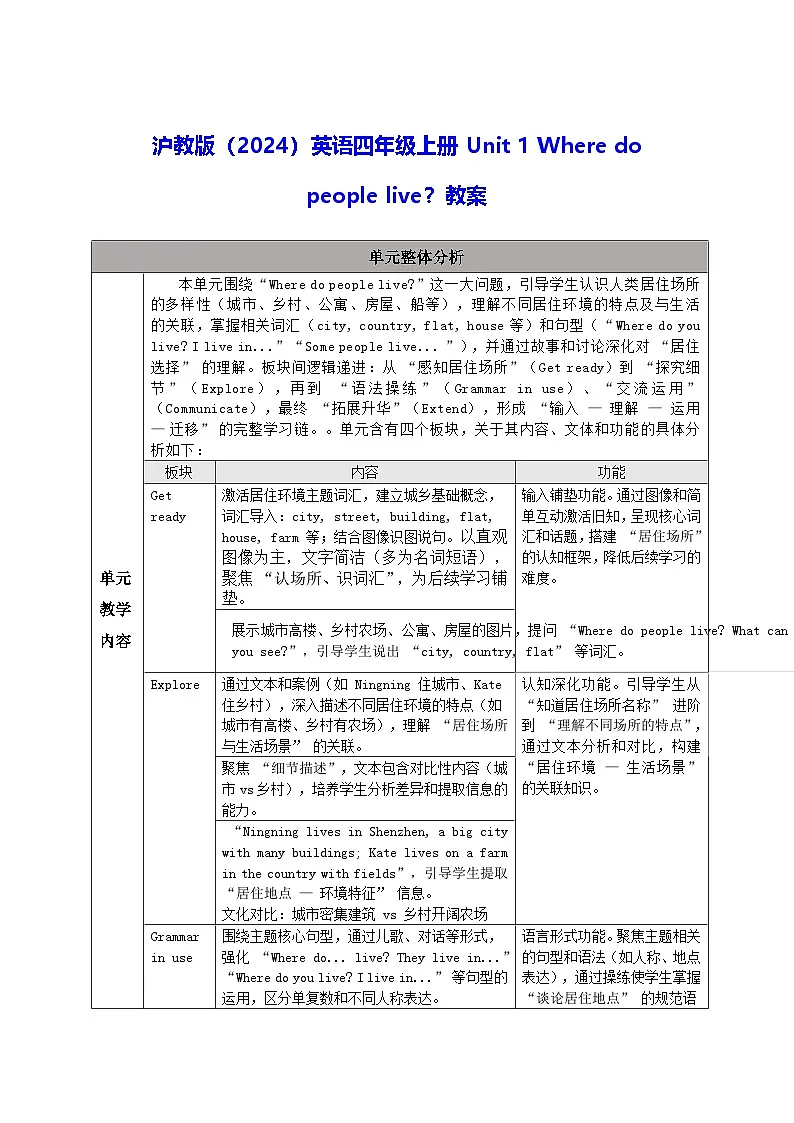
单元整体分析
单元
教学
内容
本单元围绕“Where d peple live?”这一大问题,引导学生认识人类居住场所的多样性(城市、乡村、公寓、房屋、船等),理解不同居住环境的特点及与生活的关联,掌握相关词汇(city, cuntry, flat, huse 等)和句型(“Where d yu live? I live in...”“Sme peple live... ”),并通过故事和讨论深化对 “居住选择” 的理解。板块间逻辑递进:从 “感知居住场所”(Get ready)到 “探究细节”(Explre),再到 “语法操练”(Grammar in use)、“交流运用”(Cmmunicate),最终 “拓展升华”(Extend),形成 “输入 — 理解 — 运用 — 迁移” 的完整学习链。。单元含有四个板块,关于其内容、文体和功能的具体分析如下:
板块
内容
功能
Get ready
激活居住环境主题词汇,建立城乡基础概念,词汇导入:city, street, building, flat, huse, farm 等;结合图像识图说句。以直观图像为主,文字简洁(多为名词短语),聚焦 “认场所、识词汇”,为后续学习铺垫。
输入铺垫功能。通过图像和简单互动激活旧知,呈现核心词汇和话题,搭建 “居住场所” 的认知框架,降低后续学习的难度。
展示城市高楼、乡村农场、公寓、房屋的图片,提问 “Where d peple live? What can yu see?”,引导学生说出 “city, cuntry, flat” 等词汇。
Explre
通过文本和案例(如 Ningning 住城市、Kate 住乡村),深入描述不同居住环境的特点(如城市有高楼、乡村有农场),理解 “居住场所与生活场景” 的关联。
认知深化功能。引导学生从 “知道居住场所名称” 进阶到 “理解不同场所的特点”,通过文本分析和对比,构建 “居住环境 — 生活场景” 的关联知识。
聚焦 “细节描述”,文本包含对比性内容(城市 vs 乡村),培养学生分析差异和提取信息的能力。
“Ningning lives in Shenzhen, a big city with many buildings; Kate lives n a farm in the cuntry with fields”,引导学生提取 “居住地点 — 环境特征” 信息。
文化对比:城市密集建筑 vs 乡村开阔农场
Grammar in use
围绕主题核心句型,通过儿歌、对话等形式,强化 “Where d... live? They live in...”“Where d yu live? I live in...” 等句型的运用,区分单复数和不同人称表达。
语言形式功能。聚焦主题相关的句型和语法(如人称、地点表达),通过操练使学生掌握 “谈论居住地点” 的规范语言形式,为交流运用提供工具。
歌谣强化"Where "句型,地图任务实践居住地询问
将语法规则融入居住主题情境,形式活泼(儿歌、问答),避免机械记忆。
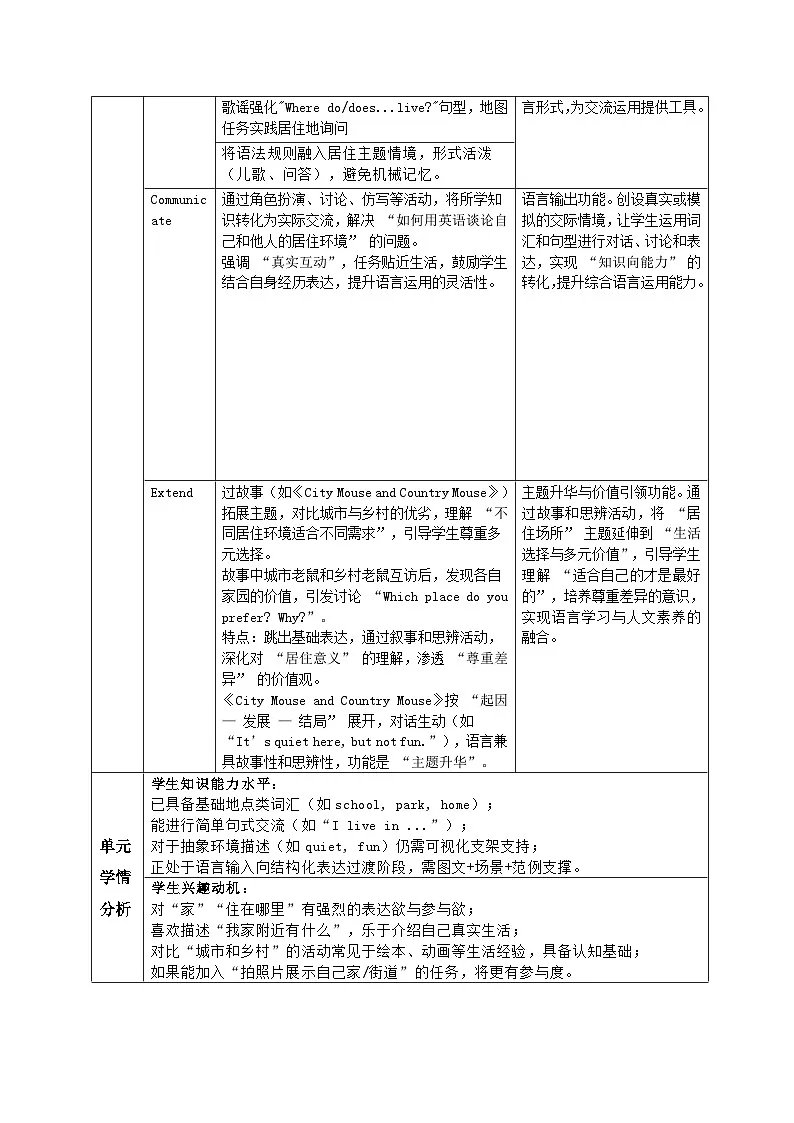
Cmmunicate
通过角色扮演、讨论、仿写等活动,将所学知识转化为实际交流,解决 “如何用英语谈论自己和他人的居住环境” 的问题。
强调 “真实互动”,任务贴近生活,鼓励学生结合自身经历表达,提升语言运用的灵活性。
语言输出功能。创设真实或模拟的交际情境,让学生运用词汇和句型进行对话、讨论和表达,实现 “知识向能力” 的转化,提升综合语言运用能力。
Extend
过故事(如《City Muse and Cuntry Muse》)拓展主题,对比城市与乡村的优劣,理解 “不同居住环境适合不同需求”,引导学生尊重多元选择。
故事中城市老鼠和乡村老鼠互访后,发现各自家园的价值,引发讨论 “Which place d yu prefer? Why?”。
特点:跳出基础表达,通过叙事和思辨活动,深化对 “居住意义” 的理解,渗透 “尊重差异” 的价值观。
《City Muse and Cuntry Muse》按 “起因 — 发展 — 结局” 展开,对话生动(如 “It’s quiet here, but nt fun.”),语言兼具故事性和思辨性,功能是 “主题升华”。
主题升华与价值引领功能。通过故事和思辨活动,将 “居住场所” 主题延伸到 “生活选择与多元价值”,引导学生理解 “适合自己的才是最好的”,培养尊重差异的意识,实现语言学习与人文素养的融合。
单元
学情
分析
学生知识能力水平: 已具备基础地点类词汇(如schl, park, hme);
能进行简单句式交流(如“I live in ...”);
对于抽象环境描述(如quiet, fun)仍需可视化支架支持;
正处于语言输入向结构化表达过渡阶段,需图文+场景+范例支撑。
学生兴趣动机:
对“家”“住在哪里”有强烈的表达欲与参与欲;
喜欢描述“我家附近有什么”,乐于介绍自己真实生活;
对比“城市和乡村”的活动常见于绘本、动画等生活经验,具备认知基础;
如果能加入“拍照片展示自己家/街道”的任务,将更有参与度。
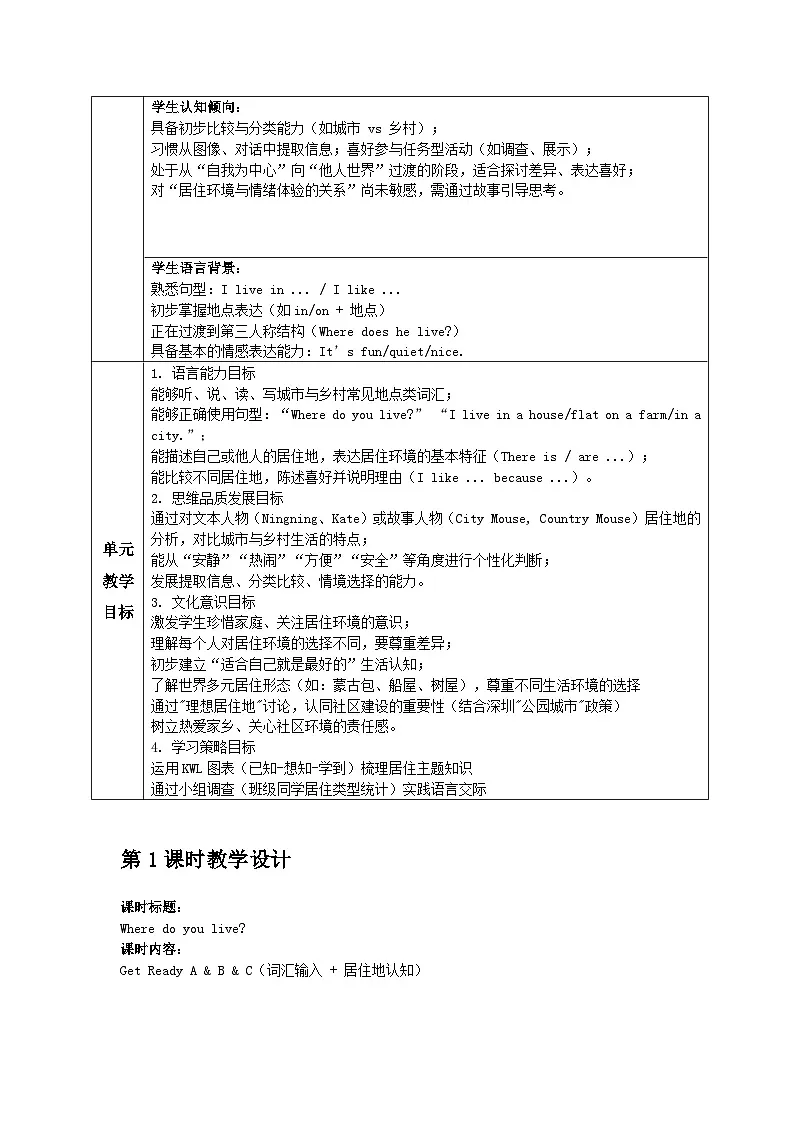
学生认知倾向:
具备初步比较与分类能力(如城市 vs 乡村);
习惯从图像、对话中提取信息;喜好参与任务型活动(如调查、展示);
处于从“自我为中心”向“他人世界”过渡的阶段,适合探讨差异、表达喜好;
对“居住环境与情绪体验的关系”尚未敏感,需通过故事引导思考。
学生语言背景:
熟悉句型:I live in ... / I like ...
初步掌握地点表达(如in/n + 地点)
正在过渡到第三人称结构(Where des he live?)
具备基本的情感表达能力:It’s fun/quiet/nice.
单元教学目标
1. 语言能力目标
能够听、说、读、写城市与乡村常见地点类词汇;
能够正确使用句型:“Where d yu live?” “I live in a huse/flat n a farm/in a city.”;
能描述自己或他人的居住地,表达居住环境的基本特征(There is / are ...);
能比较不同居住地,陈述喜好并说明理由(I like ... because ...)。
2. 思维品质发展目标
通过对文本人物(Ningning、Kate)或故事人物(City Muse, Cuntry Muse)居住地的分析,对比城市与乡村生活的特点;
能从“安静”“热闹”“方便”“安全”等角度进行个性化判断;
发展提取信息、分类比较、情境选择的能力。
3. 文化意识目标
激发学生珍惜家庭、关注居住环境的意识;
理解每个人对居住环境的选择不同,要尊重差异;
初步建立“适合自己就是最好的”生活认知;
了解世界多元居住形态(如:蒙古包、船屋、树屋),尊重不同生活环境的选择
通过"理想居住地"讨论,认同社区建设的重要性(结合深圳"公园城市"政策)
树立热爱家乡、关心社区环境的责任感。
4. 学习策略目标
运用KWL图表(已知-想知-学到)梳理居住主题知识
通过小组调查(班级同学居住类型统计)实践语言交际
这是一份小学英语沪教牛津版(六三制一起)(2024)四年级上册(2024)Unit 1 Where do people live?教案,共30页。教案主要包含了语篇研读,教学目标,教学重难点,教学过程设计,作业设计,总结与作业等内容,欢迎下载使用。
这是一份沪教牛津版(六三制一起)(2024)四年级上册(2024)Unit 1 Where do people live?教案设计,共11页。教案主要包含了单元整体概览,单元教学目标,分课时教学设计等内容,欢迎下载使用。
这是一份英语四年级上册(2024)Unit 2 Where do animals live?教案,共25页。教案主要包含了语篇研读,教学目标,教学重难点,教学过程设计,作业设计等内容,欢迎下载使用。
注册成功
资料篮

在线客服
添加在线客服
获取1对1服务
官方微信
关注“教习网”公众号
打开微信就能找资料
赛课定制
添加在线客服
获取1对1定制服务
职称咨询
添加在线客服
获取1V1专业指导服务

免费福利


.png)
.png)
.png)
