 免费领取教师福利


若您为此资料的原创作者,认为该资料内容侵犯了您的知识产权,请扫码添加我们的相关工作人员,我们尽可能的保护您的合法权益。

这是一份2025年七年级(下)译林2024版初中英语Unit1 Home Reading部分知识点,文件包含Unit1璇炬椂2HomeReading鐭ヨ瘑鐐癸紙鏁欏笀鐗堬級docx、Unit1璇炬椂2HomeReading鐭ヨ瘑鐐癸紙瀛︾敓鐗堬級docx等2份学案配套教学资源,其中学案共20页, 欢迎下载使用。
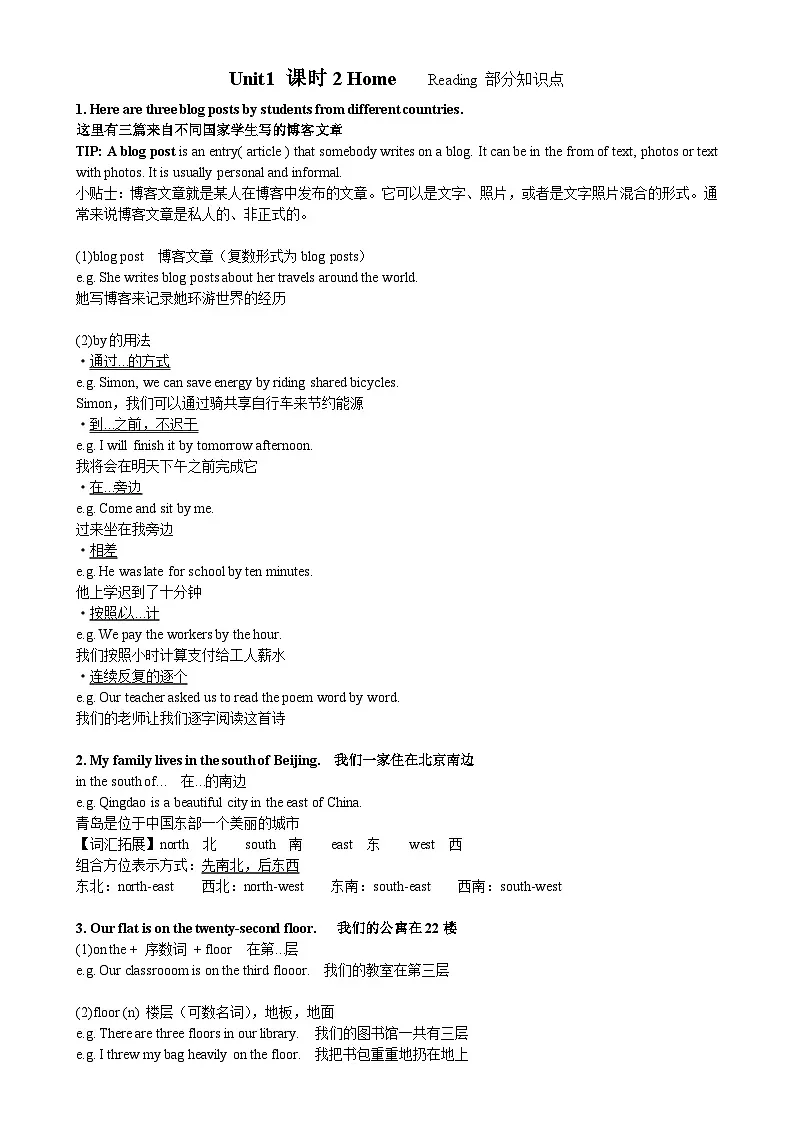
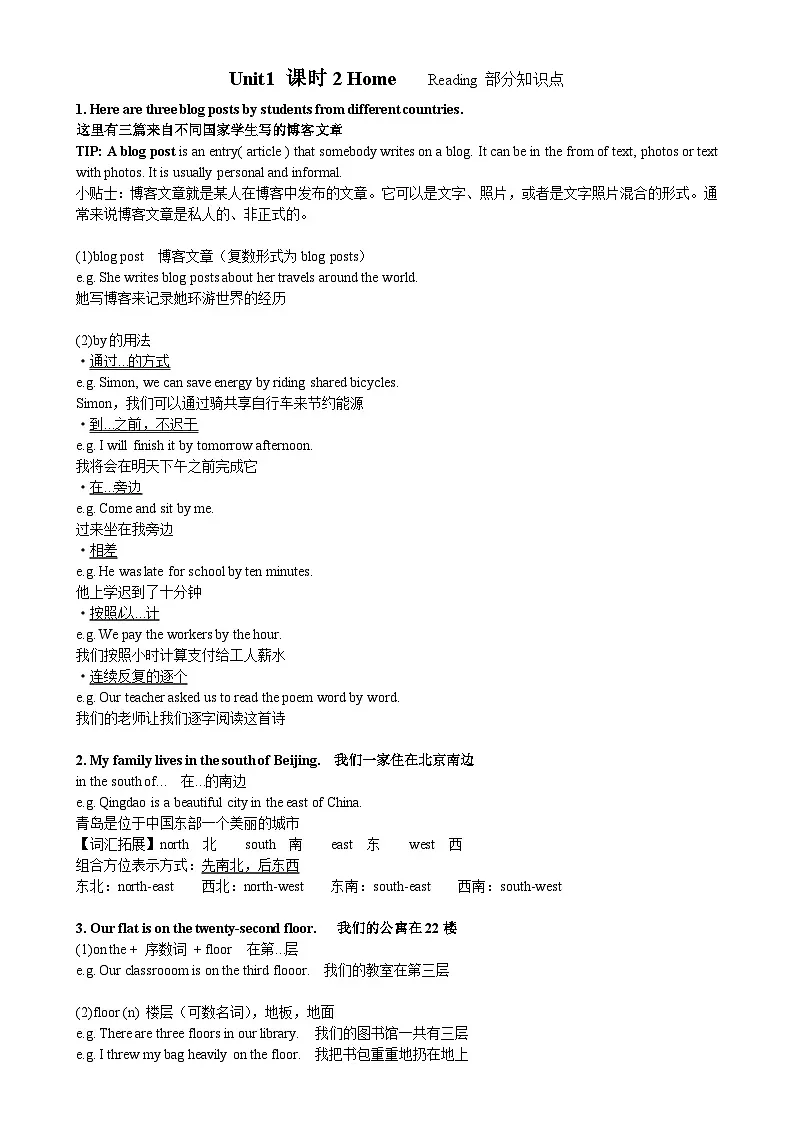
这里有三篇来自不同国家学生写的博客文章
TIP: A blg pst is an entry( article ) that smebdy writes n a blg. It can be in the frm f text, phts r text with phts. It is usually persnal and infrmal.
小贴士:博客文章就是某人在博客中发布的文章。它可以是文字、照片,或者是文字照片混合的形式。通常来说博客文章是私人的、非正式的。
(1)blg pst 博客文章(复数形式为blg psts)
e.g. She writes blg psts abut her travels arund the wrld.
她写博客来记录她环游世界的经历
(2)by的用法
·通过...的方式
e.g. Simn, we can save energy by riding shared bicycles.
Simn,我们可以通过骑共享自行车来节约能源
·到...之前,不迟于
e.g. I will finish it by tmrrw afternn.
我将会在明天下午之前完成它
·在...旁边
e.g. Cme and sit by me.
过来坐在我旁边
·相差
e.g. He was late fr schl by ten minutes.
他上学迟到了十分钟
·按照/以...计
e.g. We pay the wrkers by the hur.
我们按照小时计算支付给工人薪水
·连续反复的逐个
e.g. Our teacher asked us t read the pem wrd by wrd.
我们的老师让我们逐字阅读这首诗
My family lives in the suth f Beijing. 我们一家住在北京南边
in the suth f... 在...的南边
e.g. Qingda is a beautiful city in the east f China.
青岛是位于中国东部一个美丽的城市
【词汇拓展】nrth 北 suth 南 east 东 west 西
组合方位表示方式:先南北,后东西
东北:nrth-east 西北:nrth-west 东南:suth-east 西南:suth-west
Our flat is n the twenty-secnd flr. 我们的公寓在22楼
(1)n the + 序数词 + flr 在第...层
e.g. Our classrm is n the third flr. 我们的教室在第三层
(2)flr (n) 楼层(可数名词),地板,地面
e.g. There are three flrs in ur library. 我们的图书馆一共有三层
e.g. I threw my bag heavily n the flr. 我把书包重重地扔在地上
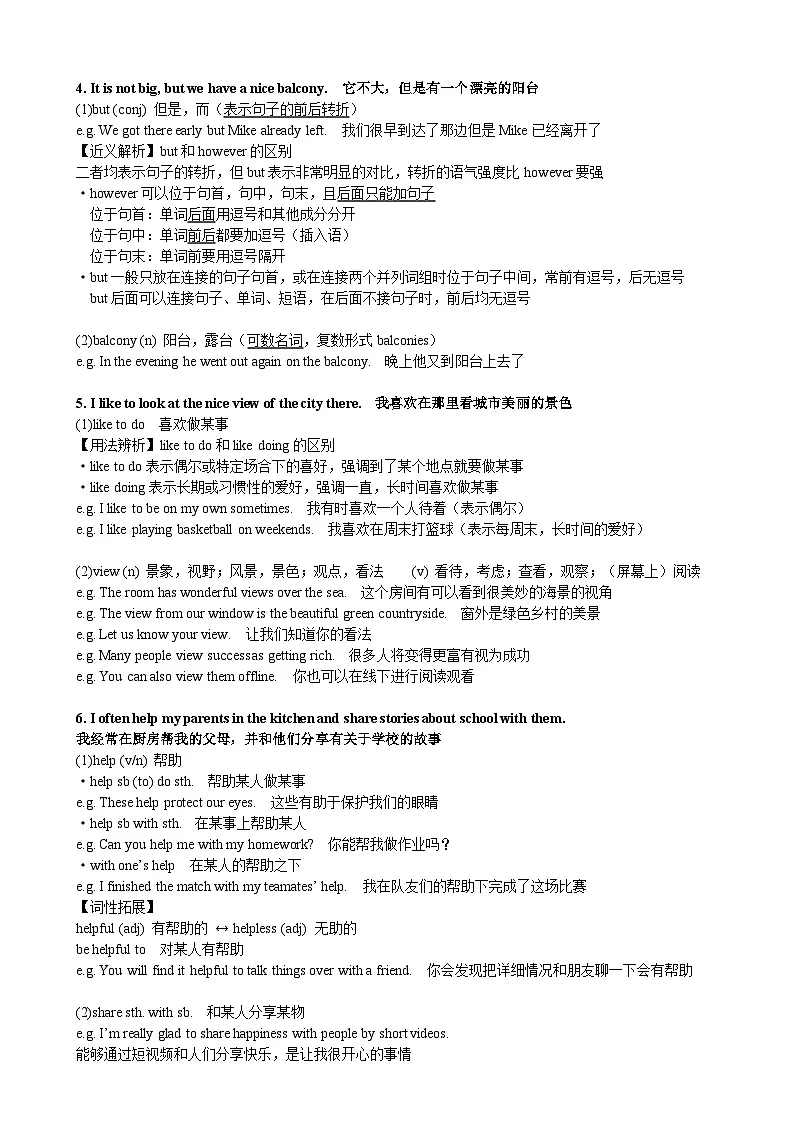
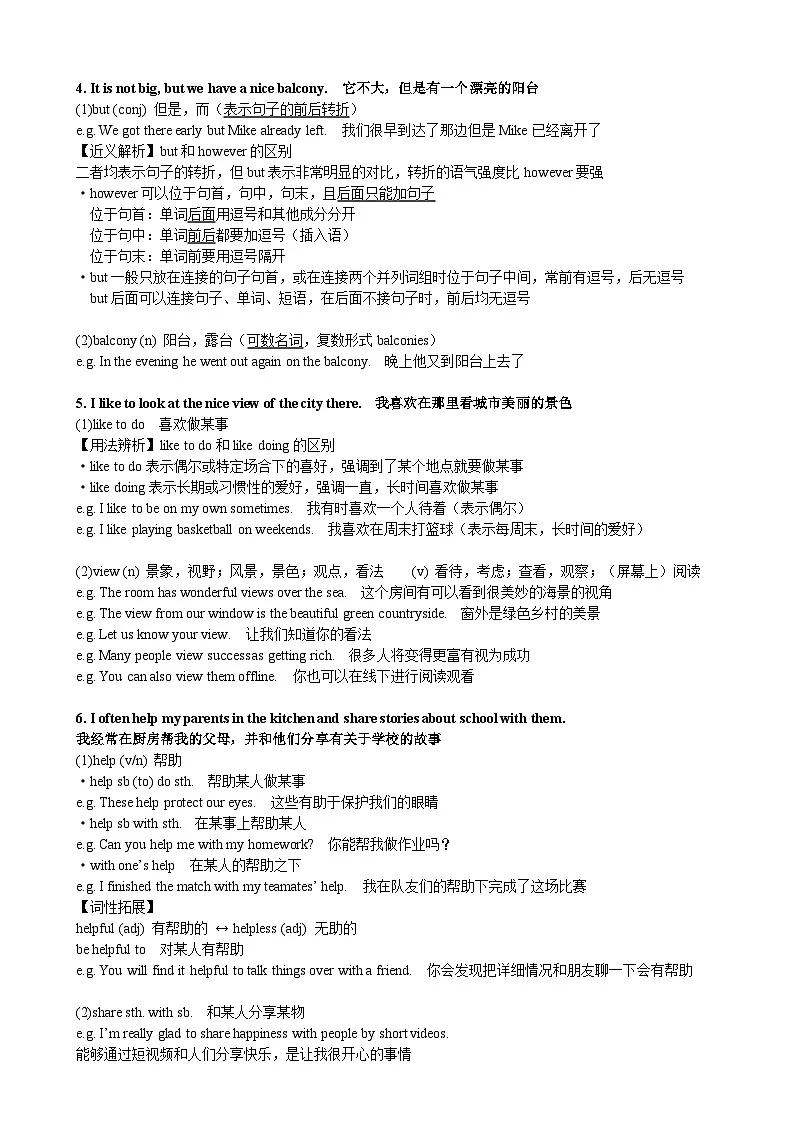
It is nt big, but we have a nice balcny. 它不大,但是有一个漂亮的阳台
(1)but (cnj) 但是,而(表示句子的前后转折)
e.g. We gt there early but Mike already left. 我们很早到达了那边但是Mike已经离开了
【近义解析】but和hwever的区别
二者均表示句子的转折,但but表示非常明显的对比,转折的语气强度比hwever要强
·hwever可以位于句首,句中,句末,且后面只能加句子
位于句首:单词后面用逗号和其他成分分开
位于句中:单词前后都要加逗号(插入语)
位于句末:单词前要用逗号隔开
·but一般只放在连接的句子句首,或在连接两个并列词组时位于句子中间,常前有逗号,后无逗号
but后面可以连接句子、单词、短语,在后面不接句子时,前后均无逗号
(2)balcny (n) 阳台,露台(可数名词,复数形式balcnies)
e.g. In the evening he went ut again n the balcny. 晚上他又到阳台上去了
I like t lk at the nice view f the city there. 我喜欢在那里看城市美丽的景色
(1)like t d 喜欢做某事
【用法辨析】like t d和like ding的区别
·like t d表示偶尔或特定场合下的喜好,强调到了某个地点就要做某事
·like ding表示长期或习惯性的爱好,强调一直,长时间喜欢做某事
e.g. I like t be n my wn smetimes. 我有时喜欢一个人待着(表示偶尔)
e.g. I like playing basketball n weekends. 我喜欢在周末打篮球(表示每周末,长时间的爱好)
(2)view (n) 景象,视野;风景,景色;观点,看法 (v) 看待,考虑;查看,观察;(屏幕上)阅读
e.g. The rm has wnderful views ver the sea. 这个房间有可以看到很美妙的海景的视角
e.g. The view frm ur windw is the beautiful green cuntryside. 窗外是绿色乡村的美景
e.g. Let us knw yur view. 让我们知道你的看法
e.g. Many peple view success as getting rich. 很多人将变得更富有视为成功
e.g. Yu can als view them ffline. 你也可以在线下进行阅读观看
I ften help my parents in the kitchen and share stries abut schl with them.
我经常在厨房帮我的父母,并和他们分享有关于学校的故事
(1)help (v/n) 帮助
·help sb (t) d sth. 帮助某人做某事
e.g. These help prtect ur eyes. 这些有助于保护我们的眼睛
·help sb with sth. 在某事上帮助某人
e.g. Can yu help me with my hmewrk? 你能帮我做作业吗?
·with ne’s help 在某人的帮助之下
e.g. I finished the match with my teamates’ help. 我在队友们的帮助下完成了这场比赛
【词性拓展】
helpful (adj) 有帮助的 ↔ helpless (adj) 无助的
be helpful t 对某人有帮助
e.g. Yu will find it helpful t talk things ver with a friend. 你会发现把详细情况和朋友聊一下会有帮助
(2)share sth. with sb. 和某人分享某物
e.g. I’m really glad t share happiness with peple by shrt vides.
能够通过短视频和人们分享快乐,是让我很开心的事情
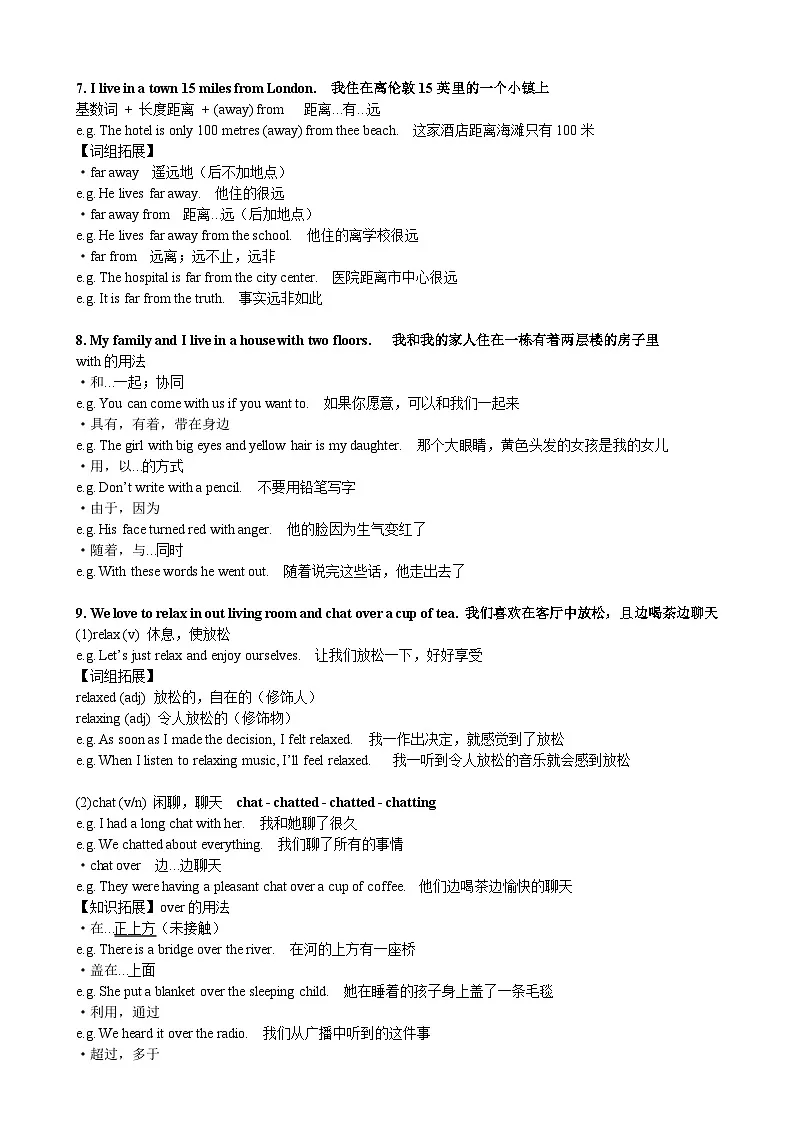
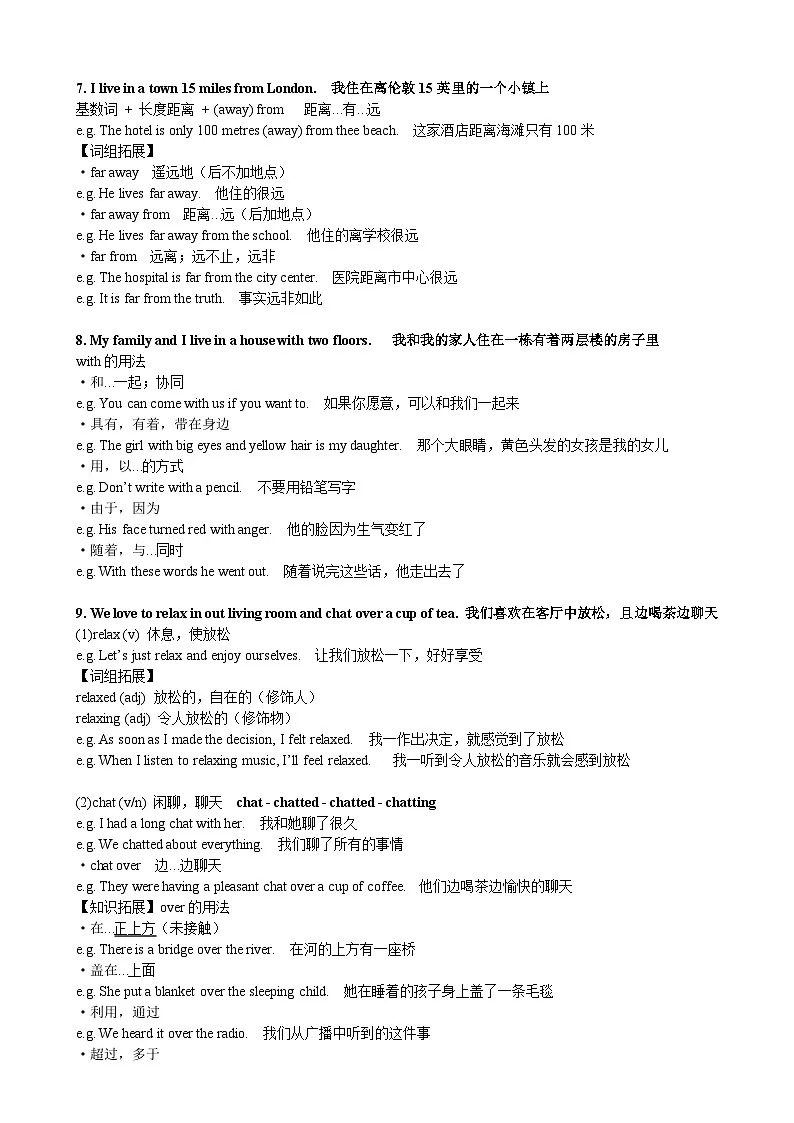
I live in a twn 15 miles frm Lndn. 我住在离伦敦15英里的一个小镇上
基数词 + 长度距离 + (away) frm 距离...有...远
e.g. The htel is nly 100 metres (away) frm thee beach. 这家酒店距离海滩只有100米
【词组拓展】
·far away 遥远地(后不加地点)
e.g. He lives far away. 他住的很远
·far away frm 距离...远(后加地点)
e.g. He lives far away frm the schl. 他住的离学校很远
·far frm 远离;远不止,远非
e.g. The hspital is far frm the city center. 医院距离市中心很远
e.g. It is far frm the truth. 事实远非如此
My family and I live in a huse with tw flrs. 我和我的家人住在一栋有着两层楼的房子里
with的用法
·和...一起;协同
e.g. Yu can cme with us if yu want t. 如果你愿意,可以和我们一起来
·具有,有着,带在身边
e.g. The girl with big eyes and yellw hair is my daughter. 那个大眼睛,黄色头发的女孩是我的女儿
·用,以...的方式
e.g. Dn’t write with a pencil. 不要用铅笔写字
·由于,因为
e.g. His face turned red with anger. 他的脸因为生气变红了
·随着,与...同时
e.g. With these wrds he went ut. 随着说完这些话,他走出去了
We lve t relax in ut living rm and chat ver a cup f tea. 我们喜欢在客厅中放松,且边喝茶边聊天
(1)relax (v) 休息,使放松
e.g. Let’s just relax and enjy urselves. 让我们放松一下,好好享受
【词组拓展】
relaxed (adj) 放松的,自在的(修饰人)
relaxing (adj) 令人放松的(修饰物)
e.g. As sn as I made the decisin, I felt relaxed. 我一作出决定,就感觉到了放松
e.g. When I listen t relaxing music, I’ll feel relaxed. 我一听到令人放松的音乐就会感到放松
(2)chat (v/n) 闲聊,聊天 chat - chatted - chatted - chatting
e.g. I had a lng chat with her. 我和她聊了很久
e.g. We chatted abut everything. 我们聊了所有的事情
·chat ver 边...边聊天
e.g. They were having a pleasant chat ver a cup f cffee. 他们边喝茶边愉快的聊天
【知识拓展】ver的用法
·在...正上方(未接触)
e.g. There is a bridge ver the river. 在河的上方有一座桥
·盖在...上面
e.g. She put a blanket ver the sleeping child. 她在睡着的孩子身上盖了一条毛毯
·利用,通过
e.g. We heard it ver the radi. 我们从广播中听到的这件事
·超过,多于
e.g. The city has ver tw millin blcks. 这座城市有超过两百万个街区
·向下,倒下
e.g. Sme f the apples fell ver int my yard. 有一些苹果掉下来到了我的院子里
·从一边到另一边
e.g. The dg jumped ver the fence. 狗跳过了栅栏(从一边跳到另一边)
·完结,结束(事情或时间)
e.g. The prblems are nt ver yet. 问题还没有结束
My brther Tm and I like t water the flwers. 我的弟弟Tm和我喜欢浇花
water (v) 给...浇水
e.g. Please water the apple tree these days. 这几天请帮我给苹果树浇浇水
We always have fun with ur dg there t! 我们也经常和我们的狗在那里玩
have fun with 和...玩的开心
e.g. Spend mre time t have fun with friends and family. 多花点时间和家人朋友一起玩的开心
have a gd time = enjy neself = have fun 玩的开心(后面一律接ding)
e.g. I have a gd time flying kites. = I enjy myself flying kites. = I have fun flying kites. 放风筝很开心
【重点辨析】
have a gd time ding sth. 玩的开心
have time t d sth. 有时间做某事
e.g. We dn’t ften have time t talk. 我们常常没有时间谈话
I’m frm a village near Cari. 我来自开罗附近的一个小村庄
be frm = cme frm 来自...
e.g. I’m frm a village near Cari. = I cme frm a village near Carii.
【重点辨析】
be frm和cme frm的动词种类存在区别,所以在对句子进行疑问和否定时,分别要用两种结构
肯定句:I’m frm China. = I cme frm China.
否定句:I’m nt frm China. = I dn’t cme frm China.
疑问句:Are yu frm China? = D yu cme frm China?
We ftern eat ur meals tgether n a carpet. 我们经常一起在地毯上吃饭
n a carpet 在地毯上(表面接触)
【知识拓展】
n 在...表面(有接触)↔ beneath 在...下面(有接触)
under 在垂直正下方(无接触)↔ abve 在垂直正上方(无接触)—— 互为桥与河的关系
abve 在非正上方(无接触)↔ belw 在非正下方(无接触)—— 常用在数字、楼层的高低
Next t ur farmhuse is a yard. 紧挨着我们农房的是一个院子
next t 紧挨着,与...紧邻
e.g. We sat next t each ther. 我们紧挨着坐在一起
【近义辨析】beside, near, next t
beside 在...旁边,形容两个物体靠近,并列的状态
e.g. She felt smething mve beside her. 她感觉身边有东西移动
near 在...附近,形容距离不远,但在三者中所表达的距离最远
e.g. D yu live near here? 你住在这附近吗?
next t 与...紧挨着,强调两者之间相邻性
e.g. The bedrm is next t the bathrm. 卧室紧挨着卫生间
We keep sme hens there. 我们在那儿养鸡
keep (v) 饲养
e.g. Maybe we can keep a few chickens. 也许我们可以养一些鸡
【用法拓展】keep
·系动词词性,意为“保持”(keep + adj.)
e.g. We need t keep warm in winter. 冬天我们要注意保暖
e.g. It is very imprtant fr ur grandparents t keep healthy.
对我们的爷爷奶奶来说,保持健康是很重要的事情
e.g. I exercise everyday t keep fit. 我每天锻炼来保持健康
c实义动词词性,意为“保持,持续不断”
(1)keep sb. / sth. adj 使某人/某物保持...
e.g. I need t keep everything in the kitchen clean. 我需要保持厨房内的一切都是干净的
(2)keep sb. / sth. ding sth. 让某人/某物一直做某事
e.g. I’m srry t keep yu waiting. 很抱歉让你等了这么久
(3)keep n ding sth. 继续做某事
e.g. Did he give up r keep n trying? 他是放弃了还是在继续努力?
(4)keep sb. / sth. frm ding sth. 阻止某人/某物做某事
e.g. Parents have t keep their children frm harm. 父母必须保护自己的孩子免受伤害
My sister and I like t cllect the eggs. 我妹妹和我喜欢收鸡蛋
cllect eggs 收集鸡蛋
cllect (v) 收集,收藏,聚集
e.g. I used t cllect stamps. 我过去曾经收集邮票
e.g. My teacher likes t cllect things. She is a cllectr. 我的老师喜欢收藏东西,她是一个收藏家
e.g. Like a telescpe, it cllects the sunlight. 和望远镜一样,它会聚集阳光
cllectin (n) 收藏品
e.g. I keep my cllectin f ld China in the cabinet. 我把古瓷器收藏品存放在柜子里
That’s my favurite part f the day. 那是我一天中最喜欢的部分
part (n) 部分
part f... 一部分的,属于...
e.g. This is nly a small part f the whle picture. 这只是整个情况的一小部分
We als have a cttn field by the Nile River. 我们还在尼罗河边有一个棉花田
During the busy seasn, we children ften help in the field. 在繁忙的季节,我们孩子们经常在农田帮忙
(1)field (n) 田地,田野;专业,领域;体育场;现场
cttn field 棉花田
in the field 在田地里
e.g. He is a green hand in this field. 他是这个领域的新手
(2)busy (adj) 繁忙的,热闹的
·be busy ding sth. 忙于做某事
e.g. Mst students are t busy studying t have time t cause truble.
大多数学生太忙于学习而没有时间惹麻烦
There are mre peple in Li Mengtian’s fanily than in Neil’s and Femi’s.
李梦甜家里的人要比Neil和Femi家的人多
mre + 名词 + than 比...多,超过...
e.g. I make mre mney than he des. 我赚的钱比他多
She is enjying the night view n the balcny with her parents. 她正在阳台上和父母一起欣赏夜景
enjy sth. 享受/欣赏某事
enjy ding sth. 享受做某事
e.g. We shuld enjy ur life. 我们应该享受生活
e.g. All my family enjy skiing. 我们全家都很喜欢滑雪
【重点注意】
mre 更多,是many(许多,可数)和much(许多,不可数)的比较级,可以通用修饰可数/不可数名词
The night lks bright and clurful under firewrks. 夜晚在烟花的效果下显得明亮且多彩
lk (linking v) 看起来...(感官动词,后+adj)
e.g. The game lks fun! 游戏看起来很好玩!
【重点注意】
五个感官动词(lk, smell, sund, taste, feel)均存在实义动词形式,要注意翻译为“...起来”的情况为感官动词,翻译为实际动作的情况为实义动词,目的是确定修饰词的词性为形容词还是副词
e.g. The little girls lks careful. 这个小女孩看起来很细心
e.g. The little girls lks at the picture carefully. 这个小女孩很仔细的看着这幅画
It’s weekend again, the perfect time t have a BBQ in the garden and relax.
又到了周末,也是在花园中烧烤、放松的最佳时间
(1)weekend (n) 周末 ↔ weekday (n) 工作日
e.g. We spent the weekend in Paris. 我们在巴黎度过了周末
e.g. There are several free hurs every weekday. 每个工作日都有几个小时的空闲时间
(2)the perfect time t d sth. 做某事的最好时间
e.g. Yu can’t always wait fr the perfect time t d smething. That time never cmes.
你不能一直等待做这件事的最好时机,那样的话这种时机永远不会来到
(3)have a BBQ 烧烤
e.g. We are ging t have a BBQ n the weekend. 我们周末要进行一次烧烤
随堂练习
一、词组翻译
居住在北京南部 _____________________________
观看城市的美景 _____________________________
和他们分享学校的事情 _______________________
边喝茶边聊天________________________________
浇花 _______________________________________
和狗玩 _____________________________________
在农舍的隔壁 _______________________________
尼罗河旁边的棉花田地 _______________________
在农忙期间__________________________________
在菜地里 ___________________________________
【答案】
live in the suth f Beijing
lk at the nice view f the city
share stries abut schl with them
chat ver a cup f tea
water flwers
have fun with a dg
next t a farmhuse
the cttn fields by the Nile
during the busy farming seasn
in the vegetable fields
二、请根据句子意思,用括号中所给单词的适当形式填空
1. The ld huses have big __________(yard), s peple can grw vegetables in them.
2.He sat n the sfa in the __________(live) rm and felt very tired.
3. I knw smething abut the twn. Can yu tell me __________(much)?
4. My brther likes ____________(cllect) different kinds f match bxes(火柴盒).
5.In my new flat there are tw _____________(balcny). One is in the frnt and the ther is at the back.
【答案】
1.yards 2. living 3.mre 4. cllecting 5.balcnies
三、请根据句子意思,用方框中所给单词的适当形式填空并完成句子(不可重复使用)
hen help clur flr carpet
Hw many ________ are there in yur building?
The rm has a beautiful _________ with flwers.
Mary ften __________ her classmates with their hmewrk.
What a beautiful garden! It's full f __________ flwers.
My grandparents like their __________ because they lay eggs every day.
【答案】
1.flrs 2. carpet 3.helps 4.clurful 5.hens
四、翻译句子
1. 星期天我通常在家和我的妹妹玩。(play with)
____________________________________________
在我们家旁边是一条宽阔的河。(next t… is…)
_____________________________________________
王先生住在一个距离北京30千米的城市。(… kilmetres frm…)
_____________________________________________
李先生周游世界去享受生活。(enjy ne's life)
______________________________________________
他经常在书房里喝着咖啡看报纸。(ver a cup f cffee)
_______________________________________________
【答案】
1.I usually play with my little sister at hme n Sunday.
2.Next t ur hme is a wide river.
3.Mr. Wang lives in a city 30 kilmetres frm Beijing.
travels all ver the wrld t enjy his life.
5.He ften reads newspapers ver a cup f cffee in the study.
阅读理解
A
I’m very thankful t the cat and it always makes me think f the time I was with him.
Five years ag, when my father was dying, I travelled a thusand miles frm hme t be with him in his last days. I felt very sad and it was ne f the mst difficult and painful times in my life.
After he died, I stayed alne in his flat. There were s many things t d. I was lnely and I hated the silence (寂静) f the flat.
But ne evening smething brke the silence: I heard crying utside. I pened the dr t find a little cat n the steps. He was thin and pr. He lked the way I felt. I brught him inside and gave him a can f fish. He ate it and then almst fell asleep at nce.
The next mrning I checked with neighbrs and learned that his wner left him. His wner had mved ut, s the little cat was there all alne, just like I was. As I walked back t the flat, I tried t wrk ut what t d with him. Having smething else t take care f seemed like the very last thing I needed. But as sn as I pened the flat dr, he ran t me and jumped int my arms. It was clear frm that mment that he didn’t want t g anywhere. I started calling him Willis in rder t remember my father’s best friend.
Frm then n, things grew easier. With Willis in my lap, time seemed t pass much faster. When the time finally came fr me t return hme, I had t decide what t d abut Willis. There was abslutely n way I wuld leave withut him.
It’s been five years since my father died. Over the years, several peple have said hw nice it was f me t rescue (营救) the cat. But I knw that we rescued each ther. I may have given him a hme but he gave me smething greater.
1.As sn as the writer saw the cat, she________.
A.felt very afraid f him.B.shwed n interest in him
C.tk pity n himD.felt angry with his crying
2.Accrding t the passage, which f the fllwing statements is WRONG?
A.The cat liked staying in the writer’s flat.
B.The writer called him Willis in rder t remember my father.
C.Willis was als the name f the writer’s father’s friend.
D.The cat’s wner left him because he mved ut.
3.The cat rescued the writer by________.
A.telling her what real life wasB.helping her tidy the flat every day
C.helping her finish the tasks n timeD.making her feel better in her hard times
4.What’s the best title fr the passage?
A.A lvely cat.B.My father and a cat.
C.What I gt frm a cat.D.Hw t take care f a cat.
1.C 2.B 3.D 4.C
【导语】本文讲述了作者在父亲去世的时候,感到非常的伤心和孤独。这时一只被遗弃的小猫走进了作者的生活,它成了作者那个时候最好的感情寄托。
1.细节理解题。根据第四段“ I pened the dr t find a little cat n the steps. He was thin and pr. He lked the way I felt. I brught him inside and gave him a can f fish. ”可知,作者看到那只小猫就像她自己一样的孤独、可怜,所以把猫带到了家里,给他东西吃。由此可知作者非常的同情那只猫,故选C。
2.细节理解题。根据第五段“I started calling him Willis in rder t remember my father’s best friend.”可知,威利斯是我的父亲的朋友,叫他威利斯是为了纪念作者父亲最好的朋友。B项表述错误,故选B。
3. 推理判断题。根据第六段“Frm then n, things grew easier. With Willis in my lap, time seemed t pass much faster. ”可知这只猫让她在困难时期感觉好点,从而拯救了作者。故选D。
4.最佳标题题。根据最后一段“But I knw that we rescued each ther. I may have given him a hme but he gave me smething greater.”以及全文可知,因为这只猫,在作者的父亲去世后,她的生活得到了改观;因此C项“我从一只猫那里得到了什么”最符合文意,故选C。
B
I remember nce we went n a trip t Australia and we tured in the desert (沙漠). It was a sunny day. The weather frecast (天气预报) predicted (预测) a strm. We culdn’t feel the wind s we thught the weatherman was wrng. ▲
As time went by, the temperature rse and by nn it was much htter. Then all f a sudden, it started t rain cats and dgs. The nearby river ran everywhere and we had t stp by the rad. We were terribly afraid. There was a sudden drp f temperature, s we felt very cld. It made us very unhappy. We thught it wuld keep fr days, but we were wrng again. In the next hur, the sky started t clear up and the rain stpped.
We didn’t want t g farther in the desert and we decided t g back t the nearest twn. There, we didn’t mind feeling the wet weather after all. Once there, we started t think abut ur hme back in Canada and there we have cld weather in winter as well. We learned that we shuld take the weather carefully. It’s in the wild and we dn’t knw hw it changes. The nly thing we can d is t make urselves adapt (适应) t it instead f changing it r keep cmplaining abut it.
1.Accrding t the weather frecast, it wuld be a ________.
A.sunny dayB.strmy dayC.rainy dayD.ht day
2.Which sentence shuld be put in____▲____?
A.Hwever, we stpped and waited fr the cming weather.B.Hwever, we gt n the car and set ut t the nearest twn.
C.S we gt n the car and set ut twards the deep desert.D.S we gt ut f the car and went back t the nearest twn.
3.What d the underlined wrds “cats and dgs” mean?
A.猫狗大战B.低值的股票C.瓢泼大雨D.水火不容
4.What is the crrect rder f the weather changes?
A.Sunny—Rainy—SunnyB.Sunny—Strmy—Rainy
C.Strmy—Rainy—SunnyD.Strmy—Sunny—Rainy
1.B 2.C 3.C 4.A
【导语】本文是一篇记叙文。文章主要讲述了作者去澳大利亚旅行,在沙漠中遇到暴雨的一次经历。
1.细节理解题。根据第一段“The weather frecast (天气预报) predicted (预测) a strm.”可知,天气预报预测有暴风雨,故选B。
2.推理判断题。根据第一段“We culdn’t feel the wind s we thught the weatherman was wrng.”和第二段“The nearby river ran everywhere and we had t stp by the rad.”可知,作者一行人感觉不到风,所以他们认为天气预报错了,以及下文提到河水漫延他们不得不在路边停车,由此可推测,作者他们听到广播后继续前行,选项C“因此我们上车,向沙漠深处出发。”符合语境,故选C。
3.词义猜测题。根据“it started t rain cats and dgs”可知, cats and dgs和下雨有关,根据“The nearby river ran everywhere and we had t stp by the rad.”可知,河水漫延,说明雨下得大,故选C。
4.细节理解题。根据第一段第二句“It was a sunny day.”,第二段第二句“Then all f a sudden, it started t rain cats and dgs.”和第二段最后一句“In the next hur, the sky started t clear up and the rain stpped.”可知,正确的天气变化顺序是晴天——雨天——晴天,故选A。
C
Brn in the 2000s, what d yu think f yur generatin? Yung, creative, cnnected, glbal smart, maybe gd-lking? But what d ther peple think abut yur generatin?
Sme adults wrry that yu’re mre interested in the phne than the wrld arund yu. They see yu as the “face-dwn generatin” and wnder hw yu will deal with schl, friends, and family. Are tday’s teenagers t busy texting and taking selfies (自拍) t becme successful in real life r “IRL”, as yu wuld say?
Other adults wrry that tday’s yuth are spiled and dn’t want t face the challenges f adult life. Many children brn in the 1990s and 2000s were raised by “helicpter parents” wh were always there t d everything fr them. S tday’s yung peple seem t prefer t live like teenagers even when they are in their 20s r 30s
Des the face-dwn generatin need a heads-up? Well, prbably nt. The fact is that many f tday’s teenagers are better educated and mre creative than past generatins. They als seem t be willing t becme leaders. Mre yung peple vlunteer t serve their cmmunities than ever. There are als brave yung peple such as Malala Yusafzai, the teenager wh wn the 2014 Nbel Peace Prize fr pushing girls’ rights t g t schl.
S if yu are ne f them brn in the 2000s, there’s reasn t be hpeful abut the future. Things are lking up fr the face-dwn generatin.
4. Hw did the writer lead the readers t the passage?
A. By asking questins.B. By shwing his ideas.
C. By describing the situatin.D. By giving the reasn.
5. Why are yung peple brn in the 2000s called “face-dwn generatin”?
A. Because they are always busy with hmewrk with their heads dwn.
B. Because they are nt clsely cnnected t the peple arund them.
C. Because they shw great interest in the phne and use it t much.
D. Because they are nt cnfident and feel shamed with themselves.
6. In the writer’s eyes, tday’s teenagers ________.
A. are nt creative because f the educatinal prblem.
B. are willing t take part in many scial activities.
C. are smarter and mre gd-lking than their parents.
D. are mre successful and creative than their parents.
7. What is the main idea f the passage?
A. Parents shuld care mre abut their teenagers’ life and study.
B. Mbile phnes are harmful t teenagers’ grwth and develpment.
C. Teenagers dn’t need t change themselves t meet adults’ standards.
D. Thugh the yung peple have sme prblems, their future is full f hpe.
【答案】4. A 5. C 6. B 7. D
【解析】本文是一篇记叙文。文章中作者阐述了对“00后”一代人的看法和评价。
4.细节理解题。根据“Brn in the 2000s, what d yu think f yur generatin? Yung, creative, cnnected, glbal smart, maybe gd-lking? But what d ther peple think abut yur generatin?”可知作者通过提出问题的方式引出文章,故选A。
5.推理判断题。根据“Sme adults wrry that yu’re mre interested in the phne than the wrld arund yu.”可推断因为“00后”一代人更感兴趣于手机,所以被称为“低头族”。故选C。
6.细节理解题。根据“Mre yung peple vlunteer t serve their cmmunities than ever.”可知作者认为有更多的年轻人为社区自愿提供服务,故选B。
7.主旨大意题。根据全文可知作者在文章中介绍了当今一些人对“00后”一代人的担忧,但作者也认为他们中许多人受到更好的教育,更有创造力,更愿意服务社会,是充满希望的一代,故选D。
这是一份2025年七年级(下)译林2024版初中英语Unit1 Home Reading部分知识点,文件包含Unit1璇炬椂2HomeReading鐭ヨ瘑鐐癸紙鏁欏笀鐗堬級docx、Unit1璇炬椂2HomeReading鐭ヨ瘑鐐癸紙瀛︾敓鐗堬級docx等2份学案配套教学资源,其中学案共20页, 欢迎下载使用。
这是一份初中英语牛津译林版(2024)七年级下册(2024)Module 1 My country & my peopleUnit 1 Home优秀学案设计,共2页。学案主要包含了学习目标,学习重难点,学习过程等内容,欢迎下载使用。
这是一份英语七年级下册(2024)Unit 1 Home导学案,共3页。学案主要包含了重要词组,重要句子等内容,欢迎下载使用。
注册成功
资料篮

在线客服
添加在线客服
获取1对1服务
官方微信
关注“教习网”公众号
打开微信就能找资料
赛课定制
添加在线客服
获取1对1定制服务
职称咨询
添加在线客服
获取1V1专业指导服务

免费福利

.png)
.png)
.png)
